Slow Time on the Ancient Tea Horse Road: A Teramont, Nine Days in Western Yunnan, and a Millennial Dialogue with Mountain Tea
Slow Time on the Ancient Tea Horse Road: A Teramont, Nine Days in Western Yunnan, and a Millennial Dialogue with Mountain Tea
Prologue: When Life Hits the Pause Button
Some journeys are about arriving; others are about leaving. Leaving behind those days sliced into fragments by schedules, leaving behind the fragmented time filled with screens and notifications.
On February 20, 2026, the moment our family of three touched down at Kunming Changshui Airport, we surrendered our lives to the mountains and the aroma of tea. No anxiety about rushing, only the ease of chasing scenery. Starting with a cup of clear tea in Pu'er, we followed the ancient path, searching for old village烟火 (the warm, lively atmosphere of daily life), exploring secret tea mountains, and keeping a millennial appointment with mountains and tea.
This self-driving trip spanned nine days, passing through Kunming, Yuxi, Pu'er, Jingmai, Lincang Yongde, Mangshi, and Tengchong. The total cost was 20,646.5 RMB (excluding round-trip flights). We rented a Volkswagen Teramont for 4,127 RMB. The car was big enough to hold our luggage and all our imaginings of a slow life.
Pre-Trip Essentials: Five Survival Rules for Driving in Western Yunnan
Before you start this journey, there are a few things you must know — not all scenery is within easy reach, and not all roads are wide and flat.
1. Leave the Driving to an Experienced Pro Yunnan is full of speed limits, dense mountain roads, and sections with two-way single lanes where passing requires extreme caution. You'll encounter a curve every few hundred meters, and 180-degree hairpin turns are routine. Never drive fatigued, and never drive at night — unless you want to experience an "out-of-body experience."
2. An SUV is a Must, Not an Option Road conditions on parts of Jingmai Mountain, Yongde, and Mangshi are genuinely poor — gravel roads, rugged mountain paths. A low-clearance sedan will make you cry from心疼 (heartache for your car). Our Teramont handled the bumps steadily and securely.
3. Respect is the Best Way to Travel Western Yunnan is a multi-ethnic region. When entering Buddhist temples or ancient villages, keep quiet and check for photography restrictions before taking pictures. This isn't a rule — it's common courtesy.
4. Slow Down — That's the Rhythm of Western Yunnan Tea mountains and ancient towns don't need a checklist-style visit. Stop as you please and immerse yourself — that's the right way to experience them.
5. Buying Jade? Check the Certificate First When buying jade in Tengchong, always ask for an NGTC national inspection certificate. Prices at trade city stalls and markets are flexible, and you can bargain boldly — but without a certificate, no matter how cheap, don't touch it.
DAY 1: Kunming → Fuxian Lake → Ailao Mountain — A Harsh Wake-Up Call on Day One
Fuxian Lake: A Fleeting Glimpse of Blue
We landed at 11:50 AM, picked up and inspected the car, and headed straight for our first stop — Fuxian Lake in Yuxi.
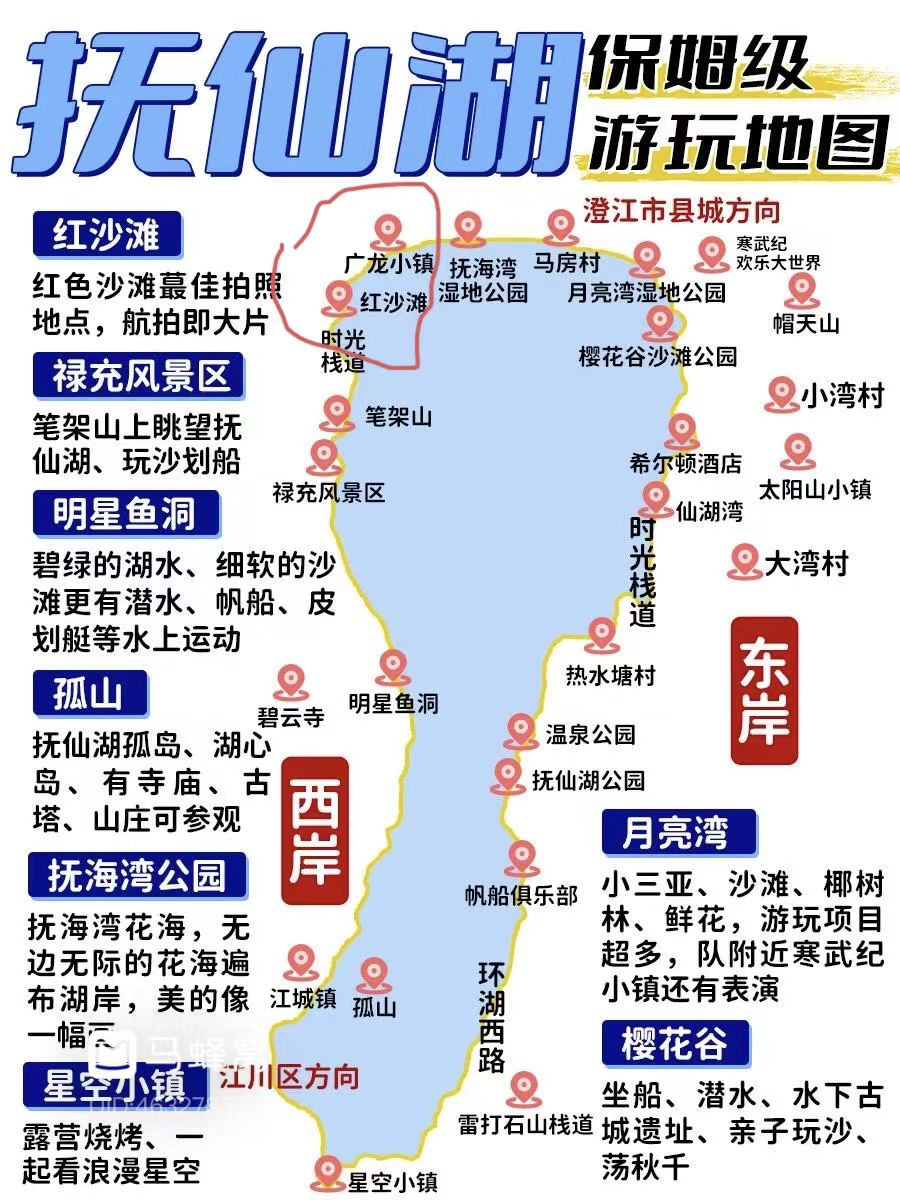
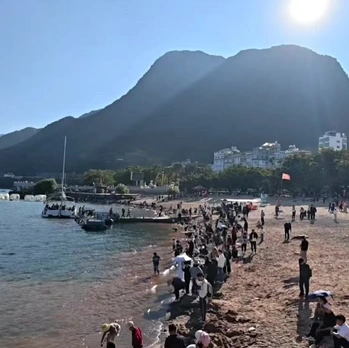
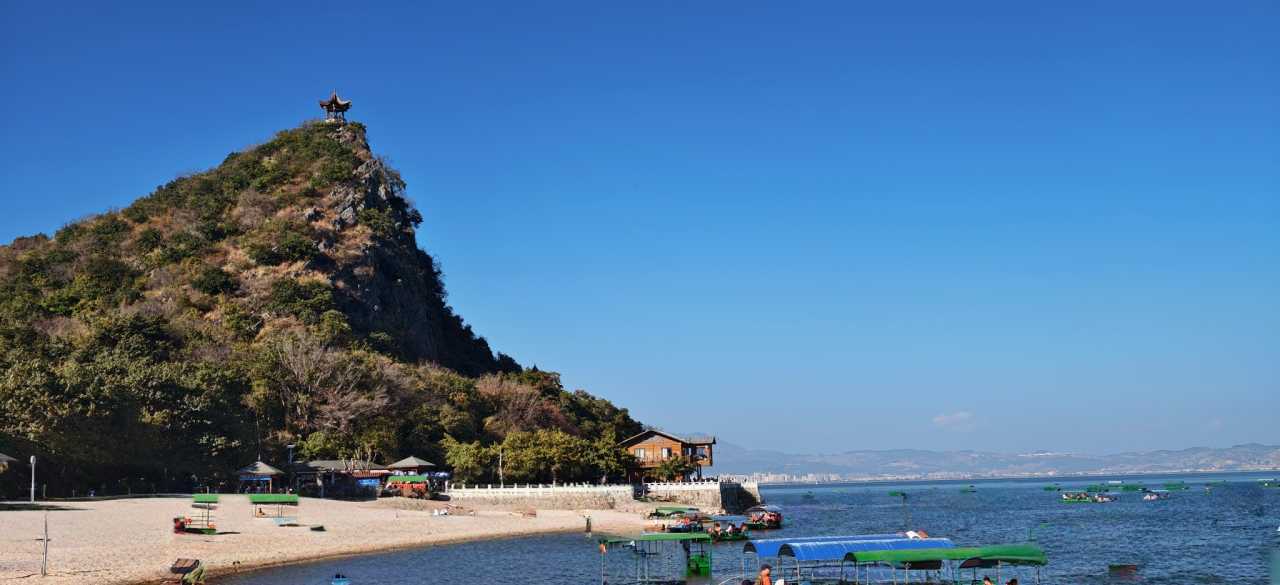
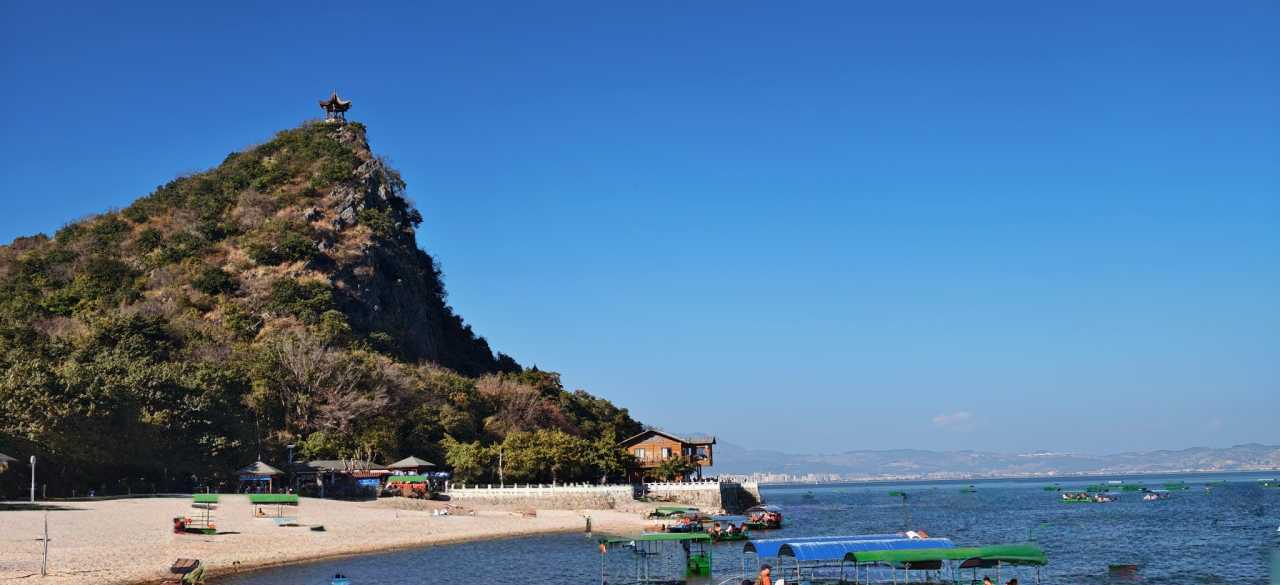
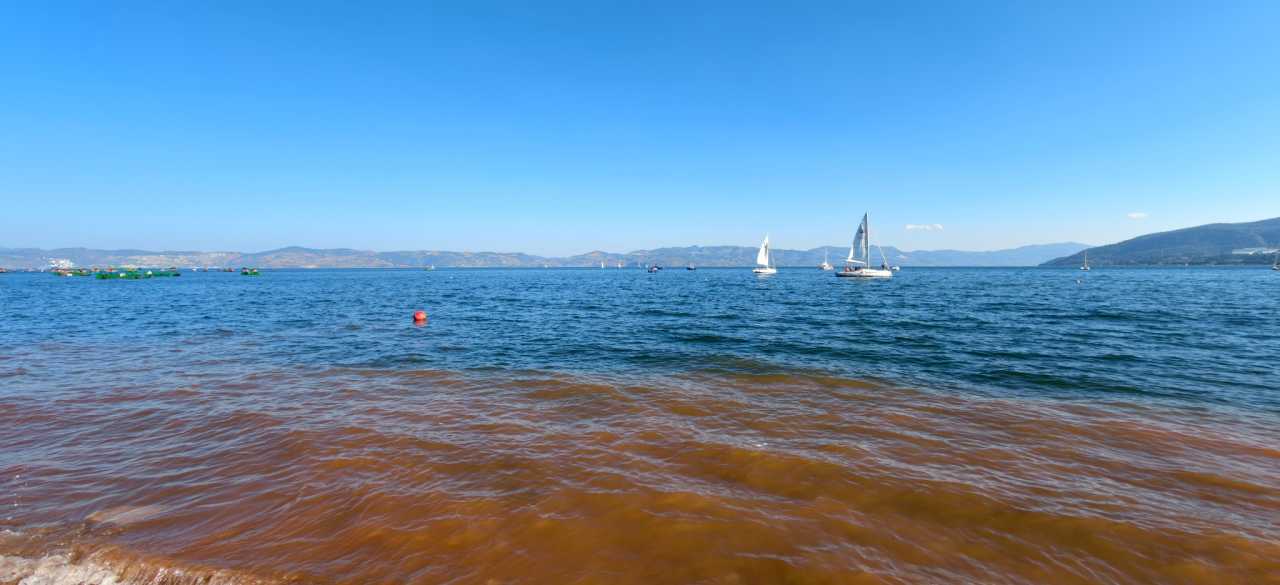
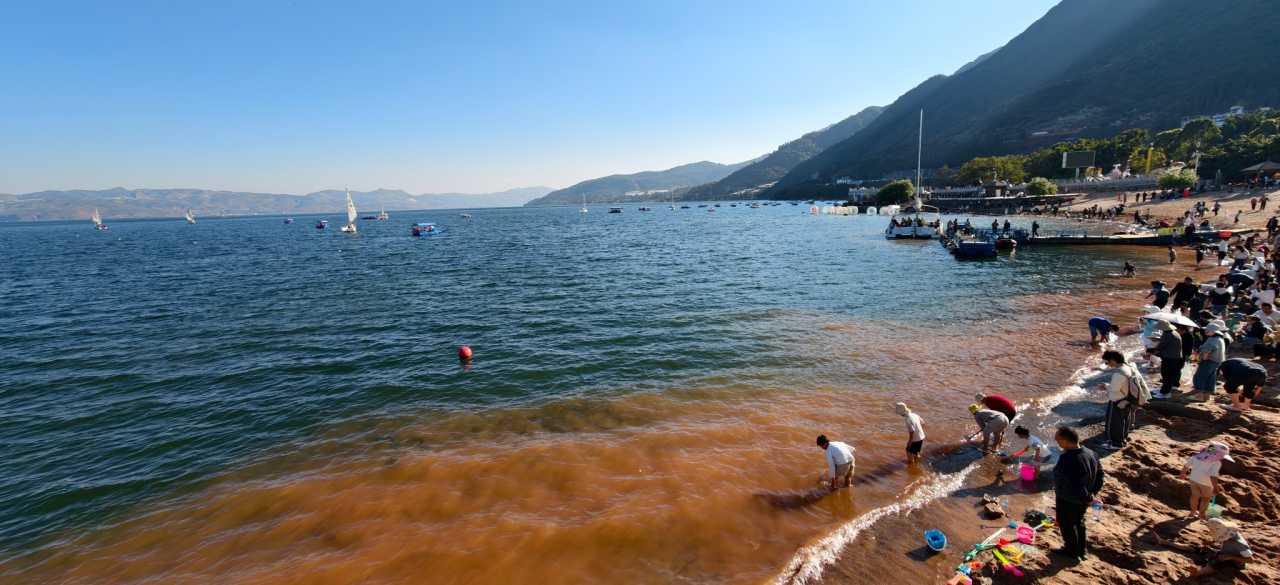
The east and west shores of Fuxian Lake offer many activities, but we only had half a day, so we chose the west shore. Driving south from Guanglong Town, we stopped at Lucong Scenic Area. This is the only 4A-level scenic spot on Fuxian Lake, nestled against Bijia Mountain and facing the lake. It features a golden sand beach, traditional "water-pulling fishing," and copper-pot fish. On the fourth day of the Lunar New Year in winter, the golden sand beach was still alive with the laughter of families playing in the water.
There were many people — photoshopping might be a bit of a chore. But if it weren't for the holiday, sitting at the foot of Bijia Mountain by Fuxian Lake, sipping some wine, waiting for the sunset to slowly sink into the lake — well, we could dream, but we had to keep moving.
Ailao Mountain: A Terrifying Night on the Mountain Road
From Fuxian Lake to Ailao Mountain, the map showed only 250 kilometers, but the navigation app said it would take 6 hours. To save time, we chose a "fastest route" that cut through villages. It did save some time, but those nearly 30 kilometers of winding mountain roads were not for the faint of heart.
It was a two-way single lane the entire way, with a curve every few hundred meters, almost all close to 180-degree hairpin turns. Several times we met oncoming cars on roads too narrow for two vehicles to pass. Our friend had to get out and direct us, inch by inch, to squeeze by. Thank goodness it was night, and thank goodness we had a battle-tested driver — we made it safely, albeit shaken, to the Shishan Mountain Lodge in the Ailao Mountain primeval forest.
Strongly recommended for future travelers: Choose the highway on your navigation app. Don't do what we did.
DAY 2: Ailao Mountain → Nake Li → Pu'er — From Sea of Clouds to Tea Horse Post Station
Morning at Ailao Mountain: No Sea of Clouds, But Found Myself
Maybe it was altitude sickness, or maybe it was the terrifying mountain road from yesterday — my head was pounding, and I went to bed early last night.
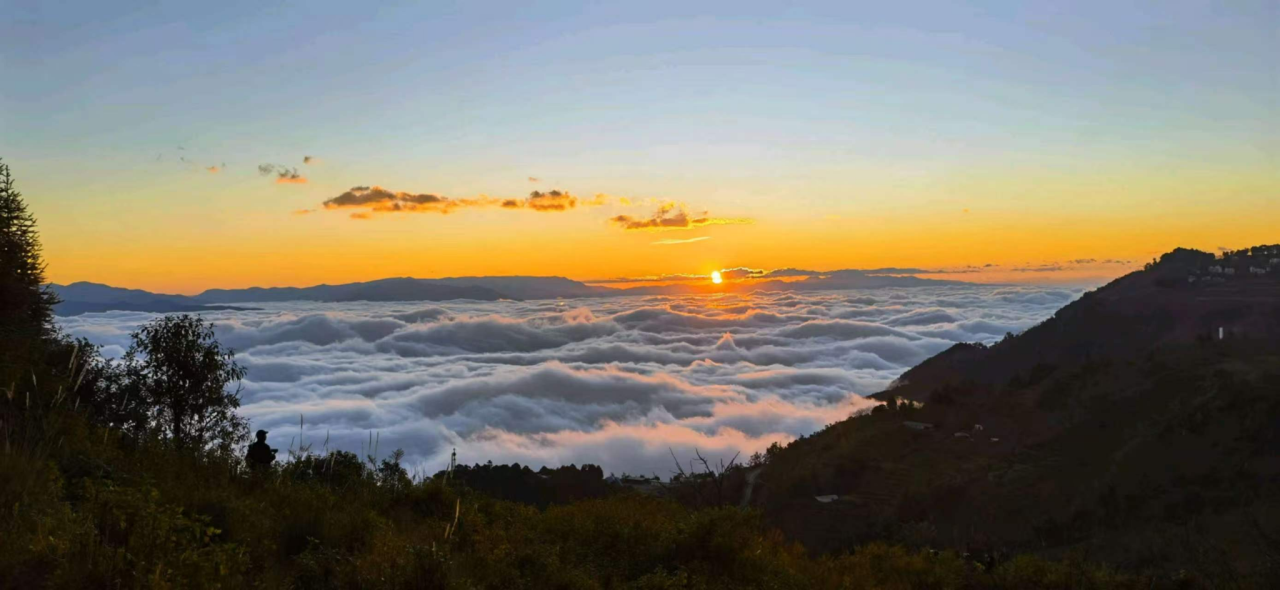
I was woken by a rooster's crow. I pulled back the curtains to find the sky just beginning to lighten, Ailao Mountain still submerged in deep blue. In autumn and winter, cold air meets warm, moist valley air, making this season perfect for forming stable, thick seas of clouds. I took out my camera, waiting for the moment when "morning mist locks a thousand mountains, and rosy clouds break through the vast sky" — but unfortunately, the stunning scene of sunrise and rolling clouds never came.
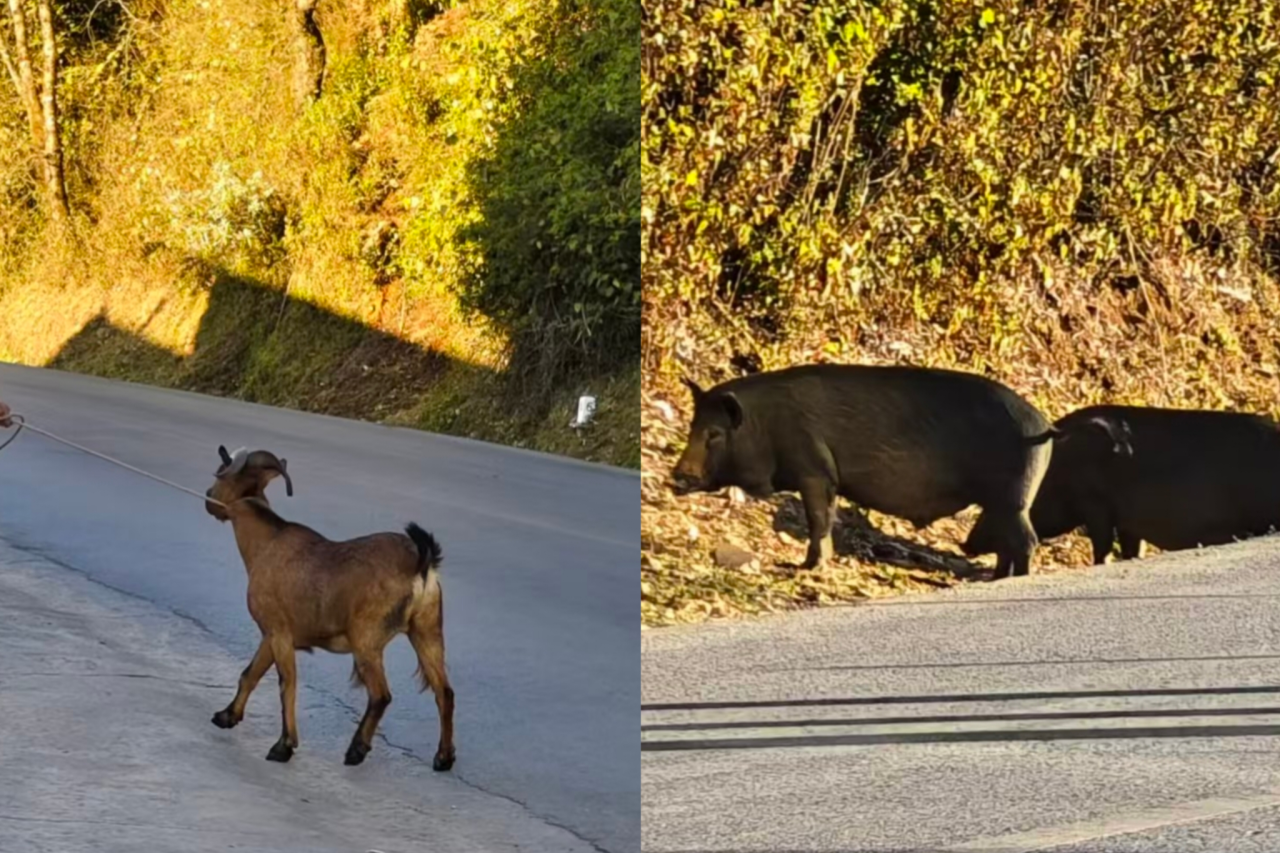
But breakfast — Yunnan rice noodles (米线) — cured everything. Sitting in the lodge's nearly 360-degree panoramic room, with distant mountains, forests, free-range chickens and pigs, and cured meats hanging by the window, the morning sun warming my face — suddenly, the rice noodles tasted amazing, and my headache disappeared.
Basking in the sun, sipping Pu'er tea, gazing at the distant mountains. I secretly wished I could have a few more days a year to just space out like this.
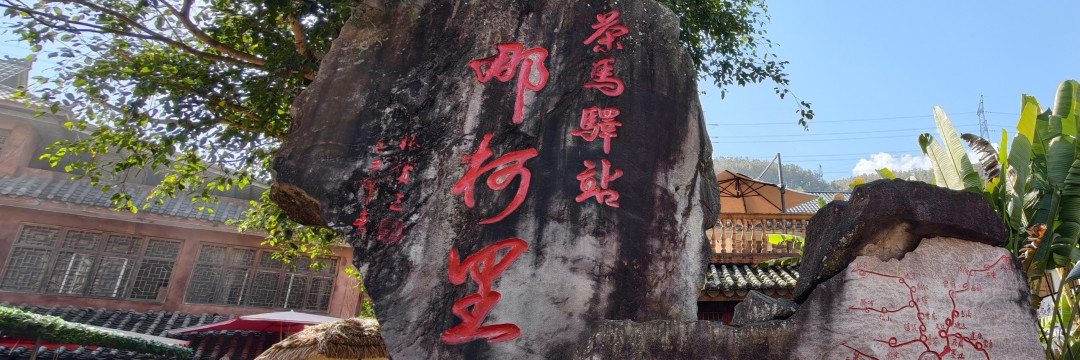
Nake Li: A Millennium in Horse Hoof Prints
From Shishan Mountain Lodge to the Nake Li Tea Horse Post Station was about 260 kilometers, with the navigation app showing a 3.5-hour drive. At 3:00 PM, after weaving through ancient streets crowded with people and vehicles, we finally arrived at Nake Li.
This was an important post station on the ancient Tea Horse Road from Pu'er Prefecture. Today, it has transformed into a 4A-level scenic area integrating cultural tourism, leisure, and immersive experiences. Once a bustling post station for horse caravans, it has now become a trendy, photo-worthy destination described as "seeing the mountains, seeing the water, and remembering your hometown."
For 60 RMB, we rode a small local pony along the bluestone paths, searching for the clear horse hoof prints — the most direct evidence of a millennium of trade.
Rongfa Inn (荣发马店) was a must-visit. This inn, established in the late Ming Dynasty, has a history of several hundred years. A couplet at its entrance reads: "Who rules the impassable mountain passes? I play host to chance-met travelers." It carried a special poetic weight. We ate authentic horse caravan food there — bean soup with cabbage, home-style stir-fried pork, and homemade cured meat. The cooking was simple, but the ingredients were delicious. I especially recommend the tofu dipped in sauce — surprisingly impressive.
As the origin and distribution center of Pu'er tea, Nake Li has now also embraced coffee culture. At the village entrance, "Beigui Coffee Warehouse" (北归咖仓) is a tea-and-coffee courtyard converted from an old house. We ordered a cup of Mandheling and a cup of Geisha, sat in the peaceful courtyard away from the noise, basked in the sun, and enjoyed the "coffee in one hand, tea in the other" vibe.
Night in Pu'er: Blueberry Freedom and Firecrackers for the God of Wealth
Leaving Nake Li, we drove less than half an hour into downtown Pu'er. We checked into a homestay in Sunshine New City, a residential complex along the Xima River, close to Simao Old Street's Daijia Alley.
After dropping our bags, we took a taxi to May Day Square — a night market selling fruits and snacks. Local vendors weigh things in kilograms. The blueberries were cheap and sweet, so we bought two jin (about 1 kg), achieving "blueberry freedom."
We strolled along May Day Street for about ten minutes until we reached the Ao Family Pu'er Restaurant (敖家普洱菜) in Daijia Alley. The restaurant had a unique rule: they would only start cooking the next table's food after finishing all the dishes for the current table. We ordered the owner's recommendations: white flower bean soup and spicy stir-fried sour tips — both made from wild mountain vegetables from Pu'er, full of earthy flavor. The chili chicken and porcini mushrooms (牛肝菌) were rich and flavorful, though a bit oily and salty for our Northern Chinese palates.
The highlight of the fifth day of the Lunar New Year was setting off firecrackers to welcome the God of Wealth. As luck would have it, there was a designated firework zone right below our homestay. We bought a string of firecrackers and a box of fireworks and went to the Xima River bank to ring out the old and welcome the new. As the fireworks shot into the sky and the firecrackers popped, we made a wish for a smooth and safe 2026.
DAY 3: Da Kaihe Coffee Estate — The Amazing Journey from Seed to Cup
February 22. We stayed up chatting and drinking tea until 2:00 AM last night. Waking up, we ordered delivery and continued drinking tea and chatting. They say plans can't keep up with changes — all the government offices and scenic spots on our itinerary were completely ignored. At noon, feeling we'd had enough tea, we decided to experience the charm of Yunnan coffee and drove to the Pu'er Da Kaihe Coffee Estate.
Da Kaihe is not only one of the origins of Pu'er coffee but has also transformed from pure cultivation to a boutique estate experience through an innovative "coffee + cultural tourism" model, becoming a popular destination for coffee origin tourism in China.
It felt a bit like a strawberry-picking farm on the outskirts of Beijing — rows of greenhouses, each with its own way of attracting visitors. Here, it was similar. You could walk into the coffee groves, hand-pick fresh coffee cherries, visit the processing plant to see the pulping and roasting process, and finally taste a cup of coffee you helped make, experiencing the entire journey "from seed to cup."
The estate also created a trendy photo spot using coffee waste — the "Moon Meditation Hut" (月球冥想屋), where any photo you take is guaranteed to blow up your social feed. On the two-story observation deck, tourists were sitting, sipping coffee, chatting, and even livestreaming.
One of our travel companions was a foodie with a deep knowledge of coffee. She expertly recommended various coffees and fine pastries — and every single cup was perfect. We had three pour-overs, each with a distinct character: Xiacheng (霞光, natural process) was rich and full-bodied; Mujiaozi (木姜子, honey process) had a unique, highly recognizable aroma of Yunnan's native Litsea cubeba (wood ginger); and Little Bee (小蜜蜂, honey process) was the undisputed bestseller. We paired them with three desserts: the red velvet cake was decent; the raspberry cake was sweet and tangy with a light texture; but the most recommended was the Yunnan Black Tea Basque cheesecake — rich cream cheese infused with the fragrance of Yunnan black tea, creating a deeper, more complex flavor.
The Wa King's Feast: A Three-Thousand-Year-Old Banquet
Dinner was a major highlight of the trip — the Wa King's Feast (佤王宴).
This is a tradition passed down for over 3,000 years among the Wa people in the Pu'er region, often called the Wa's "Manchu Han Imperial Feast." Originally a royal feast hosted by the Wa King for tribal leaders, national heroes, and honored guests, it has now become the highest form of Wa hospitality.
The Wa people are a hospitable ethnic group. The welcoming ceremony for the Wa King's Feast goes far beyond a simple "welcome" — it's a complete, enthusiastic, and sacred ritual: greeting guests at the village gate, seating them, the shaman's opening ceremony, folk performances, and toasting. The entire process runs from the guests' arrival until the feast officially begins.
What was especially unique was the performance during the feast. It wasn't a distant show on a stage but a highly interactive, ongoing entertainment woven throughout the meal. Song, dance, toasting, and folk customs blended together, letting you truly feel the carnival atmosphere as you ate and drank — the hall was filled with singing, laughter, and blessings.
The Wa King's Feast offered a balanced mix of meat and vegetables, with complete main dishes and soups. The most representative staple was chicken porridge (鸡肉烂饭), called "Mo Ni Ya Bu Rao" (馍尼亚布绕) in the Wa language — it's both a dish and a meal, sticky, smooth, and savory. The meat was abundant: dried beef, grilled fish, grilled eel, loach, red-tailed fish, steamed sausage, steak, tripe, roast suckling pig... The portions were huge, and just choosing a few items filled the table.
DAY 4: Jingmai Mountain — A Millennium-Old Ancient Village in a World Heritage Site
February 23. Our journey followed the mountains, carefully choosing our scenery: strolling through the peaceful, warm Nuogan Ancient Village, feeling the gentle poetry of the Dai village; heading to Wengji Ancient Village to wait for the golden sunset to bathe the old village and tea groves; and spending the night in Mangjing Upper Village, lulled to sleep by the mountain breeze and the faint fragrance of tea.
First, Get This Straight: Which Manghong?
Before I record the itinerary, let me clarify Manghong, or you might get confused. There are two Manghongs in Yunnan: one is Manghong Village in Manghong Lahu and Bulang Ethnic Township, Gengma County, Lincang; the other is Manghong (Manghong Big Village/Old Village) in Mangjing Village, Huimin Town, Lancang County, Pu'er. They are 270 kilometers apart. Because we were heading to Yongde in Lincang, I mistakenly chose the Lincang Manghong Village for my research. Luckily, I caught the mistake in time and adjusted our booking to the Laping Awa Inn (腊平阿佤客栈) in Mangjing Upper Village.
The Millennial Tea Veins of a World Cultural Heritage Site
On September 17, 2023, the "Cultural Landscape of Old Tea Forests of the Jingmai Mountain in Pu'er" was successfully inscribed on the World Heritage List. The administrative scope of the heritage area lies within Jingmai and Mangjing villages in Huimin Town, Lancang County. It is composed of four Dai villages and five Bulang villages, forming the core protection zone.
The four Dai villages are Jingmai Big Village, Mengben, Manggang, and Nuogang (Nuogan) Ancient Village. The five Bulang villages are Wengji, Wengwa, Mangjing Upper Village, Mangjing Lower Village, and Manghong Big Village. Each village has its own cultural vein; each forest has its own millennium.
Nuogan Ancient Village: Where Deer Come to Drink
"Nuogan" means "place where deer come to drink" in the Dai language, named because wild deer often came here to drink water in ancient times. The village's architecture features typical stilted wooden houses (干栏式木楼), built on the hillside in a pleasingly irregular pattern. The ground floor is left open for storage and livestock, while the second floor is for living, with wide verandas and balconies. The roofs are covered with grey tiles, and the ridge ends curve upwards, layer upon layer.
The village layout is centered around the village heart (寨心), with houses, temples, and lanes arranged around it. Four ancient trees guard the village. The Buddhist temple sits on higher ground, serving both as a place of worship and a great viewpoint. Walking through the village, everything looks ancient, filled with the烟火 (warm, lively atmosphere) and cultural heritage of a thousand-year-old Dai village.
Wengji Ancient Village: A Golden Fairytale at Sunset
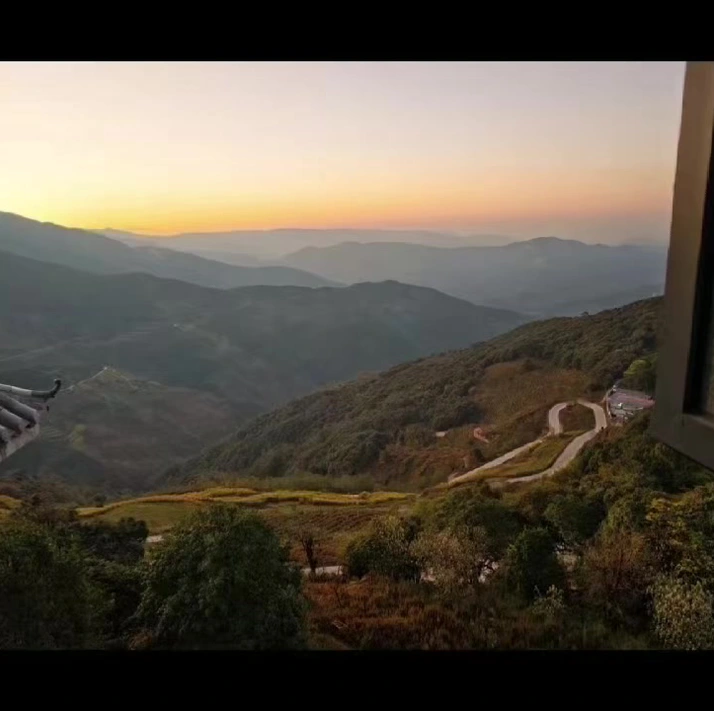
Wengji, in the Bulang language, means "the place chosen by divination." The ancient village has preserved its residential houses, folk customs, and traditional clothing intact. The village is centered around the ancient village heart, with houses arranged around it. The buildings are mostly two-story bamboo-and-wood houses, built into the hillside with sloped roofs and hanging tiles for drainage and ventilation. At the village's high point stands the Wengji Ancient Temple, the oldest Buddhist temple on Jingmai Mountain, with a cypress tree inside that is nearly 3,000 years old — a truly magnificent sight.
We waited for sunset at Wengji. At that moment, the golden light spread over the ancient village and tea groves, and the whole world fell silent.
Three Key Words for Jingmai Mountain
Gravel Road: Entering the mountain, you immediately encounter Jingmai's signature cobblestone/gravel winding road, undulating all the way. The tires crunched over the angular stones, and the car shook and rattled. The gravel road is deliberately preserved to protect the ancient tea forest ecology, limit vehicle speed, and maintain the mountain's tranquility. It took us one day and one hour to exit Jingmai Mountain, costing 16 RMB.
Pu'er Tea: As a core production area of the World Heritage site, Pu'er tea prices in Jingmai are relatively stable, but the fame brings a higher premium. Jingmai is at an altitude of 1,400-1,600 meters, with older ancient trees. The tea features orchid and honey aromas, with a significant lingering fragrance in the cup — it belongs to the "aroma and flavor school."
Laping Awa Inn (腊平阿佤民宿): "Laping Awa" means "good Bulang tea" in the Bulang language. The owner was warm and generous, inviting every guest to taste his homemade white liquor for free. The liquor was strong, but the owner's hospitality was even stronger. The owner's young son, about three or four years old, had handsome features and looked like a little prince from Nepal — utterly charming.
DAY 5: Manghong Sunrise → Lincang Yongde — The Longest Stretch of Road
February 24, 7:00 AM. The sky was still dark as we set off for the Octagonal Pagoda area in Manghong Ancient Village to watch the sunrise. The viewing slope was already crowded with tourists. We spent 10 RMB to stand by an egg stall on the slope for a better view with fewer people.
At 1:00 PM, we left Jingmai Mountain and set out for Yongde in Lincang. This was the longest stretch of the trip — about 360 kilometers, with the navigation app estimating five hours.

The first half was on the Ruili-Mengding Expressway, which was in trial operation and toll-free, with almost no other cars. The road was so good that we unconsciously pressed the accelerator, reaching speeds of 150-160 km/h. The second half of the expressway wasn't open yet, so we turned onto winding mountain roads, and the speed slowed down. As we twisted and turned, the sky gradually darkened. At 8:00 PM, we met our friend in Yongde on time.
We came to Yongde to see a friend who works with tea. As we drove into the county town, I was a bit surprised — the streets were lined with colorful lights and LED displays, instantly pulling us from the ancient mountain villages back to a modern city. Our friend explained that Yongde has an average annual temperature of 17.4°C and was recently named a "China Climate Livable City (County)." Its agriculture focuses on nuts, mangoes, walnuts, and medicinal herbs, earning it the titles "Hometown of Chinese Mangoes," "Hometown of Australian Nuts," and "Hometown of Terminalia Chebula."
Listening to this, I suddenly felt that this small town had been hiding its charm quite well.
DAY 6: Mingfeng Mountain — Silence Before a Millennium-Old Tea Tree
February 25, 9:00 AM. Our friend took us to try the local breakfast — rice noodles with pea flour soup (稀豆粉米线). Peas are ground into flour, simmered until thick and smooth, then poured hot over blanched rice noodles or served with a freshly griddled rice flour pancake. Chili oil, cilantro, crushed peanuts, and pickled vegetables are added to the bowl, each adding its own fragrance. That first bite was rich but not greasy, the warmth spreading from my stomach and waking me up completely.
Yongde is a core production area for the large-leaf variety of Yunnan Pu'er tea, producing famous teas like Mangfei, Big Snow Mountain, Meizi Qing, and Mingfeng Mountain.
First Stop: Mingfeng Mountain Tea Garden
The garden is about 30 kilometers from the county town, at an elevation of 1,900 meters. Most of the tea trees are over one to two hundred years old. The thicker the moss on the trunk, the older the tree. Before I came, I thought that tea trees shorter than a person were "terrace tea" and that ancient trees should be towering. But I learned that for easier harvesting, and also because of the Pu'er tea boom in 2008, many ancient trees were "dwarfed" (矮化) — even in an old garden like Mingfeng Mountain, the trees aren't tall. You just set up a support to pick the new leaves at the top.
Second Stop: Phoenix Nest (凤凰窝)
Following a newly opened path for a short distance, we reached the core ancient tea tree area of Mingfeng Mountain. Here, Boss Zhai has applied for protection for over twenty Phoenix Tree Pu'er tea trees, each one registered and documented. But in the last two years, a few more have withered, and the annual yield is pitifully small.
Third Stop: The Millennium-Old Ancient Tea Tree — The Place That Made Me Silent
Boss Zhai then drove us another thirty or forty li (15-20 km), over mountains and through valleys for over two hours, to a small, nameless village. Beyond the surrounding mountains lies Myanmar.

Scattered here and there were many wild ancient tea trees, over a thousand years old. Each one was too big for one person to wrap their arms around. A few were tall, straight "pole trees" reaching straight for the sky. In earlier years, these trees were off-limits for harvesting, and only in recent years have they been allowed to be picked for one day a year. Last year, it was April 5th, and it was said that over a dozen people could stand on a single tree at once.
A few families live in the village, making a living from producing pine resin. Although it's close to the border and the mountain roads are winding, judging by the newly built houses, life there must be comfortable.
Standing in front of those thousand-year-old tea trees, I suddenly felt that this entire journey wasn't about looking at trees — it was about looking at time.
Jingmai vs. Yongde: A Dialogue Between Two Pu'ers
As seasoned tea drinkers, we compared the two types of tea. Both belong to the Yunnan large-leaf variety of Pu'er, but their styles are distinctly different: Jingmai, at 1,400-1,600 meters, belongs to the "aroma and flavor school"; Lincang Yongde's Mingfeng Mountain, at 1,900-2,000 meters, has a higher altitude, stronger tea energy (茶气), and a more powerful physical sensation — it belongs to the "power school."
DAY 7: Lincang → Mangshi → Tengchong — From Mountains to Exotic Lands
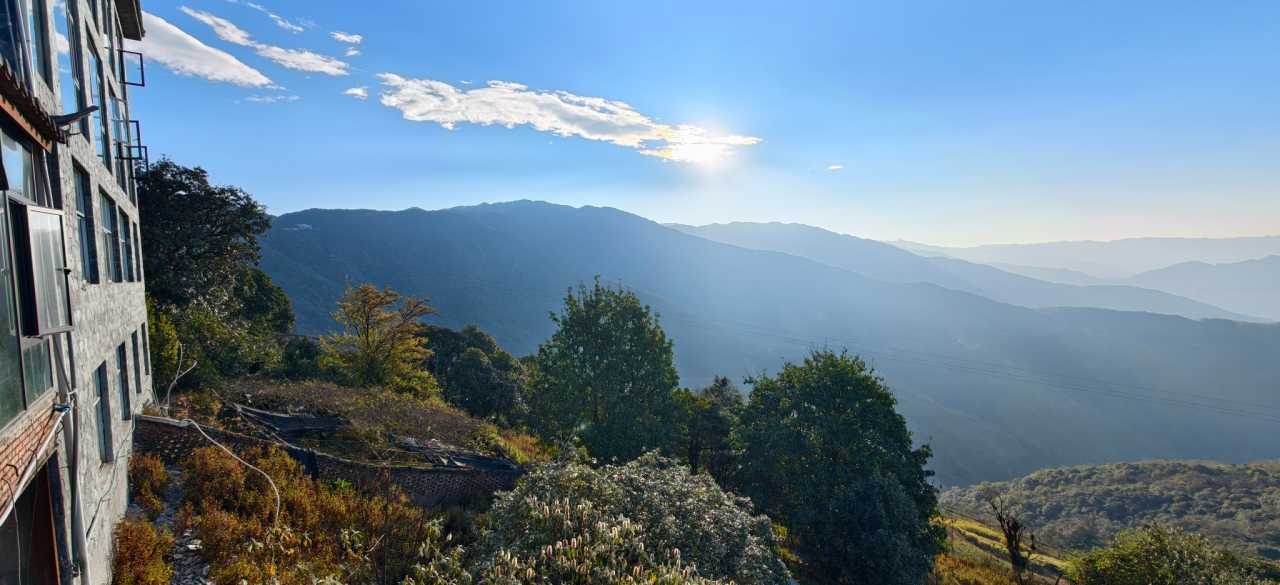
February 26. Last night, the sky turned overcast, and this morning, thunder rolled with the rain. Boss Zhai said it hadn't rained here in three months, and the tea farmers were all hoping for this sweet rain. Carrying the moisture and hope of the mountains, we set off at 9:00 AM for Mangshi.
We drove along National Highway 219, winding through rugged mountain roads with endless peaks and ridges. The 200-plus-kilometer journey took a bumpy five hours.
Meng Huan Golden Pagoda: China's First Golden Buddha Pagoda
Mangshi is a county-level city in the Dehong Dai and Jingpo Autonomous Prefecture, right on the border with Myanmar. The entire small town is steeped in a strong, exotic atmosphere.
The Meng Huan Golden Pagoda (勐焕大金塔) stands atop Leiyarang Mountain by Peacock Lake in southeastern Mangshi, at an elevation of 1,079 meters. It is China's first golden Buddha pagoda and Asia's first hollow Buddha pagoda. The main hall covers 2,000 square meters, with four Buddha statues enshrined on the central square pillar facing east, west, north, and south: Sakyamuni Buddha, Guanyin Bodhisattva, the Medicine Buddha, and Maitreya Buddha. The ancient pagoda was first built in 1803 but was later destroyed in war; the current golden pagoda was rebuilt in 2004.
We bought four fresh flowers from a small shop and, after entering the main hall, proceeded clockwise from the east to pay respects to each of the four Buddha statues — this is the traditional ritual of Theravada Buddhism. Climbing to the top viewing platform, we had a 360° panoramic view of the entire Mangshi cityscape, with distant mountains and nearby sights all in full view.
Yunnan Wild Mushroom Hotpot and Paoluda (泡鲁达)
For lunch, we had Yunnan wild mushroom hotpot (滇芝菌野生菌火锅) with a chicken broth base that was heartwarmingly fresh. Although it was past the peak mushroom season and most were frozen, the broth was still rich and delicious after simmering. Chicken termite mushrooms (鸡枞菌), "see-hand-green" mushrooms (见手青), porcini mushrooms (牛肝菌), and other varieties were tender and smooth, melting in the mouth. We also ordered must-try snacks in Mangshi: crispy, flaky "thrown pancakes" (甩粑粑), and refreshing, palate-cleansing paoluda (泡鲁达). Paoluda is somewhat similar to Hainan's "qingbuliang" (清补凉), made with a coconut milk base, chewy tapioca pearls, and white jelly, served chilled to beat the heat.
DAY 8: Rehai (Hot Sea) → Heshun Ancient Town — A Geothermal Wonderland and Border Town Memories
February 27. We set out from our homestay in Heshun Ancient Town for the Rehai Scenic Area. Rehai is a national 5A-level tourist attraction and a national geopark, located 8 kilometers south of Tengchong County in Qingshui Township.
Arriving early in the morning, we first bought two strings of eggs outside the scenic area — 10 RMB for 8 eggs. Carrying this touch of everyday life, we began our journey into this geothermal wonderland. Walking slowly up the valley, we were greeted by billowing steam. Pearl Spring (珍珠泉) bubbled with strings of rising pearls; Frog's Mouth Spring (蛤蟆嘴泉) pulsed and spurted; Lion's Head Spring (狮子头泉) varied in water flow, each with its own character.
Heshun Ancient Town was the last stop of the trip. Bluestone paths, white walls and black tiles, small bridges over flowing water — this border town had a gentleness rivaling the water towns of Jiangnan, but with a uniquely relaxed Western Yunnan character. We checked into the "Cloud Spring Lakeside" (云间温泉湖畔) and soaked in the hot springs, letting the fatigue of the past nine days slowly dissolve in the steaming water.
Epilogue: The Answer on the Ancient Tea Horse Road
February 28. We went shopping at the Tengyue Trade City, then flew to Chengdu to transfer back to Beijing.
Nine days. Over 2,000 kilometers. One Teramont. One family of three. From the hustle of Kunming to the terror of Ailao Mountain, from the horse hoof prints of Nake Li to the millennium-old villages of Jingmai Mountain, from the carnival of the Wa King's Feast to the silence of Mingfeng Mountain, from the exotic charm of Mangshi to the warm springs of Heshun.
Throughout this journey, we weren't rushing to get somewhere. We were searching for an answer to life.
Perhaps the answer was in that cup of Pu'er tea, in that cup of coffee, in that bowl of rice noodles with pea flour soup, in the silence of that thousand-year-old tea forest. It tells us: life doesn't have to be so hurried. The scenery is right there on the road, and the most beautiful scenery is often those encounters we never planned for.
The Ancient Tea Horse Road spans a millennium — but it's really just the time it takes to brew a pot of tea. And we are merely travelers passing through this long river of time, stopping for a drink.
You should also read:
Two Girls' Graduation Trip: Dali and Shuanglang – A Poetic Farewell to Mountains and Sea
Two Girls' Graduation Trip: Dali and Shuanglang – A Poetic Farewell to Mountains and Sea Preface: Catching the Tail of Youth, Heading South During our senior year of college, my roommate and I – two girls studying in Beijing – decided to bid farewell to…
Continue reading...
Body in Hell, Heart in Heaven: A Pilgrimage Through Tiger Leaping Gorge — A Dialogue Between Heaven and Earth
Body in Hell, Heart in Heaven: A Pilgrimage Through Tiger Leaping Gorge — A Dialogue Between Heaven and Earth Introduction: When the Gorge Splits Open Beneath Your Feet Some say Tiger Leaping Gorge is the closest place on Earth to the border between "hell" and…
Continue reading...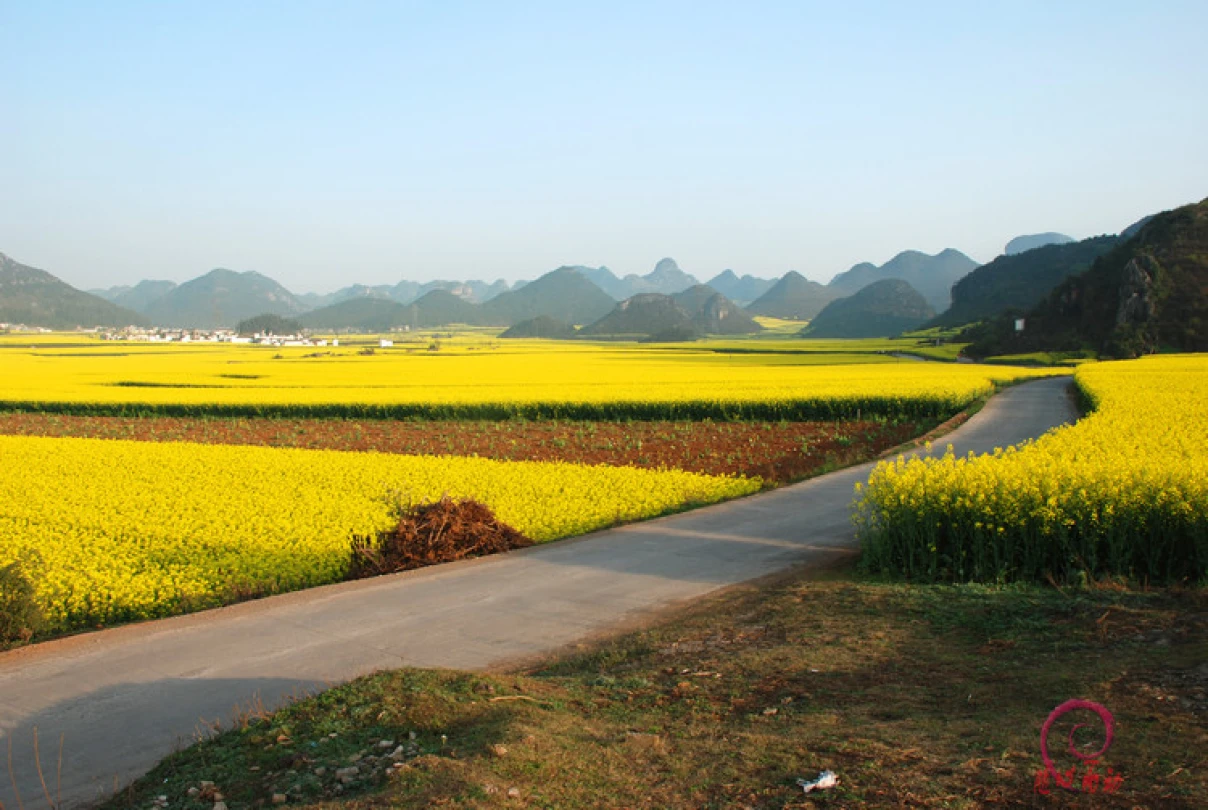
Golden Luoping: A Romantic Encounter with Sunshine and Seas of Flowers
Golden Luoping: A Romantic Encounter with Sunshine and Seas of Flowers Introduction: The Third Time's the Charm Some landscapes are destined to be seen at the right moment. For me, that was exactly the case with Luoping's rapeseed flowers. On February 22, 2011, the Luoping…
Continue reading...