The Grand Beauty of Yuanyang: A Land Carved by Cultivation
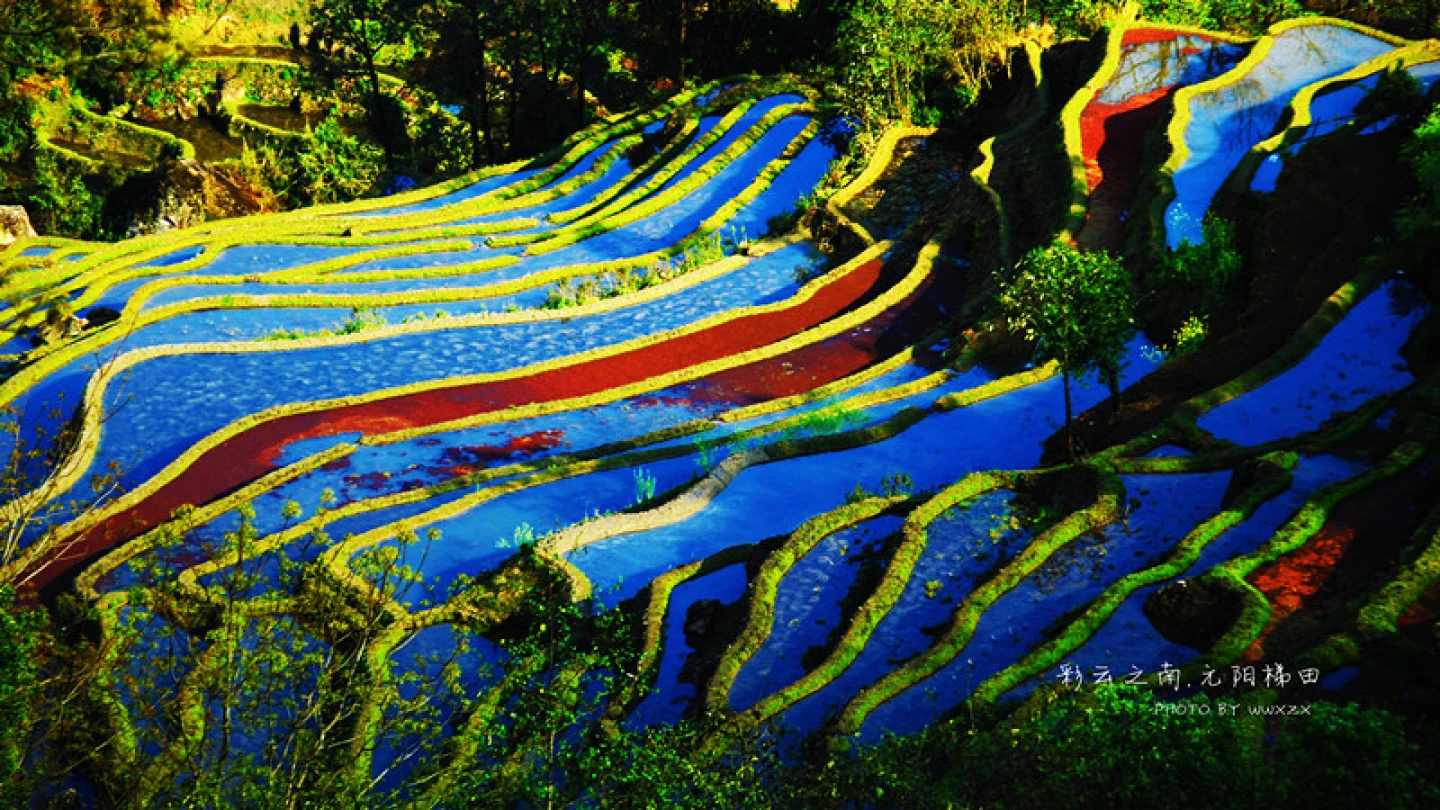
The Grand Beauty of Yuanyang: A Land Carved by Cultivation
A Belated Journey
Chengdu has finally cleared up. After several consecutive days of rain, the sunset gently pours through the window. I sit in front of my computer, staring blankly at over three thousand photos. These images stubbornly lie in their folders, each one telling a story—yet here I am, back in Chengdu for two days, while my soul remains in Yunnan, in Yuanyang, beside the rice terraces that the Hani people have cultivated for generations.
Plow oxen, ducks, farmers, lines, blocks of color... Over three thousand shutter clicks, capturing nothing more than another vivid imprint I've left on this journey. The same place, but with different weather and different light, is enough to make one unable to resist pressing the shutter. And the process of selecting photos is a sweet torment—I can't bear to delete a single one, as each carries a memory.
Where should this travelogue begin? With the colors? The lines? Or the time spent on the ridges of the terraced fields? Every fragment deserves to be presented in the most brilliant way, but alas, I only have the skill of a rambling storyteller—and a fragmented one at that. So, dear readers, please bear with me.
The Origin: A Childhood Imagination of the Hani People
The Hani ethnic group, a minority I first heard about when I was very young, has always planted a seed in my heart.
I remember secretly reading my father's books as a child. In a children's novel, I came across a story about a young Hani wrestler from the Ailao Mountains. That book sparked my earliest imagination of this people—a resilient, tenacious ethnic group living stubbornly among the towering mountains. From then on, the Hani people left a deep impression on me, mysterious and unyielding.
Later, in the documentary Wild China, I saw the Hani again—this time, with rice as the thread, leading to the magnificent画卷 (picture scroll) of the Yuanyang Hani Rice Terraces. Although the film's imagery was completely different from the Hani people I had imagined as a child, those layered, winding pastoral scenes far exceeded my expectations.
Since then, whenever I thought about the places I most wanted to visit, the Yuanyang Hani Rice Terraces would always come to mind. The longer the time passed, the stronger this desire grew, becoming harder and harder to erase from my thoughts.
Early this year, a few friends gathered, and the name came up again. The long-suppressed urge to travel was stirred once more, a chord plucked, producing only a simple note: Let's go.
And so, I packed a few thin clothes, grabbed my camera and eyes, and bought a hard-seat ticket on the K113 train from Chengdu to Kunming. Off I went.
Trip Overview: Bumpy Roads, Endless Anticipation
Transportation Route
Getting from Chengdu to Yuanyang is a long journey. I chose the most economical option—hard seat.

- Chengdu → Kunming: Train K113, hard seat ticket 140 RMB, about 19 hours. Departs Chengdu at 1:00 PM, arrives in Kunming at 7:50 AM the next day. Passes through Meishan, Emei, Hanyuan, Ganluo, Puxiong, Xichang, Panzhihua, Guangtong, etc.
- Kunming → Gejiu: From Kunming Railway Station, take Bus 60 (1 RMB) to the Eastern Bus Terminal, then transfer to a bus to Gejiu (92 RMB including insurance), about 5 hours.
- Gejiu → Yuanyang Xinjie Town: Buses run continuously, 29 RMB including insurance, about 3 hours (with a stop in Nansha County).
If you're short on time, you can also fly directly to Kunming and then transfer, arriving at the old county seat of Yuanyang the same day. But for someone like me, with plenty of time and a tight budget, torturing the body a bit is also an experience.
There's also a route via Jianshui to Yuanyang. Although I haven't tried it, time-wise, both routes take about a day. If the transfers go smoothly, you can just barely catch the sunset. Our transfers went very smoothly—basically buying tickets and hopping on—but we still didn't arrive in Yuanyang until 6:30 PM.
Accommodation Recommendations
We stayed at the Yafeng Inn near the Xinjie Bus Station, 50 RMB for a double room per night. Since it was close to the station, it was very convenient for chartering cars or catching rides, so we stayed there for our entire time in Yuanyang. From the Yuanyang station heading toward Longshuba, you'll find similar small guesthouses—cheap, with slightly poor hygiene, but the owners are all very friendly. If you're in a group, you can bargain down to 30 RMB per room, depending on your negotiation skills. If you want something nicer, there are standard rooms near Xinjie Square, similar to budget chain hotels in the city.
Food Recommendations
Liujun Restaurant (near the square) was our go-to for dinner. Fried pork ribs, stinky tofu fish, two seasonal local vegetables, and two bottles of beer—all for just 90 RMB. Generous portions and authentic flavors. We had dinner there for the next two nights as well.
I especially recommend the boxed lunch (盒饭) 100 meters in front of the Xinjie Town post office—2 RMB for all-you-can-eat rice, 1.5 RMB per meat dish, and 0.5 RMB per vegetable dish. Don't let the word "boxed lunch" fool you; the taste is absolutely incredible! Stir-fried pork with pickled vegetables, steamed egg, wild greens... A big bowl full, each bite brings pure happiness to your taste buds. In Chengdu, this bowl would easily sell for 30 RMB. If they were open in the evening, we probably would have eaten all our meals there.
Chartering a Car and Transportation Tips
We shared a charter car with a couple surnamed Han. The driver was called "Terraced Fields Sky Brother" (梯田天翼哥), and it cost 270 RMB per day for everything (he even has a Weibo account—very modern).
If you want to save even more, you can try: 1. Check if other people chartering cars at your accommodation have extra seats and ask to join. 2. Near the station, there are three-wheelers and vans that pick up locals. For distant places like Duoyishu and Laohuzui, it's about 10–20 RMB; for closer spots, it starts at 3 RMB. 3. Hitchhike.
Of course, if you have a bigger budget, chartering a car for the whole trip is very convenient, usually around 300 RMB per day. But personally, I think you'll gain more by walking and exploring as you go.
Day One: Impressions of Gold
Charter Car Route
Xinjie Town Bus Station → Duoyishu Scenic Area (sunrise) → Huangcaoling Viewpoint → Shengcun Market (walk through the market) → Bada Scenic Area → Masuzhai Tea Factory Viewpoint → Dayutang Hani Village (walk to the next stop) → Jingkou Folk Village → Laohuzui Scenic Area → Longshuba (sunset) → Xinjie Town
On this day, we took the charter car to quickly tour the must-see classic spots of the Yuanyang Rice Terraces, and also got a detailed understanding of the distances and time consumption between each point.
We got up at 5:00 AM and set off, not finishing until nearly 8:00 PM after sunset.
Ticket Tips
A combo ticket costs 100 RMB. If bought separately: Duoyishu + Bada is 60 RMB, Laohuzui is 30 RMB, and Jingkou Folk Village is 30 RMB.
But as it turned out, all tickets are just a formality. My principle: Follow the locals; there are free entrances everywhere. After all, the villagers need to go down to work in the terraced fields, so by taking those small field paths, you can get into any scenic area without a ticket. After the first day, we didn't buy any more tickets for the rest of our time there, happily wandering through the terraces and visiting all the major spots several times.
Shengcun Market
The market in Shengcun was full of delicious food: grilled tofu (3 pieces for 1 RMB), grilled chicken tips, grilled chicken tails, watermelon, pineapple, bananas, and of course, cold noodles and rice noodles. You could also find mint and some wild greens. The locals seem to have a strong passion for chicken tails—almost every barbecue stall had them as a highlight. Meat skewers were 1 RMB each, very affordable.
Weather and Light
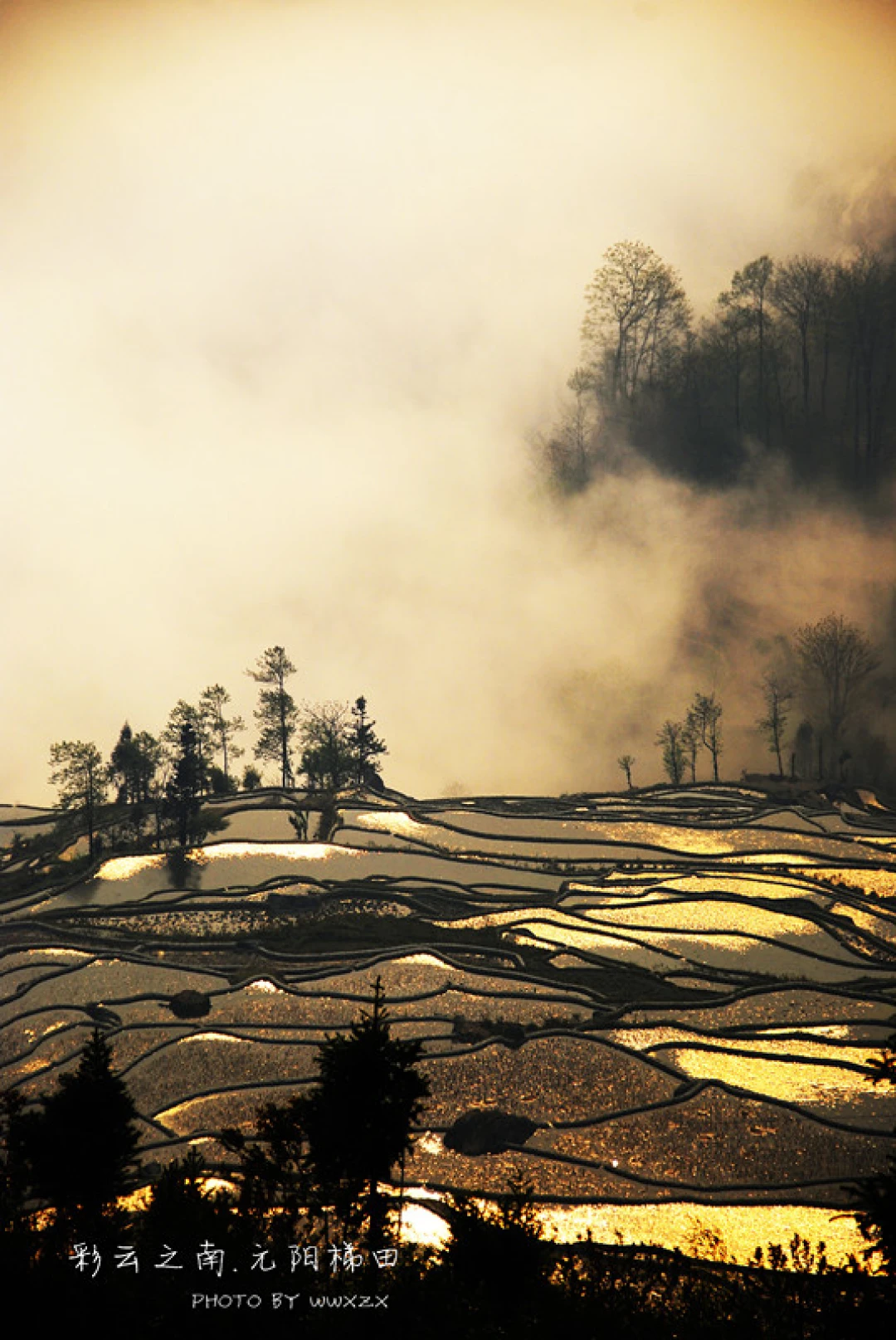
The weather was clear that day, but because it hadn't rained for a long time, the air was hazy with poor visibility. It didn't improve until the afternoon. After a day of shooting, I desperately hoped for some rain—to wash away the dust in the air and make everything clear and transparent.
Day Two: Blue Enchantress
Hope in the Rain
My prayers from the day before seemed to have worked—early in the morning, it really started raining in Yuanyang. Rain meant the air would become perfect, and if it cleared up again, it would surely be a poetic and beautiful scene. Of course, I also worried that the rain would keep falling, ruining the beautiful views ahead.
Fortunately, the weather cooperated. After half a day, the rain stopped. And when it stopped, we had already been out in the rain for a long time, right below Shengcun in an open area with no other photographers, experiencing the pastoral mountain scenery in the rain.
The appearance of sunlight really got us excited. In our three days in Yuanyang, the most vibrant colors all came from this afternoon.
"Cut Cat's Land"
We bought rain boots (men's black 25 RMB/pair, women's blue 20 RMB/pair) and followed the field ridges down from Shengcun. The reason we chose Shengcun was mainly because of the postcards I bought at Laohuzui the day before—each one was beautiful, but due to my personal preference for blue, I decided to head down into the fields from Shengcun that day.
The weather wasn't clear at first. Light rain and moderate rain took turns drenching us for the first few hours. But the Yuanyang Rice Terraces in the rain, though a bit hazy, offered a completely different view. The rain brought a fresh, clean feeling to the fields—a sensation you can only fully appreciate by walking right into them.
Whenever the rain let up a bit, my companion and I would run wild along the field ridges. Maybe because of the rain, or maybe because the field we went to wasn't a tourist spot at all, and we had walked deep into its center, not a single person disturbed our happy photo session in this field all afternoon. It became our private vegetable patch—I proudly named it "Cut Cat's Land" (切猫の地).
In Yuanyang, all the locals recommend places like Duoyishu, Bada, and Laohuzui. When it comes to Shengcun, people mostly talk about the market and the local culture. Who would have thought that the houses by the market were hiding such beautiful scenery? So, Yuanyang has many hidden beauties along the roadside, blocked by trees and houses. As long as you're willing to use your legs and walk in, you'll discover them.
The Skylight Opened
After noon, the rain gradually stopped. A patch of blue sky appeared in the distance, and at that moment, I couldn't contain my excitement. I stood on the field ridge, shouting loudly for the blue sky to move above us.
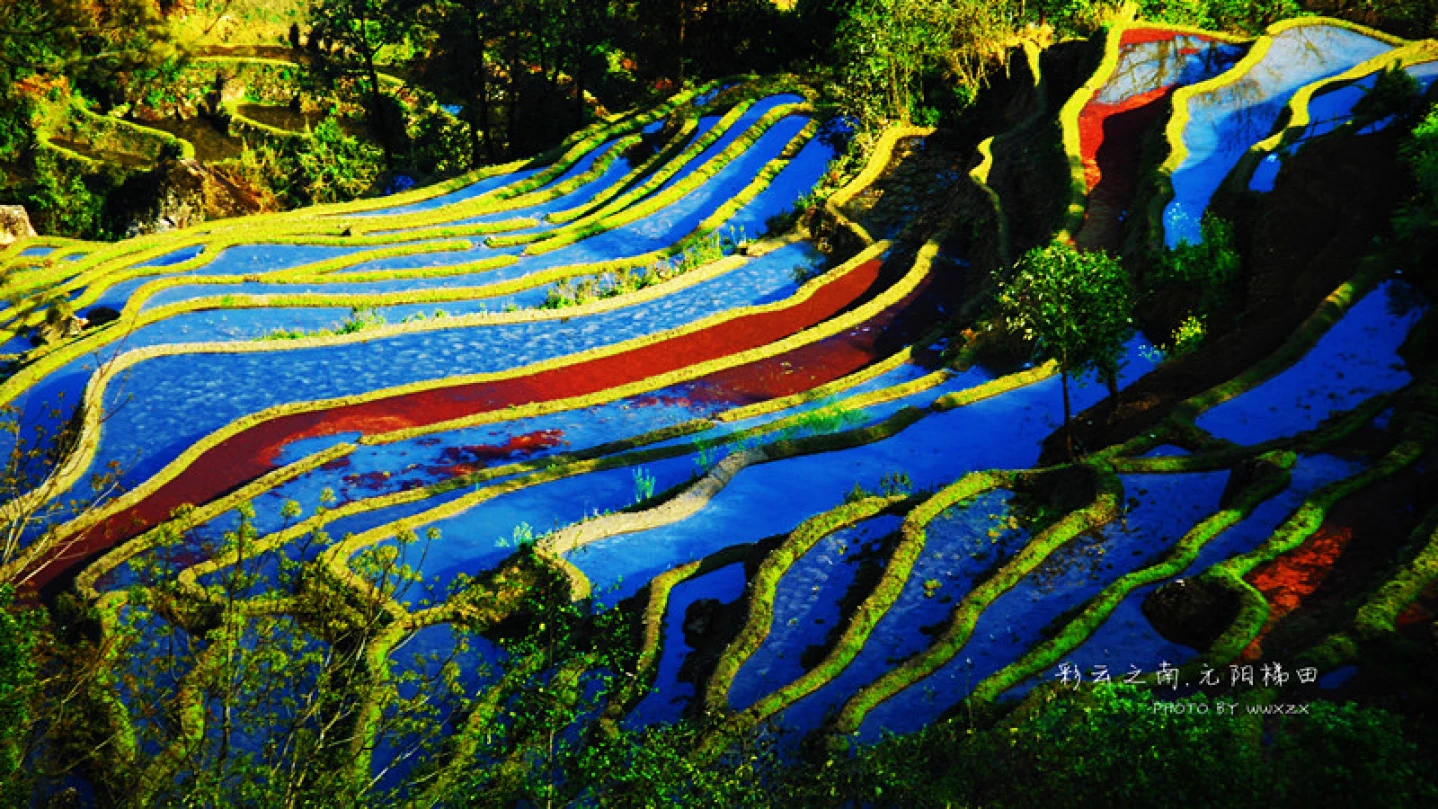
The wind and clouds cooperated, and heaven, with a kind of luxurious favor, opened a blue skylight right above our heads. Because this skylight persisted all afternoon, sunlight poured through it. Standing there, we felt an indescribable happiness—watching the water fields change with the light, reflecting various shades of blue, happiness came too suddenly, too intensely.
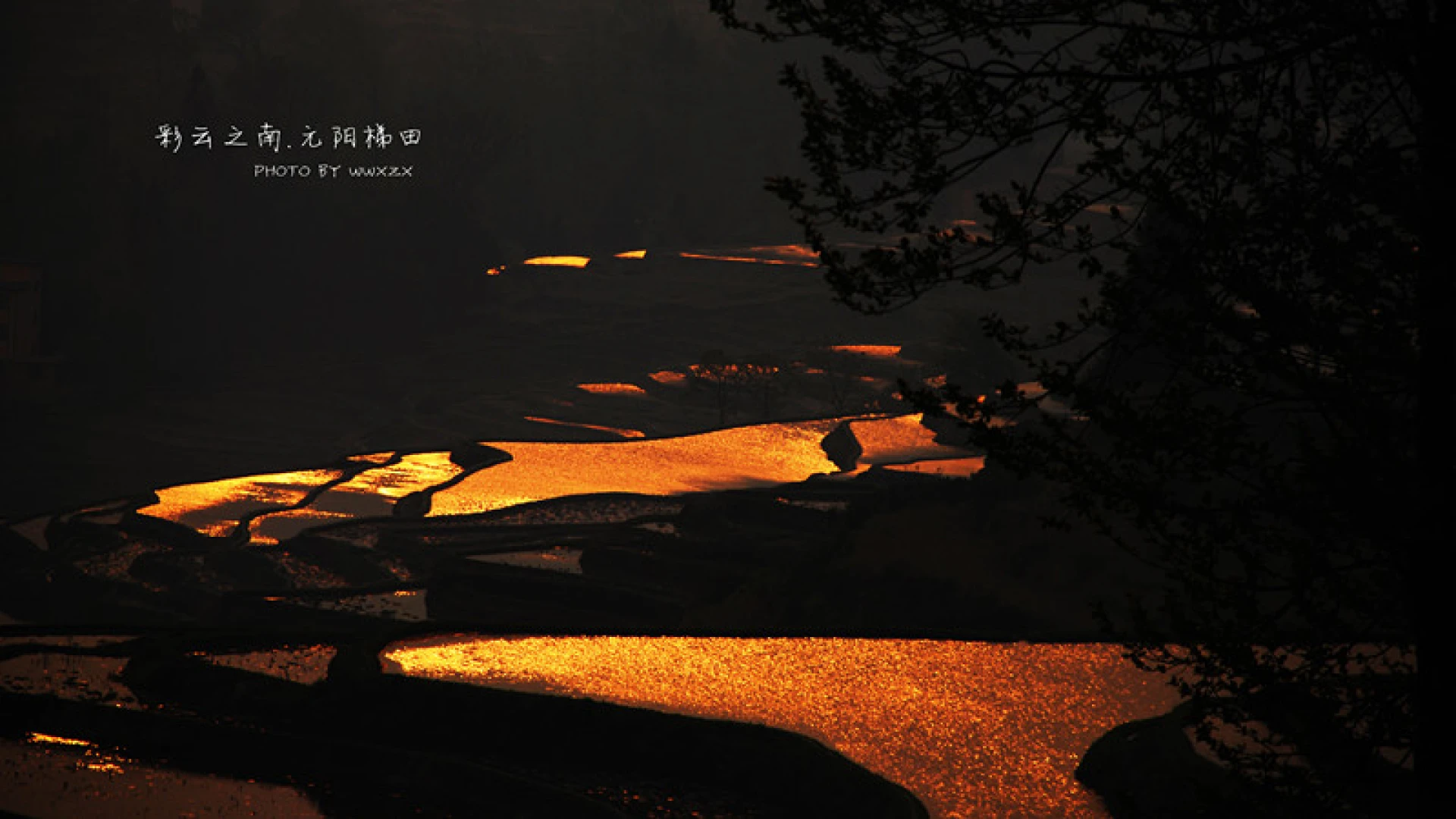
That afternoon, we only went to two places: one was this Shengcun "Cut Cat's Land," which devoured nearly 4GB of memory, and the other was Bada. Since we couldn't capture the sunset at Shengcun, after some hesitation, we rushed to the nearest spot, Bada. The sunset, in a way different from the golden hues of the previous night, presented us with another kind of colorful splendor.
The impression left by the second day was more about blue—so let's end this day's record with a blue tone.
Day Three: The Simplicity of Clear Skies
The third day was clear and cloudless, but it didn't feel as good as the day before when the rain had cleared. So I took quite a few small scenes, but fewer grand landscapes.
Afterword: More Connections with the Terraces
Later, because of work, I went to Yuanyang two more times, a bit later in the season. But I still feel that the first time had the best opportunities and the best light.
The second time, I went alone, entered the fields from outside the scenic area, and walked along the terraces for three days, passing by most of the spots I had visited before. Laoyingzui (Old Eagle's Beak) was a new discovery.
The third time, I wandered alone again. Interestingly, I bought a pair of local waterproof high-waisted pants that people wear when plowing the fields. Then I borrowed a plow ox and a plow, and plowed a field myself. That feeling was the best experience. Of course, I also deeply felt the hardship of the labor—the terraced fields covering the mountains were even more awe-inspiring.
Conclusion: What Yuanyang Taught Me
The beauty of Yuanyang is not the kind that stuns you at first glance. It's a beauty that requires you to walk into it, to spend time feeling it.
If you just charter a car to the scenic spots, take photos, and move on, you'll miss far too much. The easygoing Yuanyang welcomes you with tickets. But the Yuanyang I know welcomes you with field paths, ducks, and oxen in the water. Get closer, and you'll see more details, collect more stories, and create memories unlike anywhere else.
The time spent on the field ridges, the patience of waiting for sunlight in the rain, the moments of brushing past local farmers—all of these are more precious than any photograph.
Yuanyang is a land carved by cultivation. The Hani people, over a thousand years, have etched this magnificent画卷 (picture scroll) into the towering mountains. And I am merely a brief passerby in this scroll, fortunate enough to have used my camera and my eyes to capture its most moving form.
If you also want to go to Yuanyang, my advice is: Don't rush, don't just stare at the scenic spots. Walk in, slow down, and let the lines and light of the terraced fields lead you into a different world.
All photos in this travelogue are original. Please contact the author for reproduction.
You should also read:
Stillness and Motion: A Yunnan Journey in Golden October – A Dialogue Between Soul and Landscape
Stillness and Motion: A Yunnan Journey in Golden October – A Dialogue Between Soul and Landscape From October 15 to 30, 2012, I embarked on a 16-day journey through Yunnan, starting in Lijiang, passing through Lugu Lake, Shangri-La, Meili Snow Mountain, and Yubeng, finally ending…
Continue reading...
Xishuangbanna Self-Drive Tour: Into the Tropical Wonderland at the Edge of the Sky (Complete Guide)
Xishuangbanna Self-Drive Tour: Into the Tropical Wonderland at the Edge of the Sky (Complete Guide) Introduction: A Dream Fulfilled Thirty Years Early Some journeys are destined to happen at a specific moment in time. For me, a self-drive trip to Xishuangbanna was originally the first…
Continue reading...
Dreamland – Lijiang: A Talking Comic Travel Guide
Dreamland – Lijiang: A Talking Comic Travel Guide Prologue: When Lijiang Takes Root in Your Heart Some places leave a mark on you forever. They're like an old song on repeat, suddenly playing in your mind on an ordinary afternoon. For me, Lijiang is that…
Continue reading...