The Slow Life of Lijiang: A Soft Dream on the Yunnan-Guizhou Plateau
The Slow Life of Lijiang: A Soft Dream on the Yunnan-Guizhou Plateau
Some places, just by hearing their name, stir a ripple in your heart. Lijiang is one of those names. It's not the kind of destination that demands you tick off a checklist of sights. Instead, it's a place where you willingly "waste time." The moment you step onto its soil, you'll notice time slows down, your heartbeat eases, and even your breath carries the scent of sunlight.
This article chronicles my ten-day meandering journey from Lijiang to Shangri-La, Lugu Lake, and finally Shuhe. There was no rush to get anywhere, only the pleasure of slowing down. If you too long for a journey of self-reflection, then come with me, and let's step into this soft, dreamlike time on the plateau.
Departure: From Shanghai to Lijiang, A Date with Blue Skies and White Clouds
Taking off from Shanghai Pudong Airport, transiting through Kunming, we finally landed at Lijiang Airport. Our driver looked surprised: "You guys are lucky. Flights from Kunming to Lijiang are rarely on time." We exchanged smiles, feeling as if our good fortune had begun from that very moment.
The scenery outside the car window kept changing: fields, sunflowers, endless mountain ranges, and those blue skies and white clouds I'd seen countless times in other people's photos. At that moment, I knew I had stepped into another world.
Dayan Ancient Town: Getting Lost Is Also Romantic
Checking into "Open Sesame," Waking to the Sound of Flowing Water
We stayed at the "Open Sesame" (Zhima Kaimen) guesthouse on the edge of Dayan Ancient Town, recommended by fellow travelers online, and it lived up to its reputation. The inn was built by the water, and at night you could hear the gurgling stream, even mistaking it for rain. The room was clean and airy, with no air conditioning, but the electric blanket was warm enough. Wooden doors, bamboo and rattan, rustic décor—every detail spoke of Lijiang's way of life.
After dropping our luggage, I couldn't resist taking photos of everything. Almost every guesthouse in Lijiang is like a small piece of art, with its meticulous decoration and poetic name, making you want to stay and savor it slowly.
Lost in the Ancient Town's Alleys
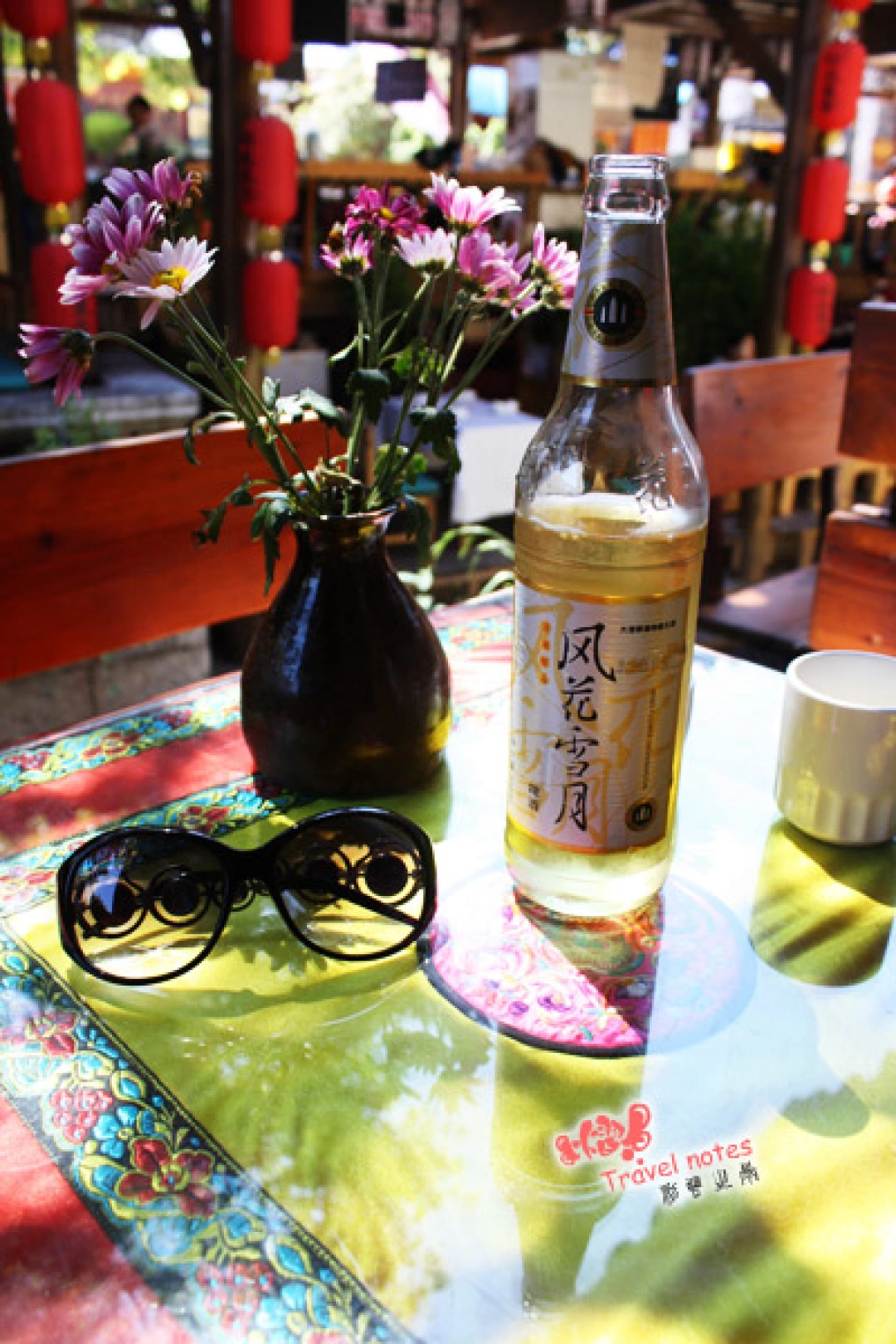
Stepping out of the inn, we began exploring this legendary ancient town. Lunch was at a restaurant whose name I can't recall, across from a lively snack street. Little fish swam endlessly in the water channels. I ordered a glass of "Wind, Flower, Snow, and Moon" (Feng Hua Xue Yue) wine, and under the lazy sunlight, enjoyed a classic Lijiang afternoon.
After eating and drinking our fill, we ventured deeper into the alleys. We came across a street performer with a majestic eagle on his shoulder. We passed by walls inscribed with Dongba script, those pictographic characters still in use today, as if whispering ancient secrets. We tried the A'an yogurt recommended by the Mafengwo travel guide—rich and creamy. I also had shaoxiancao (grass jelly) for the first time—only to realize later that it's available in almost every bubble tea shop back home. Talk about being "out of touch with the times."
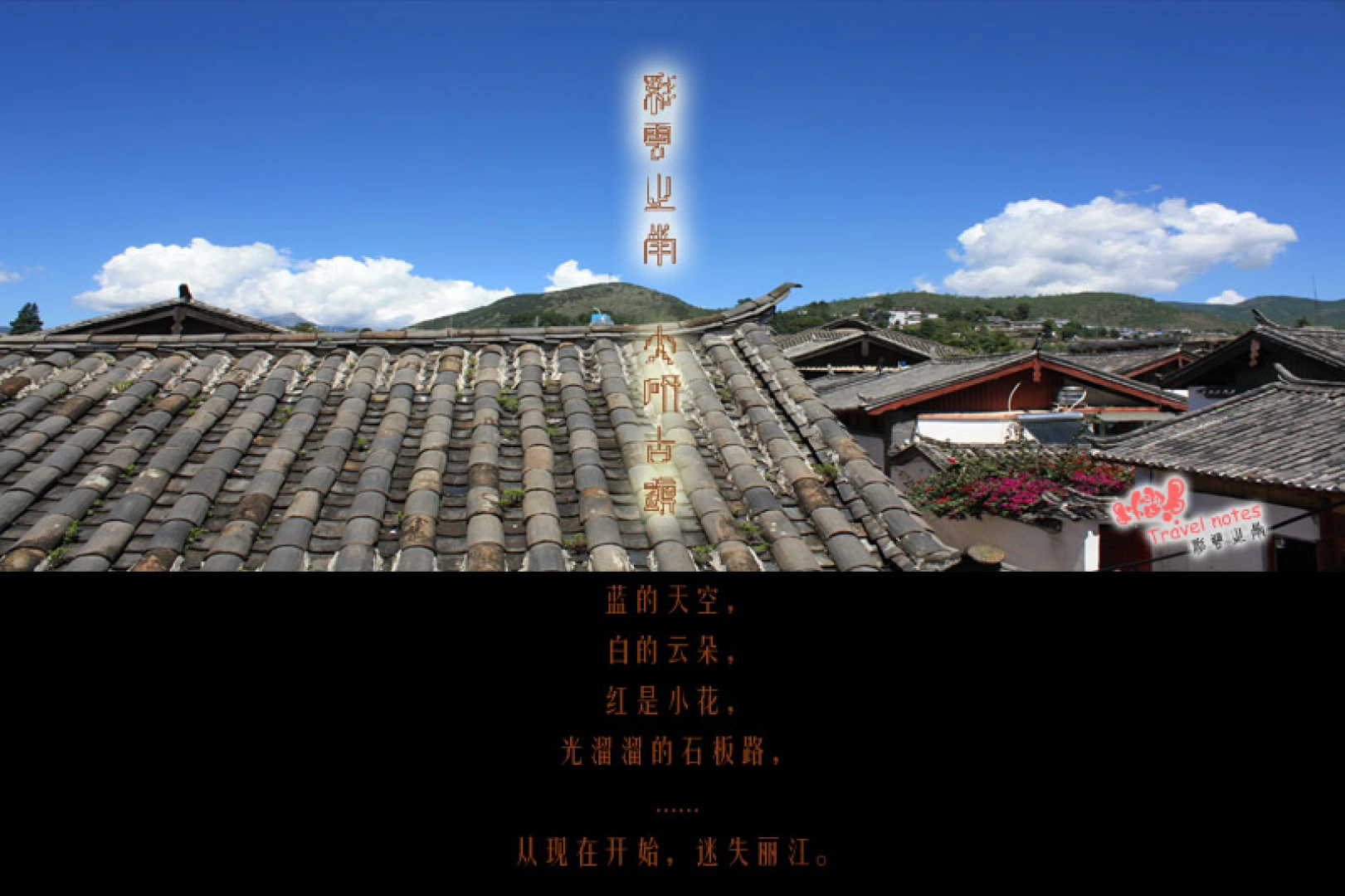
On a small hillside in Dayan Ancient Town, we found a teahouse with a commanding view, ordered a cup of coffee, and sat there comfortably for three hours. Not because we didn't want to leave, but because we were lost. Map in hand, we had no idea where we were. The streets of Lijiang aren't meant for walking—they're meant for getting lost. And that's absolutely true. Since we couldn't find our way back, we decided to simply enjoy the beauty of being lost. Overlooking the ancient town, all we could see were rows of blue-tiled roofs, with wamao (roof cats, traditional ceramic ornaments) standing on top. Closing my eyes, I could even hear the distant sound of students reading aloud from a school.
Night Falls, The Ancient Town's Other Face

At seven in the evening, the sky was still bright—exactly the kind of evening I love. As night fell, the ancient town transformed, revealing a wilder side. Bar Street was bustling, with music blaring from every establishment. Young men and women in Naxi costumes stood outside their shops, beckoning customers. We chose the quietest bar we could find and sat down to experience a different kind of night.
And so, wandering and getting lost, we came to know Dayan Ancient Town on our very first day.
Jade Dragon Snow Mountain: Holiness and Emotion
The Mountain at Dawn, Within Reach
In Dayan Ancient Town, almost every house faces Jade Dragon Snow Mountain. On our second morning, looking through the window, we saw Lijiang's iconic snow mountain. The sky was perfectly clear, and the mountain was visible in every detail.
At Ganhaizi Meadow, we paid our respects to this sacred mountain. Some say that standing at the foot of the mountain, you can feel its grandeur and a deep, heartfelt emotion. For me, I could only feel its tranquility and holiness, and the lingering attachment of the clouds that refused to leave.
Our driver said we were lucky. Many tourists miss the mountain due to the unpredictable high-altitude weather. It had been raining continuously for over twenty days in early September, but the day before we arrived, the sky cleared. I was grateful for this gift from heaven, and I felt a mysterious connection to Jade Dragon Snow Mountain.
Impression Lijiang: A Performance That Moves You to Tears
The girl at the guesthouse said it was wonderful. The driver said the same, even claiming it would make you cry. I didn't understand—how could a performance make you cry? It wasn't until the very end that I vaguely understood what moved everyone. It was a raw, authentic way of life, a reverence for nature, a genuine exchange of human emotion. It calls back the most original human heart. Although I never actually cried, I was genuinely moved, and tears welled up in my eyes. I remember that soft song, "Going Home" (Huijia). After returning, I searched for it on Baidu and listened to it many times. Finally, I understood why the locals said it was so good, why it moved people to tears—it was their life and their love for nature.
Spruce Meadow, Blue Moon Valley, and White Water Terrace
We went up to Spruce Meadow (Yunshanping), a meadow on the mountain at over 3,000 meters. It's actually quite small—after visiting Potatso National Park, it seems especially tiny. Behind us was the main peak of the snow mountain, looking close but still far away.

Another scenic spot on Jade Dragon Snow Mountain is Blue Moon Valley (Lan Yue Gu) and White Water Terrace (Baishui Tai). The water was like a painting, reflecting the blue sky, the melted snow water shifting from white to blue. A child in ethnic costume sat on a yak, wading through the water, the scene frozen in time. At White Water Terrace, we washed our hands in the snowmelt: once for career advancement, twice for wealth, three times for good luck in love.
The weather on the mountain was fickle—one moment clear and sunny, the next a sudden downpour of sunshower, then clearing up again. In the drizzling rain, we caught a glimpse of a "meter of sunlight" breaking through the clouds. That day, I fell in love with this place.
Shangri-La: A Hidden Realm of Grass and Lakes
Lashi Lake and Tiger Leaping Gorge
At Lashi Lake, we rode horses along the ancient Tea Horse Road. In the tall grass, as high as a person, the horses munched contentedly on beans. The cliffside path at Tiger Leaping Gorge was nerve-wracking, yet I couldn't help but steal more glances.
Rainbows and Star Euphorbia
They say Shangri-La is a mysterious and lonely place. On the way there, we received a beautiful gift. Amidst intermittent light rain, the blue sky pushed through the dark clouds, casting down a ray of sunlight, and we saw a rainbow. It was the biggest, longest, and most vibrant rainbow I had ever seen, spanning three mountain peaks. We lingered for a long time, watching until it slowly faded.
The fiery red sea of langduhua (star euphorbia, a poisonous flowering plant) was the most unique sight on this plateau. This plant, whose roots are toxic, turns a brilliant red in late autumn, bringing new life to the highlands. It symbolizes a tenacious will. It is said that star euphorbia is the last line of defense before grassland turns into desert. For those who have walked out of the desert, seeing it is seeing hope.
Potatso National Park and Songzanlin Monastery
Potatso National Park (Pudacuo) is stunningly beautiful, especially the trees and lakes. "Potatso" means "the lake that ferries all beings to the other shore." The horses there had round bellies, spending their days eating and sleeping. Living in such a beautiful place—how lucky they are. After returning, I even dreamed of the thousand-year-old double-lipped fish. Truly a blessed place.
Songzanlin Monastery was the worst value for money in terms of tickets, and the sights were just average, but it turned out to be the most photogenic place. It felt like we had truly arrived at the Potala Palace. The worshippers prostrating themselves before the temple, and the auspicious crows (considered sacred birds) circling overhead, all inspired a sense of awe.
Lugu Lake: A Mirror of the Sky
Seven Hours on the Road, Just for a Glimpse of the Lake
Nestled among encircling mountains lay a lake, like a mirror reflecting the blue sky, white clouds, and peaks. When the sky was blue, the lake was blue; when there were clouds, the lake mirrored them too. This was Lugu Lake, a place of beautiful legends, a mysterious kingdom.
We spent an entire day crossing countless mountain ranges before finally peeling back the veil of Lugu Lake. The mountain roads were treacherous, dangerous, and prone to landslides. Beneath us lay the "Eighteen Bends of Lining" (Lining Shiba Wan), which turned out to be the easiest part of the journey.
The Gap Between Reality and Dreams
When I finally saw the Lugu Lake of my dreams, my heart felt heavy. The beautiful scenes from photos seemed to have vanished. All we could see were roads churned up by bulldozers, hillsides scarred with red earth, and dust flying everywhere. Tourism development had caused serious damage to the environment around Lugu Lake. Because of the influx of tourists, the place had changed.
Quiet Time on Lige Island
We arrived at Lige Island on Lugu Lake around seven in the evening. After checking into our guesthouse, we took a walk by the lakeside. A big dog on a boat was named "Hero" (Yingxiong), with a yellow plastic toy in its mouth—its most treasured possession. We brewed a pot of Pu'er tea and listened to the sounds of nature.
In the morning, we didn't rush. We slept in until we naturally woke up. We had breakfast at a restaurant-bar on Lige Island. People in Lijiang have no real concept of time; they follow the sun, sunrise and sunset, with a time difference of nearly 90 minutes. So our breakfast took half an hour to arrive.
Boating on the Lake, A Landscape Painting
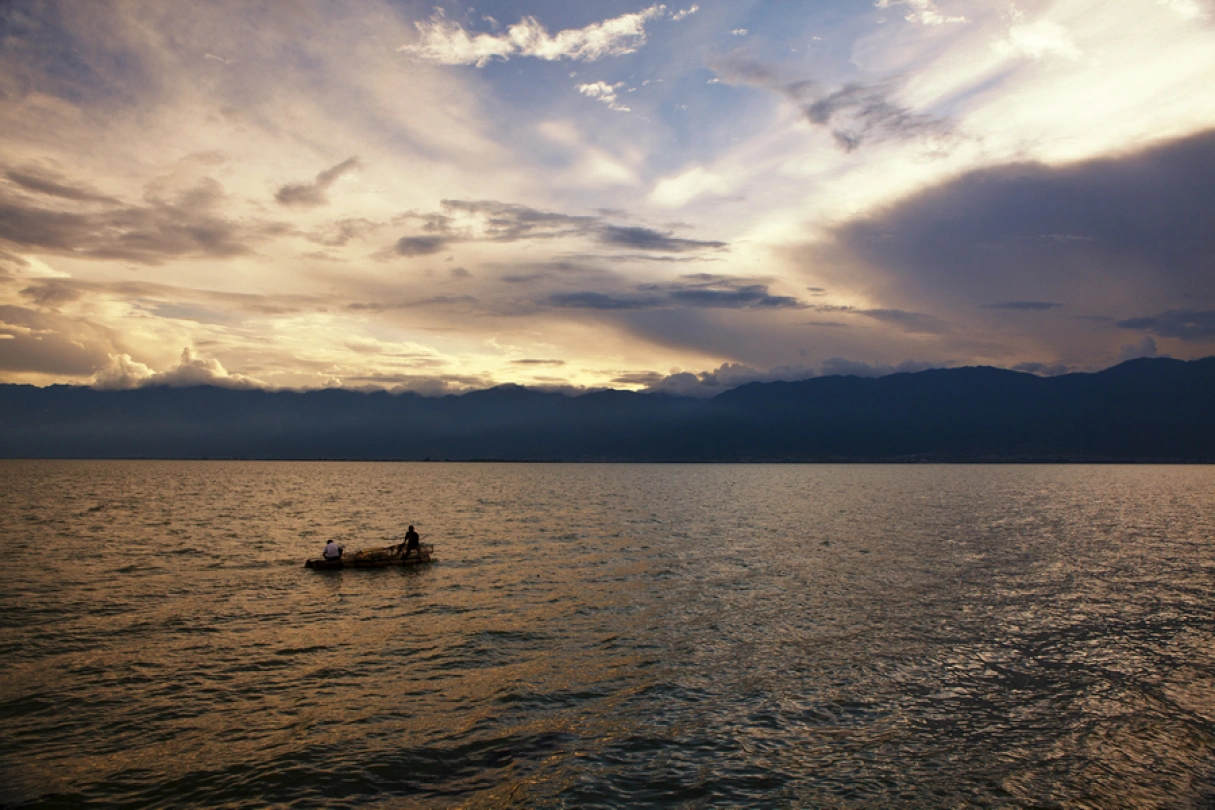
We found a small boat and set out to explore the mirror-like lake. The sky was full of clouds that day, and we couldn't see the blue sky—that was the only regret of our trip to Lugu Lake. But the lake surface looked like an ink wash painting with its own unique charm. The scenery on both sides was pleasant, and the reflection of Lige Peninsula was especially beautiful.
On the surface of Lugu Lake floated "water-nature-wandering-flowers" (shuixing yanghua), a type of algae that produces small white flowers above the water. It can also be cooked as a dish, with a unique flavor and a subtle fragrance.
Colorful Lige and the Puppies
We stayed at "Colorful Lige" (Wucai Lige) on the edge of Lige Island, a very distinctive house. However, for those who prefer things clean and tidy, it might be a bit uncomfortable, as the whole house was very rustic—"nest" would be a more fitting description. But that's precisely the charm of Colorful Lige. The guesthouse had just had a litter of five puppies, incredibly playful. Whenever I had free time, I loved playing with them. In the morning, the puppies would climb up to the table, watching you eat breakfast, hoping you'd spare a piece of barley cake.
Shuhe: A Lover's Slow Time
Checking into "Lovers' Knot," Discovering the Beauty in Details

For the last two days of our trip, we chose Shuhe Ancient Town and checked into the "Lovers' Knot" (Qingren Jie) guesthouse. The courtyard was large and tastefully decorated, with the owner's thoughtful touches everywhere. Online, the Lovers' Knot didn't look particularly impressive, but once we arrived, we found that many details were more beautiful than the photos. This was a recurring highlight of staying in so many guesthouses in Lijiang—a charm that only the guests can truly experience.
There was a semi-open lounge area where you could brew tea, read a book, or talk about your dreams in the afternoon. I especially loved the semi-open study. On sunny days, sunlight streamed through the windows; on rainy days, you could listen to the crisp sound of raindrops.
The Laziest Dog and the Most Leisurely Life
His name was "Baobao" (Baby), a Chinese rural dog, but the laziest dog I've ever met on my travels. Whenever you crouched down and reached out to pet him, Baobao would immediately flop onto his side, closing his eyes and enjoying the attention, no matter how you touched him. His posture was always utterly blissful. He loved basking in the sun, lying motionless at the entrance. If you told him you were taking him to buy sausages, he would follow you all the way, weaving through the streets of Shuhe.
Shuhe's Small but Beautiful Charm
Shuhe is very small; you hardly need a map. We just walked aimlessly through the streets of Lijiang. There was a free exhibition hall displaying Buddhist artifacts and historical materials. A tea called "Drunken Beauty" (Zui Meiren) was particularly delicious, with a light, sweet fragrance.
Before coming to Shuhe, I heard it was like Shanghai's Xintiandi, but I don't think so. It has its own unique character and a different kind of flavor. The silversmiths at work in their shops, the colorful clothing boutiques, the quaint little stores painting on wood—all of it was captivating.
Shuhe has so many skies and stone bridges. If I come again, I will definitely stay longer, to savor its beauty slowly.
Epilogue: What I Want to Say About Lijiang
Lijiang is not a place to be measured by footsteps, but a place to be felt with the heart. It's like an addictive book, filling those who haven't been with imagination and longing, and leaving those who have returned with a sense of regret and a desire to go again.
At least, I'm addicted. I even seriously considered moving there and living for five years.
If you're thinking of going to Lijiang, my advice is: Don't rush. Don't tick off a checklist. Don't over-plan. Leave time to get lost, to daydream, to wake up to the sound of flowing water, and to fall asleep in the sunlight.
Because the slow life in Lijiang is never a choice—it's a state of being.
Travel Tips: - Best Season: September to November, when the weather is clear and the scenery is most beautiful. - Transportation: It's recommended to fly to Kunming and then transfer to Lijiang, or fly directly to Lijiang. - Accommodation: Book in advance and choose guesthouses in quieter areas. - Essentials: Sunscreen, umbrella, and a warm jacket (high altitude means large temperature differences). - Budget Reference: Approximately 20,000 RMB for a two-person, ten-day trip (including flights, accommodation, meals, tickets, and activities).
For more travel stories, feel free to follow my page.
You should also read:
A Journey Through Shuanglang's Guesthouses: Finding Life as It Should Be on the Shores of Erhai Lake
A Journey Through Shuanglang's Guesthouses: Finding Life as It Should Be on the Shores of Erhai Lake Prologue: When Life Hits the Pause Button Have you ever had one of those moments? When the city's towering buildings press down on your chest, when you're swept…
Continue reading...
Dreaming of Lijiang, Dreaming of Shangri-La: A Journey That Lets Your Soul Breathe Deeply
Dreaming of Lijiang, Dreaming of Shangri-La: A Journey That Lets Your Soul Breathe Deeply Life is like a long trek. We're always rushing through the concrete jungle, searching for a glimmer of light in the monotony of our days. Then one autumn, I heard the…
Continue reading...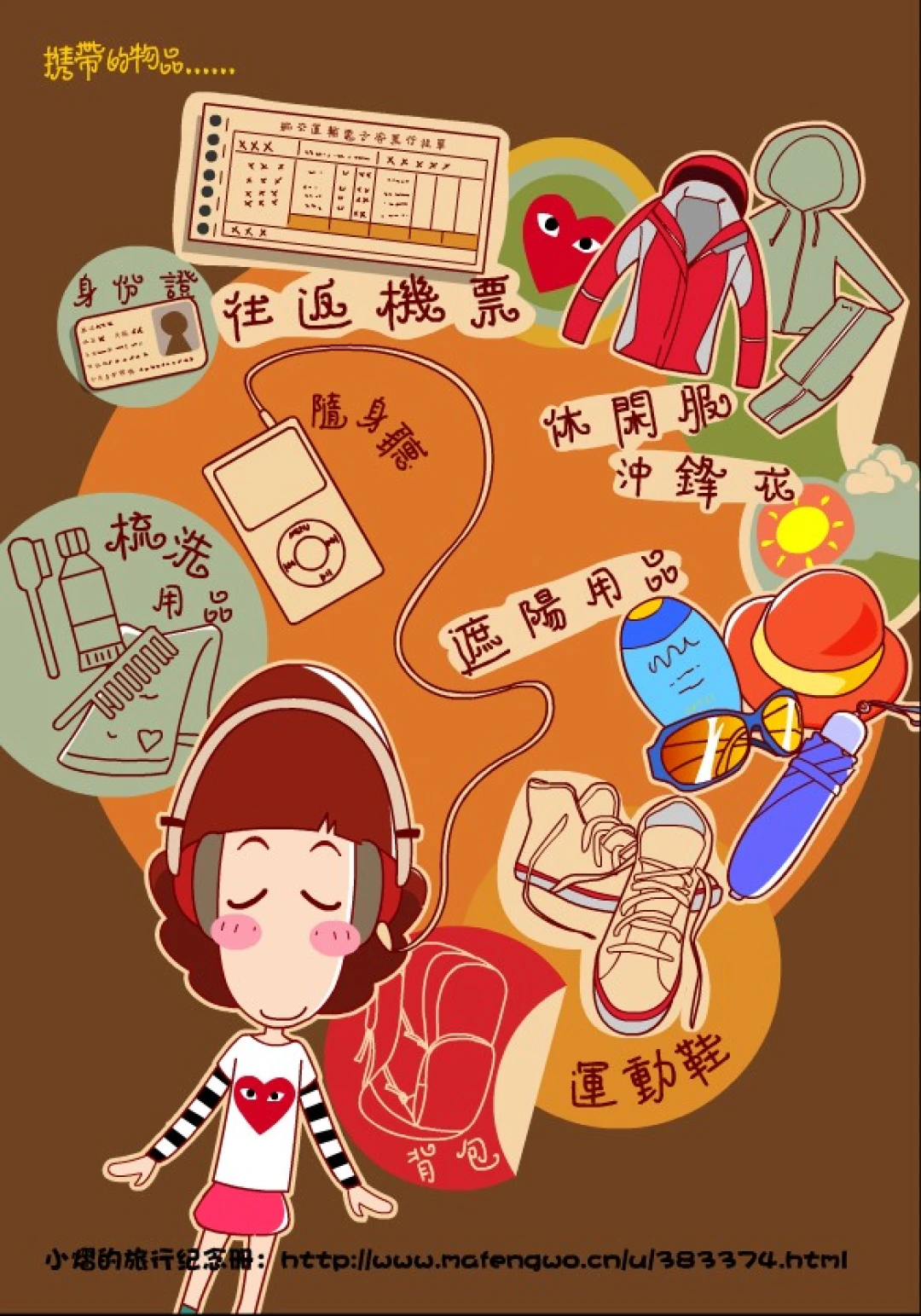
Dreamland – Lijiang: A Talking Comic Travel Guide
Dreamland – Lijiang: A Talking Comic Travel Guide Prologue: When Lijiang Takes Root in Your Heart Some places leave a mark on you forever. They're like an old song on repeat, suddenly playing in your mind on an ordinary afternoon. For me, Lijiang is that…
Continue reading...