14 Days Chasing Dreams in Yunnan | A Romantic Encounter Amidst "Wind, Flowers, Snow, and Moonlight"
14 Days Chasing Dreams in Yunnan | A Romantic Encounter Amidst "Wind, Flowers, Snow, and Moonlight"
From Kunming to Shangri-La, we spent half a month traversing Yunnan's most breathtaking landscapes
Foreword: Why Yunnan?
It's been nearly a year since that spontaneous Yunnan journey. Finally, I've overcome my procrastination and decided to put these memories into words.
What prompted me to write is simple—my camera roll is overflowing with photos I can't bear to delete. They're like candies, so sweet that I can't help but want to share them.
When it comes to Yunnan, everyone has their own labels. Some love its eternal spring-like weather and picturesque scenery; others complain about the rampant shopping tours and tricky tour guides... But regardless, it remains the top domestic destination for countless travelers. For independent travelers like us, most of those "pitfalls" can be avoided, leaving behind Yunnan's purest beauty.
This was my third time setting foot on this land. The first was at age 14, during the summer after elementary school graduation. The second was in my junior year of college, a whirlwind tour of the popular cities. This time, it was a 14-day long journey with George—his first time in Yunnan, so I packed in all the classic destinations. Although some places felt a bit "fatiguing" to me, since "we were already here anyway," why not accompany him through it all?
📸 A Few "Showstopper" Photos First
Too many photos to count, but let me pick a few favorites to whet your appetite.
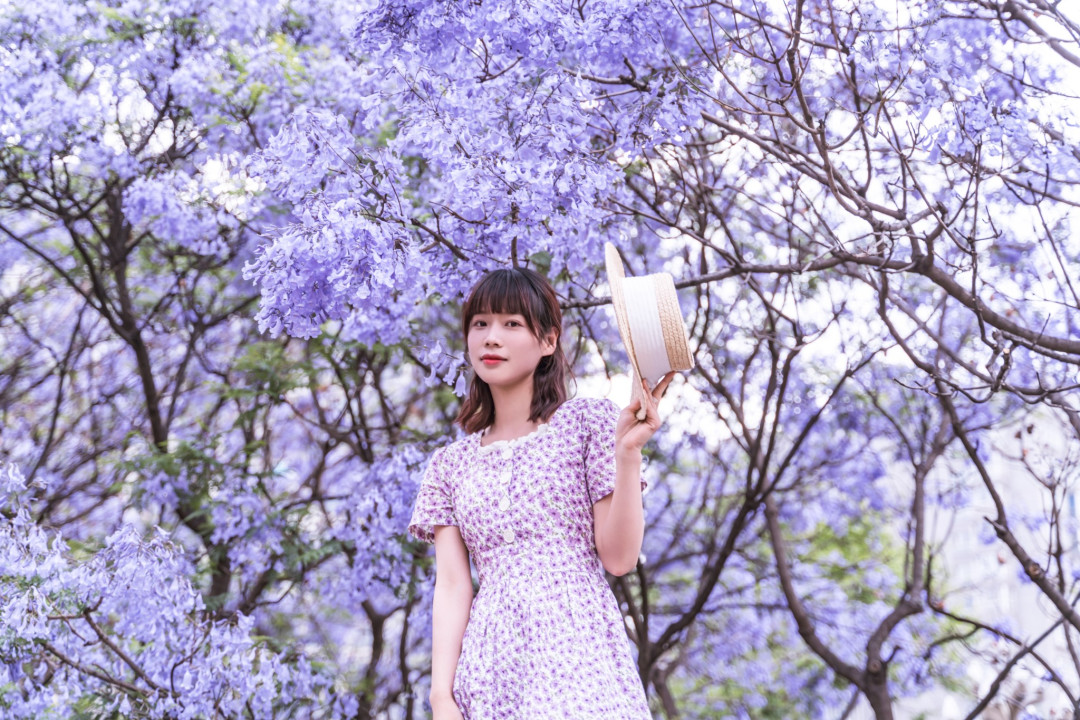
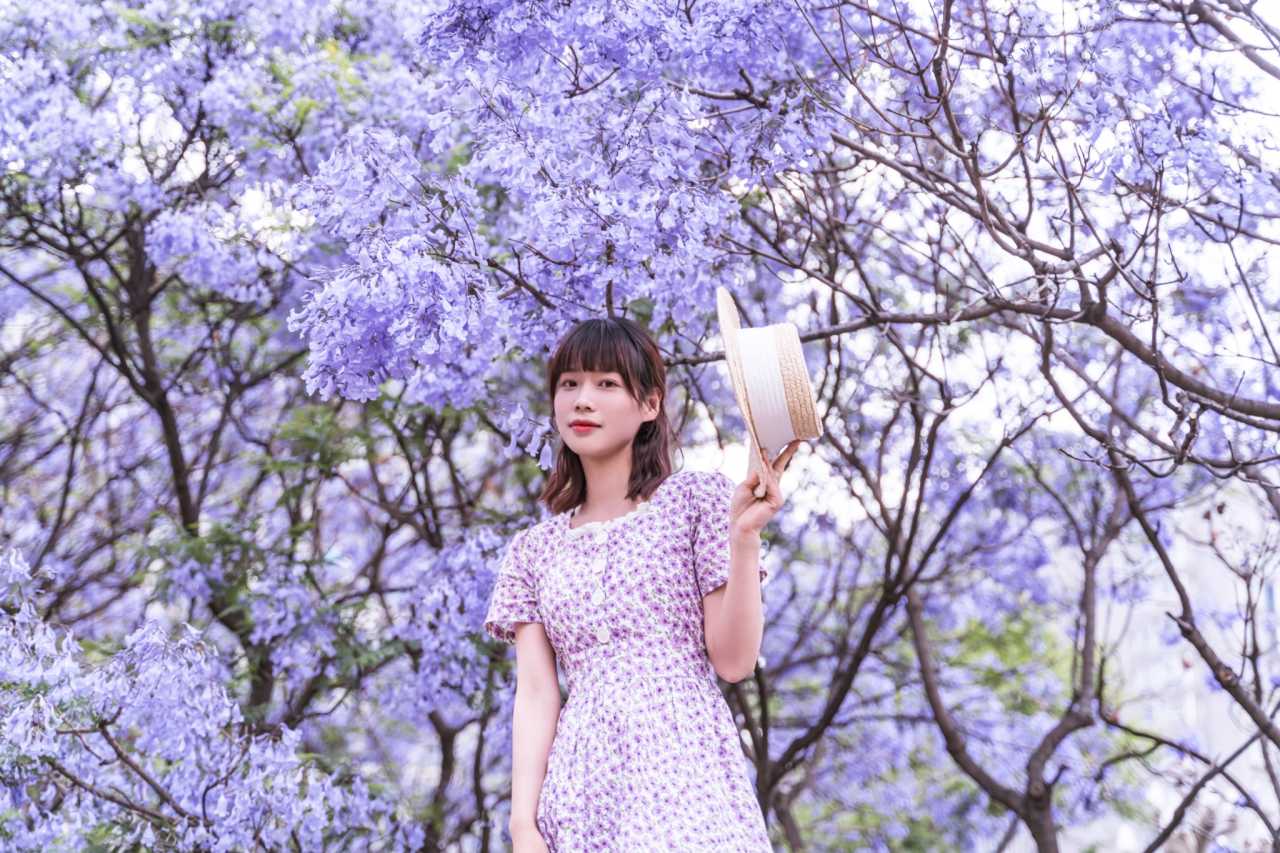
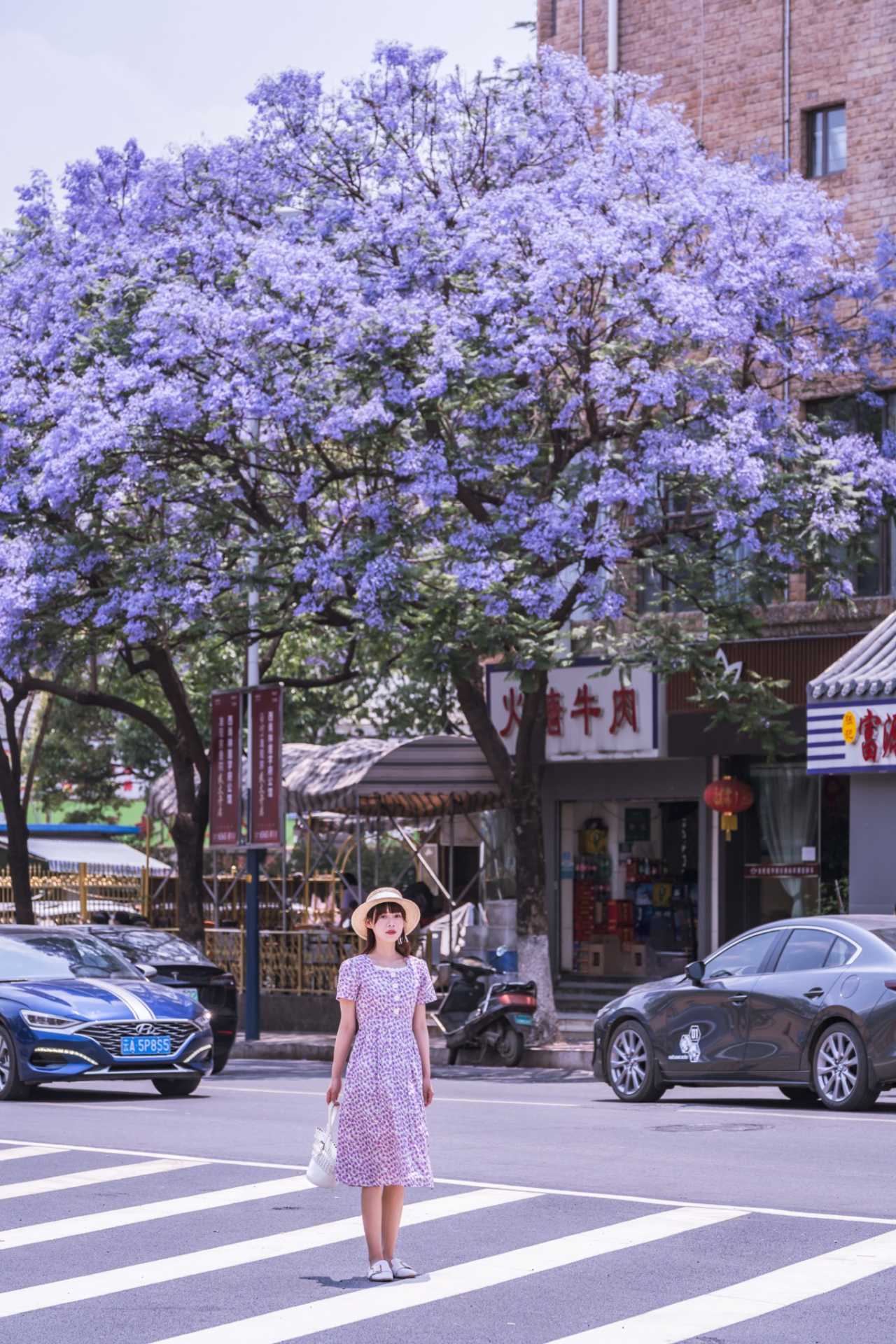
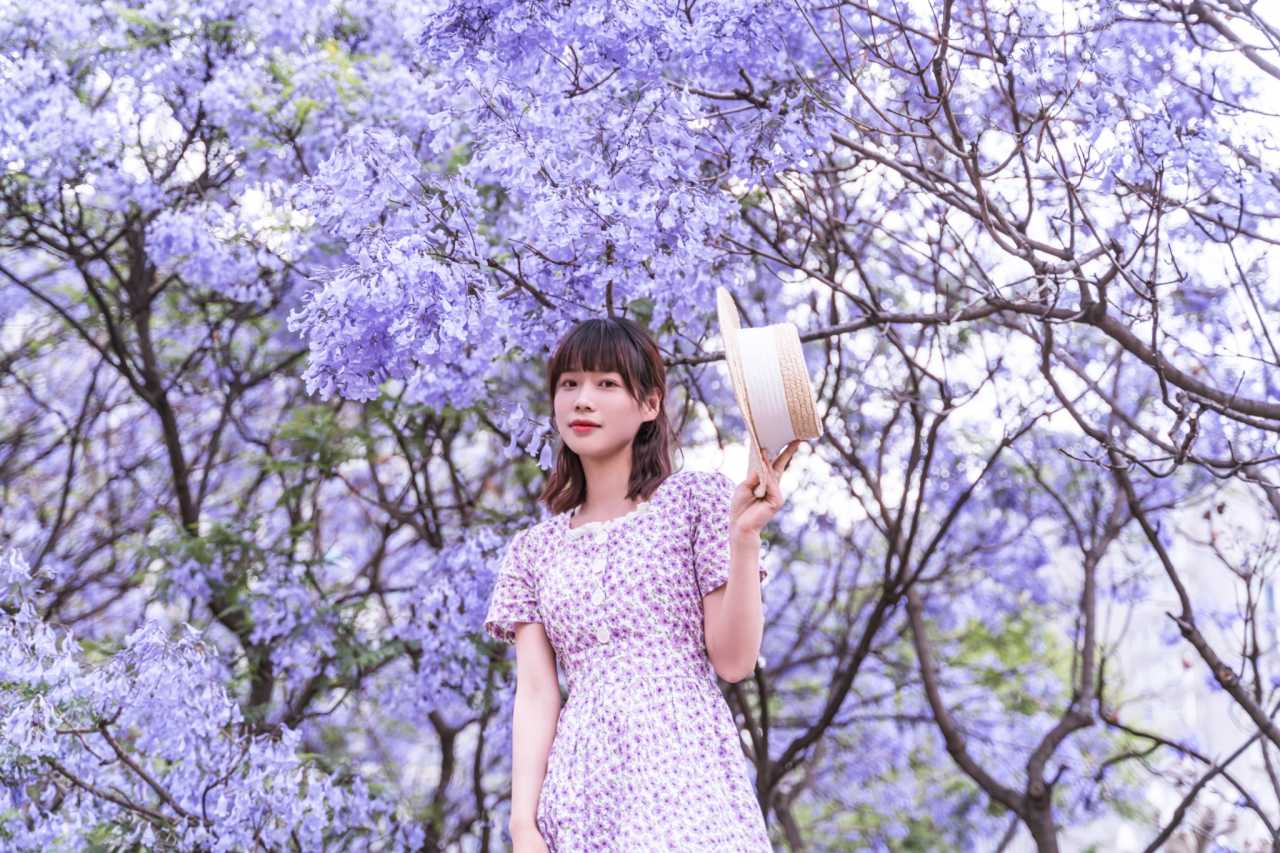
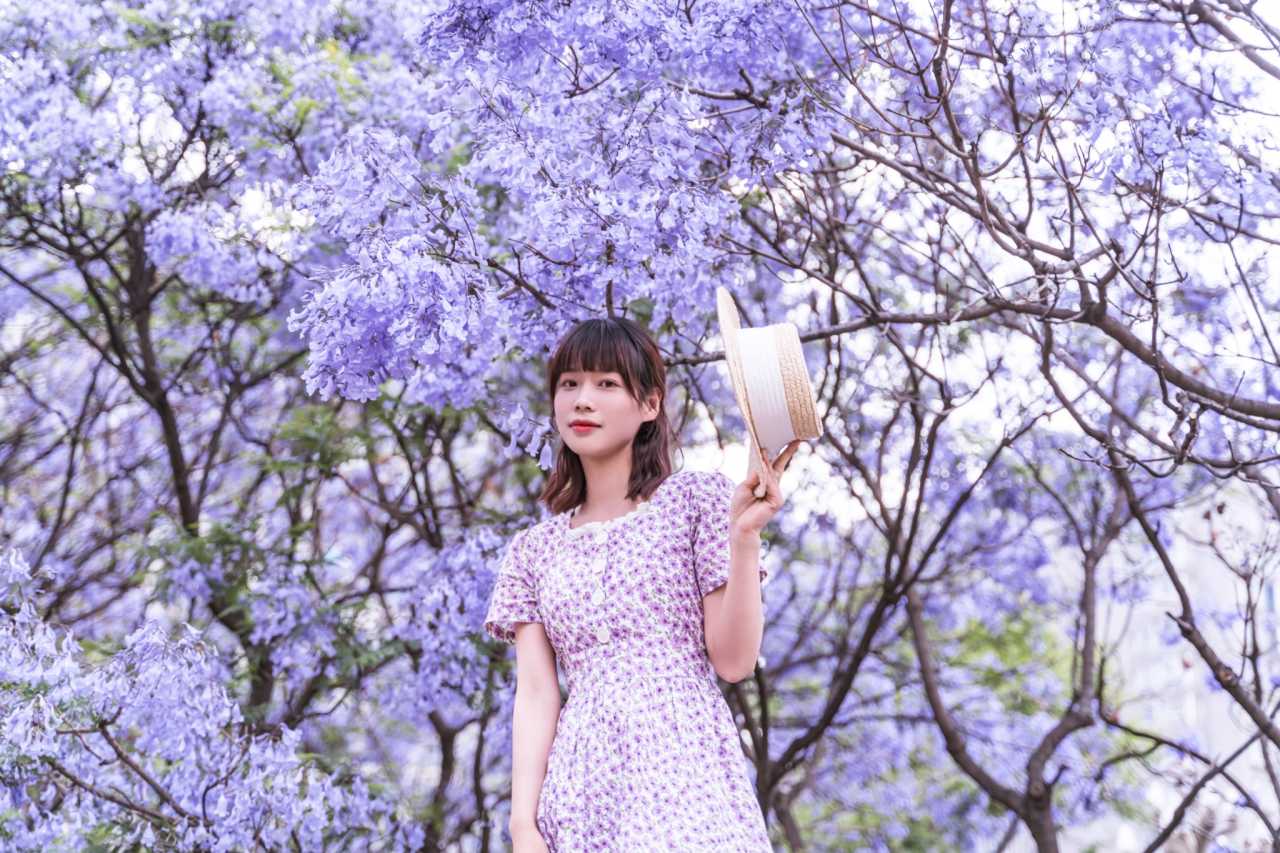
In early May, Kunming's jacaranda trees were in full bloom. We happened to catch this purple spectacle. Coincidentally, Pantone had just announced its 2022 Color of the Year—Very Peri, which is exactly the shade of jacaranda. That vibrant blue-purple felt like the courage we found after quitting our jobs and starting anew.
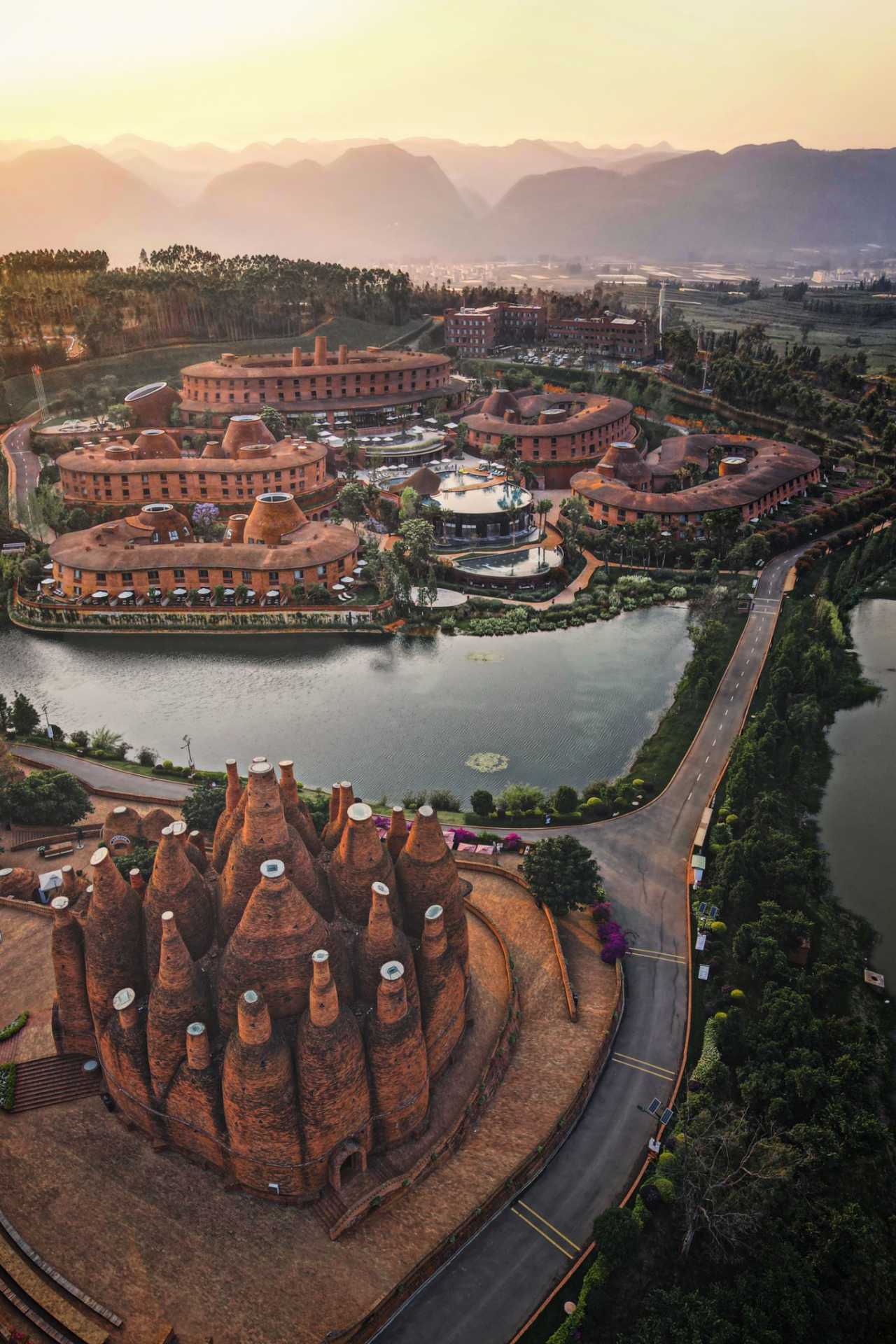
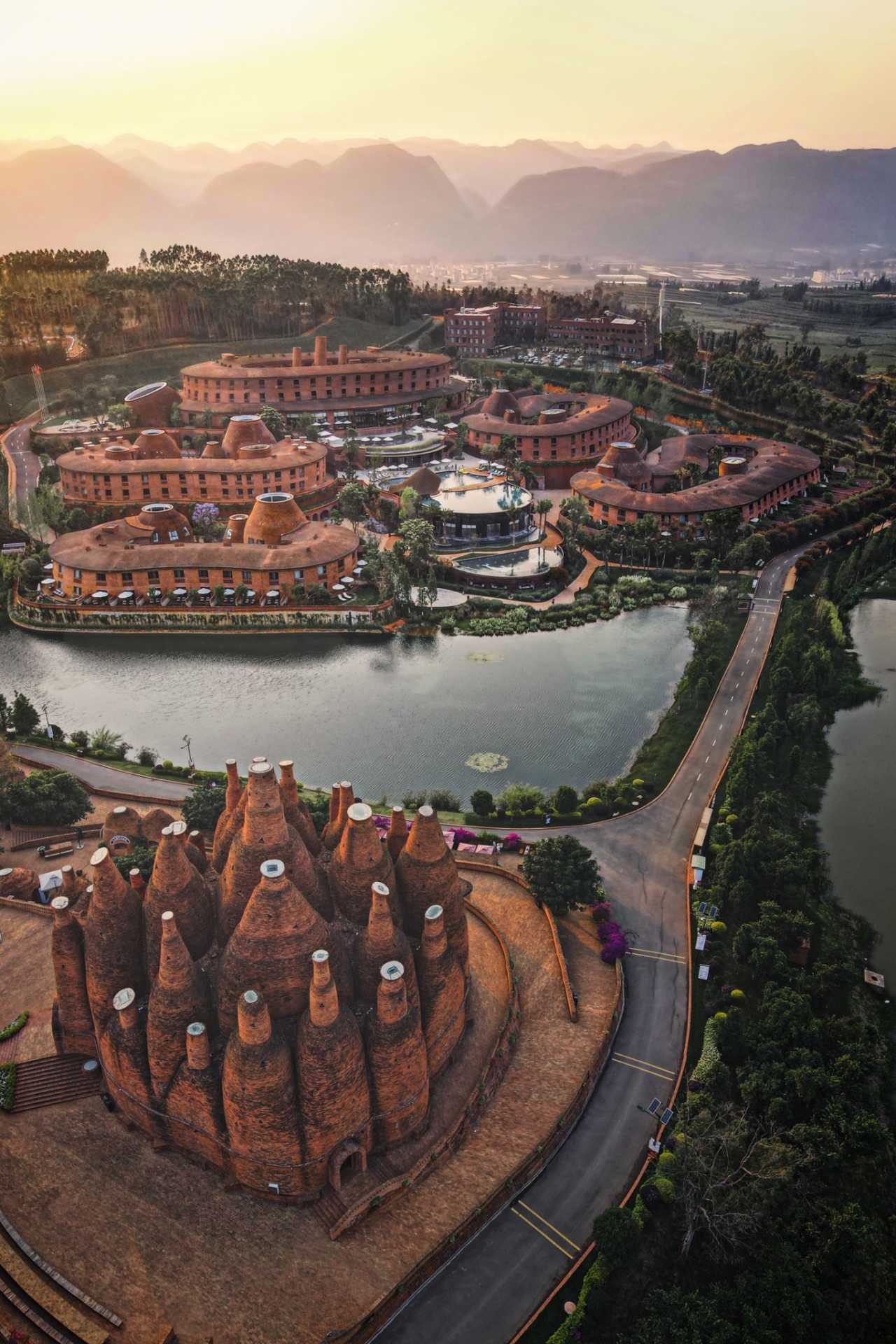
Mi Le's Dongfengyun (East Wind Rhyme) felt like a mysterious kingdom from the future. The kaleidoscope-like buildings made of red bricks shimmered in the sunset. Next to them, vast fields of purple verbena flowers created a romance that made you want to fall in love.
Yuxi's Modou Mountain was a hidden gem we stumbled upon by accident. Wind turbines dotting the hillsides, pink wildflowers, rolling mountain ranges... every frame looked like a movie scene.
Shangri-La's Balagezong held a touching story about a "road builder." Standing on the observation deck overlooking the grand canyon, the vastness and majesty could only be truly appreciated in person.
And then there was Lugu Lake's Lovers' Beach, with its pinkish-blue waters so unreal they seemed like a dream. Although the bareness of Lige Peninsula was disappointing, surprises always came when least expected.
We visited eight ancient towns in total, with Baisha and Shaxi being our favorites. They lacked the hustle and bustle of Dali and Lijiang, offering instead the tranquility beneath snowy mountains and the weathered charm of the Ancient Tea Horse Road.
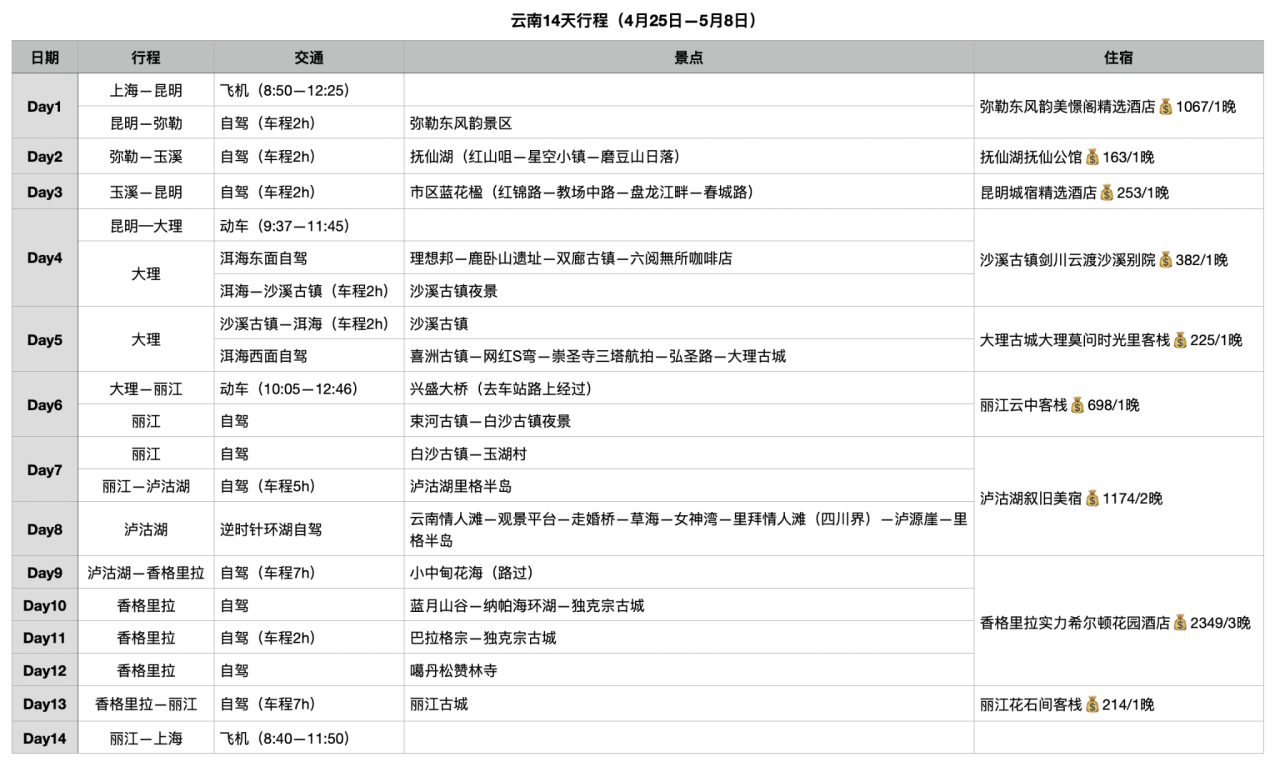
🗺️ Itinerary Overview: 14 Days, Our Route
With so many cities involved and high costs for returning rental cars at different locations, we opted for a combination of "high-speed rail + rental car." The trains between Kunming, Dali, and Lijiang were convenient, while other destinations required self-driving. I've heard that a train line now connects Lijiang to Shangri-La, making things much easier.
But honestly, I don't recommend visiting so many places at once. Yunnan's geography is vast, and each destination has its own best season. In late April and early May, Kunming's jacaranda is at its peak, but Shangri-La is still barren with no grass in sight. Lugu Lake is best for viewing water lilies from May to October, and seagulls from October to March the following year; Dali's Erhai Lake also has seagulls from November to March, while Xizhou's wheat waves depend on the harvest season.
My advice: Choose 3-5 days per trip, go to the right place at the right time, and you'll see Yunnan at its most beautiful.
Day 1: Shanghai → Kunming → Mile | Stumbling into a Mysterious Kingdom
After landing in Kunming, we picked up our car and headed straight for Mile. This small city in the Honghe Hani and Yi Autonomous Prefecture is about a 2-hour drive from Kunming. When people hear "Mile," most think of the laughing Maitreya Buddha, but what drew me here was the city's whimsical architecture.
Dongfengyun (East Wind Rhyme) | The Light and Shadow Magic of a Kaleidoscope
We arrived at Mile Dongfengyun at 3 PM, dropped off our luggage, and eagerly set out to explore the scenic area. The centerpiece is the Kaleidoscope Art Museum—supported by 31 pillars, with reinforced concrete below the arches and bricks above relying solely on friction to form arches spanning up to 36 meters. The interior blends Western domes with Chinese kiln aesthetics, embodying a postmodern style.
Why is it called a kaleidoscope? Because as the sunlight shifts, the light inside the building creates ever-changing patterns, just like a kaleidoscope. Unfortunately, the interior was closed when we visited, so we could only imagine the vibrant display.
But even the exterior was stunning enough. The architecture incorporates wine culture and Yi ethnic fire traditions, shaped like wine bottles, with red bricks glowing like flames in the sun. Walking around it, taking photos from different angles, every shot looked like a work of art.
Surrounding bougainvillea flowers bloomed with wild abandon, complementing the red brick structures perfectly. As a girl, I can't resist flowers—I dove into the bushes and spent ages taking pictures.
Before sunset, we made it to the verbena flower fields. From April to October, Dongfengyun is called the "Provence of Central Yunnan." Six hundred acres of purple flowers swayed in waves with the breeze. The setting sun cast a soft, pinkish glow over the field; as twilight deepened, it turned into a dreamy, deep blue-purple, like an oil painting.
A railway track runs through the fields, inscribed with "I love you" in various languages—a unique touch. But a word of caution: don't step into the flower beds and damage the plants. Standing on the bricks at the edge with flowers as your foreground works just as well for photos.
Dongfengyun Guide: - Tickets: 60 RMB for adults, 20 RMB for the sightseeing car - Staying at the Meijingge Hotel grants free admission - Opening hours: 8:00 AM – 6:00 PM
Day 2: Mile → Yuxi | From Red Brick Castle to Pink Beach
Meijingge | Living Inside the Scenery
We had dinner at the hotel—a 288 RMB set meal for two that was generous and delicious, especially the dessert with peach gum, so good I wanted to take it to go.
The next morning, we spent time taking photos around the hotel. The red brick architecture matched Dongfengyun's style seamlessly. The central courtyard's pillars, though we joked they looked like giant chimneys, had a pleasing symmetry. The infinity pool was a prime photo spot, though it was too cold to swim. From the pool, you could see the kaleidoscope building, with its reflection creating a beautiful scene.
A bowl-shaped structure at the hotel entrance echoed when you spoke inside—it was breathtaking the first time we walked in. This was the most expensive hotel on our trip, over 1000 RMB a night, but also the most beautiful.
Hongshanzui | Pink or Orange?
From Mile, we drove to Yuxi's Fuxian Lake, with our first stop being Hongshanzui Pink Beach. This spot is controversial—many say it's not pink at all, leaning more toward red-orange. But anyone familiar with photography knows that light changes color. Fuxian Lake itself is beautiful, and Hongshanzui is a free, wild attraction—why criticize its imperfections when you can just play in the water and walk on the sand?
From a drone's perspective, the blue lake, red sand, and green vegetation created rich layers of color. Up close, the sand had small particles but lots of impurities, and under good sunlight, it did have a pinkish tint.
Hongshanzui Guide: - Free admission - Navigate to "Hongshanzui" and park by the roadside
Starry Sky Town | A Nordic-Style Sales Office?
We grabbed lunch at a roadside restaurant, then headed to Fuxian Lake's Starry Sky Town. It's actually a sales office—after registering, tell the staff you want to go to the Cliffside Park, and they'll arrange a ride. You can visit even if you're not interested in the properties.
The Cliffside Park is built along the lake, with pure sky and water as its backdrop, attracting many wedding photo shoots. Everywhere you looked, it screamed Nordic style—green plants, white walls, grassy fields, and azure lake water. It was indeed a scenic spot.
Starry Sky Town Guide: - Free admission - Check opening hours with the front desk
Modou Mountain | Giant Wind Turbines and a Pink Sunset
Before sunset, we drove to Modou Mountain, one of my favorite spots on this trip.
Jiangchuan and Huaning counties are divided by Modou Mountain—one side is a land of fish and rice, the other wild mountain scenery. We came to see the giant wind turbines. Driving to the top, we overlooked Fuxian Lake, with rolling hills, flowers, and grasslands—every shot was an Instagram-worthy masterpiece.
There were almost no other cars on the road up, with red soil on both sides, similar to the pink beach. Each turbine had a number; I recommend heading to the top ones, numbers 1108-1110. The summit had platforms and boardwalks with great views. Sheep grazed on the grass, making it feel like a natural farm.
I brought a picnic blanket and spread it on the ground, instantly creating a vacation vibe. The wind was strong at the top, so remember to dress warmly. By the time we descended, it was completely dark with no light—we had to drive carefully.
Day 3: Kunming | Chasing the Purple Spectacle of Jacaranda

We made a last-minute stop in Kunming after seeing that the jacaranda trees were in bloom. From late April to early May is peak season, and we were right on time.
Kunming has several jacaranda viewing spots, each with its own charm. But many guides only list street names, which led us astray a few times. Here's my detailed version:
Hongjin Road | Jacaranda at a Residential Entrance
Our first stop was Hongjin Road, which was the least impressive. A row of jacaranda trees at the entrance of a residential complex was too tall for good people shots. The only nice sight was flowers falling on car roofs, which looked quite artistic.
Navigate to: Hongjin Road, Hetangyuese Residential Area; parking 5 RMB/hour
Jiaochang Middle Road | The Famous Street Lives Up to Its Name
We quickly moved on to Jiaochang Middle Road—and it didn't disappoint! Both sides of the street were lined with blooming jacaranda. A slight upward angle gave you a background full of flowers. It was also great for drone shots, with the purple canopy weaving through the buildings.
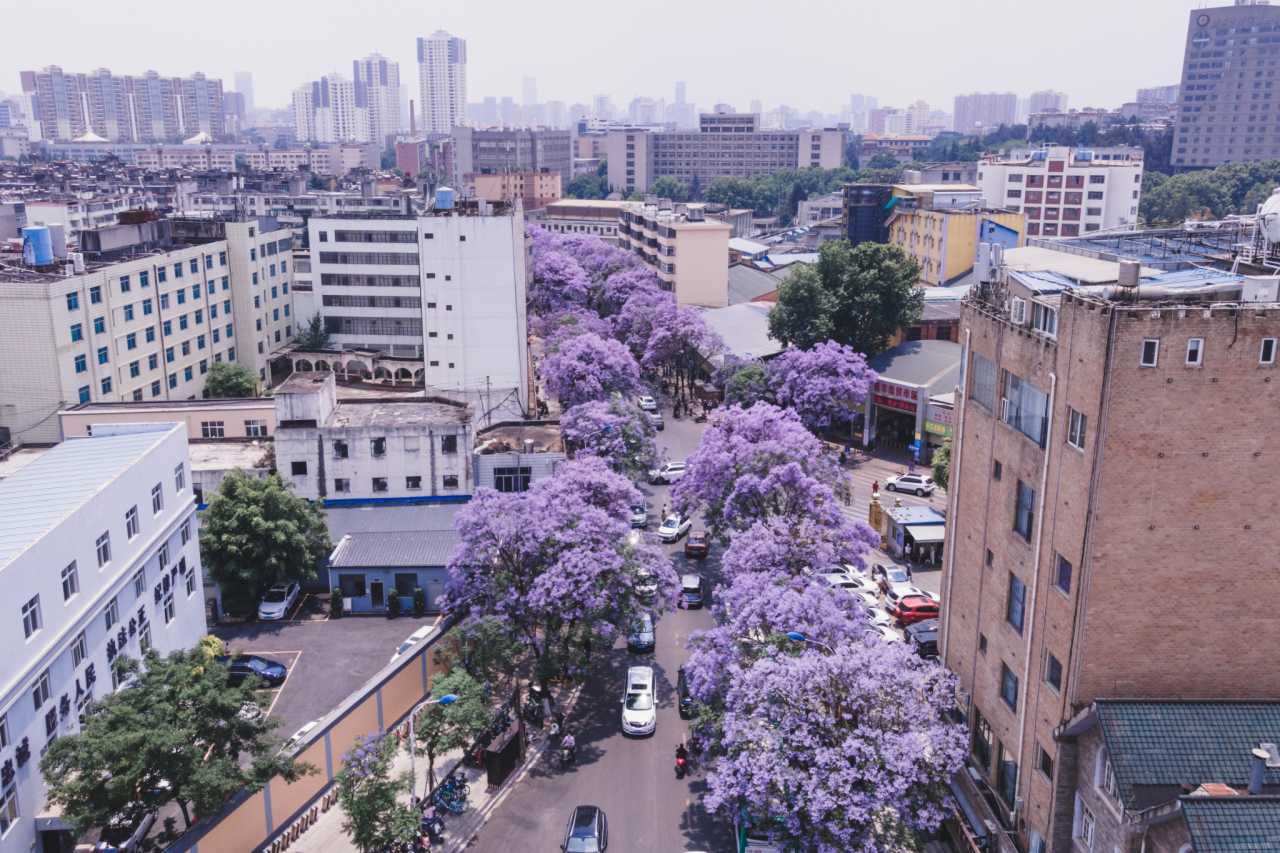
What struck me most was how fashionable the local aunties were! They dressed trendier than many young girls and knew how to pose.
The best spot was at the three-way intersection near Jiaochang Middle Road Kindergarten, where there's a car-free area to stand. A nearby photography shop had set up steps; if you can't shoot yourself, you can pay them. Street vendors also sold jacaranda ice cream for 10 RMB each.
Navigate to: Jiaochang Middle Road Kindergarten; parking 5 RMB/hour
Panlong River Bank | Jacaranda by the Riverside
The third spot was also lovely. The riverside setting offered a different vibe—jacaranda trees growing in a more natural environment. A large tree stood beside a railway track; photographers stood on the bridge while models posed by the river. An abandoned railway track nearby was also great for photos.
Navigate to: No. 18, Lijiang Road, Wuhua District (Jiang'an Xiaoqu Yuejiangli)
Chuncheng Road | Sitting on a Wall for Photos
The last stop was Chuncheng Road. Unlike other spots where you could only stand under the trees, there was a low wall here where you could sit and get closer to the flowers. But be careful—only a small section had low-hanging blooms, so you might have to queue for photos. The downside was the presence of many amateur photographers with big lenses; I'd advise girls not to wear short skirts.
Navigate to: Tailong Hongrui Hotel; parking 4 RMB/hour
Day 4: Kunming → Dali | "Wind, Flowers, Snow, and Moonlight" by Erhai Lake
In the morning, we took the high-speed train to Dali. After arriving, we picked up our rental car and had a Dai ethnic specialty lunch nearby—it was delicious.
We continued our self-driving tour around Erhai Lake. Today, we explored the eastern shore, heading to Shaxi Ancient Town in the evening. Renting a convertible is popular around Erhai, costing a few hundred a day, but I found the road conditions and air quality mediocre—not quite the romantic sunset drive I'd imagined.
Like many, I was full of anticipation on my first visit to Dali. "Wind from Xiaguan, flowers from Shangguan, snow on Cangshan Mountain, moonlight over Erhai Lake"—nature's craftsmanship had created a stunning landscape of snow-capped mountains, blue waters, and fields. But this time, I was quite disappointed—probably worn out by the Instagram-worthy spots and resistant to the commercialization.
But Erhai Lake itself is still beautiful. My advice: find a nice guesthouse, sit back in a chair, feel the lake breeze, watch the blue sky and white clouds, and enjoy a more relaxed vacation.
Lixiangbang | "Little Greece by Erhai"
Our first stop was Lixiangbang, also known as "Erhai's Santorini." It's actually a hotel complex that attracts visitors because of its photogenic architecture. But it's just a few blue houses—definitely not worth a special trip. Too many tourists, too many stairs to climb. Unless you're staying there, with access to shuttle buses and quieter photo times.
The idealized photos look beautiful, but in reality, the steps are packed with people, and you'd have to Photoshop them out later. We gave up immediately.
The Lonely Tree | Poetic Cliffs
Next was a wild spot. Near the Tinghuatang Seaview Garden Guesthouse, we found a lonely tree. Sitting on its trunk felt like floating above Erhai Lake, with a sense of solitary beauty. On clear days, the lake was so transparent that a single tree or rock became a scenic highlight.
Luwo Mountain | "Shipwreck Cove" and a Broken Wall
Luwo Mountain Ruins, also known as Lovers' Cliff, resembles a bay area. It's quite hidden as you descend. The best photo time is after 4 PM, and with luck, you might catch "Jesus light" streaming through. There are caves on both sides—the left one is better, where you can stand on rocks in the water.
Another photo spot is a broken wall that frames the scenery and people like a picture frame. There's also a large tree with leaves almost touching the water.
Shuanglang Ancient Town | Bai Ethnic Heritage
Shuanglang has a long history, preserving a complete Ming and Qing dynasty historical and cultural district. But it's quite commercialized now—I've visited several times without exploring much.
Shuanglang Guide: Free, open all day
Liuyue Wusuo | A Seaview Coffee Shop
We came to Shuanglang for this seaview coffee shop. It had an adorable British Shorthair cat that wasn't afraid of people. By the lake, they'd set up a Turkish-style photo spot, and we leisurely waited for the sunset.
Shaxi Ancient Town | Moonlight Serenity
After watching the sunset, we drove to Shaxi Ancient Town. Although it belongs to Dali, it's far from Erhai Lake, with winding mountain roads. Driving at night, it took us over two hours to get there. After checking into our guesthouse, we went out looking for dinner, but all the restaurants were closed. We ended up buying instant noodles and eating in our room.
But the long drive and missed dinner didn't dampen our love for Shaxi. Walking on the small paths at night under a sky full of stars, the silence broken only by insects and birds, it felt like a hidden paradise. "I want to live here forever"—that's the feeling it gave us.
Day 5: Dali | Time's Imprint on the Ancient Tea Horse Road
In the morning, I took a photo at the tea table in the guesthouse courtyard. We had to return to Erhai in the afternoon, so our time in Shaxi was limited. After breakfast, we couldn't wait to see what it looked like in daylight.
Shaxi Ancient Town | The Only Surviving Market on the Tea Horse Road
Shaxi's history dates back to the Spring and Autumn and Warring States periods, making it one of Yunnan's bronze culture birthplaces. After the Tang Dynasty, nearby salt wells turned it into the "Salt Capital" of the Tea Horse Road. Caravans passed through here for a thousand years, and today, the United Nations has recognized it as "the only surviving market on the Ancient Tea Horse Road."
In the ancient town, horse hoof prints are still visible on the stone slabs, as if time has stood still. There's no noise like Lijiang, no glitz like Dali—just the most authentic ancient town life. We strolled along the bluestone paths, admired the old houses, soaked up the sun, and drank coffee. Time seemed to slow down.
Final Thoughts: Yunnan Is Worth Visiting Again and Again
Over 14 days, we traveled through Kunming, Mile, Yuxi, Dali, Lijiang, Lugu Lake, and Shangri-La. We witnessed the purple romance of jacaranda, heard the light-and-shadow stories of the kaleidoscope, felt the breeze of Erhai Lake, and walked the stone paths of the Ancient Tea Horse Road.
Yunnan's beauty isn't about seeing everything at once—it's about discovering something new every time you go. This time, I saw the jacaranda in full bloom; next time, I want to see Lugu Lake's water lilies. I missed Xizhou's wheat waves this trip; next time, I'll go at the right season.
If you're planning a trip to Yunnan, remember: choose the right time, choose the right place, and take it slow. The most beautiful scenery often appears when you least expect it.
Finally, a few practical tips: 1. Transportation: High-speed rail between cities, then rent a car for local travel—most convenient 2. Time: Don't try to cover too many places at once; 3-5 days is ideal 3. Season: Kunming jacaranda in April-May, Lugu Lake water lilies May-October, seagulls October-March 4. Accommodation: For great views, stay at scenic-area hotels 5. Mindset: Don't let Instagram spots dictate your experience; slow down to discover true beauty
Yunnan, see you next time.
You should also read:

God’s Abandoned Palette: A Self-Drive Journey Through Yunnan’s Dongchuan Red Land
God’s Abandoned Palette: A Self-Drive Journey Through Yunnan’s Dongchuan Red Land Travel has never been about reaching some distant geographic coordinate. It’s about encountering, along the way, the version of yourself buried beneath the rubble of daily routine. During this May Day holiday, I finally…
Continue reading...
Cloud Travelogue · Dali of Wind, Flowers, Snow, and Moon: A Three-Day, Two-Night Journey of a Free Spirit
Cloud Travelogue · Dali of Wind, Flowers, Snow, and Moon: A Three-Day, Two-Night Journey of a Free Spirit I am a cultured female foodie with a touch of rogue charm. I slung on my backpack, took my lover's hand, and set off on a spontaneous…
Continue reading...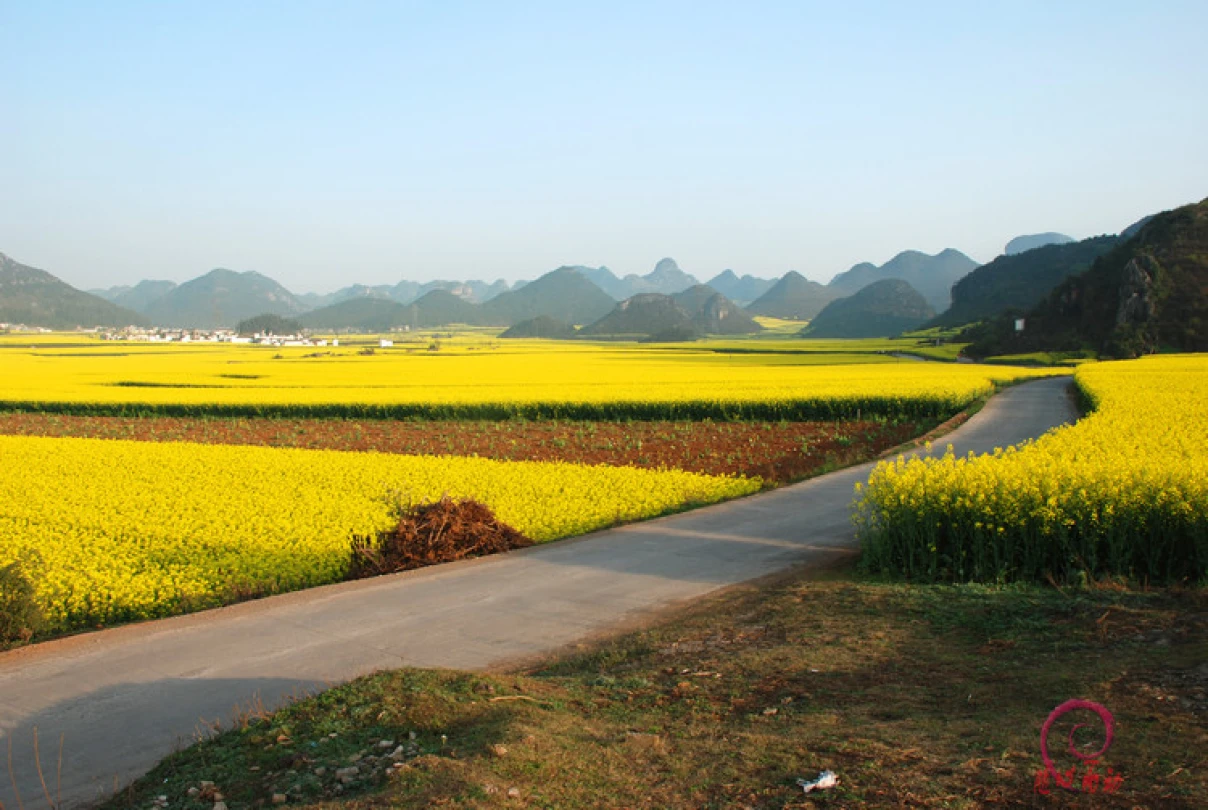
Golden Luoping: A Romantic Encounter with Sunshine and Seas of Flowers
Golden Luoping: A Romantic Encounter with Sunshine and Seas of Flowers Introduction: The Third Time's the Charm Some landscapes are destined to be seen at the right moment. For me, that was exactly the case with Luoping's rapeseed flowers. On February 22, 2011, the Luoping…
Continue reading...