God’s Abandoned Palette: A Self-Drive Journey Through Yunnan’s Dongchuan Red Land

God’s Abandoned Palette: A Self-Drive Journey Through Yunnan’s Dongchuan Red Land
Travel has never been about reaching some distant geographic coordinate. It’s about encountering, along the way, the version of yourself buried beneath the rubble of daily routine.
During this May Day holiday, I finally drove toward a land I had heard so much about yet never visited—Dongchuan’s Red Land. To my shame, this wonder, hailed by photography enthusiasts as “paradise,” lies a mere 250 kilometers from Kunming. Yet I had put it off, excuse after excuse. Some people dismiss it as “just farmland on the mountain.” Others say, “It’s right under your nose—you can go anytime.” But when I finally stood on that soil, I realized every delay was a betrayal.
As our wheels rolled over winding mountain roads, my eyes were met with vast expanses of red, green, yellow, white, and purple—like an overturned paint box stretching from my feet to the horizon. In that moment, every doubt about whether it was “worth it” crumbled, leaving only the rawest, most primal awe rising from the depths of my heart. That evening, we checked into a small mountain village called Huashitou (Flower Stone). On the wall hung a saying: “God’s abandoned palette on Earth.” Cheesy as it was, it was too precise to argue with. So I borrowed that line as the opening of this travelogue.
Departure: The Winding Road from Kunming to the Red Land
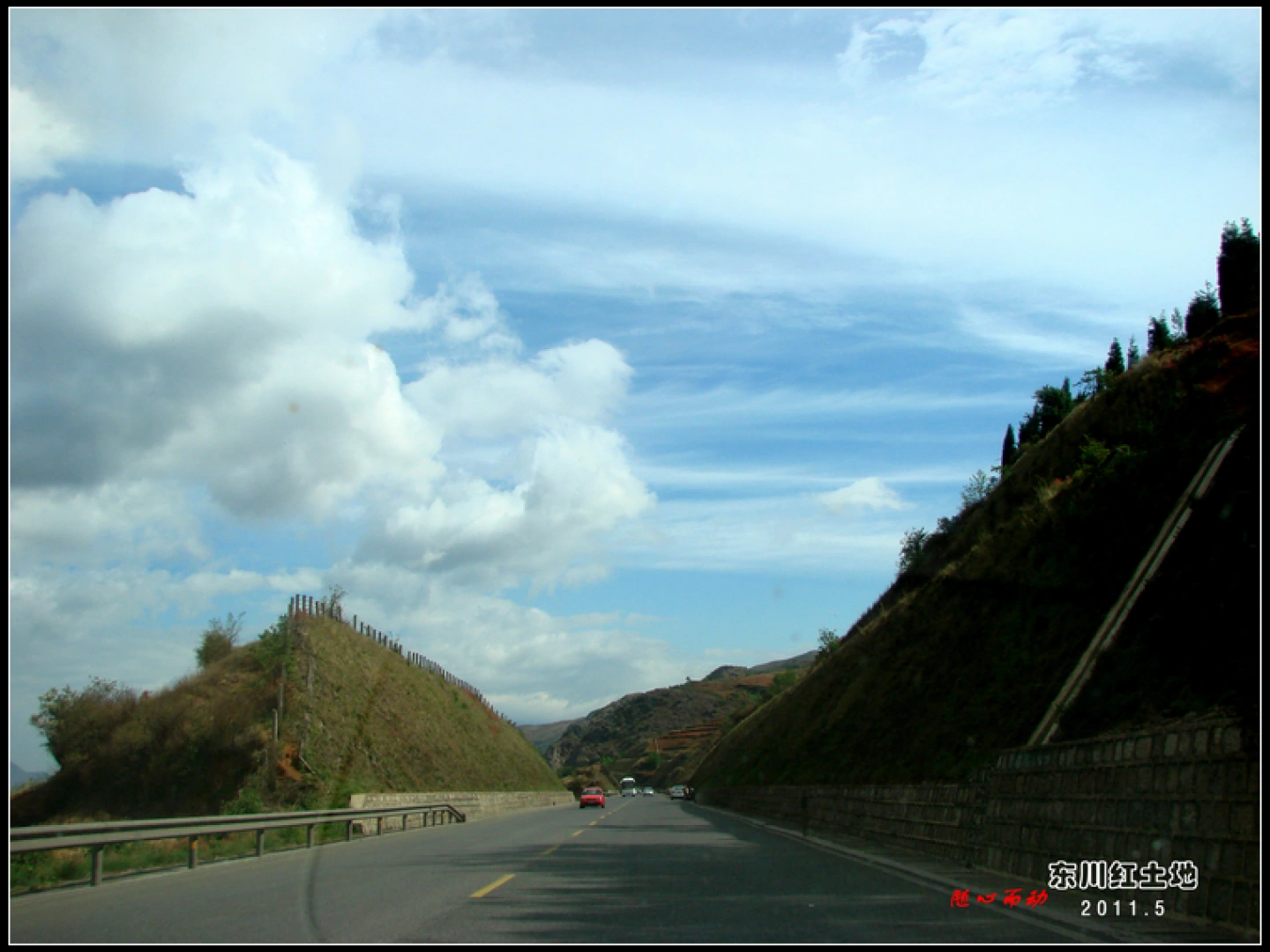
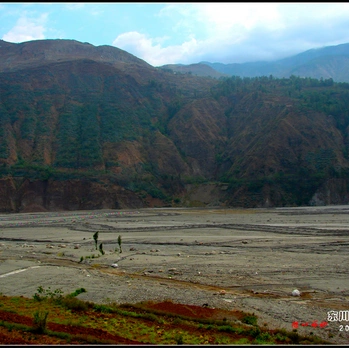
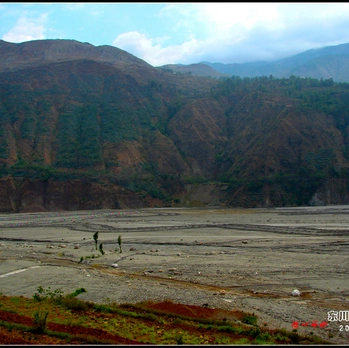
April 30, 2011. The first day of the holiday. A cloudless sky. At 8:30 a.m., we set off from Kunming, heading east along the Kunming-Qujing expressway, then onto the Songming-Daibu highway. After exiting at Longtan, we entered the Longdong Highway—a road that snakes along the Xiaojiang River valley, flanked by the stark, unsettling remains of mudslides.
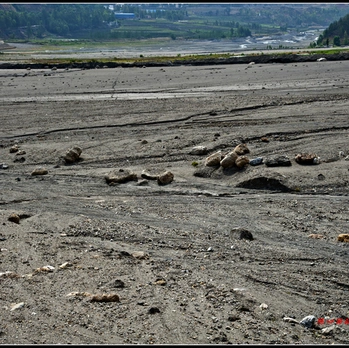
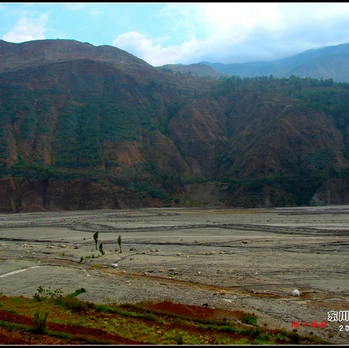
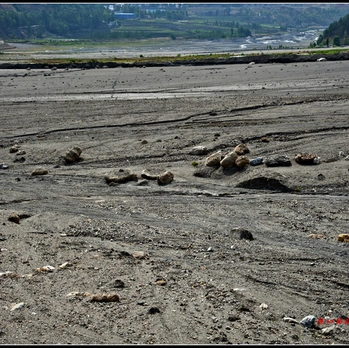
Dongchuan is famous for its mudslides, and that’s no exaggeration. The rock formations on both sides of the Xiaojiang River are loose, the vegetation sparse. During the rainy season, mudslides charge down like unbridled horses, carrying boulders and broken trees in their wake. But it is precisely this extreme ecological imbalance that has forged a rugged, raw natural landscape. To farm, locals have built dam-like embankments in the valley, waging a stubborn battle against nature.
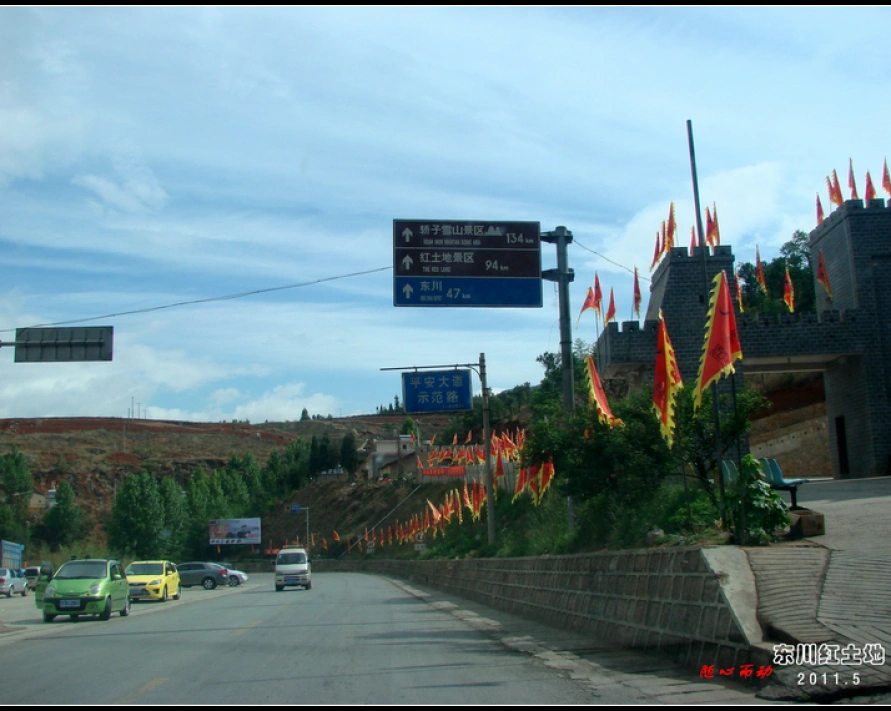
We didn’t enter Dongchuan city center. Instead, we turned directly onto the county road from Xincun to Yangjiawan and began our ascent into the mountains. Around the 24-kilometer mark on the “Xinyang Line,” we officially entered the Red Land scenic area. Over the next twenty to thirty kilometers, roughly ten viewpoints are scattered. They include: the “Red Earth Terraces” and “Mudslide Great Bend” at Shuipingzi; the “Sunset Gorge” at Songmaopeng Dongguagou; the “Red Land Panorama” and “Old Dragon Tree” at Huagou; and the “Splendid Garden,” “Rainbow Slope,” “Damakan,” “Music Score Hollow,” and “Tile House Ridge” around the T-junction of Huashitou Village.
This area, spanning a hundred square kilometers, concentrates the most typical, enchanting, and poetic colors, lines, and light of Yunnan’s red soil plateau. It is not only a holy land for photographers but an irresistible temptation for anyone who yearns for beauty.
Setting Up Camp: A Warm Night in Huashitou Village
We drove slowly, stopping to admire the scenery and take photos. Around 2:30 p.m., we arrived at Huashitou Village. This is the heart of the entire scenic area—almost every viewpoint lies within ten to twenty kilometers, making travel extremely convenient.

We randomly chose a farmhouse inn called “Shanlihong Jiujia” (Mountain Red Wine House). The owner, Mr. Zhang, was a warm-hearted man. When he heard we wanted to take photos, he immediately drew a hand-drawn route map and gave us a scientifically planned schedule: go to “Splendid Garden” and “Rainbow Slope” in the afternoon, arrive at “Sunset Gorge” before 4:30 p.m., then head to “Music Score Hollow” and “Tile House Ridge,” returning to the inn for dinner at 7:00 p.m.; the next morning, arrive at “Damakan” before 6:40 a.m. to watch the sunrise, and on the way back, stop to re-shoot any favorite spots.
As it turned out, this schedule was perfect. The timing and the light were just right. Of course, from a photography standpoint, different seasons, positions, and angles offer vastly different experiences. But generally speaking, the colors of the Red Land are slightly soft before 9:00 a.m., dry and harsh under the strong midday sun, and most moving from 3:00 p.m. onward into the evening. Locals say the Red Land is most vibrant after a rain shower clears up—though I missed that opportunity this time, I have no doubt it’s true.
Walking on the Palette: A Journey of Stunning Beauty and Deep Immersion
Red Earth Terraces: First Sight, Pure Shock
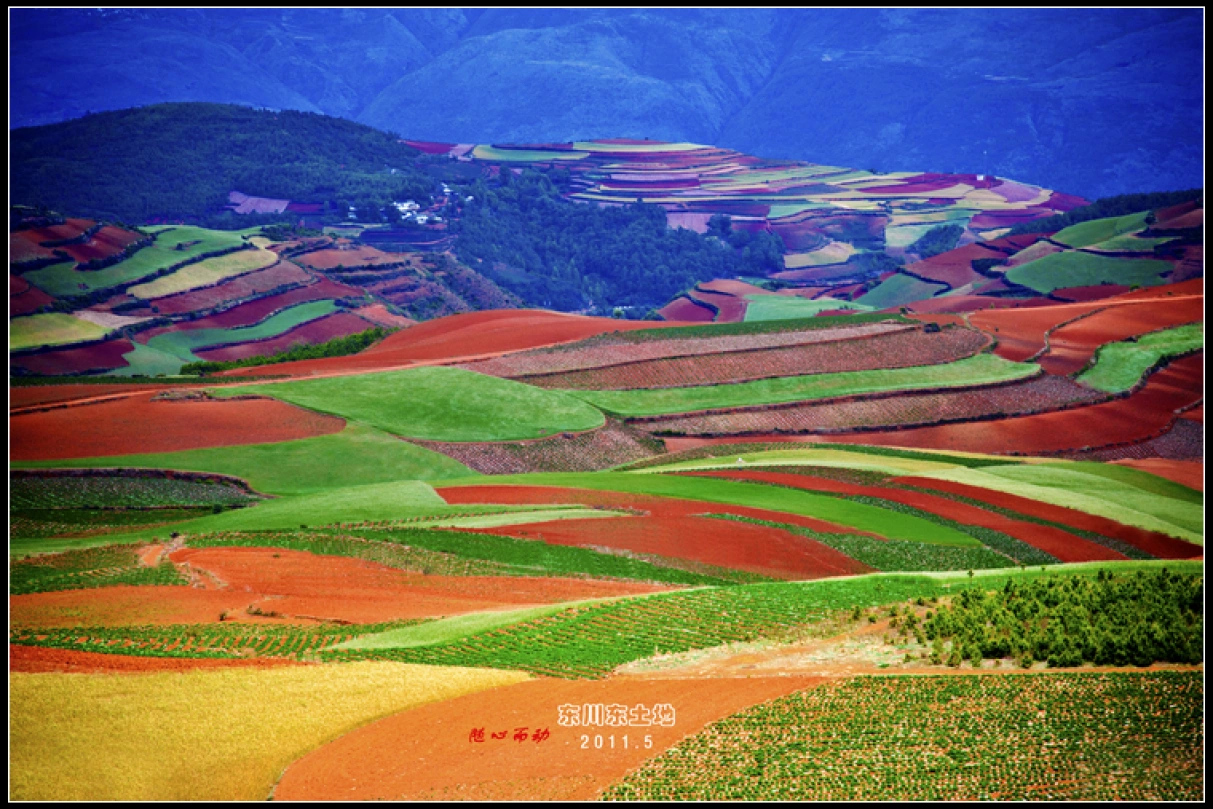
As we climbed the winding Xinyang Line, around the 24-kilometer mark, the first vista to burst into view was the “Red Earth Terraces.” On the opposite side of the gorge, the entire mountain—from base to summit—had been carved into layer upon layer of terraced fields. The lines rose and fell with the mountain’s contours, natural and effortless. Deep in the mountains, villages nestled among green clusters dotted the landscape, telling stories of people’s tenacious will to survive. Looking at those stacked curves, I couldn’t help but think of dinosaur fossils—an ancient, mysterious beauty.
Mudslide Great Bend: A Timeless Desolation
We pressed on, the road stretching out along a ridge. To the north lay the gorge of the Red Earth Terraces; to the south, a mudslide gorge. The mountain spine was etched with the marks of time, as if every gully told a story of billions of years of wind and rain. Standing at the cliff’s edge, the fierce mountain wind howled past. Even without a fear of heights, I couldn’t help but feel a pang of vertigo.
Red Land Panorama and Old Dragon Tree: Openness and Tranquility
After passing Songmaopeng Village, we reached Huagou. At an altitude of about 2,600 meters, this is a broad, open plateau. Rolling hills, wheat fields, and potato fields interwove into enormous blocks of color. The terrain was high and expansive, the horizon vast. I particularly loved this spot—on the return trip the next day, I made a point to stop again.
By the roadside, a photography enthusiast from Guangdong told me this was his third time shooting the Red Land. I lived so close, yet it was my first. I felt a flush of embarrassment. A little further on, a small path led to a solitary old dragon tree. Said to be over a thousand years old, it stood alone in the middle of the fields, like a guardian of the earth.
Splendid Garden and Rainbow Slope: The Earth’s Palette
Splendid Garden, just two or three kilometers from Huashitou Village, is a massive depression. A sightseeing boardwalk built along the mountainside offers an excellent vantage point, overlooking the entire Huashitou Village. Rainbow Slope, not far from Splendid Garden, is smaller in scale but richer in color. As the afternoon light slanted down, the crops in different plots reflected different hues, as if the earth itself were breathing.
Sunset Gorge: The Swan Song of Light and Shadow
At 4:20 p.m., we arrived at Sunset Gorge in Songmaopeng Dongguagou Village. As the name suggests, its most beautiful moment is at sunset. Because the landscape lies in a deep valley surrounded by mountains on three sides, sunlight departs early. The best viewing window is between 4:00 p.m. and 5:30 p.m.
As we entered the village, a few children were sent by adults to collect parking fees—five yuan per car, no cheating. Following a small path to the best shooting spot, we found that every corner of Dongguagou offered a fine view. When the last rays of the setting sun spilled over the red earth, the whole world seemed bathed in a golden halo.
Music Score Hollow and Tile House Ridge: Poetry in the Sunset
Music Score Hollow sits right by the roadside, its terrain strangely shaped—like a musical staff carved into the earth. At sunset, this place is at its most enchanting. Standing there, you could see Tile House Ridge in the distance.
Tile House Ridge gets its name from a small village perched high on the mountain. From here, you can look down on both the near and distant red lands. Interestingly, there was an old man in a sheepskin coat, carrying a long tobacco pipe, accompanied by his wife in Yi ethnic attire and his granddaughter. They posed against the red land backdrop for tourists to photograph. The old man was completely at ease, unfazed by the forest of camera lenses—clearly a “professional model.” Before leaving, we gave him a little money—after all, this too is a form of labor.
Damakan: The Frenzy of Sunrise
The next morning, we stumbled out of bed in the dark at 5:50 a.m., ready to head to Damakan for sunrise. But our car was blocked by other vehicles, and it took a while to free it. We arrived at Damakan close to 6:30 a.m. Dozens of cars were already parked along the roadside. We scrambled up a small hill, only to find the narrow viewing boardwalk packed to capacity—no good shooting spots left.
At 6:40 a.m., the sun finally peeked its red face from behind the thick clouds atop the Wumeng Mountains. Instantly, the sound of shutters filled the air. Though I didn’t capture the ideal “sunlit red land,” watching those “fanatics” wrapped in inn quilts to watch the sunrise made me laugh—this, after all, is the charm of travel, isn’t it?
The Return: From Red Land to the Bronze Capital of the South
Back at the inn, we had breakfast and then retraced our route. We drove slowly, stopping again to re-shoot some favorite spots. Around 11:20 a.m., we arrived in Dongchuan city center.
Dongchuan, historically known as the “Bronze Capital of the South,” has a history of over 2,100 years, dating back to the establishment of Tanglang County in 135 BC during the Western Han Dynasty. It once boasted rich copper deposits, nurturing a millennium-old bronze civilization. Today, copper resources are nearly exhausted. In 1999, Dongchuan was downgraded from a city to a district and placed under Kunming’s jurisdiction. The city center was renamed “Tongdu Town” (Bronze Capital Town), preserving a piece of historical memory.
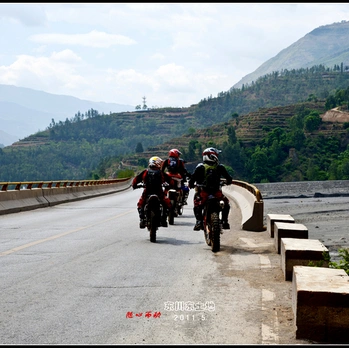
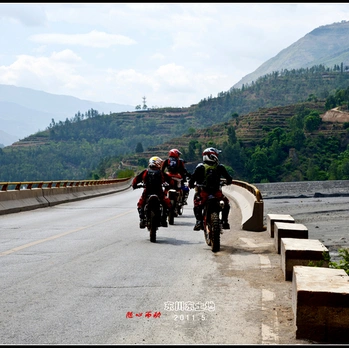
The midday heat was intense. We found a pleasant coffee shop on the street, sipped coffee, ate cold treats, and scrolled through the photos on our camera, waiting out the noon sun. We didn’t set off back to Kunming until 2:30 p.m. As we left the city, we hit a massive traffic jam—turns out, we had run into the “2011 China Mudslide Car and Motorcycle Cross-Country Race.” That, too, is a signature feature of Dongchuan.
Conclusion: The “God” Who Creates Beauty
On the way back, my mind lingered on those vivid, colorful images. Then I thought: the “God” who created the Red Land landscape isn’t entirely divine. It is, more than anything, the result of centuries of hard labor by the local people. It is they who, on this red soil plateau, used their own hands to carve out fields, year after year planting different crops by season, giving rise to this grand and beautiful vista. In this sense, the common people are the “God” who creates beauty.
Goodbye, Red Land. I will come again.
Practical Tips
Transportation
- Self-drive: From Kunming, take the Kunming-Qujing expressway, then the Songming-Daibu expressway. Exit at Longtan, follow the Longdong Highway to Dongchuan Xincun, then turn left onto the Xincun-Yangjiawan county road and ascend into the mountains. The scenery begins after the 23-kilometer mark on the “Xinyang Line.” The core scenic area is around Huagou. The round trip is about 500 kilometers.
- Backpackers: Kunming North Bus Station has direct buses to Dongchuan Red Land Town (formerly Fazhe), departing at 7:50 a.m. and 8:30 a.m. daily. Tickets are around 40 yuan. The bus passes through Music Score Hollow, Huashitou, Splendid Garden, and other spots. The journey takes about 5 hours.
Clothing
The scenic area sits at an altitude of about 2,500 meters. Temperature differences between morning and evening are significant, so bring a thick jacket. Sunny days have strong UV rays—sun protection is essential.
Food and Accommodation
There are many farmhouse inns in the core Red Land area, mostly newly built three-story buildings. They are safe and clean, with prices ranging from 20 to 100 yuan per night. Rooms are equipped with electric blankets and solar water heaters. Meals are usually eaten at the inn where you stay, costing about 20 yuan per person. At the inn we stayed in, “Shanlihong Jiujia,” a three-dish-one-soup dinner was 52 yuan, and a breakfast of poached egg noodles was 5 yuan. Prices double during major holidays, so book in advance.
Photography
- Best months: February for residual red tones; May–June for golden wheat; September–December for the three colors of rapeseed (green, white, yellow). Locals say the third day after rain is when the Red Land is most beautiful.
- Timing: Damakan sunrise is around 6:40 a.m.; the best window at Sunset Gorge is 4:30–5:30 p.m.; Music Score Hollow and Tile House Ridge are best in the evening light.
- Car rental: Non-driving visitors can ask their innkeeper for help renting a car to tour the viewpoints.
Other
- The Red Land scenic area currently does not charge an entrance fee, but do not step into farmers’ fields without permission, or you may be asked to pay.
- On the way from Longtan to Dongchuan, you can see the Xiaojiang mudslide landscape. The Xiaojiang River is 138.2 kilometers long, flanked by steep cliffs and massive mudslides—a consequence of ecological imbalance, yet also a wonder of nature.
All information in this article is based on on-the-ground experience during the May Day holiday of 2011. Please check the latest updates for any changes.
You should also read:

Body in Hell, Heart in Heaven: A Pilgrimage Through Tiger Leaping Gorge — A Dialogue Between Heaven and Earth
Body in Hell, Heart in Heaven: A Pilgrimage Through Tiger Leaping Gorge — A Dialogue Between Heaven and Earth Introduction: When the Gorge Splits Open Beneath Your Feet Some say Tiger Leaping Gorge is the closest place on Earth to the border between "hell" and…
Continue reading...
Cloud Travelogue · Dali of Wind, Flowers, Snow, and Moon: A Three-Day, Two-Night Journey of a Free Spirit
Cloud Travelogue · Dali of Wind, Flowers, Snow, and Moon: A Three-Day, Two-Night Journey of a Free Spirit I am a cultured female foodie with a touch of rogue charm. I slung on my backpack, took my lover's hand, and set off on a spontaneous…
Continue reading...
The Meaning of Travel – A Tengchong Story: A Journey of the Heart and Personal Growth
The Meaning of Travel – A Tengchong Story: A Journey of the Heart and Personal Growth Setting Out, Only to Return a Better Self Some say travel is nothing more than leaving a place you're tired of, only to go to a place where others…
Continue reading...