2020 Stargazing Chronicle: When the Universe Handed Me a Love Letter

2020 Stargazing Chronicle: When the Universe Handed Me a Love Letter
How long has it been since you last looked up at the stars?
I asked myself that question. The answer made me a little uneasy—before 2020, I couldn't even name Orion.
But that year, like a person possessed, I chased celestial bodies across half of China. From my own balcony to thousand-meter peaks, from a comet's flyby to torrents of meteor showers, I received the ultimate romance from the universe.
Prologue: Why "Ultimate Romance"?
2020 began in a way no one expected. When life hit the pause button, I found a completely new rhythm—looking up.
That year, my list of "cosmic gifts" captured went like this:
- January: My balcony, touching the Winter King—the Orion constellation
- May: Wugong Mountain in Jiangxi, embracing the summer Milky Way arch
- July: Sanqing Mountain and the wilderness, chasing Comet NEOWISE
- August: Yuhua Mountain, the Perseid meteor shower arriving right on schedule
- December: Yuanmou Earth Forest in Yunnan, the Geminid meteor shower closing the show
Why call it "ultimate romance"?
Because Betelgeuse in Orion could explode into a supernova at any moment. Comet NEOWISE won't return for 6,800 years. And a meteor goes from blazing bright to extinguished in just one second.
These things transcend time, space, and dimensions. Humans can never truly "possess" them—we can only briefly "encounter" them.
Isn't that the most extreme form of romance?
January: Orion on the Balcony, and a Star About to Explode
In late January 2020, my long stretch of staying at home began.
While others were stockpiling food, binge-watching shows, and fretting, I found a secret base on the balcony.
Every night after 10 PM, once my parents turned off the lights and went to sleep and the streetlights switched off on schedule, I'd bundle up in my thickest down jacket, haul out my camera, occasionally grab a bag of chips or an apple, and climb out onto the balcony.
There was no light pollution there—just a sky so clean it looked like a hurricane had swept through it.
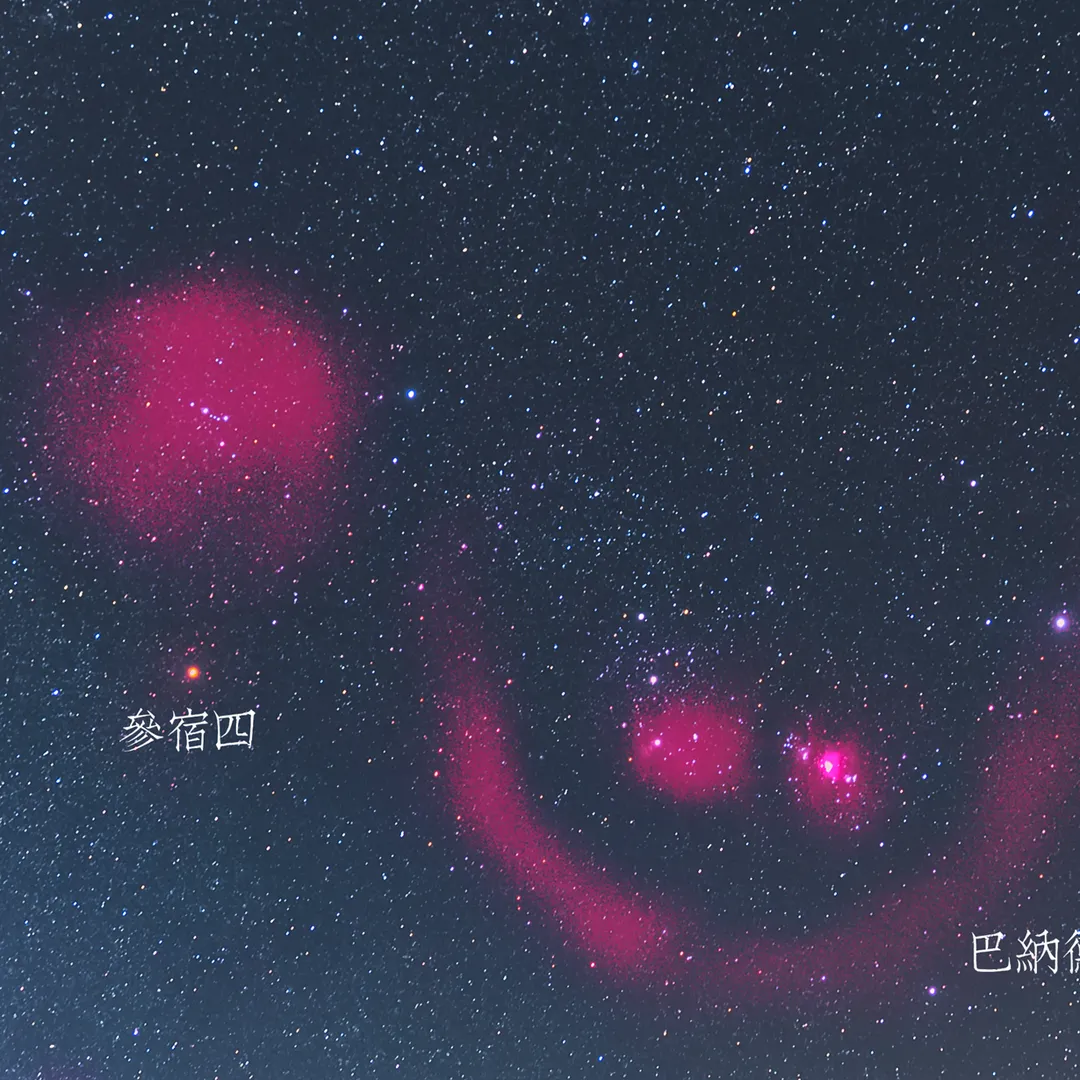
Orion hung right overhead.
"Three stars point south, the New Year's at your mouth," as the old saying goes. And it was right. On New Year's Eve, with no moonlight, Orion stood center stage like the lead actor, with Sirius, Procyon, and the Pleiades cluster as his supporting cast.
For the first time, I captured Barnard's Loop—that faint red nebula, like a crimson sash drifting from Orion's belt.
It took several nights of fiddling to get a barely passable photo. But the satisfaction in that moment was more precious than any blockbuster film.
You know what? When a star dies, it blasts every element from its life into space, forming a nebula. And at the center of that nebula, new stars are born.

Every brilliant nebula we see is a story of cosmic life and death.
And the ending of that story? Humanity was born.
The original cosmic explosion became stardust, and in the end, that stardust became us.
Betelgeuse, that red supergiant just 600 light-years away, had been noticeably dimming since October 2019.
Astronomers said it could explode at any moment.
If it does, it will be the first supernova within the Milky Way that humans have ever been able to observe.
I call this "the romance of the supernova"—even death comes bearing light.
May: The Milky Way Arch at Wugong Mountain, and the Thrill of a First Mosaic
By May, summer had arrived early in the south. I invited a friend who was about to leave on a long journey, and we climbed Wugong Mountain.
In the past, I insisted on hiking from the base to the summit—that stubbornness of a geology major. But my knees wouldn't agree anymore, so I learned to take shortcuts: cable car plus walking plus cable car, using the fewest steps to reach the highest peak.
A thick white mist covered the summit. I thought the night was a washout.
But as dusk fell, the clouds parted like a stage curtain being slowly drawn back. The sunset blazed, and the night sky turned a deep, jewel-like blue.
I'd calculated using an app that the Milky Way would rise around 9 PM. But by 9:30, I still couldn't see a thing with my naked eye.
"Light pollution is hiding it," I told my friend.
Then I took a long-exposure shot with my camera—the Milky Way had already crept up from the horizon.
"Look, Scorpius!"
"Where, where?"
"That string of stars."
"I think I see it."
"Have you ever seen the Milky Way before?"
"No."
"Then this is the romance I'm giving you."
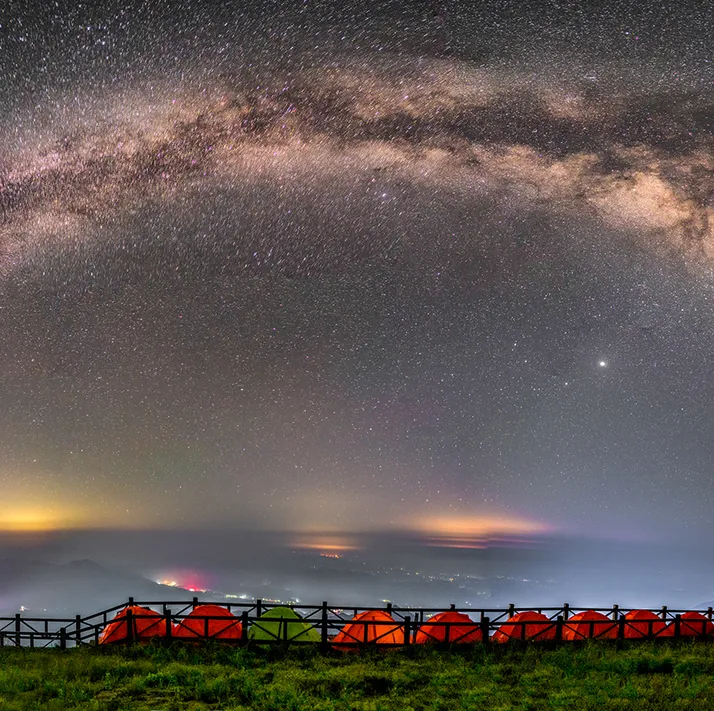
I decided to shoot a Milky Way arch—capturing it like a bridge across the sky.
I had zero experience. Pure instinct. I locked the tripod, rotated the head horizontally, shooting from one end of the Milky Way to the other. Six frames. Then I tilted up for another row—three rows total. Eighteen shots.
Back home, I used software to stitch them together. It worked!
Not satisfied, I shot a second set—four rows, 28 frames. The result was even more complete.
Jupiter, Scorpius, Saturn, Altair, Vega... all the most dazzling parts of the summer Milky Way were in there.
Imagining the Milky Way as a bridge is one of humanity's most beautiful fantasies about the universe. A bridge made of billions of stars—wouldn't you want to walk across it?
I didn't sleep until 3 AM. The tent area at the summit was packed, but in the deep of night, I still had the starry sky all to myself.
From that night on, I felt the universe had drawn closer to me—not in distance, but in spirit.
July: Comet NEOWISE, a Gift Limited to Once Every 6,800 Years
The biggest surprise of 2020 was Comet C/2020 F3 NEOWISE.
I called it "the 2020 limited-edition cosmic gift."
Discovered on March 27, it reached its closest point to Earth on July 22. After that, it would leave, not returning for 6,800 years.
Visible from the Northern Hemisphere, the higher the latitude, the better. The optimal viewing spot was Inner Mongolia, but I didn't have vacation days, so I had to take my chances in the south.
June and July in the south are monsoon season—the rain was relentless and demoralizing. I waited until mid-July, when clear skies finally arrived.
For my first attempt, I went to Sanqing Mountain. I figured higher ground meant a better view, but I underestimated the microclimate of mountain peaks—clear skies at the base, thick clouds at the summit.
I hiked to the closed-off Yujing Peak. The sky was gloomy. At sunset, the clouds in the west were as thick as a quilt.
Dejected, I returned to my hotel, ready to shower and call it a night. I pulled back the curtain—the clouds had cleared!
The Milky Way was brilliant. Jupiter hung high. I grabbed my bag and rushed out, climbing steps in the dark. Sanqing Mountain's stairs are famously exhausting. Panting and drenched in sweat, I finally made it to the West Coast trail.
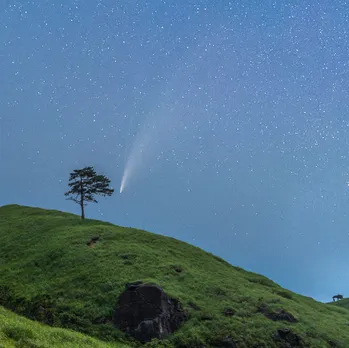
I scanned the northwest horizon—and there, beneath the Big Dipper, I saw Comet NEOWISE.
How to describe that moment?
A gift. A gift from the universe. So precious, so beautiful, so romantic.
It was the brightest comet visible to humans since 1997. It had crossed the entire solar system to come before us.
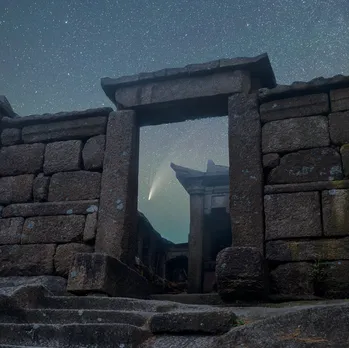
The mountain was too high, the comet's head hidden below the mountain haze, but the faint blue stream of its tail glowed with an indescribable beauty.
NEOWISE's orbital period is 6,800 years. The last time it visited Earth was around 4,800 BCE—the Stone Age.
Back then, humans were still dancing on cliffs and running through the wilderness.
In just 6,800 years, this blue planet had changed beyond recognition.
That's time, isn't it? It can fold, it can stretch, but it can never go backward.
I chased it a second time, a few days later, climbing a wild mountain with a friend.
A third time, in late July, as the comet was about to leave Earth. I found a dilapidated temple on a hilltop and bid farewell to this visitor from across time and space.
I hope that 6,800 years from now, human civilization will still be thriving.
August: The Perseid Meteor Shower at Yuhua Mountain, and an Obsession with 3,000 Photos
Compared to a comet that comes once every 6,800 years, meteor showers are the universe's annual gift.
The Perseids, one of the three major meteor showers in the Northern Hemisphere, arrive faithfully every year in early to mid-August.
This year's peak was on August 13. But a typhoon hit that day.
I went to Yuhua Mountain—an obscure, unnamed peak in Zhangshu, Jiangxi. With a few people I'd never met before, I drove from Nanchang straight to the summit.
The wind at the top was brutal. The clouds were overwhelming. I couldn't even see the wind turbine blades, and I was afraid my tripod would blow away.
Behind the cloud cover, the Milky Way was faintly visible, but the meteor shower was basically a no-go.
The only thing I got that night was one bright meteor.
I couldn't accept it. Two days later, on the weekend, we went again.
This time, there was a whole group. We brought tents, watermelon, barbecue supplies—ready to spend a cool summer night on the mountain.
A rainbow appeared at dusk. At sunset, the Gan River looked like a golden ribbon.
But the clouds in the sky... they were thick.
As night fell, someone started the barbecue. The atmosphere got lively. I looked up to check a dozen times—overcast!
"It's raining!"
Secretly, I was happy. I'd learned about mountain microclimates the hard way. Rain often meant clearing skies were on the way.
Sure enough, after a burst of wind and rain, the clouds were swept away.
Jupiter hung high. The Milky Way was glorious. I told my friends, "There's still a meteor shower tonight, you know."
This is the joy of stargazing—you get to see scenery that most people never do.
That night, I shot for nearly eight hours, close to 3,000 frames.
I even freeloaded a few meteors from my buddy's shots.
It took me a week to compile one final image: first a base shot of the sky, then all the meteor captures aligned to the same star points, masked and blended onto the base.
True starglitter, stars falling like rain.
After midnight, my friends were all asleep. I was alone at the summit. The mist had completely cleared, and the sky was a dome overhead.
I found a large rock and lay down. The howling of the mountain wind seemed to vanish. That night, the sound of meteors streaking by felt quiet. The clamor of the turning sky poured endlessly into my dreams.
Goodnight, shooting stars.
December: The Yuanmou Earth Forest, and the Grand Finale of the Geminid Meteor Shower
The Geminids, another of the Northern Hemisphere's three major meteor showers, peak every year around December 13.
But this year, on December 12, a cold front swept through. The entire central and eastern parts of China were overcast or rainy.
I checked the map. Only Yunnan and the central-western regions were clear.
I spent half a day planning the trip and headed straight for the Yuanmou Earth Forest in Yunnan.
I woke up at 4 AM to catch the earliest high-speed train.
When I arrived in Yuanmou, the sky was clear as if it had been washed.
The otherworldly landscape of the Earth Forest, bathed in moonlight, looked like an alien planet. I set up my gear and waited for the Geminid meteor shower to begin.
That night, I saw the densest meteor shower of my life—one after another, like the sky was raining light.
Orion's Barnard's Loop, the meteor shower, the Earth Forest, and me.
When I saw a massive fireball streak across the sky, lighting up the ground, I thought—
Even dead dust can shine in the dark night, illuminating the earth.
Humans, too, are just a fleeting flash of light in the universe's long darkness.
Our lives are like meteors—the most precious moment in all of space.
Epilogue: The Universe's Gift List, and My Ultimate Romance
After a year of stargazing, these are the gifts I received:
- Barnard's Loop in Orion, and a star that could explode at any moment
- The Milky Way arch at Wugong Mountain, and the thrill of my first successful mosaic
- Comet NEOWISE, a romance limited to once every 6,800 years
- The Perseid meteor shower, 3,000 photos traded for a sky full of stars
- The Geminid meteor shower, above the Earth Forest, with fireballs lighting up the land
I know these photos aren't "earth-shattering."
But behind every single one is a story: the smell of chips on the late-night balcony, the snoring in a mountaintop tent, the sudden clarity after a storm, the held breath as a meteor blazed past.
The romance of the universe isn't about how vast it is. It's that it's willing to share its most precious moments with someone who simply looks up.
If you want to chase the stars, remember a few things:

- Location: Get away from light pollution. Higher altitude is better.
- Timing: Avoid the full moon. The best nights are around the new moon.
- Gear: A camera, tripod, and shutter release cable. Even a phone can work.
- Mindset: Go with the flow. Clouds will clear. Rain will stop. The stars will come out.
Most importantly—don't just stare at the camera screen.
Put down the equipment sometimes. Use your eyes.
Because some kinds of romance can only be etched into your heart by seeing them yourself.
In 2020, the universe handed me a love letter.
I've written it down as this travelogue.
Now, it's your turn.
Look up at the night sky. Who knows? The universe might be writing to you, too.
You should also read:
A Journey for Farewell: When Solitude Becomes the Best Healing
A Journey for Farewell: When Solitude Becomes the Best Healing Introduction: Not All Journeys Are for the Scenery In the summer of 2013, I embarked on a solo trip across Guizhou, Yunnan, and Hunan. This was no ordinary excursion—not for checking off Instagram-worthy spots, not…
Continue reading...
Grant Me a Love Affair with Kawagebo: In Yubeng, I Found What Heaven Looks Like
Grant Me a Love Affair with Kawagebo: In Yubeng, I Found What Heaven Looks Like Prologue: The Reason for Setting Out "Don't forget why we started, just because we've gone too far." The moment the plane broke through the clouds, the roar of the engines…
Continue reading...
Under the Clouds, a Sweet Secret: A Honeymoon Journey for Love and Hiking
Under the Clouds, a Sweet Secret: A Honeymoon Journey for Love and Hiking Before We Set Off: From Mount Kailash Pilgrimage to Yubeng Trek In May 2012, I boarded a bus bound for Ngari Prefecture alone, driven by a single obsession—to perform the sacred circumambulation…
Continue reading...