2025, A Solo Journey to Yunnan: Rediscovering the Power of Walking Between Snowy Mountains and Gorges
2025, A Solo Journey to Yunnan: Rediscovering the Power of Walking Between Snowy Mountains and Gorges
Foreword: Why Yunnan?
Life in the city is always fragmented by clocks and schedules. Work, meetings, commuting—a never-ending cycle. But there's always a voice inside saying: it's time to hit the road.
At the end of 2025, I finally made good on that long-brewing idea. Using a Hainan Airlines "Fly as You Wish" pass, I redeemed a ticket and flew solo to Lijiang. No elaborate plans, no precise itinerary—just three destinations: Tiger Leaping Gorge, Shangri-La, and Abuji Lake.
This wasn't a spur-of-the-moment impulse, but a deliberate interruption of life's rhythm. I wanted to measure real distances with my feet, to feel the thinness of high altitude with my own breath.
Day 1: Flying Through the Night
After work on Friday, I dragged my suitcase into Pudong Airport. On Metro Line 2, a foreign passenger was carrying a giant Tigger plush toy—there was something absurdly heartwarming about the scene.

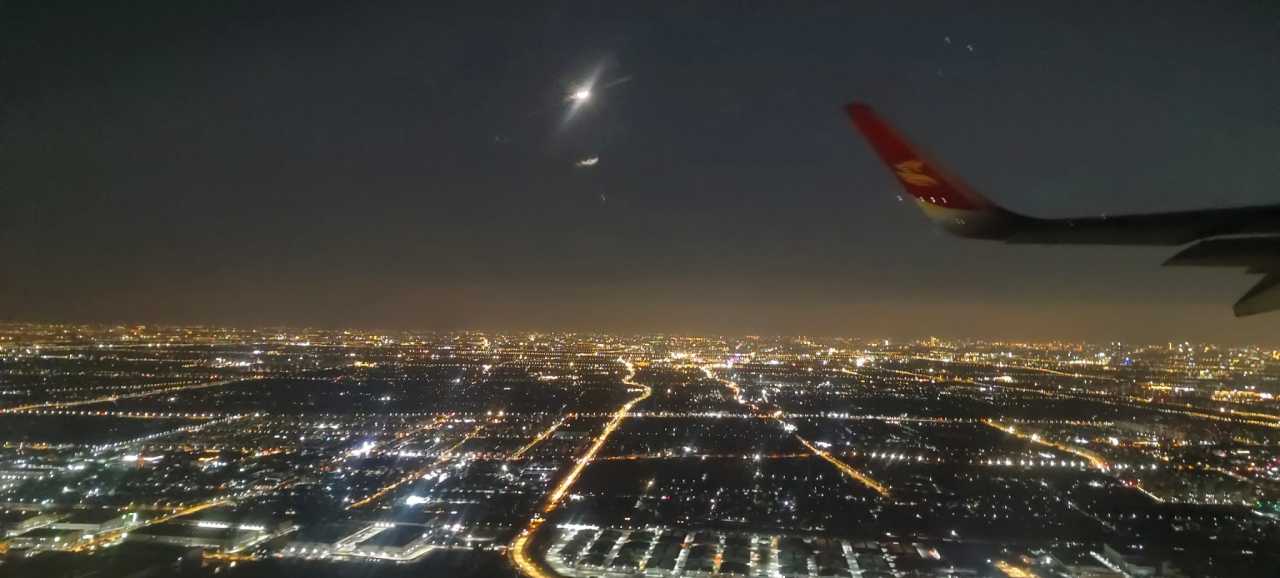
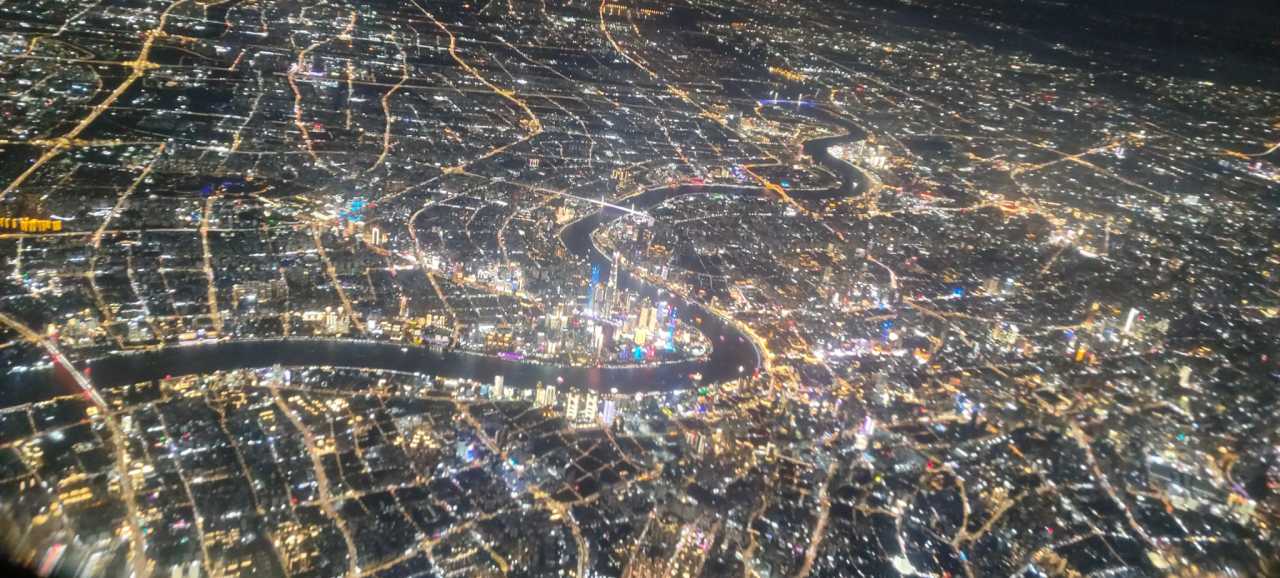
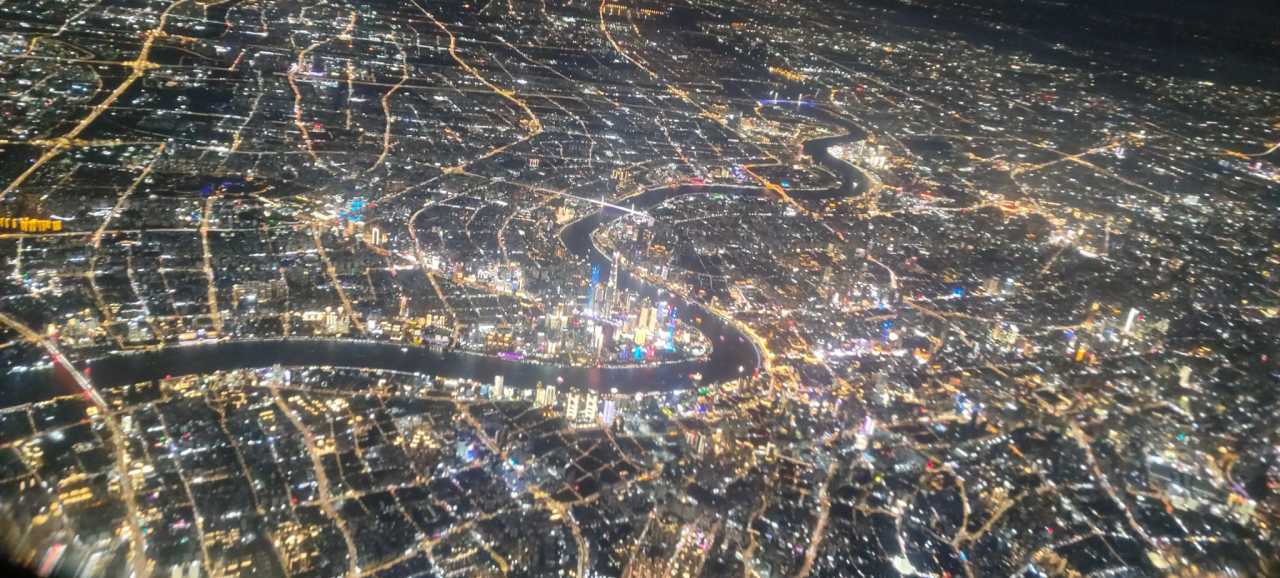
Check-in, security, the little train to the satellite terminal. The plane took off into the night sky, and Shanghai's sea of lights spread out beneath me. The "kitchen three-piece set" (Shanghai's iconic skyscrapers) on both sides of the Huangpu River were clearly visible—the city's most recognizable landmarks.
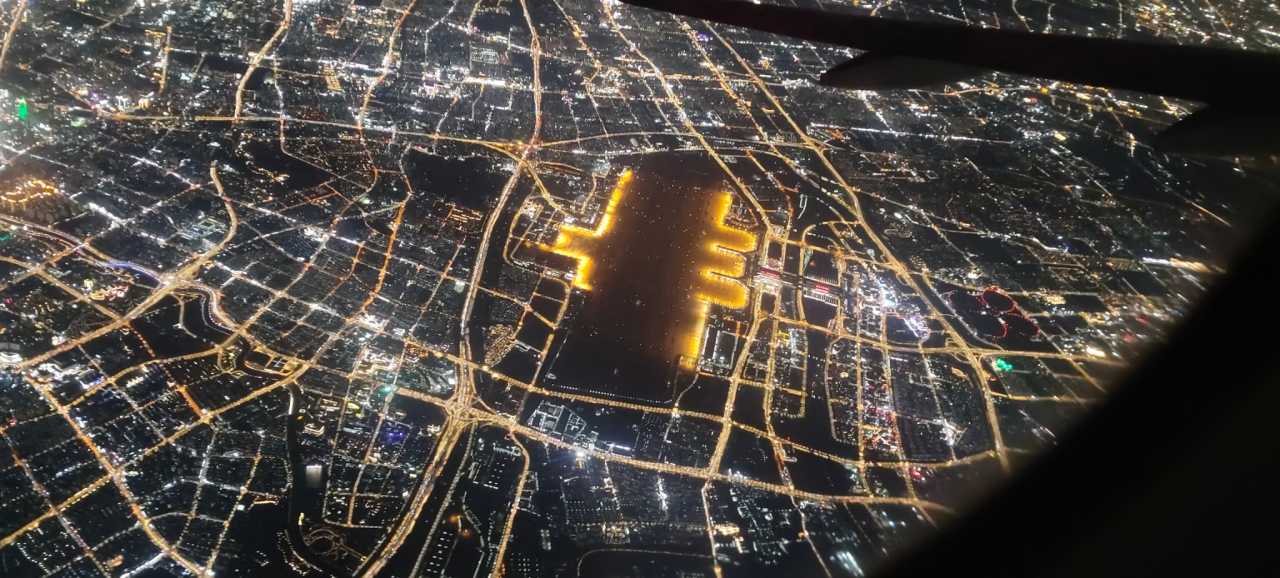
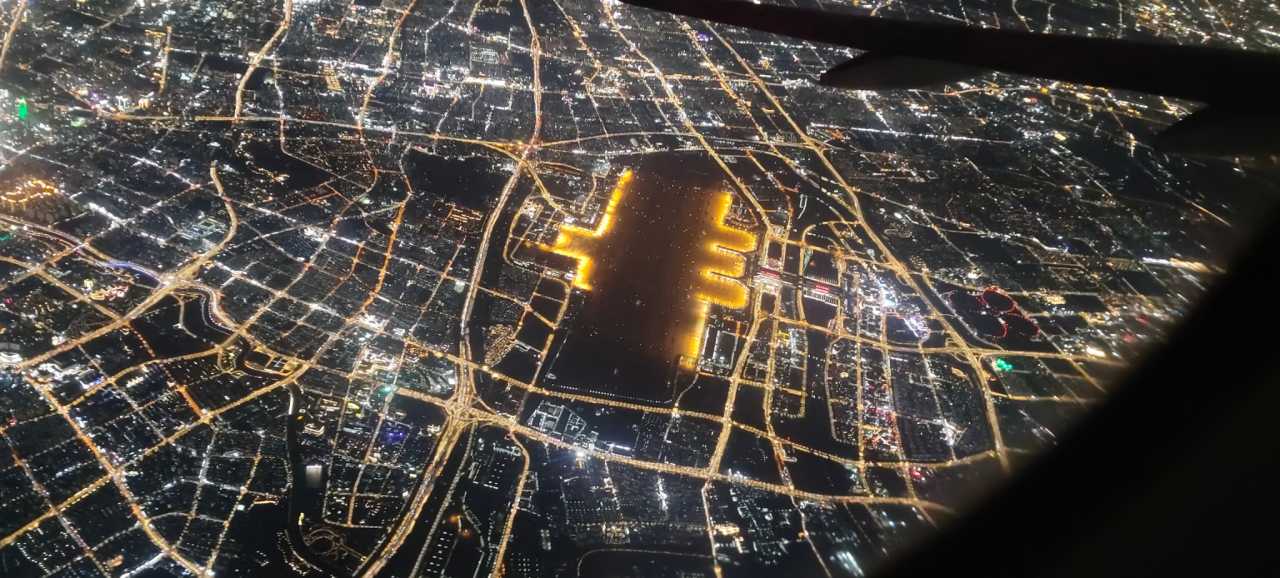
For the first time, I saw Dachang Airport in northern Shanghai from above—usually I'd watch planes take off and land there from the ground, and now I was the one looking down. The silhouette of Hangzhou Bay and the lights of the cross-sea bridge flickered faintly in the darkness.
At half past midnight, the plane landed at Lijiang Airport. The airport bus passed through the sleeping ancient town; most shops were closed, but some convenience stores still had their lights on—uncommon elsewhere. I got off near the old town and took a taxi to my booked hotel.
Day 2: The Tiger Leaping Gorge High Trail—Walking Above the Canyon
Morning Chicken Soup Rice Noodles and Golden Snowcap
Before dawn, I found a breakfast shop already open near my hotel. Their specialty was local chicken rice noodles (土鸡米线), so I ordered a bowl of chicken soup noodles and a chicken leg.
The flavor was surprisingly good. The broth was sweet and savory, made with black-boned chicken—firm-textured but not tough. The price was also very reasonable.
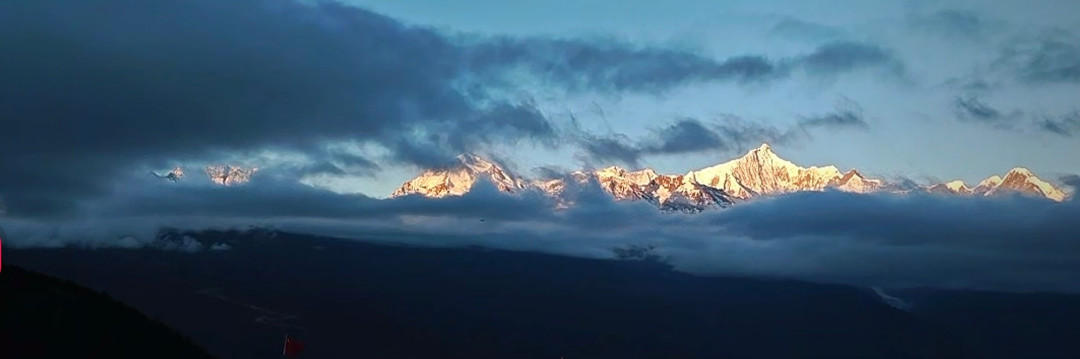
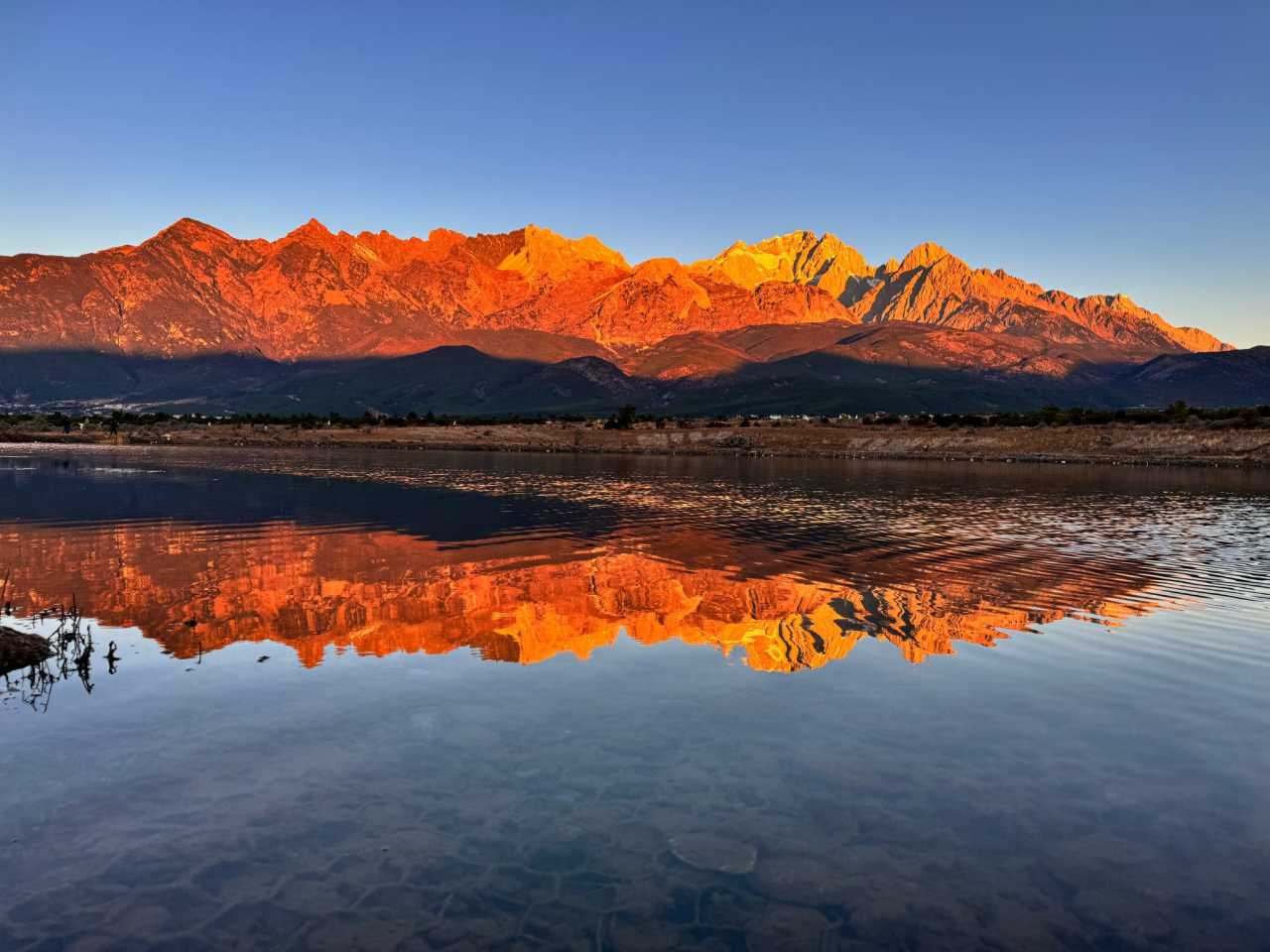
Back at the hotel, I caught the Golden Snowcap (日照金山) on Jade Dragon Snow Mountain—golden sunlight spreading slowly from the peak. In that moment of stillness, all the rush of travel faded away.
Tiger Leaping Gorge: Choices and Uncertainty
On the road from Lijiang to Shangri-La, I shared a car with other travelers. Among them was a young Korean girl who looked very small and spoke no Chinese, so we chatted in English the whole way.
Before setting out, I'd learned that most of the Tiger Leaping Gorge hiking trails were closed, especially the low trail near the Jinsha River. Only the Upper Tiger Leaping (tourist area) was open. But the other passengers got off early, planning to take a taxi to Naxi Family Inn and hike the High Trail—supposedly, parts of it were still accessible.
The driver's information was confusing: "The section past Half-way is under repair. If you try to cross, they'll catch you and fine you." Different pieces of news swirled together, and I didn't even know where I should go.
The Korean girl next to me and a few foreign passengers couldn't understand the driver's dialect-laced Mandarin, so I ended up as an impromptu translator. At that moment, I wasn't even sure where I was headed myself.
In the end, I decided to take the High Trail. Starting from Tea Horse Inn, I skipped the toughest "28 Bends" section, saving a lot of energy. Starting from Naxi Family Inn would have required two days, but I needed to reach Shangri-La that night.
Hiking the High Trail: Finding Grandeur in Peril
The core experience of Tiger Leaping Gorge lies in the choice between the "High Trail" and the "Low Trail." The High Trail is an ancient path along the mountainside, once part of the Tea Horse Road—rugged and steep, but offering panoramic views of the gorge and facing the snowy peaks directly. The Low Trail is a road along the river—flat and easy, but with lackluster scenery.
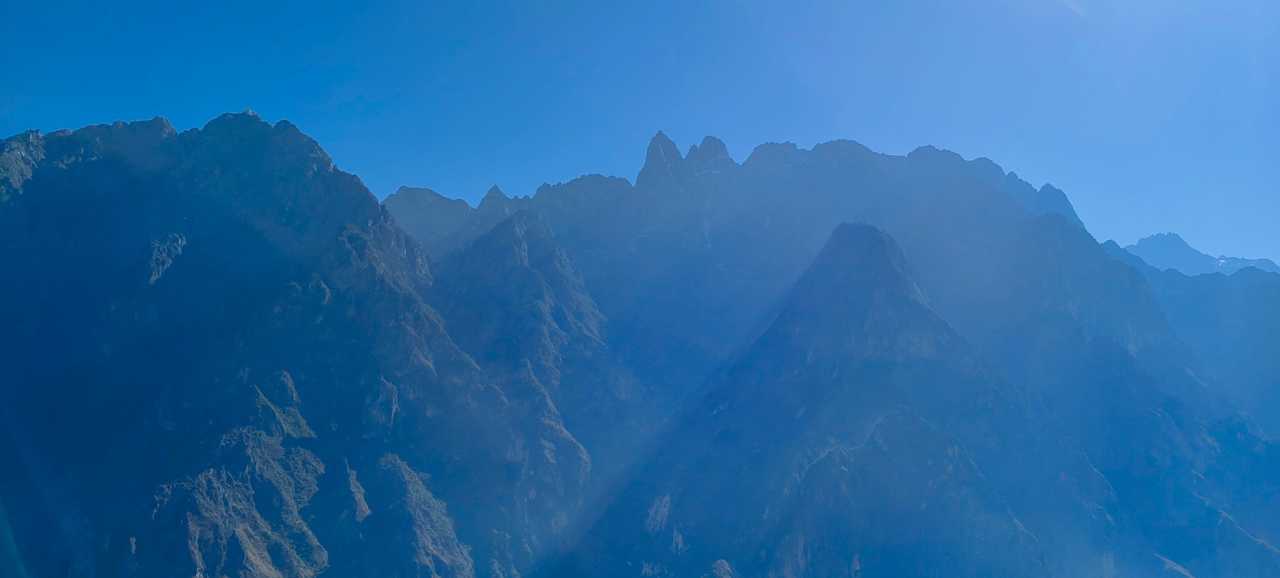
On either side of the Jinsha River in Tiger Leaping Gorge, one bank belongs to Haba Snow Mountain, the other to Jade Dragon Snow Mountain. The elevation drop from peak to river exceeds 3,000 meters—extremely steep.
The scenery along the way was overwhelming: firecracker flowers, golden lotus emerging from the earth, three-needle barberry—I had to look up the names of these plants later. There were also burial sites of unusual forms, and locals selling various mountain products.
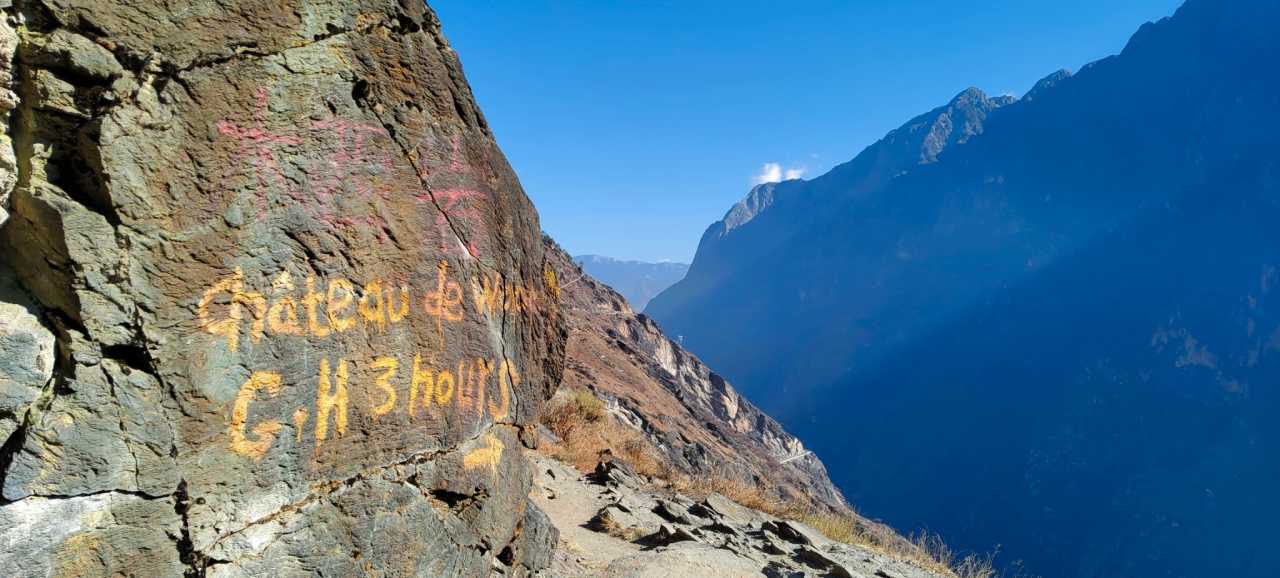
The trail wound along the mountainside, overlooking the Jinsha River, where the winding road below looked like a thin thread coiled around the mountain's base.
Half-way: Where Art Meets History
From Tea Horse Inn to Half-way Guesthouse, the path was relatively flat. Half-way has a viewing platform called "Sunsi Ni Balcony" (爽死你阳台)—the name is blunt, but the view is genuinely breathtaking. The towering mountains unfolded before us. For us, it was beautiful scenery; for locals, especially in the past, it meant incredibly difficult travel.
Half-way's restroom was surprisingly artistic, its walls hung with ancient farm tools—kids today probably have no idea what they were used for. There were also cured meats, succulent plants, and unidentified wild fruits.
The Korean girl had to leave early because she had a bus ticket back to Lijiang for a little after 2 PM. I helped her find a shared ride to the parking lot, and we waved goodbye. Half-way had various stir-fried dishes, but I was in a hurry, so I just ate some snacks I'd brought and kept moving.
From Half-way to Tina's: Challenges and Risks
The path from Half-way onward was noticeably harder. That day, I saw more Koreans than Chinese on the trail—I later learned that a hugely influential Korean celebrity had visited Tiger Leaping Gorge, making it a hot destination.
There was a protruding pointed rock where you could take beautiful photos—but it required a fee and was a bit dangerous. A flock of sheep walked along nonchalantly, completely unbothered by the tourists. A few were tied to the roadside by their owners because they "would run off."
When I reached Longdong Waterfall, I thought about how a little boy had fallen there and died in February—truly tragic. The Tiger Leaping Gorge hiking trail is not safe; it requires some outdoor experience and safety awareness.
Continuing on, there were guesthouses or government facilities under construction, with giant drones occasionally carrying materials overhead. In contrast, when I went to Nepal's ABC trek later during Chinese New Year, they still rely on porters carrying loads up the mountain one by one.
The descent. My companion and I decided to walk all the way to Tina's (Tina's Guesthouse), unlike most people who stopped at Zhang's Teacher Inn. So by the end, we were basically the only ones on the trail, and sometimes it felt like there was no path at all.
Around 3 PM, we finally reached Tina's. The two tickets for Upper Tiger Leaping that I'd paid 90 yuan for were completely wasted—and they were only valid for the day.
Tragedy and Reflection at Tiger Leaping Gorge
While waiting for a ride to Shangri-La in the parking lot, I learned more: Tiger Leaping Gorge originally had many steep attractions close to the river, but they've been closed for safety reasons. Two months after I hiked the gorge, two accidents happened within five days—a little boy fell to his death at a waterfall, and a young man fell into the river while washing a cup at a rock called "Mad Stone." Word has it the young man's body still hasn't been recovered—the water's vortex created negative pressure, pulling him down and wedging him between rocks. By the time he was found, he was badly decomposed, and his family gave up the recovery effort.
It's a tragedy, and a reminder: behind nature's beauty, there's always unpredictable danger.
Day 3: Shangri-La—Moonlight City and Abuji Lake
Dukezong Ancient Town: Millennia of Tea Horse Road History
At 4:30 PM, I left Tiger Leaping Gorge for Shangri-La. Along the way, we saw Haba Snow Mountain in the distance, with Tibetan-style houses scattered by the roadside.
Arriving in Shangri-La, the temperature dropped noticeably. Dukezong Ancient Town—a thousand-year-old Tibetan town at 3,300 meters elevation, meaning "Moonlight City" in Tibetan. It was an important stop on the Tea Horse Road and is the best-preserved large-scale Tibetan民居 (residential complex) in China.
The Tibetan architectural complex at Turtle Mountain Park and its giant prayer wheel drew attention. Tibetan Buddhist statues differ from Han Chinese Buddhism—in Tibetan Buddhism, the God of Wealth is a drinker. Many people went to turn the giant prayer wheel, but I didn't join the crowd.
Nowadays, in Lhasa or Shangri-La, it's mostly tourists wearing Tibetan-style clothing. The dairy products in the old town are delicious, especially the cheese. I had dry-pot yak meat (干锅牦牛肉) at a popular restaurant, and the owner gave each guest a hada (ceremonial scarf) with blessings—top-notch service.
That night, I stayed at a guesthouse with good conditions and even offered oxygen. But I've climbed over 5,000-meter snowy mountains without needing oxygen.
Abuji Lake: New Trail Through Old—A High-Altitude Challenge
At 6 AM, it was still dark, with quite a few stars in the sky. I found an early-opening breakfast shop and ordered a basket of Hangzhou-style soup dumplings with yak meat filling (牦牛肉馅杭州小笼包), eating them with chili—pretty good.
The driver was also our guide. He picked up several people along the way, then headed to the starting point of the Abuji Lake hiking trail—Face-Washing Basin Pass (洗脸盆垭口). On the way, the driver suggested we watch a livestream of that morning's sunrise over Meili Snow Mountain.
The New Trail to Abuji Lake is something you can fully "buy your way through"—four-wheeled motorbikes roared past, kicking up dust. But I chose to walk.

At over 3,000 meters elevation, there was an abundance of usnea lichen—apparently a food source for Yunnan golden monkeys. After about 4 kilometers, we reached Pasture No. 1. Many people were hanging from a "网红树" (Instagram-famous tree) for photos. Distant snowy peaks, nearby yaks—some were shy of people. This area is far from human settlements, with bears and other wildlife. I've read more than one travelogue about people camping here overnight and having bears approach. But during the day, it's generally fine.
Continuing on, it felt like walking through an enchanted forest. After a few more kilometers, we reached Pasture No. 2. The guide told us to have lunch here—there were flatbreads, meat, and freshly brewed butter tea. My carmates came from all over; several were from Guangdong, some had already gotten Hong Kong residency. There was also a young couple from Shanghai who had decided to come on a whim, without any hiking gear.
As elevation increased, trees became stunted and shrubs took over. When we reached Pasture No. 3, the distant snowy mountains were clearly visible—one was Yading's sacred mountain, and from another angle we could see Meili Snow Mountain.
The snow on the trail hadn't melted, and icy sections were slippery. Dead trees stood alongside alpine rhododendrons—when spring comes and the rhododendrons bloom, it must be spectacular.
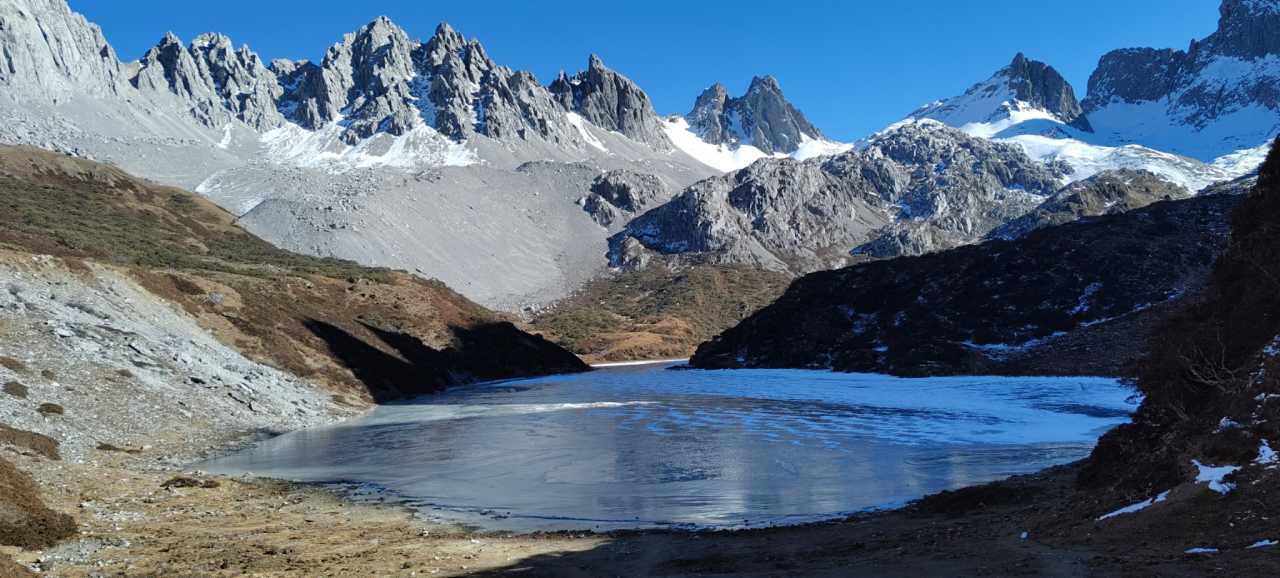
At even higher elevations, only grass and moss remained. Approaching Abuji Lake, we'd already walked 14 kilometers one way, at nearly 4,300 meters elevation. The frozen Abuji Lake was surrounded by dark, jagged mountains and scree slopes.
The path from the pass down to Abuji Lake was extremely steep and slippery, with obvious safety hazards. Going downhill was manageable for us, but going up would have been absolutely soul-crushing.
New Trail Through Old: Efficient and Diverse
Taking the "New Trail Through Old" route meant we didn't have to backtrack the 14 kilometers we'd already covered on the New Trail—saving a lot of energy and offering more varied scenery. Walking on the narrow path along the scree slope, the valley below was the endpoint.
The Old Trail's scenery was generally less impressive than the New Trail's, but the temperature was very low. The mountains surrounding Abuji Lake looked completely different from the Old Trail side compared to the pass.
Some of the slopes down to the farm at the bottom were also very steep. The guide had arranged for his wife to pick us up at the farm—unlike the New Trail, the Old Trail ends at a farm where you can't catch a ride; only local herders can drive in.
We waited quite a while for some teammates at the endpoint—the young wife in the Shanghai couple wasn't feeling well, her shoes were too slippery, and she was mentally exhausted. As the guide and his wife drove us back to Shangri-La, the girl threw up.
When we arrived at Shangri-La Station, the couple suggested I eat preserved rib hotpot (腊排骨火锅) back in Lijiang. Done—added to the plan.
Day 4: Lijiang—Ancient Town and Snow Mountain
Jade Dragon Snow Mountain's Golden Snowcap
Early in the morning, I took a bus to Dongba Valley, on the edge of Jade Dragon Snow Mountain. There were a lot of people watching the sunrise, and plenty of cars. A few small ponds allowed for reflection shots of the Golden Snowcap.
As the sky gradually brightened, Jade Dragon Snow Mountain kept changing colors—the Golden Snowcap was truly beautiful. Though what the naked eye saw wasn't as stunning as what phone cameras captured, the quiet awe of the moment can only be felt in person.
On the shared ride back to Lijiang Ancient Town, we passed through Shuhe Old Town.
Lijiang Ancient Town: The Daily Life of a World Heritage Site
My flight was in the afternoon, so I had some time in the morning to explore Lijiang Ancient Town. I only learned that morning that Lijiang Ancient Town is a UNESCO World Heritage Site.
Also known as Dayan Town, Lijiang Ancient Town was first built in the late Song and early Yuan dynasties, and was an important stop on the Tea Horse Road. The town's water system is impressive—water from Jade Dragon Snow Mountain and nearby Black Dragon Pool is channeled into the town, creating a landscape of "every household with flowing water, every door with drooping willows."
The water was remarkably clear. Like other ancient towns, Lijiang has a strong commercial atmosphere. Giant pu'er tea cakes, the Kegong Archway (科贡坊)—this iconic structure was originally built to honor the Yang family's achievement of having three members pass the imperial examinations in one generation. Many locals sat in their doorways, soaking up the sun.
The town's alleyways, clear flowing water and water plants, local ethnic minorities, succulent plants—everything was quiet and beautiful.
Mu Palace: Lijiang's "Forbidden City"
Mu Palace (木府) was the mansion and residence of the Naxi chieftains of Lijiang, serving as the core symbol of their power and culture during the Yuan, Ming, and Qing dynasties. It's known as "Lijiang's Forbidden City." The Mu family's surname "Mu" (wood) was directly bestowed by Ming Emperor Zhu Yuanzhang—he removed one stroke from his own royal surname "Zhu" (朱) and gave it to the Naxi chieftain family.
The palace's central building, the Council Hall (议事厅), was where the Naxi chieftains discussed state affairs. Inside, the chieftain's throne sits. The Ten Thousand Volumes Tower (万卷楼), the highest point of Mu Palace, was a landmark building for storing books and showcasing culture.
Inside Mu Palace, there's a tamarisk tree (also called Guanyin Willow or Red Willow) over 600 years old—one of the palace's "treasures." There are also orchids and cherry blossoms. From Mu Palace, looking down over Lijiang Ancient Town, Jade Dragon Snow Mountain is clearly visible in the distance.
Mu Palace offers free guided tours, and the guides are excellent. But at the end, they take you to sample tea—voluntary, no pressure.
Zhongyi Market: Everyday Life and Edible Insects
With some time left, I also visited Zhongyi Market. Various dried fruits, lingzhi mushrooms, sanghuang mushrooms, cured meat, white snow tea, all kinds of dried goods and medicinal herbs. There were also roasted potatoes, fresh gastrodia elata, and all sorts of insects.
I bought some insects—they tasted pretty good. And of course, there were all kinds of mushrooms, including 见手青 (a type of bolete that turns blue when touched). There were also freshly skewered and grilled yak meat skewers.
I ordered the most expensive mushroom fried rice, but it wasn't good—dried bacillus mushrooms (干巴菌) were just too dry. On the other hand, 水性杨花 (a local aquatic vegetable, literally "watery and flirtatious") was refreshing and tasty.
Return: Sunset and Twilight from Yunnan to Shanghai
At the entrance to the ancient town, I asked the staff to arrange a shared ride to the airport. Arriving at Lijiang Airport, I flew back to Shanghai.
Sunset. Twilight. When I landed at Hangzhou Xiaoshan Airport, I ordered a bowl of 片儿川 (a Hangzhou-style noodle soup with bamboo shoots, pickled greens, and pork).
In the middle of the night, I returned to Shanghai. The next morning, I went back to work.
Afterword: The Meaning of Walking
This Yunnan trip had no perfect plan, no stunning photos. It even left plenty of regrets—I didn't make it to Yubeng Village, didn't climb Jade Dragon Snow Mountain, and wasted my Tiger Leaping Gorge tickets.
But it's precisely these imperfections that made the trip real. On the High Trail of Tiger Leaping Gorge, I learned to make choices amid uncertainty. On the scree slopes of Abuji Lake, I experienced the difficulty and persistence of high-altitude walking. In Shangri-La's ancient town, I felt the weight of the Tea Horse Road's history.
The greatest gain from traveling solo isn't how many sights you see, but rediscovering yourself along the way.
If you're planning a trip to Yunnan, remember a few things: - The Tiger Leaping Gorge High Trail is worth hiking, but always prioritize safety - The Abuji Lake "New Trail Through Old" route saves energy and offers diverse scenery, but the altitude is high—know your limits - Shangri-La's yak meat and cheese are delicious - Lijiang Ancient Town's preserved rib hotpot is worth trying - Zhongyi Market's insects are worth a taste, but proceed with caution on the mushroom fried rice
Finally, thanks to that Korean girl at Tiger Leaping Gorge for the company, to the guide couple at Abuji Lake for their care, and to everyone I met on the road.
2025, a solo journey to Yunnan—here it ends.
But the walking never ends.
You should also read:

Two Girls' Graduation Trip: Dali and Shuanglang – A Poetic Farewell to Mountains and Sea
Two Girls' Graduation Trip: Dali and Shuanglang – A Poetic Farewell to Mountains and Sea Preface: Catching the Tail of Youth, Heading South During our senior year of college, my roommate and I – two girls studying in Beijing – decided to bid farewell to…
Continue reading...
Body in Hell, Heart in Heaven: A Pilgrimage Through Tiger Leaping Gorge — A Dialogue Between Heaven and Earth
Body in Hell, Heart in Heaven: A Pilgrimage Through Tiger Leaping Gorge — A Dialogue Between Heaven and Earth Introduction: When the Gorge Splits Open Beneath Your Feet Some say Tiger Leaping Gorge is the closest place on Earth to the border between "hell" and…
Continue reading...
Cloud Travelogue · Dali of Wind, Flowers, Snow, and Moon: A Three-Day, Two-Night Journey of a Free Spirit
Cloud Travelogue · Dali of Wind, Flowers, Snow, and Moon: A Three-Day, Two-Night Journey of a Free Spirit I am a cultured female foodie with a touch of rogue charm. I slung on my backpack, took my lover's hand, and set off on a spontaneous…
Continue reading...