7 Days in Echigo-Tsumari: 33 Stories Behind the Land Art Festival's Permanent Works That Warm the Heart
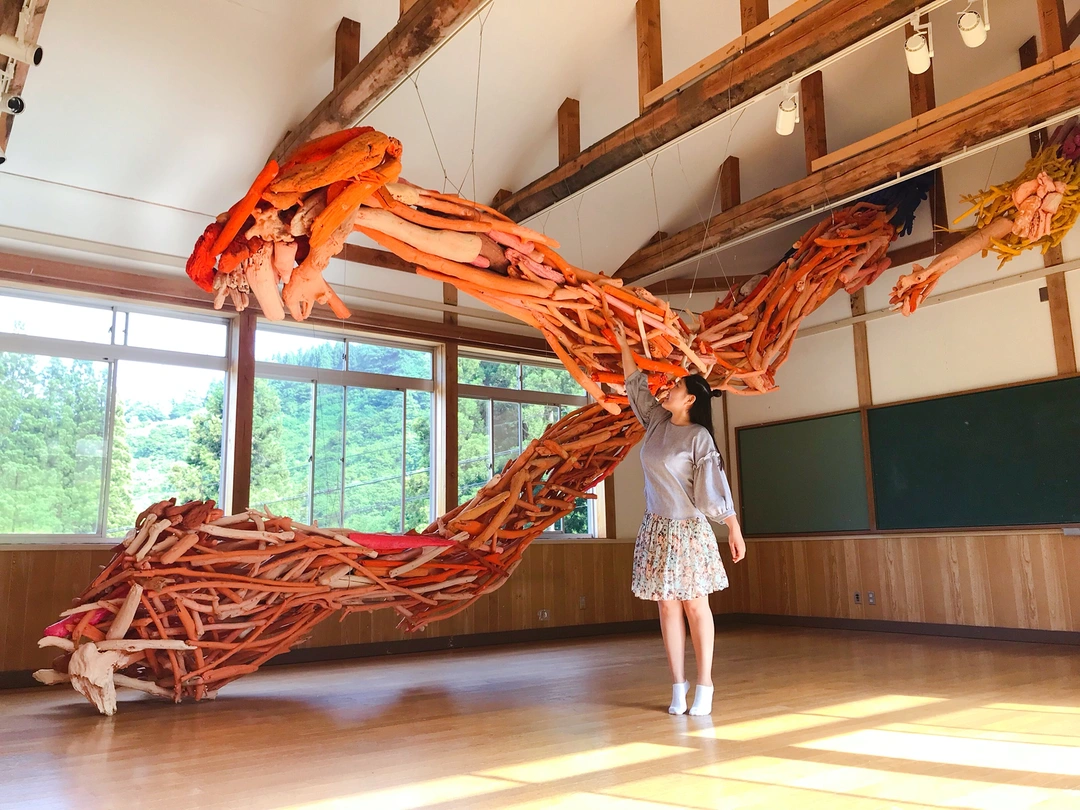
7 Days in Echigo-Tsumari: 33 Stories Behind the Land Art Festival's Permanent Works That Warm the Heart
Prologue: A Decade-Long Promise of Art and Friendship
"I would rather die for my beliefs than live without them."
This is the deepest realization I gained from the land of Echigo-Tsumari. In May 2018, I set out with two close friends—Bamboo and Little Tiger—on a journey through this countryside illuminated by art. Eight days, 33 permanent installations, and countless stories that brought tears to our eyes. This is not just a travelogue; it's a tale of healing, friendship, and art.
Ten years ago, on a late spring night in Beijing, I walked out of MAO Livehouse and struck up a friendship with a young man whose warm smile lit up the darkness. His name was Bamboo. Over the next decade, we traveled together from Beijing to Sichuan, Taiwan, Japan, and England... In 2016, we stumbled upon a place almost no one had heard of: Echigo-Tsumari. It was my first encounter with this breathtaking region. Two years later, I returned with Bamboo and Little Tiger, as if keeping a date with an old friend.
Little Tiger is my long-time collaborator—a Capricorn with a warm smile who used to direct TV shows. She's a pure idealist who strives for perfection in everything, so much so that I once mistook her for a Virgo. On this trip, the three of us drove across 760 square kilometers of land, searching for forgotten stories.
What Is the Echigo-Tsumari Art Field?
"Through art, I hope that forgotten places can regain hope, and that lonely, neglected elderly people can smile again." — Curator-in-Chief, Fram Kitagawa

The Echigo-Tsumari Art Field, held every three years, began in 2000 and has now spanned 17 years. It is hailed as "the world's largest international outdoor art festival." With the 760-square-kilometer landscape of Echigo-Tsumari as its stage, it brings together works by top global artists—a true "museum without a roof."
Artists like Yayoi Kusama, Christian Boltanski, Ilya and Emilia Kabakov, as well as China's Cai Guo-Qiang and Taiwan's Jimmy Liao, have all left their mark here. The festival's philosophy is "embracing nature," using the power of art to connect with local life, breaking down barriers of region, age, and culture, and fostering a model of sustainable community renewal.
During this May trip, we visited 33 permanent works. In August, I would return again for the 2018 Art Field, which would feature 380 pieces.
Niigata: A Small City in Spring
When our plane landed at Niigata Airport, I could barely see any cars or people moving outside. Clean and quiet—that's my enduring impression of Japan. No noisy crowds, no screaming children—everything felt wonderfully peaceful.
The temperature was like a spring day in Beijing: bright sunshine, but cool in the shade. Our taxi driver was a cheerful elderly man. He dropped Little Tiger and me at our lodging, then took Bamboo to Niigata Station. Once again, we were splitting up for separate adventures—a rhythm that made me feel a twinge of reluctance.
Niigata City was almost too quiet. I walked for five minutes without encountering a single person. I stumbled upon Ryoun-ji Temple, about which I could find little information. But it stood silently in the sunlight, a gentle breeze rustling the leaves, offering a rare moment of tranquility. Pigeons lined the streets; I spent 15 minutes photographing them. A secondhand bookstore exuded stories. At a nearby kindergarten, children were bursting with energy. Then came Niigata Station, bustling with people—a shock to my system after so much calm.
Teradomari: Guardians of the Coastal Road
After picking up our rental car, we drove along the coastal highway. At the Kariwaya parking lot, the shouts of children drew our attention. It was a small baseball game. The kids were full of fighting spirit, while parents stood outside snapping photos. I don't understand baseball, but their enthusiasm was infectious.
After winding through narrow roads, we arrived at the Teradomari Seafood Market. It faces the sea, with a huge parking lot out front. We got there around 3 PM, and many stalls closed at 3:30. It was like a "cleaner version of the Jingshen Seafood Market" in Beijing: stalls on the first floor, seafood processing on the second. Grilled items and seafood soup were available on the ground floor—and the key was that it was cheap! Seafood lovers shouldn't miss it.
After eating our fill, we continued our journey. I always say that life truly happens on the road—only then do you feel truly alive.
Tokamachi: The Joy of Reunion
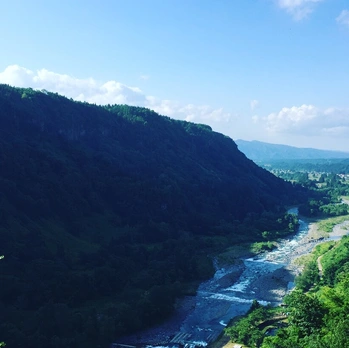
Our small car wound through rural fields, through tunnels and over bridges. When sunlight streamed through a cliffside tunnel, and when I saw the "Echigo-Tsumari Art Field" sign appear in the distance, I knew—I was home.
For the past two and a half years, I had longed to return to Echigo-Tsumari. Seeing it again, excitement and joy overwhelmed me—I almost wept. That feeling defies any words. I stopped the car and simply stood there, feeling the breeze of Echigo-Tsumari.
By the time we reached our lodging, it was almost dark. The croaking of frogs echoed around us. For the next three nights, we would live a rustic, pastoral life.
One afternoon, we strolled through downtown Tokamachi. Many shops along the street were closed. There were few people but many cars. We came across a combined artwork and restaurant: the Tokamachi Handicraft Center Ikote (No. T309, 2015). Designed by Japanese artist Takaharu Tezuka, it's a two-story wooden building with a covered alleyway—a feature once typical of Tokamachi homes. Today, the first floor houses a restaurant, where the waitresses wore kimonos.
Tokamachi Area: Getting to Know You Again
Three Gates and Three Travelers
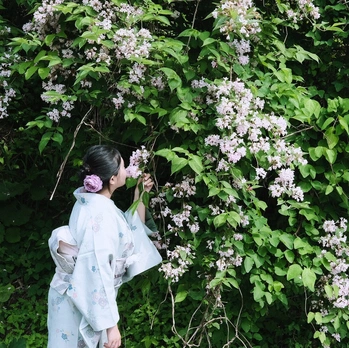
Three Gates (No. T028, 2003) was created by Greek-American artist Stephen Antonakos. Fascinated by the shape of vertical gateways, he created a new form where two gates work together at their peaks. Even when heavy snow falls, people can find their way through them.
Behind the gates stands Three Travelers (No. T305, 2015), designed by the same architect as the Satoyama Museum of Contemporary Art—the renowned Hiroshi Hara. Three travelers, a motif that also appears in an Austrian village.
Satoyama Museum of Contemporary Art: My Lucky Place
The Satoyama Museum of Contemporary Art (No. T025, 2003–2015), also designed by Hiroshi Hara, is a comprehensive cultural facility combining contemporary art exhibition halls, a hot spring, a café, and a local specialty shop. The museum itself is a work of art, with a vast open atrium embracing the sky—an open building that invites nature inside.
In 2012, it was upgraded to a contemporary art museum, with a permanent exhibition on the second floor. The Satoyama Radio Station and the official Art Field shop are also here. This year's theme was "Hojoki" (The Ten-Foot-Square Hut), with space designed around a "one-jō-square" (about 3 meters) concept, featuring modular, movable small structures.
I call the Satoyama Museum my lucky place because here I met incredibly helpful Art Field staff, and also encountered the kimono shop owner I'd met two and a half years earlier. Their kindness helped us fulfill our wishes for the rest of the trip.
The Museum of Stars and Forest Poetry
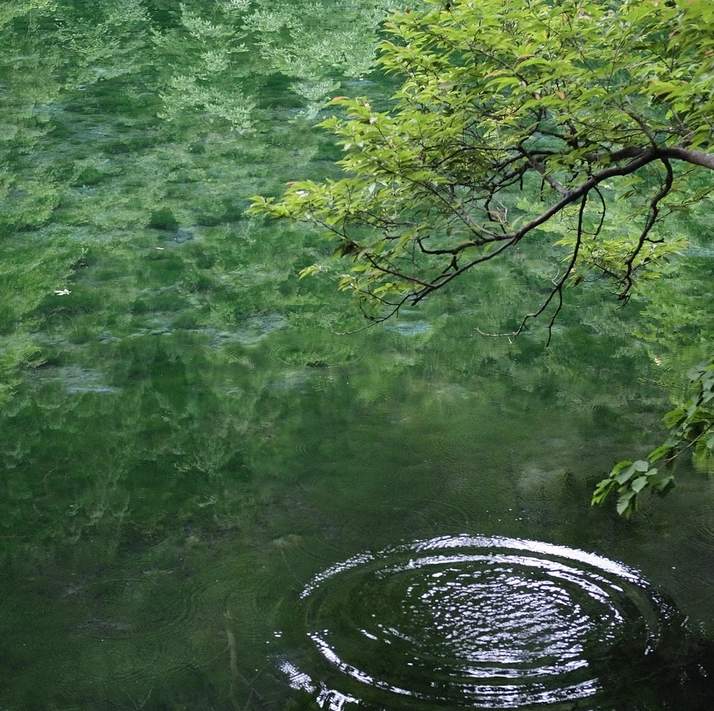
Hidden deep in the forest, this tiny museum's name alone stirs the imagination. It faces a small lake—absolutely stunning! Sure, there were plenty of mosquitoes, but that didn't matter. We went to see a woodblock print exhibition. Beautiful, but not for sale, and no photography allowed. Just look with your eyes and feel with your heart.
The Museum of Picture Books and Forest Fruits
No. T173, 2009–2015. There are two versions of this story. One goes like this: When picture book artist Seizo Tashima arrived at Sanda Elementary School, abandoned in 2005, he began to weave a story in his mind—about the last three students left at the school, their favorite female teacher, and the ghosts that had always lived there. This isn't a horror story; the ghosts have their own personalities.
The official version is that the artist transformed the entire school into a "space picture book," giving it new life by telling the story of those last three students. In 2015, "monster" and "goat" works were added.
Whether story or reality, both are tinged with sadness. That's Echigo-Tsumari for you: many works are created from abandoned schools and homes. The principal's office is now a café serving light meals and cake. We could almost see Seizo Tashima's mischievous smile.
Matsudai: A Gathering of Masters
The area around Matsudai Station is dotted with green fields and terraced rice paddies, with about 50 art pieces scattered across the "Satoyama Field Museum."
The Rice Field Stage—Snow Country Farming Culture Village
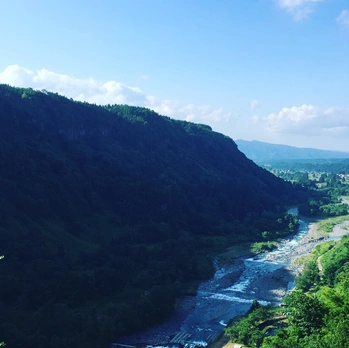
No. D053, 2003–2015. This is the center of the Satoyama Field Museum, designed by the Dutch architecture firm MVRDV—their first project outside Europe. Finding works around the Rice Field Stage was a bit of an ordeal: narrow uphill roads and difficult parking. During the festival, it's best to walk.
Matsudai Residents' Museum
No. D054, 2003, by Spanish artist Josep Maria Martin. The second floor has a small exhibition of this year's works and images.
In the Desert, Around the Fire
No. D057, 2003, by French artist Fabrice Hybert. The light comes entirely from natural sources.
Climbing Frame on Wheels
No. D116, 2004, by Japanese artist Hitoshi Ushijima. Originally outdoors, it's now displayed alongside a work by Japanese artist Shuzo Fujimoto.
The Rice Terraces: Art Field's First Work
No. D001, 2000, by Russian-American artists Ilya and Emilia Kabakov. This work blends poetry, rice paddies, and sculpture, turning the silhouettes of farmers at work into yellow and blue metal cutouts, magnified several times and placed among the terraced fields. In winter, they are buried under snow; now, in spring, they merge vibrantly with the land.
Flowers Blooming in Echigo-Tsumari
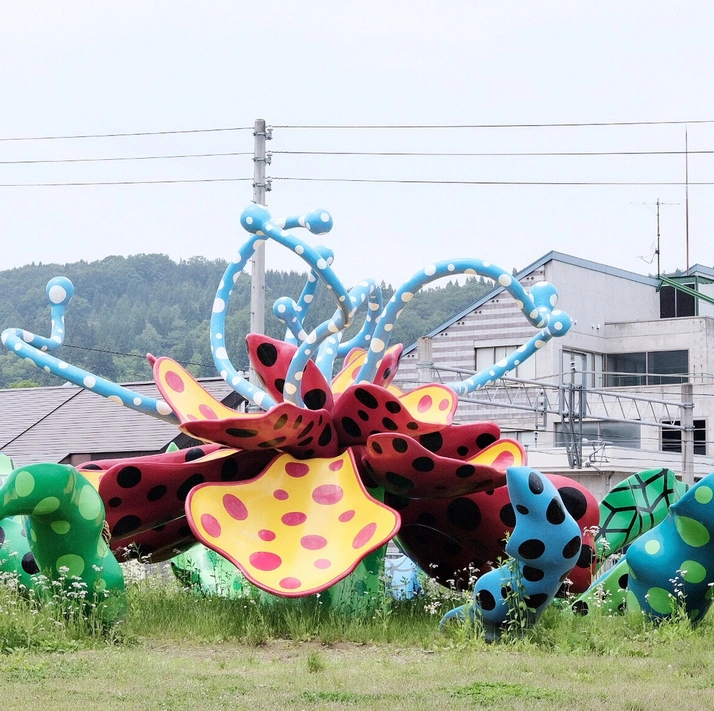
No. D061, 2003, by Japanese avant-garde artist Yayoi Kusama. She said: "This is a work created together with the land of Echigo-Tsumari—one of my proudest pieces. I hope people from all over the world come here and are deeply impressed by the forest and these artworks."
Rice House
No. D066, 2003, by Chinese artist Yung Ho Chang + FCJZ. We drove around the mountains for ages trying to find this one. On our way back, we spotted it by chance, but there was no road leading up to it—a bit disappointing.
Water Basin
No. D004, 2000, by Japanese artist Izumi Tachibana. In 2000, it was placed in this abandoned terraced rice paddy. When water drips from the basin, it produces an inexplicable melody, as if reminding us of what the terraces truly need. Eighteen years later, the terraces have been reborn, with trees and flowers.
Scarecrow Project
No. D006, 2000, by Brazilian-American artist Oscar Oiwa. Red scarecrows are scattered across the terraced fields. One extends an arm; another holds a baby—representing a family working the land.
○△□ Tower and Red Dragonfly
No. D003, 2000, by Japanese artist Shintaro Tanaka. A red dragonfly sculpture sits atop a 14-meter-high pillar, swaying in the breeze under the blue sky. Winter snow buries many works, but this red dragonfly is meant to bring spiritual solace to the people living in the snow country.
Inverted City
No. D184, 2009, by Cameroonian-Belgian-French artist Pascale Marthine Tayou. A row of giant pencils hangs from a thick beam, each pencil bearing the name of a country. The pencils vary in color and height, fixed in a stainless steel frame about 2 meters high. Looking up at it, you feel both awe and a sense of threat.
Castle 61
No. D002, 2000, by French artist Christian Lapie. These charred wood sculptures stand on the slope of Mount Tanada, resembling a community or a group of people. The artist created a new world on a site where a house once stood, bearing witness to human life and history.
Traveler's Labyrinth
No. D063, 2003, by Japanese artist Isao Toshimori. Inspired by ancient European labyrinths used to pray for the safety of sea travelers, the artist hopes all travelers can begin a new life journey by following the maze, appreciating the blessings of nature.
Step in Plan
No. Y026, 2003, by Dutch artist John Körmeling. This is a large signboard at a crossroads in Tokamachi and Matsudai. Look closely, and you'll not only find a map of Matsunoyama but also climb the map tower. It started as a small toy model and was expanded to over 20 meters high. The text design was done by Japanese typography master Katsumi Asaba. The two artists had never met until the day the work was completed, when they coincidentally ran into each other and immediately embraced. The azaleas around the work were planted by Körmeling and local residents.
Nakasato: Stories That Move You to Tears
The Satoyama Museum of Contemporary Art was my lucky place. Thanks to the helpful staff I met there, we got to know SU-chan. Though we only had half a day, and it was raining, she took us on a tour of the Nakasato route. SU-chan is an incredible storyteller. At every stop, the stories she told moved Little Tiger and me so deeply that tears welled up in our eyes.
For the Many Lost Windows
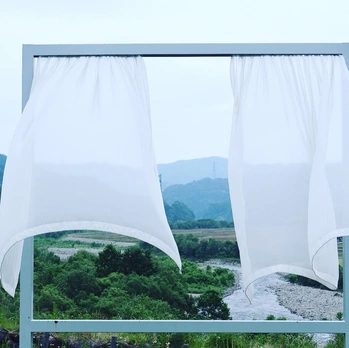
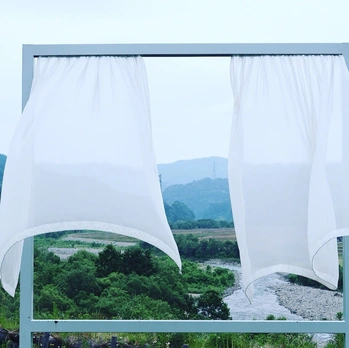
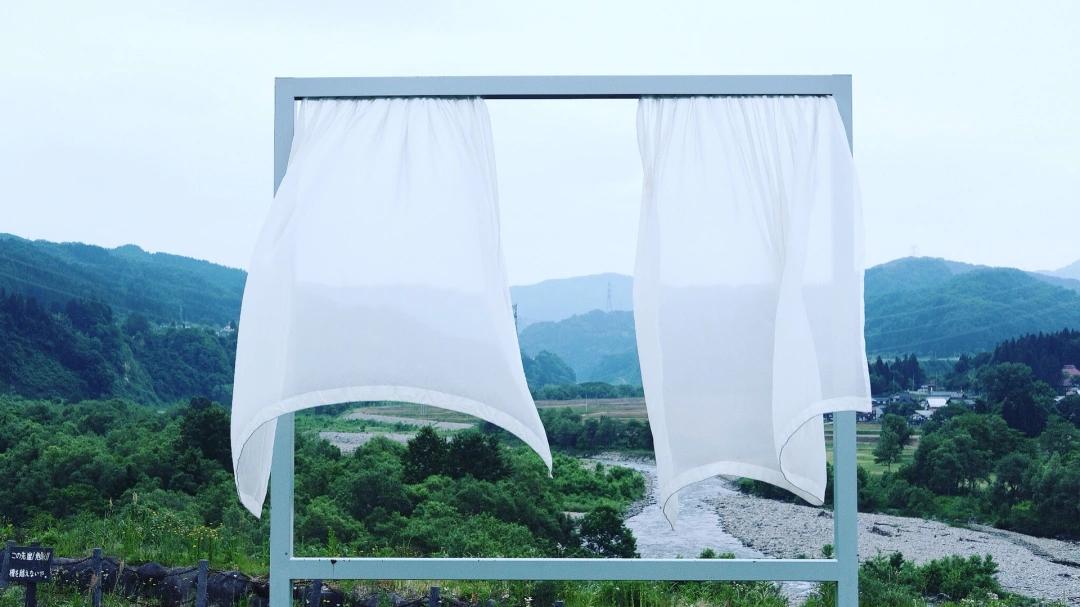
No. N028, 2006, by Japanese artist Akiko Utsumi. The view from a room's window becomes "my view." The village across the way was nearly wiped out by an earthquake; people lost their homes, lost the scenic views from their windows. Utsumi resolved to create a work like a small flower, one that wouldn't obstruct nature. She placed a window in the middle of a rice paddy, hoping the fluttering curtains would bring sunshine and the breeze of the satoyama (rural countryside) to visitors' hearts, reminding them to always remember the beauty that once was, and to stay strong even in hardship.
Potemkin
No. N019, 2003, by the Finnish architecture firm Casagrande & Rintala. This work addresses a riverside forest in the village of Kuramata that had been illegally used as an industrial dumping site. It's part of Niigata Prefecture's "Pocket Park Development Plan." The artists were involved from the start, ensuring the work retained the basic elements of a park while being completed within the public budget.
We affectionately called it the "Iron Park." A great place to cool off in summer, with tire swings for kids. Traces of Taiwanese visitors from the day before were still there. There was also a meditation spot.
Kiss & Goodbye
No. T325, T326, 2015, by Jimmy Liao (Taiwan, China). The JR Iiyama Line connects Nagano and Niigata prefectures. Jimmy Liao entered two of its stations and brought the world of his picture book Forget Me Not to life in three dimensions around the stations.
Jimmy Liao loves Echigo-Tsumari and has visited many times. But when his agent approached Fram Kitagawa, he was rejected several times. Once, when Kitagawa mentioned Jimmy Liao in his office, a Hong Kong staff member exclaimed excitedly, "Is it really Jimmy Liao? Is he really coming?" This joyful conversation convinced Kitagawa to accept him.
In 2015, Jimmy Liao's team created three-dimensional installations of two scenes from Forget Me Not at the Echigo-Yuzawa Station and Tsuchiari Station, two small stops on the JR Iiyama Line. To make them permanent exhibits, Jimmy Liao launched a fundraising campaign in Taiwan, with donors' names left on the works.
At Tsuchiari Station, the nearby kindergarten teacher wanted the children to participate in the creation. Some of these little ones couldn't even talk yet; it was their first time seeing a foreigner, their first time holding a paintbrush. Each child worked with such care. And so, the children and Jimmy Liao's team completed the work together. The parents would proudly say, "My child was part of this artwork."
Epilogue: Healing with a Decade
The Echigo-Tsumari Art Field is a treasure hunt that anyone can join and enjoy. 33 works, 33 stories—each one deeply moving.
What can you do with ten years? What can you gain, what can you lose? What can you keep, what can you change? What can you start, what can you end?
If I spend ten years getting to know, understanding, and cherishing someone, then it doesn't feel long at all. Ten years ago, on a late spring night in Beijing, that young man with the warm smile standing under a tree became my friend for a decade. We traveled together from Beijing all the way to Echigo-Tsumari, healing each other through companionship.
What Echigo-Tsumari taught me is not how great art is, but how art can restore hope to forgotten places and bring smiles to lonely, neglected elderly people. Those abandoned schools, those forgotten villages—reborn through the hands of artists. Those who lost their windows find their views again in the fluttering curtains.
If you ever have the chance to visit Echigo-Tsumari, please slow down. Don't just snap photos and check in. Listen to the stories behind each work. You'll discover that what truly warms the heart is not art itself, but the people who create it and the lives that art transforms.
Practical Tips: - Best travel times: May (spring) or August (during the Art Field) - Transportation: Self-driving recommended; the 760 sq km area is vast - Approximate cost: About 26,000 RMB per person (8 days) - Must-see works: The Rice Terraces, Flowers Blooming in Echigo-Tsumari, Kiss & Goodbye, For the Many Lost Windows - Food recommendation: Teradomari Seafood Market (cheap and fresh)
Echigo-Tsumari: healing with a decade. And I will come back again.
You should also read:

Solo in Yunnan: A Wanderer’s Guide to the Land of Eternal Spring
Solo in Yunnan: A Wanderer’s Guide to the Land of Eternal Spring There’s something magical about traveling alone. No compromises, no schedules to keep, no one to please but yourself. I’ve been on the road for nearly three months now, and not once have I…
Continue reading...
God’s Abandoned Palette: A Self-Drive Journey Through Yunnan’s Dongchuan Red Land
God’s Abandoned Palette: A Self-Drive Journey Through Yunnan’s Dongchuan Red Land Travel has never been about reaching some distant geographic coordinate. It’s about encountering, along the way, the version of yourself buried beneath the rubble of daily routine. During this May Day holiday, I finally…
Continue reading...
Body in Hell, Heart in Heaven: A Pilgrimage Through Tiger Leaping Gorge — A Dialogue Between Heaven and Earth
Body in Hell, Heart in Heaven: A Pilgrimage Through Tiger Leaping Gorge — A Dialogue Between Heaven and Earth Introduction: When the Gorge Splits Open Beneath Your Feet Some say Tiger Leaping Gorge is the closest place on Earth to the border between "hell" and…
Continue reading...