A Date with the Milky Way at 4,200 Meters: Finding the Soul of Autumn in Shangri-La
A Date with the Milky Way at 4,200 Meters: Finding the Soul of Autumn in Shangri-La
Prologue: When the Photographer Finally Becomes the Subject
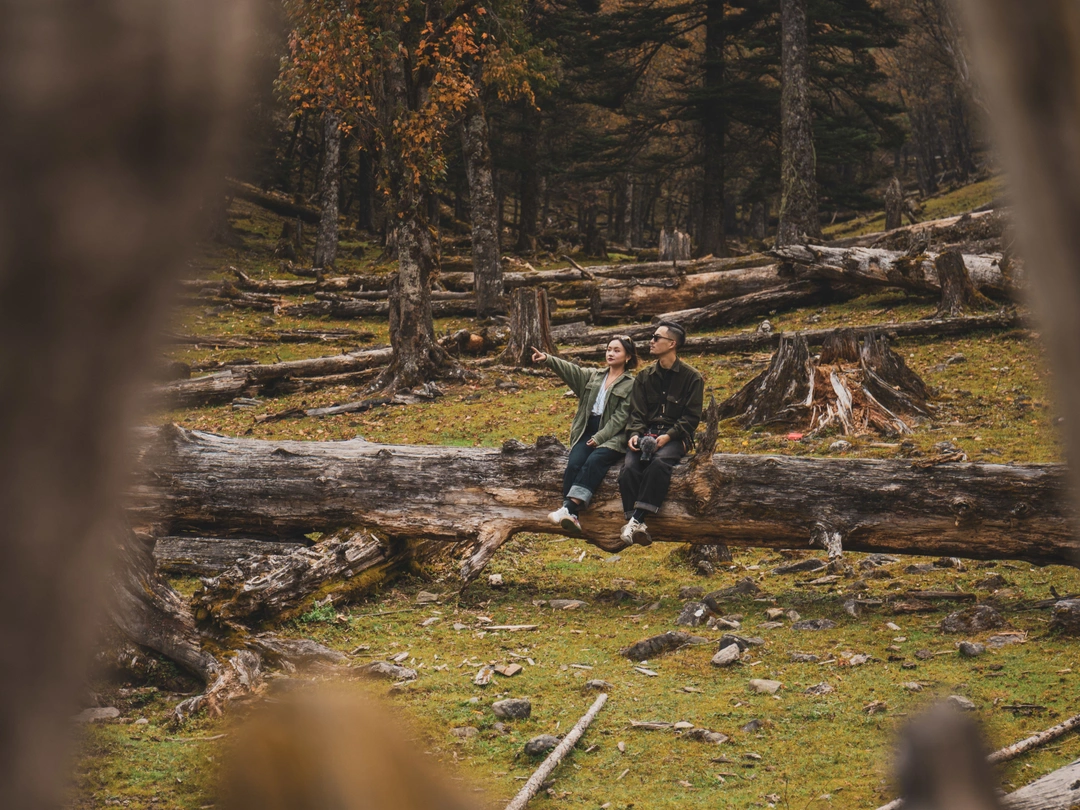
For most people, autumn is a season of harvest. For us—a pair of post-95s photographer lovers—it used to mean one thing: peak season. Every year, we'd run from park to park, campus to campus in Kunming, capturing "autumn portraits" for countless girls. Like migratory birds, we migrated through the season year after year, never truly owning a single autumn for ourselves.
Then came October 2020. An unexpected invitation pulled us deep into the mountains of Shangri-La. And there, we finally gave autumn back to ourselves.
This isn't your typical travelogue. This is a story about escape. About reunion. About embracing the Milky Way at 4,200 meters above sea level. Mountains, seas of clouds, canyons, lakes, pastures—and the songs of herders echoing through the mist, the jingle of bells around horses' necks. These became our most precious memories of this autumn.
If you don't have the patience to read every word, at least look at the pictures. But if you'll spare a few minutes, I want to tell you: the real Shangri-La might be closer than you think.
Chapter One: Heading for the Shangri-La in Your Heart

Shangri-La Is Not a Legend—It's Real
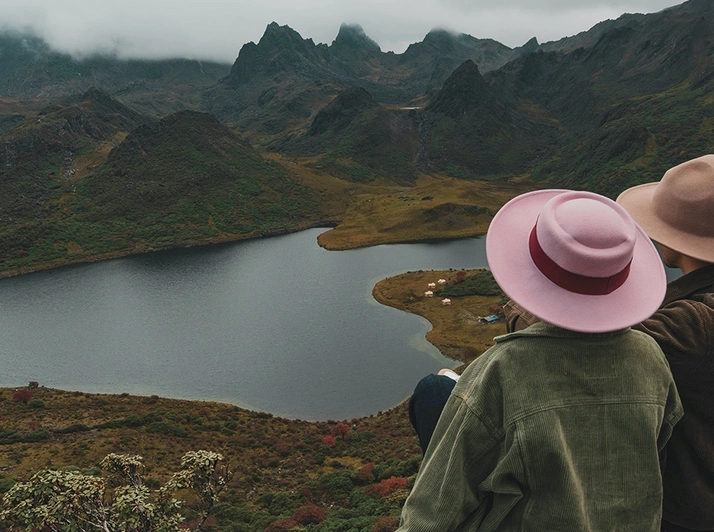
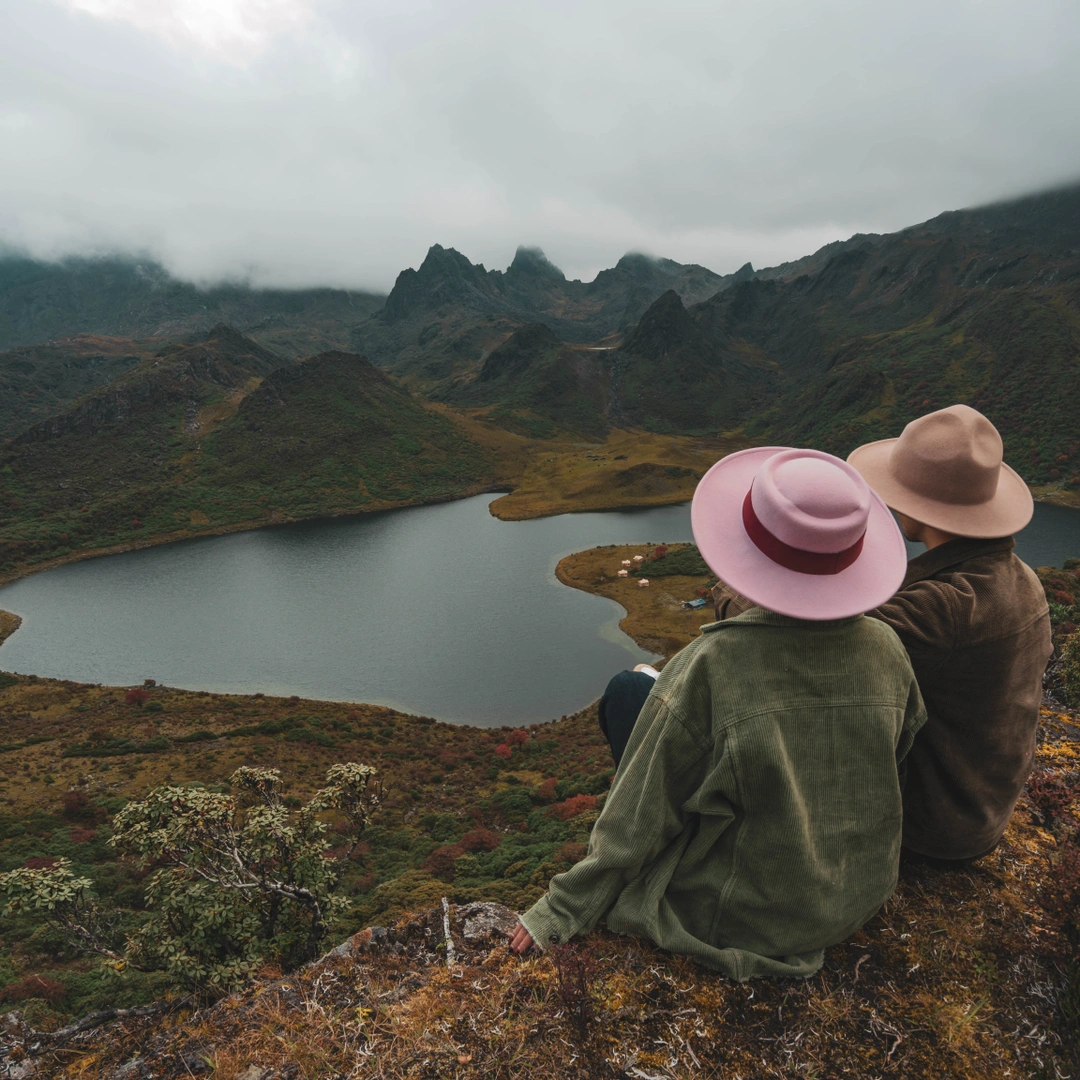
"Deep in the snow mountains of the Qinghai-Tibet Plateau lies a hidden place, a kingdom surrounded by double-layered snowy peaks. There are glaciers, canyons, forests, meadows, lakes, gold mines, and pure air—this is the kingdom of Shangri-La."
That's the ideal world James Hilton painted in Lost Horizon. For many, Shangri-La is abstract, aspirational, even unreal. But in Yunnan's Shangri-La, in this valley where we "embraced the autumn Milky Way," I found my own true Shangri-La.
An Adventure Born from an Online Meetup
It all started at the end of September. A user named "Xingchen" (Starlight) messaged our studio, inviting us to experience a niche route he'd personally crafted.
I'd heard of Xingchen before. He was a well-known photographer in Kunming, later opened a city guesthouse. My best friend and I had even stayed at his Xi'an property during college. Later, Rose and I opened our own photography studio and guesthouse locally. Xingchen had been quietly following our social media for a long time. In September, he extended this invitation. We met for the first time at Starbucks, hit it off immediately, and started planning this "cloud journey."
The route was indeed Xingchen's own creation. This year, his city guesthouse added a "wild luxury" stargazing camping itinerary—though "wild luxury" is my own label. The route's flawless execution depended on local guides, horse handlers, and those adorable, well-behaved horses.
Xingchen's guesthouse has a beautiful name that fits the route perfectly: Fanxing (Starlight).
From Dali to Shangri-La: The Rain God Finally Took a Break
After wrapping up Rose's work in Dali, we met up with an old friend, Sanbing, and drove several hours through the night to Lijiang. We planned to rest briefly and set off for Shangri-La early the next morning.
The next day, we woke up naturally, took our time, and passed the bridge that reads "Welcome to Diqing" again—six months since our last visit.
Our destination this time was Haba Village, at the foot of Haba Snow Mountain. The route required passing through the middle-upper section of Tiger Leaping Gorge. It's dangerous, sure, but not as terrifying as the rumors suggest. The problem was the constant road construction over the past two years—drive a bit, hit a traffic jam, drive a bit more. Add the sheer cliffs along the way, and nobody dared to speed.
Strangely enough, we'd been to Lijiang many times, and it rained every single time. Except this time. Blue skies and white clouds accompanied us the whole way. I sighed with relief that the "rain god" had finally clocked out, and felt even more hopeful about this journey.
Canyons began appearing along the road. From inside the car, we couldn't see the cliffs below, but we could hear the roar of the raging river. When we reached the main entrance of Tiger Leaping Gorge Scenic Area, the staff asked us to buy tickets. We explained we weren't entering the scenic area, registered our information, and drove straight through toward Haba Village.
When we saw that big road sign, we knew we'd truly entered Tiger Leaping Gorge. On the left, hundred-meter cliffs. Taking photos from the car felt like documenting the beginning of an expedition. On the right, another cliff face, with one rock that looked uncannily like a tiger's head. We hit our first traffic jam just as we entered the gorge—right under that "tiger head."
Looking back, the road had no guardrails on the right side. I stood by the car door and photographed the river below—muddy water flowing into the distance. Compared to the rapids inside the scenic area, it was already much calmer here.
Sanbing, who was traveling with us, was an entertaining chatterbox. Normally, I sleep through road trips, but this time I didn't close my eyes once. We talked about our college days shooting photography, about how we'd changed over the years. We reached the same conclusion: neither of us was really cut out for turning photography into a business.
First Night in Haba Village: A Taste of Home
When we reached a small canyon, we knew Haba Village was getting closer. Sanbing said this was a secret photo spot he and Xingchen had discovered on their last trip. White clouds drifted over the river valley and plains, and through the gap in the tall mountain canyon came the softest beams of pre-sunset light. It was a heavenly spot—so beautiful you could appreciate it with just your naked eyes.
Tiger Leaping Gorge in autumn was under construction almost the entire way. A journey that should have taken two or three hours stretched into nearly six. The last stretch of mountain road before Haba Village was still under construction. We waited for an excavator to go back and forth a few times, and another 40 minutes vanished on that dirt road.
When we reached the guesthouse, it wasn't dark yet. We could just barely see the faint glow of the sun beyond the mountains. Ribbon-like clouds floated among the peaks—truly like a fairyland.
The guesthouse was called "Haba Cloudside Inn," located in a local Hui Muslim village. The landlady came out to greet us, and the guide for the next day had already arrived and was waiting. The landlady wasn't that old, but I have a habit of calling some people "Ayi" (auntie)—though it was a bit awkward, since everyone else called her "Jiejie" (big sister).
Jiejie warmly asked if we were hungry. If so, we could eat first without waiting for Xingchen. He'd taken guests up the mountain that day and was still on his way down when we arrived. Jiejie had stir-fried a few dishes in minutes. The first bite tasted like home—exactly like my grandmother's cooking! My stomach clearly loves home-style food best.
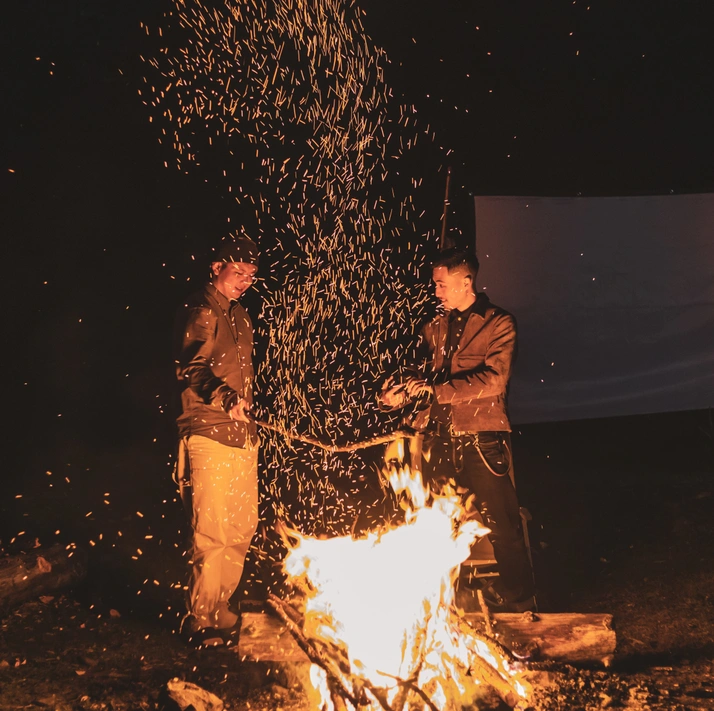
We'd barely put down our chopsticks when Xingchen returned. He'd specially bought a light-painting wand, waiting for us to play with it together.
Evenings in Haba Village are wonderfully relaxing. The guys fiddled with the light-painting wand on the grass outside. I sat in the kitchen, drinking tea Jiejie had brewed, warming myself by the newly lit stove, chatting with her. Jiejie had started researching Xiaohongshu (Little Red Book) to promote the inn, but she was too busy to post consistently. She regretted it herself.
Before bed, our guide Brother Chen gave us a pannier bag—the kind used on horseback. We couldn't bring suitcases up the mountain. One backpack each—and of course, ours were filled entirely with camera gear.
Back in our room, we quickly packed our camping gear for the next day. Medicine, wet wipes, disposable underwear—all essentials.
I went to sleep nearly five hours earlier than usual. Someone who normally stays up until 2 a.m. was scrolling through their phone, ready to sleep by 9:30. But lately, I've been struggling with unfamiliar beds. I never sleep well the first night in a new place. My mind kept thinking: tomorrow has to be sunny. I finally drifted off around 4 a.m.
Chapter Two: Stepping into the Forest's Milky Way
Pre-Departure Preparations
I woke up a little past eight. I pulled back the curtain—bright, cloudless skies outside. I rushed to get ready, then practically ran downstairs for breakfast. Jiejie had prepared rice noodles (mixian)—again, exactly like my grandmother's cooking. I immediately messaged my mom: "Today's sister cooks just like home. I love it!"
After breakfast, Xingchen gave us a short camping orientation. He explained the route, taught us how to start a fire in the wild, and distributed gear: one headlamp per pair, a pair of gloves each, a whistle, a raincoat, and a pack of dry rations. That pack of rations would eventually become my "scenic-view snack" while stargazing.
"Nature bestows life with vitality and beauty, like hidden treasures waiting to be discovered."
The expedition team set off!
Riding Through Della Pasture
Our route: start from Haba Village, drive through the Yi ethnic village, gather at the pasture above it, ride horses with pannier bags uphill, pass through Della Pasture and Yangfang Pasture, camp at Lanhuaping (Orchid Flat) tonight, and reach our final destination tomorrow—a place the locals call "Black Sea Lake."
Xingchen told us to reply to any WeChat messages quickly and post on social media—because once we went up the mountain, we'd be completely off the grid. For most city dwellers, losing signal—is it anxiety and panic, or a rare chance to relax? Rose and I have recently come to enjoy this state. For me, with dozens of WeChat messages piling up every few minutes, I welcome any chance to find quiet and truly appreciate what's in front of me.
As our car wound through the Yi village, I messaged my close friends: "I'm going off the grid for three days!"
When we reached the meeting pasture, the horses were already there, grazing on the grass. My horse was led up from the village by a Yi auntie. Brother Chen helped us tie all the pannier bags onto the horses' backs. Since my horse was smaller, and I'm a lightweight woman, the luggage distribution worked out perfectly.
First stop: Della Pasture. I was still a bit scared of riding at first. I didn't dare take out my camera. Both hands gripped the saddle handle tightly as I tried to adjust my balance going uphill and downhill, terrified of falling off. From the start to Della Pasture, the scenery was so beautiful it made me want to cry—but I didn't take a single photo. I kept it all in my eyes. It was my first time in such pristine nature. I was so excited that when I held up my camera to shoot a VLOG, I talked way more than usual.
When we reached Della Pasture, everyone dismounted awkwardly. As for me, the horse handler practically had to lift me off—so clumsy I wanted to cry, which made everyone burst out laughing.
This is what Della Pasture looks like: surrounded by forest, clouds swirling around the mountaintops. The clouds shifted quickly, making the sunlight flicker across the mountains. Scattered dots of sheep dotted the meadow—adorable.
Xingchen's horse was called Ali. Obedient and sensible, he was the tallest in the team, often leading the way like a big brother. Brother Chen, our guide in green, had years of mountaineering experience. Routes like this were a breeze for him. The auntie in red ethnic clothing—her horse was the gassiest in the team. It farted countless times along the way. It was also Sanbing's mount. Sanbing kept saying the horse had a bad liver, then changed his mind: "I've decided—this is a foodie. It never stops eating grass. No wonder it has so much gas."
The auntie in the headscarf was my "horse handler" on the first day. On the second day, her son brought the horse. The young guy kept saying this horse was the best-behaved. I never learned its real name, so I gave it one myself: "A-Brown." Names starting with "A" feel more fitting for the Tibetan region.
Light and Shadow in a Hidden Realm
On the way from Della Pasture to Yangfang Pasture, we crossed a small stream. It flowed down from Black Sea Lake—a true glacial spring! The water was bone-chillingly cold, but when I tasted it, it was surprisingly sweet. Inside the Haba Snow Mountain Nature Reserve, everything is well preserved.
A gravel path wound into the distant forest. The stream flowed between the stones. At first glance, it looked like a secret realm. Xingchen found a rock to sit on—probably the highest photo spot around. With that pose, he already looked like the expedition leader.
Brother Chen could tell we were itching to take photos. He knew there was no stopping us from starting our shoot right here. He handed me my backpack to get my camera, then said he'd go ahead to the herder's hut and wait for us. We should hurry up and finish shooting.
That little path—we got completely addicted. We photographed it from every angle. Xingchen was about to move on when he turned back and saw our position looked good. He asked Sanbing to pass him the camera and successfully captured our first couple photo of the trip.
On the way to the herder's hut, I realized autumn comes fast in the Haba Nature Reserve. The trees were turning yellow. The grass was taking on a faint yellow-green hue. The earth really had put on a light-yellow coat.
We passed a herder's hut. Inside was the shepherd's own vegetable garden. Behind the hut stood a single golden tree—the only perfectly shaped tree within a kilometer. It looked profoundly lonely. A path made of old wooden planks seemed to lead into the deepest part of the forest. I loved this little path. Having Sanbing along was a blessing—he's a professional wedding photographer, after all. He coached us through every pose.
Butter Tea Time at the Herder's Hut
As we neared the hut, the road turned into an uphill climb. Altitude sickness started kicking in. Every step was a struggle. My legs felt like they were filled with lead. I couldn't catch my breath. I took tiny steps, hoping that would give me enough strength to reach the hut on the hillside.
From a distance, I could see Brother Chen and the horse-handler aunties tying up the horses in front of the hut. Brother Chen stood at the door, waving. Xingchen, Sanbing, and Rose were already far ahead of me. By the time I reached the hut, I was gasping for air.
Brother Chen told me to wash my hands quickly and come inside to eat some baba (flatbread). The water for washing was glacial spring water—bone-chillingly cold, clear, and sweet. The horse handlers all cupped their hands and drank some after washing. The aunties sat at the door, eating lunch and chatting, showing no signs of fatigue.
An old grandfather lived in this hut year-round. Every winter, he'd spend time up in the mountains. His daily lunch was simple: butter tea with plain flour baba. Locals only drink salty butter tea—the milk and oil flavor is richer. Grandfather burned firewood. Next to the fire lay the baba. We sat around the fire, warming ourselves.
Inside the small hut was a container for churning butter tea. We sat by the fire watching Grandfather make the tea. He put in quite a bit of butter. Rose couldn't get used to the taste, but I was fine—I'm an old hand in Yunnan, always the quickest to adapt to local customs. Except this time, Grandfather put a bit too much salt in the tea. Even Brother Chen found it salty and kept adding hot water.
Our luck on this trip was incredible. It had been rainy for days before, but the day we went up the mountain was perfectly clear. While we sat in the hut drinking tea, sunlight filtered through the clouds and slipped through the gaps in the wooden walls, creating beautiful patterns of light and shadow. For a moment, it felt like a scene from a fairy-tale wooden cabin.
Brother Chen, leaning against the doorframe smoking—he looked incredibly cool! That little wooden hut was a perfect setting for dramatic light-and-shadow photos.
Crossing the "Tree Beard" Forest
We chatted with Brother Chen and the grandfather for a long time. Since both Brother Chen and the grandfather were Hui Muslims, we had even more to talk about—I'm Hui too. Brother Chen said the Hui people in Shangri-La were descendants of those who migrated south from the north long ago to escape war. That's why, in this predominantly Tibetan area, Haba Village also has a Hui village.
We said goodbye to Grandfather. Brother Chen and the aunties went out first to adjust the pannier bags on the horses. In my heart, I secretly hoped I'd get to see Grandfather again.
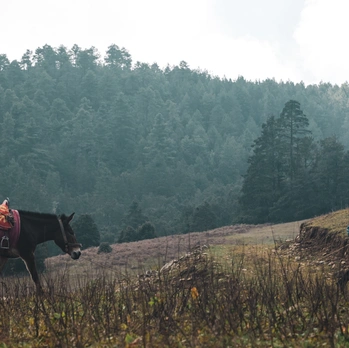
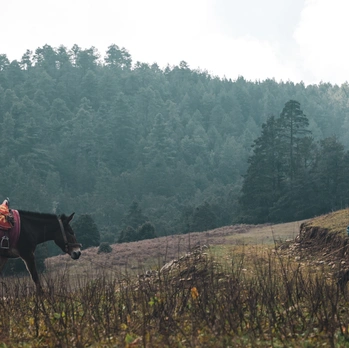
As we entered the forest ahead, the surrounding trees were draped in "beards." Brother Chen called it "songluo" (lichen); locals call it "tree beard." This stuff doesn't grow just anywhere—it only appears in places with excellent ecology. In the Haba Snow Mountain Nature Reserve, it hung from nearly every tree. In other scenic areas of Shangri-La, you'd need to go to higher altitudes to find it.
We passed through fir trees covered in tree beard. The horses carried us over fallen logs lying on the moss. About 20 minutes deeper into the forest, we'd reach today's campsite. Trees full of beard, ground covered in yellow-green moss—like stepping into a dream forest. This was Alice's Wonderland!
The Campsite: Warmth Under the Stars
We emerged from the forest into an open space. The sky was clear, though the distant Haba Snow Mountain was hidden behind clouds. Still, Xingchen said this was the best weather they'd had recently.
When we reached this open meadow, we were just a few hundred meters from the campsite. But no one could resist the urge to take photos. We lined up for our "posing-on-horseback" shots. Brother Chen, wearing his green work hoodie, put on a brown fedora Xingchen had bought for the camp staff, and carried my big backpack—he looked more like an explorer than anyone else.
From a distance, we could see the camp tents. The local guys had already set up the campfire. Smoke curled into the distance. I was still out of breath, so I picked up a tree branch to use as a walking stick. It actually seemed to help.
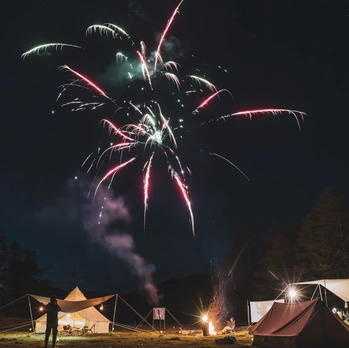
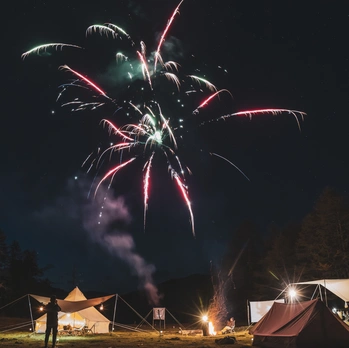
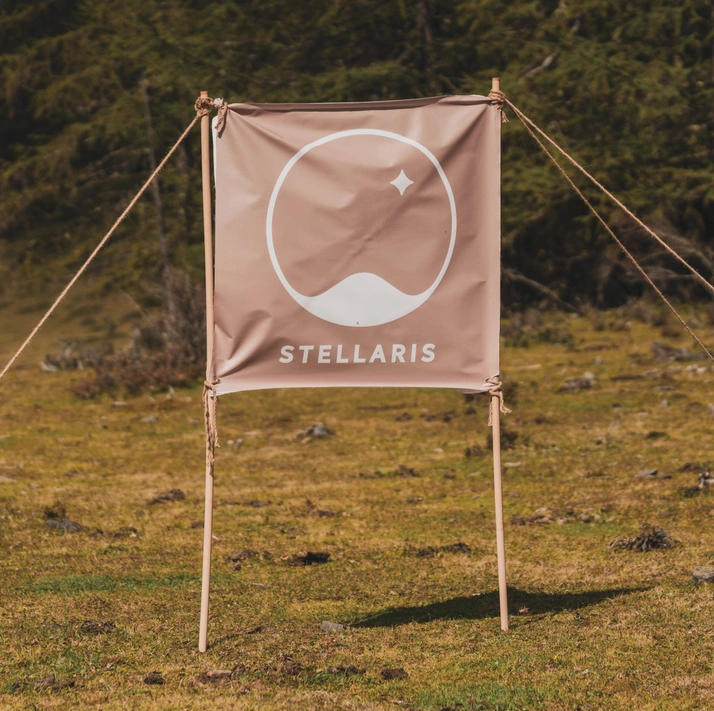
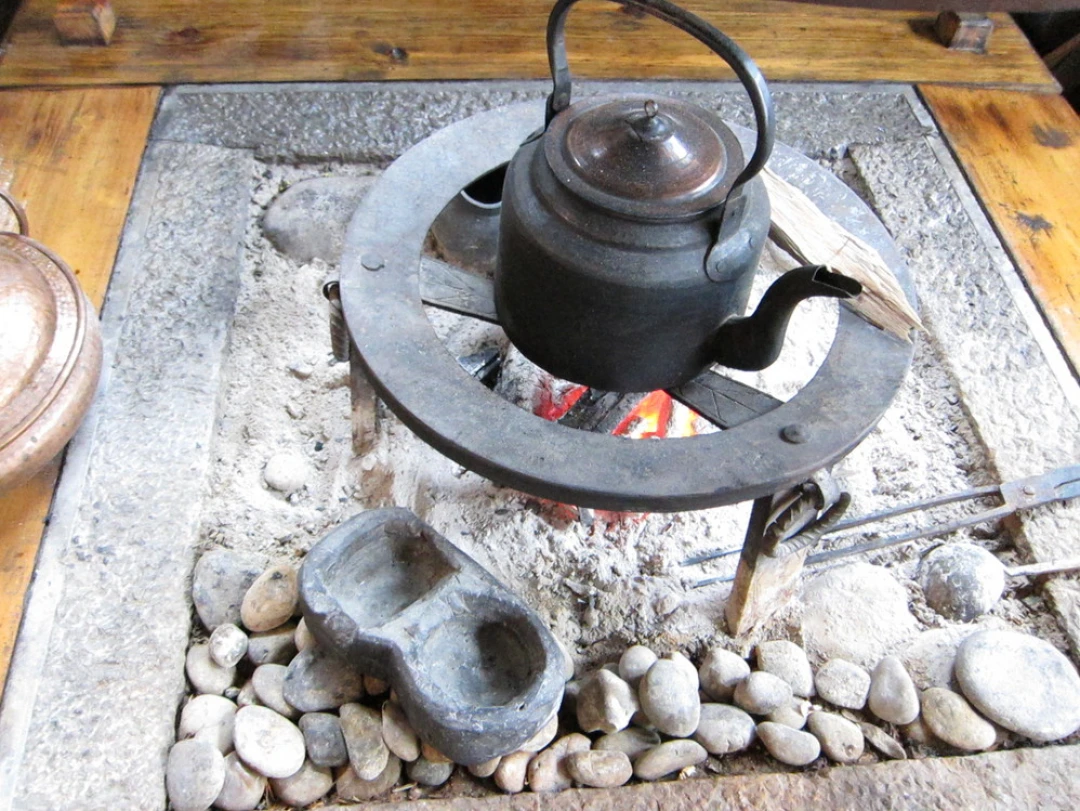
At the campsite, the "Fanxing" logo stood prominently at the entrance. An iron kettle simmered over the campfire. The guys filled our thermoses with hot water. All camp trash would be burned here—that's how local Tibetans do it. Not a single piece of litter remains on the mountain.
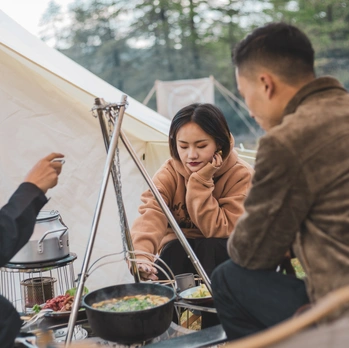
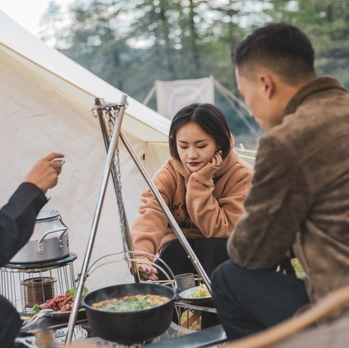
The guys were already preparing lunch. With simple outdoor cooking gear, they'd make all our meals for the next few days. Xingchen called us into the main tent for hot tea. "Lunch is fried rice," he said. All the ingredients—vegetables, fruits—were brought up from the village by horse. Because of that, every bite felt more precious.
The main tent served as our "living room." Xingchen had decorated it warmly and romantically. A small table held fruit and flowers. Wooden crates and kerosene lamps were arranged perfectly. Yunnan's autumn sunlight was especially beautiful that day. Behind the main tent, the sky was surprisingly blue. Clouds kept shifting with the wind—hard to believe this place had been rainy just days before.
The sleeping tents were also thoughtfully arranged: military-style tents and teepee tents. Double beds only fit in the military tents. Rose and I chose the one closest to the "kitchen." If I were traveling alone, the cute teepee tent would definitely be my first choice.
Epilogue: The Milky Way Burns Hot, and Life Is Worth Living
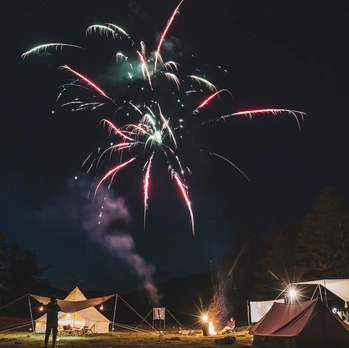
At the 4,200-meter campsite, we sat around the campfire. Above us, the Milky Way blazed. Beside us, the fire glowed warm. In that moment, I finally understood why so many people are willing to travel over mountains and rivers just to see the stars.
Not because the stars are beautiful—though they are. But because when you stand under them, you realize how small you are. How insignificant your worries become. All that anxiety, that rat-race pressure, that obsession with engagement metrics back in the city—it all seems laughable here. All you can think is: it's good to be alive. It's good to be alive like this.
The next day, we rode to our final destination—Black Sea Lake. The water was so clear you could see the bottom. It reflected the snow mountains and clouds. We set up our tents by the lake and waited for sunset. When the last ray of sunlight disappeared behind the ridge, the Milky Way slowly rose—like a river of light flowing across the sky.
In that moment, I understood what it means when people say "the Milky Way burns hot." Not hot in temperature—hot in the heart. That feeling of being so moved by nature that words fail you. That awe of realizing you're alive in the middle of a miracle.
Practical Tips
If you want to experience this "embrace the autumn Milky Way" journey, here are some practical tips:
- Best Time: Mid-to-late October through early November. Autumn colors are at their peak, and the weather is relatively stable.
- Gear Checklist: Headlamp, gloves, whistle, raincoat, dry rations—these are the basics.
- Dealing with Altitude Sickness: 4,200 meters is no joke. Prepare in advance. Walk slowly.
- Prepare to Go Off-Grid: No signal on the mountain. Arrange your work in advance. Tell your family and friends.
- Environmental Awareness: Pack out all trash. Protect this pristine land.
- Horseback Riding Tips: Lean forward going uphill, lean back going downhill. Hold on tight.
- Stay Warm: Temperature differences between day and night are huge on the plateau. Down jackets and thermal underwear are essential.
Final Thoughts
This journey taught me one thing: real travel isn't about checking in at spots and posting on social media. It's about giving yourself to nature, letting nature redefine you.
At 4,200 meters, we embraced the Milky Way. We crossed mountains and lakes. And we found ourselves. The Milky Way burns hot—not because of temperature, but because of passion.
If you feel the city is too crowded, life too anxious, give yourself a trip like this. Go to a place 4,200 meters high. Look at the stars. Listen to the wind. Let yourself come alive again.
Because Shangri-La is not a legend. It's there, waiting for you to set out.
You should also read:
Dreaming of Lijiang, Dreaming of Shangri-La: A Journey That Lets Your Soul Breathe Deeply
Dreaming of Lijiang, Dreaming of Shangri-La: A Journey That Lets Your Soul Breathe Deeply Life is like a long trek. We're always rushing through the concrete jungle, searching for a glimmer of light in the monotony of our days. Then one autumn, I heard the…
Continue reading...
Yunnan! Paradise on Earth – The Yubeng Chapter: A Soul-Cleansing Journey into Seclusion
Yunnan! Paradise on Earth – The Yubeng Chapter: A Soul-Cleansing Journey into Seclusion Prologue: Why Yubeng? If you ask me which place in Yunnan is most worth hiking to, I would answer without hesitation: Yubeng. This is not an answer I give lightly. As a…
Continue reading...
Golden Luoping: A Romantic Encounter with Sunshine and Seas of Flowers
Golden Luoping: A Romantic Encounter with Sunshine and Seas of Flowers Introduction: The Third Time's the Charm Some landscapes are destined to be seen at the right moment. For me, that was exactly the case with Luoping's rapeseed flowers. On February 22, 2011, the Luoping…
Continue reading...