A Journey Through Time: The Earthen Forest of Yuanmou — April 2011 Chuxiong & Yuanmou Self-Drive Guide
A Journey Through Time: The Earthen Forest of Yuanmou — April 2011 Chuxiong & Yuanmou Self-Drive Guide
Some journeys are destined to take root in your memory. In April 2011, I set out from Shuhe in Yunnan, heading north toward the Chuxiong Yi Autonomous Prefecture, in search of the Yuanmou Earth Forest — a place often called "the world's foremost earthen forest wonder." This wasn't a spur-of-the-moment decision, but a long-planned pilgrimage: to witness with my own eyes the pillars of earth sculpted by water and time over 1.5 million years, and to dance a nameless dance beside a bonfire in the ancient Yi town.
If you're planning a self-drive trip through Yunnan, this guide might help you avoid a few detours and pick up a few unexpected treasures along the way.
Departure: From Shuhe to Chuxiong — A Gentle Goodbye
On the morning of April 11, in the courtyard of the Rose Garden Inn in Shuhe, Ah Yun brought me a steaming bowl of sweet glutinous rice balls (tangyuan). Ah Jian and Xiao Zhang helped me stuff the last pieces of luggage into the trunk. I stood at the door, my eyes a little watery, but I tried to play it cool: "Come on, you three big guys — how about a warm farewell hug?"
After staying for a month, we'd gone from strangers to friends — the kind of bond that makes travel so precious. I had no idea when I'd return to that cozy little courtyard, but the engine was running, and the road ahead was calling.
At noon, we passed through Dali and made a detour to that familiar restaurant on Yeyu Road for sour radish and black fish (suan luobo wujiang yu), reliving that tangy, spicy, and savory flavor. By 2 p.m., we were on the highway, heading west. At 6 p.m., we reached our first stop: the Chuxiong Yi Ancient Town.
Yi Ancient Town: Where Replica Meets Real Life

First Impressions: A "Breathing" Replica Town
The Yi Ancient Town is a typical tourism development project, but I have to admit — it's been executed with surprising sophistication. The roads are remarkably wide, and you can actually drive through the town, which is almost unheard of in most ancient cities. Most inns and hotels have parking right out front, making it incredibly convenient for self-drivers.
We chose the England Hotel — the name sounds fancy, but the interior decor leaned a little tacky. Still, it was clean and tidy. At around 100 RMB a night, the value was reasonable. The hotel was close enough to the square to wander over whenever we wanted, but far enough to avoid the noise.
Nighttime Revelry: Bonfires, Dancing, and Food

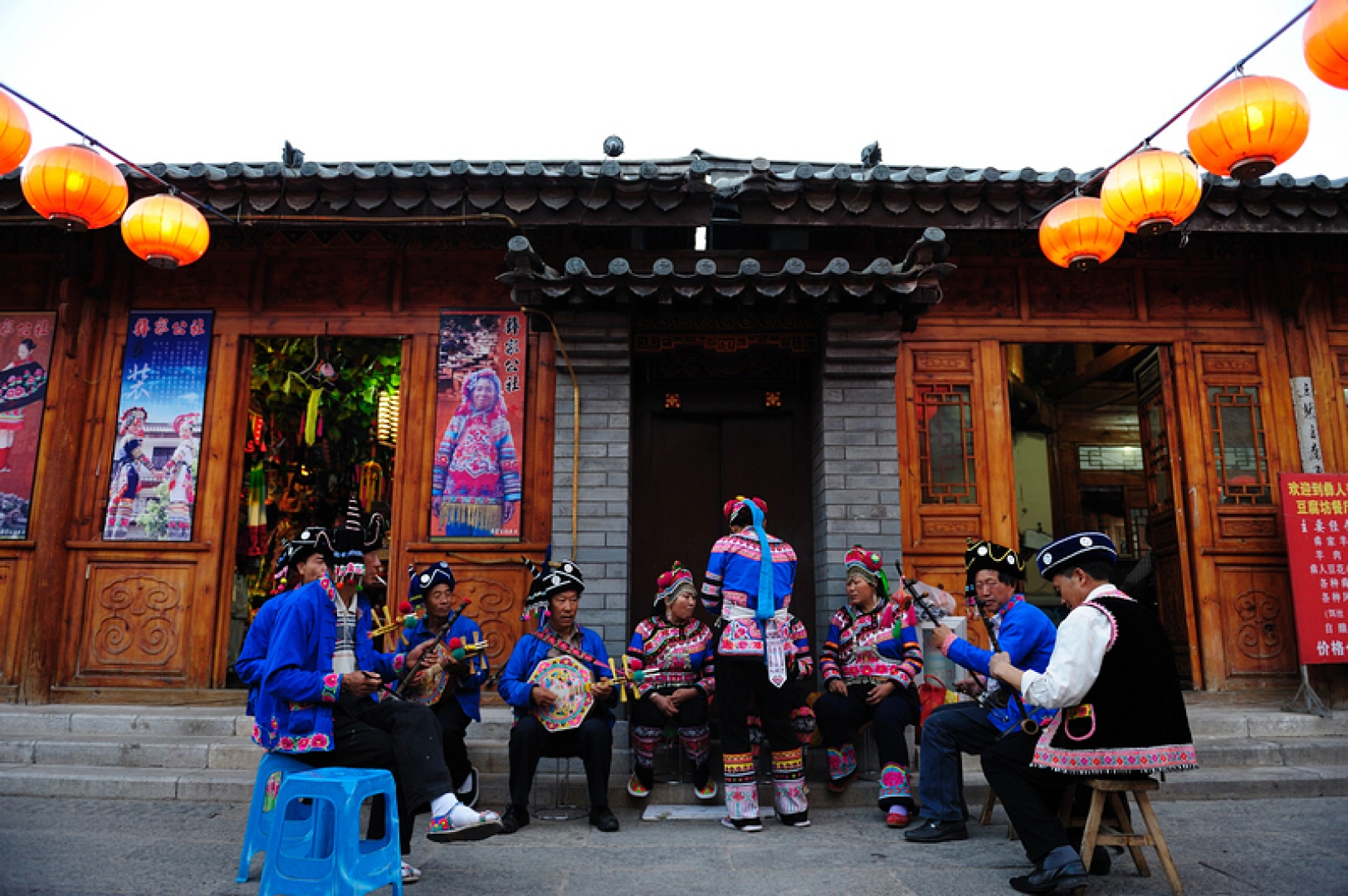
From 7 to 9 p.m., vehicles were banned from the town — that time belonged to the visitors and locals. Red lanterns hung high, elderly people in traditional Yi costumes danced through the streets, and tourists joined in, clapping and spinning. The atmosphere was infectious.
A food street wound along a small river, and we picked a random stall. We ordered wild vegetable soup, scrambled eggs, and stir-fried fern with pork — the exact names have faded from memory, but I still remember the tangy pickled radish and the bill: about 120 RMB. Since we weren't driving that night, Xiao Qiu joined me for a few beers. Nearby, someone was chugging from a large bucket of "Wind, Flower, Snow, Moon" beer (Feng Hua Xue Yue). My eyes were greedy, but my stomach was already full. I finally tried it later in Wuding — it was light and bland, so I didn't miss much.
After dinner, we strolled through the streets. Rows of balloon-shooting game booths stretched on and on, an impressive sight. Then we stumbled upon another bonfire party. Firelight danced on everyone's smiling faces. I squeezed in and joined the dance — clumsy and uncoordinated, but who cares? Joy is joy.
Breakfast and Departure
The next morning, we stopped at a Thai coffee shop next to the England Hotel for some fried flatbread (fei bing), costing 37 RMB. There were quite a few Thai and Burmese people around, giving the local food scene an exotic twist. Then we headed to another spot for a spicy clay pot rice noodles (la shaguo mixian) — 18 RMB, warm and invigorating.
Heading to Yuanmou: Surprises on the Provincial Road
With no highway, we drove north on provincial roads. The scenery was strange — it was April, but it felt like early autumn: yellow rice paddies, red shrubs, and vast open fields stretching under the sun. At first, it was refreshing, but after a while, the monotony set in.
To make matters worse, our GPRS navigation led us onto County Road 325 — a truly narrow, winding goat trail. Bumpy, tight, and full of turns, it cost us nearly an hour of back-and-forth. Still, there was one unexpectedly beautiful spot along the way, a small compensation for the detour.
Road condition note: The route from Chuxiong to Yuanmou weaves between provincial and county roads, some sections in poor condition. Drive carefully and allow plenty of time.
By 3 p.m., we finally got back on the highway. At 4:20 p.m., we arrived at Wumao Earth Forest.
Yuanmou Earth Forest: An Epic Carved by the Earth
What Is an Earth Forest?
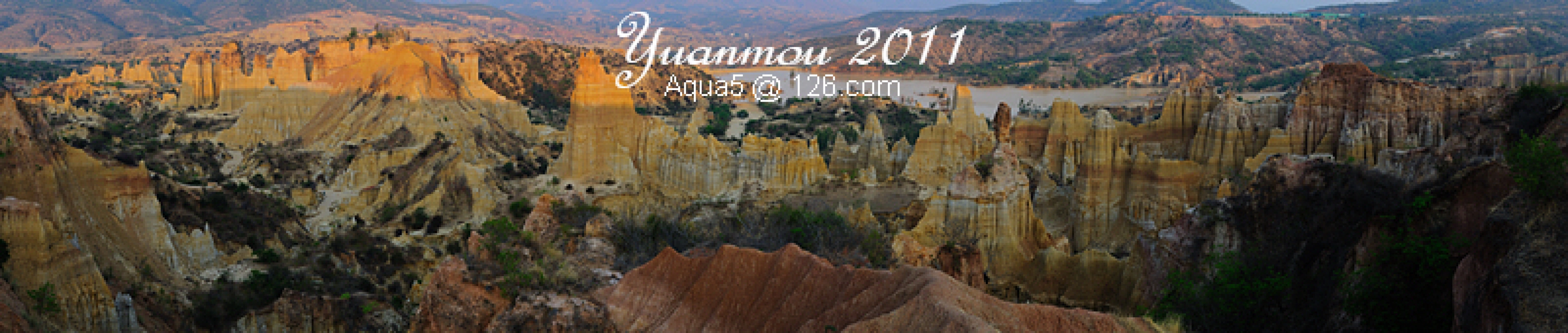
Simply put, an earth forest (tulin) is a columnar terrain formed by accumulations of soil, looking from a distance like a forest — hence the name. It typically appears in basins or valleys, shaped by water erosion over millennia. Sand and clay, sculpted by wind and rain over millions of years, create these bizarre natural formations. Scientific surveys have found rich deposits of animal and plant fossils, as well as precious minerals like quartz and agate.
The Yuanmou Earth Forest is hailed as "the world's foremost earthen forest wonder," dating back about 1.5 million years. It is one of Yunnan's "Three Forests," alongside the Xishuangbanna Tropical Rainforest and the Lunan Stone Forest. Among its most famous sections are Wumao Earth Forest, Banguo Earth Forest, and Langbapu Earth Forest. Filmmakers like Zhang Yimou (Riding Alone for Thousands of Miles) and Chen Kaige (The Promise) have shot here, along with other films like The Hunting Song, The Gourd Letter, The White Garment Village, and The Killer's Love.
Earth forests are classified into four types by shape: bud-shaped, castle-shaped, bamboo shoot-shaped, and iron-hat-shaped. These forms mix together, creating a landscape of endless variety and ever-changing beauty.
Wumao Earth Forest: A Wild, Rugged Castle
Wumao Earth Forest is located in Luoxing Village, Wumao Township, Yuanmou County, also known as Hutiaotan (Tiger Leaping Shoal) Earth Forest. Its pillars are predominantly castle-like, screen-like, or curtain-like, typically 10 to 15 meters high, with the tallest reaching 27 meters. From a distance, the landscape is crisscrossed with ravines, wild and desolate, like an abandoned fortress. Up close, it resembles a series of monumental sculptural groups.
The scenic area is dotted with imaginative names: Little Western Paradise, East Sea Dragon Palace, European Opera House, Cathedral County, Old Castle... each name a collision of nature and human creativity. The main loop is about two kilometers; if you want to explore every nook and cranny, allow at least two to three hours. A word of caution: it's easy to get lost inside. It's best to go with a companion and avoid venturing alone.
There are also beach buggies available for rent, perfect for thrill-seekers.
Ticket price: 80 RMB per person (or 100 RMB for a combined ticket with Xinhua Earth Forest)
Accommodation: There are three hotels inside the scenic area, all sharing one main phone number (0878-8352020), offering three tiers: - Cave Hotel (Yaodong Binguan): Cave-style bungalows, newer facilities, three-star decor, priced at 328 RMB - Earth Forest Hotel (Tulin Binguan): A three-story building with small rooms and older facilities, akin to a budget guesthouse, around 128 RMB - Youth Hostel (Qingnian Lüshen): Bungalows, the cheapest option, with beds for several dozen RMB per person
Food: There's one restaurant at the bottom of the big slope outside the entrance — the only place to eat nearby. The day we visited, the power was out, so we had a candlelit dinner: stir-fried chili with pork, tomato and egg soup, stir-fried bottle gourd, and a complimentary plate of watermelon. Total: 62 RMB. The food was decent, and the vegetables were fresh.
Langbapu Earth Forest: A Colorful Landscape Painting
Because of the power outage at Wumao, Xiao Qiu decided we should drive to Langbapu Earth Forest for the night. Two hours of night driving — honestly, avoid it if you can. Mountain roads, tight curves, poor visibility — it demands extra caution.
Langbapu Earth Forest, also known as Xinhua Earth Forest, is located in Xinhua Township, 33 kilometers west of Yuanmou County town, 15 kilometers from Banguo Earth Forest, at the junction of Yuanmou, Dayao, and Mouding counties. The scenic area covers 8 square kilometers, with tall, dense pillars of all types. The conical pillars are particularly well-developed, generally 8 to 25 meters high, with the tallest reaching 42.8 meters — the highest in the Yuanmou Earth Forest.
What's most breathtaking is its color: the tops of the pillars are predominantly purplish-red, the middles grayish-white, and the bases yellow. Standing on a high vantage point, it looks like a giant landscape painting, almost unreal. Unlike Wumao, Xinhua Earth Forest doesn't have fancy names — you're free to imagine and name the formations yourself.
The area apparently offers paid activities like hot air balloon rides, but we visited during the off-season. The entire scenic area had only the two of us, and we saw no other activities or staff.
Ticket price: 70 RMB per person (or 100 RMB combined with Wumao Earth Forest)
Driving route: Kunming → Fumin → Wuding (get on the highway) → Yuanmou → Earth Forest exit. After exiting, don't turn left (that's the road to Wumao). Go straight for 1 kilometer, then turn right → Julin → Pingtian → drive 28 kilometers to Xinhua Middle School, turn left → Hewai Earth Forest → Xiao Village Bridge → Langbapu Earth Forest (Hei Shaowu's "Photography Home")
Accommodation: We stayed at a youth hostel-style inn inside Langbapu — green bungalows, newly renovated, with large rooms but basic facilities. A standard room cost 160 RMB. You could see the stars at night, and in the morning, you'd wake up to the earth forest right outside — the location was unbeatable. Alternatively, there are farmhouse inns in Langbapu Village, and two-star hotels and ordinary guesthouses in Yuanmou County town.
Food: There's also a restaurant at the entrance of Langbapu, which looked like a converted conference hall. There were quite a few flies, but it didn't feel dirty — locals light candles to keep them away. The prices were even cheaper than Wumao: four dishes for 60 RMB — stir-fried cured pork, scrambled eggs with scallions, stir-fried green beans, and taro and cabbage soup. The menu was limited; we picked our dishes from the fridge. The food was actually quite good.
Conclusion: What's Worth Taking Away
Looking back on this trip to Chuxiong and Yuanmou, a few moments remain unforgettable: dancing wildly at the bonfire party in the Yi Ancient Town, the romance of a candlelit dinner at Wumao Earth Forest, the shifting colors of Langbapu Earth Forest in the morning light... and of course, the less-than-perfect parts — getting lost on county roads, the night without electricity, the fly-filled dining hall.
But isn't that what travel is all about? Perfection and imperfection woven together, creating memories that are uniquely yours.
A few key tips for those planning their own trip: 1. Road conditions: The provincial and county roads from Chuxiong to Yuanmou are complex. Download offline maps in advance and allow plenty of time. 2. Tickets: A combined ticket for Wumao and Xinhua Earth Forests costs 100 RMB — better value than buying separately. 3. Accommodation: If you want to catch the sunrise, stay inside the scenic area. If you prefer better amenities, choose Yuanmou County town. 4. Food: Restaurant options inside the scenic areas are limited. Bring your own snacks and water. 5. Safety: The earth forest is easy to get lost in. Always explore with a companion and don't wander off alone.
Finally, let me end with a line I use often but never tire of: Because I dream of the world, my travels never end. May you, too, find your own moments of wonder in this landscape carved by time.
This article is based on a self-drive trip in April 2011. Some information may have changed since then. Please verify the latest details before your trip.
You should also read:
Into the Hidden Valley: A Solo Journey Through the Mysterious Dulong River
Into the Hidden Valley: A Solo Journey Through the Mysterious Dulong River Deep in the northwestern corner of Yunnan Province, tucked away from the modern world, lies a place that feels like a secret whispered among mountains. The Dulong River Valley is not just a…
Continue reading...
God’s Abandoned Palette: A Self-Drive Journey Through Yunnan’s Dongchuan Red Land
God’s Abandoned Palette: A Self-Drive Journey Through Yunnan’s Dongchuan Red Land Travel has never been about reaching some distant geographic coordinate. It’s about encountering, along the way, the version of yourself buried beneath the rubble of daily routine. During this May Day holiday, I finally…
Continue reading...
Body in Hell, Heart in Heaven: A Pilgrimage Through Tiger Leaping Gorge — A Dialogue Between Heaven and Earth
Body in Hell, Heart in Heaven: A Pilgrimage Through Tiger Leaping Gorge — A Dialogue Between Heaven and Earth Introduction: When the Gorge Splits Open Beneath Your Feet Some say Tiger Leaping Gorge is the closest place on Earth to the border between "hell" and…
Continue reading...