A Journey Through Western Yunnan: A Tapestry of Mangshi, Ruili, Tengchong, and Kunming
A Journey Through Western Yunnan: A Tapestry of Mangshi, Ruili, Tengchong, and Kunming
Introduction: My Fifth Journey to the Land of Colorful Clouds
Some places feel like old friends, calling out to you when you least expect it. For me, Yunnan is exactly that. From the towering majesty of snow-capped mountains to the serene stillness of its lakes, from the weathered charm of ancient towns to the vibrant tapestry of its ethnic cultures, this land possesses an almost magical pull that draws me back time and again. This was my fifth visit to Yunnan, and each encounter feels like opening a brand-new storybook—every page brimming with surprises. This time, I hoped for even more discoveries and moments of wonder.
On the morning of National Day, sunlight streamed through the windows of the airport express train, carrying a lazy warmth. The carriage was surprisingly uncrowded; passengers sat quietly, and in my ears, a single song looped—Hao Yun's Going to Dali. That familiar melody whispered like an old friend, instantly pulling my thoughts toward the horizon. I recalled wandering the cobblestone streets of Lijiang, listening to the rhythm of raindrops dripping from eaves. Those memories, woven with both beauty and regret, had become a bittersweet embellishment to my travels. Now, with anticipation in my heart, I was ready to embark on a new journey and write the story of this trip.
Itinerary Overview
- Day 1: Beijing → Mangshi | Wuyun Temple, Pinde Hong Restaurant, Mangshi Square
- Day 2: Mangshi | Silver Pagoda, Golden Pagoda, Mengbana Zhenqi Garden
- Day 3: Ruili | One Village Two Countries, Mengmao Banquet
- Day 4: Tengchong | Dieshuihe Waterfall, National Martyr Cemetery, Beihai Wetland
- Day 5: Tengchong | Rehai Geothermal Area, Heshun Ancient Town
- Day 6: Tengchong | Official Hotel, Heshun Ancient Town Night View
- Day 7: Tengchong → Baoshan | Qiluo Ancient Town (Wenchang Palace, Li Family Courtyard, Shuiying Temple), Yongchang Pavilion
- Day 8: Kunming | Old Street, Lu Han Mansion, Cuihu Park, Yunnan Military Academy, Yunnan Impression Show
- Day 9: Kunming | Nie Er Memorial Hall, Anti-Japanese War Memorial Hall, Duiyue Building
Day 1: Mangshi—First Encounter with the City of Dawn

Arriving at the Border Town
As the plane descended, the clouds outside the window spread across the sky like cotton candy, shimmering with golden light under the sun, as if I had entered a dreamlike wonderland. Stepping onto the soil of Mangshi, the first things that caught my eye were the sapphire-blue sky and the rolling green mountains. The lush vegetation lay like a thick emerald carpet, warm and radiant.
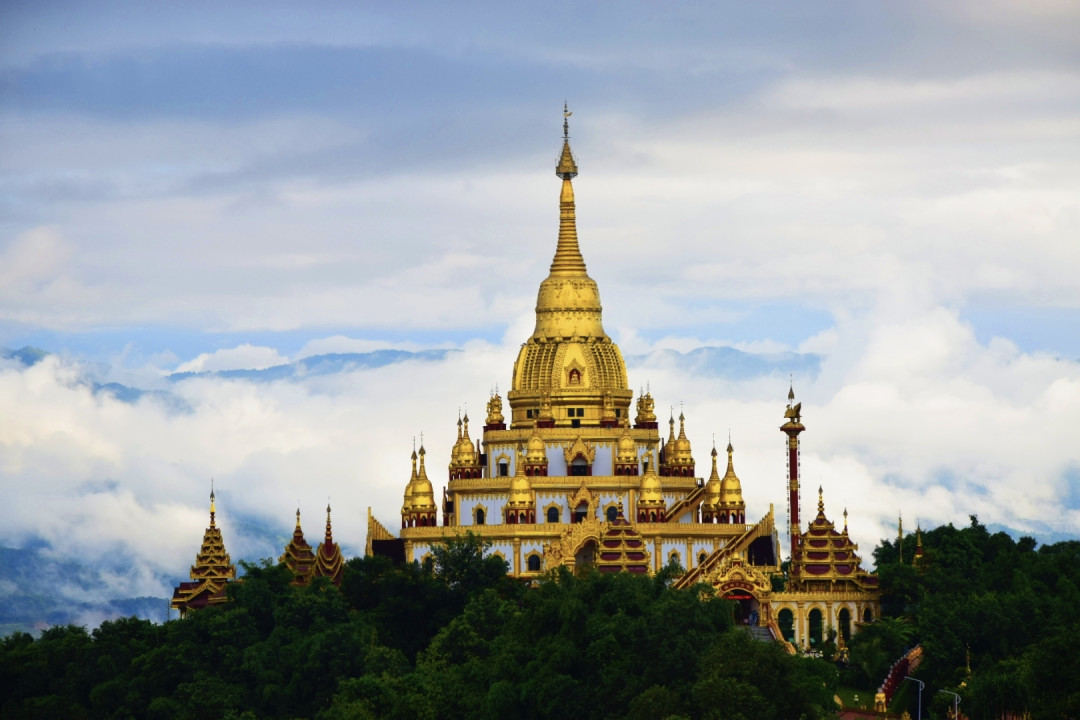
Mangshi, a border town with over 2,000 years of history dating back to the Han Dynasty, carries the beautiful nickname "City of Dawn." Here, there is no hustle and bustle of big cities—only slow-moving time and a rich exotic atmosphere. Renting a small electric scooter, I weaved through streets lined with coconut palms, sunlight filtering through the leaves to cast dappled shadows. A gentle breeze brushed my face, and in the distance, the golden spires of pagodas gleamed, as if emerging from an ancient myth.
Wuyun Temple: The Thousand-Year Story of the Golden Temple
Wuyun Temple, known in the Dai language as "Zang Han," meaning "Golden Temple," was first built in the fourth year of the Kangxi reign of the Qing Dynasty (1665). It is the oldest Buddhist temple in Mangshi and holds a special place in the region's Buddhist history. At the gate stand five ancient banyan trees, where egrets perch year-round. From afar, they look like five white clouds, giving the temple its name. Inside, a golden pagoda rises, surrounded by eight smaller pagodas, each with a Buddha niche beneath its spire. Gold-engraved tassels hang from the tops, glittering in the sunlight. Over the centuries, the temple endured war and upheaval—its Buddha statues and pagoda were destroyed during the Anti-Japanese War, and during the Cultural Revolution, nearly all its halls and scriptures were lost. It was not until 1984 that reconstruction began, and the temple was rededicated in 1985. Its architecture blends Dai and Han styles: the gate is Han-style, while the main hall is distinctly Dai. Stone lions mark its status as an official temple.
Night Market and Food: Rustic Vitality

After leaving Wuyun Temple, I planned to visit the trendy restaurant "Pinde Hong." The courtyard was picturesque, and the peacock-shaped dishes were tempting, but the queue was too long, so I gave up. On the way back to the hotel, I stumbled upon a small shop selling 螺蛳粉 (snail rice noodles). It turned out to be the most delicious I had ever tasted—crispy fried eggs, tender braised chicken feet, and a broth that achieved the perfect balance of spiciness, sourness, pungency, and umami. My friend Shi Tou Jiu Jiu suggested we go to Liuzhou someday to try the authentic version. It was a great idea—another destination added to our travel wish list.
As night fell, Mangshi Square came alive. Jingpo people in vibrant traditional costumes danced around a bonfire. The night market blazed with lights, offering exquisite handicrafts and delicious snacks. A pagoda-shaped pavilion stood solemn and majestic under the illumination, its golden body radiating a soft glow. At that moment, the small towns of Northeast China and this southwestern borderland merged in my memory—the same rustic vitality, the same intoxicating charm.
Day 2: Mangshi—The Golden and Silver Pagodas and the Curious Garden
Clear Broth Beef Rice Noodles at Lanlu Breakfast
In the heavy morning rain, I took a taxi to the wildly popular "Lanlu Breakfast" spot. The shop was tiny, with peeling walls, but packed with people. Yunnan's rice noodle shops always have a rich array of condiments and toppings. I love the small sour limes, but I still can't bring myself to enjoy 折耳根 (houttuynia cordata, or fish mint).
A steaming bowl of clear broth beef rice noodles arrived before me, its aroma rising with the heat. The broth was clear and glossy, with a thin sheen of oil—the result of hours of simmering beef bones, their essence fully extracted. Tender slices of beef, evenly cut, melted on the tongue. The rice noodles were distinct, smooth, and chewy, each strand coated in the rich flavor. After finishing the meal, the rain stopped—my travel luck always holds.
Menghuan Silver Pagoda: The Pristine Beauty of a Silver Pearl

I had seen stunning photos of the Silver Pagoda online years ago, and now I finally saw it in person. The Menghuan Silver Pagoda stands 66 meters tall, with a diameter of 46 meters. Its pure white base gleams under the sun, like a brilliant silver pearl set atop Lei Ya Rang Mountain. The pagoda consists of 80 smaller towers, each spire crafted from Dai silver. When the breeze blows, wind chimes tinkle with a crisp, melodious sound.
The pagoda has four levels. The first level's 12 small towers symbolize the Twelve Nidanas, representing the cycle of cause and effect in the world. On the west side, three platforms include two with glass floors—the famous "Sky Mirror" photo spots. Unfortunately, the morning backlight wasn't ideal for photos. The queue of eager young women and aunties grew restless; I spent only half a minute there before retreating. But even without the Sky Mirror, the views were stunning—the sky was magnificent against the light, and the Silver Pagoda took on a different, enchanting charm.
From the observation deck, I could see the entire Mangshi panorama. The Golden Pagoda on the opposite peak framed perfectly with the smaller pagodas in the Silver Pagoda complex—a harmonious and striking contrast of gold and silver.
Mengbana Zhenqi Garden: A Hidden Bamboo Forest Paradise
After 10 a.m., traffic near the Silver Pagoda became congested. We rode our electric scooters to Mengbana Zhenqi Garden. The garden is filled with various banyan trees, their branches and leaves forming vast canopies, their roots intertwining in intricate patterns. What delighted me most was the bamboo grove—tall, slender bamboos rising straight up, their leaves rustling in the breeze like a soft melody. I found an open space, using the bamboo as a backdrop for photos. Leaning against a stalk or standing in the middle of the path, the pictures had an otherworldly quality, as if I were a wandering swordsman or a reclusive sage, far from the noise of the world, seeking inner peace.
The garden also features live fruit trees—jackfruit, pomelo, banana—and towering cacti, standing like silent, steadfast giants. Peacocks roam freely, displaying their iridescent plumage as they stroll. Grafted bougainvillea bloom in a riot of colors, creating a sea of flowers that lasts all year.
Tree-Encased Pagoda: A Witness to Love and Miracles
On the way back to the hotel, I stopped to see the Tree-Encased Pagoda. Built in the mid-18th century by a Mangshi chieftain to commemorate a military victory, the pagoda was later neglected during wartime. A banyan seed sprouted in a crack, and over time, the roots grew to envelop the structure, creating a remarkable sight. The pagoda stands over 10 meters tall, while the tree atop it reaches 30 meters, with a canopy covering nearly 1,000 square meters.
The local Dai people consider it a "Love Pagoda." Legend has it that during the Qing Dynasty, a chieftain's daughter named Han Lun fell in love with a warrior named Yan Tun during the Water Splashing Festival. After a tragic turn of events, they died together. Moved by their unwavering love, the villagers buried them in a single grave and built the pagoda in their honor. A parrot, having lost its owners, flew to the pagoda every day, crying out, and dropped banyan seeds into the cracks. The seeds took root, grew, and slowly formed the tree-encased pagoda we see today. In 1985, the Dehong Cultural Relics Management Office restored the site, adding four mythical "Gaduo" beasts and four small pagodas to the base, with Buddha statues enshrined in niches. Remarkably, this created a new phenomenon: a pagoda encasing the tree, which itself encased the original pagoda—a double wonder.
Day 3: Ruili—The Border Wonder of One Village, Two Countries
The distance from Mangshi to Ruili is only 100 kilometers, and a taxi ride took just over an hour. The Vienna Hotel in Ruili was a pleasant surprise—spacious and luxurious rooms, far surpassing other branches of the same brand.
One Village, Two Countries: Life Along the Border
The "One Village, Two Countries" scenic area is located on the China-Myanmar border in Yinjing Village, Shunha Village, Jiexiang Township, Ruili City, Dehong Dai and Jingpo Autonomous Prefecture. Here, the border runs directly through a Dai village, splitting it in two. The Chinese side is called Yinjing, and the Myanmar side is called Mangxiu. During the National Day holiday, the area was packed with tourists, a stark contrast to the otherwise quiet city of Ruili.
In Ruili, the border is often marked by bamboo fences, village paths, ditches, or earthen ridges. Sometimes, a single step can take you from China into Myanmar. Villagers from both sides have lived as neighbors for generations, crossing back and forth frequently, their lives closely intertwined. The scenic area features a well shared by both countries—sitting right on the border—and a swing: as you gently sway, one moment you're in China, the next you've "swung" into Myanmar.
But my favorite part was the pagoda-style architecture, shared by both sides of the border. Speaking of Myanmar, that land of deep history and brilliant civilization should be a pilgrim's dream—the thousands of pagodas on the Bagan plains, bathed in golden morning light; the red walls and golden roofs of Mandalay Palace, radiating royal grandeur; the Shwedagon Pagoda in Yangon, soaring into the clouds, dazzling and resplendent. Yet today, mentioning Myanmar stirs complex emotions in many. That land, once so alluring, now feels out of reach for various reasons—a thought that brings a touch of melancholy.
Days 4-7: Tengchong—A Symphony of History and Nature
Dieshuihe Waterfall and the National Martyr Cemetery
Tengchong's first stop was Dieshuihe Waterfall, where water cascaded down with breathtaking power. Then I visited the National Martyr Cemetery, resting place for the souls of the Chinese Expeditionary Force soldiers. Standing in the cemetery, the weight of history pressed down on me. Those young lives, sacrificed for their country, commanded deep respect.
Beihai Wetland and Rehai Geothermal Area
Beihai Wetland is a high-altitude volcanic barrier lake, lush with water plants and wildflowers. Boating through it felt like navigating a green maze. The Rehai Geothermal Area showcased Tengchong's volcanic wonders—steaming hot springs, bubbling boiling pools, and the smell of sulfur in the air. Soaking in a hot spring washed away all fatigue.
Heshun Ancient Town: The Tenderness of Time
Heshun Ancient Town was the place I lingered in most. Nestled against mountains and beside water, its cobblestone paths wind gently, and Ming and Qing Dynasty buildings are beautifully preserved. At dusk, the setting sun gilded the rooftops, bathing the entire town in golden light. At night, lanterns lit up, revealing a different, serene beauty.
Qiluo Ancient Town: A Hidden Gem
Qiluo Ancient Town is another pearl of Tengchong. Wenchang Palace, Li Family Courtyard, and Shuiying Temple—each site carries the weight of history. With few tourists, it's a place to savor slowly.
Days 8-9: Kunming—The Cultural Depth of the Spring City
Cuihu Park and the Yunnan Military Academy
Cuihu Park in Kunming is a favorite spot for locals. The lake shimmered, and red-billed gulls circled overhead. Nearby, the Yunnan Military Academy is an important site of modern Chinese military education, having trained many generals. Its architecture blends Chinese and Western styles, dignified and elegant.
Yunnan Impression and the Anti-Japanese War Memorial Hall
In the evening, I watched the Yunnan Impression performance. Yang Liping's dance brought Yunnan's ethnic cultures to life with breathtaking artistry. The Anti-Japanese War Memorial Hall reminded me of those fiery years, and at the Nie Er Memorial Hall, the melody of the "March of the Volunteers" seemed to echo in my ears.
Duiyue Building: Kunming's Romantic Side
Duiyue Building is a trendy photo spot in Kunming. Its unique architecture, illuminated at night, seemed to converse with the moon. Here, I took my last photo of the trip, a fitting conclusion to this journey through western Yunnan.
Conclusion: The Meaning of Travel
Nine days through western Yunnan—from Mangshi's exotic charm to Ruili's border wonders, from Tengchong's historical depth to Kunming's cultural richness—every stop left unforgettable memories.
Perhaps the meaning of travel isn't about how many places you visit, but about those moments—gazing at the sky beneath the Silver Pagoda, dreaming of martial arts in a bamboo grove, standing in solemn silence before the Martyr Cemetery, or simply sitting quietly in the night of Heshun Ancient Town. These moments, like pearls, string together the journey of life.
Yunnan, this land of colorful clouds, has a thousand reasons to make you fall in love with it. And I am already looking forward to my sixth visit.
Practical Tips:
- Transportation: Mangshi, Ruili, and Tengchong are close to each other. Taxis or hired cars are the most convenient options.
- Accommodation: The Vienna Hotel in Ruili offers excellent value. In Mangshi, staying near Mangshi Square is convenient.
- Food: The clear broth beef rice noodles at Lanlu Breakfast, roadside 螺蛳粉 (snail rice noodles), and fresh-squeezed mango juice in Mangshi are all must-tries.
- What to Wear: Yunnan has large temperature differences between day and night, so bring a light jacket. For photos at the Silver Pagoda, light-colored clothing works best.
- Timing: Arrive at the Silver Pagoda before 8 a.m. to avoid crowds. Visit One Village Two Countries in the morning; the afternoon light is better for photos.
You should also read:
Into the Hidden Valley: A Solo Journey Through the Mysterious Dulong River
Into the Hidden Valley: A Solo Journey Through the Mysterious Dulong River Deep in the northwestern corner of Yunnan Province, tucked away from the modern world, lies a place that feels like a secret whispered among mountains. The Dulong River Valley is not just a…
Continue reading...
God’s Abandoned Palette: A Self-Drive Journey Through Yunnan’s Dongchuan Red Land
God’s Abandoned Palette: A Self-Drive Journey Through Yunnan’s Dongchuan Red Land Travel has never been about reaching some distant geographic coordinate. It’s about encountering, along the way, the version of yourself buried beneath the rubble of daily routine. During this May Day holiday, I finally…
Continue reading...
Body in Hell, Heart in Heaven: A Pilgrimage Through Tiger Leaping Gorge — A Dialogue Between Heaven and Earth
Body in Hell, Heart in Heaven: A Pilgrimage Through Tiger Leaping Gorge — A Dialogue Between Heaven and Earth Introduction: When the Gorge Splits Open Beneath Your Feet Some say Tiger Leaping Gorge is the closest place on Earth to the border between "hell" and…
Continue reading...