A Spring Date: A Self-Drive Journey Through the Hidden Wonders of Yunnan, Guangxi, and Guizhou
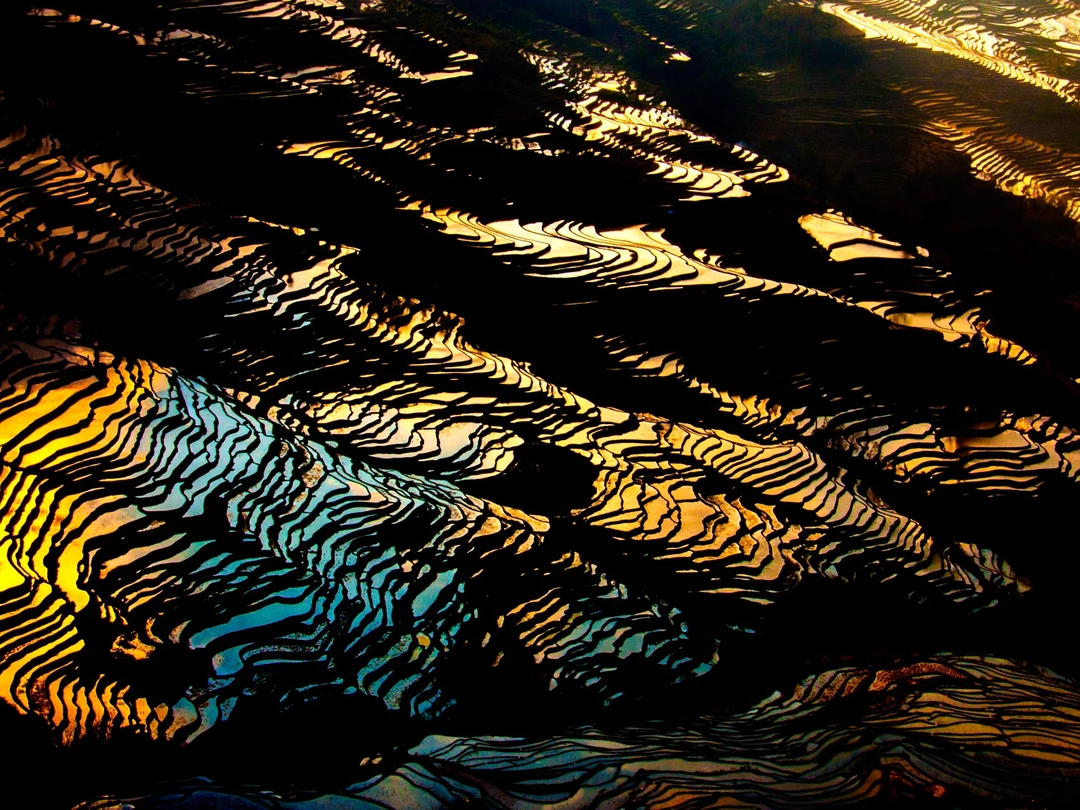
A Spring Date: A Self-Drive Journey Through the Hidden Wonders of Yunnan, Guangxi, and Guizhou
Preface: When Travel Becomes a Faith
"If you don't walk out, you will think this is the whole world." This line from Cinema Paradiso strikes like a gentle thorn, piercing the heart of everyone who yearns to roam.
We often sit in spaces smaller than ten square meters, scrolling through landscapes spanning ninety-five thousand kilometers, yet we carry a heart far more expansive than that distance. Life is more than the mundane grind before us—there is poetry and the pastoral dream beyond. This phrase has been repeated countless times, but only those who truly hit the road understand that the faraway is never an escape; it is a return.
I have visited Yunnan, Guangxi, and Guizhou many times. If you only know Lijiang, Dali, Guilin's karst peaks, or Huangguoshu Waterfall, perhaps one trip is enough. But I know that Yunnan is more than Kunming and Lijiang, Guangxi more than Guilin and Beihai, and Guizhou more than Huangguoshu. I know those hidden places that transform with the seasons, those corners buried deep in the mountains that may not even appear on maps. So when spring blooms, I keep my promise again.
This time, we brought a drone and our family, setting out from Zhanjiang in Guangdong. We crossed three provinces, covering nearly 3,000 kilometers along a southwestern loop. This is a self-drive journey about spring, about landscapes, and about the warmth of everyday life.
Day 1: Departing Zhanjiang, Entering the Landscape Scroll of Jingxi

The HeNa Expressway: The Fairyland's First Road
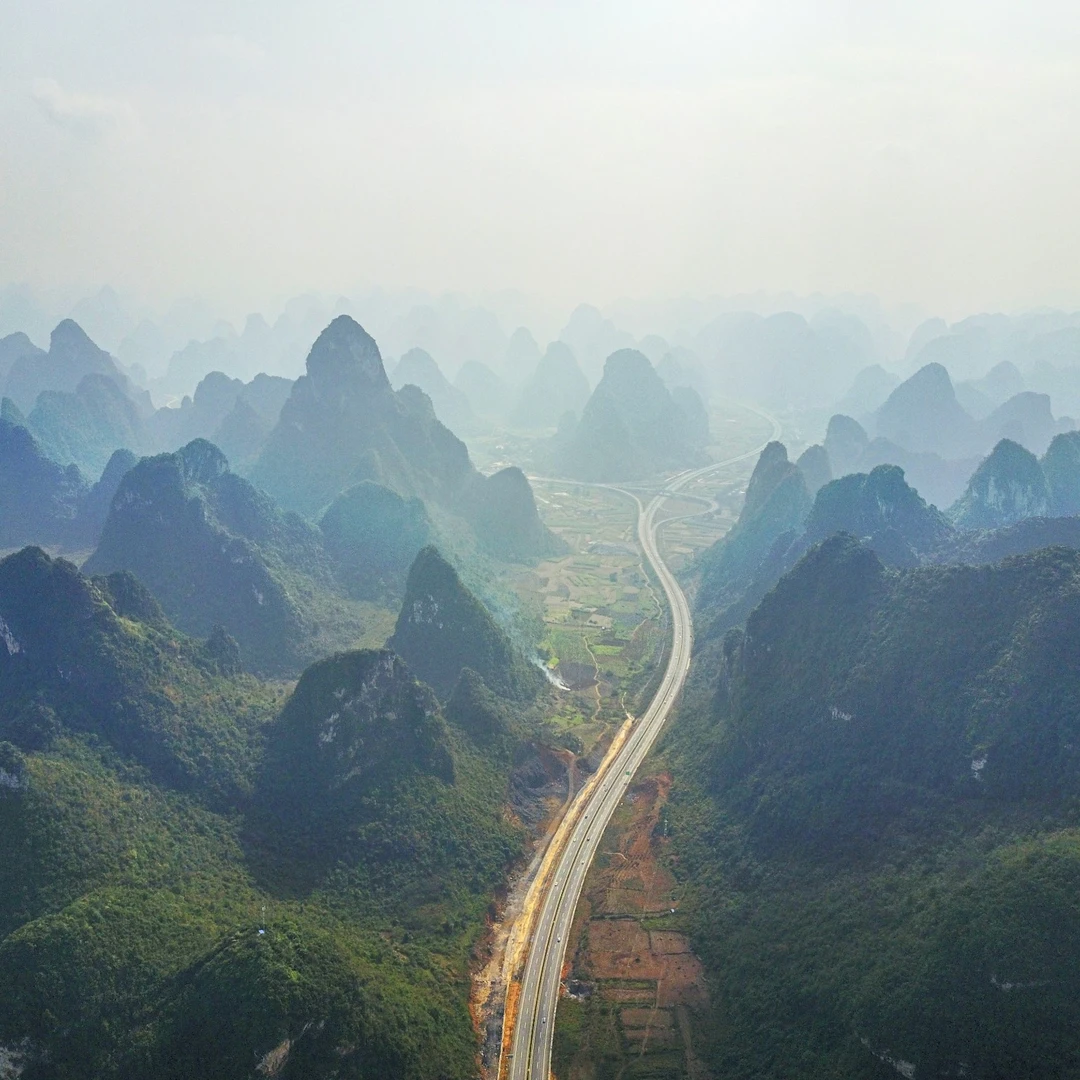
On the first day of the new year, we set out from Guangdong in thick fog. It wasn't until after ten in the morning that the sky gradually cleared. As our car passed Chongzuo, endless karst peaks suddenly burst into view—a sight so stunning it can only be truly felt in person.
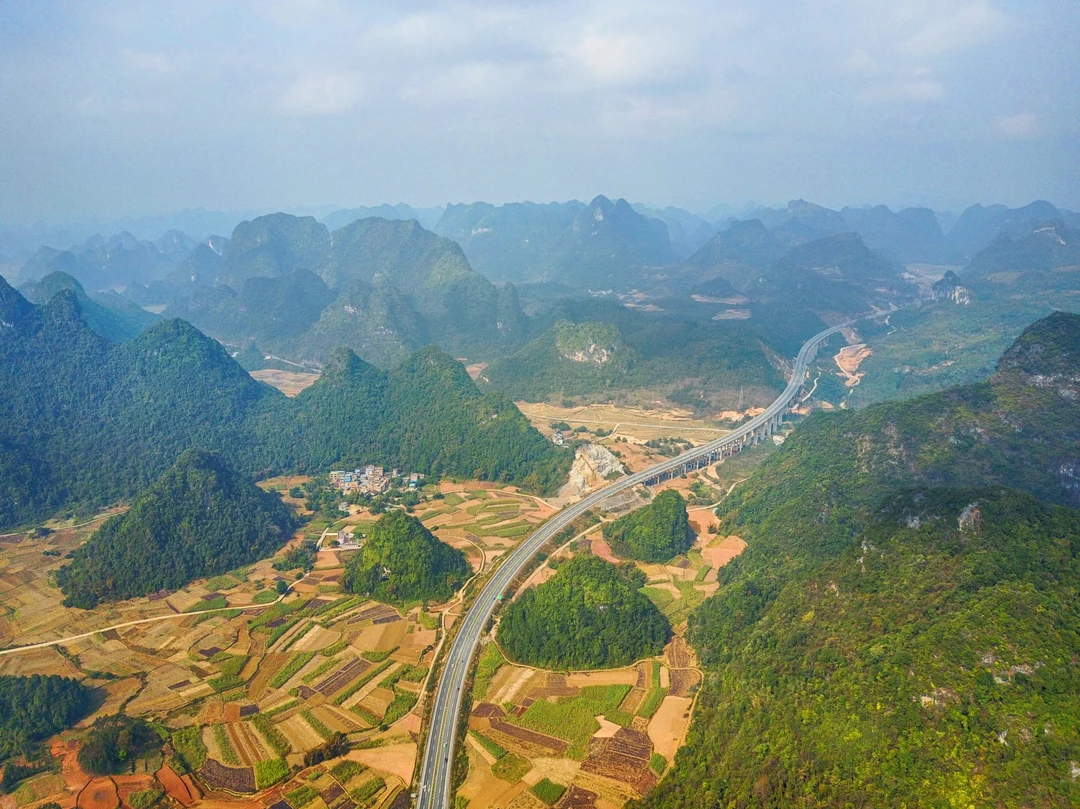
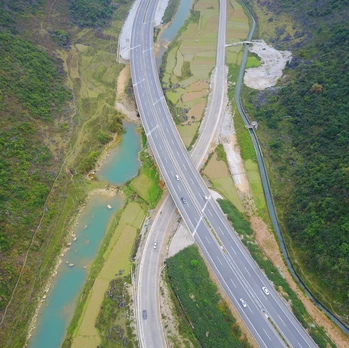
At the Daxin service area, I couldn't wait to launch the drone. From above, the peaks stood like pillars, surrounded by patchwork fields of various shapes. The HeNa Expressway wound through them like a ribbon, earning its reputation as "the Fairyland's First Road." On a highway like this, hours behind the wheel felt like nothing.
Sandie Waterfall: Serendipity and Saving Money
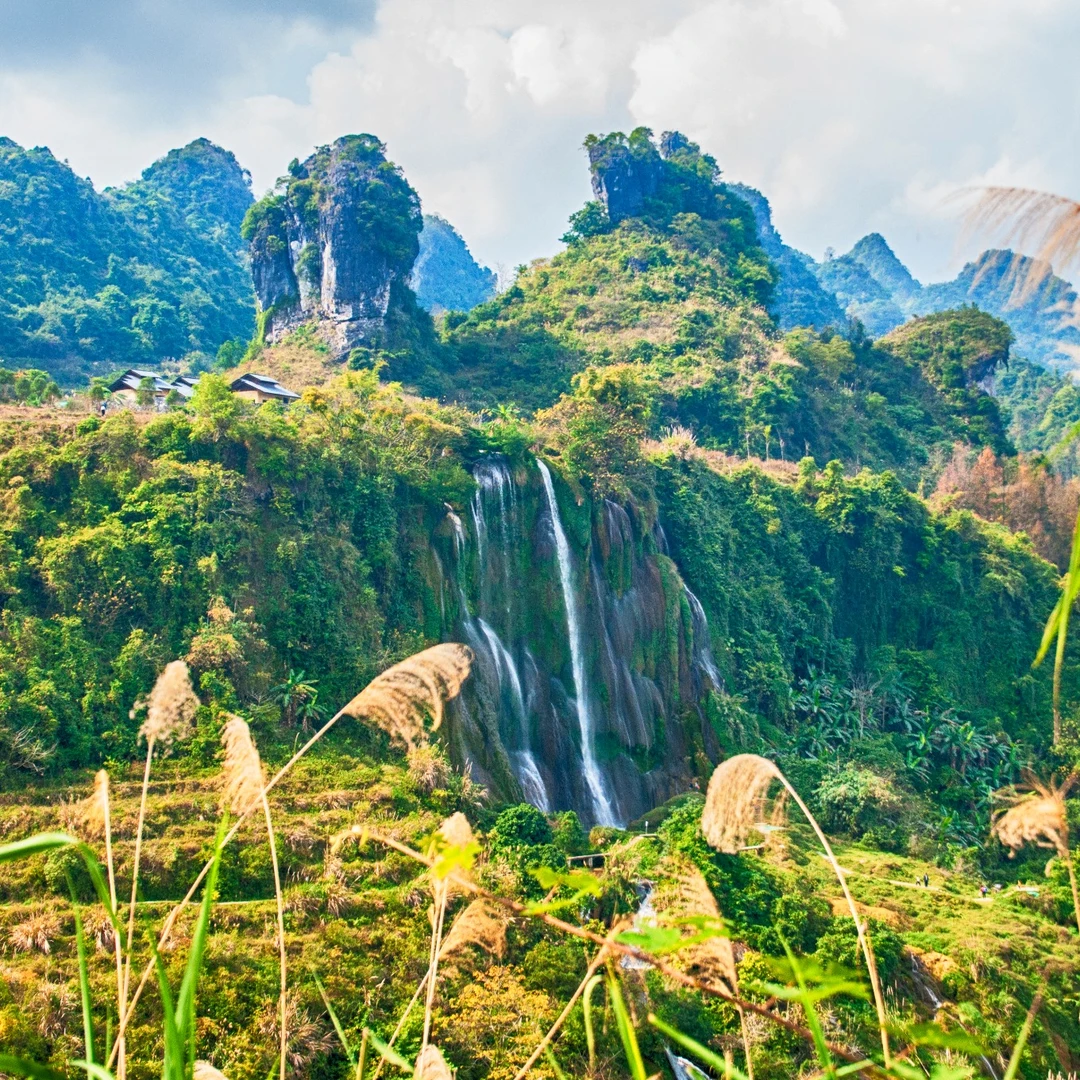
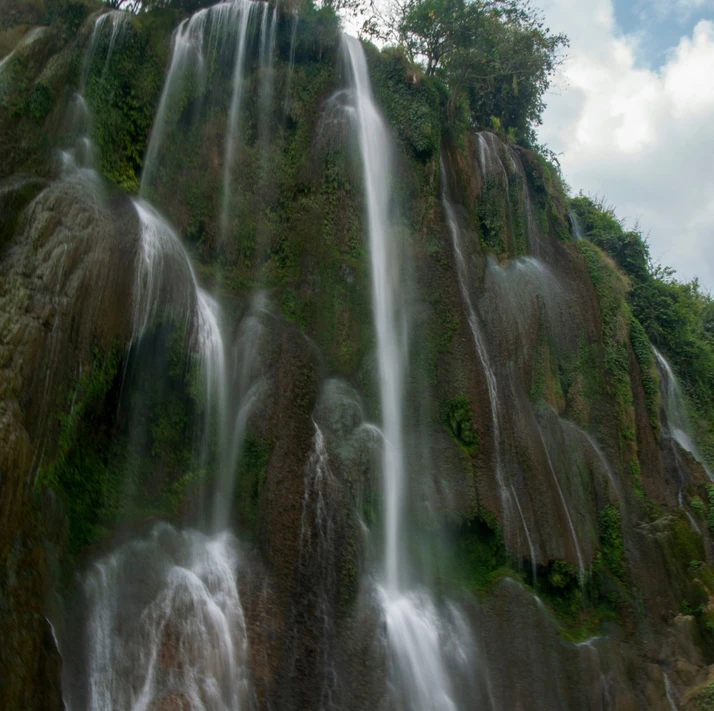
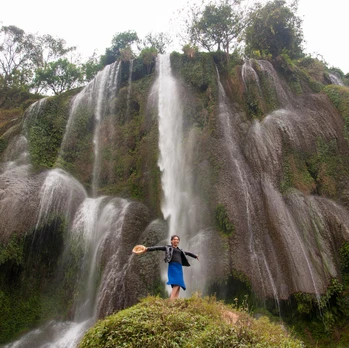
We exited the expressway at Detian and drove a short distance along Provincial Road 316 by the Heishui River, arriving at Sandie Waterfall. Last year, we missed this scenic road because of a delay at Detian Waterfall and ended up driving it at night, seeing nothing. This time, we skipped Detian entirely and headed straight for Jingxi's wild waterfalls.
In spring, Sandie Waterfall's flow was modest. There was a parking lot at its base with an attendant charging a fee. Climbing up from the lot, someone stood at the entrance collecting 10 yuan per person. But we took a small path near the Sandie Tunnel first, climbed to the Xu Xiake Pavilion on the opposite side, and then walked to the waterfall's base—without spending a cent. By pure chance, we saved over a hundred yuan.
Sandie Waterfall is one of Jingxi's eight scenic wonders. A Qing Dynasty poet, Cai Hongzun, wrote: "Splitting open the green hibiscus, it falls like a string of pearls; a hundred cascades spray, a bolt of silk stretches across the river." Though the dry season reduced its volume, its serene beauty remained captivating.
Aibu Waterfall Cluster: Beauty Revealed by Drone
Following the navigation to Aibu Village, we were greeted by a pool of emerald water embracing green hills. After parking, I immediately launched the drone. Without aerial views, I would never have grasped the stunning scale of Aibu's beauty—the turquoise Nantan River cascading down several levels to form the Aibu Waterfall Cluster. This river is the upper reach of the Heishui River and the Guichun River, which feeds Detian Waterfall, belonging to the Pearl River system.
The road into Aibu Village was narrow, and during the Spring Festival, traffic was heavy—parking and passing were both challenges. The scenic area is still undeveloped and free to enter, but there are no facilities. Rumors from a few years ago said it would merge with Erlang Waterfall to become the "Ailang Scenic Area," but judging by the progress, approval hasn't come through. Several new scenic spots in Jingxi follow this pattern: fencing off natural beauty and charging admission, which is disappointing.
Shijiu Ferry Bridge and Erlang Waterfall: Missed Opportunities and Regret
On the way from Aibu to Erlang Waterfall, we passed Shijiu Ferry Bridge. Here, the clear waters of the E'quan River and Longtan River converge, making the river appear wider and more picturesque than elsewhere. Sunlight sparkled on the surface. The locust trees, water banyans, and bamboos along the bank were lush green, while the aquatic algae looked even more tender.
Just before Erlang Village, we passed a terraced field with beautiful, flowing lines. But as dusk approached, I worried that reaching Erlang Waterfall after dark would be worse, and since we still had Yuanyang's terraces ahead, I didn't stop to photograph it. Later, I couldn't find any related images online, and I still regret it.
Finding Erlang Waterfall was no easy task. There was no navigation, so we had to ask locals. Villagers said we could drive up, but the road was barely wide enough for one car, steep and winding. If a car came from the opposite direction, there was no way to reverse. I'd advise others to park below and hike, or take a villager's motorcycle. After navigating this nerve-wracking path, we finally saw the legendary Erlang Waterfall—but in this season, it was just a trickle. To see it in full force, you must wait until summer.
Day 2: From Jingxi to Puzhehei, A String of Wonders
Babao: A Photographer's Paradise Hidden in the Mountains
The next morning, we set out for Puzhehei. Passing through Babao Town in Guangnan, I deliberately exited the expressway to visit this much-hyped "National Photography Creative Base."
The expressway offered great views as the car climbed and descended hills, passing through one tunnel after another into Yunnan. Exiting at Babao, I launched the drone immediately. The turquoise river was the soul of this small town. The rapeseed flowers along both banks weren't vast in scale but were scattered everywhere. Around ten in the morning, the light was perfect, turning the blossoms a brilliant gold.
The river water was intoxicatingly blue, with bare willow branches swaying in the breeze. A covered bridge spanned the river—a perfect spot for photos, with a stunning backdrop. Feeling hungry, we found a rice noodle shop for a delicious bowl before continuing. Crossing Guangxi, Yunnan, and Guizhou, we ate countless bowls of rice noodles and rice vermicelli. Some were astonishingly good, others mediocre, but the cheap shops usually made the best.
The Red Soil of Wenshan
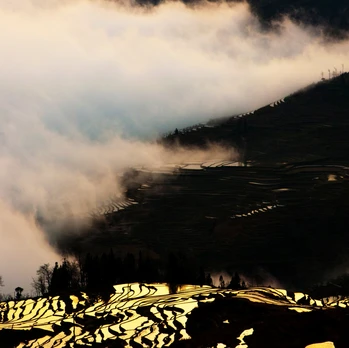
On the expressway exit road to Puzhehei, we spotted beautiful red-soil fields and stopped for aerial shots. This soil is rich in iron, oxidized by sun and rain into rust-colored earth. Plowed fields revealed the red soil's natural hue, looking like palettes from above.
The Huashan Festival: Meeting a Miao Girl
Before entering Puzhehei, we revisited the Huashan Festival we'd attended the previous year. Taking photos with locals is a great idea, and a young Miao girl didn't seem afraid of strangers. Across from the festival was a large rapeseed field, where many festival-goers were taking pictures. Our one-year-old son was thrilled in the sea of flowers. My daughter played on a hand-powered swing for 5 yuan, enjoying it for a long time. This scene brought back memories of carefree childhood summers at my grandmother's house.
Puzhehei: The Beauty of Staying Put
Leaving the festival, a ten-minute drive brought us to Puzhehei. I had fond memories of this place from last year, so I brought the whole family. Puzhehei is truly a place to settle in for a while. Costs are reasonable, local guesthouses are charming, and prices are low. My careless sister left her wallet and ID at the inn, but the owner contacted us through the booking site—so touching.
Arriving at Puzhehei Wetland Park in the afternoon, we found the same heavy traffic as last year, queuing to enter. Last year, I rushed to Mishan Hill for sunset as recommended by the innkeeper. This time, with the family, I let them take a horse-drawn carriage while I wandered near Xianrendong Village and flew the drone. The advantage of a drone is not having to climb every hill.
At the Silver Lake Bridge near Xianrendong Village, a line of egrets soared into the sky. I captured a sunset shot with the drone, where the sun's last rays pierced the clouds, emitting a golden light that felt almost sacred. The sunset clouds were exceptionally beautiful. I regretted not climbing for a sunset view, but life is like that—not everything can be perfect. After sunset, the blue hour painted the sky indigo, reflected in the mirror-like lake, intoxicating with its mountain-and-water beauty.
Day 3: Puzhehei's Dawn and Jianshui's Ancient City Smoke
Puzhehei's Morning: The Early Bird Catches the View
Early morning in Puzhehei was stunning. Last year's sunrise from Qinglongshan was still vivid in my memory—though I couldn't get a good spot and had to shoot handheld between rocks, the sunrise was breathtaking. This time, without climbing, I experienced a different kind of beauty.
I hopped onto an empty boat for a photo—a magical moment. The houses below glowed warmly in the morning light. Flocks of egrets, swans, and other large water birds came out to feed—truly, the early bird catches the worm, and early risers see the best sights. The wetland park was shrouded in thin mist. Puzhehei's famous lotus flowers were out of season, leaving only withered stems. In the morning light, playing with the kids at the boat dock was a warm, precious time.
From the drone, I enjoyed a 360-degree view of Puzhehei Lake, scattered solitary peaks, rice paddies, and fish ponds.
Jianshui Ancient City: A Glimpse and Regret
Leaving Puzhehei, we reached Jianshui Ancient City in the afternoon. First, we visited the Zhu Family Garden, but it was so crowded I couldn't take a single satisfying photo. I'd heard Jianshui was still a lesser-known ancient city—why so many people? Well, it was Spring Festival. This visit was just a glimpse; next time, I'll come in the off-season and stay for days. An ancient city needs to be savored slowly.
Jianshui's Chaoyang Tower, originally called Yinghui Gate, was built in the 22nd year of the Hongwu reign of the Ming Dynasty (1389). Its architecture resembles Beijing's Tiananmen, earning it the nickname "Little Tiananmen," but it's no imitation—it was built earlier. Entrance costs 40 yuan, which didn't feel worth it.
Jianshui's north gate, Yongzhen Gate, has been destroyed and rebuilt multiple times—first in war, then during the post-1949 demolition of city walls. What stands now is a reconstruction from a few years ago for tourism. Writing this, I recall Liang Sicheng's lament over Beijing's city walls.
In the evening, on the way to the Yang Family Garden for dinner, we passed the Zhilin Temple. Built during the Yuanzhen reign (1295-1297), it is famous for its well-preserved main hall, a 700-year-old Yuan Dynasty wooden structure. Inside, two Buddhist white-line murals from the Yongle reign of the Ming Dynasty (1403-1424) survive: one depicts Sakyamuni preaching, the other a Peacock Bright King Dharma Assembly.
The Yang Family Garden is one of Jianshui's three famous gardens, with an elegant, rustic atmosphere. It's also a restaurant open to the public. During Spring Festival, many dishes were unavailable, but the offerings and flavors were distinctive. Too hungry to photograph, we dug in and ate heartily.
Day 4: Shuanglong Bridge, Tuanshan Village, and Yuanyang Terraces
Shuanglong Bridge: The Soft Light of Dawn
On our second day in Jianshui, we finally saw its ancient charm. Heading to Shuanglong Bridge at dawn before breakfast was the right choice. For scenery and photography, early morning is always best. Only then, away from the crowds, can you see the city's original, rustic face.
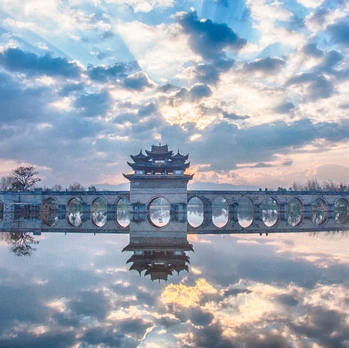
Shuanglong Bridge sits 5 li west of Jianshui Ancient City, with weeping willows swaying along the bank. This three-pavilion, seventeen-arch stone bridge is also called the Seventeen-Arch Bridge. It spans the confluence of the Lujiang and Tachong Rivers, earning its name from the saying "one bridge locks two dragons." It is recorded in China's bridge-building history.
The bridge can be viewed from all sides, allowing for sunrise or sunset shots in both direct and backlight. Walking on the bluestone surface, the ancient stone and the old trees by the piers tell stories of history. We were lucky with the weather—the sun hid behind clouds, which acted as a softbox, allowing us to capture beautiful reflections and layered photos. When the sun emerged from the clouds, the world was bathed in golden morning light.
Tuanshan Village: A Living Relic
A ten-minute drive from Shuanglong Bridge along Baituan Road brought us to Tuanshan Ancient Village. Compared to the crowded Jianshui Ancient City, this is a relatively lesser-known spot. Importantly, it's a living relic—people still live here.
The meter-gauge railway in Jianshui was part of the Yunnan-Vietnam Railway built by the French over 100 years ago, running through the Red River Valley to Haiphong in Vietnam. It was mainly used to transport Yunnan's minerals. Jianshui Ancient City's rise and fall are tied to this history.
Originally a Yi settlement, the name in Yi language is "Tusheer," meaning "land of hidden gold and silver." Han immigrants, the Zhang family, settled here from the Ming Dynasty. By the late Qing Dynasty, they struck it rich through the Gejiu tin mines and returned home to build lavish mansions. This small village transformed into a refined cluster of traditional Chinese architecture.
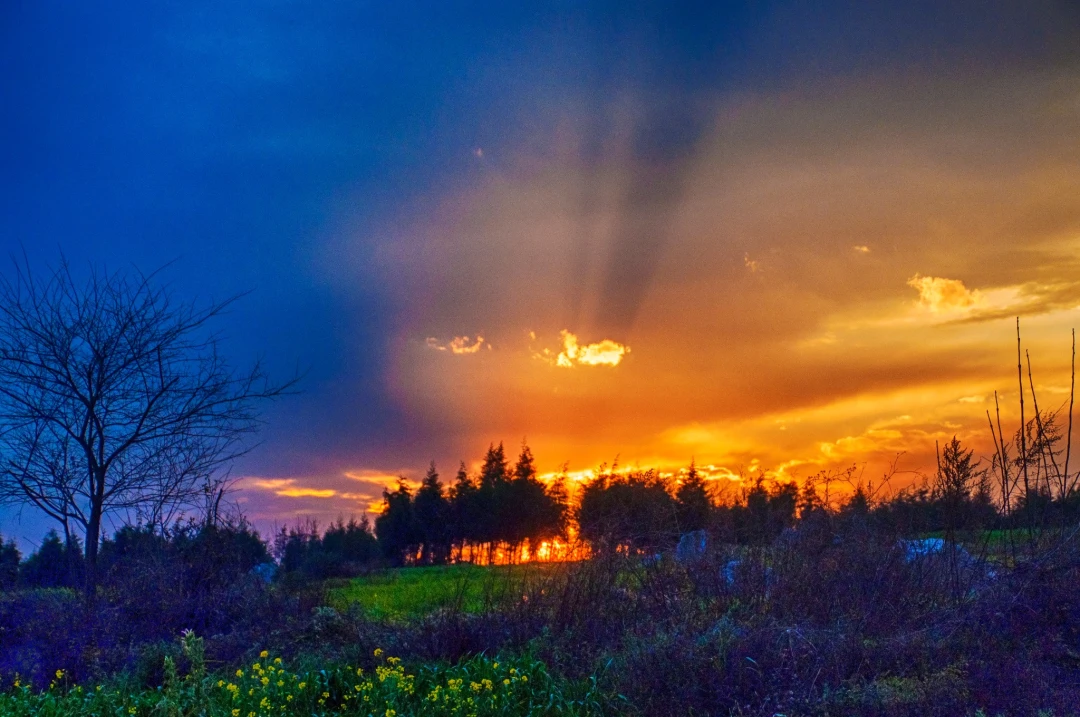
Tuanshan is a typical southern Yunnan Han immigrant village. The founding ancestor, Zhang Fu, came from Poyang County in Jiangxi during the Hongwu reign of the Ming Dynasty. Today, 15 well-preserved large residences, 3 village gates, 3 temples, and 1 ancestral hall remain. The architecture is orderly in form, flexible in layout, rich in spatial variety, and elegant in appearance—representing the typical features of southern Yunnan residential architecture. In 2005, the World Monuments Fund listed it as a World Monument.
Inside the village, weathered houses are everywhere, each with its history and former glory. Tall walls and deep courtyards mark the grand estates. One called "Sima Di" is said to be the only large household in the village not belonging to the Zhang family. The Zhang clan adhered to the "hundred forbearances" family motto, maintaining good conduct and encouraging learning. During the Guangxu reign of the Qing Dynasty, with the rise of Gejiu tin mining, Zhang descendants made their first fortune in mining and established the "Tianjichang" trading company, doing business in Kunming, Shanghai, Hong Kong, and Vietnam.
The wealthy merchants transported gold and silver home by mule train, building exquisite mansions on their ancestral land to honor their lineage. This is the Zhang Family Garden. It is divided into living quarters and an ancestral hall, with a pond in front and a hill behind, planted with banyan trees for shade and blessing.
Unlike the crowded Zhu Family Garden, here you can find a quiet corner to sit alone, daydream, and admire these century-old houses. Many old residences are still inhabited, though a bit cluttered, but that doesn't detract from their beauty. Old buildings with people have spirit. I love this worn, rustic charm—the daily clutter of life is exactly what gives it soul.
Handicraft weavers can be seen throughout the village, and tourism has boosted sales of their woven goods. Old villages, old houses, old people—this is the reality not only of Tuanshan but of most Chinese villages.
Tuanshan is currently being developed into a 4A-level scenic area. The first step is to relocate villagers from every room of these grand houses to a new village built nearby. But the matchbox-style apartment design displeases the residents, and construction has stalled. This issue can be resolved, but for a historically and culturally valuable ancient village, the architecture is only the external form. The people living in these ancient buildings, their way of life, and the social and cultural bonds formed in daily existence—these are the village's inner soul. If all the villagers move away and every mansion is restored into a pristine "museum," will this village become a hollow, lifeless shell? I worry.
Yuanyang: Sunset Over the Terraces
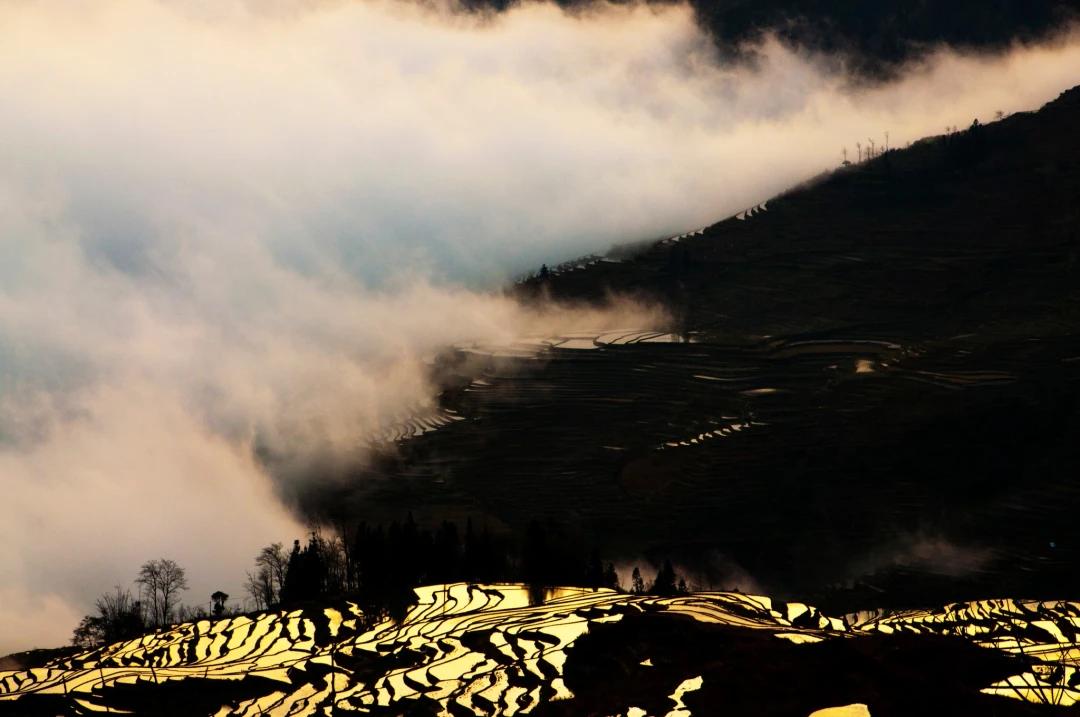
Leaving Jianshui, we continued toward Yuanyang. There are two routes. One provincial road cutting through the Ailao Mountains is reportedly rough, and fearing we'd miss sunset, we took the longer way via Gejiu on the Geyuan Highway. Though still winding, the road was wider, with more distance between the pavement and the cliffs.
Conclusion: Spring Never Disappoints Those Who Set Out
Eight days, nearly 3,000 kilometers, crossing Guangxi, Yunnan, and Guizhou. From Jingxi's wild waterfalls to Babao's turquoise river, from Puzhehei's lake-and-mountain scenery to Jianshui's ancient charm, from Tuanshan's century-old houses to Yuanyang's magnificent terraces—I saw more beauty than I could absorb.
Some places you visit once and want to return; others you've never been to but already feel familiar. These may be your home far away, or the homeland of your heart. Spring never disappoints those who set out. When you hit the road, you'll find that the most beautiful scenery isn't at the destination—it's on the journey itself.
Practical Tips: - Visit Jingxi's wild waterfalls in summer; the dry season reduces their flow - The road to Erlang Waterfall is poor; hike or take a villager's motorcycle - Puzhehei is best enjoyed by staying a while; local guesthouses offer great value - Visit Jianshui Ancient City in the off-season; early morning is best for photography - Tuanshan Village is under development; visit soon to experience its original character - Allow plenty of time for Yuanyang's terraces; the provincial roads are challenging
May every journey of yours meet the most beautiful spring.
You should also read:

Body in Hell, Heart in Heaven: A Pilgrimage Through Tiger Leaping Gorge — A Dialogue Between Heaven and Earth
Body in Hell, Heart in Heaven: A Pilgrimage Through Tiger Leaping Gorge — A Dialogue Between Heaven and Earth Introduction: When the Gorge Splits Open Beneath Your Feet Some say Tiger Leaping Gorge is the closest place on Earth to the border between "hell" and…
Continue reading...
Cloud Travelogue · Dali of Wind, Flowers, Snow, and Moon: A Three-Day, Two-Night Journey of a Free Spirit
Cloud Travelogue · Dali of Wind, Flowers, Snow, and Moon: A Three-Day, Two-Night Journey of a Free Spirit I am a cultured female foodie with a touch of rogue charm. I slung on my backpack, took my lover's hand, and set off on a spontaneous…
Continue reading...
The Meaning of Travel – A Tengchong Story: A Journey of the Heart and Personal Growth
The Meaning of Travel – A Tengchong Story: A Journey of the Heart and Personal Growth Setting Out, Only to Return a Better Self Some say travel is nothing more than leaving a place you're tired of, only to go to a place where others…
Continue reading...