Dali, Yunnan: A Slow Encounter with Wind, Flowers, Snow, and Moonlight Between Cangshan and Erhai
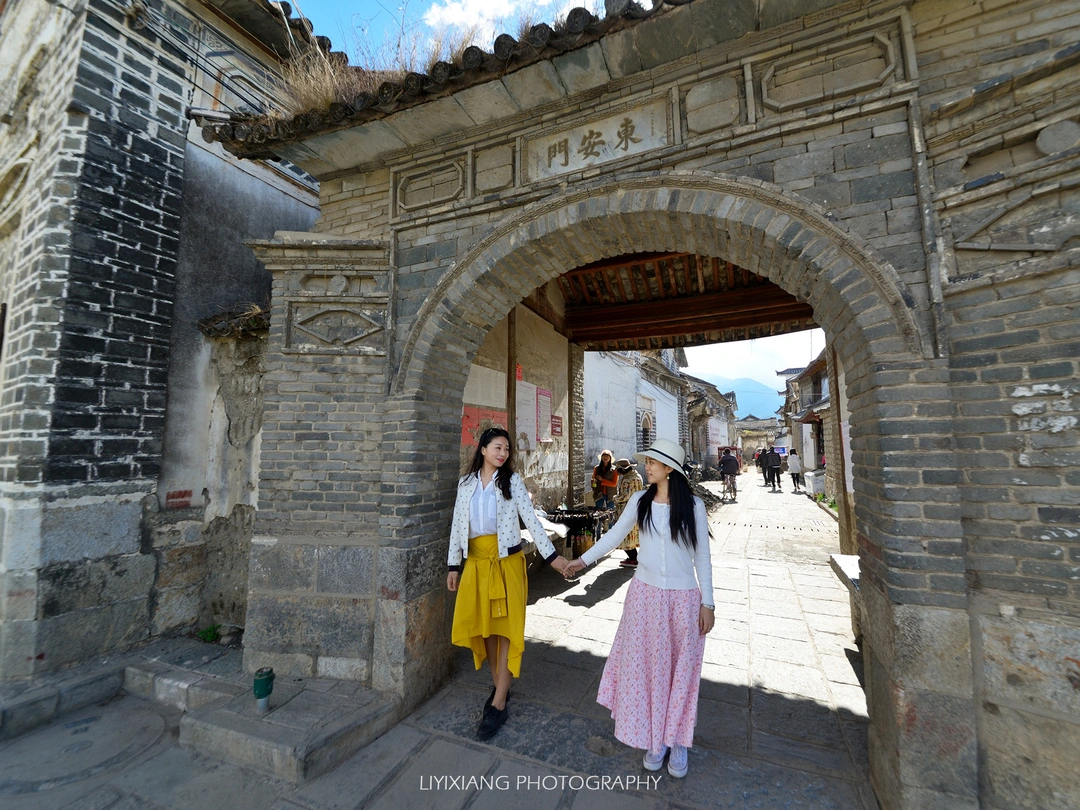
Dali, Yunnan: A Slow Encounter with Wind, Flowers, Snow, and Moonlight Between Cangshan and Erhai
Life doesn’t always have to be a relentless climb upward. Sometimes, wandering sideways leads to wider horizons.
This trip to Dali began with a promise made to friends a year ago. Plans changed along the way, but in the end, Tingting, Huohuo, and I made it happen. In April 2017, we set off from Guangzhou, spending eight days circling Erhai Lake. We passed through Dali Old Town, Caicun, Xizhou, Shaxi, and Wase, before flying back from Haidong Airport. We skipped the crowded hotspots of Lijiang and Shangri-La, and even reluctantly gave up our long-cherished dream of visiting Weishan. We just wanted to soak in this small city nestled at the foot of Cangshan Mountain and the edge of Erhai Lake.
Fifteen years ago, I had rushed through here on a group tour. One glance was enough to etch its beauty into my memory. This time, we decided to slow down.
Kunming: A Half-Day Stroll at a Transit Hub
From Airport to Green Lake: A Chaotic Little Exploration

On the first day of the Qingming Festival holiday, the airport expressway was clogged with anxious drivers. We took the airport bus from Luogang, yet still arrived at Baiyun Airport later than Huohuo, who had come by high-speed rail from Shenzhen and then transferred to the metro. Luckily, our flight was on time. Flight CZ3415 touched down smoothly at Kunming Changshui Airport. As we stepped out of the cabin, Kunming’s overcast sky and chill air greeted us.
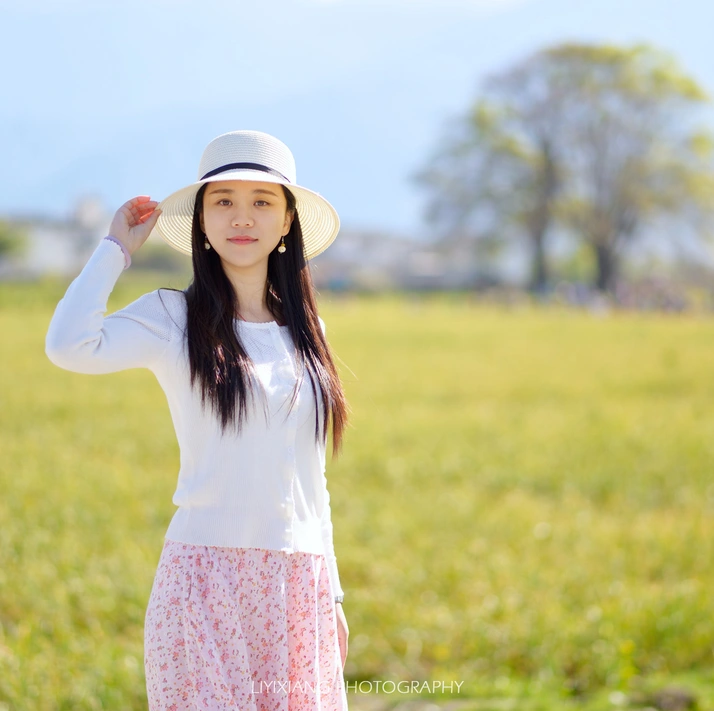
For most travelers, Kunming is just a transit stop—and we were no exception. That night, the 22:23 K9602 train would carry us to Dali, leaving us half a day to explore the city. First, we took the airport bus to Kunming Railway Station to store our luggage. A quick complaint here: Kunming’s airport bus management is a mess, with chaotic stops and disorganized queues. The bus dropped us at Jinjiang Hotel, a ten-minute walk from the station. Luggage storage was cheap, though—5 yuan per piece, regardless of size.
With our bags stowed, we hailed a DiDi and headed straight to Green Lake (Cuihu).
Military Academy, Green Lake, and Yuantong Temple: A Tapestry of History and Blossoms
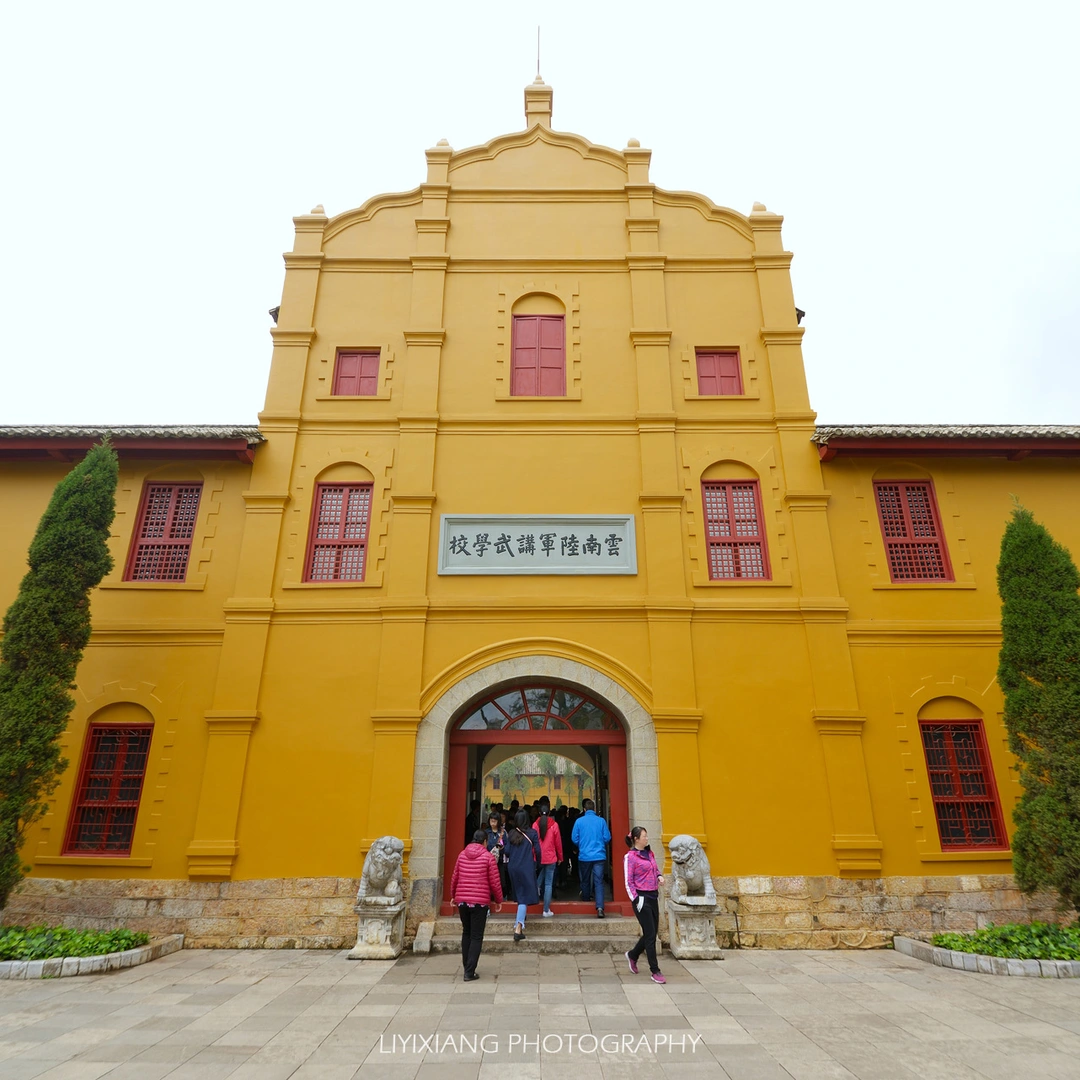
Our first stop was the Yunnan Military Academy (Yunnan Lujun Jiangwu Tang). Founded in 1909, this military school was a cradle of modern Chinese military talent and is now a national heritage site. We only snapped a photo outside, without going in.
Across from the academy lies Green Lake Park. Originally part of Dianchi Lake, it became a separate body of water as the water level dropped. Two causeways—the north-south “Ruan Causeway” and the east-west “Tang Causeway”—intersect at an island in the middle. Green Lake is famous in winter for flocks of red-billed gulls. Every year from November to March, tens of thousands of these birds migrate from Siberia to winter here. Sadly, we were a month late and missed them.
Nearby, Yuantong Temple is one of Kunming’s oldest Buddhist temples, with a history stretching back to the Nanzhao Kingdom period as the Putuo Temple, over 1,200 years ago. A primary school textbook essay titled “The Tide of Flowers” describes this very place: “Kunming has Yuantong Temple, and behind the temple is Yuantong Hill…” But the essay mentions crabapple blossoms; we saw cherry blossoms instead—pink flowers hanging like bells from branches, swaying gently in the breeze.
Yuantong Temple has a unique feature: the main gate sits at the highest point, and the path descends as you go deeper—a rare design for a temple. Inside stands the “Yuantong Shengjing” archway, built during the Kangxi reign of the Qing Dynasty. Legend says the calligraphy was personally inscribed by Wu Sangui, though this might be apocryphal. At the center of the courtyard lies a release pond, with an octagonal pavilion surrounded by water. A couplet on the pavilion reads: “Water’s sound like ancient zither music, mountain’s hues paint a fresh picture,” evoking the charm of a Jiangnan garden.
Our last stop was Yunnan University. Founded in 1922 on the site of the old Yunnan Examination Hall, it was originally named Private Donglu University. Entering through the south gate, we first saw two archways—“Jiaoteng” (Soaring Dragon) and “Fengqi” (Rising Phoenix)—followed by ninety-five grand steps. These steps were designed by Tang Jiyao, the university’s founder, to symbolize the “supremacy of nine and five” (a reference to imperial authority), hinting at his self-styled role as the “King of Yunnan.” At the top stands Huize Hall, a Western-style building modeled after the main building of the University of Paris. It exudes an austere grandeur, surrounded by ancient trees. The ginkgo avenue is another highlight of the university; in November, the “golden ginkgo fall” is ranked among China’s top ten most beautiful campus scenes.
A Bowl of Crossing-the-Bridge Noodles: Tasting Yunnan
After exploring the campus, it was time for dinner. We took a DiDi to Qiaoxiangyuan Crossing-the-Bridge Rice Noodles (Renmin Middle Road branch). In truth, these attractions are within walking distance of each other. The most logical route would be: Yuantong Temple, Yunnan University, Green Lake Park, the Military Academy, and finally Qiaoxiangyuan.
In Yunnan, you have to eat the most authentic crossing-the-bridge rice noodles. Qiaoxiangyuan is a chain restaurant. You pay at the counter, and there’s a cold-dish window nearby. We ordered the noodles, with various ingredients soaking in the broth and flower petals sprinkled on top—a feast for the eyes and palate. We also added steam pot chicken (qiguo ji) and a few cold dishes, all of which were tasty.
After finishing our noodles, we still had time before the train. The night air in Kunming was bitingly cold, so we found a café to sit in. The coffee was mediocre at best, but the ambiance was photogenic.
At 22:23, the K9602 train departed on time. This train’s final stop was Lijiang, so our arrival in Dali was scheduled for 5:34 AM—an awkward time.
Dali Old Town: Where History Meets Everyday Life
A Rainy Dawn in Xiaguan
At 5:34 AM, the train pulled into Dali Station. The station is in Xiaguan, the capital of Dali Prefecture, which has been a military stronghold since the Nanzhao period. The cold was biting as we stepped off. We had two options: take one of the minivans touting rides to Dali Old Town, or rest up in Xiaguan first. Given that inns wouldn’t be open so early, we chose the latter.
We dragged our luggage down the street and found a reasonably clean hotel to rent a day room. It took some effort to get hot water from the shower. After freshening up and resting a bit, we woke to heavy rain outside. We called a DiDi ride-share to Dali Old Town. The drive from Xiaguan to the old town took about 20 minutes, along the Dali Highway that hugs Erhai Lake, offering beautiful scenery.
We had booked Yunnong Boutique Inn, located south of the old town, a ten-minute walk from the South Gate. The inn had a lovely little courtyard and was on a quiet side street, away from the main road. Staying inside or outside the old town each has its perks: inside offers convenience for dining and shopping; outside provides better value for money.
Wandering the Old Town: Echoes of a Millennium from Nanzhao to Dali Kingdom
The innkeeper recommended a restaurant called Bamu Xuan Bai Ethnic Flavor Garden, just a few minutes’ walk away. Unlike the milder Kunming cuisine, Dali food leans sour, salty, and spicy. Sour-spicy fish, yellow braised chicken, seaweed, and sea snails are staples at almost every restaurant. There’s also a local specialty called “tree flower and tree bark,” which is actually a type of lichen.
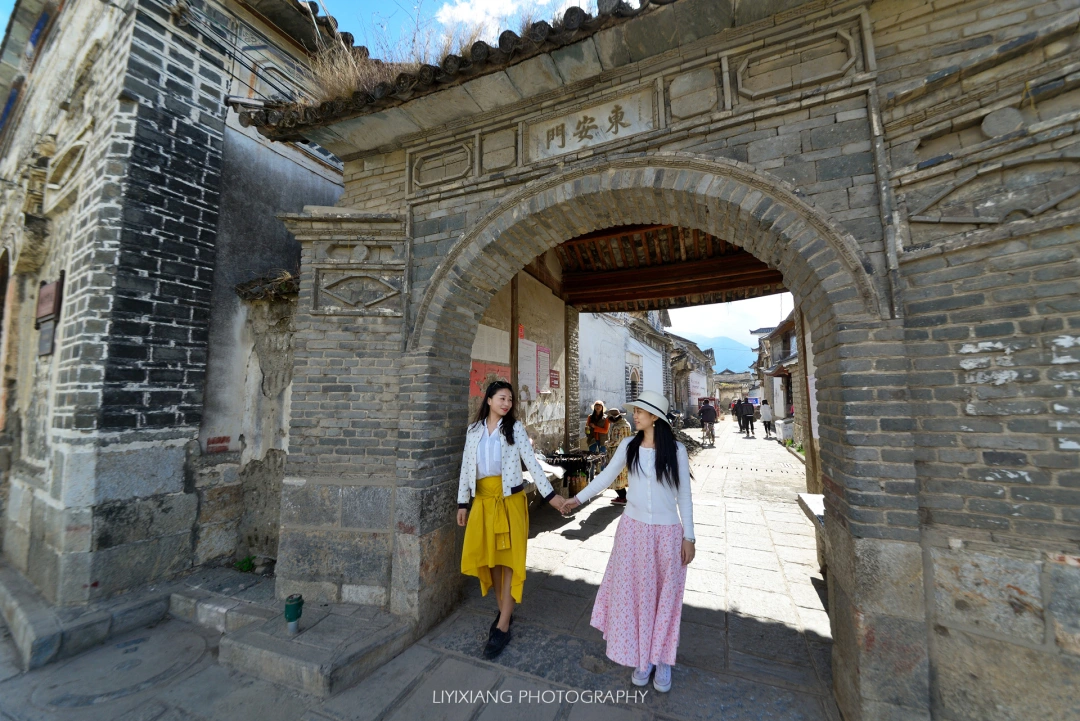
After a hearty meal, we began exploring the old town. Dali’s history dates back to the Nanzhao regime, which roughly corresponds to China’s Tang Dynasty. Later, the Duan family’s Dali Kingdom ruled until Kublai Khan’s southern campaign, when Yuan soldiers crossed the Jinsha River on leather rafts and conquered the kingdom. The old town we see today was first built during the Hongwu reign of the Ming Dynasty. The city walls are no longer intact, but the four gates remain—the north and south gates face each other, while the east and west gates do not, a layout said to be related to feng shui.
Inside the old town, the Dali City Museum was originally the mansion of Du Wenxiu, a leader of a Qing Dynasty uprising. It’s a three-courtyard complex. We arrived close to closing time and couldn’t enter, but the cherry blossoms in the courtyard were in full bloom. The Five-Cloud Tower (Wuhua Lou), built during the Dali Kingdom period, has long been demolished; what stands now is a replica. Excavations reportedly unearthed dozens of ancient stelae from the Dali Kingdom and Yuan Dynasty.
Street vendors sell rushan (milk fans), and we bought some to try. This snack—made by grilling or deep-frying milk into thin sheets—is the star of the Yunnan saying, “Milk made into sheets to sell.” The most authentic version comes from Dengchuan in Eryuan County. But we weren’t fond of the strange cheese-like flavor. Whether it’s good or not is a matter of taste.
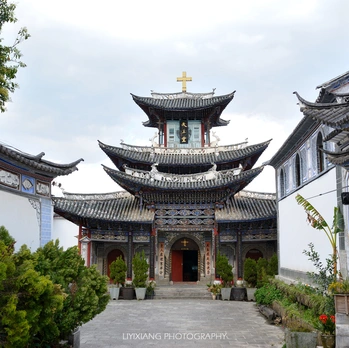
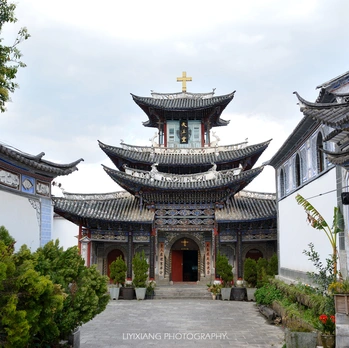
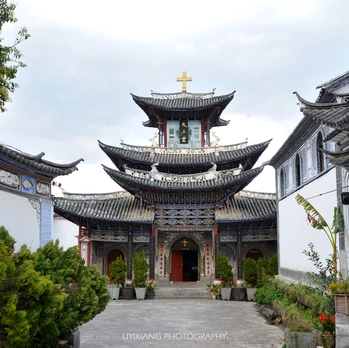
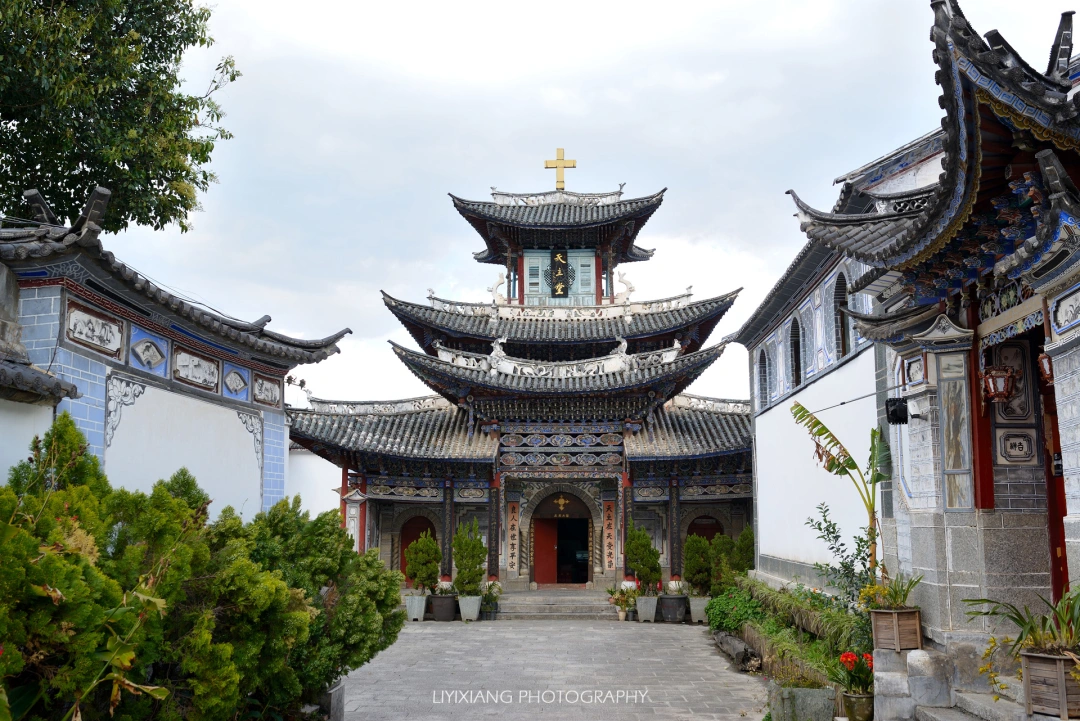
Scattered throughout the old town are ancient temples and churches of Confucianism, Buddhism, Islam, and Catholicism. On a small alley off Renmin Road, the Catholic Church combines Chinese and Western styles in a Bai-ethnic wooden structure. The Western-style gate is intricately carved, and the chapel to the east enshrines a statue of the Virgin Mary. On Yuer Road, Yuer Garden offers a peaceful retreat from the bustle. Converted from a fruit tree nursery, the garden is planted with local Dali flowers and rare plants.
Foreigner Street (Yangren Jie) is located on the middle section of Huguo Road. Though only a few hundred meters long, it’s a must-visit for tourists. In the 1980s, foreign backpackers discovered this area, which had the old town’s only guesthouse at the time, turning it into a backpacker hub. We had dinner at Old House Private Kitchen on Foreigner Street. The place was hard to find, but navigation apps got us there. It was tiny, housed in an old building, and often had a queue. We ordered yellow braised chicken, stir-fried chives with shrimp, and wild golden-thread vegetables, along with a small measure of rice wine. The food was good, and the prices were fair.
Three Pagodas of Chongsheng Temple: The Grandeur and Vicissitudes of a Royal Monastery
The next morning, we had rice noodles (ersi) for breakfast at a small shop near our inn, then headed to the Three Pagodas of Chongsheng Temple. This royal monastery from the Dali Kingdom period had outrageously expensive tickets, so we bought a more affordable package from our innkeeper that included tickets and round-trip transport.

Chongsheng Temple was built during the Nanzhao period and was once famous for five great treasures: the Three Pagodas, the Nanzhao Great Bell, the Rain-Bronze Avalokiteshvara statue, the Three Holy Golden Statues, and the “Buddha Capital” plaque. But apart from the pagodas, all were destroyed by wars and natural disasters over the centuries. The current building complex was reconstructed in recent years.
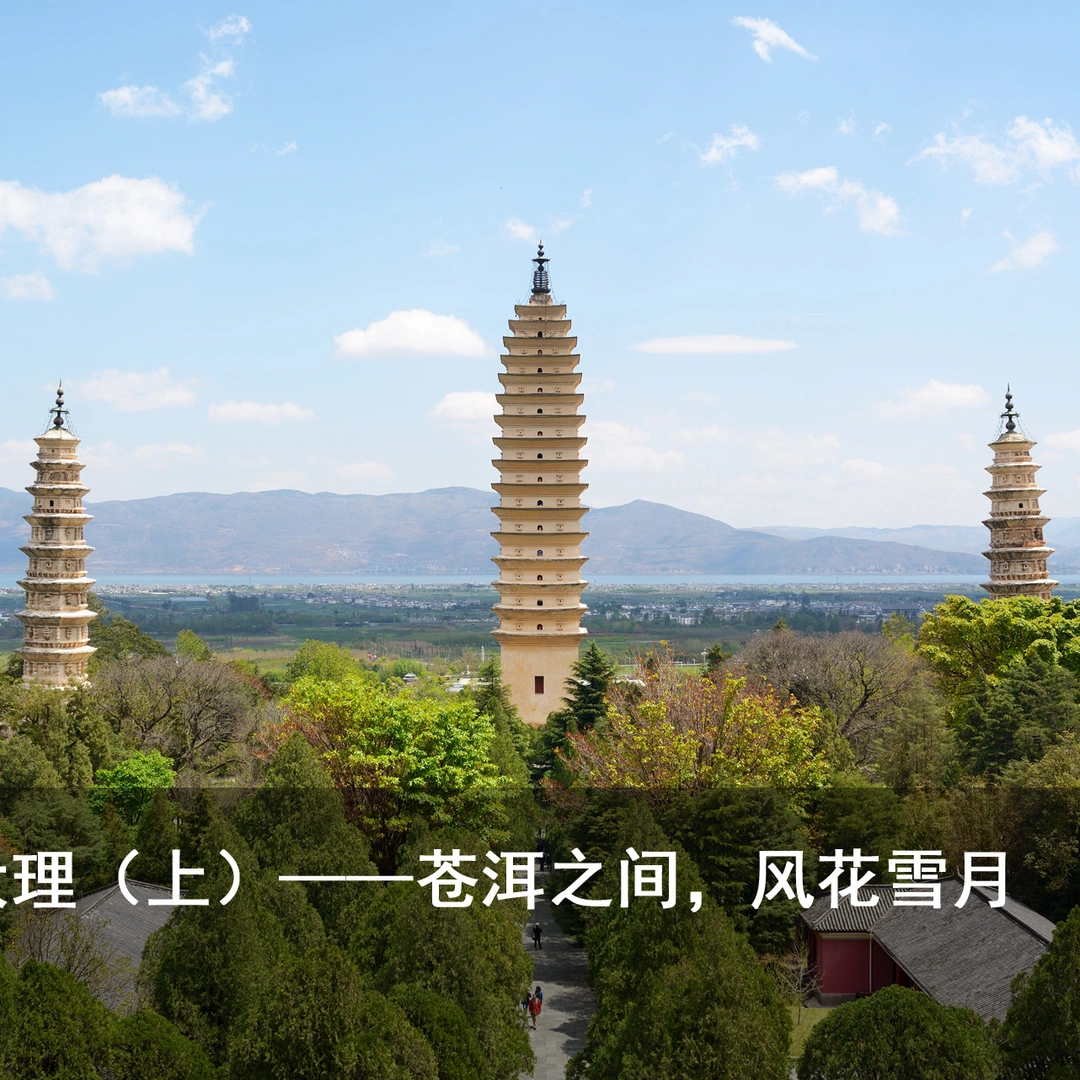
Of the twenty-two emperors of the Dali Kingdom, nine abdicated to become monks at Chongsheng Temple. Among them was Duan Zhengyan, the sixteenth king, who served as the inspiration for Duan Yu in Jin Yong’s novel The Demi-Gods and the Semi-Devils. The three pagodas consist of one large and two small ones. The large one, called Qianxun Pagoda, stands with the two smaller pagodas in a tripod formation. It is one of the tallest ancient pagodas still standing in China, belonging to the same Tang Dynasty architectural style as the Giant and Small Wild Goose Pagodas in Xi’an. Inside the reconstructed Rain-Bronze Avalokiteshvara Hall (rebuilt in 1999) stands a statue of the deity. The original, cast during the Tang Dynasty, was smashed and melted down in the last century; the current statue is a replica based on a late Qing Dynasty photograph.
Reunion with an Old Friend: A Cup of Coffee, Six Years
After leaving Chongsheng Temple, we returned to the old town to visit an old friend—Xiaobei. We had met six years ago in Xining and later traveled together to Lhasa. He later opened an inn in Dali, then sold it and started a café called “Rushi” (Thus Come). The walls were covered with barista certifications, showing he had become a true coffee connoisseur. His two dogs, Mountain and Jasmine, were also at the café.
It had been six years since we parted ways on Barkhor Street in Lhasa. Meeting again, we caught up and chatted about the present. Xiaobei personally brewed three cups of coffee for us. Though I know little about coffee, I could tell his skills were top-notch. In his own words, his coffee in Dali was unmatched—even if you stood on the summit of Cangshan Mountain, you wouldn’t find a rival.
But if you’re hoping to visit Rushi Café and taste the master’s work, I’m sorry—you’re out of luck. By the time I wrote this travelogue, Xiaobei had already transferred the café and taken an indefinite leave to wander the world.
Caicun: A Quiet Corner by Erhai Lake
After saying goodbye to Xiaobei, we returned to the inn to pick up our luggage and called a DiDi to Caicun. Caicun is the closest lakeside village to Dali Old Town, making it a great spot to enjoy Erhai Lake. We booked the Yunshui Qingshe Inn, which was affordable. Though the room didn’t have a front-row lake view, it was just a two-minute walk from the water.

By the lakeside, we found a large wetland. Caicun’s traditional livelihood is fishing, and while tourism is growing, it’s much quieter than the dusty, chaotic Shuanglang. Perhaps because everyone is busy building inns, few people open restaurants, so dining options in Caicun are limited. We found a small family-run place called Dazhaobi Private Kitchen on Dianping, and the food was decent.
That evening, the three of us went up to the rooftop terrace of the inn, enjoying the lake breeze and beer. It had its own charm.
Xizhou: A Living Museum of Bai Culture

Morning by the Lake and an Unexpected Upgrade
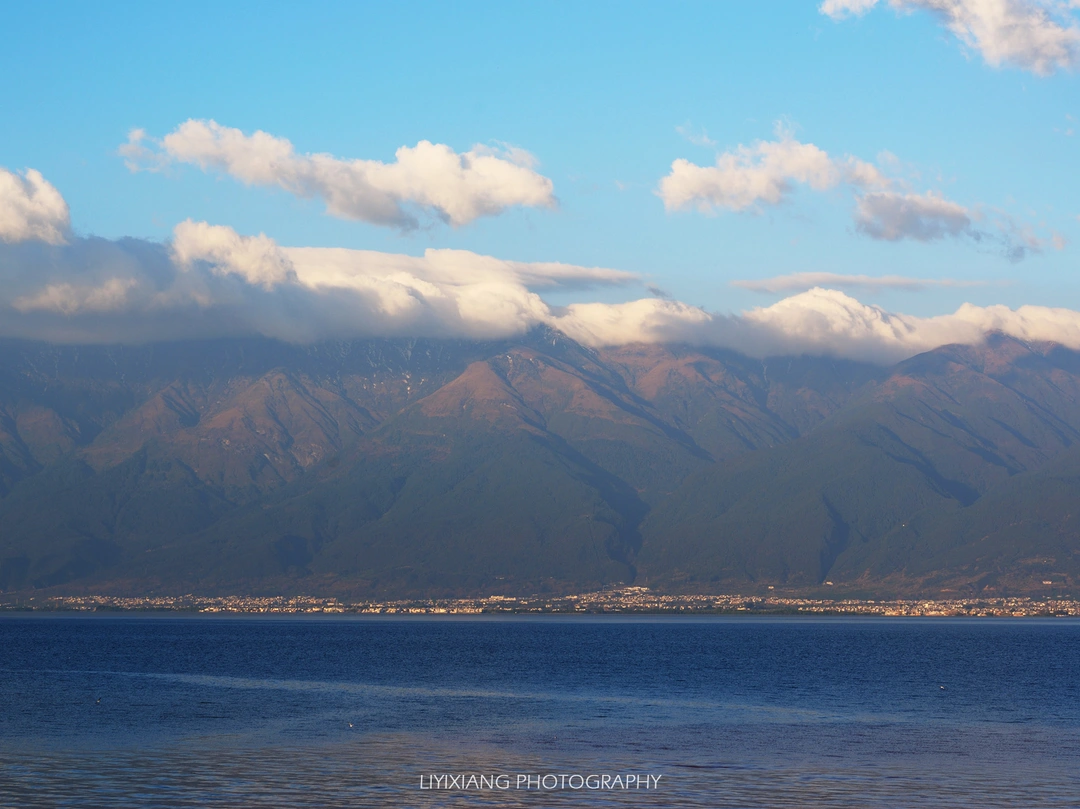
On the fourth day, the weather wasn’t great, but I still got up early to catch the sunrise by the lake. The clouds were too thick, and I didn’t see a true sunrise. The lake wind was strong and bitingly cold. I returned to the inn, woke the two girls, and after a simple breakfast, we walked along the shore to Caicun Pier. Near the pier, the wetland park offered a refreshing scene of gentle breezes and rippling blue waters.
Leaving Caicun, we booked a DiDi ride-share to Xizhou. The car took part of the West Ring Road along Erhai, then the Dali Highway, arriving in about half an hour. We stayed at the Nilyu Huashijian Inn, located in Xianglong Village rather than Xizhou town center, but it was close to the central Sifang Street. The inn was clean, comfortable, and great value. The owner played outdoor movies in the courtyard at night. Tingting and I had booked a standard room, but since there were few guests that night, we were upgraded for free to a family room—spacious and lovely.
Xizhou’s Past: A Land of Scholars and Merchant Legends
Xizhou is the largest town in the northern part of the Dali basin. Though the Bai people are the majority, centuries of Han Chinese cultural influence have made Xizhou’s residents value education highly. During the Ming and Qing Dynasties, the town produced over seventy jinshi (successful candidates in the imperial examinations). In the Republican era, the Xizhou merchant guild wielded considerable power, which explains the many grand mansions here, giving rise to the saying, “Poor Dali, rich Xizhou.” Relatively speaking, Xizhou remains under-commercialized, with locals still living in the streets and alleys.
The central Sifang Street is a small square surrounded by shops. In the square stands the “Timing Archway,” originally built during the Ming Dynasty to honor several jinshi from the town. Villagers who achieved success in the imperial exams could have their names inscribed on it. The current structure is a replica. On Sifang Street, the Yan Family Mansion is a representative example of Bai residential architecture. Built in the early 20th century, it belonged to the wealthy merchant Yan Zizhen. Entry requires a ticket, and there’s a Three-Course Tea performance inside, which didn’t interest us, so we skipped it.
We had lunch at Yuhe Garden, recommended by our innkeeper. The dishes were similar to previous days, but Xizhou’s lower prices made it feel like better value. After eating, we continued wandering the ancient town.
Across the fields, we could see a large courtyard with earthen-yellow walls—Xilin Yuan (Xizhou Linden Centre). Originally the residence of Yang Pinxiang, a famous Xizhou merchant, it was completed in 1948 and is a national heritage site. In 2008, it was converted into a hotel by an American named Brian Linden. Not far from Xilin Yuan is Yongxiangju, with the words “Min Ju Zhi Kui” (Foremost Among Folk Residences) inscribed on its gate. The courtyard is filled with camellias, and from the third-floor corridor, you can see farmland with distant mountains.
The Jiyisi Inn is a garden-style inn converted from an old “horse-turning-corner” building, once a wealthy merchant’s mansion. Its name is a tongue-twister: “Ji Yi Si.” As rain began to fall, we went upstairs to the inn’s café bar to sit for a while.
Haishe: A Tongue Sticking into Erhai
When the rain stopped, the sun came out brilliantly. We took a motorized tricycle to Haishe Ecological Park, about three kilometers northeast of Xizhou town. This is a narrow, three-sided peninsula that extends into Erhai Lake like a tongue, hence the name “Haishe” (Sea Tongue). The scenery differs on each side: one side has waves crashing against the shore, while the other has gentle ripples—a picturesque landscape. At the entrance stand a pair of “husband-and-wife trees,” a must-photo spot for almost every visitor to Xizhou and a popular location for wedding photography.
As the sun set, we took the tricycle back to Sifang Street. Though it wasn’t dark yet, most shops had already closed, leaving only the Sifang Street Food Shop still open. This restaurant is recommended by Lonely Planet: Yunnan. Several large wine jars stood against the wall; the owner used to work at a distillery.
Suddenly, I remembered we hadn’t tried Xizhou baba (flatbread) since arriving. Huohuo and I bought the last one from the only stall still open on Sifang Street. This so-called “Chinese pizza” is a flaky flatbread made from wheat flour, baked between two layers of charcoal, available in sweet and savory versions.
Shaxi: The Last Market on the Ancient Tea Horse Road
From Xizhou to Shaxi: Two Hours of Mountain Roads
On the fifth morning, the weather was beautiful, with snow clearly visible on the summit of Cangshan Mountain. Tingting and I took a walk near the inn, soaking in the pastoral scenery bathed in morning light. We couldn’t find a place for breakfast near the inn, so we walked all the way to town for two bowls of noodles, packing an extra bowl for Huohuo.
After breakfast, we set off for Shaxi. From Xizhou to Shaxi, public transport requires a transfer at Jianchuan county town, which is inconvenient. The night before, we had booked a DiDi ride-share for the journey, which took about two hours.
Sideng Street: A Corner Where Time Stands Still
Known as “the last market on the ancient Tea Horse Road,” Shaxi is now a quiet,古朴 (ancient and simple) little town. Sideng Street, centered around Sifang Square, was once the busiest market in old Shaxi. We had booked the Yunhai Shanying Resort Hotel at the entrance to the town’s periphery. The hotel’s design was unique, with a fish pond built indoors, and the rooms were well-equipped. The downside was that it took at least a fifteen-minute walk to reach the core area of Sideng Street.
Shaxi’s restaurant scene is far less developed than its accommodation options, with few choices for dining. We found a small shop on the street and ordered a few stir-fried dishes. After eating, we headed to Sideng Street.
The core buildings of Sideng Street are the ancient stage and the Xingjiao Temple. The stage faces the main gate of Xingjiao Temple, because performances were primarily meant for the gods and Buddhas. The main structure of the stage is the Kuixing Pavilion, where local Bai people worshipped the god of literature. Though restored, it largely retains its original appearance. Xingjiao Temple was built in the 13th year of the Yongle reign of the Ming Dynasty (1415), making it nearly 600 years old. It is the largest, most typical, and most representative surviving temple of the Esoteric Buddhist “Azali” sect in China. The mountain gate features two giant, fierce-looking vajra warriors, which can be a bit frightening.
On Sifang Square, there’s a café called “Yezi’s Shop” (Leaf’s Shop), with an enviable location and rustic decor. Sitting on the stone steps outside, basking in the sun and watching passersby, was pure bliss. The coffee and desserts were good, though a bit pricey.
Yujin Bridge: Stones Polished by Time
The Tea Horse Road originated from the tea-for-horse trade in the ancient southwestern borderlands, flourishing during the Tang and Song Dynasties and peaking in the Ming and Qing. Shaxi, once a prominent town on this road, now only retains its ancient streets and stone bridge, quietly tucked away in a corner. The Heihui River flows gently outside the town, spanned by the crescent-shaped Yujin Bridge. Built during the Kangxi reign of the Qing Dynasty, the bridge was rebuilt in 1931. At the bridgehead, a stele corridor houses a stone tablet with the “Repair Bridge Fundraising Inscription.” Today, the bridge’s stone slabs are pitted and worn, glowing with a bluish sheen from countless carts and footsteps over the centuries.
For dinner, we chose Orange Restaurant, found on Dianping. To our surprise, it was crowded, with several tables of foreign tourists. The flavors were milder than Dali’s. Before dinner, my stomach was a bit upset, so I had little appetite. After eating, I returned to the hotel early to rest.
Market Day: A Sea of People in Shaxi on Friday
On the sixth morning, I didn’t get up early due to my stomach issues. By the time I went out, it was already bright. It was Friday, and Shaxi holds a market every Friday. Besides strolling along the Heihui River, we also visited the town market.
When we reached the market street, it was already packed with people. Elderly women carrying bamboo baskets, old men puffing on pipes, women haggling over prices… Going to the market was clearly the best way to experience local life.
Wase: Tranquility on the Eastern Shore of Erhai
After lunch in Shaxi, we arranged for a minivan to take us to our final stop—Wase. Overall, Shaxi and Xizhou are both places where tourism is still in its early stages, and they were my two favorite spots on this trip.
The drive from Shaxi to Wase took about two hours via the Dali Expressway, passing through the Shuanglang service area. The service area has an observation platform offering a high vantage point over Cangshan Mountain and Erhai Lake. The afternoon sun was too harsh, and the strong backlighting made for poor photos.
After leaving the expressway and driving a bit further, we arrived at Wase town. Located at the foot of Jizu Mountain, Wase was historically known as Luchuan and sits at the center of Erhai’s eastern shore. Objectively speaking, Wase’s lake views and water quality are slightly inferior to Shuanglang’s. But Shuanglang is currently a massive construction site, with dust and noise everywhere, so we chose to stay in Wase. The minivan dropped us directly at our booked inn, Caicai Jia Haijing Kezhan (Caicai’s Home Lakeview Inn)…
Final Thoughts: Wind, Flowers, Snow, and Moonlight—Nothing More
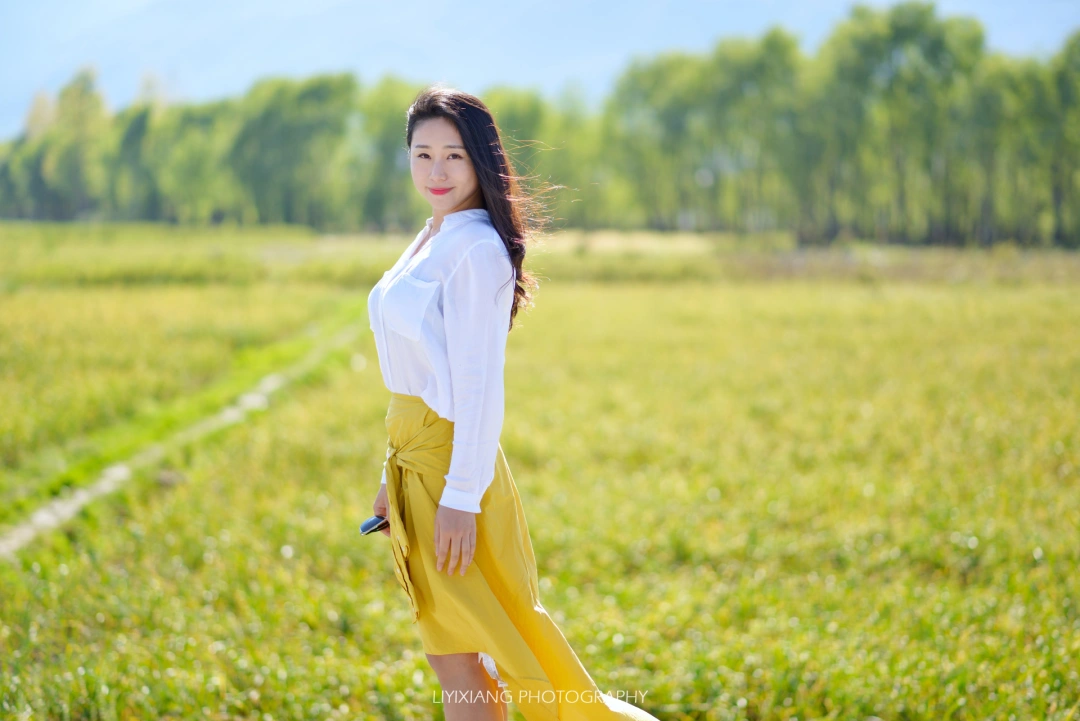
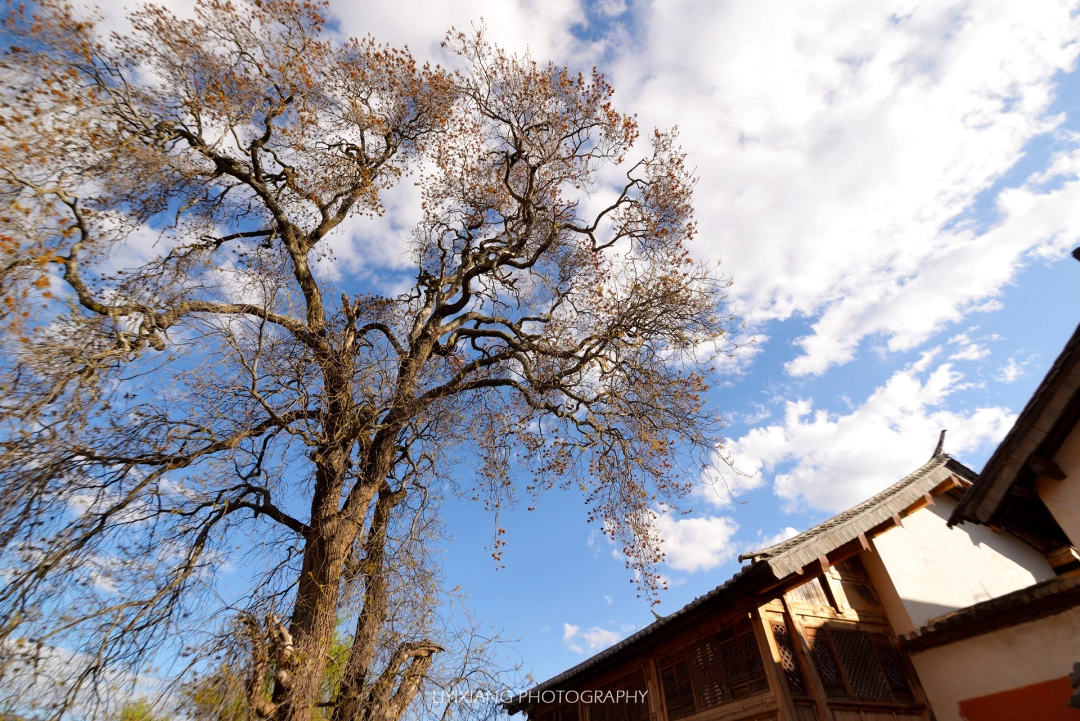
Eight days, a full circle around Erhai Lake: from Kunming to the old town, from Caicun to Xizhou, from Shaxi to Wase. No rushing, no checklist-style sightseeing—just slow walking and quiet observation.
The beauty of Dali isn’t in its attractions; it’s in the everyday. It’s the snow on Cangshan’s summit at dawn, the gentle breeze by Erhai at dusk, the Xizhou baba on Sifang Street, the sunlight in front of Shaxi’s ancient stage. The so-called “Shang Pass Flowers, Xiaguan Wind, Cangshan Snow, Erhai Moon” is really just an attitude toward life—slow down, and you’ll see the wind, flowers, snow, and moonlight.
If you’re planning a trip to Dali, my advice is: don’t be greedy, don’t rush. Pick one or two places you like and settle in. Even sitting by the lake and daydreaming is better than rushing through every sight. Because the most beautiful scenery is often not in the travel guides, but in the moments you catch out of the corner of your eye when you least expect it.
You should also read:

Solo in Yunnan: A Wanderer’s Guide to the Land of Eternal Spring
Solo in Yunnan: A Wanderer’s Guide to the Land of Eternal Spring There’s something magical about traveling alone. No compromises, no schedules to keep, no one to please but yourself. I’ve been on the road for nearly three months now, and not once have I…
Continue reading...
Body in Hell, Heart in Heaven: A Pilgrimage Through Tiger Leaping Gorge — A Dialogue Between Heaven and Earth
Body in Hell, Heart in Heaven: A Pilgrimage Through Tiger Leaping Gorge — A Dialogue Between Heaven and Earth Introduction: When the Gorge Splits Open Beneath Your Feet Some say Tiger Leaping Gorge is the closest place on Earth to the border between "hell" and…
Continue reading...
Cloud Travelogue · Dali of Wind, Flowers, Snow, and Moon: A Three-Day, Two-Night Journey of a Free Spirit
Cloud Travelogue · Dali of Wind, Flowers, Snow, and Moon: A Three-Day, Two-Night Journey of a Free Spirit I am a cultured female foodie with a touch of rogue charm. I slung on my backpack, took my lover's hand, and set off on a spontaneous…
Continue reading...