First Trip of 2025: A Self-Drive Adventure Through Xishuangbanna, Exploring the Ancient Villages, Tea Forests, and Sea of Clouds at Jingmai Mountain
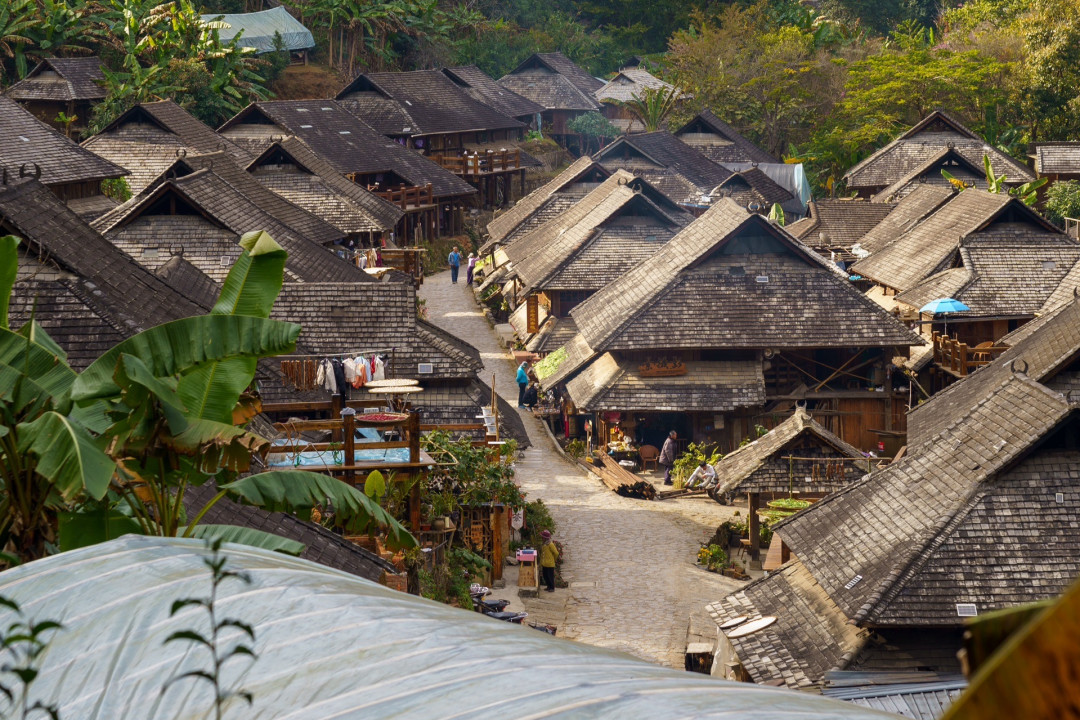
First Trip of 2025: A Self-Drive Adventure Through Xishuangbanna, Exploring the Ancient Villages, Tea Forests, and Sea of Clouds at Jingmai Mountain
Some places, once they plant a seed in your heart, are destined to grow. Jingmai Mountain is exactly that kind of place.
In early 2022, I had planned to take my mother to this legendary tea mountain, but the trip was shelved due to the pandemic. Three years later, when I reopened my travel wishlist, I discovered that Jingmai Mountain had been successfully inscribed as a UNESCO World Heritage Site in September 2023. A thought immediately struck me: if I don't go soon, will it become the next Xijiang Qianhu Miao Village—overrun by tourism? So without hesitation, I cobbled together my annual leave, grabbed my mom, and in January 2025, we embarked on a spontaneous warm-weather getaway.
Why Jingmai Mountain?
The UNESCO World Heritage Centre's description of Jingmai Mountain still stirs the heart: this cultural landscape in Yunnan, cultivated over more than a millennium by the Blang and Dai peoples following practices dating back to the 10th century, is a living testament to harmony between humans and nature. Villages surrounded by forests and tea gardens nestle among ancient tea trees. The understory cultivation method blends seamlessly with the mountain ecosystem and subtropical monsoon climate. The local people firmly believe in the "Tea Ancestor," holding that tea trees possess spirits and nature is alive with divinity—a faith woven into every traditional ritual and festival.

Simply put, this is no ordinary tea plantation. It is a living, breathing cultural museum.
Trip Overview: Four Days, Three Nights of Slow Living
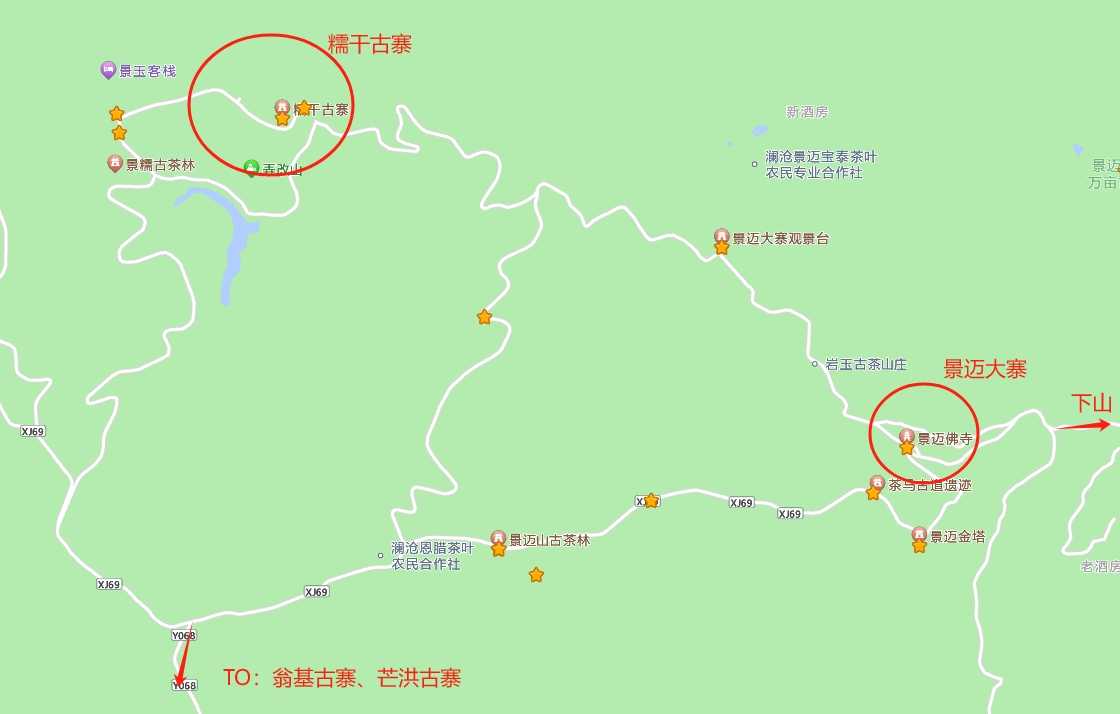
We chose a Friday evening flight from Shanghai to Xishuangbanna, using the weekend plus annual leave to carve out four days. Most of our time was dedicated to Jingmai Mountain—because real travel isn't about ticking boxes; it's about immersion.
Day 1: Morning Light at Manting Park, Evening Glow at Jingmai Mountain
Morning: Manting Park and the General Buddhist Temple
On our first day after landing in Banna, we stopped at a roadside shop for a bowl of 鸡汤米干 (chicken soup rice noodles)—warming and comforting. Then we headed straight to Manting Park, the former imperial garden of the Dai kings. Admission was 40 yuan, open from 8 a.m. to 5 p.m.
Our walking route was straightforward: entering from the northeast gate, we passed the Dai King's Palace, the Zhangha Pavilion, the City Heart Pagoda, the Leaf Garden, the Twin Pagodas, the yacht dock, the Octagonal Corridor Bridge, the White Pagoda, and finally arrived at the General Buddhist Temple. The entire loop was about 2 kilometers, with plenty of stops—just right for a morning stroll.
In December, Manting Park was exploding with flowers. Tropical blooms I couldn't name blazed red and shone yellow, as if to say: Winter? Never heard of it. The White Pagoda at the General Buddhist Temple looked especially sacred against the blue sky. Though separated from Manting Park by just a wall, the temple is free to enter.
Afternoon: Driving to Jingmai Mountain
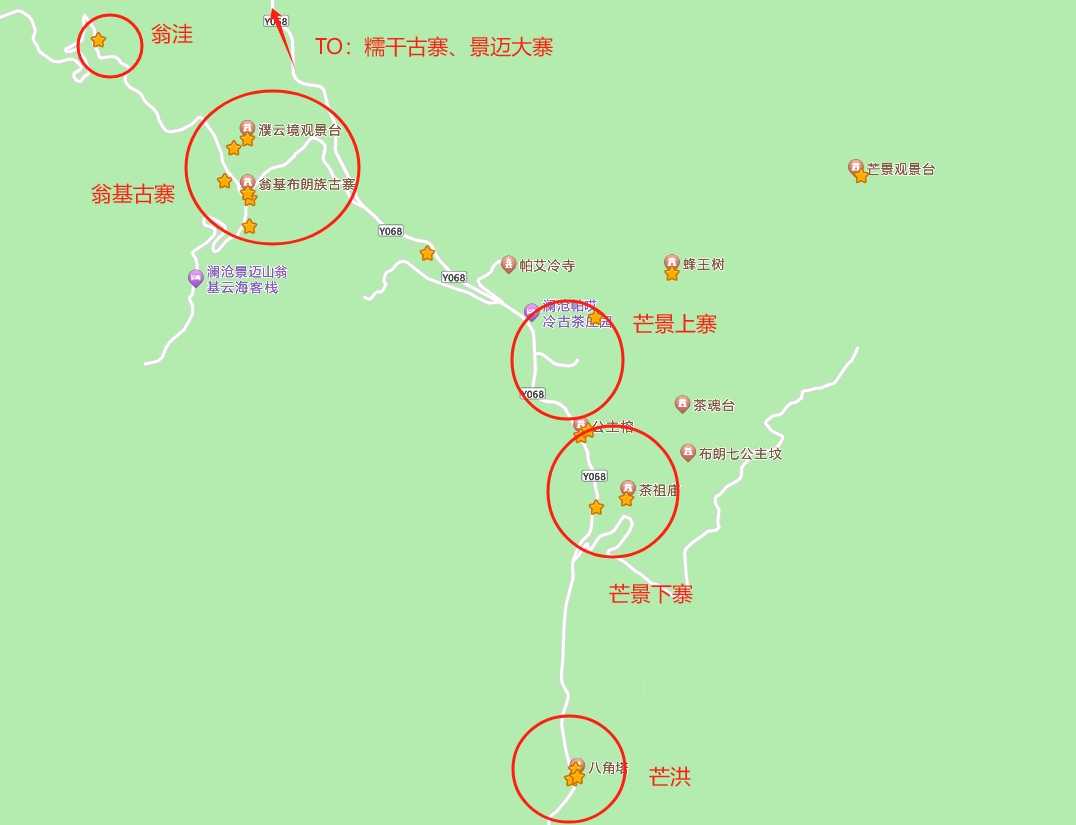
At 11 a.m., we picked up our ride for the trip from Yihai Rent-a-Car—a Yingbao R Pro (a sporty Chinese sedan). The drive from Banna to Jingmai Mountain took about 3.5 to 4 hours, with two distinct road sections: the first half was national highway, occasionally congested; the second half, starting from Huimin Town and heading uphill, featured three types of surfaces—cement, stone, and flagstone. The stone sections required careful driving; 20 km/h was our safe speed. Locals could manage 40-50 km/h, but after seeing cars with tires punctured by sharp rocks, we wisely slowed down.
Evening: Dapingzhang Ancient Tea Forest
After passing the Jingmai Mountain entrance gate, our first stop was Dapingzhang Ancient Tea Forest. The tea trees here are classic understory cultivation: tall canopy trees above, tea trees below, forming a unique ecological structure. Following the walking path from the west gate to the east gate, we encountered the Tea King—a 1,400-year-old ancient tree that was unassuming yet commanded deep respect.
A young worker at the tea factory explained that the old tea trees on Jingmai Mountain belong to the Camellia sinensis var. assamica (arbor species), while later introductions are large-leaf varieties. The tree types differ, and so do the leaves: ancient tea leaves are smaller, new tea leaves larger. Tea farmers can tell just by looking at fresh leaves whether they come from true ancient trees.
Nightfall: Nuogan Ancient Village
Leaving Dapingzhang, we stopped by Nuogan Ancient Village, a Dai settlement tucked in a mountain hollow with over a thousand years of history. The eaves of the houses were decorated with ox horns, and every village has a "village heart"—a central post where, according to legend, ancestors would hang food. If it wasn't eaten by wild animals by the next morning, the site was deemed safe for settlement.
We had dinner at a local-run restaurant. The 腊肉 (cured pork) was so fragrant we wanted to take some home. 炒芭蕉花 (stir-fried banana flowers) was a delightful surprise, and the 罗非鱼 (tilapia) was cooked with rich spices—every bite tasted of the mountains.
Accommodation: Fangwu Zhiwai
That night we stayed at "Fangwu Zhiwai," a stylish guesthouse on Jingmai Mountain. In the evening, we experienced the traditional 火塘 (hearth fire). The charcoal crackled, and warmth spread from our feet to our hearts.
Day 2: Sunrise Over the Sea of Clouds, Tea-Scented Ancient Villages
Early Morning: Sunrise at Manghong Octagonal Pagoda
At 7:30 a.m., we drove up to Manghong Village. Behind the Octagonal Pagoda parking lot, stone steps lead to a small dirt slope—a perfect spot for watching the sunrise. That morning, the sea of clouds was thin, a delicate layer draped over the mountains like a sheer veil over the earth.
The Manghong Octagonal Pagoda is a Blang Theravada Buddhist stupa, first built during the Kangxi reign of the Qing Dynasty. The original temple is long gone, leaving only this pagoda standing quietly, witness to centuries of wind and rain.
Late Morning: Wengji Blang Ancient Village
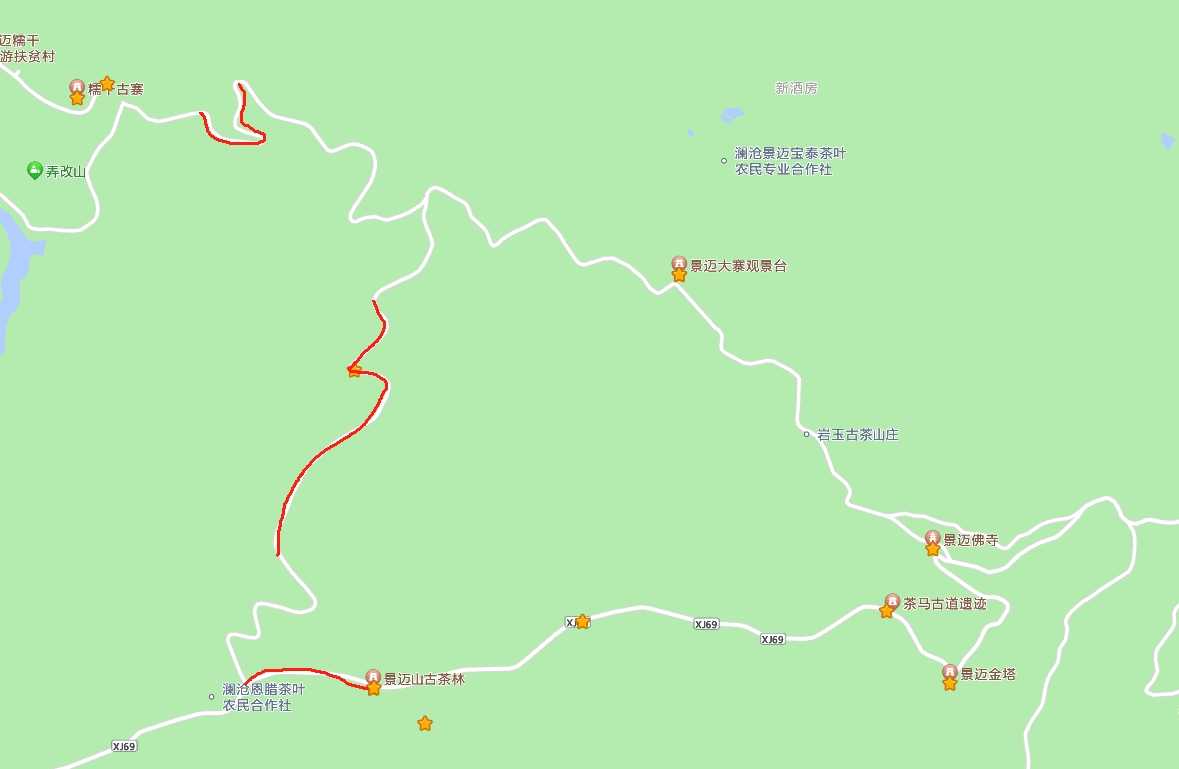
The eaves of Wengji Ancient Village are marked with a symbol of one bud and two leaves—a nod to their tea-based livelihood. The ancient Buddhist temple's steps bear the same emblem. Village heart, ancient trees, flagstone paths—everything remains authentic and untouched.
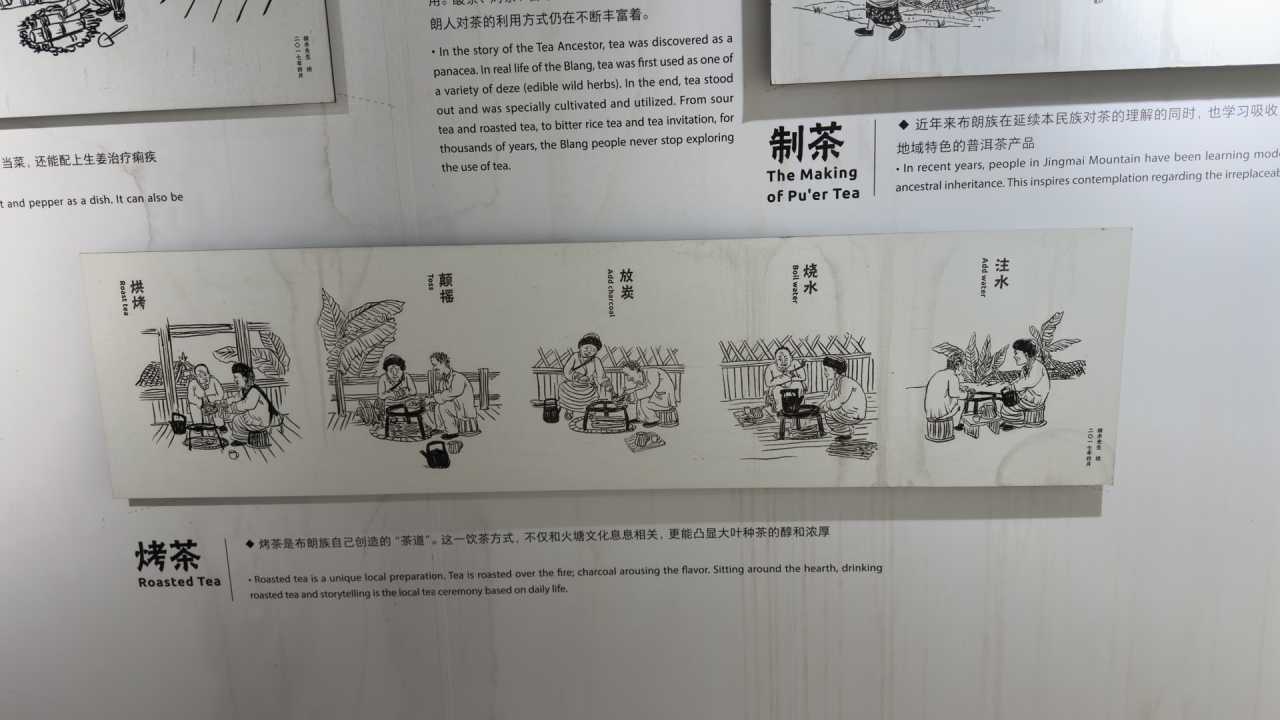
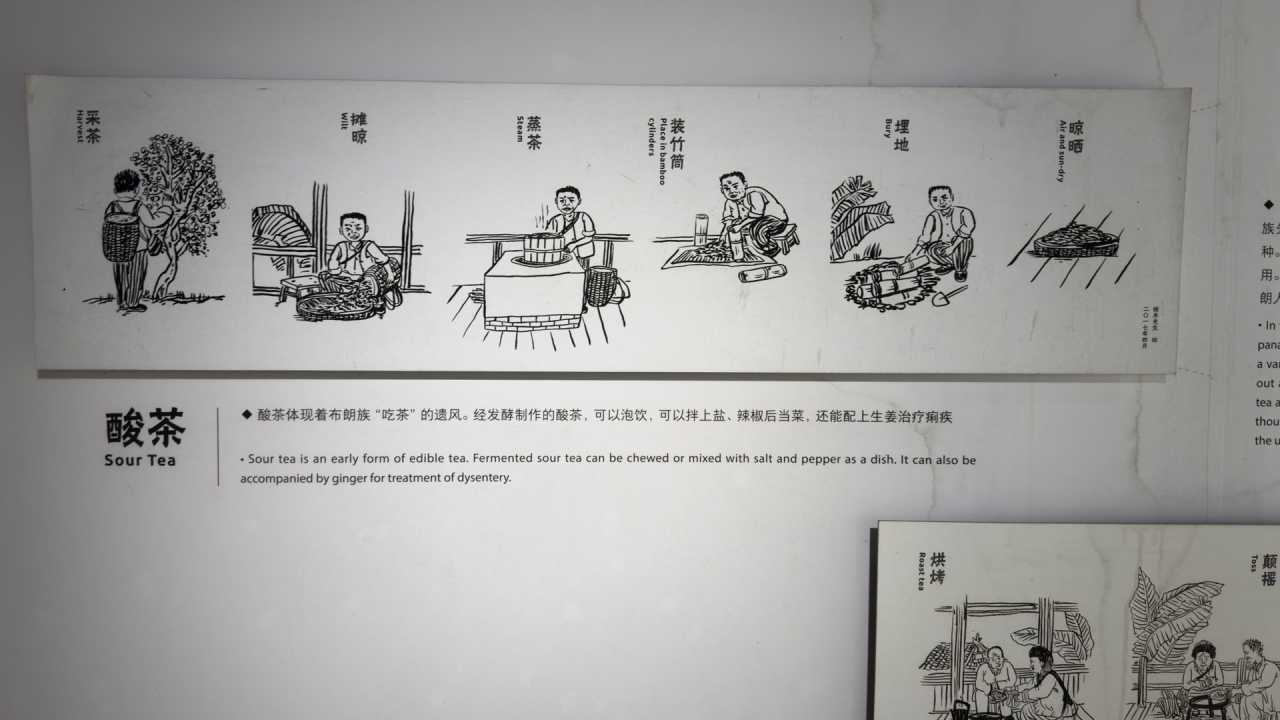
We joined a 普洱茶饼 (Pu'er tea cake) making workshop. From fresh leaf picking to 杀青 (kill-green/fixation), 揉捻 (rolling), and 干燥 (drying), each step held centuries of wisdom. Locals on Jingmai Mountain love 生茶 (raw/sheng Pu'er), but for us, it was too astringent—too high in polyphenols. So we tried 熟茶 (ripe/shou Pu'er), 白茶 (white tea), 晒红 (sun-dried black tea), and a special 酸茶 (sour tea)—the Blang people mix it with spices and eat it as a side dish. Any leftovers can be dried into tea.
Evening: Slow Life in Manghong Old Village
We had dinner under a tamarind tree in Manghong Village, catching half a sunset. Manghong's old village is quieter than Nuogan and Wengji, with far less commercial buzz. Walking downhill, we saw villagers going about their daily lives—chickens and dogs within earshot, time seemingly standing still. Ancient trees were everywhere, each one bigger and older than the last, making us stop and gaze upward in awe.
Day 3: Thick Sea of Clouds, Golden Pagoda in Morning Light
Early Morning: Dazhai Viewing Platform
Mom wanted to watch the sunrise from the Dazhai viewing platform and grab a coffee at Beigui Kacang (a local café). We granted her wish. That morning, the sea of clouds was especially thick, like a giant woolen blanket spread across the mountains. Only from the high vantage point could we see villages and tea forests emerging and disappearing in the mist.
After the sunrise, the tea factory worker told us that locals prefer watching the sunrise from the Golden Pagoda. We stopped by Jingmai Golden Pagoda on the way. Though trees blocked much of the view, the gaps still revealed a spectacular sea of clouds. The "three perfections" of Jingmai Dazhai—cherry blossoms, ancient village, and sea of clouds—were on full display.
Afternoon: Man Duo Natural Village
Descending from Jingmai Mountain, we spent another three-plus hours driving back to Banna. On the way, we stopped at Man Duo Natural Village, home to a thousand-year-old well and village tree. Honestly, unless you're passing by anyway, it's not worth a special trip. The morning market in Man Duo is somewhat famous, but keep your expectations modest.
Nightfall: The Bustle of Gaozhuang
From Man Duo, we headed to the fruit wholesale market. We bought a few 释伽果 (sugar apples) and 燕窝果 (dragon fruit with white flesh)—two pieces for 25 yuan, just enough for a taste. As dusk fell, we wandered through Gaozhuang. Mom wasn't interested in the crowded Star Night Market, so we strolled near the Great Golden Pagoda Temple. The architecture in Banna is distinctive—commercial streets, restaurants, hotels, night markets, and countless costume-and-makeup photography shops. The liveliness was almost dizzying.
Day 4: Farewell to the Warm Winter, Flying Back to Shanghai
Our flight was at noon, so we spent the morning wandering around the city. We found a trendy sticky rice spot, then searched for 巴拉达 (a fried Indian-style bread/pancake) near a middle school food street. We didn't find it, but we had 饵块饼 (a grilled rice cake) instead—delicious. We arrived at the airport two hours early, snagged a seat in the exit row, and flew happily back to Shanghai.
Practical Guide: Jingmai Mountain Through the Seasons and Key Details
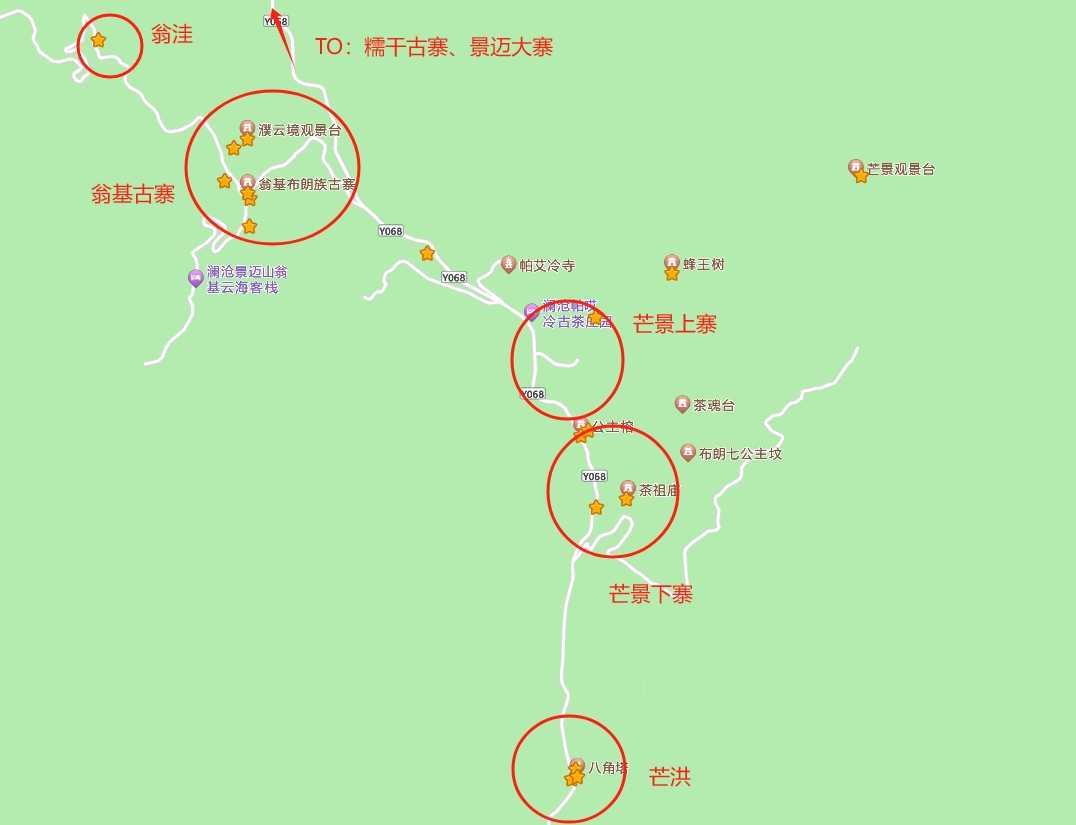
Village Layout on Jingmai Mountain: - Jingmai Dazhai: A newer Dai village, ideal for sunrise and sea of clouds views - Nuogan Ancient Village: A Dai settlement in a mountain hollow, great for cloud-sea views - Wengji Ancient Village: A Blang village on a hillside, perfect for sunset - Manghong Village: A Blang village—east side for sunrise, west side for sunset
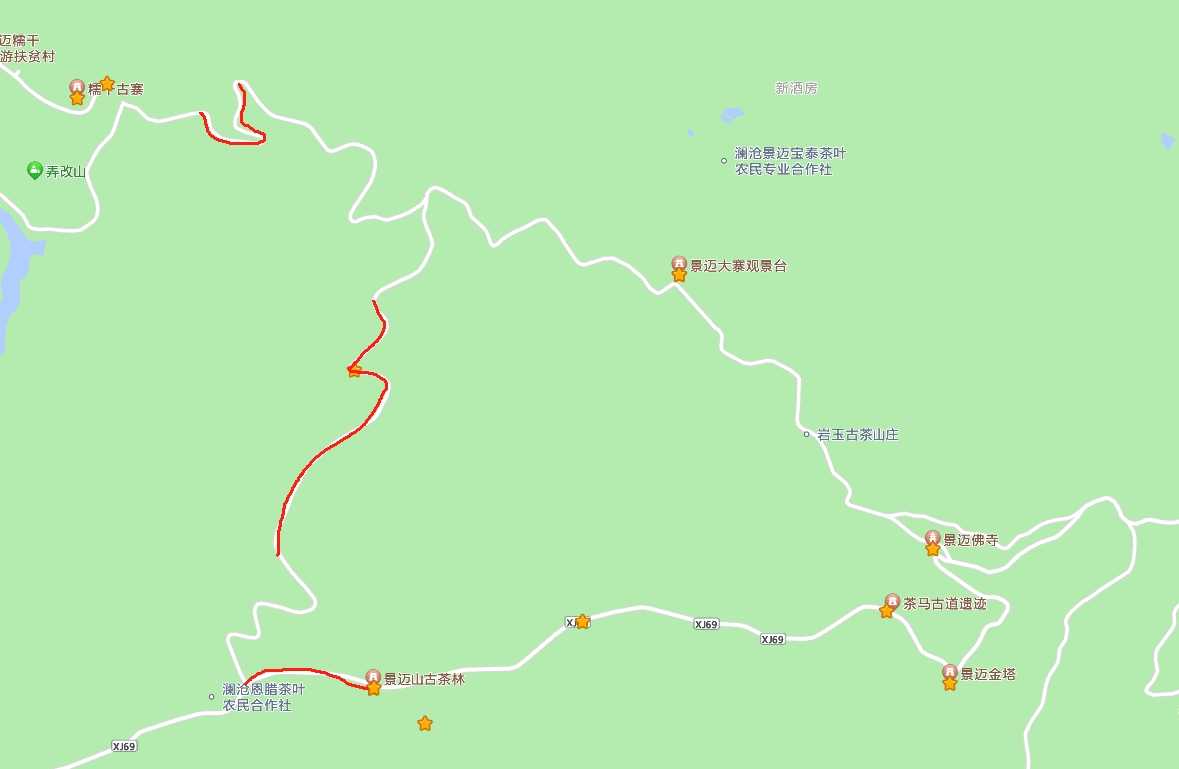
Winter Cherry Blossom Hotspots: 1. The road leading to Nuogan Ancient Village 2. The road to the west gate of Dapingzhang Ancient Tea Forest 3. The stretch from the Jingmai Dazhai–Nuogan fork to the Dapingzhang west gate fork
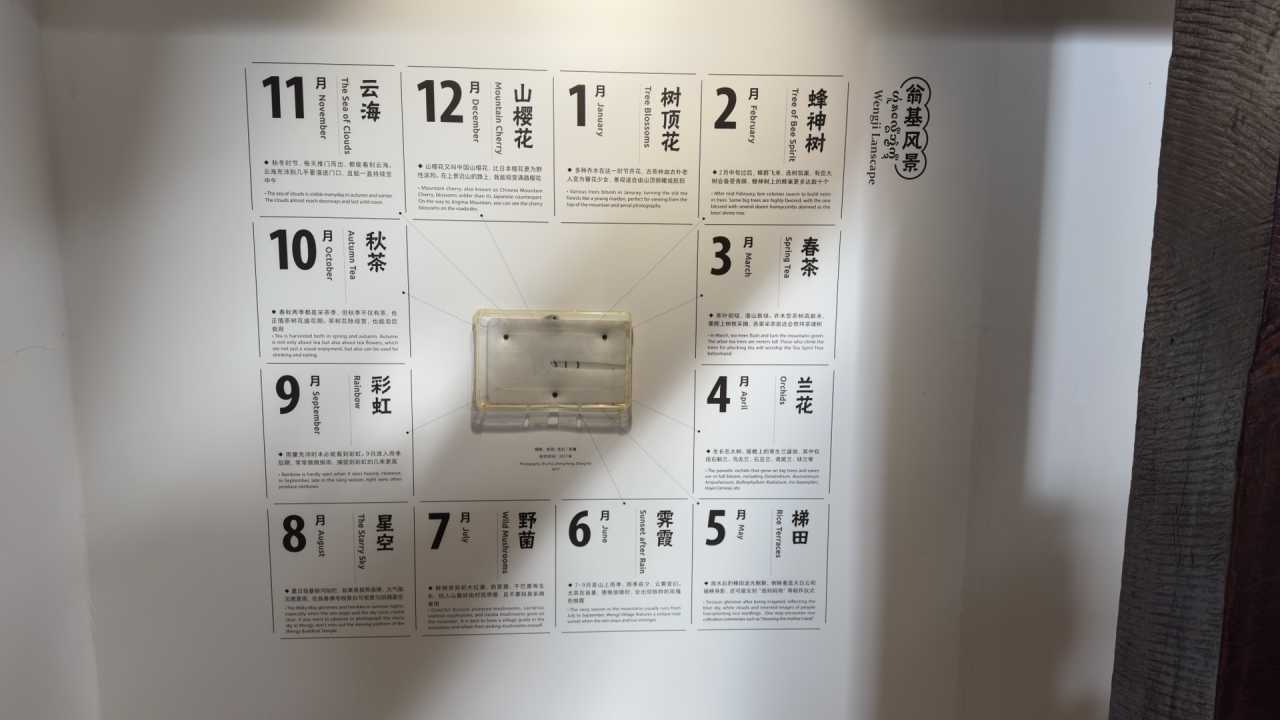
Jingmai Mountain's Seasonal Highlights: - January: Tree-top flowers - February: Bee Spirit Tree - March: Spring tea harvest - April: Orchids - May: Terraced rice fields - June: Rainbow-hued clouds at dawn/dusk - July: Wild mushrooms - August: Starry skies - September: Rainbows - October: Spring tea (second flush) - November: Sea of clouds - December: Mountain cherry blossoms
Basic Pu'er Tea Classification: - 生茶 (Raw/Sheng Pu'er): Fresh leaves → withering → kill-green → rolling → shaping → drying → final processing - 熟茶 (Ripe/Shou Pu'er): Raw sun-dried green tea → fermentation → drying → final processing - 白茶 (White Tea): Fresh leaves → withering → drying - 晒红 (Sun-Dried Black Tea): Fresh leaves → withering → rolling → fermentation → drying - 酸茶 (Sour Tea): Fresh leaves → withering → kill-green → rolling → packed tightly in sweet bamboo tubes, sealed → buried and aged → 100-day fermentation
Final Thoughts
We spent most of this trip on Jingmai Mountain. Not because other places aren't worth visiting, but because Jingmai's rhythm is made for slowing down. Downtown Xishuangbanna is too noisy, bustling with energy, while Jingmai Mountain feels like a hidden paradise where time loses meaning.
If you're thinking of going, I'd suggest leaving sooner rather than later. Since becoming a World Heritage site, Jingmai Mountain is being discovered by more and more people. Go before it becomes the next Xijiang Qianhu Miao Village. Go while those ancient villages are still breathing quietly. Go while the sea of clouds is still willing to linger for you.
After all, some places, once they plant a seed in your heart, are destined to grow.
You should also read:
Two Girls' Graduation Trip: Dali and Shuanglang – A Poetic Farewell to Mountains and Sea
Two Girls' Graduation Trip: Dali and Shuanglang – A Poetic Farewell to Mountains and Sea Preface: Catching the Tail of Youth, Heading South During our senior year of college, my roommate and I – two girls studying in Beijing – decided to bid farewell to…
Continue reading...
Body in Hell, Heart in Heaven: A Pilgrimage Through Tiger Leaping Gorge — A Dialogue Between Heaven and Earth
Body in Hell, Heart in Heaven: A Pilgrimage Through Tiger Leaping Gorge — A Dialogue Between Heaven and Earth Introduction: When the Gorge Splits Open Beneath Your Feet Some say Tiger Leaping Gorge is the closest place on Earth to the border between "hell" and…
Continue reading...
Jianshui Ancient Town: A Timeless Secret Deep in Southern Yunnan, Waiting for Those Who Understand
Jianshui Ancient Town: A Timeless Secret Deep in Southern Yunnan, Waiting for Those Who Understand On the travel map of Yunnan, the romantic allure of Dali and the picturesque canals of Lijiang have long been trodden by countless visitors. Yet there is one ancient town…
Continue reading...