Five Days and Four Nights: Encountering 2021 in Xishuangbanna – A Spontaneous Tropical Adventure
Five Days and Four Nights: Encountering 2021 in Xishuangbanna – A Spontaneous Tropical Adventure
Foreword: A "Zen" Departure
One day at the end of November, I sat at my desk, staring blankly at the course schedule on my computer screen. By late December, most of my classes would be wrapping up, and that restless seed inside me began to sprout wildly – it was time to get out and breathe. The destination was chosen on a whim: Xishuangbanna. No deep deliberation, no back-and-forth weighing of options. Just "this is it."
Normally, once I settle on a destination, I dive headfirst into travelogues, itineraries, and hotel bookings. But this time, my days were packed with work and my nights swallowed by homework. Until a week before departure, my knowledge of Xishuangbanna was limited to two vague concepts: "there's a tropical rainforest" and "peacocks can fly." Self-drive or hire a car? Which hotel to stay at? What attractions are there? I had no clue. Fortunately, Banna isn't that big. With Jinghong city center as the hub, most surrounding attractions can be visited and returned from in a single day – that gave me a sliver of confidence.
On departure day, I had a six-day vacation in my pocket but only four days of itinerary planned. Even more dramatic: I originally planned to rush back for class on New Year's Day, but after booking my flights, I got a notification saying class was postponed... The frustration of "losing two perfectly good vacation days" still makes me want to beat my chest and stomp my feet when I think about it. But on second thought, isn't this exactly what makes travel so captivating? Plans never keep up with changes, and surprises often hide within those very changes.
Actual Itinerary Overview
- Day 1: Shanghai to Xishuangbanna, night tour of Manting Park + bonfire party
- Day 2: Xishuangbanna Tropical Botanical Garden, Chinese Academy of Sciences (self-drive)
- Day 3: Wild Elephant Valley → Manzhang Village → Dai Show (self-drive)
- Day 4:原始森林公园 (Primitive Forest Park)
- Day 5: Manting Park (daytime version)
- Day 6: Mange Fruit Market, afternoon flight back to Shanghai

All accommodations were in Gaozhuang Xishuang Jing (Gaozhuang Scenic Area), and I visited the Starry Night Market every single night without fail. If I were to rate the attractions:
- Five stars – must-visit: Botanical Garden (CAS), Dai Show, Manzhang Village (you could even stay overnight)
- Four stars – recommended: Wild Elephant Valley (if you actually see elephants), Manting Park
- Others: The rest are so-so – go if you have time, don't force it if you don't.
Day 1: From Shanghai to Banna – A Switch of Light and Temperature
During the Flight: The Tyndall Effect Outside the Window
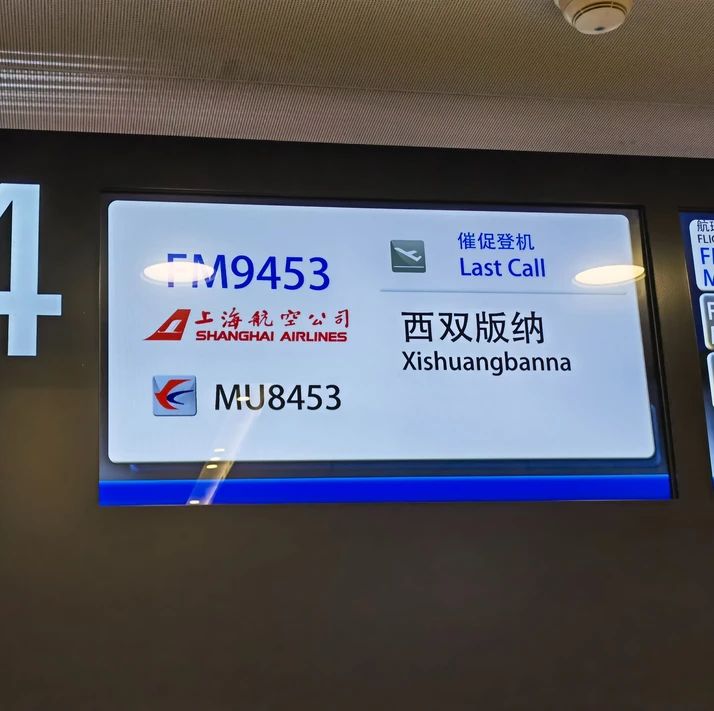
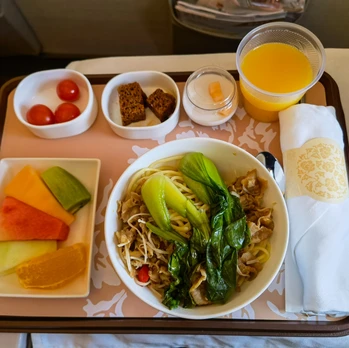
There's only one direct flight from Shanghai to Xishuangbanna, and it arrives in the middle of the night. I chose the 8:45 AM flight with a stopover in Kunming, landing around 2 PM – just enough time to use half a day. I used points to upgrade to first class – great value for money.
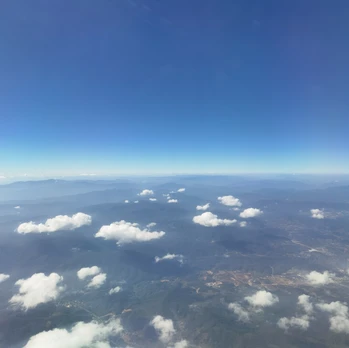
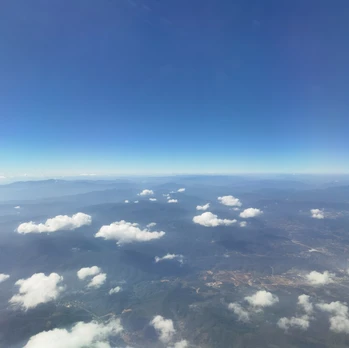
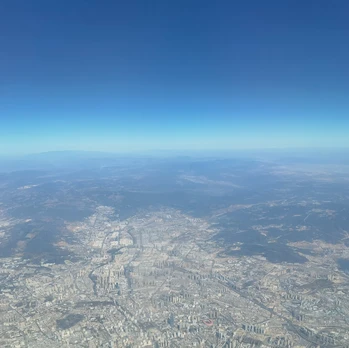
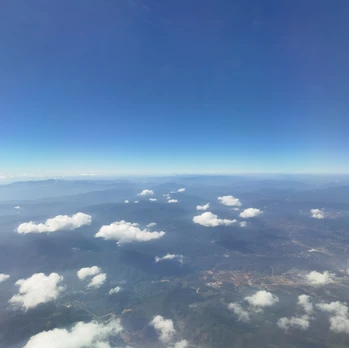
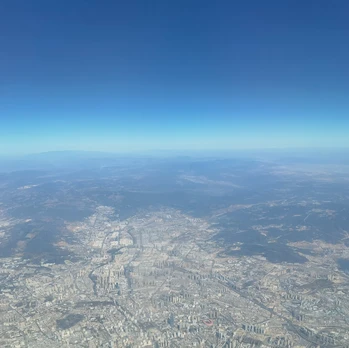
Not long after takeoff, the clouds outside gradually thinned. When that deep, dazzling blue burst into view, I knew we were approaching Yunnan. The last time I came to Yunnan, the most stunning experience was watching sunlight pour down like a waterfall – I later looked it up and learned it's called the Tyndall effect. During the stopover in Kunming, I didn't even dare turn on my phone, afraid that my location would turn my travel code red – there had just been a suspected COVID case in Kunming before I left.
Landing in Banna: Mood as Beautiful as the Weather
The plane touched down at Xishuangbanna Gasa Airport. The moment I stepped out of the cabin, waves of heat wrapped in humid air hit me. My mood felt as light as a peacock – even though I hadn't seen a real one yet.
Quick tip: Many hotels in Banna offer free airport pickup. The drive from the airport to Gaozhuang takes about 20 minutes. Staying in Gaozhuang is definitely a smart choice: new hotels, plenty of options, plus the famous Starry Night Market. I scrambled to find a hotel just a week before departure. Seeing that 78% of tourists choose Gaozhuang, I followed the crowd. Lucky for me, I found a hotel that opened this year – "Gaozhuang Bole Hotel." The owner is a Jiangxi native who's been working in Banna for over a decade – warm and hospitable. He invited us for tea, told us about local customs, and it was clear he genuinely loves this land. The hotel is small but has everything you need, a five-to-six-minute walk from the night market – peaceful yet close to the action.
Manting Park Night Session: Bonfire, Performance, and Mysterious Tickets
After dropping off our luggage, we headed out ravenous. First stop: "Yunwei Fang Tuji Mixian" (Yunwei House Chicken Rice Noodles) – a chain that's cheap and delicious. It later became our daily breakfast staple. That bowl of rice noodles – golden chicken oil, tender meat – one mouthful and I was filled with pure happiness.
I booked the night tickets for Manting Park online in advance. The ticket collection process was quite "mysterious" – the contact person told me not to say anything about it, not even to the hotel owner. It made me nervous, only for them to lead me straight to the ticket counter to pick up the tickets... It really shows the various "connections tickets" floating around in Banna.
Since we had time to kill, we checked out a fruit shop across the street. It was like Granny Liu entering the Grand View Garden: black, white, red, yellow, purple, green, blue – all kinds of fruits in bizarre shapes, many I'd never even seen before. Tropical fruits have two characteristics: first, when cut open, they ooze a sticky white liquid that glues your hands and knife together – typical examples are jackfruit and abiu (yellow crystal fruit). Second, they're called fruit but have no moisture when sliced – one bite and you could choke from dryness. Even though the rice noodles were piled up to my throat, I couldn't resist buying a few small pineapples – 10 for just 5 yuan (about $0.70). How could I say no?
Manting Park was originally the royal garden of the Dai king, whose surname was "Dao" (knife). In Banna, if you meet someone who says their surname is Dao, they're definitely from a prominent local family. Ordinary folks basically have no surnames, only given names – men are mostly called "Yan XX," women "Yu XX." That's why the streets are full of "Yu XX Snack Shop" and "Yan XX BBQ Stall."
At the park entrance, there's a small golden statue. I thought it was some local tyrant, but when I got closer, it turned out to be a statue of Premier Zhou Enlai celebrating the Water Splashing Festival in Banna... Awkward.
The night ticket includes a cultural performance, a bonfire party, and a "terrible" buffet. I'd read about it in travelogues, so I ate beforehand. The performance was held in a building across from the royal palace, showcasing the customs, dances, and costumes of Banna's local ethnic groups and neighboring countries. My only complaint: the sound system was terrible – every word blasted your ears. The highlights were the Dai ethnic group and palm-leaf scriptures (贝叶经). Apparently, Dai writing is passed down only to men – boys can go to temples to learn culture, while girls can only go to school to learn Chinese. Later, our tour guide also said she can only speak Dai but not write it. In my few days in Banna, I only learned two words: "Mao Duoli" (handsome guy) and "Sao Duoli" (pretty girl) – basically "bro" and "sis."
After the performance came the water lantern release and bonfire party. The fountains sparkled in the night, creating a warm and lively atmosphere.
Starry Night Market: The Pagoda as a Lighthouse
We got back to Gaozhuang around 10 PM and rushed straight to the night market. The Golden Pagoda Temple (Dajin Ta Si) along the way became my daily "lighthouse" – whenever I got lost in the market, one look at the pagoda and I knew my bearings. A pagoda as a lighthouse, guiding your way – that metaphor couldn't be more fitting.
Past the pagoda, there it was – the famous Starry Night Market. It has everything: open-air BBQ stalls, modern bars, Yunnan snacks, Vietnamese cuisine, Yiwu-style trinkets, handmade crafts... It's easy to give in to impulse buying and just as easy to get completely lost. I went for five straight nights and still didn't see it all.
The most common stalls are the "pounded" (舂) stalls – you pick your ingredients, throw in various spices, and a big pestle and mortar make everything pounded. If you can handle spicy food, you'll love it. There's also green mango mixed with chili – a local "dark cuisine" specialty. My biggest addiction was coconut milk coffee and milk green tea – the milk tea turns matcha green when you pour hot water over it. One bag a day, without fail.
Day 2: The CAS Botanical Garden – An Encyclopedia of Tropical Plants
The Pre-Departure Dilemma: Rent a Car or Hire a Driver?
The first day was so packed that I slept straight through to after 8 AM the next day. This became my rhythm for the whole trip – up at 8, out the door by 9-something, and my plan of two attractions a day turned into one.
I went back and forth between renting a car and hiring a driver. Renting gives you freedom, but I worried about road conditions and tickets. Hiring is convenient, but it depends heavily on the driver's character – you might get dragged to commission shops. Doing the math, renting for two days plus gas came to about 400 yuan/day, while hiring was around 300-400 yuan/day – roughly the same. I chose to rent. I picked up the car at a self-service rental point near the Gaozhuang entrance – fully automated, unlocked the car through an app. Pretty high-tech.
The Botanical Garden's East and West Zones: Two Completely Different Tropical Experiences
The CAS Botanical Garden is in Mengla County, about an hour and a half drive from Gaozhuang. The entire park is divided into East and West zones. The East Zone features primitive tropical rainforest and green stone forest, while the West Zone gathers exotic flower gardens, aquatic plant gardens, celebrity tree gardens, and more – a vast variety of plants with stronger visual appeal.
I decided to visit both zones. Considering I felt like an idiot even in a fruit shop, I'd be hopeless in a botanical garden – and there are no information boards, so a guide was a must. Unfortunately, guides were in high demand – all booked by the time I arrived. I left my number on the waiting list and told the staff, "We're doing both zones, staying all day. We'll wait as long as it takes." The staff member circled my name.
We took a golf cart from the main gate to the East Zone. Quick tip: Don't skip the sightseeing cart ticket – it's really far. Without a guide in the East Zone, you'd probably struggle. It was drizzling when we left in the morning – even a thin down vest had me shivering. By noon, the sun was out, and I was sweating in a T-shirt. "Wear a cotton-padded jacket in the morning, a gauze shirt at noon" – that saying applies here too.
In the East Zone's tropical rainforest, I saw the legendary "plank buttress roots" (大板根) – rainforest trees have shallow roots and tend to be top-heavy, so they evolved these roots that look like goldfish tails to support themselves. I called them "big bone sticks," and the guide later went along with it.
We hadn't walked far when the guide called – we went back to the entrance to meet her. I have to give a shameless plug here: our guide was named Yu Yingjin. She was beautiful, had a sweet voice, gave vivid explanations, and was great at taking photos. She told us that without a guide, we might have trouble – there are all kinds of little creatures sunbathing on the railings in the forest. If you don't look closely, you won't notice them, and if you rest your hand on one, you could get stung and break out in hives.
The most stunning thing in the East Zone was a "strangler fig" (绞杀榕). Once a strangler fig wraps around a tree, it cuts off nutrients, and the inner tree eventually dies. The dead tree rots and gets eaten by termites, leaving a hollow shape. Looking up from the bottom, it's like a skylight at the top. There was also the "murder tree" – its white sap can coagulate your blood if it touches a wound. And the "golden orb weaver" spider (络新妇) – its body shimmers gold, and its web is also gold. Even more surprising: it's actually a famous local snack in Banna... If the web is easy to reach, the spider gets caught and eaten.
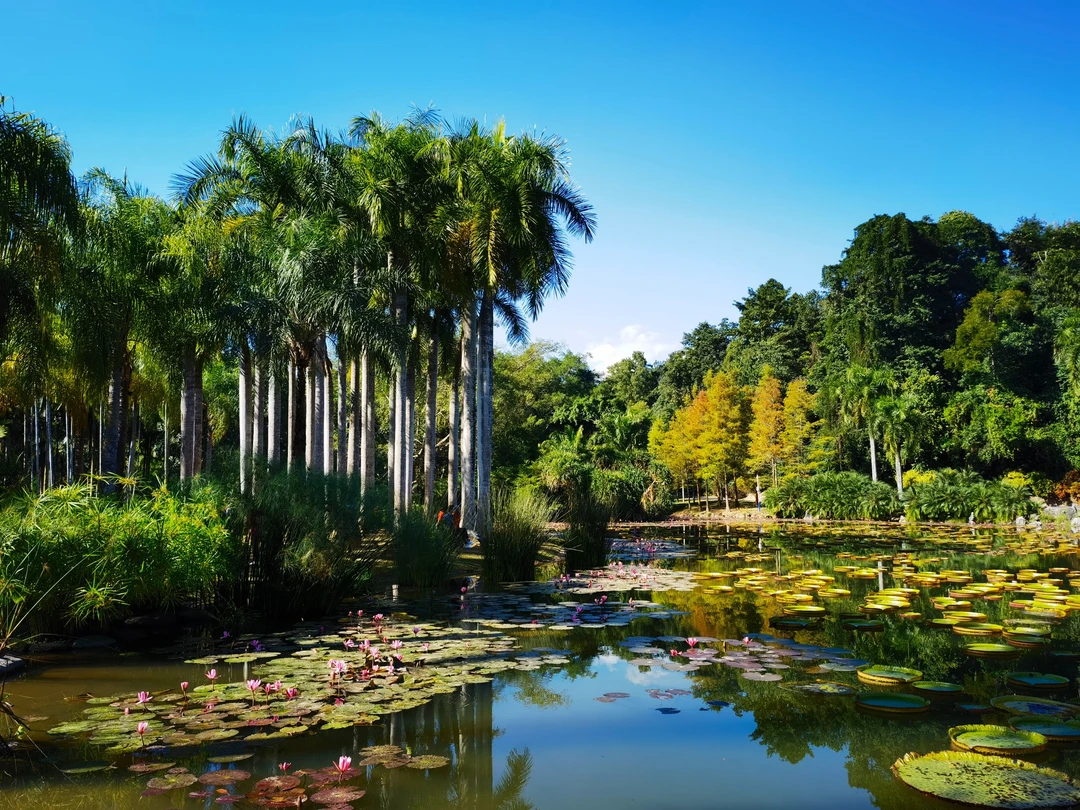
The West Zone was a sea of flowers and plants. The giant water lily (王莲) – the largest lily, said to be able to support a small child. The guide taught me how to tell lotuses and water lilies apart: lotus flowers rise above the water, while water lily flowers float on the surface. There were also traveler's palms, datura (曼陀罗), golden lotus emerging from the earth (地涌金莲), heartbreak grass (断肠草)... Too many to count. When I took photos, I thought, "Oh, so that's what it is." Now, looking back, my mind is just a blur of colors.
The most magical was the "dancing grass" (跳舞草) – as the guide sang a Dai folk song, its leaves would huddle together and then separate, as if dancing. And there was "star oil vine" (星油藤) – unremarkable in appearance, but an important plant introduced from South America for research.
We left the botanical garden around 5 PM, starving, and drove back to eat. Heading west, the sunset was blinding – in Yunnan, sunglasses are an absolute necessity when driving. That night, a roasted chicken – fragrant and delicious – I still savor the memory.
Day 3: Wild Elephant Valley, Manzhang Village, and the Dai Show – From Disappointment to Delight
Wild Elephant Valley: A "Zoo" Without Elephants
Another morning of sleeping in, followed by a luxurious bowl of rice noodles, then off we went. On the highway to Wild Elephant Valley, there were warning signs: "No Honking – Wild Elephants Crossing." The thought of elephants actually walking onto the highway was kind of terrifying. Local taxi drivers said elephants often come onto the streets looking for food and causing damage – nobody can do anything about them, and even calling the police is useless.
We entered through the North Gate, walked along the boardwalk for about 30 minutes to the South Gate, where there's an elephant show. Then we took a cable car to overlook the entire valley, and walked back to the North Gate via another boardwalk. As we entered the valley, thick fog rolled in – it felt like walking into "Silent Hill."
The first animal we saw in the valley wasn't wild – there was a keeper nearby. It was sleeping when we saw it in the morning, and still sleeping when we left the park in the afternoon. Watching the keeper bundle it into a cage – its job was basically sleeping. Lucky creature.
The elephant show was pretty dull – nothing compared to Thailand's. The most precious thing in the butterfly garden was the dead leaf butterfly (枯叶蝶) – I learned about it in textbooks as a kid, never realized it was a protected species. The cable car ride was long, about 30 minutes, and we could see signs of wild elephants below – but only footprints by the river.
After getting off the cable car, we trudged along the boardwalk under the blazing sun. We started full of hope, thinking we'd see an elephant family. Then we thought, even hearing their calls would be nice. Then we thought, in this heat, the elephants are probably napping in the shade. Finally, we thought, seeing elephants is lucky; not seeing them is normal. Two days later, someone on my social feed posted photos of an elephant family... I consoled myself: at least I saw monkeys, butterflies, wild boars, parrots, and lizards – I basically visited a zoo.
Manzhang Village: An Authentic Dai Lifestyle
Manzhang Village isn't a typical tourist attraction. There are no tour buses – only independent travelers and a few small groups who've done their homework come here. There are no pushy vendors, just warm smiles from the Dai people. We were lucky – word had it that due to a COVID resurgence, the village was planning to close its gates in two days.
At the village entrance stood an ancient bodhi tree, oozing with history. The houses were all two-story stilted buildings, with the owners living on the second floor. The first floor is elevated, and the square pillars are designed to prevent snakes and insects from climbing up. Nowadays, the first floor is used for parking and cultural displays, like papermaking and pottery.
Pottery was something I'd been tempted by in travelogues – 10 or 20 yuan per person (about $1.50 to $3), and you get a big lump of clay that feels like Play-Doh. You can play with it all afternoon. If you want, the finished piece can be fired. I saw two foreign kids making pots – they were meticulous and quite refined. We were short on time, so we spent about an hour and produced two little things. When we asked the hostess if they could be fired, she said, "These two aren't made in one piece – they'll break in the kiln."
None of the village houses have gates or locks – doors are never closed at night. The chickens were all glossy and plump – I suspect they're mixed breeds. The village still practices cockfighting, but we missed the timing. What Manzhang offers is a profoundly peaceful way of life. Everyone is simple and kind, greeting you with a smile when you meet.
The Dai Show: Speechless with Amazement
The "Dai Show" (傣秀) is directed by Frank Dragone, a world-renowned genius director who also created the "O" show in Las Vegas and "The House of Dancing Water" in Macau. He has gathered artists from Cirque du Soleil and many other renowned performers.
Before the show, I had doubts about the steep ticket price. The first act – everyone was still calm. By the second act, the whole audience was losing it, phones out. And then the final diving performance brought the house down. After watching it, I felt every penny was worth it. It shattered many of my preconceptions – at every scene, I found myself marveling, "How did they even design that?" An international, dreamlike spectacle, absolutely gorgeous – even the exit music was hypnotically catchy. I hummed it all the way back. No exaggeration – it's several notches above the various "Impression XX" shows around China.
Quick tip: Book tickets online for better prices and seats – better than anything you'll find locally. Aim for the center section, rows 4-8. The first two rows might get you wet.
After the show, we went back to the night market for more strolling: BBQ, sugarcane juice, milk tea. Honestly, the BBQ was just okay.
Day 4: Primitive Forest Park – Peacocks in Flight and Unexpected Surprises
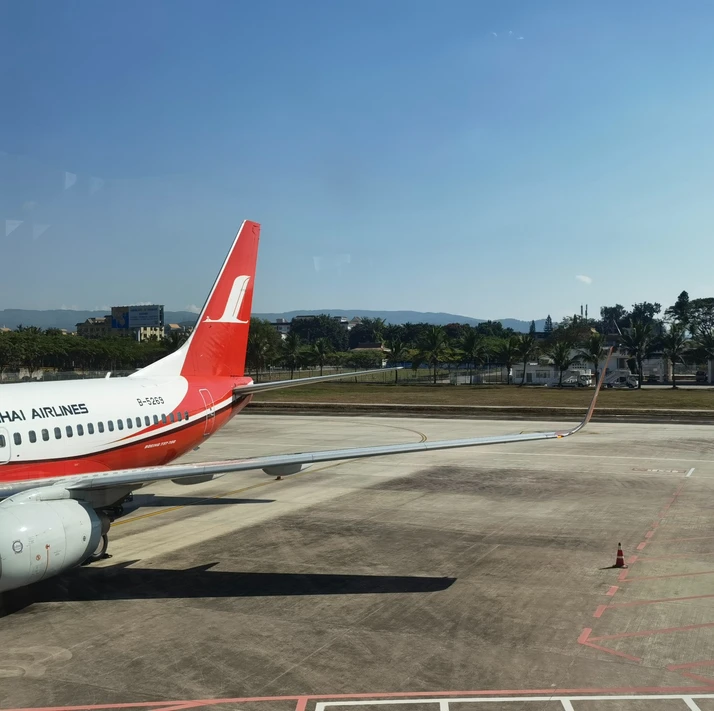
Early in the morning, I returned the car through the app – very convenient. We tried a different breakfast spot, which blended flavors from all over China – pretty good.
The purpose of visiting the Primitive Forest Park (原始森林公园) was to see the peacocks fly. Online it said you could see them during feeding time. I was calculating what time to go, afraid of missing it. When we got there, I realized it seemed to be a recurring show... (Note: the original text cuts off here, but based on context, it likely refers to a scheduled performance.)
In Closing: Five Days in Banna – Healing My 2020
Five days – not long, not short. From a hasty decision to a rewarding return, Xishuangbanna gave me more surprises than I could have imagined.
Biggest takeaway: I learned to slow down. Wake up at 8, head out after 9, visit one attraction a day, and hit the night market every night without fail. This "zen" travel style actually let me truly feel what vacation means.
Most recommended experiences: The guided tour at the CAS Botanical Garden, the pottery experience in Manzhang Village, and the visual spectacle of the Dai Show – these three are the essence of a Banna trip.
Most practical advice: - Stay in Gaozhuang – close to the night market, convenient and lively - Renting a car gives more freedom than hiring a driver, but definitely bring sunglasses - Book tickets online for better prices, but be aware of the "connections ticket" etiquette - Eat rice noodles at "Yunwei Fang" – cheap and delicious - Don't miss the Dai Show – choose center seats, rows 4-8
2020 was a special year. The pandemic pressed pause on everyone's lives. This trip to Banna felt like a deep breath – in the tropical rainforest, under the Starry Night Market, in the Dai villages, I rediscovered the rhythm of life.
Hello, 2021.
You should also read:
The Meaning of Travel: At Lugu Lake, Encountering a Dialogue Between Scenery and Soul
The Meaning of Travel: At Lugu Lake, Encountering a Dialogue Between Scenery and Soul Have you ever felt that urge—to spread a map open, run your finger across unfamiliar place names, and imagine yourself standing on that untouched land, breathing different air? Travel is never…
Continue reading...
Clouds Over the Rainbow: A Five-Day Soul Journey Through Kunming, Dali, and Lijiang
Clouds Over the Rainbow: A Five-Day Soul Journey Through Kunming, Dali, and Lijiang Prologue: The Decision to Fly into the Clouds In February, the chill of the North still lingered. A single discounted airfare sparked this spontaneous trip. Round-trip from Beijing to Kunming—1,700 yuan made…
Continue reading...
Xishuangbanna Self-Drive Tour: Into the Tropical Wonderland at the Edge of the Sky (Complete Guide)
Xishuangbanna Self-Drive Tour: Into the Tropical Wonderland at the Edge of the Sky (Complete Guide) Introduction: A Dream Fulfilled Thirty Years Early Some journeys are destined to happen at a specific moment in time. For me, a self-drive trip to Xishuangbanna was originally the first…
Continue reading...