Fly to Yuanyang! — A Complete Photography Guide
Fly to Yuanyang! — A Complete Photography Guide
A Spontaneous Photography Journey
Every year after the Spring Festival, airfare to Kunming hits its lowest point. This year, the holiday came unusually early, and February is precisely the most captivating season for the Yuanyang rice terraces. With perfect timing, favorable conditions, and a willing spirit—what reason was there to hesitate?
A three-hour flight, no detours, no hassle. At 3:30 PM, the plane touched down smoothly at Kunming Changshui Airport. Our pre-arranged driver, Xiao Li (phone: 13320504835), was already waiting at the exit. After a brief exchange of pleasantries, we loaded the luggage, stepped on the gas, and headed straight for Yuanyang!
Racing Through the Night: Eight Hours Across Southern Yunnan
The car sped south along the highway, passing through Yuxi, Jianshui, and Gejiu. The scenery outside the window gradually shifted from towering city buildings to rolling mountain ranges. Eight hours on the road felt like traveling through a time tunnel across Yunnan. At 12:30 AM the next morning, we finally arrived at the heart of the Yuanyang rice terraces—Shengcun Township.
Xiao Li helped us find a family-run guesthouse, but there was one room short. Taking things as they came, I simply laid out a mattress in the storage room and slept soundly. The floor spot was free; single rooms cost 150 yuan (about $21 USD) per night. I won't name the guesthouse—no recommendation here.
At 5 AM, I was jolted awake by fellow photography enthusiasts staying in the same place. A group of shutterbugs from Shanghai and Guangzhou were excitedly packing their gear, ready to head out for sunrise shots. It was in that groggy moment that I realized—I was already in Yuangyang, just a stone's throw away from the rice terraces I had longed to see.
Duoyishu: A Sunrise Rendezvous, A Dance of Light and Shadow
We set out before dawn, and within minutes reached our first stop: Duoyishu. This is the ultimate spot for sunrise photography—arrive late, and you won't even find space to set up your tripod.
The sky had barely begun to pale when the parking lot was already packed. I marveled: Where did all these photographers come from? Where did all these long lenses appear? Without time to dwell on it, I squeezed into the crowd, set up my tripod, and waited silently.
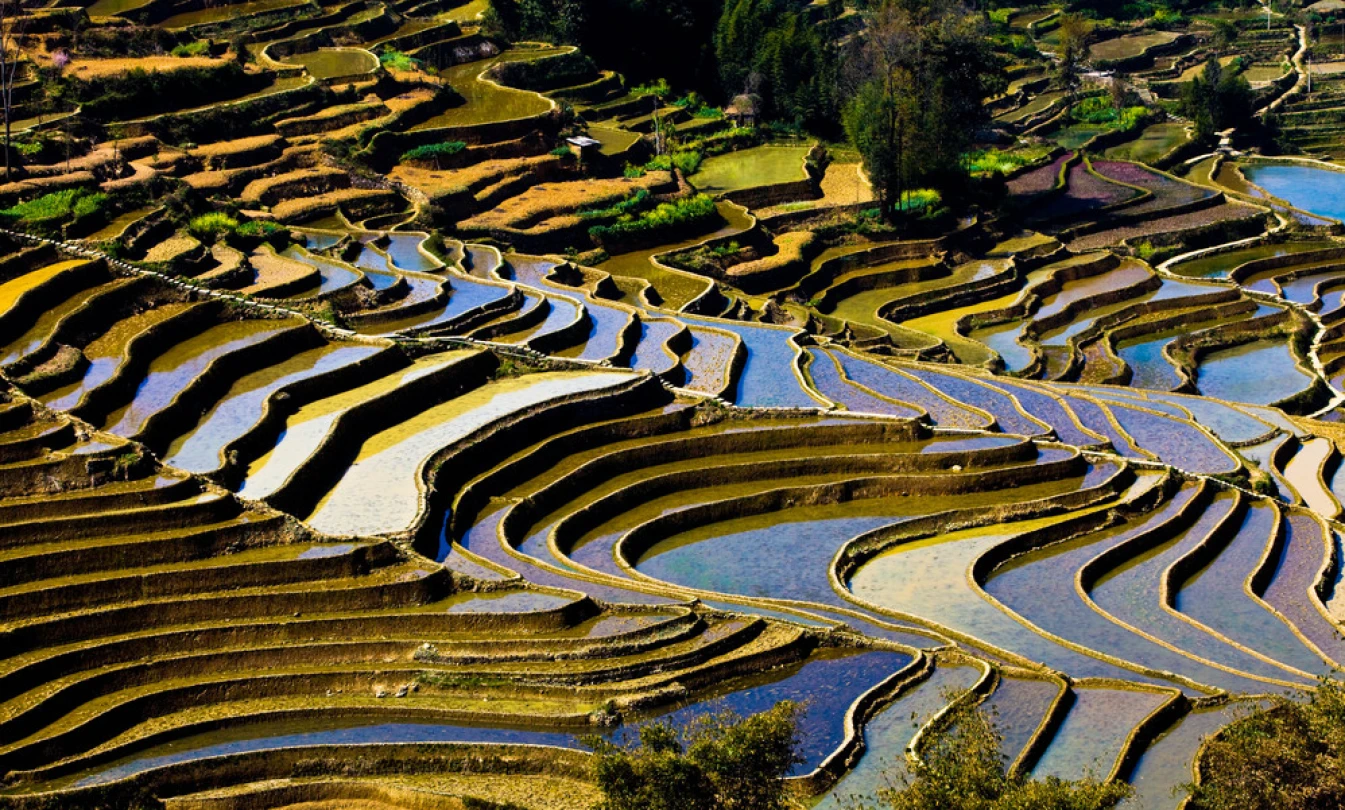
Yuanyang—a place that had haunted my photography dreams ever since I picked up a camera. All the longing, all the anticipation, came down to this single vista of terraced rice fields. When sunlight finally broke through the clouds and spilled across the layered water surfaces, the interplay of light and shadow revealed the terraces in all their breathtaking beauty. In that moment, every photograph I had ever seen became real and tangible—yes, the Yuanyang terraces truly were this magnificent.
It was also during this trip that I learned a new term: Hani. The Hani people inhabit Yuanyang, and the Honghe Hani Autonomous Prefecture is headquartered in Xinjie Town, Yuanyang County. These terraces are the legacy of generations of Hani people, which is why they are also called the Hani Rice Terraces.
The Legend of the Hani Terraces
According to legend, when the Hani ancestors first crossed the Honghe River (Red River) and rested on its southern bank, they encountered the Ailao Mountains. The mountain exuded a mysterious aura that finally made this wandering tribe stop in its tracks. From then on, a community of shepherds was transformed entirely into a people of sowers and harvesters.

The Hani people harnessed the waters of the Honghe River—rising as mist and clouds, then falling upon the high mountain forests—creating the natural wonder of "as high as the mountain, as high as the water." They built an extensive irrigation network high in the mountains, constructing countless silver-chain-like main canals that wrapped around every ridge and peak. Below these canals, they carved out hundreds, even thousands, of terraced fields. Water from the main canals flowed through countless branch channels into each field, solving the lifeblood of rice farming—water supply. The water then trickled down through layer after layer of terraces, eventually returning to the river network in the valley, creating a virtuous cycle of ecological agriculture—a perfect harmony between heaven and humanity.
When sunlight illuminates these Hani terraces, everyone gasps in awe—this is the most harmonious state that humans and nature can achieve.
Duoyishu, a small village just 6 kilometers (3.7 miles) from Shengcun, has now become an essential stop on any Hani terrace tour. Most of the Hani terrace photos circulating online were taken here. Three hours of shooting—cold but joyful. Morning temperatures hovered around 5°C (41°F), making a thick windbreaker absolutely necessary.
Shengcun Morning Market: A Bowl of Rice Noodles and a Country Fair
After the shoot, we returned to Shengcun for an authentic bowl of rice noodles (米线, mixian). This is the first culinary must-try after photography in Yuanyang.
The little shop wasn't large, but it opened before dawn every day. The reason was simple—besides local villagers, Shengcun was packed every night with photographers from all over China. The shop was run by Hani people, with an open kitchen where you could see everything. While the hygiene standards might not match those of big restaurants, a bowl of authentic cross-bridge rice noodles (过桥米线, guoqiao mixian), paired with house-made pickles and chili sauce, plus some beef or a fried egg, tasted absolutely fantastic.
Even more fortunate, we happened to catch a Hani market day! Outside the shop, villagers in ethnic attire were bustling about in small groups—Hani, Yi, Dai, Miao, Yao, Zhuang, and other minority groups had gathered from the mountains above and below. Their distinctive costumes and genuine smiles flashed by like frames of a film.
After a quick breakfast, I couldn't wait to grab my camera and hit the streets. The town's only main road was packed to the brim, with stalls lining both sides selling vegetables, snacks, fruits, clothing, and more. The colorful ethnic costumes created a stunning spectacle. Interestingly, the men seemed to do very little work—they just gathered together, smoking water pipes, looking utterly relaxed. Meanwhile, it was mostly women doing the buying and selling at the market.
Hani clothing is quite simple, almost uniformly blue-gray, with silver button ornaments on the lapels as the main decoration. Their hats are often tasseled thread caps, and some women wear thick braided wigs. The men, on the other hand, don't wear ethnic costumes at all. Their only highlight is the large water pipe they casually puff on, looking around contentedly with an air of leisurely ease.
I loved this natural, pure, and simple street scene.
Luomadian: A Hidden Paradise Behind the Trees
If not for a roadside sign, unfamiliar travelers would likely miss this spot. Driver Xiao Li stopped the car and said it was just a few dozen steps to the Luomadian shooting point.
Walking through a patch of forest on the hillside, the view suddenly opened up—a magnificent yet colorful expanse of terraced fields lay before us. A fruit tree covered in blooming pear blossoms on the slope caught the eye. Framed by the blossoms and bathed in sunlight, the terraces exuded a unique beauty. Unlike Duoyishu, this area was smaller and less imposing, but thanks to the terrain and lighting, with distant villages dotting the landscape, the colors were exceptionally vibrant.
Pear trees, terraced fields, village homes—under the blue sky and sunlight, it felt like stepping into a dreamlike paradise. Just then, an elderly couple of photography enthusiasts walked into my frame, deeply immersed in the scenery beneath the pear tree. I adjusted my focus, using them as silhouettes, and pressed the shutter.
Bada: The Breathtaking Ten-Thousand-Mu Terraces
Three kilometers (1.9 miles) west of Shengcun lies one of the most famous spots for watching sunsets, Hani terraces, sea of clouds, and village scenery. Standing at the Bada observation point, you can see a continuous stretch of over 14,000 mu (about 2,300 acres) of terraced fields, including Qingkou, Quanfuzhuang, Masuzhai, and Zhulu—this is one of the core areas of the Yuanyang terraces' application for UNESCO World Natural and Cultural Heritage status.
The terraces here are vast, spectacular, with beautiful lines and strong three-dimensionality. Starting from the Masuzhai River at an altitude of 1,100 meters (3,600 feet), thousands of mu of terraces extend continuously all the way up to the mountain peak at 2,000 meters (6,560 feet). As time and light change, the tens of thousands of mu of terraces shimmer in different hues, creating an absolutely stunning sight. Across from us was the famous Qingkou Folk Village, its mushroom-shaped houses appearing and disappearing in the hazy air.
Standing on the Bada observation deck, we chatted: "What a huge expanse of fields!" "So much water in those fields..." And I thought to myself—the rice paddies that generations of Hani people have cultivated, with the passage of time and development, are no longer just farmland in the traditional sense. They have become a work of art.
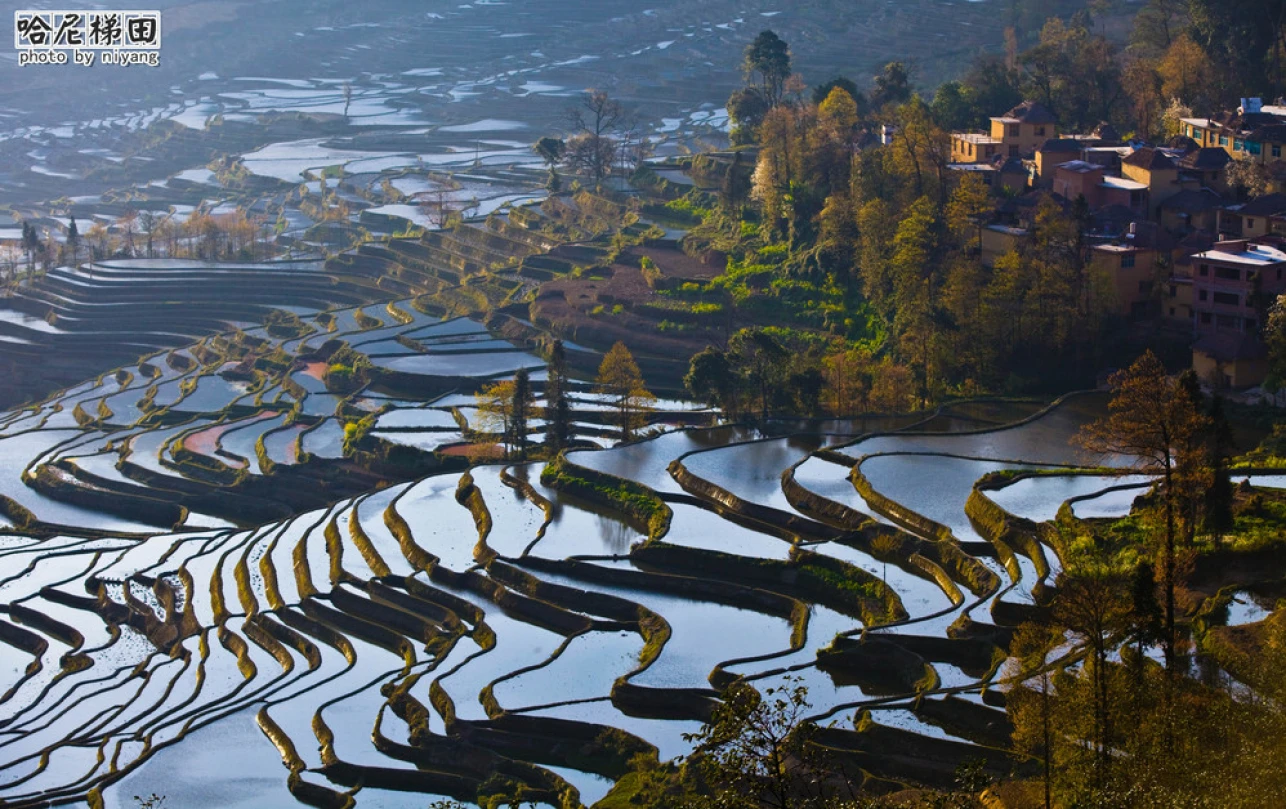
It is said that the Yuanyang Hani terraces now have water all year round—to promote tourism, the government has been developing and protecting the terraces simultaneously, while pursuing UNESCO World Heritage status. Tourism has changed Yuanyang; development has changed the Hani. The once simple farming life of rising with the sun and resting with its set has been transformed. Now, families living among the terraces have tasted the sweetness of tourism, running farmhouse inns and boosting their incomes.
At lunchtime, we walked into Dayutang Village near the Bada scenic area. This distinctive Hani village had been given a fresh look thanks to tourism. Apart from the roofs, which still hinted at the traditional Hani mushroom-shaped houses, three- and four-story buildings had sprung up everywhere. We chose the "Hani Terrace Homestay" (phone: 13577396281). From a distance, the building looked more like a villa.
The courtyard was filled with the sounds of birds and flowers, freshly decorated. We pulled out a small table and a few chairs and sat under a kapok tree in full bloom. A table full of delicious dishes, accompanied by a few bottles of crisp beer—we savored this afternoon of Hani风情 (ethnic charm). What a joy! What a delight!
A few elderly people and children sat idly by the door, their pure, warm gazes welcoming us. They spoke in the Hani language, which we couldn't understand, occasionally casting glances our way, as if not wanting to disturb our leisurely mood. This paradise-like existence instantly stripped away the worldly concerns we city dwellers, accustomed to our nine-to-five routines, had carried with us.
At this moment, the colors and light of the terraces no longer evoked the intense feelings I had before the trip. Instead, I found myself increasingly drawn to this simple, rustic life among the fields. I felt more and more moved by the new vitality of the Hani people after all the storms they had weathered—it was infectious, it was touching.
Laohuzui (Tiger Mouth): Prime Real Estate at Sunset
At 2 PM, we returned to Shengcun, sorted out our accommodation, and checked into the Xueying Hotel (phone: 0873-5620160, mobile: 15331460132 / 13987357464). This family-run guesthouse, combining dining and lodging, can accommodate 150 people for meals. Taking advantage of the strong afternoon sun, we took a nice nap to recharge for the sunset shoot at Laohuzui (Tiger Mouth) in the evening.
The Laohuzui terraces cover 12,000 mu (about 2,000 acres), making them the steepest, most magnificent, most dramatically laid out, and largest terrace area in Yuanyang. It's also a hot spot for sunset photography. The terraces here are located below the road. Standing by the roadside, even birds in the sky are below your line of sight. Even more striking, the terraces cascade downward layer by layer, their lines forming the shape of a galloping horse racing through the clouds.
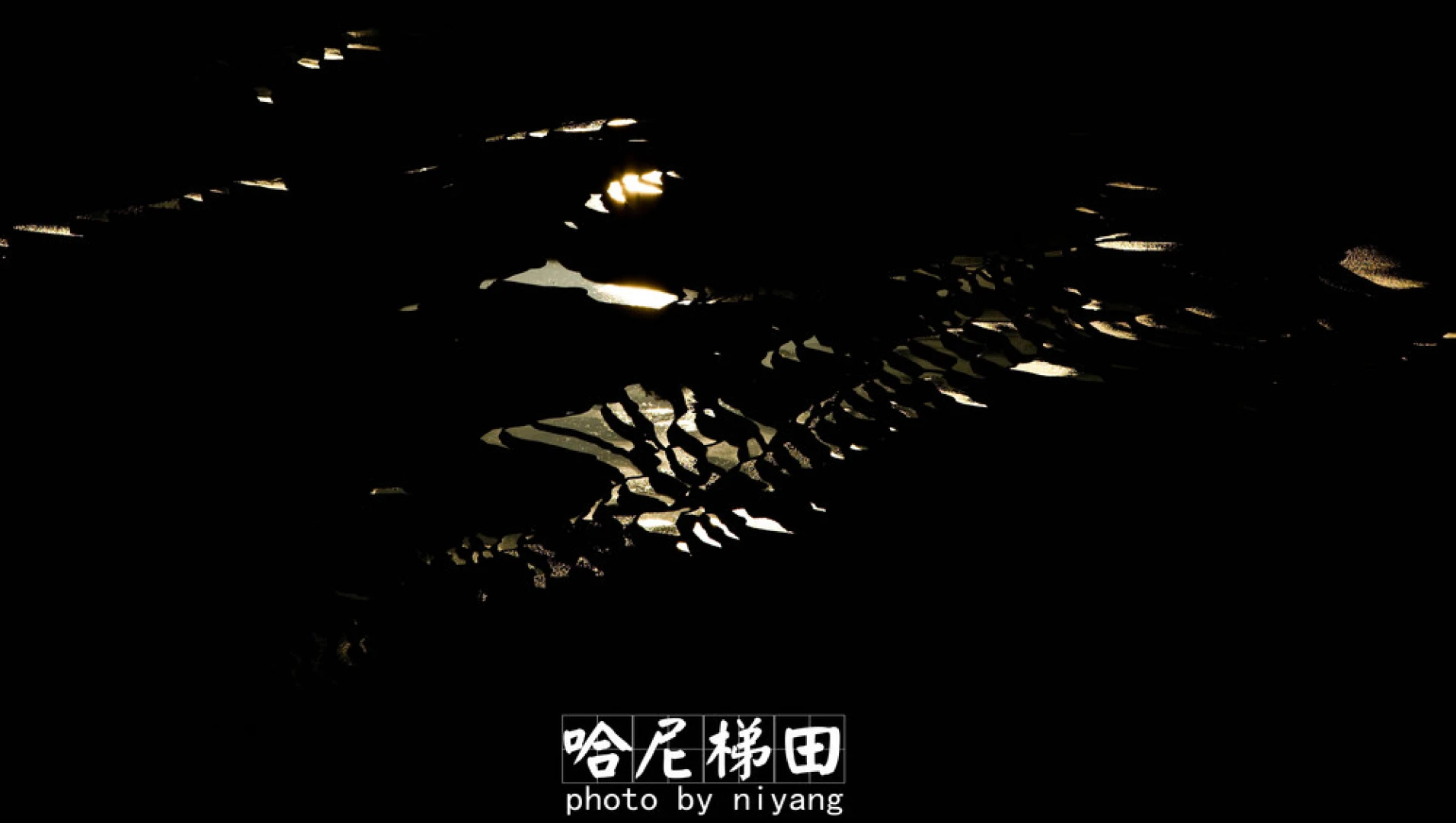
As the sun set in the west, its rays reflected off the water surface of the terraces, creating an instantly breathtaking scene. Rosy clouds, red sky, terraced fields, the galloping horse—heaven, earth, and water transformed with the movement of the sun, making one feel as if they were in a fairyland.
But what I never expected was that the sunset at Laohuzui would draw together almost every photographer and tourist in Yuanyang within just a few hours. Every tripod spot, every standing position became prime real estate as the sun dipped westward. A dense crowd gathered here, all waiting for that single moment of sunset. The array of long lenses and heavy cameras was almost enough to rival the legendary Tiger Mouth sunset itself.
From the moment the sun illuminated a single terrace below Laohuzui, they started clicking their shutters nonstop, as if trying to devour every bit of light and shadow into their cameras. The sound of shutters erupted all around, echoing through the valley.
Night Talk in Yuanyang: Beauty, Food, and Wine
When darkness fully set in, we returned to our hotel. The feast we had ordered in advance was ready for us—beautiful scenery, delicious food, and good wine. This is one of the great pleasures of being a photographer on the road.
Over dinner, besides sharing our impressions of the Yuanyang terraces and Hani culture, we spent most of the time dreaming about our next impulsive adventure: Where to go? What to shoot? When?
After the flavorful food and aromatic liquor had gone down, our conversations ranged freely across the country and beyond. It had been 24 hours since we had impulsively flown out yesterday. Tonight, under the Yuanyang night sky, we were destined to drink heartily. A table full of dishes, paired with a hefty measure of high-proof liquor—this night would be filled with nothing but snoring and the silly smiles that come from being completely intoxicated by the Hani terraces, even in our dreams.
Huangcaoling: The Last Sunrise, The Last Farewell
This morning marked the end of our trip. According to our plan, the final stop of our Yuanyang journey was the sunrise at Huangcaoling.
The same sunrise, different terraces. The same Yuanyang, different light and shadow. Just like our trip—rushing in, rushing out—but we had truly felt the beauty of magnificent Yuanyang and the charm of the Hani people.
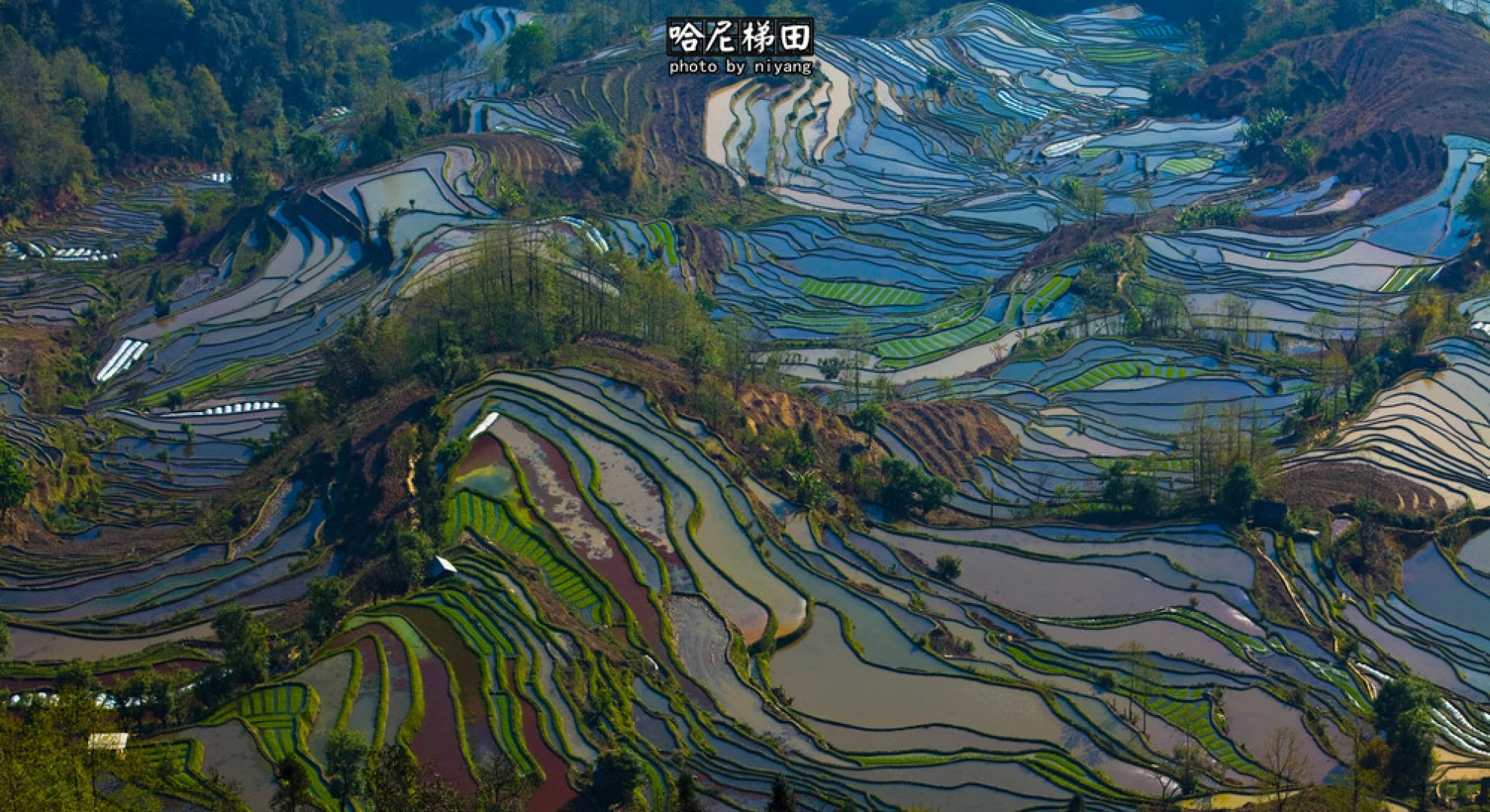
The same terrace scenery, different travel experiences—all found in this impulsive and wild journey.
The beauty of Yuanyang lies in the graceful, undulating curves of the terraces stretching for miles. Gazing from one mountain to the next, wandering through these hills, you always find at some unexpected turn a masterpiece of natural beauty unfolding before your eyes. Beyond the scenery, there is also the human touch—the families who have lived among these terraces for generations.
The Hani people created these terraces, and in doing so, they also created this wonder. Their harmonious coexistence with nature—mutually complementary, mutually enhancing—represents a perfect fusion of human culture and the natural world.
Appendix: Practical Photography Guide for Yuanyang
Best Shooting Locations
Most of the Yuanyang terraces are located along the road from Yuanyang to Lvchun:
- Tuguozhai Terraces: 5 km (3.1 miles) from the old Yuanyang county seat toward Lvchun, on the left side of the road. Best shot in the morning.
- Mengpin Terraces: 11 km (6.8 miles) further, on the right side of the road. Best in the afternoon and at dusk.
- Duoyishu Village: 24 km (15 miles) from the county seat. Take a bus toward Ganiang, passing through Quanfuzhuang, Bada Village, and Shengcun before arriving at Duoyishu.
- Bada Village: 16 km (10 miles) from the county seat, on the way to Duoyishu Village in Shengcun Township.
- Habocun Village in E'za Township: 80 km (50 miles) from the county seat. Take a bus from Nansha toward Lvchun.
- Xinjie Jinzhuzhai: 4 km (2.5 miles) from the county seat, walkable.
- Xinjie Town Longshuba: 5 km (3.1 miles) from the county seat. Best to walk—the road is too rough.
Transportation Guide
- Kunming → Yuanyang: Day express buses or overnight sleeper buses (depart around 8 PM, arrive at the new county seat Nansha at 5:30 AM, then the old county seat Xinjie at 7:00 AM). Fare: 50-60 yuan (about $7-8 USD).
- Jianshui → Yuanyang: Multiple departures morning and evening. Fare: 15 yuan ($2 USD), 2-hour ride.
- New County Seat Nansha → Old County Seat Xinjie: 28 km (17 miles). Public bus: 3 yuan ($0.40 USD) per person; minibus: 5 yuan ($0.70 USD) per person.
- Car Rental: Rent a car at the county guesthouse entrance. About 120-180 yuan ($17-25 USD) per day.
Accommodation Recommendations
- County Government Guesthouse: Opposite the bus station. Triple room: 15 yuan ($2 USD) per person; quadruple: 10 yuan ($1.40 USD); eight-bed room: 5 yuan ($0.70 USD); deluxe standard room: 150 yuan ($21 USD).
- Chen Family Inn: Near the bus station. Standard room: 40 yuan ($5.50 USD), clean. Rooftop offers views of terrace sunrise.
- Xiao Yu Hostel: Near the station square. Bed: 20 yuan ($2.80 USD) per night.
- Third Uncle's Inn: A homestay run by a Hong Kong native. 30 yuan ($4 USD) per bed. Internet available.
- Xueying Hotel: Shengcun Township. Dining and lodging combined. Phone: 0873-5620160.
Recommended Photography Gear
- Lenses: 70-200mm telephoto (here, telephoto works like wide-angle). Also consider 24-70mm or 100-400mm.
- Tripod and Filters: Absolutely essential.
- Warm Jacket: Morning and evening temperatures near 5°C (41°F). A windbreaker is most practical.
Best Shooting Season
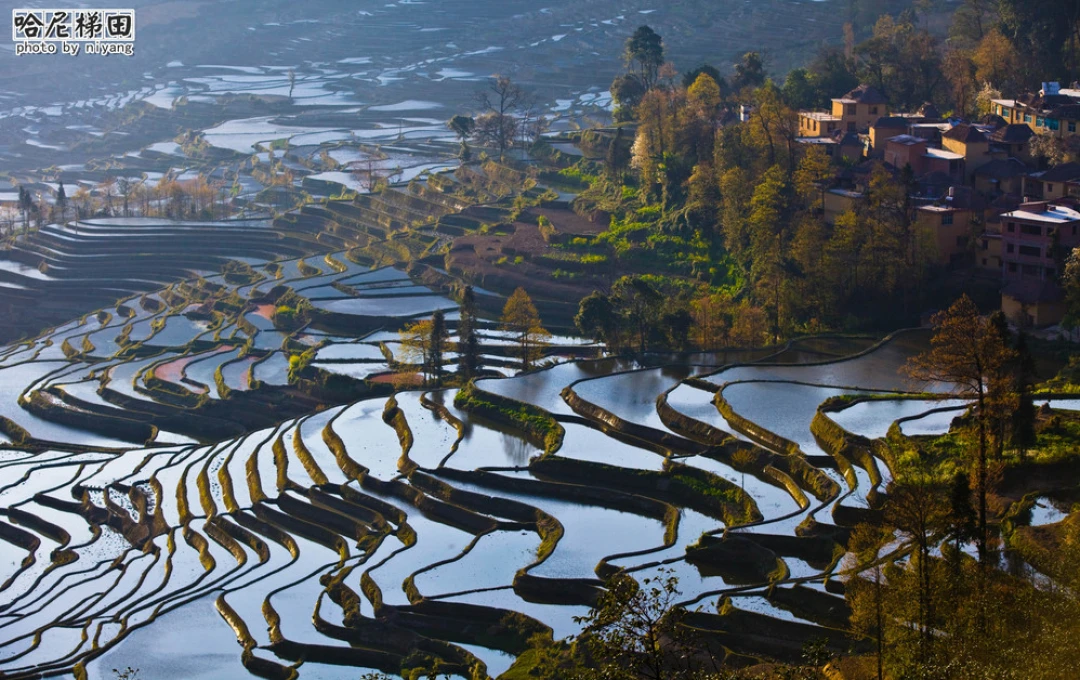
November to April of the following year, with January and February being the best. However, these months are extremely crowded, and both accommodation and shooting spots are very tight. Prepare well in advance.
Food Recommendations
- Xiao Yu Restaurant: Old Yuanyang county seat. Breakfast rice noodles and noodles. Phone: 0873-5622124.
- Xueying Hotel: Free-range chicken prepared two ways (half boiled for soup, half braised in soy sauce—75 yuan/$10.50 USD per chicken).
Friendly Reminders
- The sunrises at Longshuba and Duoyishu, and the sunset at Laohuzui (Tiger Mouth), are the highlights of the Yuanyang terraces.
- Market days (in Shengcun and Laomeng) are excellent for street photography.
- Even non-photography enthusiasts can pick any random terrace and enjoy its tranquil beauty.
- Book your accommodation in advance. Don't end up like me, "taking things as they come" and sleeping on the floor!
This travelogue is original content. Please contact the author for reprints.
You should also read:
Xishuangbanna Self-Drive Tour: Into the Tropical Wonderland at the Edge of the Sky (Complete Guide)
Xishuangbanna Self-Drive Tour: Into the Tropical Wonderland at the Edge of the Sky (Complete Guide) Introduction: A Dream Fulfilled Thirty Years Early Some journeys are destined to happen at a specific moment in time. For me, a self-drive trip to Xishuangbanna was originally the first…
Continue reading...
Big Bear and Little Cat Explore China: [A Self-Guided Tour of the Shangri-La Region: That Sky, So Blue It Feels Unreal!]
Big Bear and Little Cat Explore China: [A Self-Guided Tour of the Shangri-La Region: That Sky, So Blue It Feels Unreal!] Prologue: Why Shangri-La? In September 2011, my friend and I followed the Yunnan-Tibet Highway into the Greater Shangri-La region. Six days of travel, without…
Continue reading...
A Journey Through Time: The Earthen Forest of Yuanmou — April 2011 Chuxiong & Yuanmou Self-Drive Guide
A Journey Through Time: The Earthen Forest of Yuanmou — April 2011 Chuxiong & Yuanmou Self-Drive Guide Some journeys are destined to take root in your memory. In April 2011, I set out from Shuhe in Yunnan, heading north toward the Chuxiong Yi Autonomous Prefecture,…
Continue reading...