Four Trips to Yunnan | Exploring the World with the Same Person
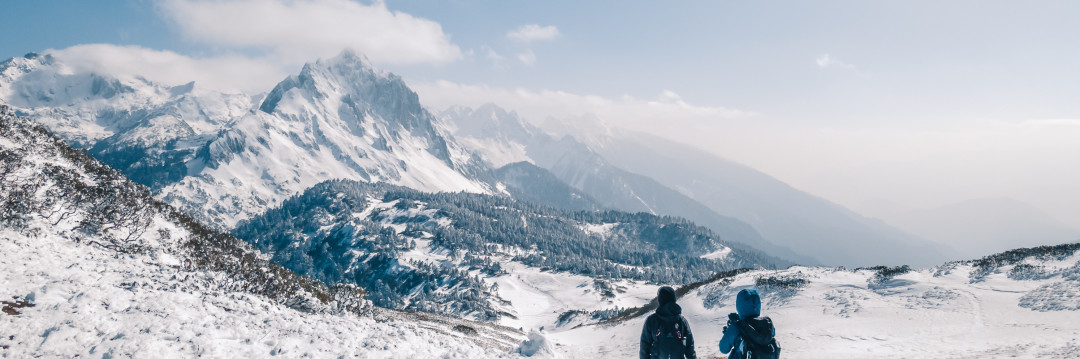
Four Trips to Yunnan | Exploring the World with the Same Person
Opening: When Travel Becomes Performance Art
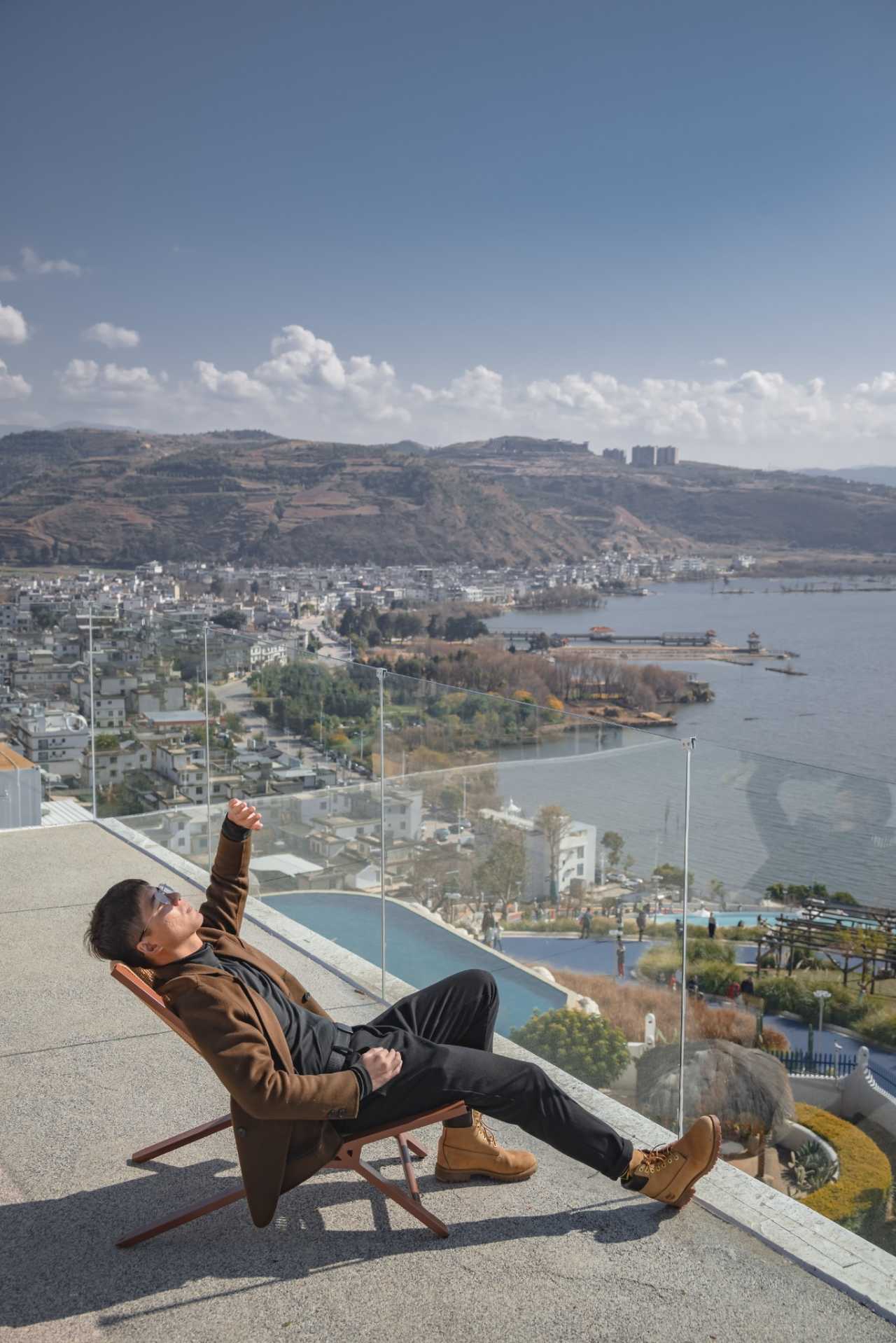
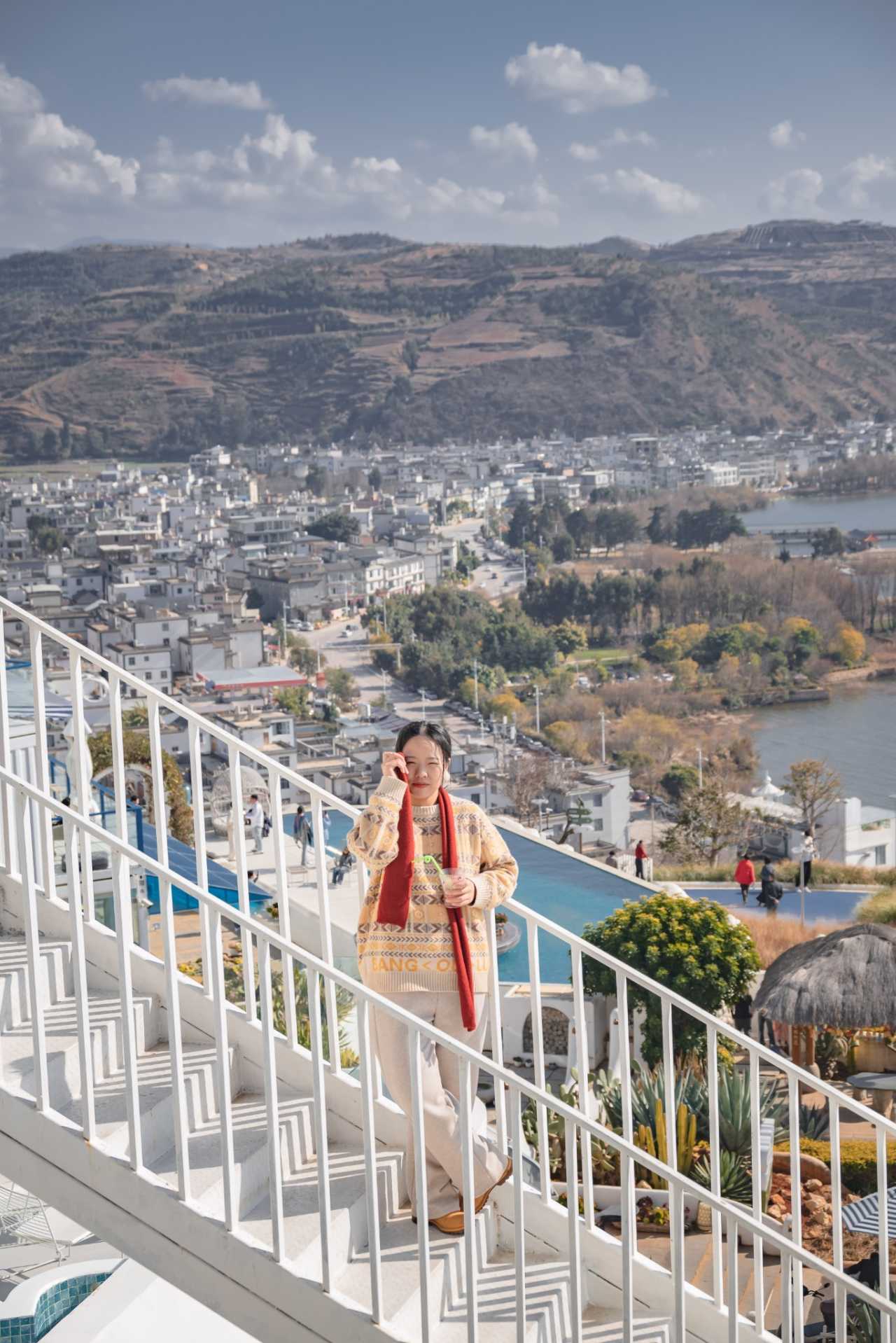
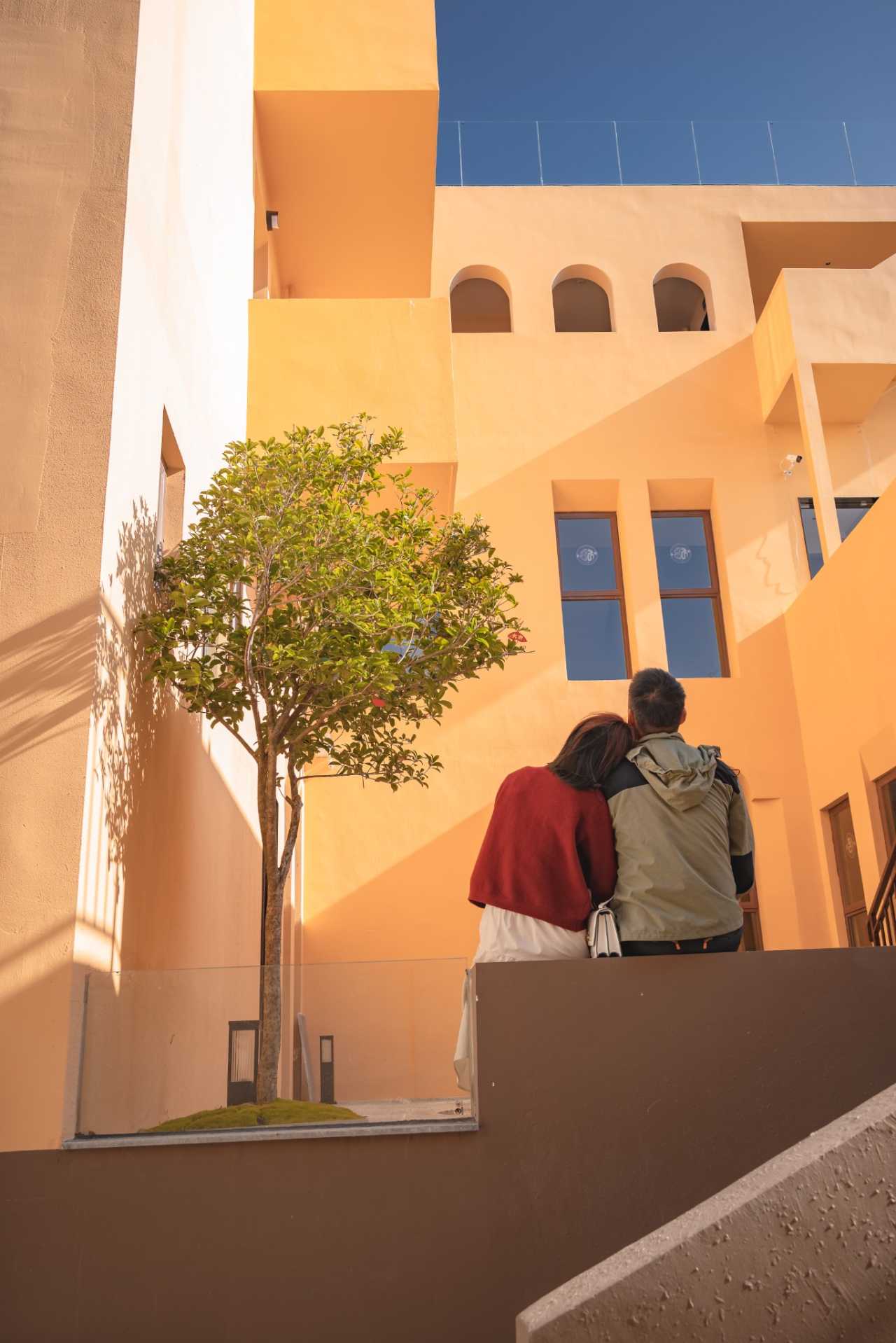
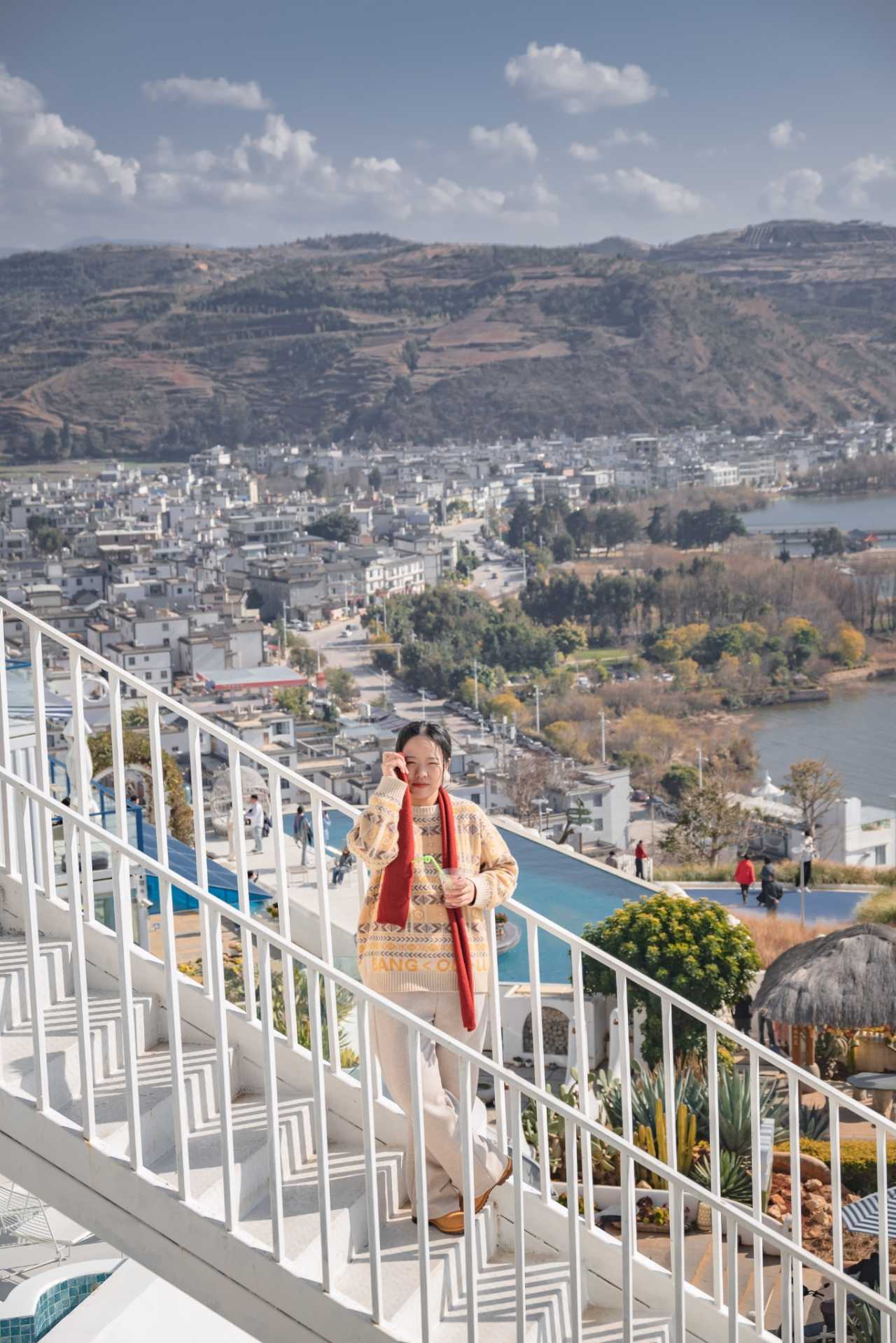
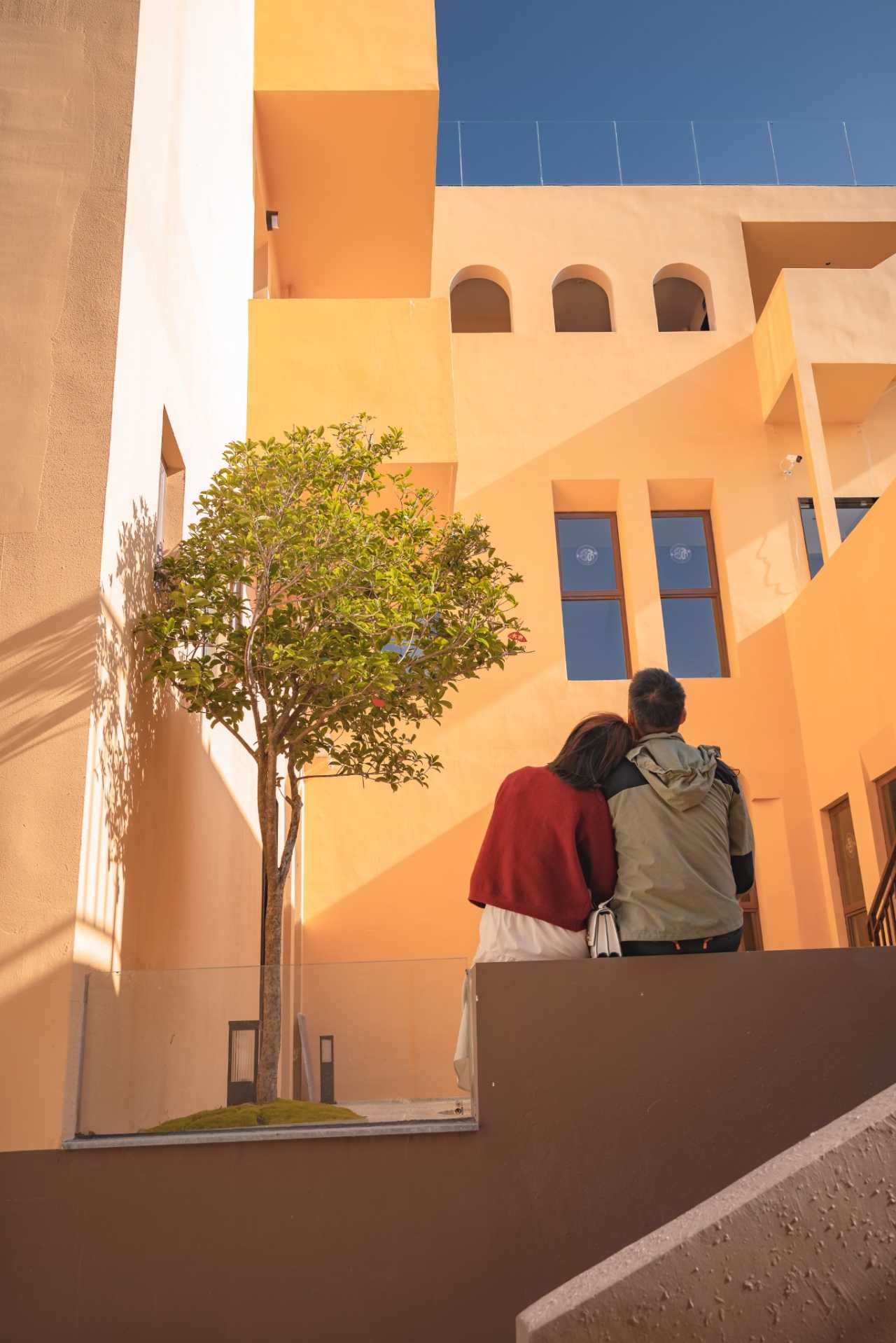
The sunlight in Dali cuts like an invisible knife, carving sugar-frost cracks into the walls of the Ideal State. Women in elegant dresses take turns occupying every Instagram-worthy spot, while their boyfriends—trained photographers in all but name—sink into practiced crouches, micro-adjusting angles to capture that perfect shot. The four of us, by contrast, felt like lambs who'd wandered into a dessert shop—creatures accustomed to threading through mountain ranges, suddenly adrift in a sea of wedding photography.

Before we could catch our breath, a woman clutching flyers materialized from nowhere, enthusiasm blazing: "Come up to the rooftop! Our hotel has the best view of Erhai Lake—and it's an exclusive photo spot." She handed over printed samples, adding, "Just spend 68 yuan on tea, and you're in. This whole area is ours." Naive newcomers that we were, we bought the ticket to this performance art. At the top, we discovered the so-called "private terrace" was riddled with holes—the "paid area" signs at every entrance had long lost their authority.
I couldn't help marveling: the greenery in the south is pure luxury. Those succulents, monstera, and cacti—plants that cost a hundred yuan a pot back north—grow wild here. As they say, well-fed kids don't steal. Out of the four of us, I was the only one eyeing every plant, tempted to dig it up.
Scrolling through my phone, I realized the most beautiful photos were the candid shots. The Ideal State, I suppose, is about seeing through the absurdity of a man-made utopia and still being able to laugh while choking on syrupy-sweet romance. Stuffed and satisfied, we set off for Shaxi.
Shaxi Ancient Town: Morning Mist Lifting, Hearts Clear
We woke early, hoping to catch dreamy morning fog at Yujin Bridge. But the temperature difference between dawn and day was too slight, and the mist refused to gather. Well, so much for the early start. We wandered the old town instead. That's when I noticed the local ethnic costumes were stunning—I'd shot similar styles before, but Sister Fen hadn't. I tried to coax her into trying one on, but she remained unmoved, content to simply stroll through the ancient streets holding Brother Xing's hand.
This town, made famous by a certain fairy-like influencer, was crawling with tourists hunting for photo spots. After years in design, I've been mulling a career shift. During this idle stretch, I sorted myself out: staying in design or switching paths isn't really a choice—it's two directions forward. What I need now isn't agonizing over which road to take, but to buckle down and build skills. When I actually have two solid offers on the table, that's when I can talk about choices. Anxiety? Pointless. Brooding with empty hands is just self-sabotage. When I'm truly ready to switch, that's when I'll deserve the word "choice." For now, I just sprint ahead.
Something clicked, and my whole energy shifted. Don't I look like Yang Zirong's Yunnan branch? I'd circled the old town three times by noon. As our meeting time with Sister Fen approached, we headed back to the hotel. But commercialized ancient towns are a headache—identical shops, identical文创 (creative cultural products), spinning your head around. I finally understood why working oxen have that hollow stare: walking through this copy-paste maze day after day, even the Buddha would need GPS.
Those two iconic Shaxi characters aren't just on the main street—they're tucked away in two side alleys too. A little wandering and you'll find them easily, no need to queue forever on the main road (Brother Xing's AI one-click phone removal aside). Back at the hotel, Big Brother asked if I wanted a zongzi (sticky rice dumpling). I declined—I'm not big on sweet sticky things—but Big Brother, you didn't mention lunch would be delayed. Otherwise, even if that second zongzi (yes, in Guangdong, we count them by "strips") fell in the trash, I'd wash it off and eat it.
From Dali to Lijiang—that's where we finally got our meal.
At the Foot of Jade Dragon Snow Mountain: Lamb Skewer Bro and an Unexpected Encounter
Thanks to the kind staff on duty at the Snow Mountain Gliding Camp, we got in for free. Sorry for accidentally wandering onto the paid photography road on the right. Warned, we scrambled out—only to gain a fifth member mid-run. Hungry as I was, I spotted a lamb. I named him "Lamb Skewer Bro." At first, I thought he was drawn to me because we share the same zodiac sign, until the sheepdog appeared. Turns out he was being herded, and he'd come to us for shelter.
As the song goes: "I fell in love with a lamb, but my home has no pasture~" Lamb Skewer Bro, we'll have to go our separate ways. Farewell.
We'd planned to leave at 5 a.m. to catch the first Yak Meadow cable car for sunrise over the golden mountain. But calculations showed slim odds, and a recent heavy snowfall made night climbing Jade Dragon unwise. So we scrapped that plan. Still, our guesthouse was perfectly positioned between Lijiang old town and Jade Dragon—up to the bars, down to the mountain, with a balcony view of the peak itself. A small consolation. I'm brilliant.
Jade Dragon Snow Mountain, sacred to the Naxi people, also has a majestic Tibetan name: "Satang," a transliteration of "Sando." Sando, or "Apu Sando," is the Naxi's supreme protective war god, as revered as King Gesar is among Tibetans. Worshipped by Naxi, Bai, and Tibetan peoples alike, Sando temples still dot the region. Lijiang's Tibetan name, "Sandian," also derives from Sando, confirming the god's influence. But nowadays, almost no one uses the Tibetan name—it's simply Jade Dragon Snow Mountain.
Ganheba: A Secret Hiking Trail Beneath the Snow Mountain
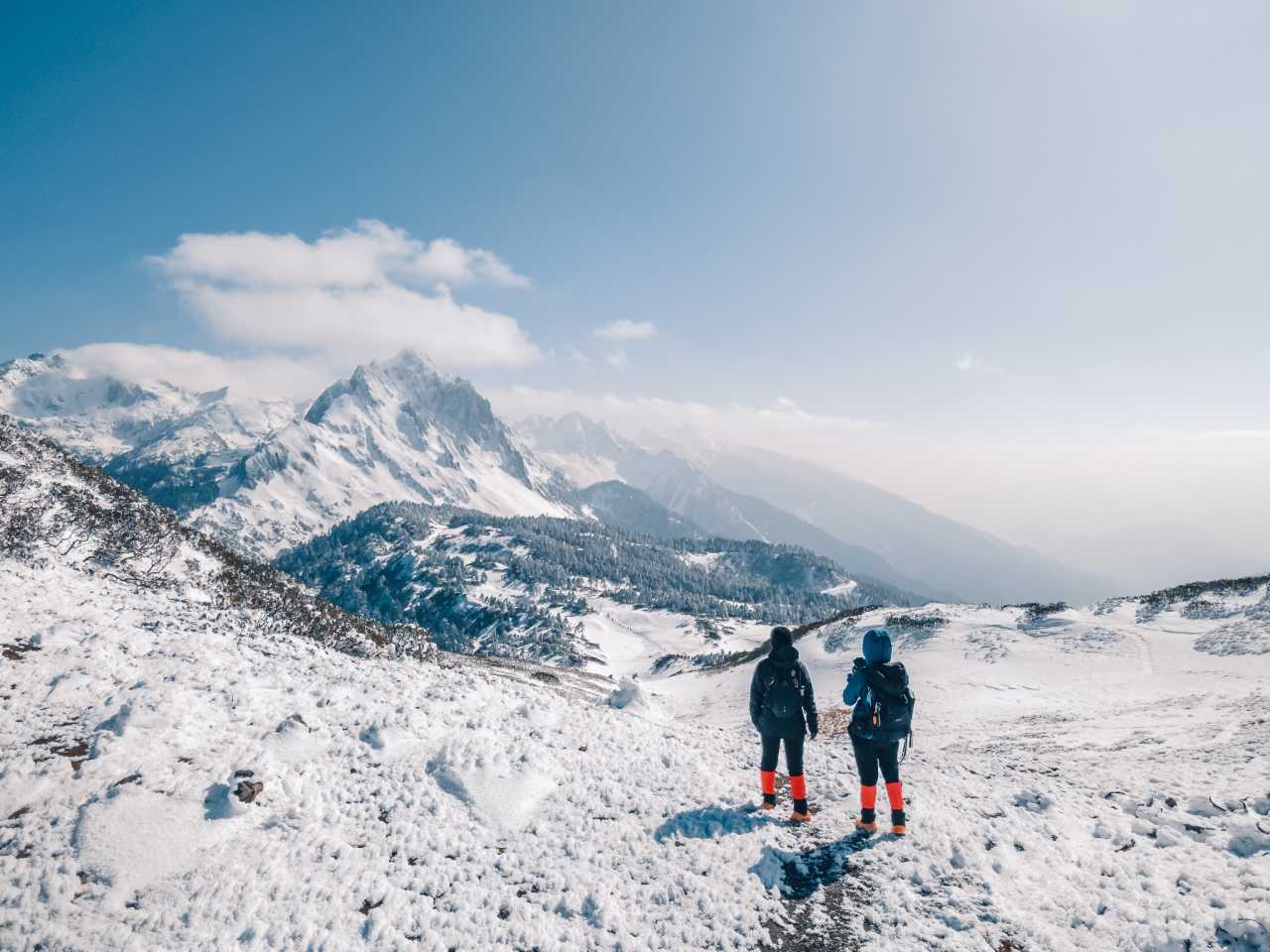
This is a hidden 15-kilometer round-trip day hike at the foot of Jade Dragon, with less than 1,000 meters of elevation gain. Along the way: snow-capped peaks, glaciers, meadows, and a unique white "beach"—yet few know of it.
At dawn, the wind howled and the sky was a menacing gray. I worried about staying warm. But soon, the clouds scattered, sunlight flooded the land, and temperatures soared. Probably skimped on breakfast—before lunch, my stomach was growling. Strange day: I'd brought the pot, the seasonings, even fruit—but no nuts or candy. Desperate, I called for a lunch stop.
And wouldn't you know it, before we ducked into the woods, we found a five-star dining spot: a big rock blocking the wind, a flat open space, and several stone stools. Sun on our backs, idle chatter, waiting for a luxurious claypot rice to cook—perfect. Full and refreshed, we set off again, steps light.

Can you believe it? Brother Xing and Sister Fen were making heart signs at each other. Well, we're in the mountains—a bit of regression is understandable. A different angle always reveals new laughs. I mean, Brother Xing's the one taking photos, and we're behind him—Sister Fen, what are you doing?
From the road closures in western Sichuan where we climbed over mountains together, to Tibet's endless dirt slopes, Hong Kong's endless dishwashing, and now Yunnan, where we're too lazy to even mock each other's sunburn—I've gotten used to the compressed biscuits you sneak into my backpack, and the three thousand ugly photos on your phone you never delete. Tell me, is this finding a travel buddy? Or is it just dragging someone down with you while you mess with life?
At the day's most photogenic spot, we were asked to take a photo by a father. After snapping, I cleverly used my phone to capture them too. An enviable pair—the dad took his eight-year-old son hiking every holiday, and the boy had already amassed considerable experience and life wisdom. You could see the教养 (upbringing) and steadiness in his behavior. He'll grow into a remarkable adult, I'm sure.
At the mountain's base, we thought we'd grab a taxi and head back. Instead, we trudged through wetlands, past Milk Lake, and down the mountain for ages before seeing headlights. My neck caught a draft in the afternoon; at night, I walked into a tree by Milk Lake—my brain grooves probably filled with dust, smooth as a koala's, incapable of thought. The word "dazed" summed me up. And they wanted me to pose? At least we got a taxi, made it back to the hotel, ate, and crashed.
Abuji Lake: A Hug at 4,000 Meters
Eyes open, and we're off. Today: the famous Abuji Lake. Online, it's described as a pristine spot in Shangri-La, traversing forests, lakes, pastures, with views of Meili Snow Mountain and Tianbao Snow Mountain.
In Sichuan, Tibet, and many wilderness areas, you see non-woven fabric. I used to wonder why. Then I watched a documentary: rising temperatures and decreasing rainfall mean grass struggles to regrow after grazing. Non-woven fabric absorbs water and insulates, protecting young shoots. Once grown, it's collected to prevent livestock from eating it or polluting the environment. Simple, yet admirable. I'll never complain about it ruining my shots again.
A hug at 4,000 meters, a confession at 12% oxygen—you call it altitude sickness, I call it heart overload. When the drone hit the swing rope, he jumped up in panic to check it—more worried than when I hit the tree and he checked my forehead (I won't let Lao Deng argue; I really did hit a branch two days ago, and he just grumbled while dusting off my hat).
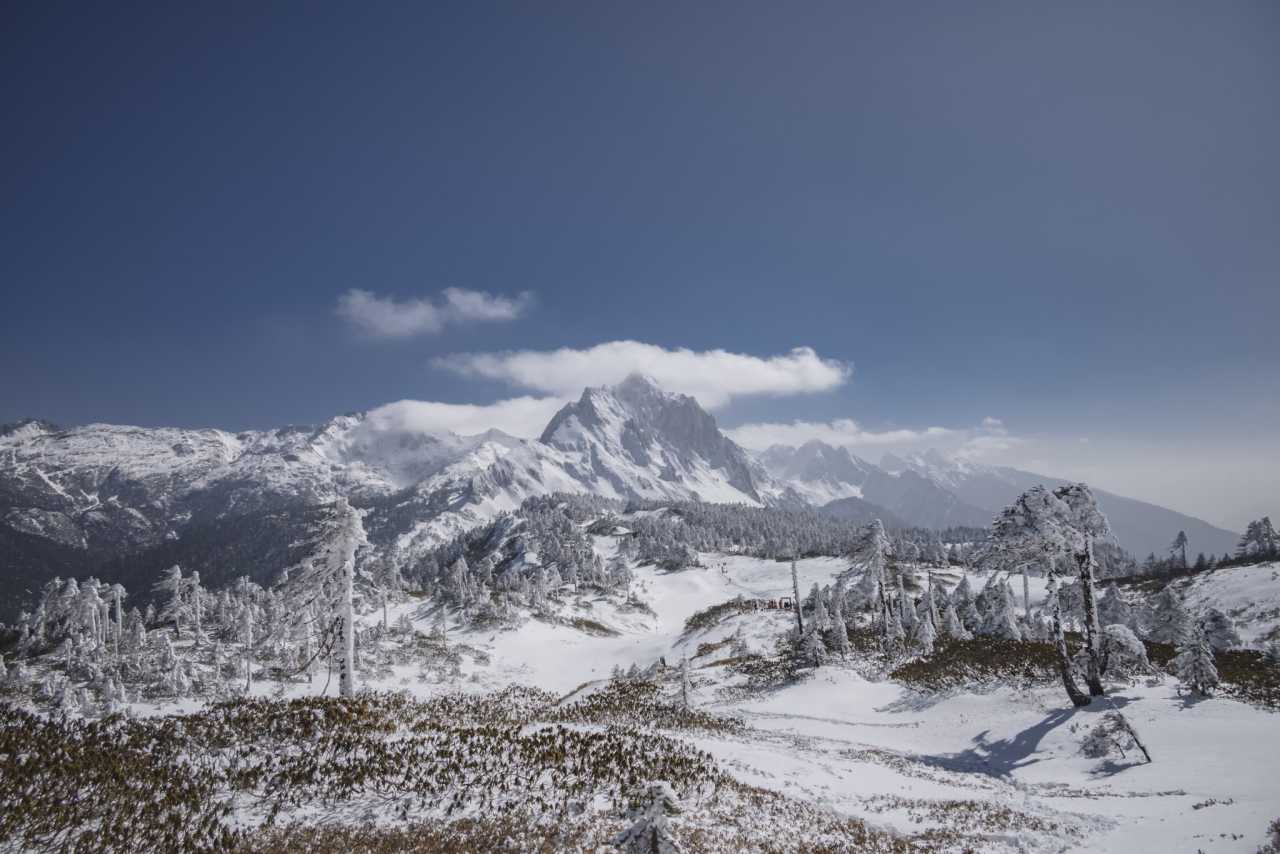
Of the three pastures, I liked the second best—it had a house, a swing, and "working donkeys." Real donkeys and horses, a rest stop. Today's "low-quality behavior" award goes, without question, to the hiking group ahead. Everyone wants that "photo of a lifetime," but stopping and starting on the trail is just wrong. I'll still remember those people dancing on my last nerve. Back at the hotel, watching my high-altitude flush fade slower than a Tibetan's, but my peeling, dark nose still severe—I'm even more annoyed.
I've forgotten what we were talking about, but I love that atmospheric photo. Before sunset, we headed home.
Meili Snow Mountain: Photo Spot Ramblings and Sacred Mountain Lore
Meili Photo Spot Ramblings
- Feilai Temple Viewing Platform: The most famous, so first. Personally, I found it so-so. The white pagoda is there, but you can't frame it with Meili up close. To get both, you'd need to climb the hill behind the hotels, and end up with a tiny pagoda and a tiny Meili.
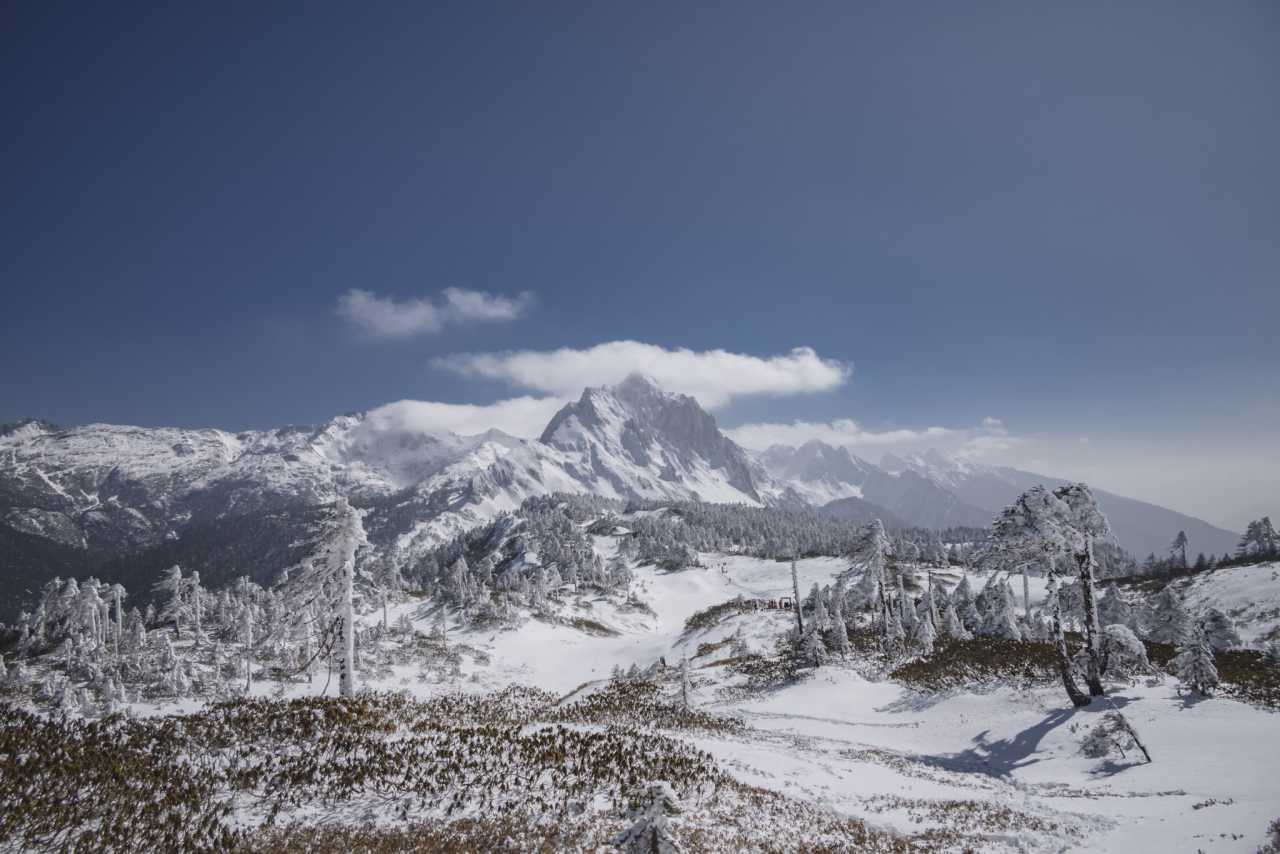
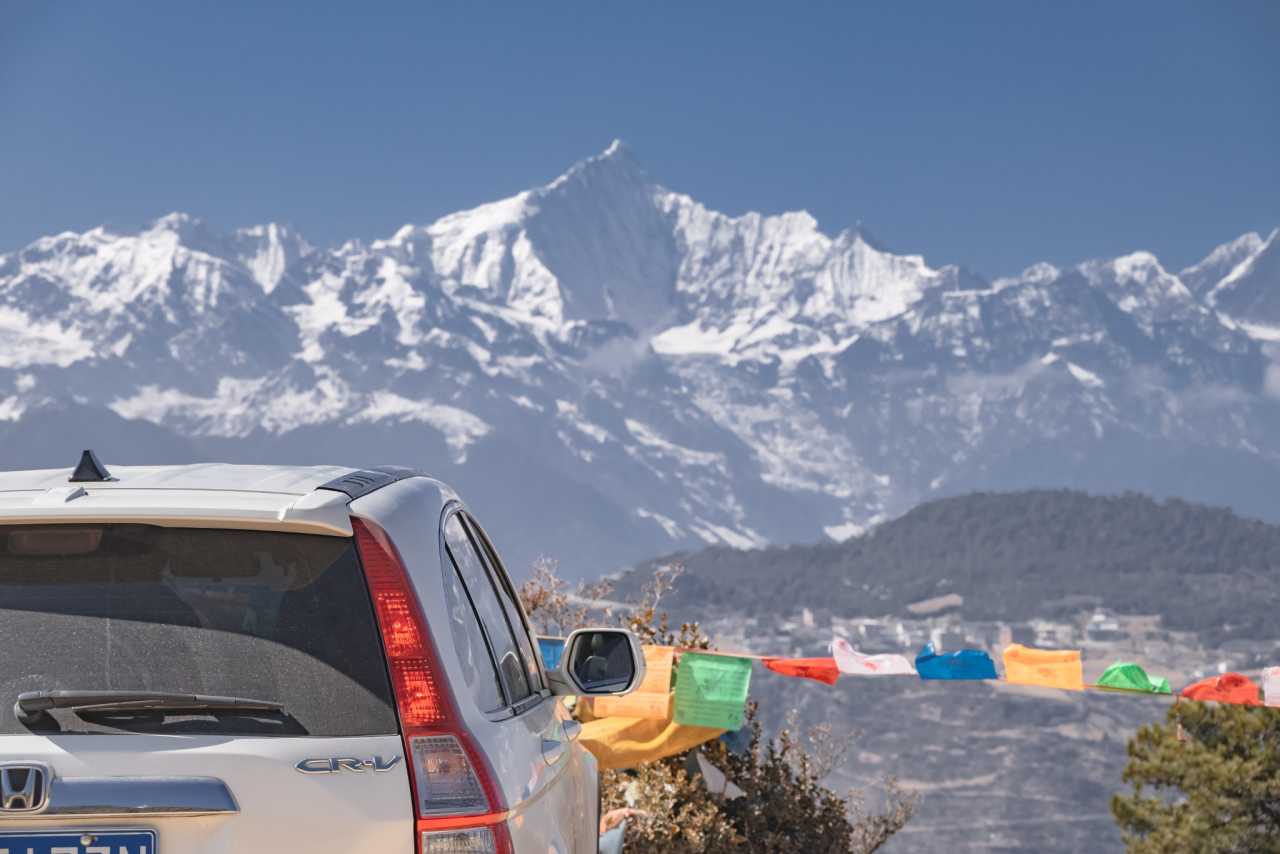
Wunongding Viewing Platform: The renowned Jixia Hotel chose well. Here, you've got foreground (prayer flags, cars), midground (a village at the mountain's foot—couldn't find its name), and background (Meili). I also love the shape of the Thirteen Peaks from here.
Lonely Tree Love Beehive: Online, it's called a lonely tree. In reality, it's busy—daily crowds gather to lean on it or stand beneath it for photos with Meili. Nearby, a mobile coffee van keeps it company year-round. The angle's similar to Wunongding, with slightly fewer people.
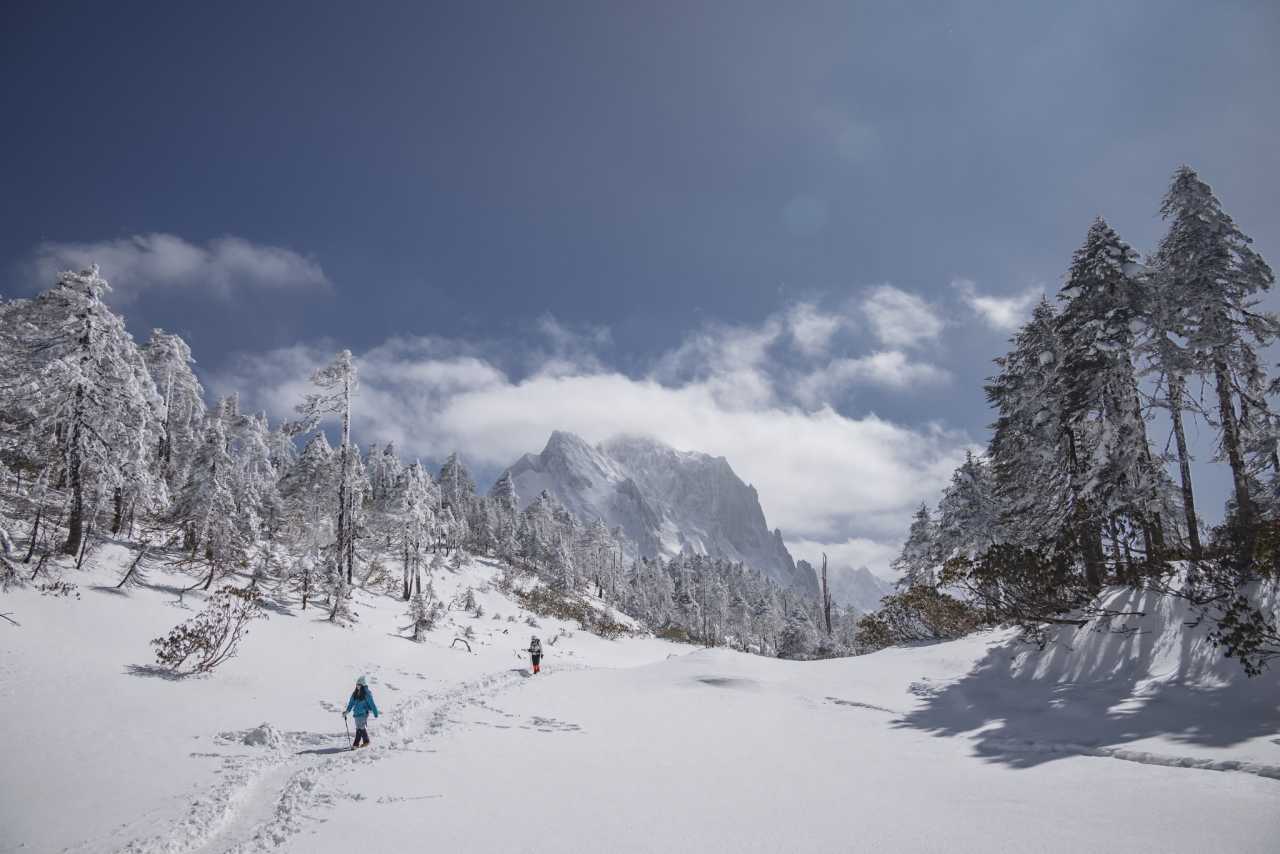
Feilai Temple No. 3 Viewing Platform: Not great value, in my opinion. A 40-minute round trip from Feilai Temple, and the scenery en route is more stunning than the platform itself. Worth it if you have time.
Near Kawagebo Peak Viewing Platform Love Beehive: Fewer people, and my anticipated spot. But the afternoon was hazy, Meili just a blurry outline, so I gave up at the entrance. Go in the morning! Afternoon is backlit.
Xueda Lake: A spot I really liked. But in winter, the lake freezes—pointless. Summer visitors should consider it, but note it's a 4-hour round trip from Feilai Temple. You could stay overnight. If "Xueda Lake" doesn't show on maps, try "Shuoda" or "Meili Xueda Lake Guesthouse."
Ever since I cheekily handed over all travel authority to Lao Deng, he's handled planning, driving, and logistics. I just show up at the designated meeting point on time and enjoy the ride, brain off, snacking in the passenger seat. Boys should take on more responsibility, right? Of course, I dutifully serve as his automatic tracking tripod—otherwise, who'd capture his handsome shots?
On the "Four Sacred Mountains"
The most common online list is "Mount Kailash, Machen Bongri, Gado Jowo, Kawagebo" (in no particular order). Some people like to compare Mount Kailash and Kawagebo.

Religiously, both mountain deities are classified as "Zan gods" in Bon mythology, though Kailash has the blessing of Bon founder Shenrab Miwo. In Tibetan Buddhism, both are mandalas of the deity Chakrasamvara, with both visited by multiple Panchen Lamas, suggesting equal status. Kailash's "center of the world" claim is Hindu—in Hinduism, it's the abode of Shiva, unrelated to Tibetan religion.
Kawagebo's title "king of the eight sacred mountains" has some basis. But these "eight sacred mountains" aren't the same as "Tibet's eight sacred mountains" (a fabricated concept). They refer to Kawagebo and his seven "brother deities" in the surrounding area, as described in a praise text by the second Karmapa, Karma Pakshi. Somehow, the story morphed into "king of Tibet's eight sacred mountains."

Mingyong is a transliteration of the Tibetan word for "mirror"—pronounced "Maiyong" in the Deqin dialect, "Mailong" elsewhere, beautified to "Mingyong." For the mountain, it refers to the bronze mirror hanging on Kawagebo's chest. So Mingyong Glacier means "mirror-like ice river." Its size and low altitude are due to two factors: Kawagebo's steep, fan-shaped peak, which funnels snow into a basin at its base, from which ice spills into the valley; and the southwest monsoon from the Indian Ocean, bringing abundant winter precipitation. Together, they create this wonder. But its low latitude and altitude make Mingyong a "warm glacier" (ice temperature near melting point), highly sensitive to climate change.
I first saw Kawagebo during the pandemic, on my third Yunnan trip. Compared to 2022, the glacier now has many exposed rocks, visibly retreating. And the increasing avalanches around Meili show that global warming is an unstoppable trend. I can only pray—pray that Kawagebo's snow falls heavier, giving the glacier a longer life.
Peacock Mountain: Sky Road and Snow Adventures
Today was the trip's highlight: the "Sky Road," the Degong Highway. This mountain is intense—a long, steep climb right from the start, with snow on the ground offering "free slides." To avoid two steps forward, one step back, I obediently put on crampons. Listening to advice pays off. But I have to say, the guy we saw snowboarding down was seriously cool—just his core and balance, gliding gracefully out of sight. I was so stunned I didn't even pull out my phone to capture his moves. A shame.
Over the past few days, Lao Deng has cemented his title as "Son of the Sun." Sunlight poured freely onto the snow, reflecting onto our faces, turning the snow into a reflector and whitening someone's coal-black face by three or four shades. Oh, look—I found a "Beijing old-style fried dough ring" on the road! I squeezed it—unexpectedly firm. Side note: not every Beijinger can stomach the famous local specialty, soybean juice (douzhi).
From the steep, winding climb to flat ground, we relaxed. The thick snow made lying down anywhere a pleasure—sprawling in a snow hollow, soaking up the sun, perfect. After the fun came biological needs. The survival rule "sky as cover, earth as pit" kicked in. I called Sister Fen to head off-trail, instructing the men to guard the entrance. A few hundred meters later, out of sight, we opened an umbrella and opened ourselves to nature—a bathroom without definition! Afterwards, I even playfully mimicked a cat's post-toilet routine—burying it. Hahaha. This stretch wasn't on the trail—hope no one steps in it.
Oh, by the way, I've been watching Hu Ge's One Way Forward. In one episode, he told Liu Tao to pack out her toilet paper, which completely floored her—are you OK? In my humble opinion, above the snow line, poop and paper freeze and should be taken out (or you'll create a poop mountain). Most hiking trails have regular climates, and paper, made from virgin wood pulp, decomposes. Poop, though different from scattered animal dung, also decomposes naturally and can be left. In short: hike responsibly, poop freely, allow everything to happen.
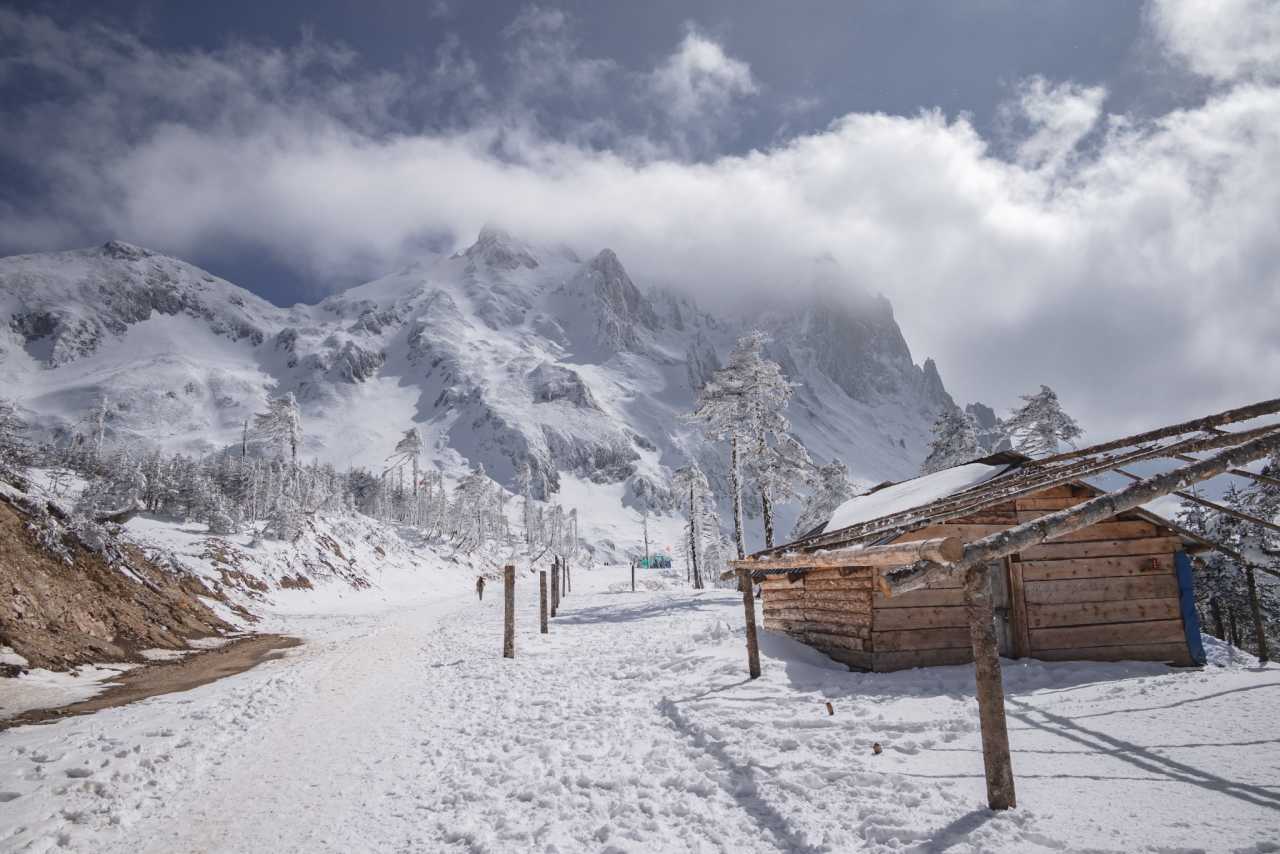
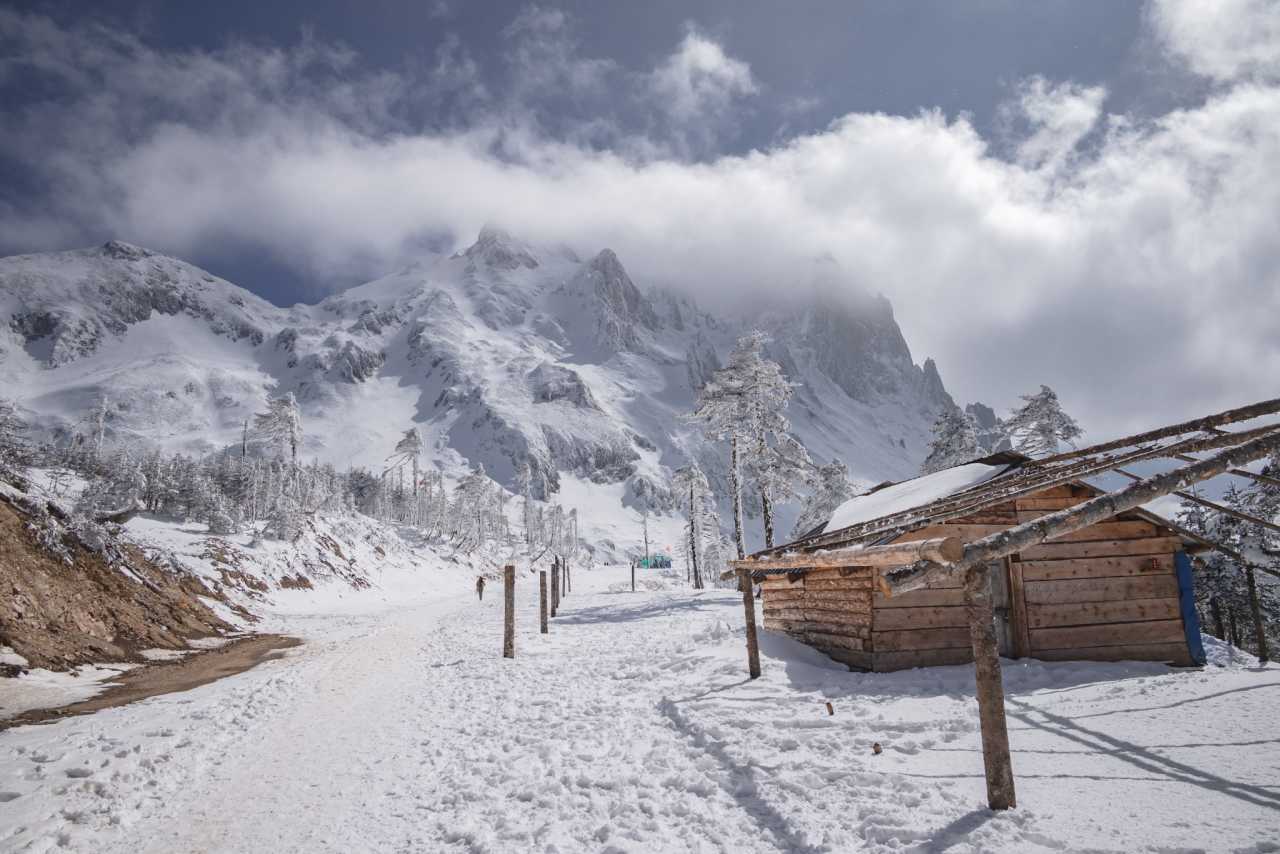
Back on the trail, we stumbled upon an abandoned wooden shack. The continuous climb had tired everyone, and with time on our side, we decided to have lunch here. After eating, Sister Fen felt her energy flagging and, afraid of holding us back, chose not to continue. We agreed: Sister Fen would sunbathe at the shack, and for the hour Brother Xing went ahead, she promised not to descend alone. Brother Xing, one-hour countdown, begin.
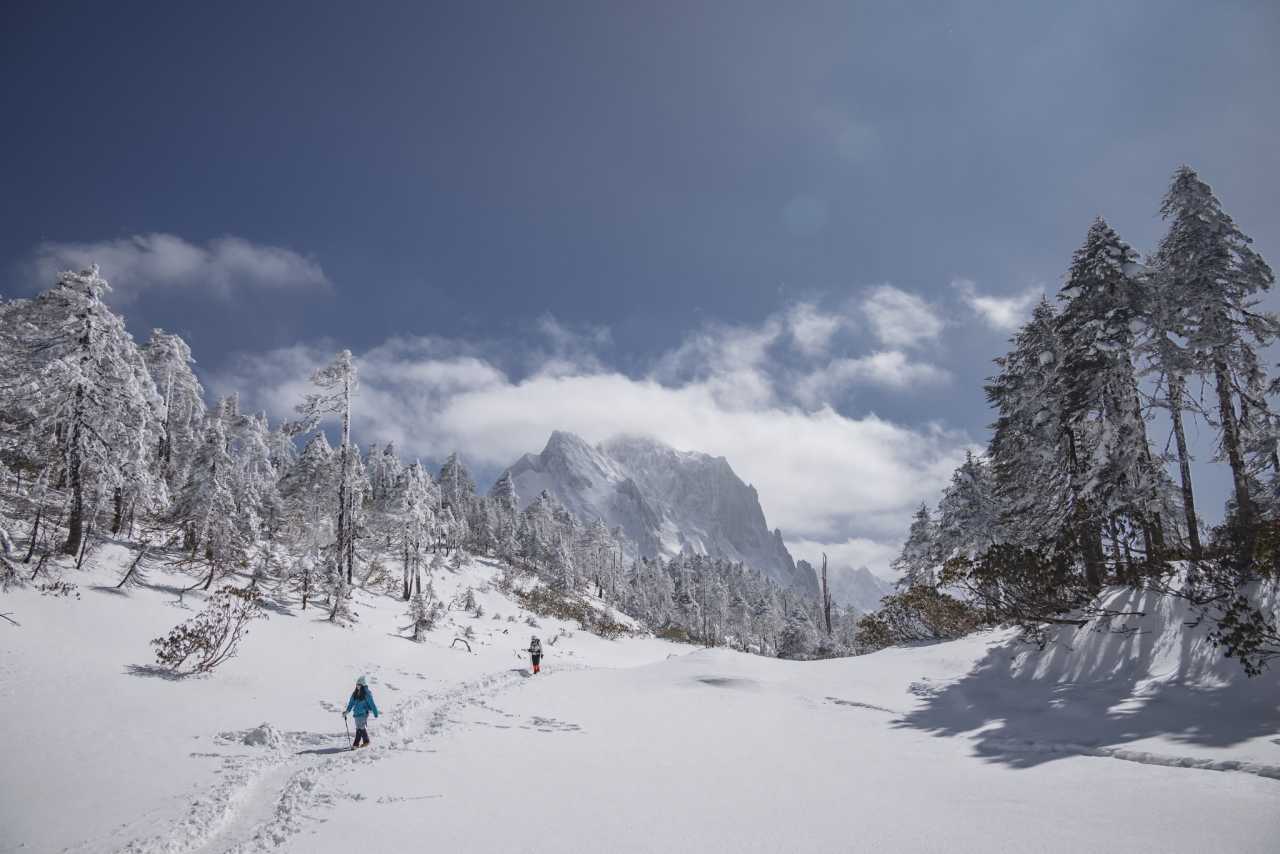
An unexpected glance back always brings surprises. The clouds added dynamism to the rolling peaks; the main peak, shrouded in mist, gained a mysterious, oppressive grandeur. This was a game of cloud and mountain, and we were like passersby intruding on their gentle conversation. A boy and a girl found buried warmth in each other's lives—the deepest harmony between souls. The serene white brought a quiet winter, but in each other's affectionate eyes, we saw a blooming spring.
We're clingy, and we're goofy. Looking at that "Snow Mountain Villa Murder" photo now, I feel more awkwardness from my "warm corpse" than from the "killer"—how to fix that? We should have continued together, but Brother Xing, worried about Sister Fen alone at the shack, resolutely gave up the unknown scenery ahead to go back. That responsible, committed back was incredibly handsome—only regret: I forgot to photograph his back and send it to Sister Fen.
Oh, one more thing: the cozy wooden shack you see on Xiaohongshu isn't the shabby one just up the trail. It's past the prayer flags, past the shack in the photo above, and a bit further on. Hope my directionally challenged self made that clear.
On one side of the mountain, along both sides of the trail, hikers had left messages—auspicious, prayerful, confessional. And then there was this one declarative statement. Seriously, what's there to write? No matter how much you let the wind and sand entangle you in this world during the day, a night's breeze will scatter it all across these vast mountains—faster than a flaky guy disappears.
Of Peacock Mountain's Twelve Heavenly Lakes, one was frozen into a heart shape. Seeing that first lake killed my curiosity about the other eleven—that's a first. Probably only ugly in winter. From Xiaohongshu, summer photos of the lake with snow-capped peaks look stunning.
I've seen plenty of national flags while traveling, even carried one to high mountains and borders. But a party flag? That was a first. So, is this a mobile party committee meeting?
The trail's endpoint was a photo frame; Big Brother's goal was fewer people. The frame was too crowded, so Lao Deng got ideas about a distant "little dirt mound." He condensed all his persuasive talk into one phrase: "Since we're here." "Hey, since we're here, why not check if that little mound has a better angle? Want hot water? Climb this little mound, and you'll get it." That's my Big Brother's motto.
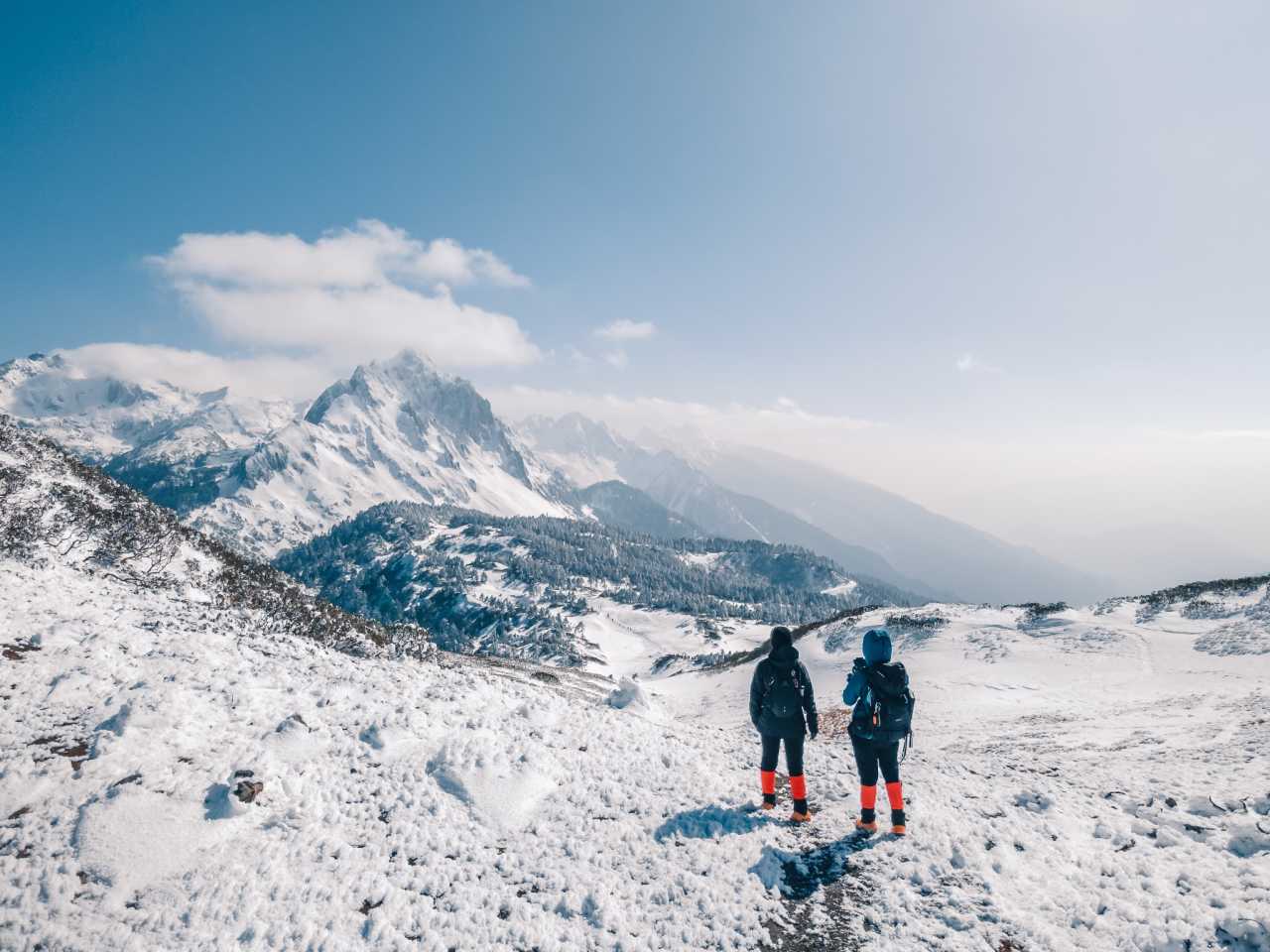
But Big Brother, who in their right mind calls a pass with at least 250 meters of elevation gain at 4,000 meters a "little mound"? According to Brother Xing and Sister Fen later: when they reached the trail endpoint and didn't see us, Brother Xing spotted two tiny black specks moving on a distant slope. His heart sank. He pulled out his phone, zoomed in 15x, and saw two orange gaiters. His suspended heart finally died. His reaction drew everyone's attention—when they realized two idiots were still climbing, they gasped.
Unfortunately, I couldn't find a panoramic shot of our "little mound" ascent. As for the view everyone's curious about—see the VCR.
In the previous section of my travelogue, I wrote the line "Exploring the world, with the same person" for Lao Deng and screenshotted it to him. He replied instantly: "Exploring the whole world? I am your world." Nice. When it comes to being smug and narcissistic, he's always my Big Brother.
Since we were here anyway, we thought about climbing the small peaks on either side of the pass for better angles. But waist-deep snow and winds of at least Force 7 or 8 made us give up. I launched the drone and spotted other climbers in the lens—a surprise, given how tough this "little mound" was. As they approached, we realized it was an old friend—Brother Xing! Shocked beyond words. Hadn't he gone back to Sister Fen? How was he here again? Where was Sister Fen? Full of questions, we waited for him to catch up. After a flurry of inquiries, we learned: Brother Xing had returned, encouraged Sister Fen, and they'd set off again, enjoying the scenery until they reached the trail endpoint.
Sister Fen said she couldn't climb. Sister Fen said she was too tired after days of hiking. Sister Fen said she'd wait at the shack. She said it all, but in the end, since she was here, she just closed her eyes and pushed through.
I remember a psychology book that said, roughly: if you just do what needs to be done steadily, without panicking, things will work out positively. Most people, though, do things while doubting and resisting. Whether something succeeds sometimes depends, weirdly, on the strength of your belief—the more you believe, the closer you are to success. Too much thinking creates problems; only action brings answers.
Sister Fen, could the photos from this trip serve as pre-wedding images? Watching them climb up and down, only one thought came to mind: every nail, every pit, has its purpose. The climbing steps I heard: facing the door, there's a nail on the top left for leverage. Step on the frame, use the nail for a pull-up, be careful, and you'll get up. Anyone interested can try.
Descending, Sister Fen was my hero—couldn't catch her, no way. Without a tripod, we didn't wait for Peacock Mountain's beautiful sunset. Sledding back to the hotel for food and rest. Praying that tomorrow's second visit to Meili will bring the golden sunrise.
Meili Snow Mountain: Golden Sunrise and Eternal Moments
Dawn crept in, and streams of clouds, light then dense, flowed unhurriedly through the valley, filling it completely. Time slipped by unnoticed as Meili was painted by the morning glow from pale ink to a gorgeous gold, finally burning like eternity.
Legend says that long ago, Kawagebo, prince of the Himalayas, was touring the Four Mang Snow Mountains when he met a beautiful fairy in a white gauze skirt. They fell in love at first sight. That fairy was Miancimu Peak, the Goddess of the Sea.
They say love is the poetry and distant horizons of life. To find a companion in the wilderness who shares the snow and the golden mountain is life's greatest fortune. Those shared cold winds and rainstorms forged armor for two souls against the world's chill. Later, looking through photos, I saw that in that famous golden sunrise shot everyone raves about, you were turning your head to look at me—all those glittering divine miracles pale beside that sideways glance, enough to last me half a lifetime.
According to Professor Qi Jixian's research, the main mountain deities of the Kawagebo region have a "guardian correspondence" with the Chinese zodiac: each zodiac year corresponds to a birth deity. Rongzan Kawagebo belongs to the sheep; Nankalamu Miancimu belongs to the snake. The first day of the Tibetan New Year in 2025 corresponds to February 28, 2025, on the Gregorian calendar—Miancimu's birth year. Happy birth year to the beautiful Goddess Peak—and while you're at it, grant the wish I secretly made.
As the sky brightened and the mountain's color faded, our eight-day journey came to an end. We never bring home the food we take on trips, so we found a service station, set up...
You should also read:

Solo in Yunnan: A Wanderer’s Guide to the Land of Eternal Spring
Solo in Yunnan: A Wanderer’s Guide to the Land of Eternal Spring There’s something magical about traveling alone. No compromises, no schedules to keep, no one to please but yourself. I’ve been on the road for nearly three months now, and not once have I…
Continue reading...
God’s Abandoned Palette: A Self-Drive Journey Through Yunnan’s Dongchuan Red Land
God’s Abandoned Palette: A Self-Drive Journey Through Yunnan’s Dongchuan Red Land Travel has never been about reaching some distant geographic coordinate. It’s about encountering, along the way, the version of yourself buried beneath the rubble of daily routine. During this May Day holiday, I finally…
Continue reading...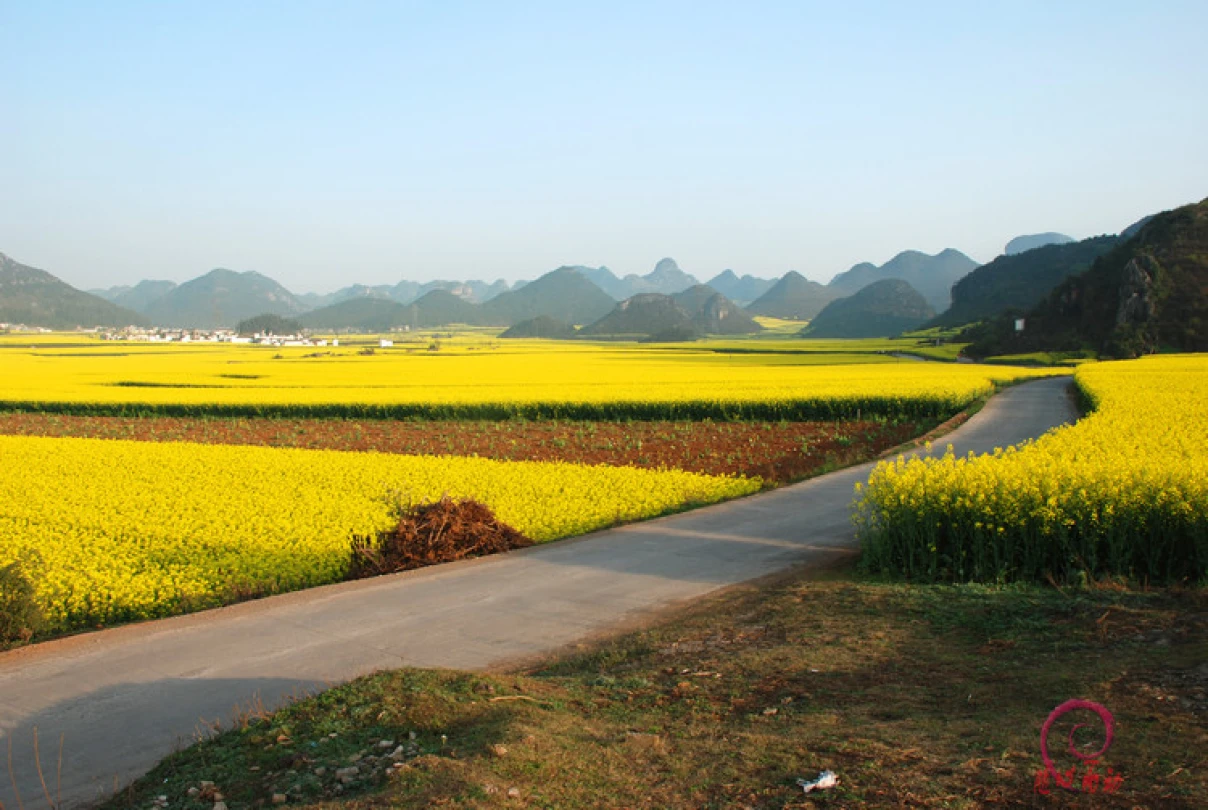
Golden Luoping: A Romantic Encounter with Sunshine and Seas of Flowers
Golden Luoping: A Romantic Encounter with Sunshine and Seas of Flowers Introduction: The Third Time's the Charm Some landscapes are destined to be seen at the right moment. For me, that was exactly the case with Luoping's rapeseed flowers. On February 22, 2011, the Luoping…
Continue reading...