【Hand in Hand, See the World】A Stroll Through Cloudy Yunnan: An Unexpected Journey from Southeast Yunnan to Xishuangbanna
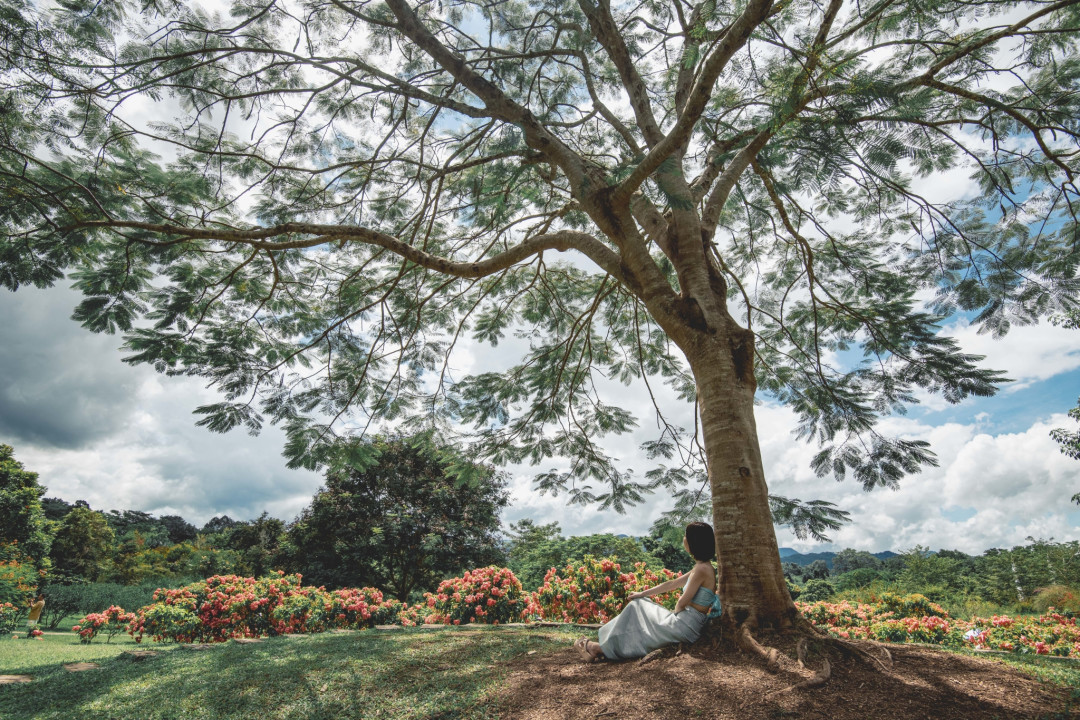
【Hand in Hand, See the World】A Stroll Through Cloudy Yunnan: An Unexpected Journey from Southeast Yunnan to Xishuangbanna
Prologue: When Plans Go Awry
This year marks my seventh year writing travelogues on Mafengwo. Though life is always busy and updates often delayed, I've never skipped a single post since I started documenting my travels. I know that in this era of short videos bombarding our eyes and people's patience being endlessly compressed, very few are willing to settle down and read a long travel piece. But for me, these words and photos are gifts to myself—they don't lie, and those memories faded by time are always worth treating gently.
Originally, our destination was Inner Mongolia. Then, for reasons we all know, Inner Mongolia was off the table, so we switched to Xinjiang. But just days before departure, Xinjiang was also added to the "blacklist." The two of us spread out a map, scanning around, and found the only place we were still interested in was Yunnan. Fine—her it was! We hastily booked flights, swapped the thick sweaters we'd packed for knit tops, and a chaotic yet surprise-filled journey began.
But as the saying goes, "If it's not a blessing, it's a curse you can't avoid." Just halfway through the trip, misfortune struck. Perhaps because heaven knew how deeply I love Xishuangbanna, the nightmare from Shanghai early this year repeated itself—a sealed-off period of time began. As for what happened next, let me tell you slowly.
Trailer: Moments That Make Your Heart Skip
- Strolling through Kunming's Old Street, feeling history settle and time stand still
- At the pink sand beach, embracing nature's unique romance
- In a resort hotel, directing our own little photoshoot for fun
- On top of Modou Mountain, watching windmills slowly turn while waiting for a stunning sunset
- At Dongfengyun, marveling at the artist's wild imagination and the charm of red brick
- In Jianshui Ancient City, treading through old lanes of blue brick, searching for traces of passing years
- In the colorful maze of Ant Workshop, falling in love across time and space
- Under the scorching sun of Gaozhuang Xishuangjing, seeing a landscape utterly different from night
- At Manting Park, pretending to be a Dai princess on the run
- At the General Buddhist Temple, listening to Buddhist chants, seeking inner peace
- At the China Tropical Botanical Garden, finding a real-life Monet garden
Itinerary Overview
| Date | Route | Highlights |
|---|---|---|
| Day 1 (Sep 24) | Shanghai → Kunming | Arrival in the Spring City |
| Day 2 (Sep 25) | Kunming | Kunming Old Street, Secret Realm M60 Creative Park, Nanqiang Night Market |
| Day 3 (Sep 26) | Kunming → Yuxi | Fuxian Lake, Yuchen Art & Image Space, Modou Mountain |
| Day 4 (Sep 27) | Yuxi → Mile | Dongfengyun Scenic Area |
| Day 5 (Sep 28) | Mile → Jianshui | Lin'an Train Station, Ant Workshop, Seventeen-Arch Bridge, Jianshui Ancient City, Zitao Street Night Market |
| Day 6 (Sep 29) | Jianshui → Pu'er | Nake Li Ancient Tea Horse Road, Torch Coffee |
| Day 7 (Sep 30) | Pu'er → Xishuangbanna | Dadugang Tea Plantation, Starry Night Market |
| Day 8 (Oct 1) | Xishuangbanna | Manting Park, General Buddhist Temple, Jinghong Great Golden Pagoda |
| Day 9 (Oct 2) | Xishuangbanna | China Tropical Botanical Garden, Bore Temple |
| Day 10-15 (Oct 3-8) | Sealed by Time | Unexpected extended stay |
| Day 16 (Oct 9) | Xishuangbanna → Kunming | Return journey |
| Day 17 (Oct 10) | Kunming → Shanghai | Home |
🚗 Kunming: More Than Just a Transit Hub
When people mention Kunming, many habitually treat it as a transit hub for Yunnan travel—a brief stop at the airport before flying off to Dali or Xishuangbanna. But my gut told me this city of eternal spring had its own unique charm. I didn't want to miss it.
Blurring Seasons, Slow Living: Kunming Old Street
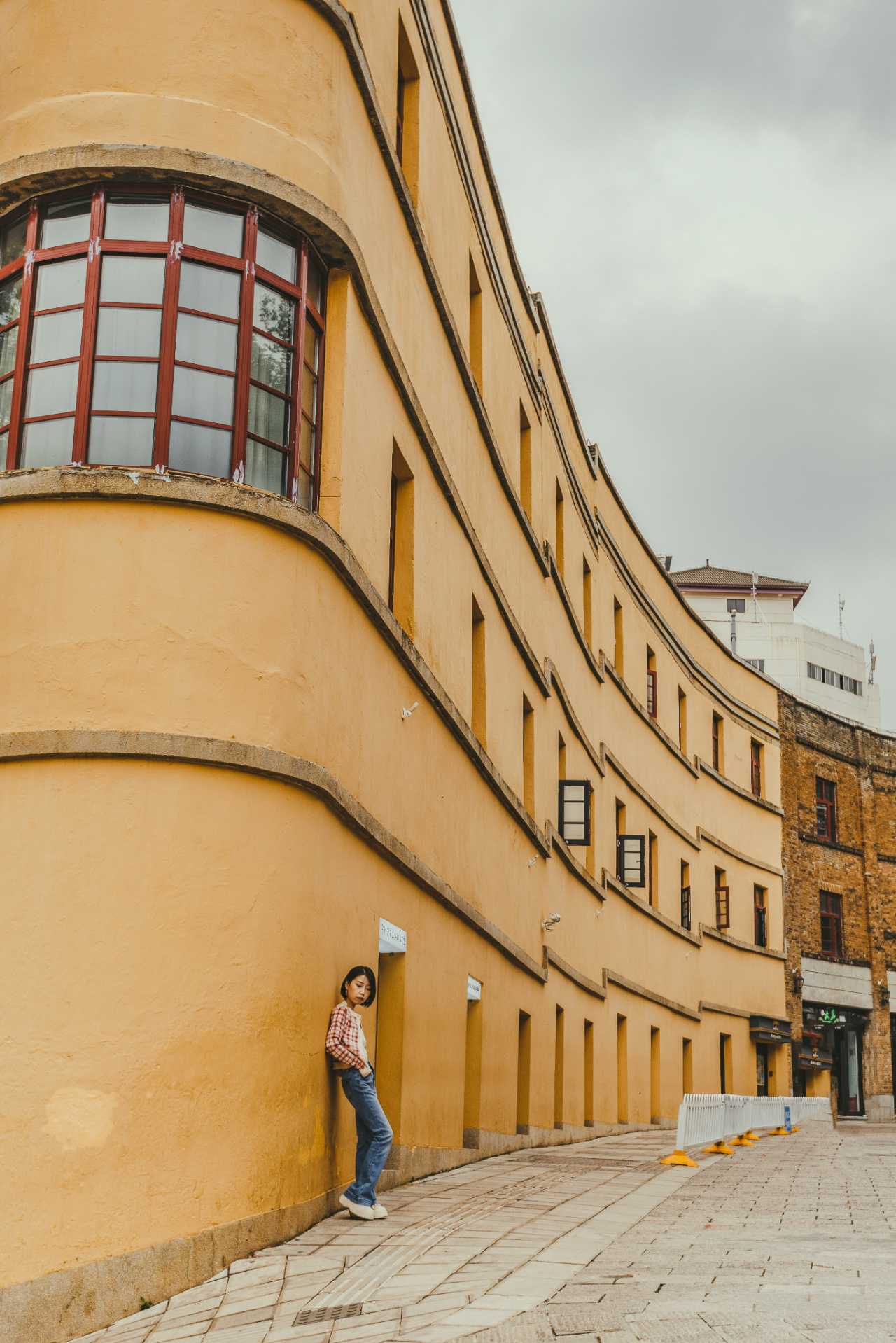
There's a kind of ease called Kunming slow living. Kunming's slowness is the slowness of seasons turning, of time flowing by. The spring-like temperatures blur the boundaries of the seasons, dulling one's perception of time. Walking through Kunming Old Street, the buildings and streets seem forgotten by time—ancient and quiet.
Actually, Kunming Old Street isn't a single street but an entire district—Guanghua Street, Yongdao Street, Jingxing Street, Qianwang Street. Here, residences and shops from the Qing Dynasty (1644-1912) and the Republic of China era (1912-1949) are preserved, forming a unique cultural imprint and microcosm of Kunming.
If you ask me when I fell in love with Kunming, it wasn't at a scenic spot seeing breathtaking views, nor at a night market tasting surprising food. It was on an afternoon on Kunming Old Street, coffee in hand, sitting by the roadside, watching the people passing by. They seemed to radiate a leisurely aura—in this society dominated by "fast living," this quality is especially unique. You naturally get infected by this atmosphere and begin to relax.
Dongfang Bookstore (Oriental Bookstore), located on the old street, is Kunming's most famous bookstore. Founded in 1926, it's nearly a century old. The current bookstore is a replica built on the original site. The moment you step through its doors, you step into flowing history. Shen Congwen, Bing Xin, Lin Huiyin—the photos and rare edition books on the walls seem to remind visitors: they were all here once.
Climbing the stairs, old books are stacked layer upon layer on one side. Compared to the first floor, the second floor is more spacious, with shelves holding classic books from around the world. Dongfang Bookstore, in its unique way, seamlessly bridges past history and present thought. Spending the time it takes to drink a cup of tea flipping through an old book, burying yourself in the pages amid the fragrance of tea and the scent of ink, learning about those bygone tales—this, perhaps, is the essence of Kunming's slow living.
A Haven for the Artsy: Secret Realm M60 Creative Park
At some point, cultural creative parks became trendy in every big city. Kunming's Secret Realm M60 Creative Park was converted from an old factory. The aging factory buildings were injected with new life by a group of the most vibrant artists and designers who moved in. It's their presence that reignited the vitality of this abandoned factory.
But unfortunately, after three years of a special period, very few shops in the park were open. No matter how bright the colors, they couldn't hide the current desolation and decay. Thankfully, it's all over now. Those carefully painted murals, meticulously planted flowers and plants, and thoughtfully arranged corners deserve to be seen by more people.
Even the most boisterous, wild person will unconsciously become artsy upon arriving here. "There's a literary youth living in everyone's heart"—that saying isn't wrong. But oddly enough, these ordinary scenes aren't absent from daily life. Yet once you're here as a tourist, your mood is completely different. Perhaps this is the joy of "escaping."
A Lifesaver for the Indecisive: Nanqiang Night Market

If you don't know what to eat for dinner, come to Nanqiang Night Market. It gathers local Kunming specialties, dishes from all over Yunnan, the rest of China, and even the world.
Moving slowly with the crowd, the dizzying array of food menus is overwhelming. Since it was our first day in Yunnan, we wanted to try everything we'd never eaten before. Luckily, each portion was small—perfect for someone as indecisive as me. I was too busy eating to take many photos. Anyway, "It's obviously commercial, but I can't dislike it at all"—that's my highest praise for this place.
🚗 Yuxi: The Understated "Back Garden of Kunming"
If Kunming is an unavoidable transit hub, then Yuxi, just 1.5 hours away by car, is less fortunate. Among Yunnan's many popular tourist cities, Yuxi barely registers. We came here just to see Fuxian Lake, which locals call the "back garden of Kunming."
Ten Thousand Acres of Glass, Ten Thousand Acres of Blue: Fuxian Lake
Once you arrive, you'll sigh: this third-largest lake in Yunnan, after Dianchi and Erhai, is truly too low-key! No wonder people say Yunnan gave Erhai to the world but kept Fuxian Lake for themselves.
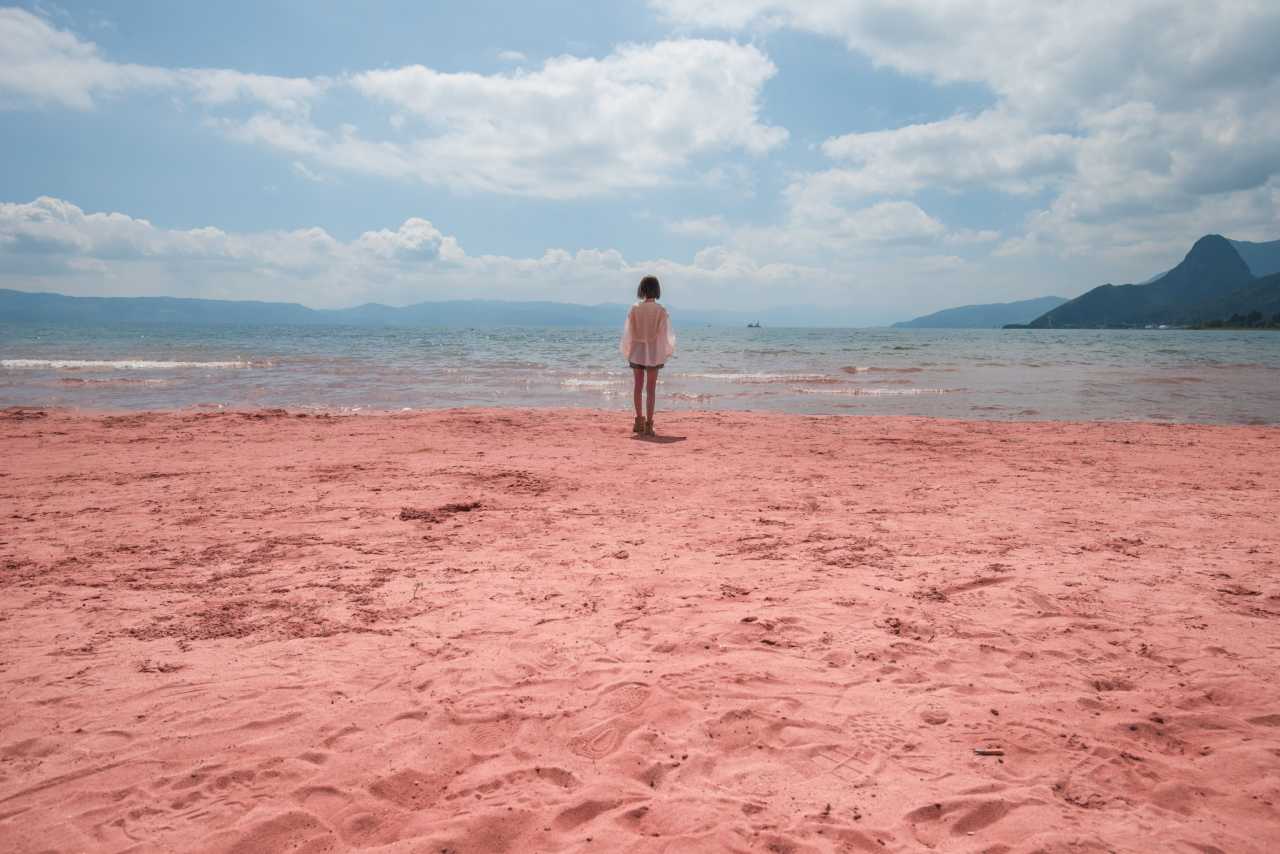
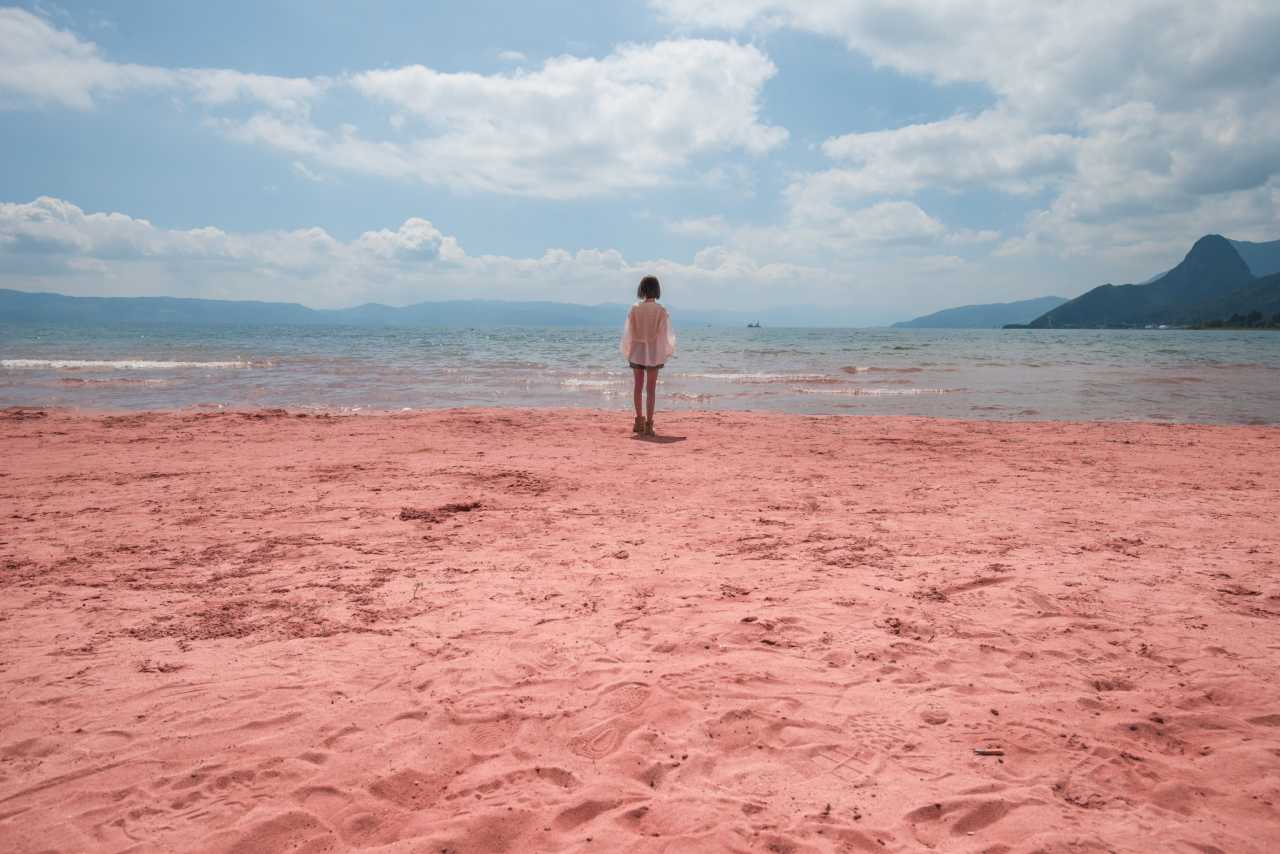
At Hongshanzui (Red Mountain Mouth), we found the pink sand beach that's all over the internet. This soft, powdery pink is like a girl's peach-toned eyeshadow palette. Although netizens say "tricked here by Douyin (TikTok)," I don't think it's that bad—the sand is indeed pink. With a little post-processing, it can still make you the envy of your friends on social media, giving your vanity a small boost.
From a bird's-eye view, the blue lake water, red sand, and green plants layer different colors on top of each other. As a free, wild scenic spot, there's no need to overly criticize its lack of realism or perfection.
Hidden in the Cherry Blossom Valley Beach Park is a Yuxi version of "Little Sanya." Scorching sun, fine sand, azure lake water, umbrellas, beach chairs, swings—in short, everything associated with the seaside can be found here. Watching the lake water shift colors, shimmering like glass, with a gentle breeze stirring ripples but no waves.
Fulfilling All Your Photoshoot Fantasies: Yuchen Art & Image Space
When it comes to taking photos, we're perfectly matched—you like taking them, I like being taken. Perfect. Although sometimes you despise me for not following directions and striking unnatural poses, and I complain that you only care about composition, not expressions, overall, we've collaborated well over the years, producing many photos we're both happy with.

If you love taking photos as much as I do and have your own personal photographer, you must visit Yuchen Art & Image Space in Xiaowan Village, Fuxian Lake. It's hailed as "the most photogenic place at Fuxian Lake"—Morocco's Chefchaouen, Santorini's white caves, Turkish sofas, lakeside cliff tents, glass infinity pools, garden wedding drapes… Various photoshoot scenes will surely fulfill all your romantic fantasies.
If Kunming's overcast skies made us underestimate the power of Yunnan's UV rays, then the slightly stinging sunlight on Fuxian Lake kept us wondering whether it was summer or autumn. Luckily, some outdoor scenes offered brief shade, but someone wasn't so fortunate—under the blazing sun all afternoon, he tanned at least two shades darker.
I used to complain that you didn't understand romance or subtlety, until I saw you patiently adjusting angles to photograph me under the scorching sun. Then I understood: this is your kind of romance—giving me the right to shine alone in front of the lens, and you've given me that for over a decade. Actually, good relationships don't need to be dramatic. They're like a small flower blooming in the flow of time—unremarkable, plain. Life is long; may we still dance with life amidst our busy work, never let down.
A Windmill Kingdom on the Mountain Top: Modou Mountain
Since we were at Fuxian Lake, we couldn't miss Modou Mountain on its southeastern shore. The road up was winding and rugged, with cliffs and abysses outside the window, and most sections had no guardrails at all—to say I wasn't nervous would be a lie.
But perhaps because the entire journey kept us on edge, when we reached the summit, let down all our defenses, and fully relaxed, the view before us was all the more breathtaking.
At the top, we walked alongside the blue sky, shoulder to shoulder with white clouds. Before us stretched连绵 mountains, giant windmills nearly within reach, and Fuxian Lake appearing and disappearing among the hills—the anime world of Hayao Miyazaki played out in reality.
The windmills turned slowly, like sword-wielding giants. Standing beneath them, I felt as small as an ant. There are always places in the world you can't reach. Perhaps these untouchable things are the most beautiful presences in our lives.
Waiting for a sunset at the mountaintop with the one you love. That day, the wind was strong, the weather cold, but because you were there, even the most boring moments were worth cherishing. And because it was you, I was willing to see all the scenery in this world hand in hand.
🚗 Mile: The City Named After a Buddha
This is the only city in the world named after a Buddha, home to the world's largest Maitreya Buddha statue and Yunnan's largest wine production base. But our purpose here wasn't to worship the Buddha or taste wine—it was for the internet-famous Dongfengyun Scenic Area. There are fairy-tale castles here, an Eastern Provence—so even if Mile is just one stop, it's worth the trip.
Eastern Romance Built with Red Brick: Dongfengyun
How many people, like me, were drawn here by the Kaleidoscope Art Museum? The entire building was designed by eccentric artist Luo Xu, built without a single steel bar or nail, entirely from local red bricks from Mile. Its shape resembles a pile of stacked wine bottles, or blazing flames, representing Mile's wine culture, the Yi people's fire culture, and a spirit of unity and upward growth.
The first time I saw this building, I thought of Gaudí—the same wild imagination, the same flowing lines. But what's even more clever is that combined with the raw, rustic red brick, it creates a uniquely Eastern romance.
It's said that in this castle of brick tubes and window mirrors, as sunlight hits at different angles through the seasons, it reveals different光影 beauty. Standing inside is like stepping into a kaleidoscope, dazzling the eyes. But unfortunately, due to the special period, the museum was closed to visitors. We could only imagine this colorful world.
Half-Cloud Art Museum is not far from the Kaleidoscope, continuing its architectural style. The exterior walls have smooth, flowing lines; the roof is undulating, layered, merging with the blue sky. From afar, it really looks like half a cloud in the sky.
There are many such red-brick buildings in the scenic area, each with its own unique character, adding a vivid stroke to Dongfengyun.
By the river, there's a vast purple verbena flower sea. A gentle breeze stirs up layers of purple waves. The setting sun casts a soft light over the purple sea, dreamlike as an oil painting, exuding romance in the twilight.
Where the flower sea meets the sky stands a cluster of square, unadorned red buildings—that's Seal Stamp Pavilion. Clear, crisp lines outline seemingly simple geometric shapes—like seals, like monuments, or like haystacks in an autumn field.
Have you seen Dongfengyun at night? Darkness softens the bright brick-red color under the scorching sun, leaving only the outlines of the buildings, with dim lights adding a touch of allure.
🚗 Jianshui: Ancient Charm Meets the Hustle and Bustle
As early as the Ming (1368-1644) and Qing dynasties, there was a saying: "Gold Lin'an, Silver Dali." Lin'an was the ancient name for Jianshui. Here, flowers bloom all year round, bringing joy and peace; here, ancient charm lingers, yet the warmth of human life is never lost.
Traveling Along the Century-Old Meter-Gauge Track: Lin'an Train Station
It's hard to imagine that in today's era of constantly breaking high-speed rail records, Jianshui still runs the world's slowest train. It's a section of the Bishi Railway, China's first private railway. Originally, the track gauge was only 0.6 meters (narrow gauge), until it was changed to 1 meter (meter gauge) in 1970. Today, passenger and freight services on this line have completely ceased. The remaining 13 kilometers have been turned into a special tourist sightseeing line, taking you to explore forgotten old times.
Lin'an Station is the departure point. The waiting room still retains its original layout—a ticket window on one side, a small shop on the other, two rows of benches for resting in the middle, and vintage chandeliers and fans hanging overhead. A strong sense of nostalgia washes over you.
Exiting the waiting room leads to the platform. The mottled, yellowed old walls have absorbed the dust of time, telling tales of historical vicissitudes.
Further inside, there are a few vintage carriages, now converted into small museums, documenting exciting and proud moments in history. Although we missed the departure time and couldn't ride the century-old meter-gauge train, we didn't regret coming here. After all, in this era of rapid development, we also need to occasionally pause and look back—perhaps that will help us move further forward.
Practical Tips: The train has four stops—departing from Lin'an Station, passing Shuanglongqiao Station and Xianghuigiao Station, arriving at the terminal Tuanshan Station, then returning. On the outbound trip, each stop lasts 30 minutes; the terminal stop lasts one hour. The return trip makes no intermediate stops. For specific schedules, follow the WeChat public account "Jianshui Ancient City Small Train."
Three Pavilions, Seventeen Arches, One Bridge Locks Two Dragons: Shuanglong Bridge (Double Dragon Bridge)

Shuanglong Bridge is located where the Tacong River and the Lujiang River converge. The "two dragons" refer to these two rivers. In ancient times when floods were frequent, people named the bridge "One Bridge Locks Two Dragons" to express their wish to control the floods. Because it has seventeen arches, it's also called the "Seventeen-Arch Bridge."
There are three pavilions on the bridge—the central one is the most magnificent, like an emperor seated high, ruling the world; the two at the ends are smaller, like generals guarding. The bridge body, built from giant stone blocks, has been polished smooth and reflective by countless passersby. Walking carefully on the uneven stone path, my fingertips brushing against the rough, cold railings, I heard in my heart the sound of "history" and "reality" colliding.
Blue Brick, Old Lanes, and Time Past: Jianshui Ancient City
To understand Jianshui, you must enter the ancient city. Chaoyang Tower (Sun-Facing Tower), built during the Hongwu era of the Ming Dynasty, is the landmark of Jianshui Ancient City and the place where the first rays of sunlight arrive each day. The ancient city is exceptionally quiet early in the morning, with the清脆 sound of copper bells hanging from the tower's eaves still audible.
Walking straight along the blue stone path, the entire ancient city isn't large—from the center to the east, west, south, or north, it takes about 30 minutes to walk out. But over 50 ancient buildings are still preserved within the city, earning it the nickname "Museum of Ancient Architecture."
Among the many cultural attractions, the most recommended is the Zhu Family Garden. Built by the Zhu brothers, local gentry in the late Qing Dynasty, as their residence and ancestral hall, it's known as the "Grand View Garden of the Southwest Border." If you want to know what "wealth" means, or understand "southern Yunnan culture," go see the Zhu Family Garden.
In classical Chinese gardens, northern imperial gardens emphasize grandeur and opulence, exuding imperial majesty; southern private residences emphasize delicacy and elegance, revealing scholarly taste. But the Zhu Family Garden perfectly blends the delicate,灵动 bones of the south with the vibrant, bright makeup of the north.
Walking among the层层叠叠, interconnected pavilions and towers, every brick and tile retains the original style of the ancient residence. Gently pushing open a door can start a journey through time. Although the Zhu family's fortunes declined over historical changes, and their former glory is no more, every corner of the mansion still faintly reveals its past splendor.
If you're tired, take a rest at Hanlin Academy (Hanlin Bookstore). This is a hidden gem bookstore in an old mansion. Stepping through the main gate and walking along a small alley, you'll find a completely different world inside—a whole wall of books. Order a cup of coffee, and you can while away an entire afternoon.
A Geometric Maze Through Time: Ant Workshop
If the pavilions, towers, and upturned eaves of Jianshui Ancient City have a kind of regulated beauty of ancient architecture, then the Ant Workshop outside the city is uniquely hard to define. It has the fresh romance of Greek architecture, the vibrant colors of Moroccan architecture, and the flowing lines of modern abstract architecture.
Coming here, the first thing that grabs you is its shape—majestic castles, towering spires, or circular corridors. The second thing is its color—dazzling Mediterranean color schemes, full of romanticism, dreamy yet playful. I marveled at the designer's wild imagination, but upon learning it was still the work of the eccentric master Luo Xu, it was no surprise—yes, only he could push bold avant-gardism to its fullest.
Originally, this was a forgotten abandoned brick kiln, so all the buildings are made from square hollow bricks pieced together. Walking through them is like wandering in a maze, peeking at this奇妙 world through the gaps, exploring the essence of art.
Circular arches stack upon each other, sunlight streaming through the gaps in the bricks. Above our heads, large clouds drift with the wind, shifting and changing, now bright, now dim. Between light and shadow, time and space are traversed, and time itself is reshaped.
The former brick kiln furnace has been painted with goose-yellow paint, transformed into a Kiln Prison Coffee Bar. Holes in the wall serve as entrances—you have to bend down to enter. Luckily, the interior is relatively spacious. Long corridors, dim lighting, no tables, only iron stools welded to the floor, and the order counter enclosed by railings—it really does feel like a prison.
True Human Warmth: Zitao Street (Purple Pottery Street)
Zitao Street gathers all the hustle and bustle of Jianshui—not just tourists, but also many locals gathering with family and friends. When night falls, colorful little lanterns illuminate the entire street, making it shimmer and dream.
The large copper pots of beef soup rice noodles (niutang guo zizhu mixian) waft the rich aroma of beef, and the grill racks sizzle, constantly tempting your taste buds. And the prices are cheap—how can you not love it?
🚗 Pu'er: An Overlooked Treasure
When people mention Pu'er, many first think of a type of tea. Besides that, Pu'er is also a tourist city in Yunnan, but because its "neighbor" Xishuangbanna is so famous, it's always been overlooked by the public eye.
Singing Caravan Songs on the Ancient Tea Horse Road: Nake Li
Nake Li is located in Tongxin Town, Ning'er County, Pu'er City. It's one of the more complete ancient courier stations preserved on the Ancient Tea Horse Road. The entire village is surrounded by mountains, like a pearl set in a green embrace—dazzling yet low-key.
Entering Nake Li, you feel the quiet lanes and lingering ancient charm. On both sides of the stone path are uniformly red-brick, black-tiled old houses. There's no excessive commercialization; it's even a bit desolate. It no longer echoes with the noisy crowds and clattering horse hooves of the past.
Primitive, rustic villages always give a sense of peace and comfort. If you're tired and weary, find a village like this—one house, two people, three meals a day, four seasons a year—it's actually quite nice.
Walking further in, you'll see the ruins of the Ancient Tea Horse Road. Climbing the steps is like embarking on a long journey. It's not hard to imagine how difficult the Yunnan-Tibet route, now considered an ultimate challenge for off-road enthusiasts, was in the era of horse caravans—sleeping in the open, enduring hardships, and traveling over mountains and rivers were unavoidable.
Stealing a Moment of Leisure: Torch Coffee
Pu'er has not only tea but also great coffee. As a重度 coffee addict who drinks two cups a day, how could I miss it? Torch Coffee, located in the city center, is Pu'er's top-ranked coffee shop and has trained many famous domestic baristas. Seeing the photos of一期期 coffee training学员 posted on the wall, you know countless people have come here to learn.

To be honest, in my eyes, there are only two kinds of coffee—good and bad. So compared to the taste and texture, I love the atmosphere here more. Whether you choose to sit inside, feeling the autumn breeze pass through, or sit outside, feeling the afternoon sunlight fill your heart—that sense of leisure and comfort is the best cure for travel fatigue.
Although I don't understand coffee, as a baking enthusiast, I have some knowledge of desserts. This randomly ordered mango cheesecake was surprisingly delicious—the top layer of mango puree had a light fruit fragrance, the middle layer of cheese was rich and creamy, and the bottom cookie crust was crispy but not greasy. It was a huge surprise for someone like me who doesn't expect much from coffee shop desserts.
Practical Tips: The shop also sells coffee beans from around the world. Coffee lovers shouldn't miss it.
🚗 Xishuangbanna: Uniquely Southeast Asian
Xishuangbanna—a place you fall in love with just by hearing its name. It should be on many people's travel lists. Here, there's sacred religious faith and exotic natural scenery; you can enjoy the simple joy of a vacation or indulge in food from all over. It's a place that's both domestic yet heavily infused with Southeast Asian vibes—a blend of different cultures, familiar yet strange, always evoking a boundless love for life. It's a unique existence in Yunnan, even in all of China.
A Different Beauty Under the Blazing Sun: Gaozhuang Xishuangjing
I always thought "Gaozhuang Xishuangjing" was a general term for the scenery within Xishuangbanna's Gaozhuang area. Later I learned it's a translation from the Dai language, meaning "Nine Pagodas, Twelve Villages," aiming to recreate the ancient prosperity of Jinghong and build a thriving "city within a city." To be honest, it succeeded. So if you've never seen this place in daylight because of the hot weather, that's a real shame.
Hundreds of years ago, Theravada Buddhism was introduced...
You should also read:

Body in Hell, Heart in Heaven: A Pilgrimage Through Tiger Leaping Gorge — A Dialogue Between Heaven and Earth
Body in Hell, Heart in Heaven: A Pilgrimage Through Tiger Leaping Gorge — A Dialogue Between Heaven and Earth Introduction: When the Gorge Splits Open Beneath Your Feet Some say Tiger Leaping Gorge is the closest place on Earth to the border between "hell" and…
Continue reading...
Cloud Travelogue · Dali of Wind, Flowers, Snow, and Moon: A Three-Day, Two-Night Journey of a Free Spirit
Cloud Travelogue · Dali of Wind, Flowers, Snow, and Moon: A Three-Day, Two-Night Journey of a Free Spirit I am a cultured female foodie with a touch of rogue charm. I slung on my backpack, took my lover's hand, and set off on a spontaneous…
Continue reading...
The Meaning of Travel – A Tengchong Story: A Journey of the Heart and Personal Growth
The Meaning of Travel – A Tengchong Story: A Journey of the Heart and Personal Growth Setting Out, Only to Return a Better Self Some say travel is nothing more than leaving a place you're tired of, only to go to a place where others…
Continue reading...