In Xishuangbanna, I Want to Become a Plant
In Xishuangbanna, I Want to Become a Plant
When the plane cut through the clouds and a thick, almost impenetrable green appeared beneath the window, I knew we had finally arrived at the place we'd talked about countless times and put off just as many.
Xishuangbanna—just saying the name makes your tongue feel the humidity and sweetness of the tropical rainforest. Our family of five flew three thousand kilometers from Beijing, arriving just before the summer crowds, to celebrate our daughter's graduation from elementary school. This trip had been brewing for so long that every time we brought it up, there was a sense of finality—"this time, we're really going." And the moment we set foot on this land, every bit of waiting became worth it.
Day One: Meeting Manzhang in the Rain of Gaozhuang
At 4:30 a.m., Beijing was still asleep as we headed to Daxing Airport. The direct flight to Xishuangbanna took off from there, and just over an hour later, the scenery outside the window shifted from the orderly north to the wild, untamed south.
When we landed at Gasa Airport, a light drizzle was falling. The air was so humid you could wring water out of it, but the temperature was much milder than Beijing's. Mr. Ding from the Rainforest Vientiane Hotel was waiting at the exit with a sign. This local driver was so warm and generous that we felt a little embarrassed—later, he didn't charge us for a couple of short rides.
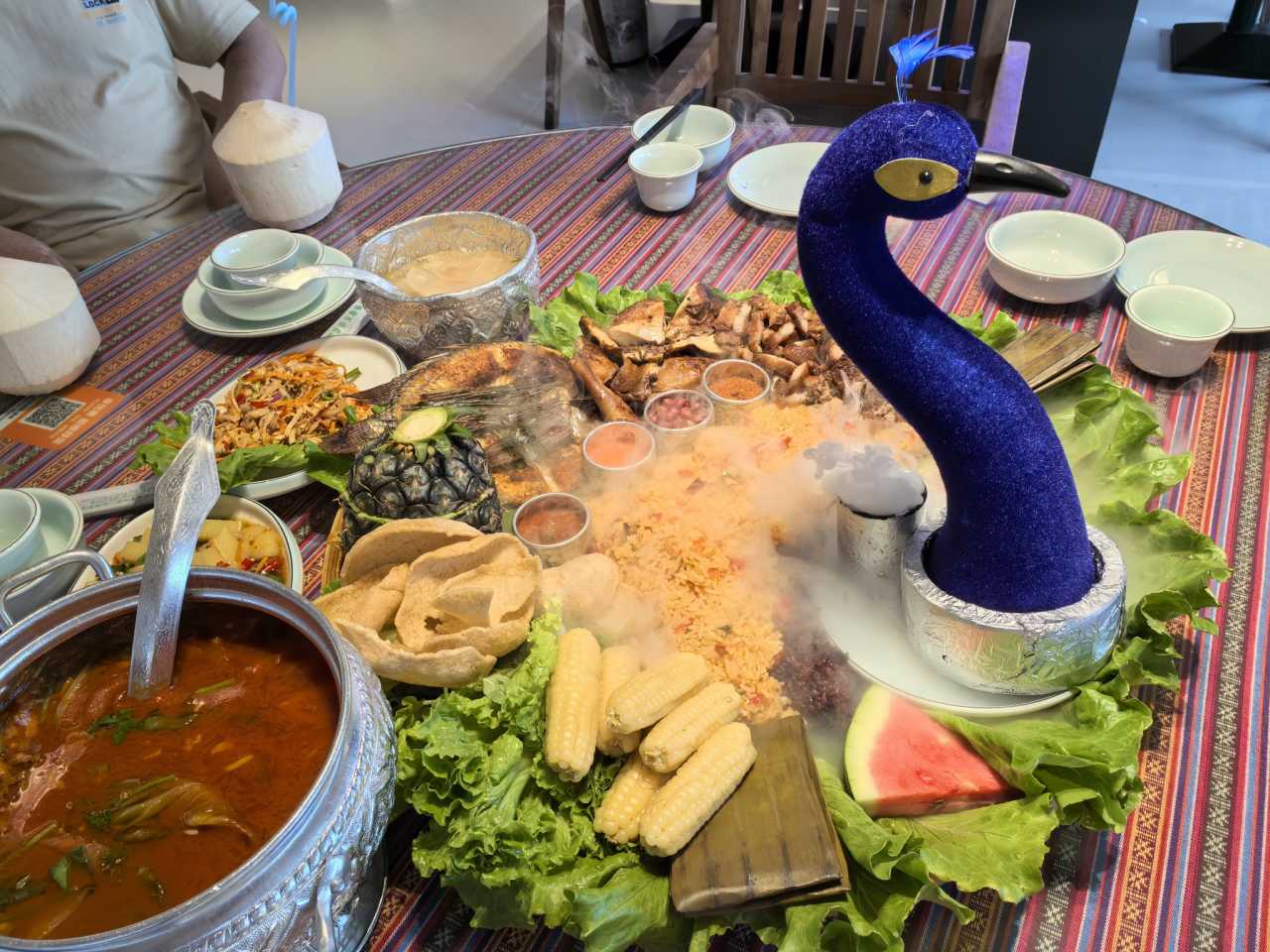
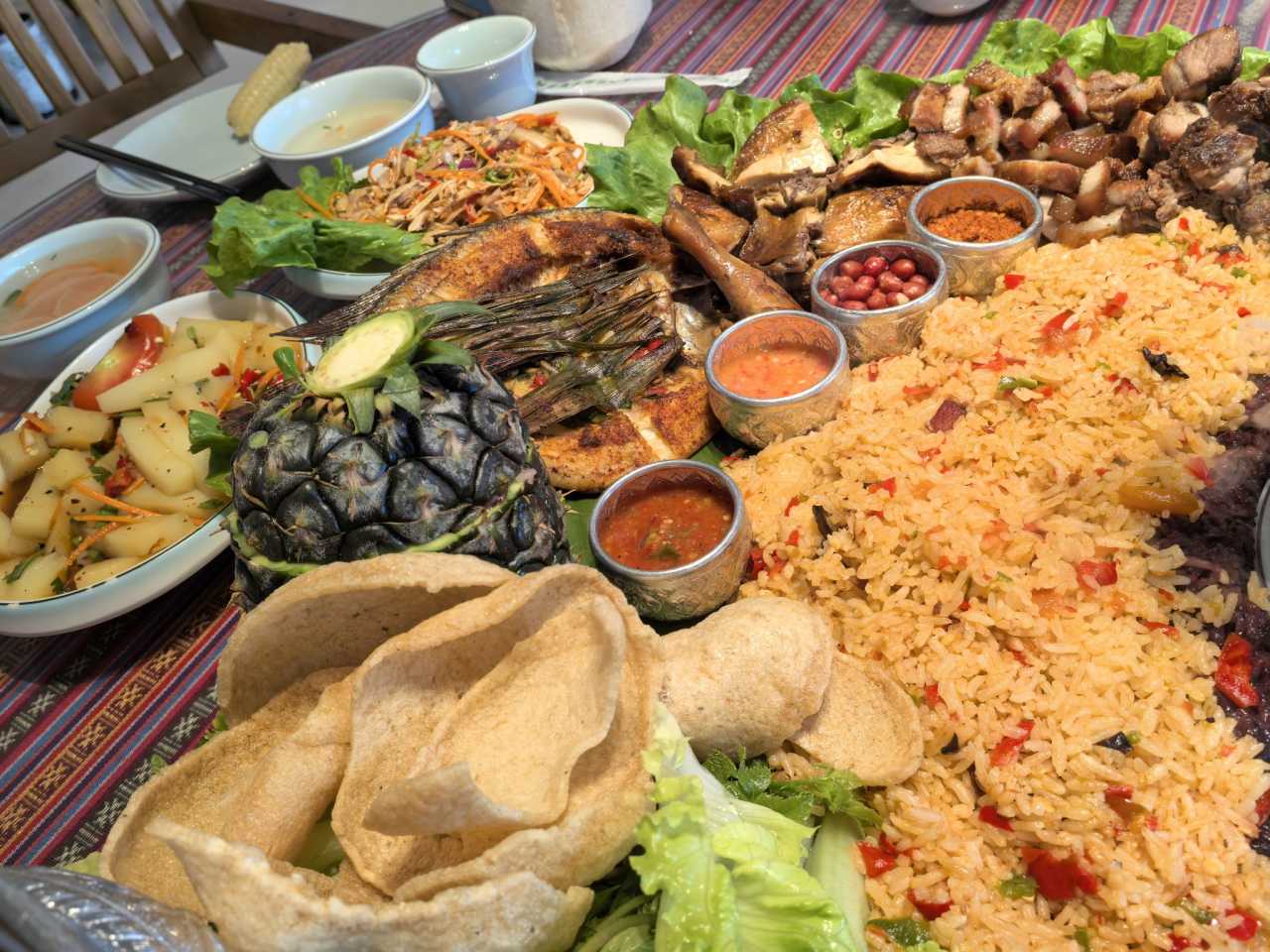
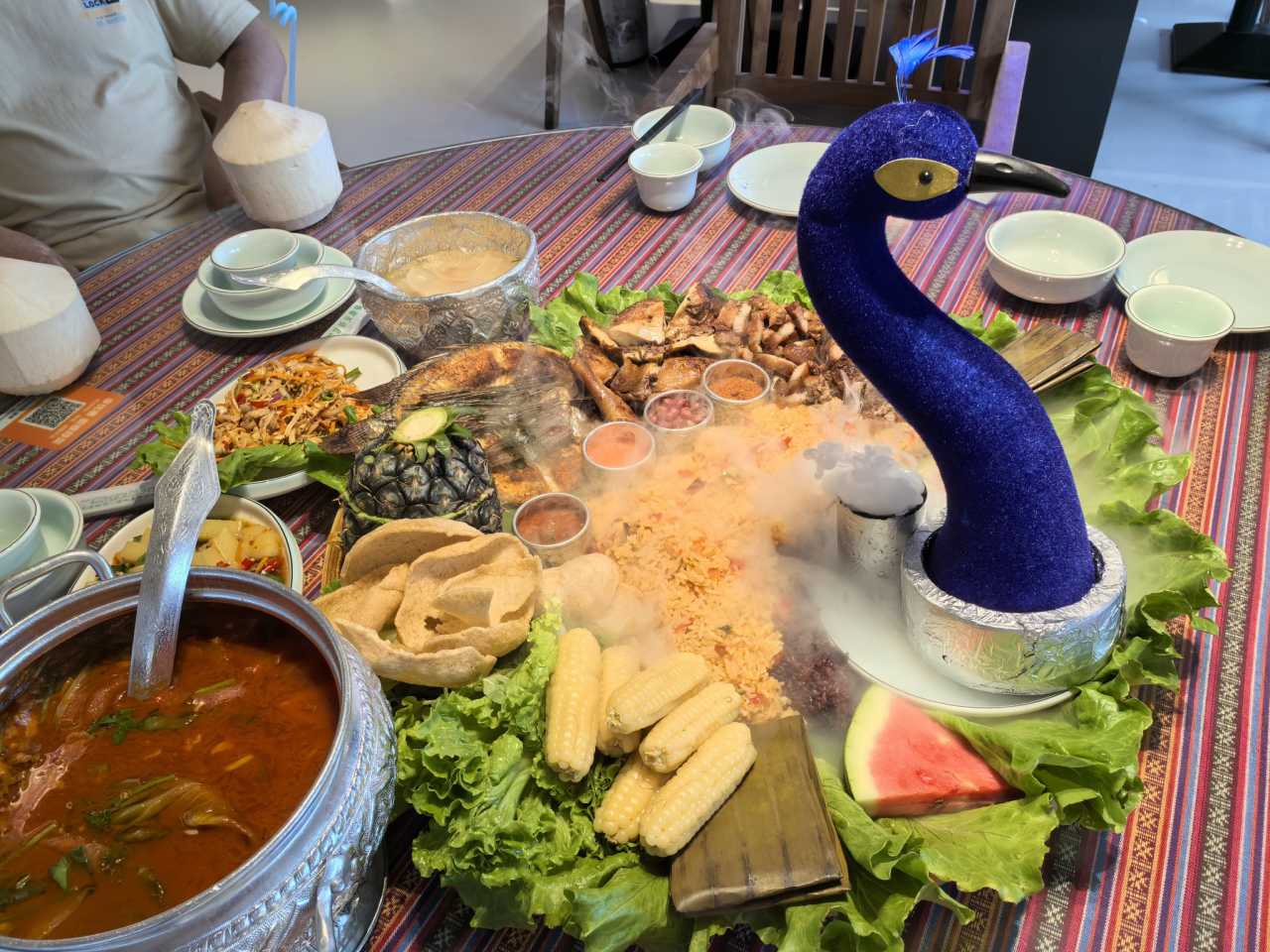
Our first proper meal was a peacock feast (孔雀宴). The smoky aroma of grilled meat mixed with the sour and spicy kick of various dipping sauces exploded on our tongues. The rice noodles were a bit too spicy and salty for us; we barely touched them. But through the restaurant's floor-to-ceiling windows, we watched the Lancang River (Mekong) flow silently in the rain—murky water with an undeniable sense of power.
When the rain stopped, we decided to visit Manzhang Village. This decision was largely inspired by a TV drama called "Borderland Tales" (边水往事)—Daban and Uncle Cai's home were both there.
Manzhang Village lay fresh in the aftermath of the rain. The plants and trees were polished bright by the rainwater, every leaf looking glazed. Growing up in the north, I couldn't resist reaching out to touch the tropical plants whose names I didn't know. Mangoes and jackfruit hung heavy on the branches. It was my first time seeing jackfruit growing directly from the tree trunk.
Every household in the village had a small stall out front, selling fruits and local snacks. A thing called glutinous rice cake (糯米饼) slowly puffed up over charcoal fires—five yuan for a big piece. We were too full from lunch to try any, and I still regret it a little.
We reached Daban. Uncle Cai's house was cordoned off with barriers. A young woman at the nearby water bar said the house had become unsafe. We could only peer in from the entrance, imagining the scenes from the drama. Rubber trees oozed white sap, and chickens were kept in the air—each with a string tied to its leg, looking from a distance like large birds.
In the evening, we stopped at a barbecue joint. A photo of the owner's granddaughter with actor Guo Qilin hung by the door. A whole roasted chicken arrived at the table—crispy on the outside, tender inside, and so fragrant with the dry rub that we forgot to take a picture. The grilled enoki mushrooms were good too, but the grilled fish had a muddy aftertaste.
On the way back to the city, dragon fruit fields stretched on endlessly. It was my first time seeing a whole dragon fruit plant—those thorny stems hung with purple-red fruits looked like something from another planet.
Day Two: The Dai King's Dream at Manting Park
Breakfast was at the hotel's rooftop restaurant, where I tried rice noodles (米干) for the first time. Thin sheets of rice flour, boiled until smooth and slippery—the texture reminded me of northern cold noodles but finer and more delicate.
Manting Park has over 1,300 years of history—it was the royal garden of the Dai kings. The park was filled with golden palaces, white pagodas, and the Release-Life Lake, all exuding the aura of the Dai royal court. Our daughter got a full makeover, dressed in traditional Dai clothing, and looked like a little Dai girl come to life. The photographer led us around, snapping pictures as we explored. One moment it would rain, the next the sun would come out—the weather changed faster than you could turn a page.
With a Manting Park ticket, you can enter the General Buddha Temple (总佛寺) directly. Remember the dress code: no bare shoulders, no shorts. Inside, the temple houses a rare bamboo-woven Buddha statue and a bodhi tree gifted by Sri Lanka—reportedly the third generation from the tree under which the Buddha attained enlightenment.
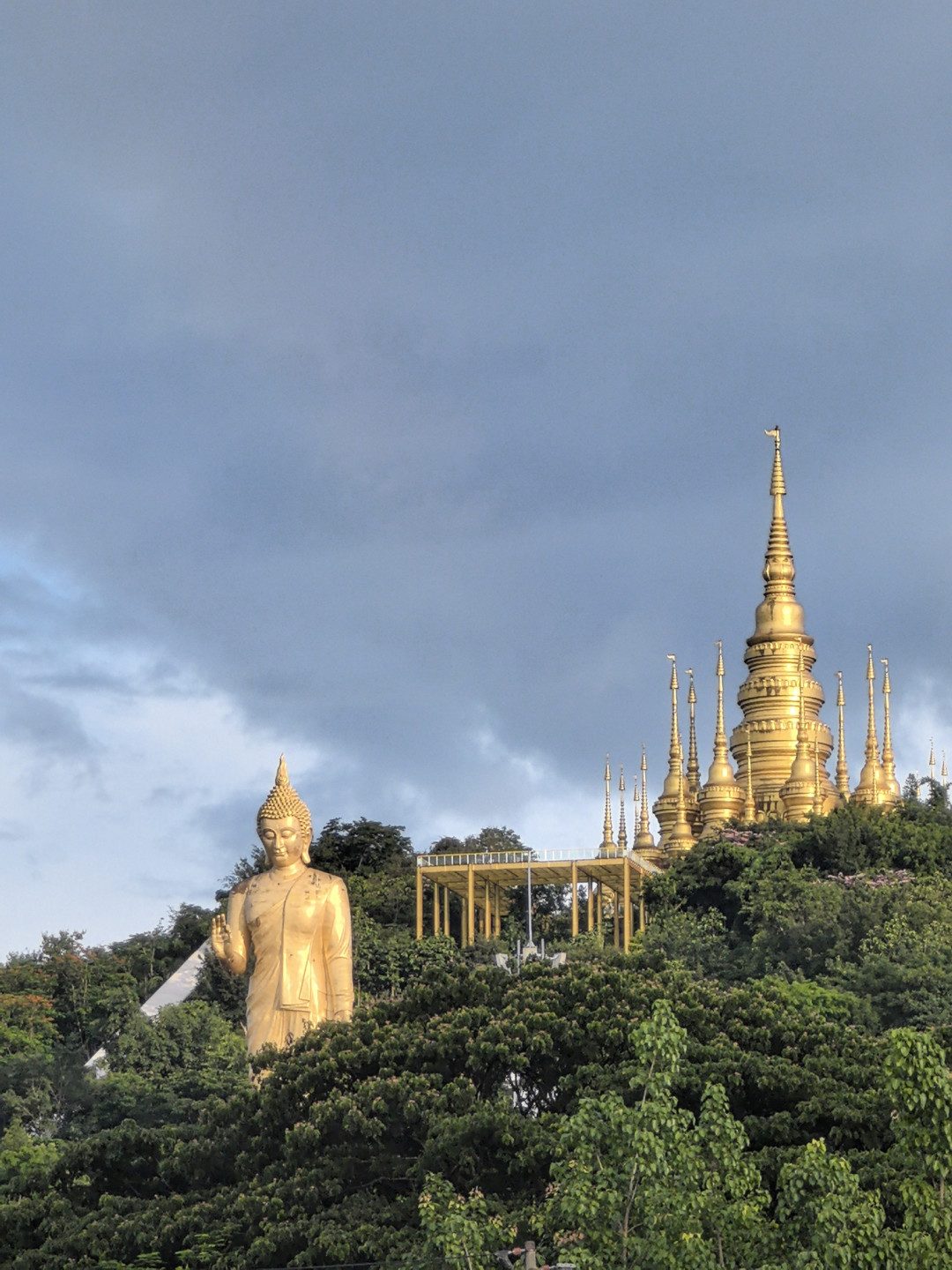
In the afternoon, we went back to the hotel for a long nap. When we woke up, the rain had cleared, and the sky was bright. Nuo's dad and I took the hotel's free electric scooter for a ride with Nuo Bao. From a distance, we spotted the Menghuo Great Buddha (勐泐大佛). The last ray of sunset hit the pagoda, turning it a brilliant gold—a sight of universal compassion.
Passing by a fruit market, we bought big green mangoes and pineapples. They were so sweet it made us wonder if everything we'd eaten before was fake fruit.
Day Three: A Fantastical Journey at the Xishuangbanna Tropical Botanical Garden
Today we moved to the Rainforest Villa. A standalone two-bedroom unit with a courtyard and a small pond, and a view of the mountains from the balcony. The setting was so beautiful it made you want to stay forever.
On the way to the Xishuangbanna Tropical Botanical Garden (中科院植物园), we took a wrong exit and drove an extra 70 kilometers. But the highway was lined with tropical trees, and flashes of pink and red flowers kept appearing, so it wasn't all bad.

We hired a young Dai girl as our guide. She told us that some trees grow their fruit directly on the trunk to make it easier for small animals to reach. Victoria water lily leaves can support up to 80 kilograms, and the South American variety can grow to two or three meters across. She also taught us the difference between lotus and water lily: lotus stands above the water; water lily lies on it.
Datura is poisonous but can be used to extract painkillers. The dancing plant (跳舞草) sways its leaves when there's sound nearby. Carnivorous plants sat in glass cases, their "mouths" open, waiting for prey to wander in. A large tree had air plants growing on it, but they didn't take nutrients from the tree—they were just borrowing a place to live.
The "firecracker flower" (鞭炮花), whose scientific name is Heliconia rostrata, is unique to Xishuangbanna. I stood in front of it for a long time. Those little red buds looked like strings of firecrackers—festive and utterly distinctive.
Day Four: Tracing My Father-in-Law's Youth
This day's itinerary was what my father-in-law had been looking forward to most.
At sixteen, he came to Xishuangbanna as a sent-down youth from Beijing and spent seven years in Manxing Village, Menghai County. Fifty years later, he returned with his wife, son, and grandchildren to walk the same roads.
The concrete road to Manman Reservoir, he told us, was built by hand using flatbed carts. From Menghai County to Manxing Village, a drive that now takes us less than an hour, took them a whole day and night on foot. Standing on the dam, he said, "Look at the reservoir we built!" There was pride in his voice, but also the weight of years.
The reservoir water was crystal clear and now serves as the drinking water source for nearby villages. In the jungle beside it, we found some mushrooms. Not recognizing them, we didn't dare touch them. One thing we'd learned these past few days: in Yunnan, don't touch any plant or animal you see—it might be poisonous.
On the way back, we visited several temples. The dome of Manlei Pagoda (曼磊佛塔) was covered with Buddha statues—a thousand Buddhas, so magnificent it left you speechless. Jingzhen Octagonal Pavilion (景真八角亭), built in 1701, was said to be modeled after the Buddha's golden silk hat. The murals at Manduan Temple (曼短佛寺) were annotated in Dai script, which we couldn't read, but the weight of history didn't need words to be felt.
The biggest surprise was Manhe Grand Buddha Temple (曼贺大佛寺). It wasn't on our original plan, but we stumbled upon it because the grilled chicken place had closed. Inside was Xishuangbanna's longest reclining Buddha statue, lying on its side with eyes open, symbolizing the Buddha's nirvana. Nuo's grandpa skillfully scooped up a ladle of water from the "First Sacred Spring" (第一圣泉)—the water was so clear you could see the bottom.
Day Five: Rainforest Adventure on Jinuo Mountain
Today we split up. My in-laws went to meet their old army comrades, while the three of us headed for a rainforest hike on Jinuo Mountain.
On the way, we passed through a village that was holding a "赶摆" (local market). Stalls lined both sides of the road, crowded with people, and steaming snacks sent up plumes of white smoke. I really wanted to stop and wander around, but we were short on time, so we drove past reluctantly.
A Jinuo woman led us down the trail, through a single-tree forest, across streams. There was a swing in the rainforest that was supposed to be refreshing, but I could only watch others enjoy it. Three-colored stones, twisted vines shaped like hemp ropes, models of bird traps—every item showed the ingenuity of the local people.
The most thrilling part was climbing the giant banyan tree. Our daughter scrambled up like a monkey, and I could only try to share in her joy from below. The stream water would be crystal clear one moment and turn muddy red the next—nature is just that capricious.
After four kilometers of hiking, I was soaked through and completely outmatched by our guide's stamina. But when we reached the rainforest restaurant, a bowl of pumpkin soup revived me completely. Simple ingredients, natural flavors—it was the best meal we'd had in days.
By the time we returned, the market was over. We bought seven dragon fruits from a roadside stall for just ten yuan. Mushrooms with red caps and pink stems were laid out on display, but I didn't dare try them.
Dinner was a wild mushroom hotpot (非遗野生菌火锅), a dish recognized as intangible cultural heritage. The server introduced a long list of mushroom names, none of which I remembered. The broth was made with black chicken, and we had to wait half an hour before we were allowed to eat—just in case, they said, so we could be taken to the hospital in time. The atmosphere suddenly turned tense. My daughter and I exchanged a glance, as if to say: "Eat up—we didn't come all this way for nothing."
The mushrooms were incredibly flavorful. No little animals came to talk to me afterward, so we passed the test safely.
Epilogue: The Little Things That Warm the Heart
On our last night in Xishuangbanna, the tire pressure warning light came on. Two guys from a nearby auto repair shop came out in the rain to check the pressure and pump air, refusing to take any money. Later, the warning light came on again, and a guy from Tuhu (a tire shop) had already turned off the lights and was about to close, but he ran back to troubleshoot when he saw us.
"It's fine," they said. "Drive safely."
In this unfamiliar place, the kindness of strangers was more unforgettable than any scenery.
On the way back, we made a brief stop in Kunming, visiting the Yunnan Military Academy (陆军讲武堂) and Green Lake Park (翠湖公园). But my heart was still in that tropical rainforest.
Final Thoughts
Seven days of travel, from Xishuangbanna to Kunming, from rainforests to temples, from peacock feasts to wild mushroom hotpot. We saw Victoria water lily leaves that can bear 80 kilograms, watched dancing plants sway, touched the sap oozing from rubber trees, and stood by Manman Reservoir listening to my father-in-law tell stories from fifty years ago.
But what I'll remember most are the unplanned moments: a snail on a wall after the rain, the impossibly sweet pineapple from a roadside stand, the evening breeze on the back of an electric scooter along the Lancang River, and the strangers who offered a helping hand without expecting anything in return.
Xishuangbanna is not a place to check off a list. It's a place that makes you want to become a plant—to spread your leaves in the rain, to photosynthesize in the sun, to sway gently in the wind, and to grow slowly.
If I ever get the chance, I'll come back. Not to take photos or tick boxes. Just to be here, quietly, as a plant.
You should also read:
Want to See the World with You: Next Stop, Yunnan [Who Says You Don’t Need a Guide for Domestic Travel? Essential Tips to Avoid Scams in Yunnan]
Want to See the World with You: Next Stop, Yunnan [Who Says You Don’t Need a Guide for Domestic Travel? Essential Tips to Avoid Scams in Yunnan] A Note Before We Begin: Why I’m Writing This Guide I’ve been lurking on Mafengwo for what feels…
Continue reading...
Winter Lugu Lake: When an "Empty" Landscape Becomes My Deepest Longing
Winter Lugu Lake: When an "Empty" Landscape Becomes My Deepest Longing Departure: Ninglang Yi Autonomous County Travel Date: December 30, 2017 · 5 Days Travelers: Couple When I was a child watching Journey to the West, the scene where Tang Sanzang and his disciples passed…
Continue reading...
Puzhehei & Dali: A Dream I Never Want to Wake From, Wandering Through Time, Making Beauty Eternal (Spring-Summer 6-Day Photography Guide)
Puzhehei & Dali: A Dream I Never Want to Wake From, Wandering Through Time, Making Beauty Eternal (Spring-Summer 6-Day Photography Guide) Living in a concrete and steel jungle, looking up at a gray sky, looking down at an endless phone screen. For someone like me…
Continue reading...