Winter Lugu Lake: When an "Empty" Landscape Becomes My Deepest Longing
Winter Lugu Lake: When an "Empty" Landscape Becomes My Deepest Longing
Departure: Ninglang Yi Autonomous County
Travel Date: December 30, 2017 · 5 Days
Travelers: Couple
Introduction: A Childhood Fantasy About the "Kingdom of Women"
When I was a child watching Journey to the West, the scene where Tang Sanzang and his disciples passed through the Women's Kingdom sparked endless imagination about that land "covered in flowers." In my mind, it was a mysterious realm inhabited only by women—of course, as I grew older, I realized reality is far more fascinating than myth.
Lugu Lake, home to the Mosuo people, is the only place in China that still preserves a matrilineal social structure. Here, "women are revered, but men are not inferior," practicing a "walking marriage" system where men don't marry and women don't wed. This unique approach to romance has been romanticized countless times, and I had long yearned to see this land with my own eyes.
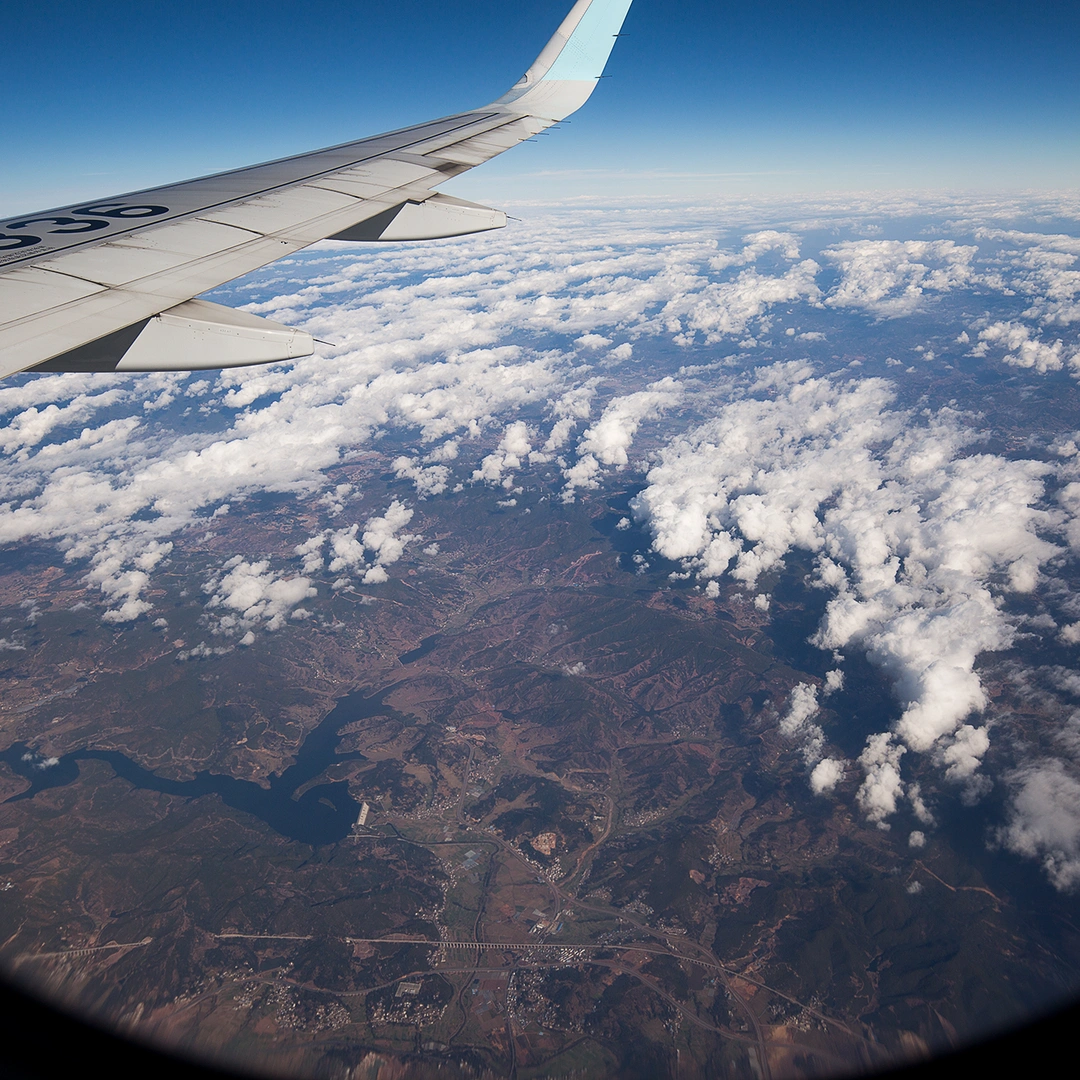
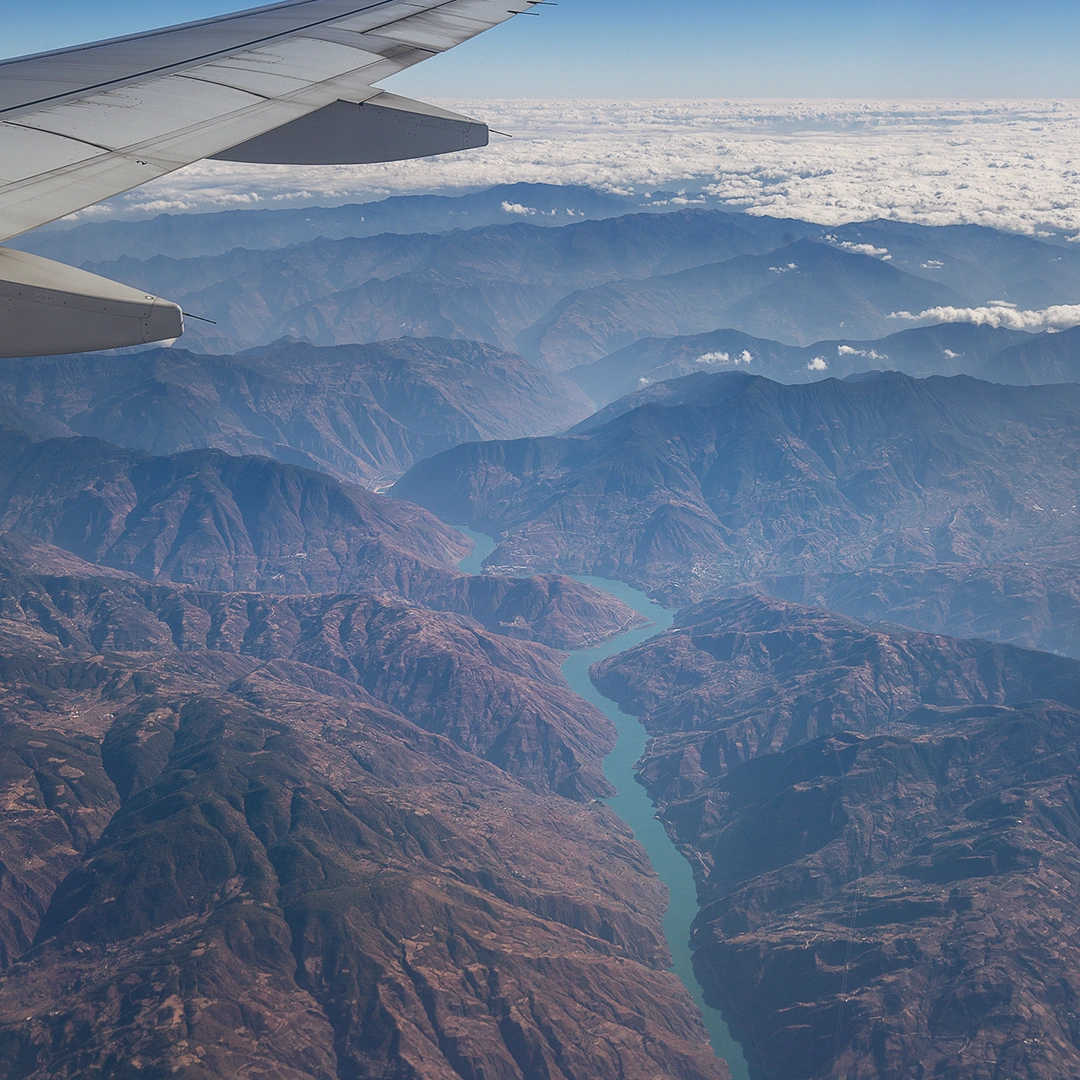
As the plane pierced through thick clouds, the sky over Lijiang suddenly cleared, and cotton-candy clouds hung low in the air—my heartbeat quickened. Gazing down at the rivers and red earth below, I found myself unconsciously humming "The Great River Flows East." Perhaps that's the magic of travel—it makes you feel unexpectedly bold and free.
Stop One: A Self-Challenge as the "King of Mountain Roads"
Getting There: The Winding Path from Hangzhou to Lugu Lake

The most convenient way from Hangzhou to Lugu Lake is to fly to Chengdu or Kunming first, then transfer to Ninglang, and finally take a bus to the lakeside. But as a seasoned independent traveler, I didn't hesitate to rent a car for a self-driving trip—this was my first journey with my wife Xiaonuan since our wedding, and our first road trip together.
However, the idyllic vision of cruising along, stopping for photos, was completely shattered by reality. From Lijiang Airport to Lugu Lake, it took nearly six and a half hours of winding mountain roads, all driven by me alone. While mountain roads had always been my favorite during past trips with my friend Taozi, this time I would gladly give up the title "King of Mountain Roads."
Surprises and Challenges Along the Way
The first worthy photo spot was just past the Eighteen Bends Observation Deck. The deck itself charges a 10 yuan entrance fee, but this free spot offers a better view, with the winding road stretching out below.
We encountered several landslides along the way, with the worst one nearly cutting off the road entirely. Fortunately, two workers were clearing the rubble, allowing us to pass safely. I heard that before the mountain roads were improved, the trip from Lijiang to Lugu Lake required a nine-hour bus ride—thank modern transportation for sparing me that ordeal.
Practical tip: If you're not obsessed with photography, drive straight to Lugu Lake before stopping. Otherwise, the scenery along the way will eat up plenty of your time—don't ask me how I know.
Around 4 PM, the moon had already climbed over the mountaintop, with a wind turbine motor directly below, creating a surreal scene. Sunset here comes two hours later than in Hangzhou, so time felt unusually abundant.
Starving, we found a Sichuan-style roadside restaurant. A serving of twice-cooked pork and stir-fried cauliflower for two, plus rice, came to 70 yuan. A bit pricey, but understandable given the scarcity of supplies in the mountains.
Stop Two: A Promise Kept a Year Late
How It Started: A Year-Long "Nagging" Battle on Social Media
This trip traces back to this time last year. I was traveling solo in Dali for photography, staying at a guesthouse recommended by a friend, where I met another key figure in this journey—Sister Rui. She runs her own guesthouse and restaurant by Lugu Lake. We hit it off immediately, bonding over our shared hometown and her past as a photographer.
She left a day before I did, and we only added each other on WeChat without a proper goodbye. Thus began a year-long "nagging" battle—she kept commenting on my posts, urging me to visit Lugu Lake, but my photography work and wedding preparations kept me from going.
Finally, in December, after tying the knot, I brought my wife Xiaonuan to keep that promise.
Arrival: Welcomed by the Most Beautiful Sunset
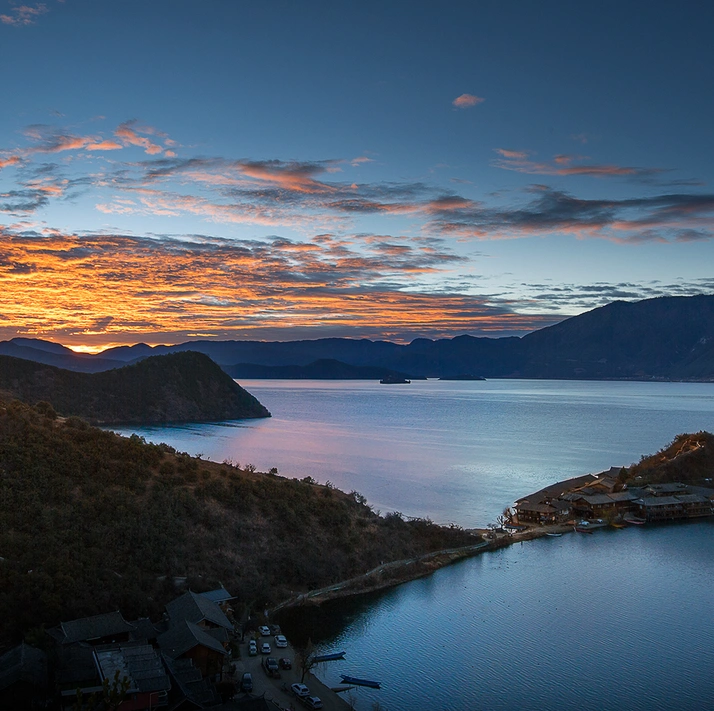
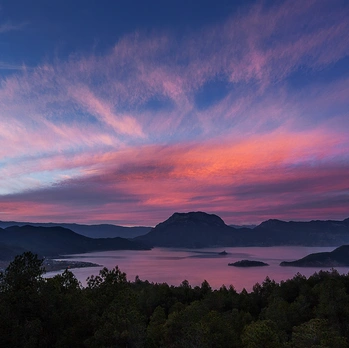
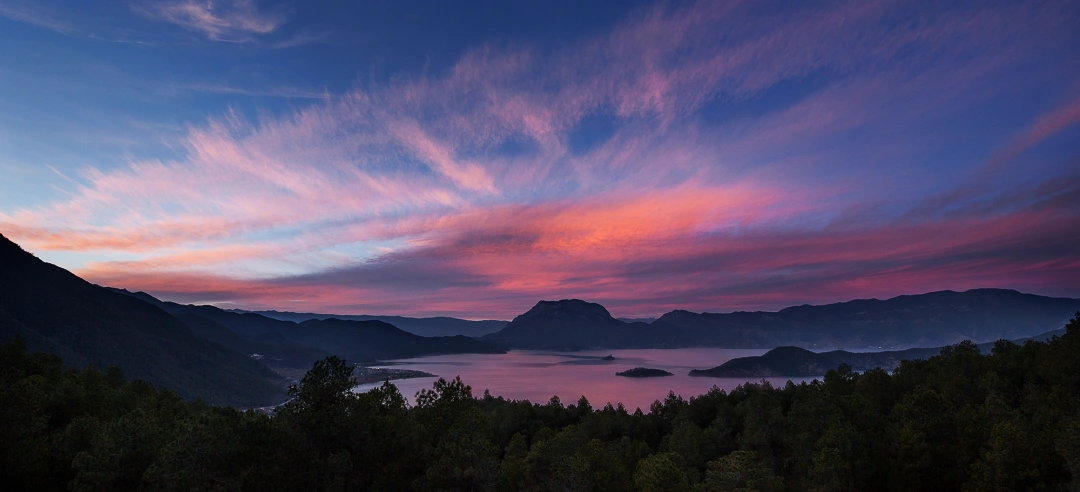
In the month leading up to the trip, we were so excited we couldn't stop talking about how "we've waited a whole year to finally come." And Lugu Lake greeted us with its most stunning face—as we entered the scenic area at 6:30 PM, the sunset was perfect, the sky ablaze with red, clouds stretched into wispy strands by the wind. I pulled over to take photos, and several cars behind us also stopped to admire the view.
Parking by Lige Peninsula's lakeside was tricky, with the already narrow road occupied by a row of parking spaces. Though it wasn't peak season, the journey to the lake was still arduous. We parked where Sister Rui had directed, then took her guesthouse's small wooden boat across the lake. From a distance, we saw Sister Rui and her husband Brother Laoge waiting on their small dock. She said I was the first friend she'd come out to welcome in six months—at that moment, a wave of pride washed over me!
Stop Three: A Taste of Lugu Lake
First Food Encounters
As soon as we arrived, Sister Rui called us to sit down and eat immediately! Though we were starving, my photographer's instinct kicked in—I had to take photos first!
Chopped pepper carp: I expected the carp to be tough and dry, but it was incredibly tender. Despite looking spicy, it was barely hot at all—the chopped peppers just made the fish more fragrant.
Twice-cooked pork: A common dish here, paired with cabbage. The rich oiliness of the fatty pork combined perfectly with the refreshing crunch of the cabbage.
Red rice: Sister Rui's own red rice from the local highlands. Lugu Lake is the only place in the world where red rice is grown at altitudes above 2,800 meters. Its glutamic acid and amino acid content is much higher than regular rice. Sister Rui said other farmers' fields yield nearly 1,000 kilograms per mu (about 0.067 hectares), while hers only produce 500 kilograms. Red rice is a coarse grain, but its texture isn't rough at all—light and fluffy. I ate three bowls.
While eating with us, Sister Rui grabbed a can of Jianlibao (a Chinese soft drink) and asked if I wanted one—needless to say, I said yes! As kindred spirits, we clearly share similar tastes.
The Best Room, the Best Night
Sister Rui reserved her best standalone villa room for us. It was too dark to photograph that night, but I had just bought my wife a new laptop for photo editing, so we brought it along to edit and post pictures daily. After a quick tidy-up, we got to work—our dedication earned a flood of likes on social media.
Stop Four: Sunrise and the Goddess Mountain
Morning Surprises
Sunrise here comes late, with the sky only beginning to brighten around 7:30 AM. The night before, I'd asked about the best spot on the peninsula for sunrise photos—a small trail behind the guesthouse leading to the island's highest point. That was today's "battlefield."
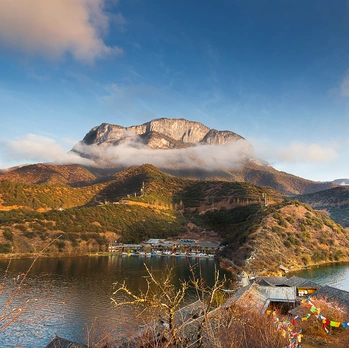
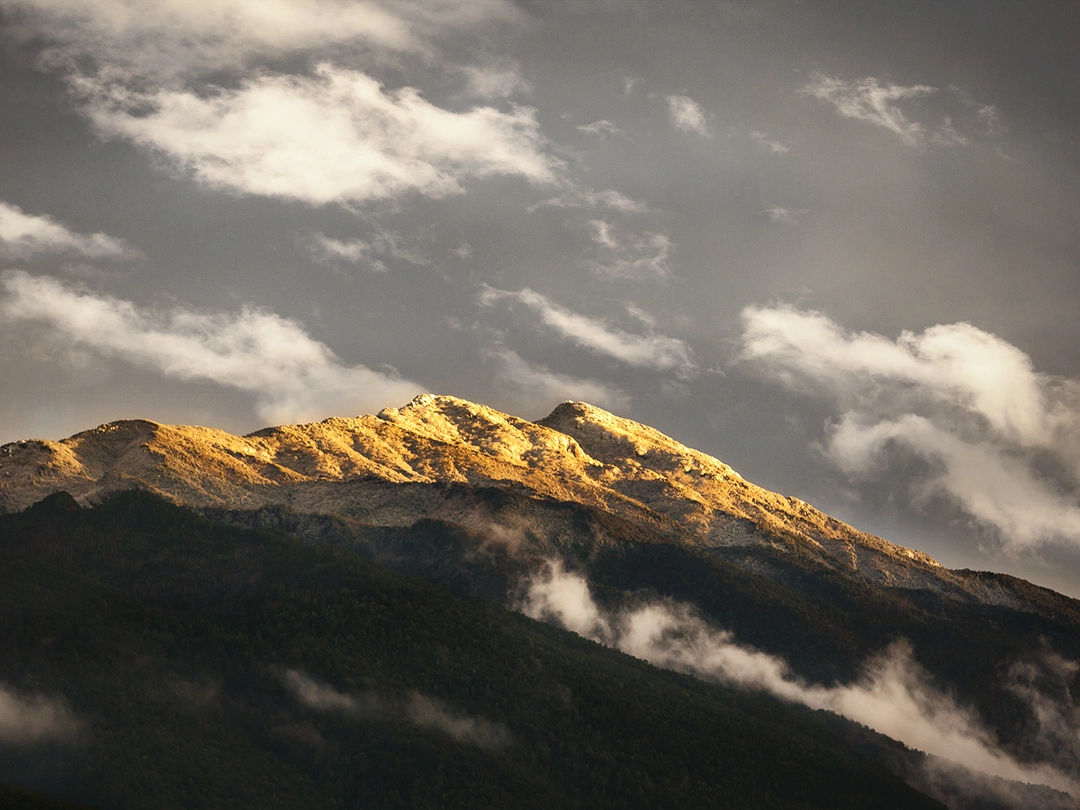
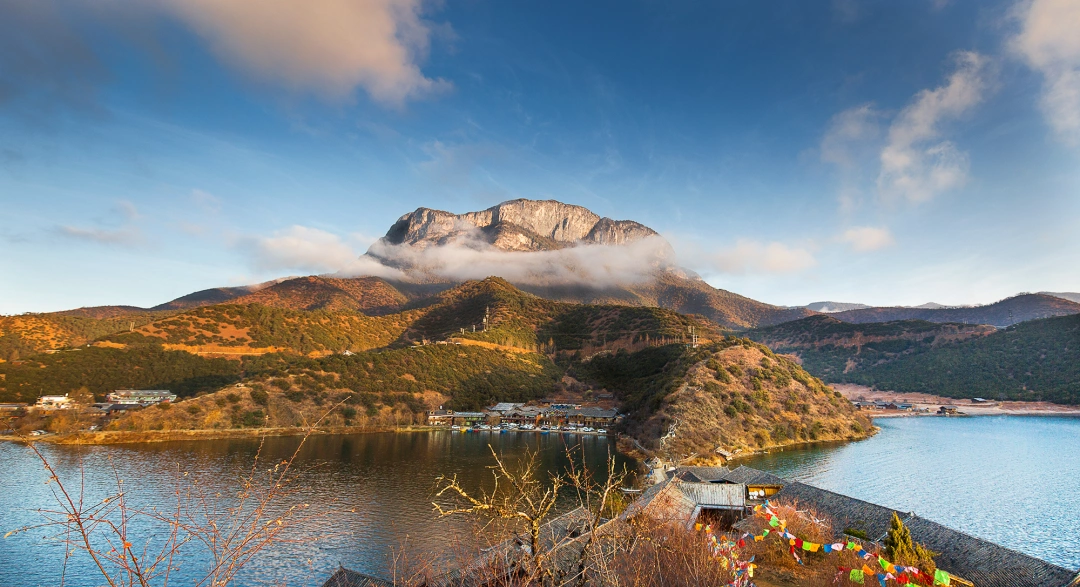
I have to admit, climbing that narrow mountain path alone before dawn was a bit unsettling. At the top, the sun hadn't yet appeared, but the clouds were already tinged with red. This wasn't the sunrise scene I had in mind, though. Then, an accidental glance behind me revealed Mount Gemu (Goddess Mountain) shrouded in mist, with sunlight just hitting the peak, wrapping it in a golden coat.
I abandoned the eastern sunrise and aimed my lens at the Goddess Mountain! The sun gradually illuminated the entire peak—time-lapse photography captured this process beautifully.
At the summit, there were Mani stones (prayer stone piles) where locals come to make offerings. I thought of Taozi, who loves Mani stones—last year in Qinghai, he'd get excited every time he saw one. But no matter, we're heading back to Qinghai for the Chinese New Year to shoot more photos!
Morning at the Guesthouse
After shooting the sunrise, I returned to the guesthouse at 9 AM, just in time for a hot breakfast. The guesthouse serves unpolluted comb honey daily, scooped directly with a small spoon—incredibly sweet. The rice noodles were the best, with just a touch of chili sauce, instantly filling me with energy.
Back in the room, I finally had a chance to admire Lugu Lake's water—so clear it's unbelievable! Sister Rui said the clearest spots have visibility up to 10 meters. Truly living up to its reputation.
Stop Five: Scouting the Lake and Photography Spots
Sister Rui often goes shooting with photography enthusiasts and knows every spot around here that yields great shots. She said today she'd take me around the lake to get a sense of the best locations.
Before leaving, she had to handle something at her restaurant. While she was busy, I took some photos of Xiaonuan. On the wall hung a stunning shot Sister Rui and a friend took of the starry sky in Yongning Township. Unfortunately, we had a full moon this time, so the Milky Way—I'll spare you for now!
One wall was covered in Polaroid photos, including one of Sister Rui with singers Teacher Wang and Teacher Cai—both with stories to tell. The restaurant had many succulents, soaking up the strong sunlight all day—no wonder they were so robust. As I photographed these little plants, Sister Rui teased, "Oh, you photographers—you never shoot the big stuff, just these little things."
The second floor of the restaurant had better lighting and a quieter atmosphere, perfect for portrait photography. The window seat on the first floor was also lovely. If we weren't about to head out scouting, I'd have ordered a drink and sat there all morning.
For tonight's New Year's Eve celebration, Sister Rui personally wrote on the small blackboard—she had to, since she asked everyone who had decent handwriting, and they all claimed theirs looked like chicken scratch.
Sister Rui ordered us two cups of hand-ground coffee—light and smooth. Xiaonuan usually can't drink coffee due to her sensitive stomach, but this time she had no issues.
First Stop Around the Lake: Daluoshui Village
This small dock was fantastic! I let both ladies take a turn posing there. It seemed like a great spot for slow-shutter photography—I'll come back for sunrise another day.
A sudden phone call pulled Sister Rui back to the guesthouse to pick up friends, so we stayed behind to shoot freely. The withered trees by the lakeside are an eternal subject. If we'd come in early December, when the leaves are golden, it would have been breathtaking. Sister Rui later told me that Lugu Lake has cherry blossoms, pear blossoms, and peach blossoms in spring, double rainbows in summer, yellow leaves and cosmos flowers in autumn—and we'd come during the season with the least to see. I was almost in tears!
Quite a few birds winter here, mostly red-billed gulls and a type of pheasant (I forget the exact name, but its status as a Class II nationally protected animal sounds impressive).
The Grass Sea and the Walking Marriage Bridge
Leaving Daluoshui and heading toward Sichuan, we reached the Grass Sea and the Walking Marriage Bridge. The bridge was too crowded for my taste. Instead, the Mani stones by the roadside and an elderly man caught my interest. The old man seemed shy—after I shot for a while, he crossed the road and went home. Still, that weathered face was incredibly photogenic.
Some boatmen hadn't set out yet, offering boat rides to the reed beds in the middle of the lake. We were short on time, so we took a few quick shots and moved on.
On the road, I spotted a small fishing boat in the middle of the lake, with a birch forest in the background. I quickly asked Sister Rui to stop, raised my camera, and waited five minutes until the boatman finally stood up! That guy was really taking his time—holding a 70-200mm telephoto lens for five minutes without lowering it. He owes me some energy compensation!
Classic Spot: Lige Peninsula Observation Deck
After the Walking Marriage Bridge, the route mostly left the lakeside and wound through villages. There were some good spots along the way, but the afternoon light made the lake surface too reflective, so I didn't stop. We drove straight to the most iconic spot—the Lige Peninsula Observation Deck, featured in every Lugu Lake travelogue. Facing south, it can capture both east and west views, but it's not ideal for sunrise or sunset.
Stop Six: New Year's Eve and Human Warmth
Back at "Time Story" (Sister Rui's restaurant), it was already 3 PM, and we were starving. This meal included the most delicious braised pork I've ever had—unassuming in appearance, but absolutely unbeatable in flavor. As for the secret recipe, I won't share it here.
These small boats set out every morning at sunrise, taking tourists to feed the gulls while watching the dawn.
Back at the guesthouse, the sunlight was perfect, filling the entire restaurant with warmth. Today, Sister Rui was sending her dog Niuniu off for mating—well, let's call it a "wedding." Saying goodbye to her "daughter" was bittersweet, and everyone took turns posing with Niuniu. It was quite a scene: a crowd gathered at the dock, lining up for photos. If Niuniu hadn't gotten impatient, this "meet-and-greet" might have lasted over half an hour! Niuniu looked utterly confused, as if she had no idea she was being sent into the "lion's den."
The Room in Sunlight
Back in the room—wow, it was a completely different sight from last night! With sunlight streaming in, the whole space felt transformed. We quickly tidied up, restoring the room to its just-cleaned state, and seized the chance to take photos.
Every room has large windows facing the lake. The bathroom was ridiculously spacious—almost bigger than the bedroom! My favorite spot was the desk in the study—sitting there editing photos, looking up occasionally at the lake outside, was pure bliss.
With such beautiful light, we had to take more photos. I had Xiaonuan change clothes and step onto the balcony for some stylish shots. The light, the colors—it was like a natural retouch, requiring almost no post-processing. Like a painting.
The Guesthouse's Stars
Another star of the guesthouse: the British Shorthair "Fatty." Six months ago, I'd seen Fatty's photo on Sister Rui's social media—he looked small then. I never imagined... he'd gotten this fat! Unlike Niuniu, Fatty isn't one to approach people willingly; you usually have to grab him to get him to stay on your lap. But I prefer cats, so searching for Fatty became a daily ritual.
Near the guesthouse's Mani stones, there was a wooden boat with colors perfect for photos. The sun was about to dip behind the mountaintop, and the backlighting for portrait shots in this setting was absolutely addictive.
The dock had already lost its sunlight, but the peninsula still basked in this gift.
New Year's Eve
From the entrance of Lige Peninsula, you can climb stairs directly to the observation deck. I wanted to catch some sunset shots while there was still light, but the sunset was too fast—by the time I climbed up, the colors had already faded, and the 15th-day moon hung in the sky.
Sister Rui insisted we take a cheesy photo holding sparklers—well, they were determined to spread some love on New Year's Eve!
This was my first New Year's Eve away from home, and it felt surprisingly great. The sour cabbage fish hotpot was fantastic! The restaurant's singer had traveled back specially for the night's performance.
After dinner, Sister Rui stayed to handle restaurant matters, while we returned to the guesthouse. On the way, we climbed the observation deck stairs again. A strong wind had picked up, making us sway. The hillside was pitch black with no lights, and when we reached the Mani stones, we were forced to turn back. The next morning, I realized the Mani stones were only a short distance from the observation deck. Life is like that sometimes—your dream is right ahead, but you just lack that bit of persistence.
The moonlight illuminated the Mani stones brightly, casting its glow across the entire lake.
Stop Seven: Hanfu and the Temple
Another Early Morning Start
Today's sunrise was decent, with more clouds than yesterday, but the mist on Goddess Mountain had vanished. A small boat glided beneath the cliff, tourists enjoying the magnificent dawn.
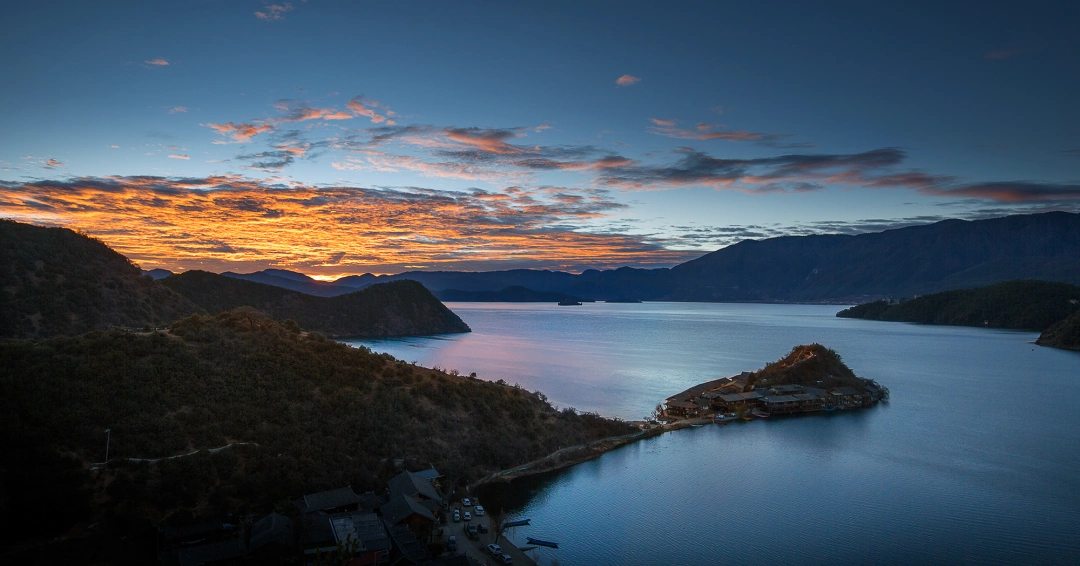
A withered tree stump on the mountain path—Sister Rui kept saying how cold it gets here in the morning. But after two days of sunrise shooting, I found the temperature tolerable. Despite forecasts of several degrees below zero, it felt warmer than Hangzhou's mornings.
Back at the restaurant, Xiaonuan was already eating with gusto. Just as I sat down, Fatty slipped in through the door and circled around my chair, begging for food. When a cat sits on the floor, staring at you with those big eyes, I have no resistance—I quickly offered up the egg pancake and rice noodles from my bowl.
After mooching off me, he went to pester the staff. Sister Rui says Fatty is aloof, but I don't see any dignity in him at all...
The morning boat tour set off again, drawing all the gulls. The guesthouse's dock always has gulls and those pheasants gathering, because the guesthouse feeds them every year—they've made it a regular feeding ground.
Hanfu Photography
Today's mission: take some hanfu (traditional Chinese clothing) photos. I've shot hanfu for countless girls, but never for Xiaonuan. After she changed and styled, Sister Rui led us to a spot we'd scouted yesterday.
A little dog followed us along the way. When I crouched down to pet it, it immediately lay on its back—but before that, it left a perfect little paw print on Xiaonuan's shoe. We never wiped it off, all the way back to Hangzhou.
The withered grass by the lake paired perfectly with the red hanfu. A light breeze sent fluffy seeds from the dry grass flying everywhere. Twirl, twirl, twirl—Sister Rui watched and exclaimed, "Oh my, I could never pull off a pose like that! I'm more suited to a tough, martial arts style."
Bringing this umbrella along was quite an effort. I'd seen hanfu photos taken at the foot of Dali's Cangshan Mountain, with blue skies and yellow grass—that style completely captivated me, so I couldn't miss this opportunity!
Yongning Township: Food and Temple
At noon, Sister Rui was busy, so she asked Qiuxi from the restaurant to take us to Yongning Township for wild mushroom chicken hotpot. Lugu Lake's wild mushrooms are famous—diverse varieties and pollution-free.
When the whole pot of chicken was brought out, I was stunned—why was it so huge! So much so that I only realized after finishing that I'd forgotten to photograph it! As for the taste, one word: umami!
After the meal, Qiuxi said she'd be our guide for the afternoon. Keeping it local, we headed to nearby Zamei Temple.
The temple belongs to the Gelug school (Yellow Hat sect) of Tibetan Buddhism. There are two types of temples here: government-supported ones and local ones. The temple's highlight is its murals.
As you enter the side hall, you're greeted by exquisite wall paintings—stunning in both color and line. Photography isn't allowed inside, so I could only capture the scene from the doorway. The walls bear many repair marks, reportedly from a major earthquake in the 1970s that cracked them all, taking cultural relic experts a long time to restore. Additionally, the murals survived because the temple was once used as a warehouse during a certain historical period, sparing it from destruction.
The main hall features paintings made entirely with pine oil, their colors breathtakingly vibrant. Visitors can light pine oil lamps for free, and Qiuxi joined us in doing so. I, of course, prayed for a smooth year ahead in 2018. No matter the occasion, candlelight in a temple always brings a sense of peace and warmth.
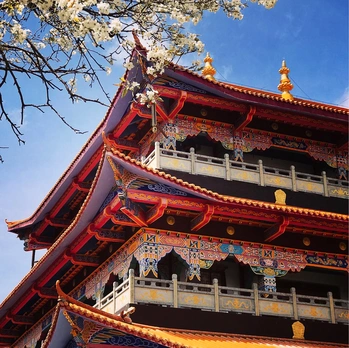
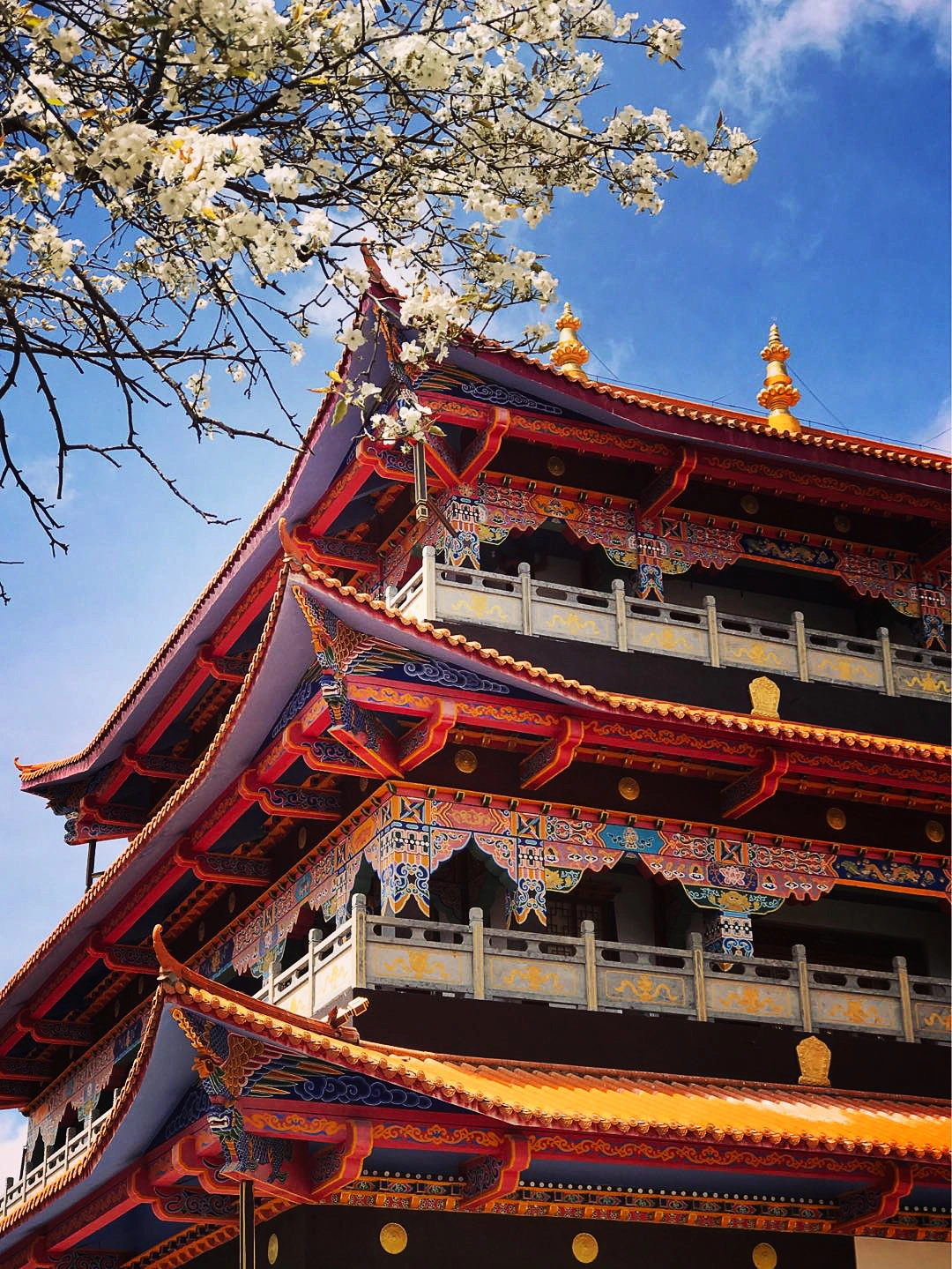
Behind the main hall, a larger hall was under construction, with some new small stupas. There was a pear tree that, when in full bloom in spring, makes you feel like you're in Kyoto. But now, those small stupas block the best shooting angle—such a shame. Qiuxi showed me photos she took in spring of previous years—absolutely gorgeous! I could only capture a single temple eaves, but even so, the image was mesmerizing.
Clouds gradually thickened, but that's exactly what I wanted. Blue skies and white clouds, paired with the temple's white walls and red-and-yellow eaves—a perfect scene frozen in my camera. Even stripped of its color, it still evokes awe.
Back at the main hall, a flock of pigeons took flight just then—truly, timing is everything! Pigeons against a temple backdrop always feel sacred.
Scenery on the Return
We started back to the guesthouse, stopping at a spot I'd scouted earlier. No matter the angle, Goddess Mountain offers a different perspective. I finally found a puddle, but it wasn't large enough to reflect the entire peak—you'll have to make do.
Many birds dotted the lake, but they were distant and skittish. Qiuxi said we could try feeding them leftover bing (flatbread) from lunch, to see if they'd swoop in like the gulls. Judging by her stiff throwing motion and Xiaonuan's goofy stance nearby, you can guess how that went.
They returned to the car, while I approached the shore alone to identify the birds. Zooming in, I found they were some kind of goose or duck species, with rich colors.
All animals here are free-range—remember, all animals! Seeing ducks strolling with their ducklings on the road, or pigs running alongside cattle and horses in the sunset fields, is perfectly normal.
Stop Eight: The Final Surprises
Dessert and Hotpot
Back at the restaurant, Qiuxi brought out cake and coffee she'd made herself. On an afternoon like this, dessert with coffee—pure happiness.
Dinner was livelier tonight, with many of Brother Laoge's friends joining. We had fresh calf hotpot; Sister Rui said the calf meat hadn't been soaked in water—it was all fresh.
Mosuo Dance and Song Performance
After dinner, Sister Rui arranged for us to watch a local cultural show: the "Flower House Love Song" Mosuo dance and song performance. It told the story of a girl from birth to adulthood, with the walking marriage segment performed particularly vividly.
The show ended with audience participation. If you weren't shy, you could join the performers in dancing. Xiaonuan, with zero sense of rhythm, just stood there like she was spacing out. The most beautiful performer, who played the female lead, also appeared on the show's poster. A young guy caught me sneaking a photo of her...
Moon Halo Phenomenon
After the show, I planned to return to the room, edit some photos, and call it an early night. But on the way, I noticed the moon was incredibly bright, and more importantly, there was a very distinct moon halo! I've seen solar halos fairly often, but a moon halo is rare. I rushed back to grab my tripod.
The Final Sunrise: A 2-Minute Surprise
I planned to get up early and head to Daluoshui's dock for slow-shutter shots of the lake. But as soon as I stepped out of the room, I saw layered fiery clouds in the eastern sky. From the peninsula's peak, I couldn't get the best angle, so after 10 seconds of deliberation, I decided to take a gamble—drive to the observation deck and see if I could catch the best moment of the fiery clouds.
I jogged a few hundred meters—though this isn't 4,000 or 5,000 meters altitude, the air is still thinner than the plains, and I nearly collapsed. Got in the car and sped uphill. But before I was even halfway, the red had already faded. Instead, a different dark red appeared near where the sun was rising.
I parked safely by the roadside, before reaching the observation deck, choosing a relatively open spot. Seeing the thick cloud bank, my heart sank—I regretted not leaving earlier and missing the initial fiery clouds. Figuring there was nothing left to shoot, and the observation deck wasn't far, I decided to go up and take a few shots anyway.
Little did I know, this decision would lead to the most spectacular sunrise clouds I'd seen in years. As I parked at the observation deck, the sky suddenly brightened. Though clouds covered the sunrise point, they were evenly layered, and golden light was slowly illuminating the entire bank. I quickly set up my tripod and pressed the shutter—but in less than two minutes, this beautiful scene vanished. The clouds thickened, and the golden light no longer shone through.
In those two magical minutes, I took fewer than 20 shots. Time-lapse could only capture this brief, brilliant moment.
After sharing this rare scene with Taozi, I drove back. The clouds continued their constant transformation, making me stop many more times along the way. The early-morning boats, bathed in dawn light, looked especially poetic. The stunning clouds reappeared, and in that moment, I could only marvel at nature's wonder!
On the roadside cliffs, flowing water had frozen into icicles. It seemed today was indeed colder—my fingers were numb from the cold while shooting the sunrise.
Epilogue: Why I Fell in Love with Lugu Lake When It Had "Nothing"
Sister Rui said Lugu Lake has cherry blossoms, pear blossoms, and peach blossoms in spring, double rainbows in summer, yellow leaves and cosmos flowers in autumn—and we'd come during the season with the least to see. I was almost in tears.
But strangely, I still fell in love with this place.
Perhaps it's because when there's "nothing," you can truly see its essence—the crystal-clear water, the misty Goddess Mountain, the sunrises and sunsets, the warm guesthouse and enthusiastic friends, the hurried passersby on the Walking Marriage Bridge, the devoutly lit oil lamps in the temple, the steam rising from the sour cabbage fish hotpot on New Year's Eve, and Fatty, utterly shameless as he begged for food.
You should also read:
Lugu Lake Cycling Tour: When I Have Money, I'll Come Back to Marry You!
Lugu Lake Cycling Tour: When I Have Money, I'll Come Back to Marry You! If not now, when? If not me, who? Some places captivate you just by hearing about them. Lugu Lake is exactly that kind of place—the Kingdom of Women, the Mosuo people,…
Continue reading...
Lugu Lake: A Place Beyond Words
Lugu Lake: A Place Beyond Words Weibo: @CallMeXiaoMiao | WeChat: miaophoto This piece of writing stems from a trip I took during the May Day holiday in 2012. To be honest, when I first published this travelogue on Mafengwo, my attention to the craft of…
Continue reading...
2012, Conquering Lugu Lake and Lijiang: A World of Azure and a City of Splendor
2012, Conquering Lugu Lake and Lijiang: A World of Azure and a City of Splendor Prologue: Three Guys on a Youthful Expedition Just after the May Day holiday in 2012, my buddies Hui Ge, Xiao Chen, and I—three strapping young men—shouldered our backpacks and set…
Continue reading...