Iron and Legend: A Journey Through Time on the Chengdu-Kunming Railway
Iron and Legend: A Journey Through Time on the Chengdu-Kunming Railway
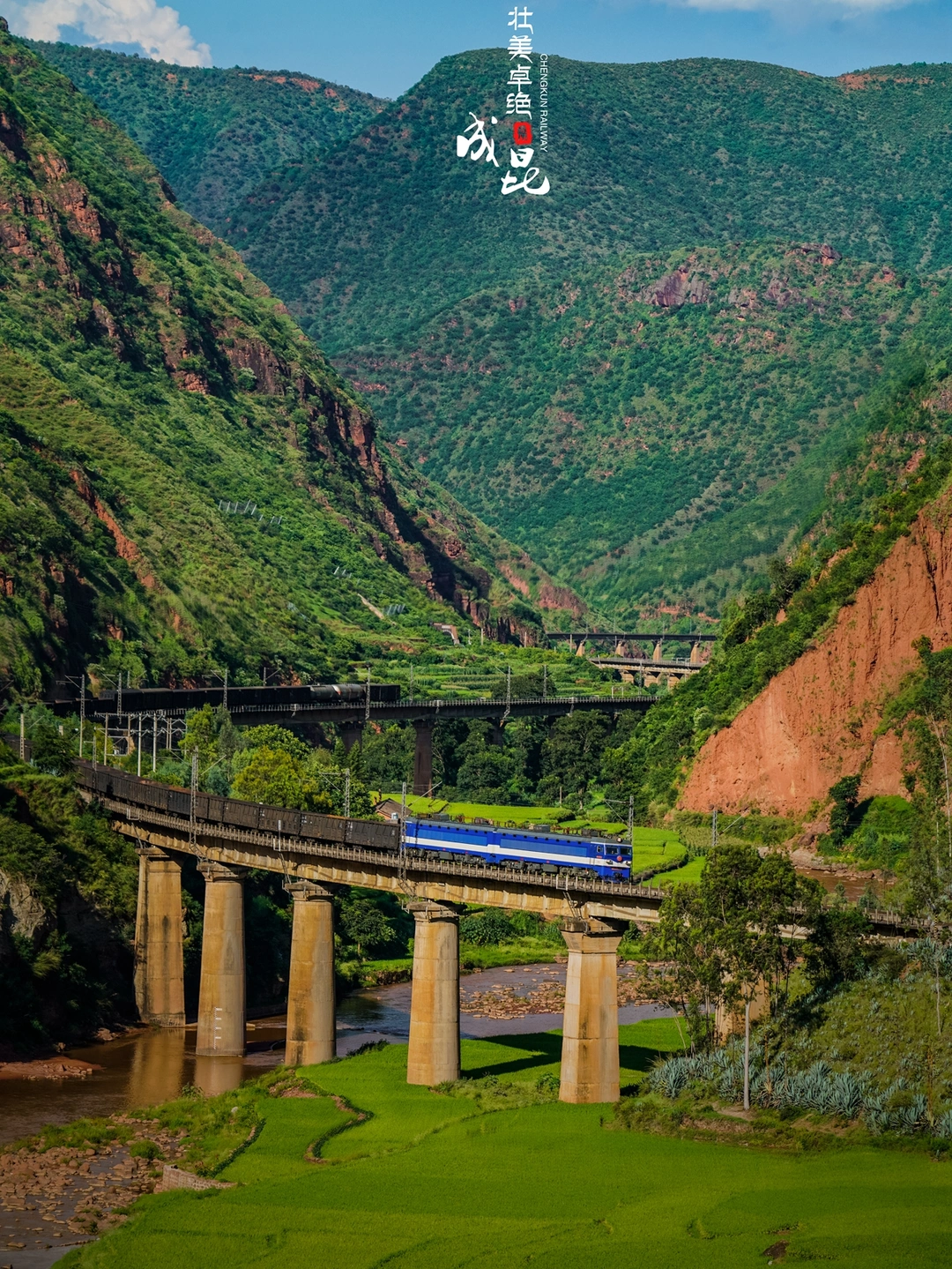
Across China's vast landscape, one railway coils like a steel dragon through the towering peaks of the Hengduan Mountains. It is more than just a transport link between Chengdu and Kunming—it is a monument carved with national spirit and epic struggle. In the summer of 2017, I set foot on this legendary railway, measuring its grandeur step by step, capturing its weathered beauty with my lens.
Origins: A Century-Old Dream
Every railway has its story, but the tale of the Chengdu-Kunming Railway is enough to stir the blood of every Chinese citizen.
1,083.3 kilometers—that's the distance from Chengdu to Kunming. Starting from the City of Brocade (Chengdu), cutting through the Liangshan region of western Sichuan, and arriving at the Spring City (Kunming) on the Yunnan-Guizhou Plateau, this railway bridged two major cities. More importantly, it gave countless people from the Liangshan mountains—whose ancestors had never stepped beyond their valleys—their first glimpse of the outside world.
You might not realize it, but the terrain this railway traverses was declared a "forbidden zone for railway construction" by many international experts. Steep cliffs, jagged peaks, deep ravines, and crisscrossing gullies—the geological conditions were extraordinarily complex. Yet, against all odds, over 300,000 railway soldiers, with nothing but flesh and blood, created a miracle in the history of human engineering during China's impoverished early years.

Did you know? When China regained its seat at the United Nations, one of the national gifts presented was an ivory carving of the Chengdu-Kunming Railway. It won a special award from the UN. That alone speaks volumes about this railway's significance.
But for me, the Chengdu-Kunming Railway is no longer just a railway. It represents a spirit—that unyielding resolve to "cut through mountains and bridge rivers." And with the construction of the new double-track line, most passenger services on the old route will eventually be replaced. So, before it changes forever, I decided to walk it, photograph it, and record this railway that every Chinese person can be proud of.
Prelude: Narrow-Gauge Memories of the Spring City
Starting from Sanming in Fujian, I took the newly opened Shanghai-Kunming high-speed railway and arrived in Kunming in under nine hours. As I stepped off the train, a cool breeze hit me, instantly pulling me into what felt like deep autumn. That's the charm of the Spring City—eternal spring, comfortable day and night.
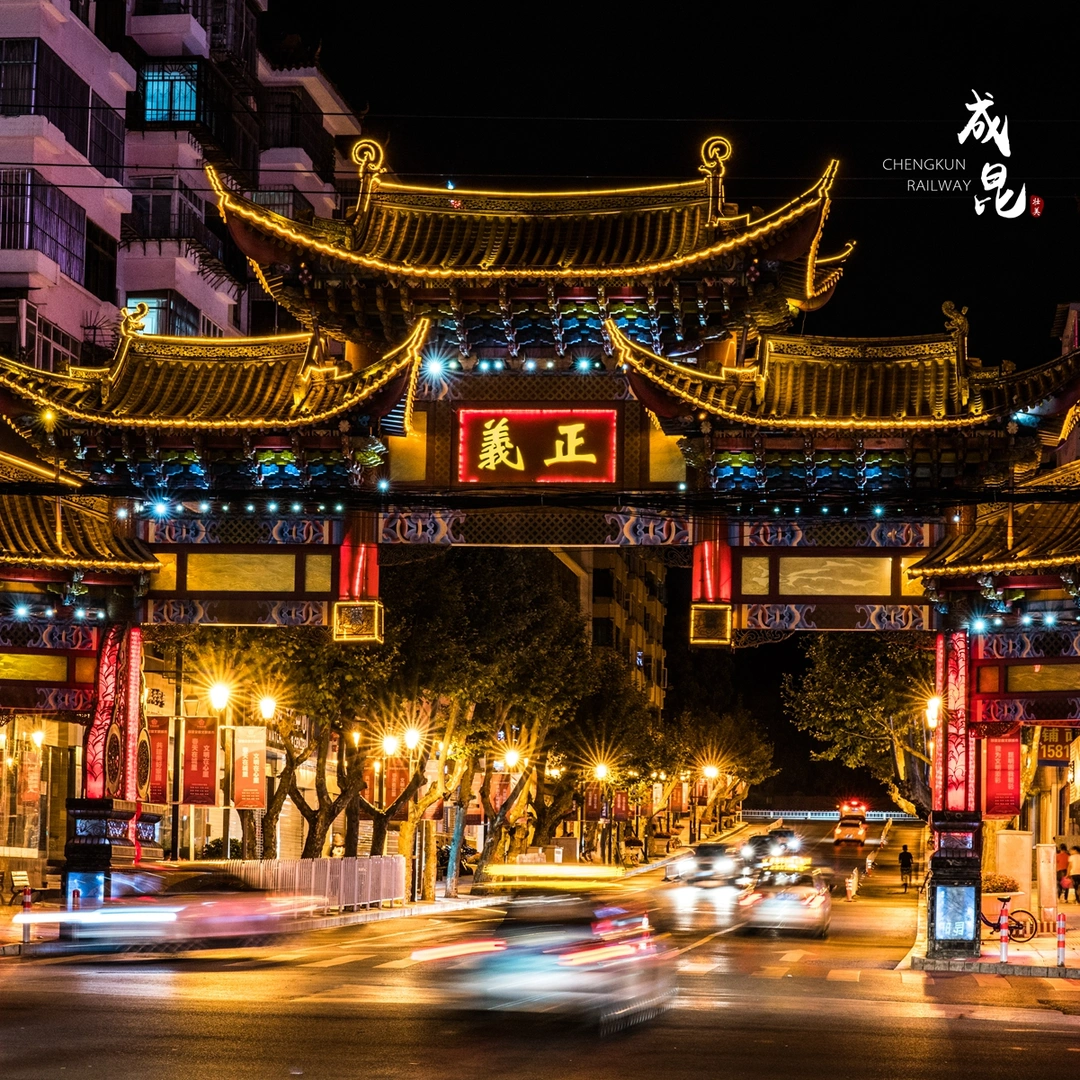
That evening, I stayed near Zhengyi Fang (Justice Square), said to be one of Kunming's liveliest areas. Even past 10 p.m., the streets were bustling. As for why it's called "Justice Square," I never found out—perhaps it honors some virtuous figures or deeds from ancient times.
The next morning, instead of heading to Dianchi Lake or the Grand View Garden, I went straight to Kunming North Station—the only station in China where meter-gauge passenger trains still operate.
"Meter-gauge" means the tracks are one meter apart, while standard gauge is 1.435 meters. Kunming North Station is the starting point of both the Yunnan-Vietnam Railway and the Yunnan-Burma Railway, both steeped in hardship. The Yunnan-Vietnam Railway was built in 1901 by French colonists under an unequal treaty, while the Yunnan-Burma Railway, started by the Nationalist government in 1938, was abandoned in 1942 when western Yunnan fell to the enemy—the blood and tears of 300,000 workers ultimately came to nothing.
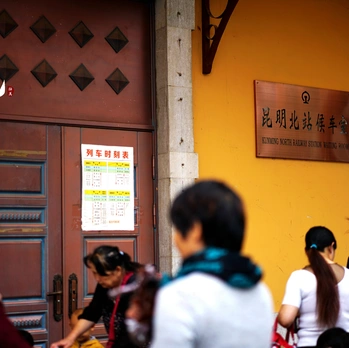
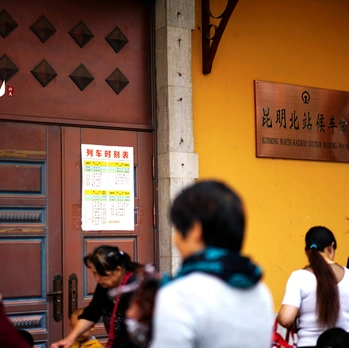
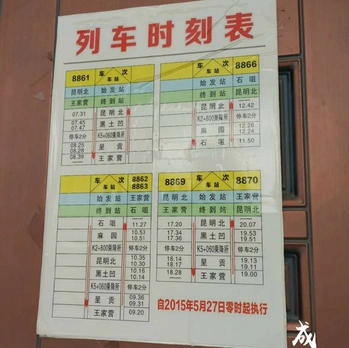
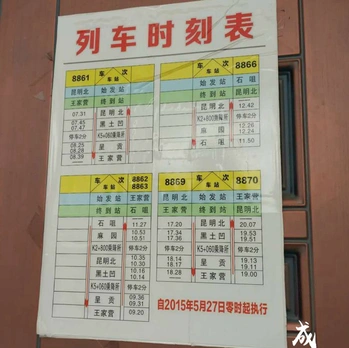
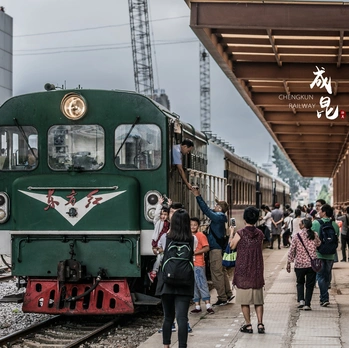
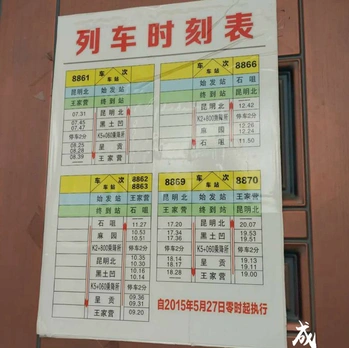
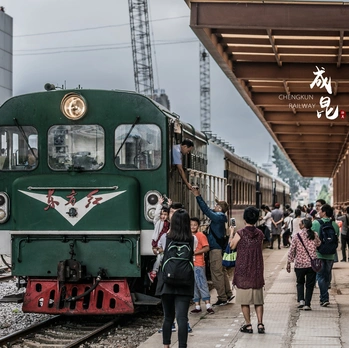
Around 9 a.m., a crowd had already gathered at the station entrance. Most, like me, were tourists eager to experience the meter-gauge railway. The timetable in the waiting room was tattered and incomplete, but luckily, I had gotten the full schedule from fellow rail enthusiasts beforehand. Our plan was to take the 10:35 a.m. train No. 8863 to Mayuan (Hemp Garden) and visit the world's only cross-shaped intersection of standard and narrow-gauge tracks.
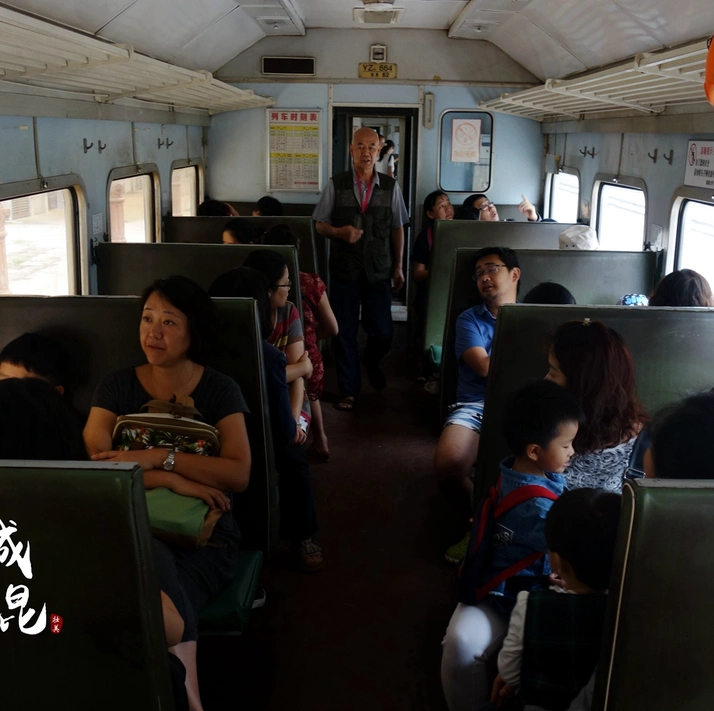
No need to buy tickets in advance—you just buy them on board. The ticket lady, in her Kunming Railway Bureau uniform, meticulously filled out each ticket by hand. Watching her write out that paper ticket, I felt a strange sense of time travel. After getting so used to machine-printed red tickets, this primitive paper slip felt oddly precious.
As the wheels rolled over century-old tracks, the clanging of steel, the whistle of the locomotive, and the chatter of passengers blended into an indescribable soundscape. These sounds are gradually disappearing from China's ever-modernizing railway network, replaced by higher speeds and more comfortable rides. The pedestrians waiting at the crossing watched our train pass like a fleeting scenery—and we watched them the same way.
World Wonder: The Cross-Shaped Intersection
After the little train reached Shizui (Stone Mouth), we took a taxi to the famous cross-shaped intersection. Located near Kunming West Station bus stop, this is the only intersection in the world where narrow-gauge and standard-gauge tracks cross at grade. The standard-gauge line is the Yunnan Copper Company's dedicated line connecting Kunming West Station with the Yunnan Smeltery. The meter-gauge line is the famous Kunming-Hekou meter-gauge railway. Since it was built in the 1950s, this crossing has never had an accident.
The attendant here, Mr. Dou, has never traveled far from home, but he's seen countless visitors come specifically to see this spot—including many foreigners. Every time a train approaches, Mr. Dou turns the French-made "key token machine," opening the "occupied section" of track to ensure only one train operates at a time. After the train passes, he twists the "key" back and locks it into the machine.
This seemingly simple operation embodies a century of railway wisdom and tradition.
Onto the Chengdu-Kunming: Datanjing Bridge and the Fala Spiral
Unexpectedly, a friend I'd known for over a decade dragged me to Chuxiong for a night. Then we headed to Guangtong North Station to board train No. 6162 to Longgudian (Dragon Bone Dike) Station, officially beginning my Chengdu-Kunming Railway journey.
Although No. 6162 is a slow train, it had already been upgraded to 25G air-conditioned carriages. While rail enthusiasts might miss the nostalgic feel, the improved comfort is a real benefit for local residents—a sign of the times.
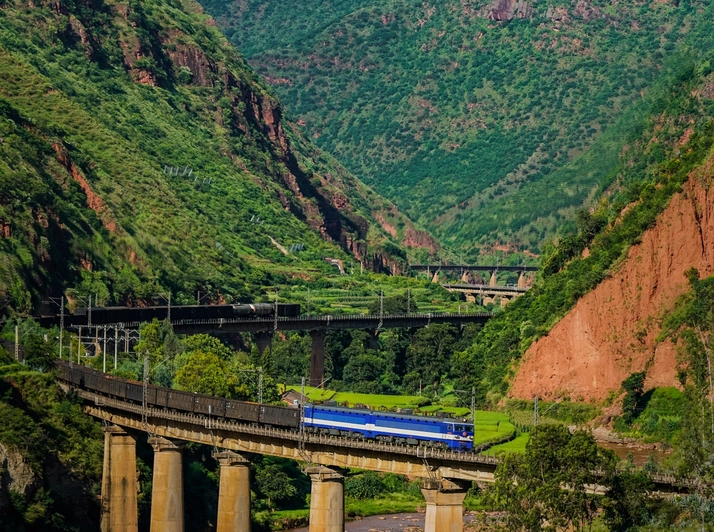
After arriving at Longgudian Station, walking toward Kunming, you'll encounter the famous Datanjing (Big Field Bamboo) Bridge. Stretching 1,166 meters, it's the second-longest bridge on the Chengdu-Kunming Railway. The Longchuan River below is only about ten meters wide, but to elevate the railway into Longgudian Station, the bridge's approach spans are remarkably grand. Today, elevated viaducts are common, but in that era of scarce resources and backward technology, the courage it took to build such a long, high bridge is hard to fathom.
Stepping onto this railway—drenched in the sweat, blood, and even lives of countless railway soldiers—I could almost feel their presence. In my ears echoed the shouts of those days; before my eyes appeared those upright figures.
The Datanjing Bridge connects from the Kunming end into the Fala (Fala) Spiral. This is the first spiral on the Chengdu-Kunming Railway heading from Kunming toward Chengdu, and also the most spectacular. Its shape is unique—the middle and lower layers form a large arc, spiraling down through the valley. For most of its length, it dominates the landscape, intertwining with the Longchuan River. For decades, the roar of steel wheels and rushing water has sounded the advance horn through the Hengduan Mountains.
Standing at the highest point of the Fala Spiral and looking back, the graceful curve of the distant Datanjing Bridge is fully visible. I couldn't help but marvel: the wisdom of our predecessors brought the steel dragon into places Western experts deemed impossible for railway construction.
Bagele Spiral: A Tunnel-Bound Revolution
Not long after the Fala Spiral comes the Bagele (Bagele) Spiral—they're very close together. At Longgudian, we found a local villager to drive us to Xiaocun (Little Village) Station, then walked along the tracks across a long bridge to Ananzhuang (Anan Village) Station.
The Bagele Spiral is the only two-tier spiral among the seven spirals on the Chengdu-Kunming Railway. Its shape is quite peculiar—the entire spiral rotates through the mountains, forming a very large circle. But interestingly, about three-quarters of this circle is inside tunnels, with only the area near the lower crossing exposed. So good photo angles are scarce.
After photographing the Bagele Spiral, we took train No. 6161 back to Guangtong North, then transferred to K1502 heading to Panzhihua. On board, I experienced the Fala Spiral's magic again: the scenery kept changing, but some views repeated themselves—just at different heights and angles. The train passed above or below the very tracks you'd just traveled on, creating a strange, wonderful sensation. That's the charm of a spiral.
Yuexi: Naituo Spiral and Iron Horse Bridge
Panzhihua—a city whose unique name I'd known since childhood—finally met me in a fleeting visit after more than twenty years. This is a famous steel city in the southwest, built on industry, shouldering the mission of driving the Liangshan region's takeoff.
The next morning, we took K9484 to Yuexi (Yuexi) Station. Yuexi is the central county town of the Yi ethnic group in the Liangshan region, with a predominantly Yi population. Since the county town is far from the station, we settled into a small inn right by the platform and hired a car to photograph the Naituo (Naituo) Spiral and the Iron Horse Bridge.
Within the 120-kilometer stretch where the Chengdu-Kunming Railway crosses the Min River and Yalong River, there are four mountain-climbing spirals, all designed to reach the highest point at 2,244 meters above sea level. This summit lies in the southern Liangshan Mountains, inside the entrance of the Shamalada Tunnel on the Chengdu end. Climbing from the Sichuan Basin at about 400 meters to the edge of the Yunnan-Guizhou Plateau at nearly 2,300 meters—a rise of almost 2,000 meters—was unprecedented in railway history at the time.
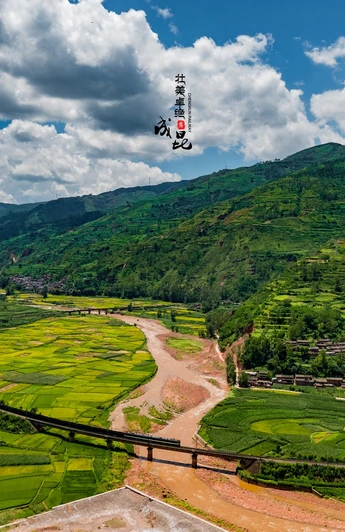
The Naituo Spiral was the first spiral built to overcome this elevation gain. It lies between Baiguo (White Fruit) and Yuexi stations. The straight-line distance is only 8 kilometers, but the altitude difference between the two stations is 196 meters. To climb this steep slope, the line first makes a horseshoe turn, then a 180-degree loop, followed by a spiral, another 180-degree turn, and then exits. The track extends for 9 kilometers, creating a spectacle of three overlapping layers of track passing through the same village.
Countless workers and railway soldiers fought on this land to build the Chengdu-Kunming Railway. And due to technological limitations, many brave men lost their lives. Along the railway, there are countless martyrs' monuments—they represent these heroes' eternal guardianship of this line.
Leaving the cement factory, we rushed to the Iron Horse Bridge before dark. This 882.65-meter-long bridge is the third-longest on the Chengdu-Kunming Railway, using flexible piers, the tallest of which reaches 50.4 meters. It stands majestically in the Liangshan Mountains, spanning two peaks, just like the line from Xin Qiji's poem: "Think back to those days, golden spears and iron horses, swallowing a thousand miles like a tiger." Indeed, it's an iron horse on the Chengdu-Kunming line, carrying countless trains thundering through thousands of days and nights.
Guancunba: The Station Blasted Out by a Single Explosion
After a night's rest at Yuexi Station, I boarded train No. 5620 early the next morning for Guancunba (Guancun Dam). This was a true "slow train," using the beloved 22-series carriages favored by rail enthusiasts—windows that open, letting you stick your head and hands out for pure joy.
The train was filled with Yi ethnic passengers, many of them villagers from沿线 settlements, carrying their farm produce to sell in town. Several large sacks of Sichuan peppercorns sat in the gangways. Even with the windows open, the pungent aroma of the peppercorns filled the air, announcing: this is Sichuan.
Guancunba Station could be called an "internet-famous" stop on the Chengdu-Kunming Railway. It sits in the Jinkouhe (Golden Mouth River) Gorge, rated by Chinese National Geography as one of China's ten most beautiful canyons. Fan Bingbing's film Buddha Mountain was shot here, putting this tiny station on the map.
Guancunba Station is surrounded on three sides by 400-meter-high sheer cliffs, with the turbulent Dadu River rushing beside it. The entire station lies between two railway tunnels, with only 500 meters of open space. In January 1965, when the Guancunba Tunnel set a national record of 100 meters of excavation per month from both ends, this remote railway tunnel in a narrow valley of southern Sichuan suddenly became the focus of national attention. The Central Committee sent a special congratulatory telegram—the only time in Chinese railway history that a tunnel received such an honor.
Deng Xiaoping, Peng Dehuai, He Long, former Railway Corps Political Commissar Lü Zhengcao, and the famous mathematician Hua Luogeng—many Party and state leaders and scientists visited the Guancunba construction site. And they wept.
The 6,107-meter-long Guancunba Tunnel is the second-longest on the entire Chengdu-Kunming Railway, after the Shamulada Tunnel. The most dangerous challenge during its excavation was "rock bursts"—sudden explosions of rock, sending fragments flying in the thousand-meter-deep tunnel. On August 12, 1965, the Second Railway Engineering Bureau used 388 tons of explosives in a single blast, demolishing 395,000 cubic meters of rock, leveling a mountain top, filling two deep valleys, and creating this rare tunnel-to-bridge-connected station—a railway station inside a mountain. Guancunba Station is thus known as "the station blasted out by a single explosion."
In the village of Shengli (Victory) above the station, there's a Railway Soldier Museum displaying artifacts from the Chengdu-Kunming Railway's construction. Sadly, perhaps out of too much reverence, I forgot to take a single photo there. But the spirit of those railway soldiers, who took "cut through mountains, bridge rivers" as their creed, is forever etched into this land.
Tragedy on the Dadu River: The Lizi Yida Disaster
Leaving Guancunba, we hired a car to the Dadu River Bridge. This 483.6-meter-long bridge is located in Wusihe (Wusi River) Town, Hanyuan County, Sichuan.
Many people don't know that beside this bridge, a horrific railway accident once occurred—the Lizi Yida (Lizi Yida) disaster on the night of July 8, 1981. A massive mudslide, carrying 840,000 cubic meters of mud, boulders, and debris, instantly swept away the 17-meter-high, 100-meter-long Lizi Yida Railway Bridge. The two locomotives, one baggage car, and one passenger car of the passing No. 442 train plunged into the Dadu River. 130 people were missing or dead, 146 injured, and the Chengdu-Kunming Railway was closed for 15 days.
In those final, desperate moments, the driver who first spotted the danger did not abandon the train to save himself. He chose to go down with it. In the last six seconds of his life, he firmly pulled the emergency brake and repeatedly sounded the whistle, sending a chilling alarm to the thousand sleeping passengers. But it was a downhill stretch, and the train's momentum was too great. The tragedy unfolded.
Later, to prevent similar accidents, the Lizi Yida Tunnel was built nearby—the tunnel now used by the main Chengdu-Kunming line. Due to time constraints, I didn't visit the now-abandoned Nainai Bao (Grandma's Wrapper) Tunnel, the site of the original accident. I only hope that the passengers who perished that night rest in peace.
Epilogue: The Spirit Endures
Afterward, I went to Hanyuan Station to board T8870 for Emei (Mount Emei). The most magnificent section of the Chengdu-Kunming Railway was now behind me.
There are thousands of railways in the world, each with its own unique scenery and stories. But for countless rail enthusiasts, the Chengdu-Kunming Railway is an unparalleled classic. Its construction and operation produced many "firsts" in Chinese and even world railway history—some inspiring, some heartbreaking. It is these "firsts" that make this railway so extraordinary.
Though history marches on, and the new double-track line will gradually take over its vital role, the Chengdu-Kunming Railway—and the countless stories and spirit behind it—will remain forever in the river of time, worthy of admiration and remembrance.
The Chengdu-Kunming Railway is no longer just a railway. It is a spirit—a spirit that urges us to strive upward. It tells us: in places that seem impossible, as long as people are willing to give, willing to sacrifice, miracles can happen.
Afterword: On this trip, I also visited the famous Leshan Giant Buddha and Mount Emei, and finally returned to Chengdu—a paradise for food lovers. Although these aren't directly related to the Chengdu-Kunming Railway, every experience on a journey is a unique, unrepeatable landscape in life.
(Some data and historical references in this article are drawn from public sources. Thanks to all who contributed to the Chengdu-Kunming Railway.)
You should also read:

God’s Abandoned Palette: A Self-Drive Journey Through Yunnan’s Dongchuan Red Land
God’s Abandoned Palette: A Self-Drive Journey Through Yunnan’s Dongchuan Red Land Travel has never been about reaching some distant geographic coordinate. It’s about encountering, along the way, the version of yourself buried beneath the rubble of daily routine. During this May Day holiday, I finally…
Continue reading...
Body in Hell, Heart in Heaven: A Pilgrimage Through Tiger Leaping Gorge — A Dialogue Between Heaven and Earth
Body in Hell, Heart in Heaven: A Pilgrimage Through Tiger Leaping Gorge — A Dialogue Between Heaven and Earth Introduction: When the Gorge Splits Open Beneath Your Feet Some say Tiger Leaping Gorge is the closest place on Earth to the border between "hell" and…
Continue reading...
Cloud Travelogue · Dali of Wind, Flowers, Snow, and Moon: A Three-Day, Two-Night Journey of a Free Spirit
Cloud Travelogue · Dali of Wind, Flowers, Snow, and Moon: A Three-Day, Two-Night Journey of a Free Spirit I am a cultured female foodie with a touch of rogue charm. I slung on my backpack, took my lover's hand, and set off on a spontaneous…
Continue reading...