Journey to Meili and Yubeng: A Spiritual Pilgrimage to Kawagebo
Journey to Meili and Yubeng: A Spiritual Pilgrimage to Kawagebo
Departure: Letting Go and Setting Out
I quit my job, dragged my exhausted body back to Kunming, and didn't even have time to submit a formal resignation to the company where I'd worked for three years. The moment the plane touched down, my thoughts were tangled like a ball of yarn — I found myself in a place I shouldn't have been, at a time I shouldn't have been there.
My heart held both anticipation and a vague sense of unease. Following an inner calling, I was about to embark on a journey. Was I searching? Seeking sensation? Taking stock of my life? At that moment, I couldn't say. Travel, for me, has always been an eternal proposition — those fleeting moments of emotion along the way help me see myself more clearly.
My father had already passed his sixtieth birthday. Due to his work, he had dedicated half his life to the mountains. After discussing it with him, we decided to travel together. I told him that our destination sat at an average altitude of 3,600 meters, and we would need to trek across mountain passes exceeding 4,100 meters. My father replied firmly: "If you can walk it, so can I." In that moment, I could feel that both my father and I shared the same desire — to conquer the mountain within ourselves.
Before the rainy season arrived, I made all the preparations. On May 20th, I set out on this long-awaited journey.
The Prince Snow Mountain: Sacred Majesty and Forbidden Peaks
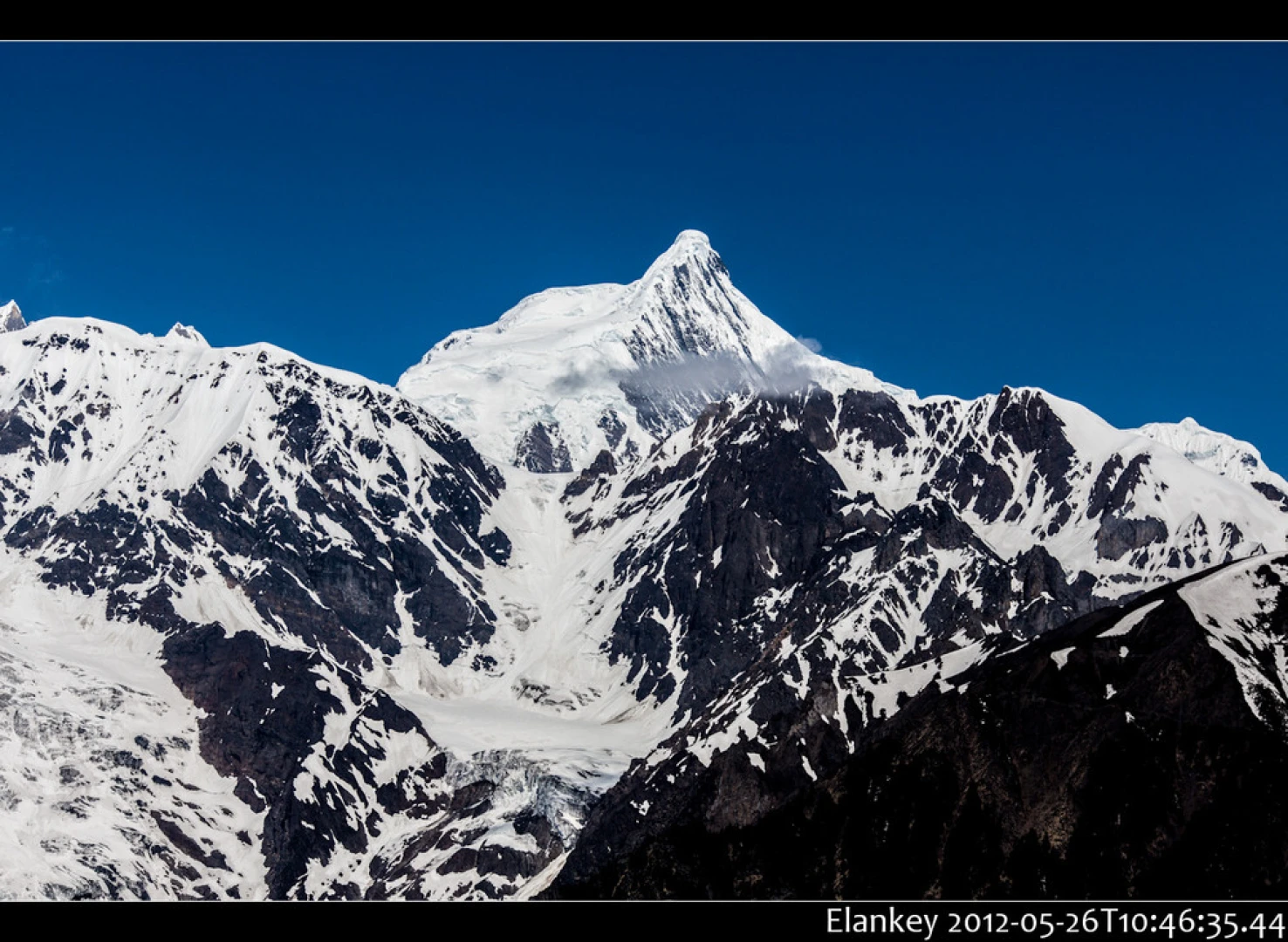
My destination was Meili Snow Mountain, but I prefer to call it by its Tibetan name — "Prince Snow Mountain." The local Tibetans refer to this sacred peak this way.
Prince Snow Mountain is revered as the foremost among the eight great sacred mountains of Tibetan Buddhism, with its main peak, Kawagebo, shrouded in mystery. In 1987, when the Japanese applied to China's National Sports Commission to climb Kawagebo, officials from the Yunnan Sports Commission actually asked Beijing: "Where is Kawagebo?" The local Tibetans continued living according to their traditions,守护ing the divine dwelling place their ancestors had worshipped for generations. It wasn't until the 1991 mountaineering disaster that shocked the world that the ancient tranquility of this sacred mountain was broken.
In 1991, a Sino-Japanese joint expedition attempted to summit, paying an extraordinarily tragic price — six of China's most elite mountaineers and eleven Japanese climbers, seventeen people in total, were laid to rest here. The vast majority of them had experience summiting peaks between 7,000 and 8,000 meters. Their equipment and personnel quality were considered world-class at the time. This disaster dealt a severe blow to China's mountaineering community. The bodies of the victims moved with the glacier's flow and were only discovered years later by local villagers on the Mingyong Glacier.
This ranks as the second deadliest mountaineering disaster in human history (the first occurred in Russia, where an earthquake killed 46 climbers). Over the following fifteen years, nine more attempts were made to climb Meili Snow Mountain: four by Sino-Japanese teams, one by a Japanese team alone, and four by American teams — all ending in failure. After 1996, out of respect for the religious beliefs and traditional way of life of the local Tibetan people, the national government officially banned climbing on Meili Snow Mountain.
The peaks of this sacred mountain each have their own names: Miancimu Peak (the Goddess Peak), Jiwaren'an (the Five Crown Peak), Bujiongsongjie Wuxue (the General Peak), and the main peak, Kawagebo.
Golden Sunlight on the Snowy Peaks: A Fleeting Sacred Moment
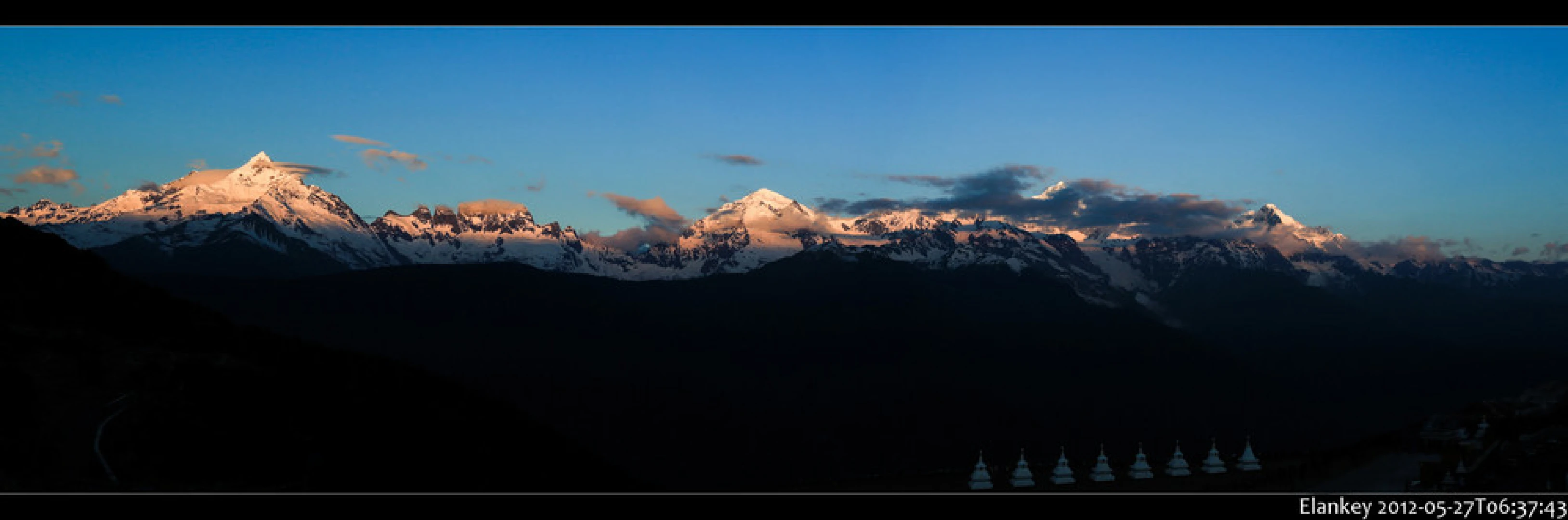
At 6:30 that morning, the sun rose, and the mountain range revealed a hint of golden light, appearing and disappearing among the clouds. I quickly adjusted my camera settings, waiting for the right moment. The air seemed to freeze; everyone held their breath. I could sense people trembling in the crowd around me — was it excitement? Anticipation? The long-awaited moment was finally arriving?

Just as the mountain range displayed its full golden glory, the thin clouds that had been lingering over Kawagebo's summit parted slightly, revealing the mysterious main peak. Cheers and shouts erupted all around. I rapidly pressed the shutter. Glancing around, I noticed an elderly man quietly weeping.
The old man was from Zhejiang Province. This was his sixth visit to Prince Snow Mountain. Every year at this time, he would come and stay for ten days to half a month, just to fulfill his dream — to witness the golden sunlight illuminating the snowy peaks with his own eyes. But in the instant I looked around, Kawagebo had already retreated behind the clouds.
I packed up my tripod and left Feilai Temple with a hint of regret. On the road, I met a driver — a full-time guide (an unlicensed tour guide and driver) who specialized in the route from Lijiang to Feilai Temple. During our conversation, I learned that he had traveled this route over forty times recently, and today was the only day he had ever seen the main peak bathed in golden sunlight.
The golden sunlight on the snowy peaks is fleeting — you can tell just from the shooting time. People had been waiting at Feilai Temple (elevation 3,400 meters) since 5:00 AM, but by the time I took that photo, many had already left. Beneath the snowy mountains and the vast sky, I felt so insignificant. As I gazed upward, a meteor silently streaked across the sky.
The Perilous Road: The Rugged Journey to Deqin
From Shangri-La to Deqin, the road was rough and uneven. Some sections could barely be called roads — a mixture of mud, water, and gravel, with scattered rockslides of varying sizes lining the roadside. The large ones were as big as truck cabs, and the smaller ones were countless. The four-wheel-drive vehicle bounced along, churning my stomach. What was more terrifying was that most of the time, the car drove down the center of the road. Whenever we had to squeeze to the side to pass an oncoming vehicle, you never knew if the next second the roadbed would collapse, sending you plunging into a ravine over a thousand meters deep.
The only thing I was grateful for was that I hadn't set out during the rainy season. I couldn't imagine what this road would be like then — one wrong move, and you could be buried by a mudslide. I remember a business trip to Pu'er in the early 2000s when I witnessed one firsthand. I was stuck on the road for two full days. A minibus ahead of me was buried by a mudslide. Two days later, bodies were dug out one by one — ears, noses, and mouths filled with mud. Some were so disfigured by rocks and debris that you couldn't tell blood from mud. Though ten years had passed, the scene was still vivid in my memory.
Crossing the Jinsha River, we pushed northwest. The sky here was an unreal shade of blue — during my years in Beijing, I had almost forgotten what the sky was supposed to look like.
When we crossed the Baima Snow Mountain Pass (elevation 4,300 meters), I encountered a yak. I envied its freedom and carefree demeanor so much. I tiptoed behind it, pressed the shutter, and quickly left, afraid that my presence would disturb even a thread of the harmony here.
When we reached Deqin, I saw a Tibetan herder tending his cattle. I pulled over, pressed the shutter through the car window, and drove on.
Feilai Temple: Contemplation Under the Stars
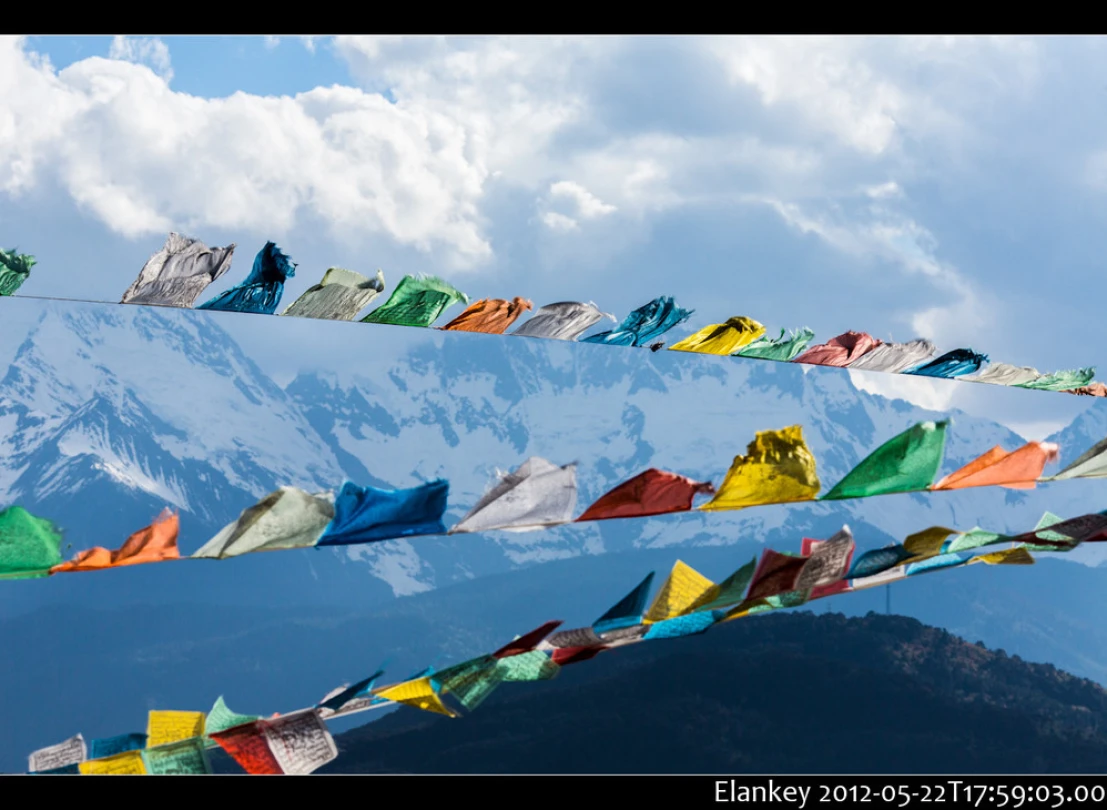
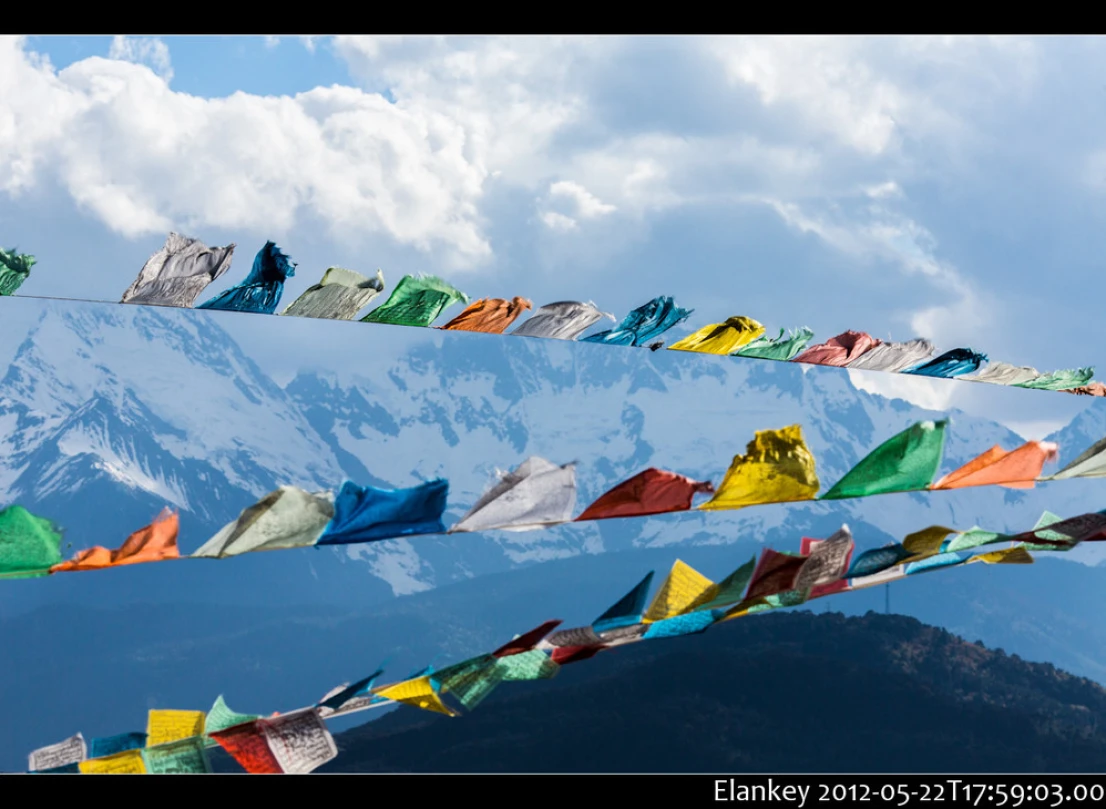
Finally, I arrived at the long-dreamed-of Feilai Temple. On the rooftops of Tibetan homes, colorful prayer flags fluttered in the wind. The breathtaking view of Prince Snow Mountain unfolded before my eyes, and I was overwhelmed with excitement. All the hardships of the journey had vanished. My father, mother, and wife were even more excited, shouting, "Look, look!"
We stayed overnight at Feilai Temple. The long night stretched on, and sleep eluded me. My father and I carried our tripods to the roadside, lit a cigarette, and admired the beautiful starry sky. I sighed countless times: The fast-paced, urbanized lifestyle had long made us forget the night sky above our heads, had made us lose the ability to feel with our hearts. Battling endlessly between ideals and reality, struggling to buy into a concrete-and-steel cage priced at 20,000 yuan per square meter, having a child, and then dying in obscurity — is this what life is all about?
Before we knew it, it was 2:00 AM. We packed up our gear, got back in the car, and returned to the hotel to wait for the next day's sunrise.
The weather didn't cooperate. The anticipated golden sunlight on the snowy peaks didn't materialize. Due to the high altitude, the local shops stocked an unusual item — luckily, I didn't need it. Smoking, running, jumping, carrying 60 jin (30 kg) of luggage up to the fourth floor — at that moment, I recalled a line from astronaut Yang Liwei: "I've exited the capsule. I feel good."
Yubeng: A Secluded Paradise
After resting for a day at Feilai Temple, I still missed seeing the golden sunlight on the snowy peaks. We continued on, heading toward Yubeng, the place that had captivated my soul.
The roadside guardrails were covered with bold declarations and reflections from the journey. Seeing guys riding motorcycles into Tibet, I couldn't help but admire them. Cycling into Tibet tests endurance and physical strength; riding a motorcycle tests courage and wisdom — because recently, there had been many robberies and murders at the junction of the Yunnan-Tibet and Sichuan-Tibet highways. Bicycles weren't worth stealing; cars were hard to rob — you might get run over. Motorcycles were the prime target.
In the village surrounded by mountains, the barley fields had already turned golden, nearly ready for harvest. The Lancang River rushed past the village. This was the only road into the mountains ahead — the so-called "Second Ring Road heroes" should try racing here for a dose of "speed and passion."
The entrance fee was 85 yuan, with a 50% discount for seniors with a senior card. To be honest, I didn't fully understand the road conditions into Yubeng. Otherwise, I would never have dared to bring my parents into the mountains.
The Lancang River surged beneath the bridge. Crossing the bridge, I officially began my journey to Yubeng. On the right, the car was pressed against the mountain; on the left, the shoulder had collapsed, leaving less than 30 centimeters of usable road. The drop was an estimated 700 to 1,000 meters. Time had transformed the landscape — the cobblestones on the mountainside told stories of ancient times. This towering mountain range was once a riverbed.
At the end of the road, I suddenly noticed a portrait of a national leader hanging in a Tibetan home. If any company in China could get its most grassroots employees to hang photos of the chairman and CEO in their homes, what would Apple be? I was utterly amazed. At that moment, I felt like kneeling and kowtowing twice.
Yubeng had no road access for vehicles, no electricity. The only way into the village was this 19-kilometer mountain trail. Due to time constraints, I had to abandon my original hiking plan and ride a mule into the mountains instead.
The 19-kilometer trail was grueling, with two-thirds of it being a continuous uphill climb. Even a fit young man would take six to seven hours. For someone like me, who spent most of my time sitting in an office, eight to nine hours would be normal. If you can't grasp what 19 kilometers of mountain trail means, let me put it this way: A typical floor is about 3 meters high, and two flights of stairs cover about 10 meters. That's like climbing 1,900 floors continuously — let's round it down to 1,000. And don't forget, the lowest altitude here is 3,400 meters.
The moment I climbed onto the mule, I regretted it — regretted bringing my elderly father and mother into these mountains. My father, on the other hand, looked relaxed, taking photos of us from behind. My mother gripped the saddle tightly, sweating profusely from nervousness.
Nanzong Pass: The Test at 3,700 Meters
Nanzong Pass (elevation 3,700 meters) was the last rest stop before entering the village. This was where the mules had to be changed — one mule couldn't handle the entire journey. Many trekkers were gathered around the fire pit, eating instant noodles. Beyond the pass, there was a one-third downhill slope, and at the end of the road lay Yubeng.
Yubeng is divided into Upper Yubeng and Lower Yubeng, with about thirty households each, totaling around a hundred people. Everything in the village — everything you could imagine — was brought in by people or pack animals. There was no other road. Carrying a washing machine into the village earned you 80 yuan. Seeing children carrying supplies, my thoughts were extremely complex — was it relief? Sympathy? Admiration? I couldn't say. At their age, I was still skipping school to play video games with my parents' money.
Due to the steep slope, the pack trains had to zigzag, which added a lot of distance. When I hiked out of the mountains, every time I encountered a pack train, I couldn't help but bow and say, "Tashi delek" — the only Tibetan phrase I knew — offering blessings to the kind people living here. In response, the Tibetan villagers would smile and say, "Tashi delek, hello."
By the roadside, a tractor was waiting to be carried into the village. According to the guide, the tractor was "dragged and pulled" into the village — they drove it where they could, and when they couldn't, about twenty strong men from the village would carry it in. Once it was in, it never left until it broke down for good.
At the end of the road, Yubeng came into view — a place of spiritual beauty surrounded by endless mountains. After entering the village, every trekker we met along the way gave my elderly parents a thumbs-up. My father and mother were filled with pride, and even after returning to Kunming, they would tell everyone: "Our son took us hiking. It was so dangerous!"
Life in Yubeng: Warmth in Simplicity
The village had no electricity, let alone gas. They relied on generators. Cooking with firewood was faster. I remembered the villages we'd seen earlier, with yellow barley fields everywhere — the villagers must have been immersed in the busyness and joy of harvest. But in Yubeng, due to the higher altitude, the barley fields were still lush green.
The village's water-powered prayer wheels — whenever villagers passed by, they would press their palms together, recite scriptures, and then move on. I began to feel a genuine warmth — a long-lost spiritual warmth.
Every wooden shingle on the roofs had a heavy stone on top to prevent the wind from blowing them off. The earthen walls felt especially thick. The concrete balcony reminded me of the "Yubeng heroes" I had seen and encountered along the way.
In the owner's kitchen, I cooked a pot of mixed vegetables and wolfed them down, barely chewing before swallowing. The fire pit was only used for heating food — because of the altitude, cooking required a pressure cooker. Otherwise, the rice would be half-raw, the potatoes completely raw, and a chicken could boil all day without being cooked.
Sitting on the observation balcony chair, all my worries and the fatigue of entering the village melted away. Facing such a view, what more could I ask for? At that moment, the words of Tsangyang Gyatso drifted inexplicably through my heart:
That day, I closed my eyes in the incense smoke of the temple, suddenly hearing the truth in your chanting;
That month, I spun all the prayer wheels, not for salvation, but to touch your fingertips;
That year, I prostrated myself along the mountain path, not for an audience, but to feel your warmth;
That lifetime, I circled mountains, rivers, and pagodas, not for a future life, but to meet you along the way.
Xiaonong Base Camp: Contemplation at the Foot of the Sacred Mountain
After restoring my energy, I began a new journey. Destination: Xiaonong Base Camp at 3,700 meters and the Ice Lake at 4,000 meters (Yubeng is at 3,100 meters).
Xiaonong Base Camp was the base camp chosen by the Sino-Japanese joint expedition. All the supplies for the climb were transported there by sixty mules and countless porters. In the quiet valley, a stream formed by melting snow from the mountains flowed year-round, winding its way. The trail led upward through dense primeval forest, with only glimpses of the sky through the gaps in the canopy.
When ancient trees fell, new life began its cycle — the eternal law of nature. People say, "Where many walk, a path appears." In Yubeng, I'd say: Even where many walk, there may not be a path.
Our Tibetan guide, Dorje — without him, I would have been lost in the forest. If you got lost here, your body might never be found. I had so many questions along the way, but after just a few steps, my heart would race, and I'd be gasping for breath, unable to speak. The young man was quiet, but whenever he talked about Yubeng, about this place, he could go on and on.
When people shared a common goal, a common ideal, I experienced an unprecedented warmth — regardless of nationality, ethnicity, or gender. People genuinely helped those in need. Even a simple "Keep going" or "Hello" felt so sweet and beautiful. On this mountain trail, there was none of the scheming and deceit of the mundane world.
When we reached the pass, at 3,644 meters, there was no cell signal. My wife's China Unicom phone had already lost its signal on the way into Yubeng.
This was Xiaonong Base Camp, chosen by the Sino-Japanese joint expedition. The weather wasn't clear that day, but there was no significant rain either. My clothes were wet, then dry, then wet again — this was the so-called "walking in the clouds" experience. While resting here, we talked about many things: from the 1991 expedition to the kora (circumambulation), to how he went up the mountain to dig for caterpillar fungus. Before we knew it, several groups of trekkers had already moved on, but we were still chatting away.
When the topic of the 1991 Sino-Japanese expedition came up, Dorje's face was filled with anger: "The sacred mountain is like my own grandfather. The expedition team wanted to step on his head." He told me that when the expedition went up the mountain, he was still young, but he clearly remembered that Tibetans from all directions gathered here. Villagers lay on the road into the village, blocking all supply convoys. Tens of thousands of monks began chanting scriptures day and night, cheering for the sacred mountain (Chinese Central Television reported that the monks were praying for the expedition). Just when the climbers were 200 meters from the summit, the sacred mountain showed its power — an avalanche killed all team members. As he spoke, his eyes sparkled with confidence: "Do you think they could have made it? So many people were cheering for the sacred mountain. They were utterly clueless."
Beside the base camp, a previous avalanche had left the area looking like this. According to Dorje, the avalanche didn't reach here, but the air blast from the avalanche had snapped the trees in this forest in half.
The Ice Lake: A Dialogue Between Geometry and Faith
On the way from the base camp to the Ice Lake, Dorje suddenly asked me, "Have you studied geometry?" I was surprised: "Yes, I have. But why are you asking this all of a sudden?"
He asked again, "What's the shortest distance between two points?"
I said, "A straight line."
Dorje said, "For you, what you love is the shortest distance to the summit, or the goal you see as the endpoint. But for them, choosing to do the kora means they respect and deeply love everything here. They would rather give up the shortest distance and circle every inch of the sacred mountain's land."
At that point, we were silent for a long time, just looking quietly, gazing at the road ahead. Before setting out, I had told myself to let go of the past and feel this place with a more open heart. But Dorje's words now plunged me into deep thought.
I collected my thoughts, pulled myself together, and moved on. A plastic bag on the trail confirmed what Dorje had said — what we love is merely the goal we see as the endpoint.
When I reached the destination, I wasn't as excited. Dorje's words lingered in my mind, refusing to leave.
A loud rumble came from the distant mountain. Before I could react, I saw huge boulders tumbling down the slope. Dorje said to me, "It's nothing. A small avalanche, very high up. It won't affect us here." Experiencing a legendary avalanche up close for the first time — the power of nature made me feel so helpless and small.
The Ice Lake was at 4,000 meters. I had to admire China Mobile — there was cell signal here. My wife's China Unicom phone was still out of service. I suddenly remembered a China Mobile commercial: A ship breaks down at sea. Countless people pull out various phones, look at them in panic. Suddenly, one person pulls out a phone, calmly makes a call, and everyone is rescued. The camera zooms in, showing the China Mobile logo and full signal bars. After leaving the mountains, I couldn't stop wondering: Where on earth did China Mobile build its base station? There's no electricity here. How does the base station work? I was baffled, but my admiration grew.
Standing on the summit of the Ice Lake, looking back at the path we'd taken, I couldn't help but sigh. Going up is easier than coming down — I slipped on the snowy trail and got a taste of high-altitude skiing. Luckily, I didn't go off the track. I only sprained my wrist.
On the way down, a trekker had a small portable speaker — very small, with some storage space. Dorje couldn't put it down. I promised to send him one when I returned to Beijing. He thanked me repeatedly: "Then I won't be lonely when I go up the mountain to dig for caterpillar fungus." After returning to Kunming, I checked on Taobao. The speaker cost 45 yuan. Shipping to Yubeng by post took 15 days, and you had to pick it up from the village yourself. For Dorje, this 45-yuan gift was as precious as caterpillar fungus.
Mani Stones and Ancient Trees: Divergent Values
The mani stones piled along the roadside were also a unique sight. My wife, Dorje, and I built one too — the tallest and most imposing one, right in the center of the frame, was ours. We made a wish and left. When Tibetans see a mani stone, they usually pick up a stone and add it to the pile, make a wish, and leave. They rarely build a new one from scratch. Tourists coming to see the scenery didn't know this, so it ended up like this — one pile per person.
On the way back to Yubeng, we came across a huge tree. My rough estimate put its age at at least 1,500 years. A Tibetan villager said it had been blown down by the wind a few days earlier. Just then, another group of trekkers arrived. Among them was a slightly overweight middle-aged man, who kept sighing as he looked at the tree: "If this tree could be hauled out of the mountains, how much would it be worth!" He kept calculating, muttering numbers like "one million, two million" (Chinese yuan), occasionally clicking his tongue in regret.
I asked the villager: "Who does this tree belong to? How is it decided?"
The villager: "Whoever sees it first owns it."
The out-of-towner: "Ah — what if you saw it first, but I insist I saw it first?"
The villager was silent for a long time, without answering. I think such a scenario had never occurred to him, so he couldn't respond.
The out-of-towner: "In the face of such enormous economic interest, I can't be honest."
The Return Journey: With Regret and Anticipation
We returned to Yubeng for one more night's rest, restored our energy, and set out on the return journey the next day. I left a bit of regret — I deliberately didn't go to Lower Yubeng or the Divine Waterfall. I think I will set foot on this mysterious and intoxicating land again. I hope to have the chance to follow Dorje up the mountain to dig for caterpillar fungus and visit the Divine Lake at 4,500 meters.
On the way out of the mountains, I was armed to the teeth. It was so dusty that I had to cover my mouth and nose with a bandana. Before long, my shoes were caked with mud.
I asked my wife: "Why did you choose to hike with me instead of riding a mule?"
My wife said, in her silly way: "You're my husband. Wherever you go, I go. I want to be your burden for life."
Because of work, my wife and I had been moving around, far from home. Looking at my adorable wife at that moment, I felt so much gratitude that words couldn't express.
The sacred mountain was filled with boundless spiritual beauty, attracting pilgrims from all directions. Accompanied by the creaking of wooden prayer wheels, they carried calm and peace on their faces, coming from thousands of miles away, forgetting life and death. Time had carved wrinkles across their serene faces, but their tired bodies held eyes that sparkled with hope — ancient and eternal, enough to make you feel the breath of the sacred. They murmured the six-syllable mantra in their hearts — lonely, but not alone.
Leaving the mountains, I met an elderly pilgrim who had walked from afar to worship here. I pressed my palms together: "Tashi delek." The old man replied, "Tashi delek. See you in Lhasa."
Our lives seem to have no need for faith. Chasing material wealth and luxury has become natural. So we see them as different. Many Tibetans live simple, hard lives, but donate their life savings to monasteries — because they believe that the life we know is only a small part of true life. The soul can be reborn. Perhaps that's why they are rough and unadorned, yet so clear.
Back at Feilai Temple, I met a fellow Kunming native. He had ridden his motorcycle alone into Tibet and was just returning from Lhasa. A close-up of his Honda 750 — it was stunningly cool. The "Second Ring Road heroes" usually ride 250cc motorcycles; racing motorcycles are typically 500cc.
Back in Shangri-La, I wandered through the old town. The ancient stone slabs had witnessed the old town's vicissitudes and its current prosperity, and also witnessed the arrival of an era where faith itself is mass-produced.
Epilogue: Conquering the Mountain Within
This journey to Meili and Yubeng was less a trip and more a spiritual pilgrimage. From the initial confusion of quitting my job to finally leaving with both regret and anticipation, what I gained was far more than the scenery along the way.
The golden sunlight on Kawagebo's snowy peaks was fleeting, but the sacredness and awe it inspired will be etched in my heart forever. The 19-kilometer mountain trail, the 4,000-meter altitude, the secluded village of Yubeng, the simple Tibetan guide Dorje — every fragment made me re-examine my own life.
My father said, "If you can walk it, so can I." He conquered the 4,100-meter mountain pass, and he also conquered the mountain within himself. And me? Perhaps I've only just begun.
Travel, for me, may always be an eternal proposition. Those fleeting moments of emotion along the way help me understand myself more clearly. Between ideals and reality, between the city and the wilderness, between material wealth and faith — each of us is searching for our own balance.
Perhaps we don't need to donate our life savings to monasteries like the Tibetans do, or conquer every peak like the mountaineers. But at least, we can occasionally stop, look up at the stars, and listen to the call deep within our hearts.
Yubeng, I will return. Next time, I will follow Dorje up the mountain to dig for caterpillar fungus, visit the Divine Lake, and feel more of this land's spiritual beauty and warmth.
Tashi delek.
You should also read:

Into the Hidden Valley: A Solo Journey Through the Mysterious Dulong River
Into the Hidden Valley: A Solo Journey Through the Mysterious Dulong River Deep in the northwestern corner of Yunnan Province, tucked away from the modern world, lies a place that feels like a secret whispered among mountains. The Dulong River Valley is not just a…
Continue reading...
God’s Abandoned Palette: A Self-Drive Journey Through Yunnan’s Dongchuan Red Land
God’s Abandoned Palette: A Self-Drive Journey Through Yunnan’s Dongchuan Red Land Travel has never been about reaching some distant geographic coordinate. It’s about encountering, along the way, the version of yourself buried beneath the rubble of daily routine. During this May Day holiday, I finally…
Continue reading...
Body in Hell, Heart in Heaven: A Pilgrimage Through Tiger Leaping Gorge — A Dialogue Between Heaven and Earth
Body in Hell, Heart in Heaven: A Pilgrimage Through Tiger Leaping Gorge — A Dialogue Between Heaven and Earth Introduction: When the Gorge Splits Open Beneath Your Feet Some say Tiger Leaping Gorge is the closest place on Earth to the border between "hell" and…
Continue reading...