Picking Colors in Southern Yunnan · Spring Stroll — An Eight-Day, Seven-Night Journey with My Parents into Yunnan's Palette
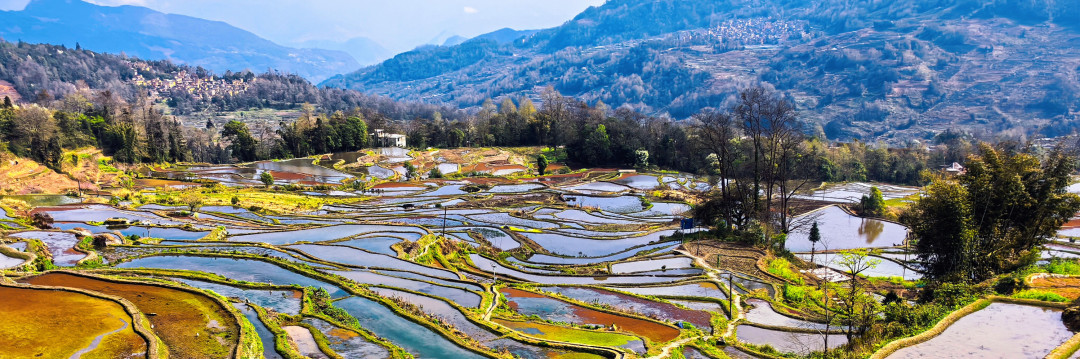
Picking Colors in Southern Yunnan · Spring Stroll — An Eight-Day, Seven-Night Journey with My Parents into Yunnan's Palette
Opening: Why Southern Yunnan?
Yunnan is a land with a kind of magic — once you visit, you can never let it go.
After wandering through the ancient canals of Lijiang, the wind-and-moon romance of Dali, and the highland mysteries of Shangri-La, I turned my gaze to the other half of Yunnan — Southeastern Yunnan. This treasure trove, often overlooked by travelers, holds a palette I had yet to unlock.
Southeastern Yunnan primarily refers to the Honghe Hani and Yi Autonomous Prefecture and the Wenshan Zhuang and Miao Autonomous Prefecture. This trip focused on Honghe Prefecture. With an average annual temperature of 18°C and spring-like weather year-round, it's practically a winter escape paradise. More importantly, the Yuanyang Hani Rice Terraces reach their peak brilliance during the water-storage period from November to April — mirror-like terraces reflecting the sky, almost unreal in their beauty. Late February falls in Yunnan's dry season, with high rates of clear skies, so I decisively chose this time to set off.
Unlike the bustling noise of Northwestern Yunnan, spring in Southeastern Yunnan is like a spilled palette: the fiery intensity of the Red Land, the shimmering colors of the terraces, the emerald clarity of Fuxian Lake... This eight-day, seven-night color-seeking journey began here.
Before You Go: How to Master Southeastern Yunnan
Getting Around
The usual starting point for Southeastern Yunnan is Kunming, with convenient and affordable flights from all over. But since the attractions are scattered and far apart, self-driving, hiring a car, or joining a tour are more practical options. This time, we booked a custom small-group tour, which saved us a lot of hassle.
A word of caution: The bumpy mountain roads at Yuanmou Earth Forest and the continuous winding roads at Yuanyang Rice Terraces can test your driving skills — it's best to have some experience before driving yourself. Other attractions are mainly on highways and not too difficult. The overall altitude ranges from 1,000 to 2,500 meters, so altitude sickness is unlikely under normal conditions.
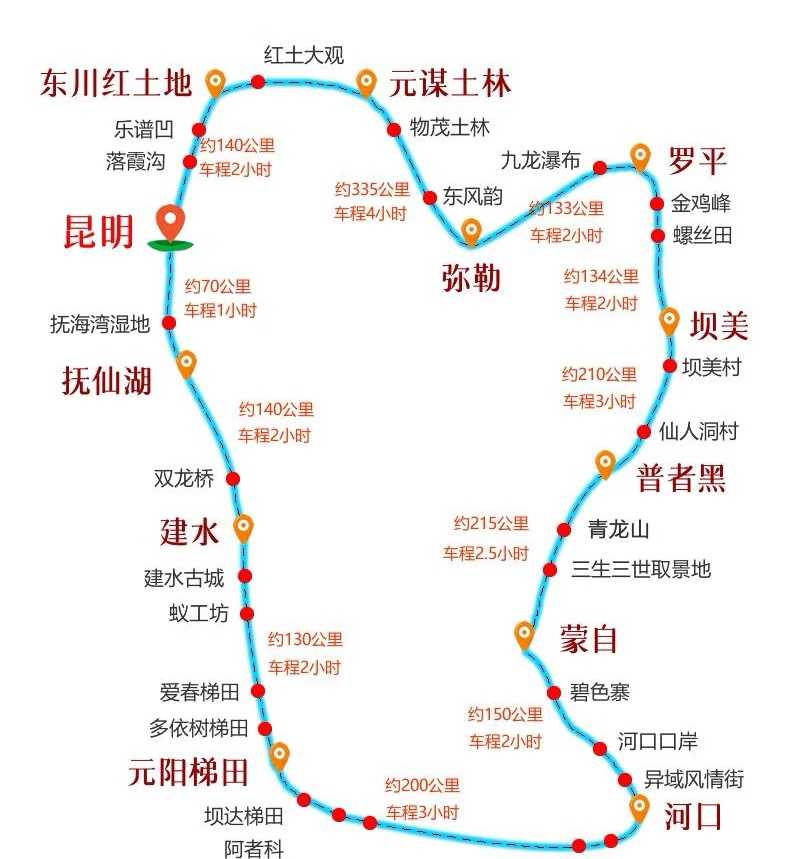
Route Planning
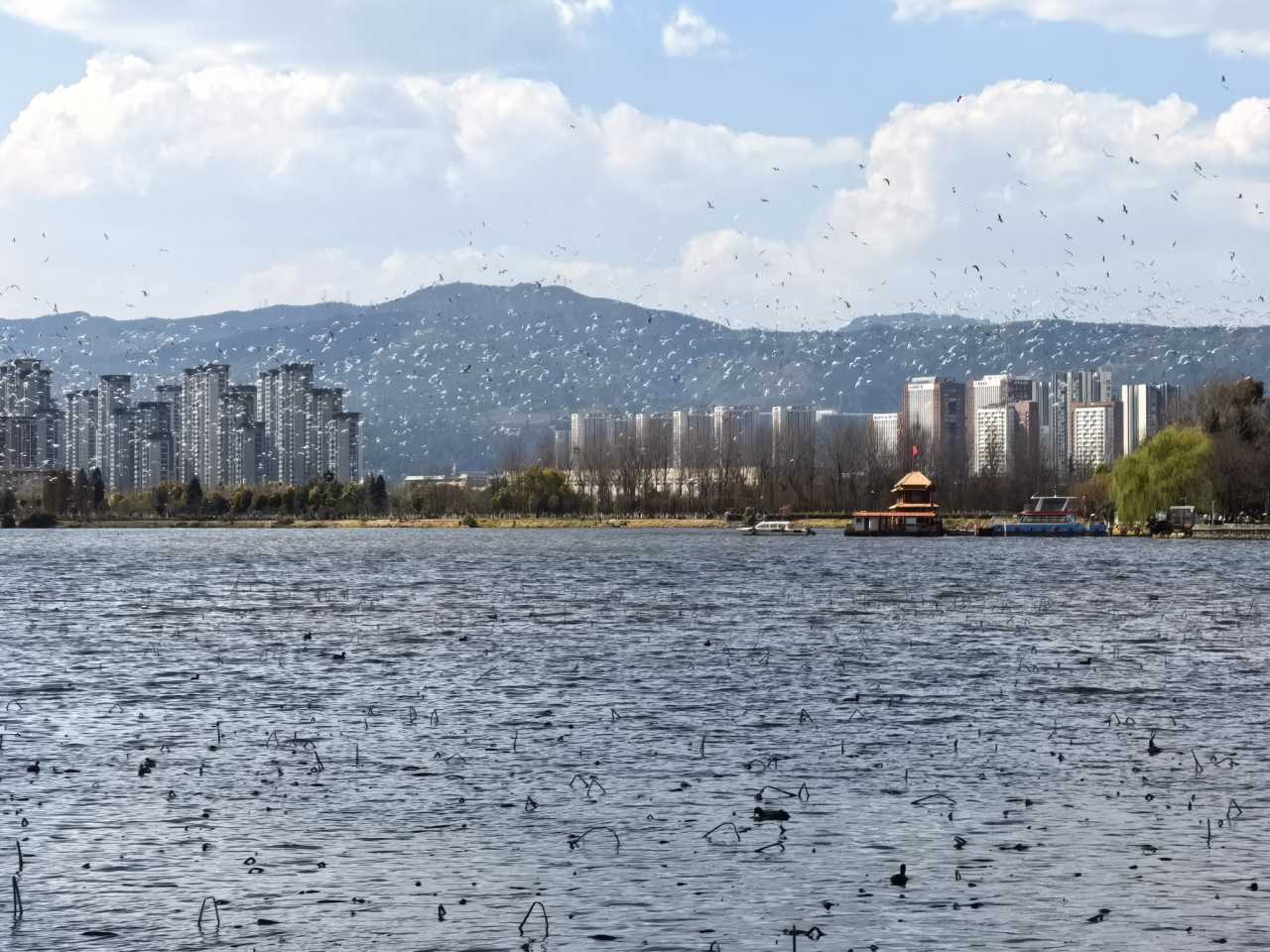
The main route through Southeastern Yunnan forms a loop. My parents had already visited Puzhehei, Bamei, and Luoping, so we skipped these spots this time. If you have more time, you can add them to your itinerary. Also, I personally found Bise Village in Mengzi to be only moderately interesting, so I opted for the more off-the-beaten-path Pingbian instead.
Tips
- Sunscreen! Sunscreen! Sunscreen! The UV rays on the plateau are extremely strong — don't let the moderate temperatures fool you.
- Dress in layers: The temperature difference between morning and evening is significant. You might wear short sleeves at noon but need a jacket in the morning and evening.
Itinerary Overview
Day 1: Kunming Changshui Airport → Qiaoxiangyuan Cross-Bridge Rice Noodles → Daguan Park → Wild Mushroom Stone Pot Fish (Fuxian Lake Old Brand) → Kunming Jiahua Plaza Hotel
Day 2: Dongchuan Red Land → Mountain Farmhouse → Yuanda International Hot Spring Resort Hotel
Day 3: Yuanmou Langbapu Earth Forest → Yihuiyuan Restaurant → Shen Weiguo Braised Chicken Shop → Maitreya Giant Yage Hotel
Day 4: Dongfengyun Scenic Area → Sister Yang's Home-Style Stir-Fry → Dishui Waterfall → Yunnan Miao Medicine Museum → Dishui Miao Village → Yunnan Daweishan Jinjiang Hot Spring Resort Hotel
Day 5: Qingkou Terraces → Bada Terraces → Laohuzui Terraces → Yuanyang Yunshang Banshan Leisure Hotel
Day 6: Duoyishu Terraces → Aichun Blue Terraces → Azheke Scenic Area → Linyou Rice Noodles → Yigongfang Art Space → Shuanglong Bridge → Zhu Family Garden → Chaoyang Tower → Daban Well → Jianshui Renjia Restaurant → Jianshui Lin'an Hotel
Day 7: Beishan Taozhuang → Wild Mushroom Stone Pot Fish → Lucheng Scenic Area → Fuhaiwan Wetland Park → Deshengqiao Bean Flower Rice Noodles → Kunming Beijing Road Panlong Wyndham Garden Hotel
Day 8: Kunming Changshui Airport → Shenzhen
Day 1: First Impressions of Kunming — A Date with Red-Beaked Gulls
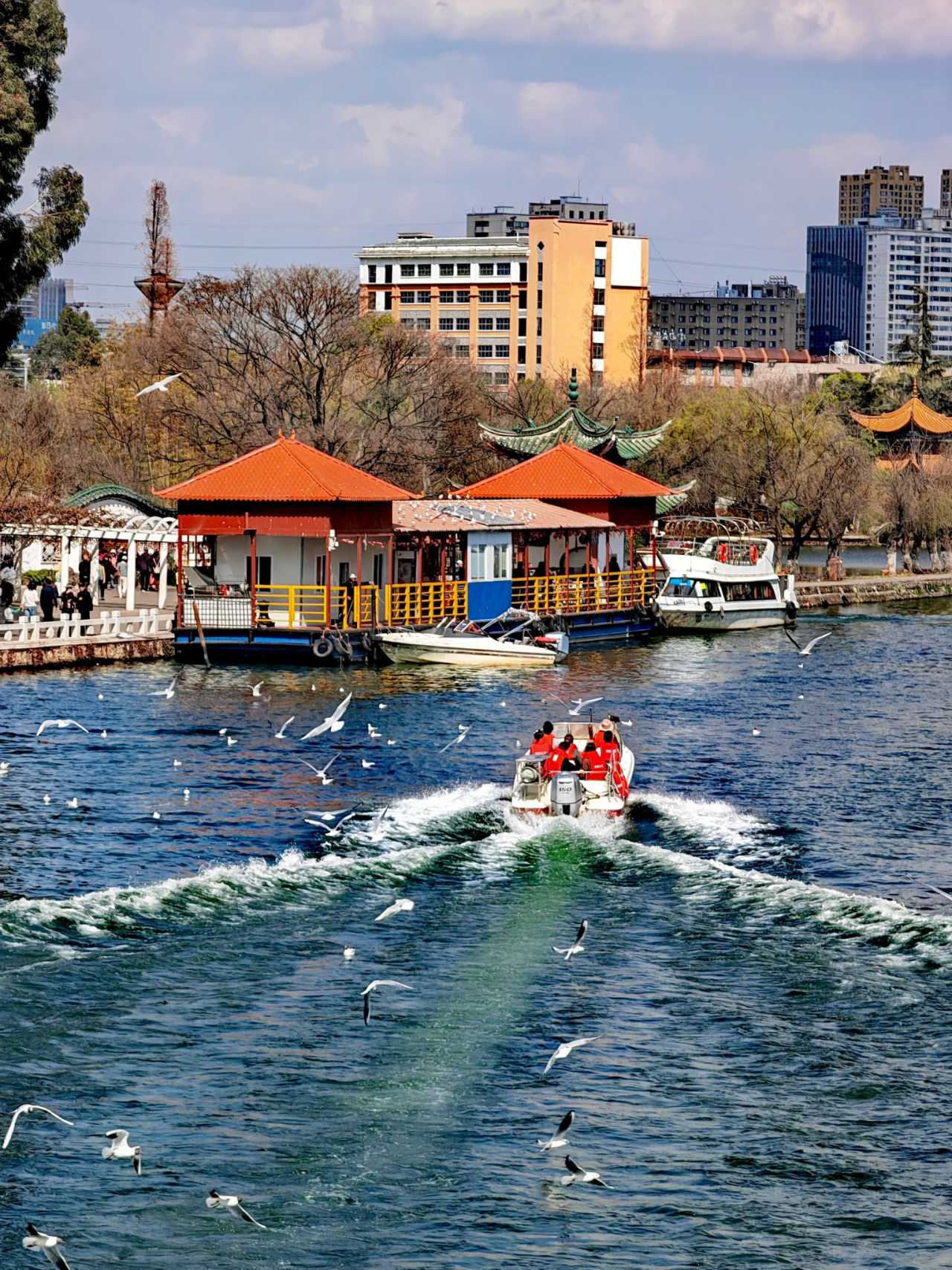
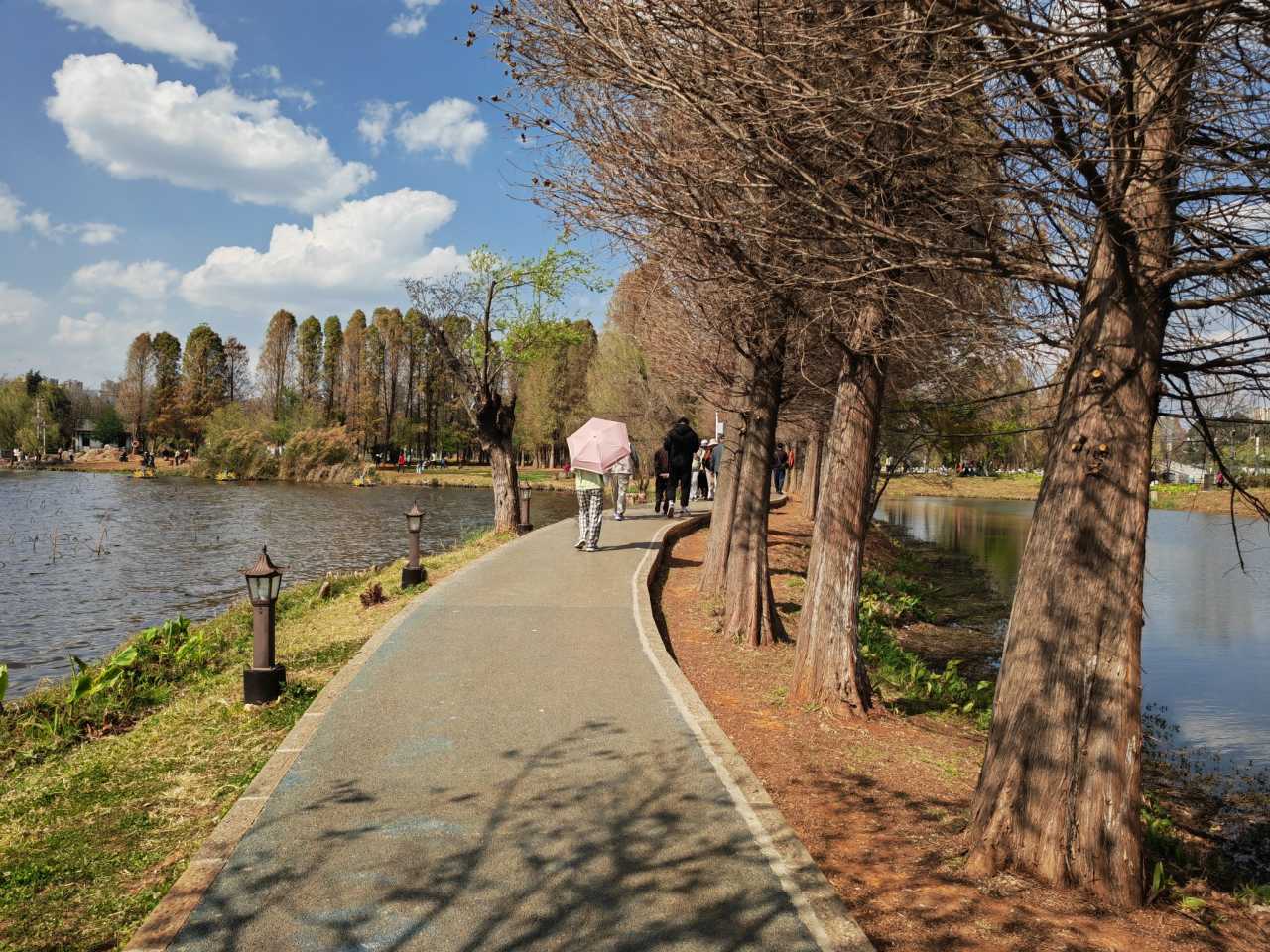
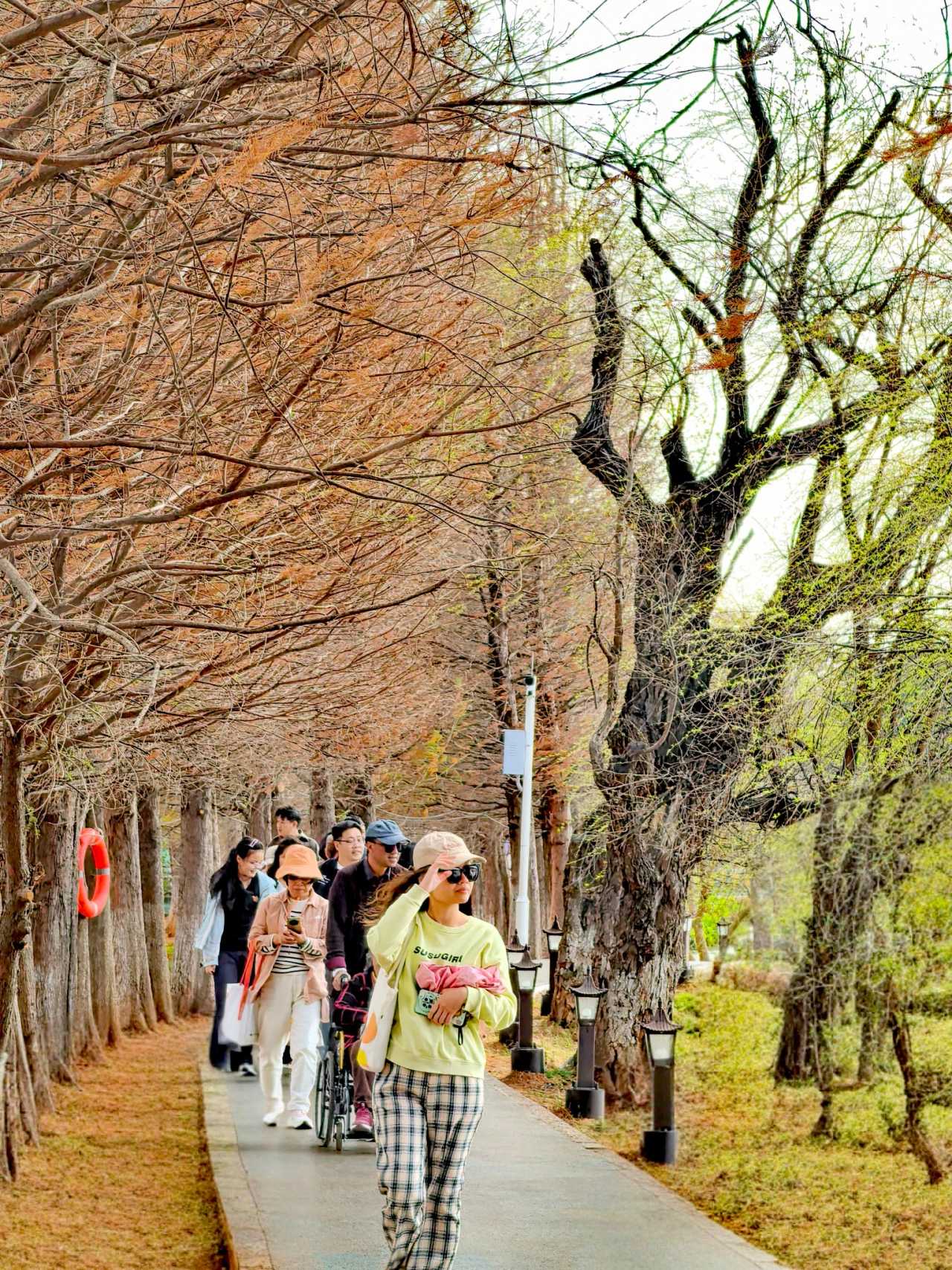
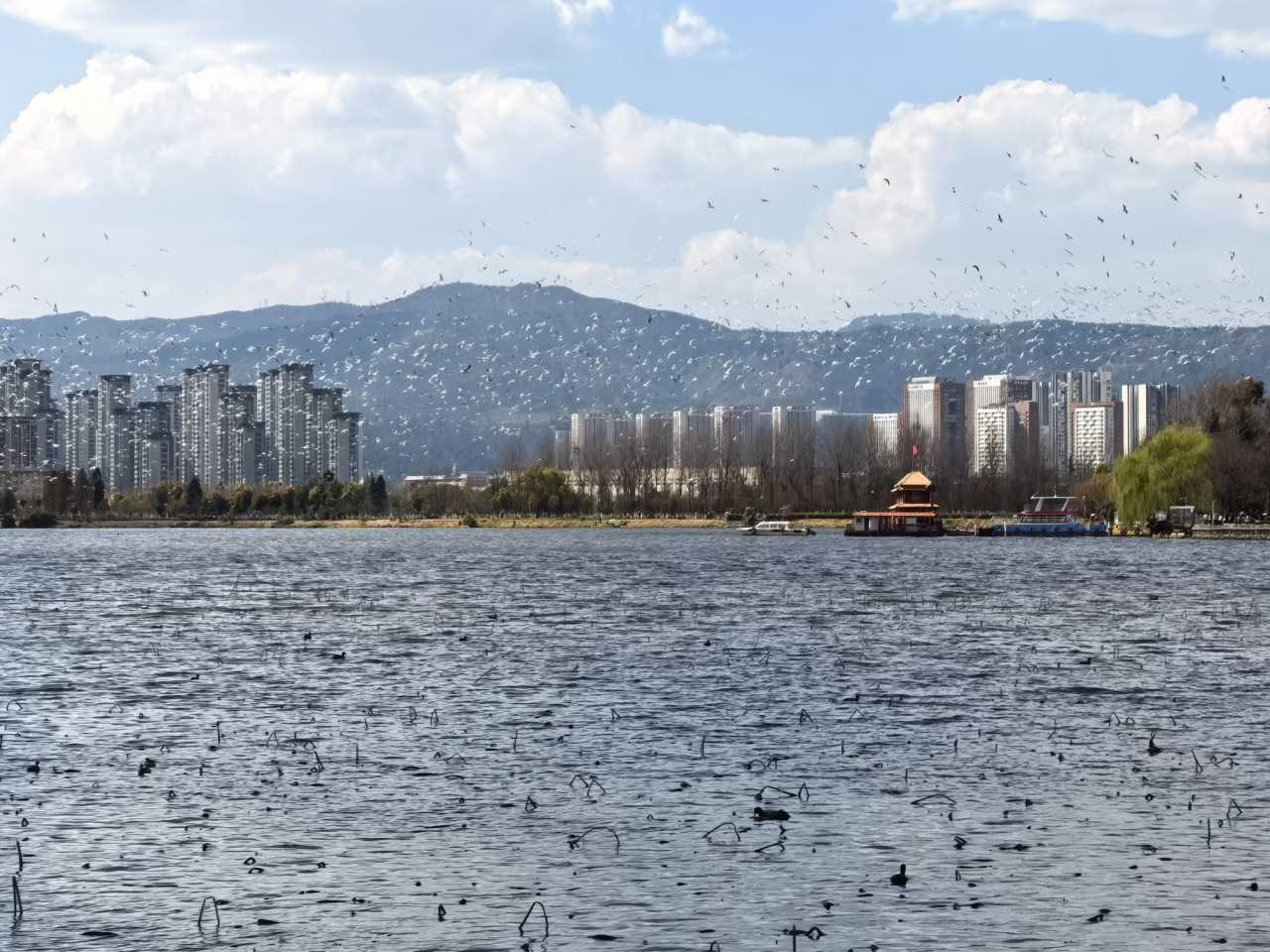
Daguan Park | A Rendezvous with Red-Beaked Gulls
Our flight arrived in Kunming at noon, and since we couldn't check into the hotel yet, we stored our luggage and headed straight to Daguan Park, about 7 kilometers away.
Daguan Park is located on the northern shore of Dianchi Lake, about 2 kilometers west of Kunming city. It's an important part of the Dianchi Lake Scenic Area and free to enter. The park was first built in the 14th year of the Hongwu reign of the Ming Dynasty, and the Daguan Tower was constructed in the 29th year of the Kangxi reign, giving the park its name.
Here, you'll find not only classical garden landscapes but also a great spot to watch red-beaked gulls in winter. We visited during the Spring Festival holiday, and popular gull-watching spots like Haigeng Dam and Haihong Wetland Park were jam-packed with traffic — it was even difficult to get a taxi back to the city. After researching, I chose Daguan Park — it's spacious enough to accommodate many people, and you won't have trouble getting a taxi. I recommend taking a taxi to the South Gate. The North Gate is closer to Daguan Tower but prone to traffic jams, and walking from the South Gate isn't far.
Along the path, flocks of red-beaked gulls on Dianchi Lake rushed toward us. Seeing them in person is a hundred times more stunning than in photos — they look like dense specks on a phone screen, but up close, their liveliness and vitality are mesmerizing.
The gulls are most concentrated on the lake near Daguan Tower, where you can observe them up close. We arrived around 3 PM, and most gulls had already eaten and were too lazy to fly for interaction. If you want to capture feeding photos, you'll have to rely on local photographers who earn money on-site — their gull food is a favorite. To fulfill my mom's wish, we hired a local to take photos: 20 yuan per shot, including a printed photo and digital copy.
After feeding the gulls, we stopped by Daguan Tower. During the Qianlong reign of the Qing Dynasty, the commoner poet Sun Ranweng wrote a 180-character couplet here, blending the scenery of Dianchi Lake with thousands of years of Yunnan history. It's hailed as "the world's longest couplet."
Compared to the crowded Haigeng Dam, Daguan Park offers close-up views of red-beaked gulls, a taste of history and culture, garden scenery, and no traffic jams — perfect!
Accommodation: Kunming Jiahua Plaza Hotel
Near the train station, with prices ranging from 400 to 4,000 yuan. It's not far from Cuihu Park and Golden Horse & Jade Rooster Archway. The standard rooms are small and the facilities a bit dated, but the service and breakfast are decent. I recommend avoiding hotels near Haigeng Dam during holidays — the traffic back to the hotel can drive you crazy.
Food Recommendations

Qiaoxiangyuan Cross-Bridge Rice Noodles: A chain restaurant where ingredients are poured into boiling hot broth at your table. I ordered tomato and beef rice noodles (over 40 yuan), while my parents had mushroom rice noodles — all tasty.
Wild Mushroom Stone Pot Fish (Fuxian Lake Old Brand): Also near the hotel, very busy during meal times. We ordered fish and a vegetable platter for over 200 yuan — decent but not outstanding. Personally, the best stone pot fish I've ever had was at Lugu Lake — the soup was milky white and incredibly sweet.
Day 2: Dongchuan Red Land — Red Earth as Paper, Light as Ink
On the second day, we officially began our Southeastern Yunnan journey, starting with Dongchuan Red Land, about 2 hours from Kunming by car. The route is mostly highway, with a winding mountain road near the scenic area.
Dongchuan is a district under Kunming city, known as the "Natural Copper Capital" with over 2,000 years of history. Today, unique landscapes like the Red Land and mudslide racing have set it on a new path of green development.
Red Land | Hailed by Experts as "Second in the World"
Experts consider Dongchuan Red Land to be the most spectacular red land in the world, second only to Rio de Janeiro in Brazil. Located in the Wumeng Mountain range, the area experiences high temperatures and heavy rainfall, causing intense weathering of the soil's primary minerals. Elements like iron and aluminum oxidize and deposit, forming vivid red iron oxide, giving the soil a fiery reddish-brown hue. Farmers grow crops like highland barley, wheat, rapeseed, and potatoes on the red land, adding even more color.
The Red Land isn't developed as a single unified scenic area; the attractions are scattered. Our visiting order was: Luosi Bay → Jinxiu Garden → Lepu Hollow → Luoxia Valley → Dama Pass → Qicai Slope.
Luosi Bay: You can photograph the road winding through the red land, and it's a sunset viewing spot. However, it's been turned into a private attraction, charging 2 yuan per person to enter. Personally, I'd suggest skipping it — the color layers aren't as rich compared to other spots.
Jinxiu Garden: The core attraction on the northwest route, best in the afternoon light, and hailed as the place with the most layered colors. The red earth is divided into patches of various sizes, planted with different crops, creating a vibrant interweaving of colors that looks like a giant palette.
Lepu Hollow: The famous spot for photos with the old man and his sheep. The nearly horizontal terraces look like a colorful musical staff. It's best to ask permission before photographing the old man — sometimes there's a fee, though we weren't charged.
Luoxia Valley: The most photogenic spot in the entire Red Land, and the only relatively formal paid attraction. Admission is 40 yuan, with a 20 yuan sightseeing car fee, or a 1-kilometer walk to the entrance. Luoxia Valley is a prominent hill in the valley, with a village on top. From the viewing boardwalk, the colors of the red land blend perfectly with the valley's contours. You can descend the boardwalk for a closer look, but you'll need to climb back up the stairs — the round trip, including photos, takes about 40 minutes.
Dama Pass: It's very windy, and you need to climb a high glass boardwalk, so we skipped it.
Qicai Slope: Offers a different perspective of the same land as Jinxiu Garden, planted with large fields of potatoes and buckwheat. It's most colorful during farming season; in late February, it's only reddish-brown.
The beauty of Dongchuan Red Land isn't in a single color, but in the collision of red and green, the interplay of light and shadow, and the symbiosis of nature and agriculture.
Accommodation: Yuanda International Hot Spring Resort Hotel
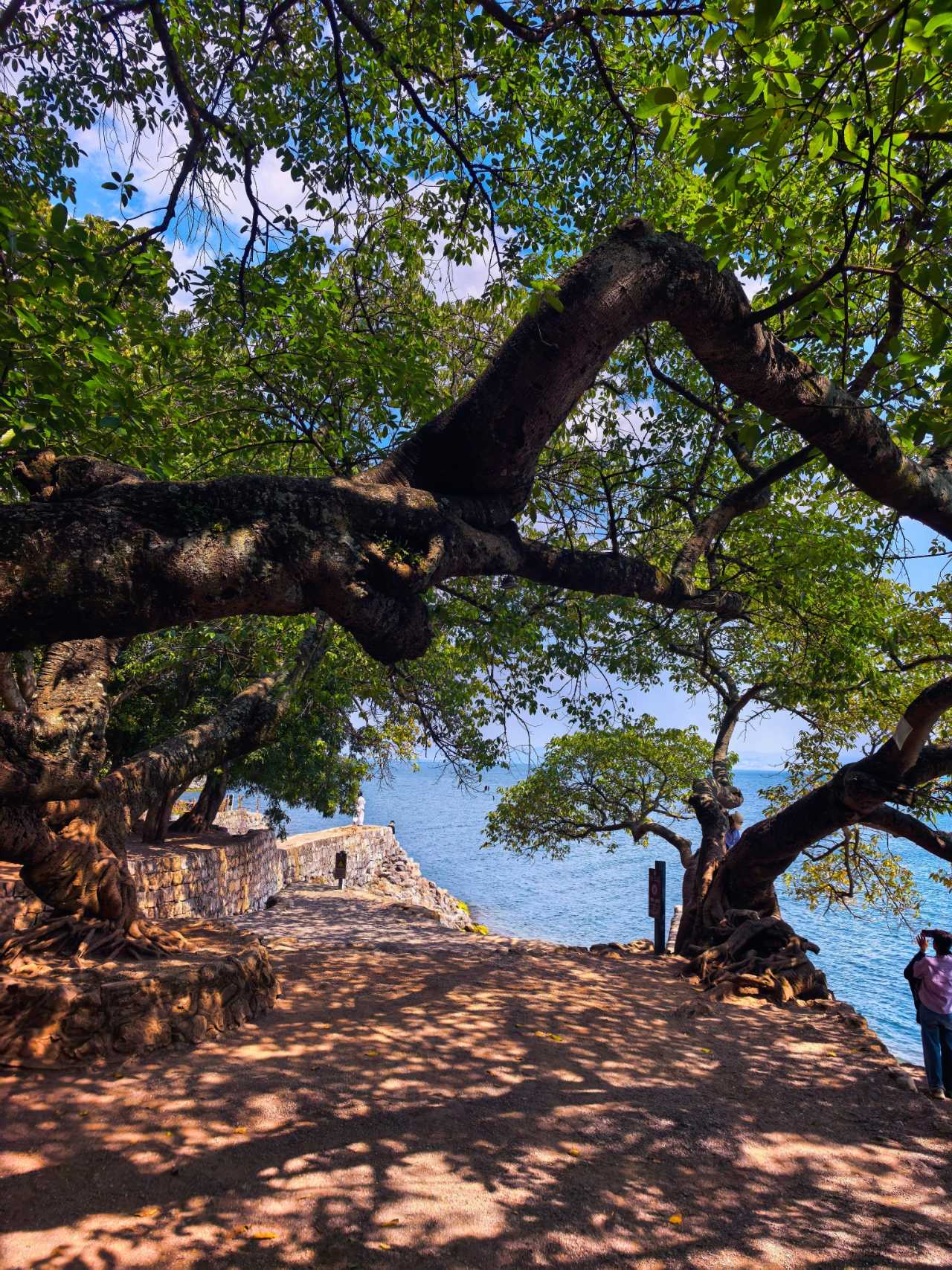
On the second night, we stayed at Yuanda International Hot Spring Resort Hotel in Yuanmou County, about 2.5 hours' drive from Dongchuan Red Land. Prices range from 400 to 2,500 yuan. The standard rooms are spacious, but the facilities are dated, and hot water is a bit unstable. The hotel has over a dozen outdoor hot spring pools, free for guests, with towel and slipper rentals. I recommend booking a room with a private hot spring — many non-guests come to use the pools. The hot spring area also has a children's playground, KTV, game machines, and a spa. Nearby dining options are limited and mostly Sichuan-style. The hotel offers a simple buffet and à la carte ordering.
Food Recommendations
Mountain Farmhouse: A random farmhouse we found in the Red Land scenic area — surprisingly good. We ordered braised chicken with potatoes, tofu, and greens (135 yuan, the owner generously charged only 130 yuan). The potatoes in the chicken were tender and flavorful, and the tofu had a strong bean taste. I'm not sure what the greens were, but they were very bitter — not recommended.
For dinner, we had the hotel's 38 yuan buffet — mediocre, not recommended.
Day 3: Yuanmou Langbapu Earth Forest — A Wilderness Color Brewed by Time
On the third day, we headed to Yuanmou Langbapu Earth Forest, about an hour's drive from the hotel, with half an hour on bumpy mountain roads.
Yuanmou is located in the Chuxiong Yi Autonomous Prefecture, in the dry-hot valley of the Jinsha River. It has an average annual temperature of 21°C and is essentially frost-free year-round. Known as the "Hometown of Eastern Humanity" for the 1.7-million-year-old "Yuanmou Man," it's also a nationally famous "Winter-Early Vegetable Town."
Langbapu Earth Forest | One of Yunnan's Three Forests
Yuanmou has two well-developed earth forests: Langbapu and Wumao. Wumao Earth Forest was developed earlier, with better facilities and easier roads. Langbapu Earth Forest was developed later, with a desolate entrance and rougher roads, but its earth pillars are taller, denser, and more colorful, reaching up to 42.8 meters — the tallest single pillar among Yuanmou's earth forests.
Yuanmou Earth Forest, along with Luliang Colored Sand Forest and Lunan Stone Forest, is known as one of "Yunnan's Three Forests." It's a unique landform formed by water erosion over 80 million to 100 million years.
Admission is 50 yuan, with a 20 yuan sightseeing car — I recommend buying it, as walking is 2 kilometers with no other attractions along the way. The scenic area has four zones, with stops at Zone 4 and Zone 1. It's best to get off at Zone 4 and walk to Zone 1, taking about 2-3 hours. If you're short on energy, you can just visit Zones 4 and 3, then return to Zone 4 by car — these two zones have the most spectacular earth pillars. The sightseeing car ticket has the scenic area's phone number; you can call for a pickup when you're done.
Getting off at Zone 4, you first overlook the earth forest from above, with the winding Liusha River stream visible below. Following the steps into the valley feels like walking through a canyon. There's a fork at the bottom; I suggest taking the Zone 4 path, which also leads to Zone 3 without missing any spots. Along the way, you might encounter free-range cattle and donkeys.
The earth pillars in Zone 3 are incredibly tall, making humans feel small before nature's masterpiece. This geological wonder feels like stumbling into a strange wilderness, with even the wind carrying a sense of ancient weight.
Accommodation: Maitreya Giant Yage Hotel
On the third night, we stayed at Maitreya Giant Yage Hotel, about 3.5 hours' drive from Yuanmou. Prices range from 300 to 750 yuan, with spacious standard rooms. The hotel has an outdoor hot spring with 5-6 pools, but no private pools in the rooms. Since it's not open to the public, there aren't many bathers, making it cleaner than the hot spring at Yuanmou's hotel, though it lacks facilities like changing rooms. For dinner, you can explore the nearby Fountain Old Street, which has plenty of dining options.
Food Recommendations
Yihuiyuan Restaurant: In Yuanmou county town, we had a bowl of sliced beef rice noodles — a large bowl for just over ten yuan, with a very sweet and savory beef broth.
Shen Weiguo Braised Chicken Shop: Braised chicken is a specialty of Maitreya, usually served with rice noodles. A bowl of braised chicken rice noodles costs 7 yuan — hard to believe for a tourist town. The chicken was delicious, well-seasoned with crispy skin.
Day 4: Dongfengyun and Pingbian — A Duet of Art and Nature
On the fourth day, we first visited Dongfengyun Scenic Area (about half an hour from the hotel), then headed to Pingbian (about 2 hours' drive).
Maitreya is located in the northern part of Honghe Prefecture, a city named after a Buddha. Its name comes from a Yi tribe called "Maitreya" during the Tang and Song dynasties, which coincidentally matches the Sanskrit name of the future Buddha "Maitreya."
Dongfengyun | Red Brick as Bones, Art as Soul
The red brick buildings at Dongfengyun Scenic Area are the work of Yunnan-born artist Luo Xu. Without a single complete blueprint, he relied solely on his imagination, leading local craftsmen to build this dreamlike castle brick by brick using local red clay.
Admission is 80 yuan, with a 20 yuan sightseeing car — you don't need the car, as it's less than 2 kilometers to the main attraction, Wanhuatong. Taking the car means missing沿途 attractions like the Colorful Flower Field. The car also doesn't go directly to Wanhuatong; you get off at Yinzhangfang and walk a few hundred meters.
After entering, turn right and go down the steps; walking along the lake path is easier.
Colorful Flower Field: Planted with over 10 varieties of flowers like lavender, iris, bellflower, and yellow crown chrysanthemum, blooming from April to October. We visited before the bloom, but the railway tracks in the field are great for photos.
Yinzhangfang: At the end of the flower field, this group of cylindrical buildings resembles red seals. Unlike Wanhuatong's rounded style, Yinzhangfang is angular and neatly arranged, housing creative shops, restaurants, cafes, and bookstores.
Wanhuatong Art Gallery: The most popular Instagram spot at Dongfengyun, its exterior looks like a pile of stacked wine bottles. The entire complex used no steel bars or nails — only locally fired red bricks from Maitreya. It blends wine culture, the fire culture of the Yi Axi branch, and a contemporary artistic spirit of upward symbiosis.
If you're not particularly interested in architecture or obsessed with photo ops, you might find this attraction underwhelming.
Dishui Waterfall | The White Cascade Hidden Behind Miao City
After leaving Maitreya, we headed to Pingbian Miao Autonomous County, known as "China's Southernmost Spring City." Pingbian is Yunnan's only Miao autonomous county, home to the Daweishan primeval forest, the century-old Yunnan-Vietnam Railway's "Renzi Bridge," and a 10,000-year-old volcanic site. With a forest coverage rate of 68.3%, it's a true "natural oxygen bar."
Dishui Waterfall is hidden in the northwest corner of Pingbian county town, free to visit. Navigate to "Dishui Waterfall Viewing Platform," then follow the signs downhill for about 15 minutes to reach the bottom. You'll need to climb back up the same way — don't take the "no turning back" path, as it's reportedly very long.
The waterfall cascades from a nearly 100-meter-high cliff, with water columns rushing down. It's not particularly spectacular, but it's free — what more can you ask for?
Miao Medicine Museum | A Glimpse into Miao Healing
Located in Dishui Miao City, the Miao Medicine Museum is the first of its kind in Yunnan Province. Free entry, no reservation needed, open daily from 9 AM to 5 PM.
The museum displays a dazzling array of plant and animal specimens from Pingbian's rich medicinal plant resources. It also introduces the unique theoretical system, diagnostic methods, and processes of collecting and preparing Miao medicinal herbs. The specimens are arranged with great design, blending modern aesthetics with medical heritage. Visiting this niche, unique museum was a delightful surprise — far from boring.
Dishui Miao City | No Need to Rush in These Waters
Dishui Miao City is located on the west side of Pingbian county town, covering about 1.4 square kilometers. It's a Miao village complex built in the Pingbian Miao architectural style. Centered on the Muyang River system, it deeply integrates Miao cultural elements with natural landscapes, presenting an ecological picture of "water reflecting Miao city."
From the second to the sixth day of the first lunar month, there's a Miao Flower Mountain Festival — we just missed it. Entering Dishui Miao City, the massive horn-shaped village gate is rich in Miao tradition. It's a great place to spend half a day on a city walk. The streets and buildings are steeped in Miao atmosphere, and the local Miao residents exude a relaxed vibe. With few tourists, it's clean and orderly, and every scene embodies the wisdom of Miao coexistence with nature.
Accommodation: Yunnan Daweishan Jinjiang Hot Spring Resort Hotel
On the fourth night, we stayed here, near the Miao Medicine Museum. Prices range from 400 to 2,000 yuan. The rooms are the most spacious of the trip, with small balconies. The hotel has a public hot spring (no private pools), with 2-3 pools open during the off-season. There weren't many guests, so my dad even had one pool to himself. Overall, the environment is comfortable and close to various attractions.
Food Recommendations
Sister Yang's Home-Style Stir-Fry: For lunch, we had braised beef noodles in Dishui Miao City — heavy on Sichuan pepper, so be cautious if you don't like it.
Jingtai Lan Small Hot Pot: For dinner, we ordered a 198 yuan set meal for two at the hotel, which was enough for three. It included pork belly, donkey meat, tripe, and a vegetable platter. The chicken soup base was excellent — I had several bowls. It was raining that day, so hot pot was perfect.
Day 5: Yuanyang Hani Rice Terraces — A Millennium-Old Carved Landscape
On the fifth day, we were supposed to visit the century-old Renzi Bridge, but a miscommunication between the travel coordinator and driver prevented it. If you have time, I highly recommend going — the Renzi Bridge is hailed as one of the "Three Great Engineering Wonders of the World," assembled from over 20,000 components and rivets, spanning a hundred-meter-deep canyon. It must be stunning in person. If you're in Pingbian on a Monday, you can also visit the Baihe Town Train Market, the only remaining train market on the Yunnan-Vietnam Railway. It's held every Monday, and when the train whistles through the market, a century of railway history blends with everyday life.
After missing the Renzi Bridge, we went directly from Pingbian to Yuanyang Rice Terraces, a 2-plus-hour drive with winding mountain roads in the latter half.
The Yuanyang Hani Rice Terraces are located in the southern Ailao Mountains of Yuanyang County, Honghe Prefecture. They form the core area of the Honghe Hani Rice Terraces, covering 170,000 mu (about 28,000 acres). This landscape, carved over 1,300 years by Hani ancestors, is known as "China's Most Beautiful Mountain Carving." It's the world's first agricultural civilization to hold three UNESCO titles simultaneously: World Heritage Site, Globally Important Agricultural Heritage System, and World Heritage Irrigation Structure. The water-storage period from November to April is the best time to visit, with sea of clouds, sunrises, and mirror-like terraces appearing in turn.
There's no general admission ticket for Yuanyang Hani Rice Terraces, but the three core scenic areas — Bada Terraces, Duoyishu Terraces, and Laohuzui Terraces — require a 70 yuan combo ticket valid for 3 days. Azheke Scenic Area costs 30 yuan. Most other terraces are free, though a few may charge a small fee by local villagers.
Qingkou Terraces | Yuanyang's First Calling Card
After passing the visitor center, the first terraces you encounter are Qingkou Terraces. The Hani name for Qingkou Village is "Oupu," meaning "a place where spring water gushes and rolls." The terraces cover over 500 mu (about 80 acres) with more than 2,000 tiers.
These first terraces are stunning enough — the blue sky dyes the water fields a deep azure, reflecting various colored water plants, while the winding ridges look like golden borders. They're on par with the famous Aichun Blue Terraces. What's more, you can walk down to the ridges at Qingkou Terraces for a close-up experience without any local fees. Walking along the ridges, the breeze carries the fresh scent of soil and grass.
Bada Terraces | Terraces Ascending to the Sky
Bada Terraces is one of the three core scenic areas of Yuanyang and one of the best spots to watch the sunset. "Bada" in Hani means "wide field terrace," and because it sits atop a high mountain, it's known as "the place closest to heaven." Bada Terraces are renowned for their vastness, grandeur, beautiful lines, and strong three-dimensionality, with a vertical drop of 1,200 meters and over 3,700 tiers.
Bada has three viewing platforms. Platform 1 is on the side, while Platforms 2 and 3 offer better shooting angles. From the platforms, nearly 10,000 mu (about 1,600 acres) of terraces spread out like a "slope sea," shimmering with light. The smallest terraces are no bigger than a dustpan, and the largest are under 3 mu (about half an acre), layered in majestic succession.
We had planned to return for sunset, but the weather looked rainy, so we skipped it — and indeed, a heavy downpour followed. The weather at Yuanyang Terraces changes rapidly; what you see is entirely a matter of luck. Some tourists even stay in Jianshui, checking the weather forecast daily, and drive to the terraces as soon as it's clear.
Laohuzui Terraces | Tiger Crouching on a Flower Pistil
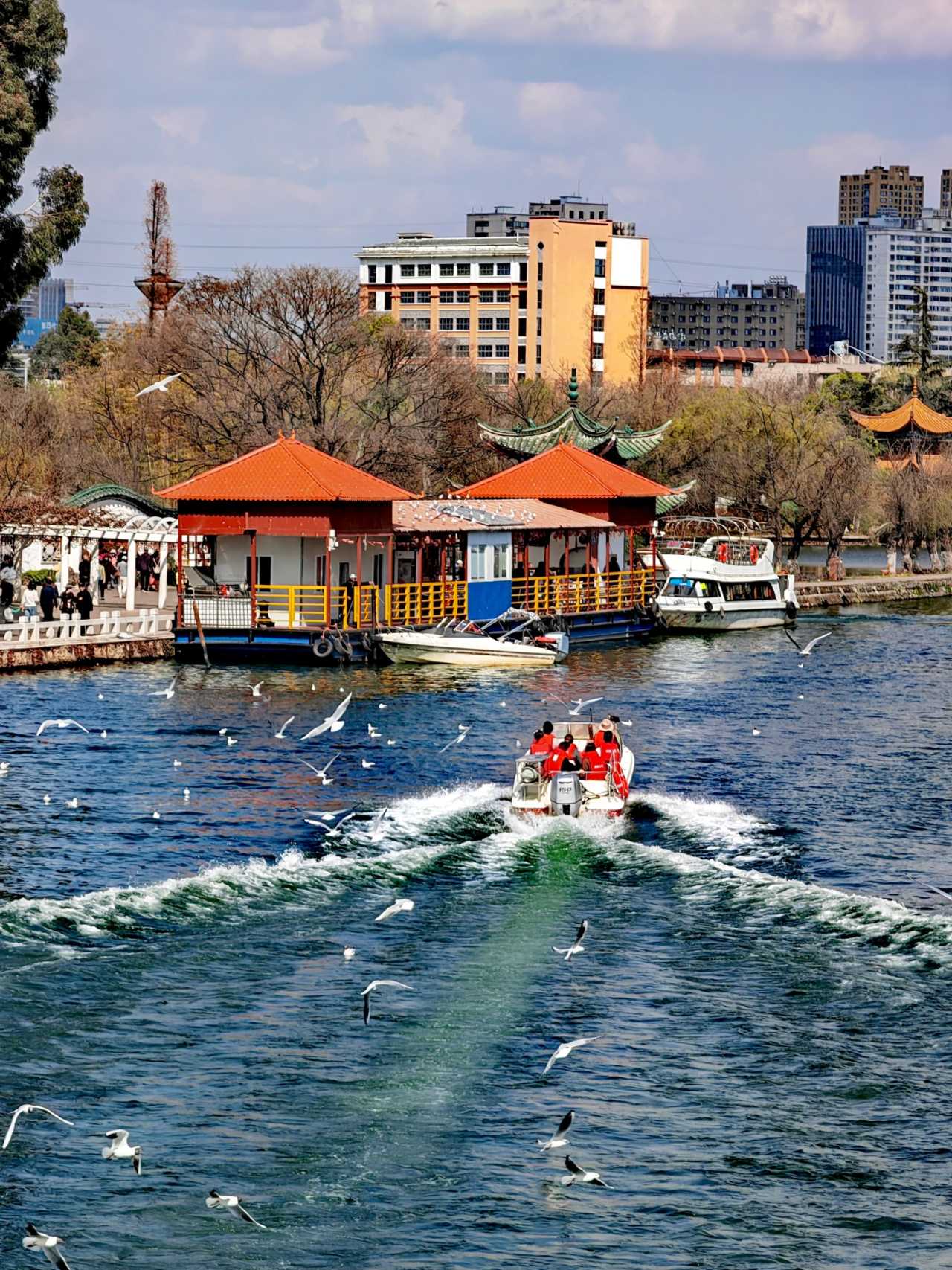
Laohuzui Terraces are in the southern Ailao Mountains, with a typical "two mountains embracing one valley" topography. The mountains are high, the valley deep, and the terrain steep, with a vertical drop of over 2,000 meters and up to 3,700 tiers. It's also one of the best sunset viewing spots.
Laohuzui has an upper and lower viewing platform. The upper platform offers a panoramic view, while the lower platform requires descending 400 steps for a closer look. If you're up for it, I recommend walking to the lower platform for better photos. From above, the terraces resemble a giant white flower in bloom, with over 3,000 mu (about 500 acres) of varied shapes, like a resting pistil.
Accommodation: Yuanyang Yunshang Banshan Leisure Hotel
On the fifth night, we stayed at Yuanyang Yunshang Banshan Leisure Hotel, opposite the visitor center and next to Qingkou Terraces. Prices range from 400 to 900 yuan. The standard rooms are decent but slightly less well-equipped than hotels in the county town. Since we had to get up early for sunrise, the hotel offered a simple breakfast-to-go pack with small bread, biscuits, eggs, milk, and fruit.
Food Recommendations
At a farmhouse near Laohuzui Terraces (I didn't catch the name), we had an amazing braised chicken for lunch. It didn't look great, but everyone raved about it. The whole chicken was stewed into a sweet, savory broth that we finished completely. One whole chicken cost 150 yuan.
For dinner, we ate at the hotel. Since it was raining, most guests ate there, and the service was slow. We ordered stir-fried beef with mint, steamed egg custard, brown sugar glutinous rice cake, and stir-fried greens, totaling over 160 yuan. The beef in the mint dish was chopped very finely — not my favorite — but the other dishes were good.
Epilogue: Southern Yunnan — Worth a Return
Eight days, seven nights — from Kunming's red-beaked gulls to Dongchuan's red land, from Yuanmou's earth forest to Yuanyang's terraces, from Maitreya's art town to Pingbian's Miao city secrets — Southern Yunnan unfolds like a slowly opening scroll, each stroke bold and vivid, every scene unforgettable.
Traveling with parents, the biggest fear is exhaustion. But this trip had a comfortable pace — not too fast, not too slow. The attractions weren't crowded, the food was affordable and tasty. Watching my parents laugh like children before the red-beaked gulls, linger reluctantly at the terraces, and relax in the hot springs — these moments were more precious than any scenery.
Southern Yunnan isn't the kind of place that dazzles you at first glance. It asks you to slow down and feel it. The fiery red land, the shimmering terraces, the vast earth forest, the tranquil Miao city — these colors will slowly seep into your memory, becoming the warmest palette in your heart.
When it comes to Yunnan, there are only two options: never, or countless times. And Southern Yunnan is a place you'll never want to leave.
You should also read:

Cloud Travelogue · Dali of Wind, Flowers, Snow, and Moon: A Three-Day, Two-Night Journey of a Free Spirit
Cloud Travelogue · Dali of Wind, Flowers, Snow, and Moon: A Three-Day, Two-Night Journey of a Free Spirit I am a cultured female foodie with a touch of rogue charm. I slung on my backpack, took my lover's hand, and set off on a spontaneous…
Continue reading...
Golden Luoping: A Romantic Encounter with Sunshine and Seas of Flowers
Golden Luoping: A Romantic Encounter with Sunshine and Seas of Flowers Introduction: The Third Time's the Charm Some landscapes are destined to be seen at the right moment. For me, that was exactly the case with Luoping's rapeseed flowers. On February 22, 2011, the Luoping…
Continue reading...
The Meaning of Travel – A Tengchong Story: A Journey of the Heart and Personal Growth
The Meaning of Travel – A Tengchong Story: A Journey of the Heart and Personal Growth Setting Out, Only to Return a Better Self Some say travel is nothing more than leaving a place you're tired of, only to go to a place where others…
Continue reading...