Rhapsody of the North Atlantic: Surprises and Wonders at the Foot of Benbulben
Rhapsody of the North Atlantic: Surprises and Wonders at the Foot of Benbulben
Some places are simply born to be written into poetry. Ireland, that emerald island embraced by the Atlantic, is precisely such a place. It doesn’t flaunt itself like Paris, nor does it carry the weight of Rome. Yet it possesses a magic that makes you willingly surrender to its charms. When Lord Byron wrote, “There is pleasure in the pathless woods, there is rapture in the lonely shore,” he could never have imagined that more than two hundred years later, a traveler from the East would follow the指引 of those very words and set foot on this land seemingly forgotten by time.
In the autumn of 2018, I set out alone, driven by an obsession with distant horizons and a hunger for the unknown, on an eleven-day journey through Ireland. With a budget of around twenty thousand yuan per person, I started in Belfast, Northern Ireland, and pushed westward along the Wild Atlantic Way, eventually arriving at the foot of Benbulben Mountain. This trip was less a vacation than a deep conversation—with myself, with history, and with nature.
Wounds and Faith: Belfast’s Darkest Memories
A City Drenched in Rain

When I arrived in Belfast, a steady drizzle was falling. The capital of Northern Ireland sat like a massive, slate-gray cobblestone, pressing heavily against the bay. The rain didn’t just wet the rooftops—it seemed to seep into the very soul of the city.
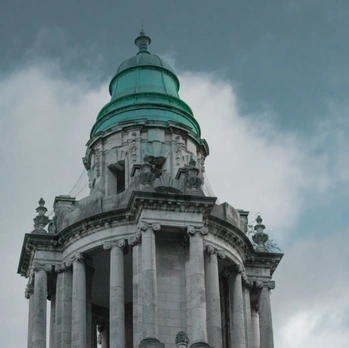
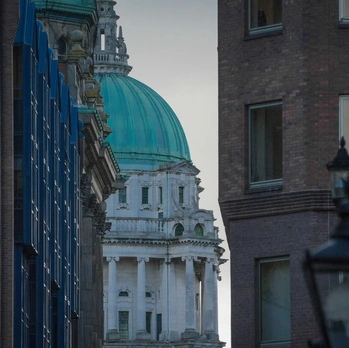
Walking through the streets, I could see the green-domed City Hall, a Renaissance Revival structure completed in 1906, built from Portland stone. It stood as a testament to Belfast’s industrial glory. But what truly caught my attention were the invisible scars. Just thirty years ago, this city was a epicenter of European terrorism, with the shadow of the Irish Republican Army looming over every street. More than three thousand lives were lost under the banner of faith.
The Peace Wall: More Than a Barrier
The next morning, I braved the drizzle and walked toward the Peace Wall in West Belfast. This is one of the most famous separation barriers after the Berlin Wall, with Catholic and Protestant communities living on either side. I was told that even in death, people of different faiths refuse to be buried together—as if they needed a wall underground as well.
The black taxi drivers who operate near the wall know this history better than anyone. They ferry tourists around, recounting the past in vivid detail. My driver handed me a marker and invited me to leave a message on the wall. Among the graffiti, “peace” and “love” were the most common words, but the one that struck me most was: “Do the right thing.”
Standing there, I couldn’t help but recall Tennyson’s words: Ireland’s cruelty stems from a lack of imagination. Here, faith divides hearts, and the Peace Wall divides the entire city.
From the Big Fish to the Titanic
After immersing myself in history, I found a Mexican restaurant in the city center and ordered a taco. In the UK and Ireland, Guinness stout is practically a staple with every meal.
On the banks of the River Lagan, a giant ceramic salmon made of blue tiles stood quietly. This is a Belfast landmark, with each scale etched with stories of the city. Legend has it that the sculpture commemorates the day this magical fish returned to the river.
Not far away is the Titanic Belfast museum. This 34.7-meter-tall building matches the height of the Titanic itself, its exterior clad in reflective aluminum panels. Some see it as a giant ship; others imagine it as the iceberg that doomed the vessel. Inside, a small cable car takes you on a journey from top to bottom, tracing Belfast’s rise from a small town to an industrial powerhouse, culminating in the construction of the Titanic. History unfolds before your eyes.
Embers and Legends: A Game of Thrones Journey Through the Dark Hedges
A Host with a 9.9 Rating
The attractions of Northern Ireland are scattered across small towns north of Belfast, making self-driving the ideal option. For a traveler like me relying on public transport, staying with locals became the only choice.
In the small town of Ballymoney, I found Elaine’s house—a two-story villa with a rating of 9.9. Every review praised the warmth of this elderly host. When I arrived around eight in the evening, the main street was empty, with only a few small shops glowing faintly. Dragging my suitcase along a country path, I quickened my pace, thinking to myself: Ireland must be one of the safest countries in Europe.
The moment I stepped inside, Elaine saw me alone with my luggage and asked in surprise, “Didn’t you drive?” When I told her I came by train, she immediately pulled out a map and helped me plan the next day’s itinerary. “Three places in one day should be enough. Don’t be fooled by the map—they’re closer than they look, but there’s still some distance.”
The Giant’s Causeway: Nature’s Masterpiece
The next morning, I boarded the train to the Giant’s Causeway. This railway line is a lifeline for the local residents, with only a handful of students and early workers on board.
At the visitor center, the staff told me that if I only wanted to see the causeway without using the facilities, I could enter for free. Looking at the cold, damp weather outside, I rubbed my hands together and decided to buy a ticket anyway—at least I could have lunch indoors.
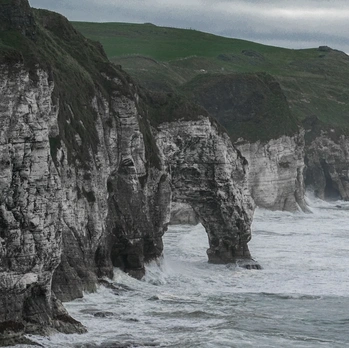
The Giant’s Causeway was formed 50 to 60 million years ago, when the North Atlantic Plate separated from Europe, triggering volcanic eruptions on the ocean floor. Molten lava met the icy waters of the North Atlantic, cooling and cracking into the hexagonal and polygonal basalt columns we see today. Over 40,000 columns stretch irregularly for several kilometers, rising up to 12 meters above sea level—a breathtaking sight.
In Irish legend, a giant built a stone path across the sea to challenge a Scottish giant. The Scottish giant crossed over to seek revenge but was frightened away by the Irish giant’s baby disguise. As he fled, he tore up the path, leaving behind what we now call the Giant’s Causeway.
Dunluce Castle and the Dark Hedges
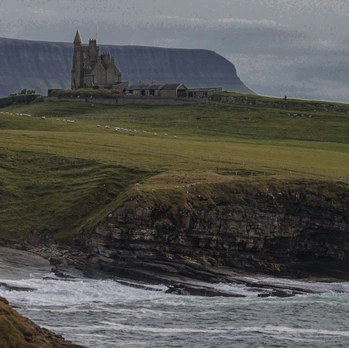
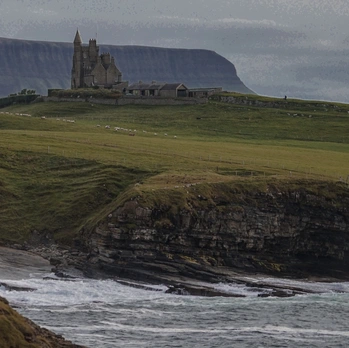
A short bus ride from the Giant’s Causeway brought me to Dunluce Castle. This ruin perched on a cliff edge is the inspiration for Cair Paravel in The Chronicles of Narnia. The castle belonged to the MacDonnell family, but they abandoned it in 1639. Rumors say the kitchen collapsed into the cliff, with the cook barely escaping.
By evening, I reached the Dark Hedges. This short, hundred-meter lane sits right next to the main road, easy to miss. The beech trees, some two to three hundred years old, look eerie in the twilight, their branches intertwining in layers. This is the King’s Road from Game of Thrones, where young Arya Stark disguised herself as a boy to flee King’s Landing.
Elaine’s advice had been spot on: come either early in the morning or late in the evening, or you’ll be sharing the spot with busloads of tourists from Belfast and Dublin.
Desolation and Silence: Poetic Dwelling at the Foot of Benbulben

Mussenden Temple: Solitude on the Cliff
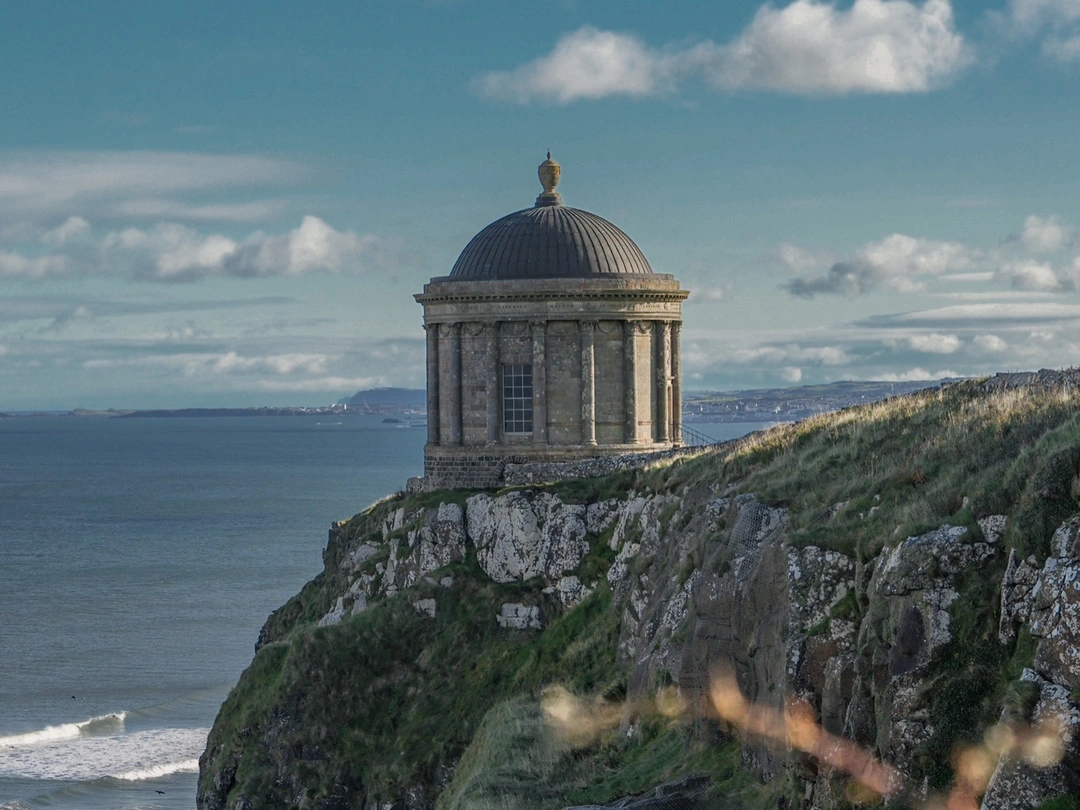
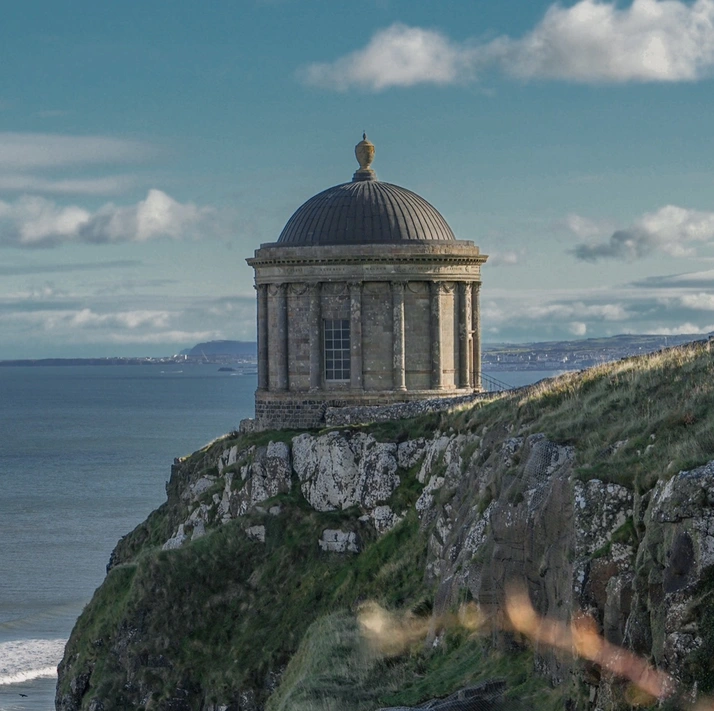
The next day, under a rare patch of sunlight, I visited Mussenden Temple. This small Roman-style temple stands alone on a cliff edge, with the calm sea behind it. Built in 1785, it has been gradually moving closer to the edge as the cliff face erodes over the years.
“Lovely weather today, isn’t it?” a man walking his dog started the classic small talk. Northern Ireland’s weather is usually gloomy, so a day like this was indeed a treat. His dog broke free from the leash and rolled joyfully on the grass. Below the cliff stretched seven kilometers of sandy beach, a famous surfing spot. From the beach, this view is the setting for Dragonstone in Game of Thrones.
The Wild Atlantic Way: A Driver’s Paradise
Beyond its iconic green landscapes, Ireland is famous for its rugged coastline. The Wild Atlantic Way stretches 2,500 kilometers from north to south, passing through Londonderry, Sligo, the Cliffs of Moher, and more. It showcases Ireland’s wildest, most natural, and most mysterious side.
As for me—a “madman” trying to follow a driving route using public transport—I could only pick a few places that intrigued me most.
Benbulben: Yeats’ Poetry and Beyond
Mullaghmore is an incredibly tiny town, about a twenty-minute drive from Sligo. Though I only encountered a handful of elderly tourists during my visit, it transforms into a popular surfing spot every summer.
Benbulben Mountain lies 15 kilometers north of Sligo, a strikingly shaped limestone hill. From a distance, it looks like a giant slice of matcha cake. It frequently appears in the poetry of W.B. Yeats, earning the nickname “Yeats’ Country.”
When a traveler arrives here, they don’t want to leave. It’s so peaceful and quiet, without the noise of pubs. You almost dare not speak loudly, afraid to disturb the tranquility. Walking through the green fields, I found myself clasping my hands behind my back, adopting a carefree, leisurely pose.
Encounter with a White Horse
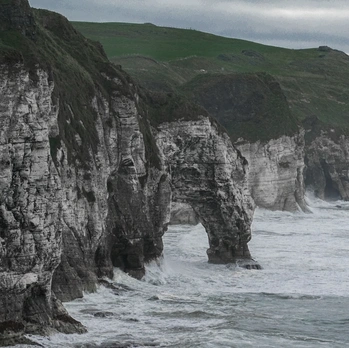
I sat on a bench by the sea, a blanket wrapped around my knees, gazing at the Atlantic. White waves crashed like lightning against black rocks, their jagged forms resembling spaceships from Star Wars jutting deep into the North Atlantic.
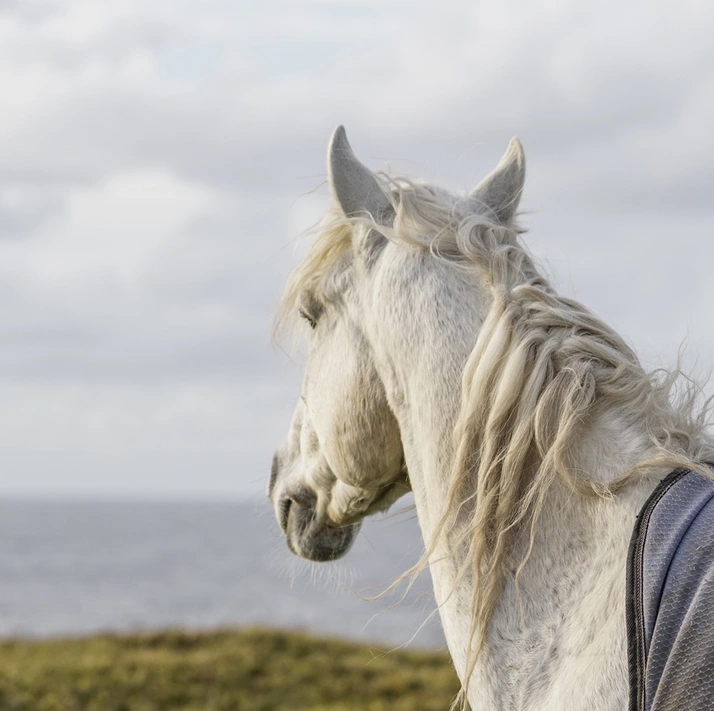
Suddenly, against the gray sky, a figure appeared—a horse. Pure white, with a golden mane flowing in the wind, it galloped toward me. It neighed loudly and stopped by the fence. I broke into a sweat—partly from fear it might leap over, partly from amazement that such an elegant creature could exist in this barren landscape.
The scenery here is haunting. But it is precisely this haunting quality that makes you feel the grandeur of nature and the insignificance of humanity.
Epilogue: Ireland, a Dream Worth Revisiting
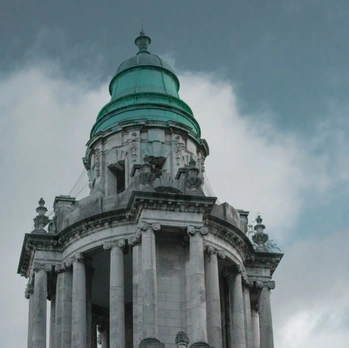
Eleven days of travel—from the gloom of Belfast to the grandeur of the Giant’s Causeway, from the mystery of the Dark Hedges to the poetry of Benbulben. Ireland is like a poem with no end, each page leaving you longing for more.
Here, people build high walls with faith, and also break down barriers with conviction. Nature tests every traveler with storms and wind, yet rewards every effort with breathtaking beauty.
If you plan to visit Ireland, here are a few tips: 1. Self-driving is the best option, especially for the Wild Atlantic Way. If you rely on public transport like I did, plan your time carefully. 2. Stay in small-town B&Bs. Ballymoney, Coleraine, or Bushmills are excellent choices. The warmth of the hosts will exceed your expectations. 3. Bring a thick windbreaker or light down jacket. Even in October, the North Atlantic wind is no joke. 4. Avoid peak hours. Visit the Dark Hedges at dawn or dusk to capture photos that are truly yours.
Ireland, this emerald island embraced by the Atlantic, will not disappoint you. It will leave an indelible shade of green in your memory—one that never fades.
You should also read:
From Resignation to Return: Northwest Yunnan, A Journey of Magical Realism
From Resignation to Return: Northwest Yunnan, A Journey of Magical Realism When "Leaving on a Whim" Meets "The Inevitable Return" For those who love to travel, there's always a restless wind living in their hearts. A few months ago, I quit my job, threw on…
Continue reading...
The Call of Colorful Yunnan: An 11-Day Heartfelt Journey – From Beijing Through the Dreamlike Corridor of Northwest Yunnan
The Call of Colorful Yunnan: An 11-Day Heartfelt Journey – From Beijing Through the Dreamlike Corridor of Northwest Yunnan Setting Off: A Heart Ready to Go Anywhere The rapeseed flowers of Wuyuan had just finished their April bloom when my restless heart began stirring again.
Continue reading...
Hiking Tiger Leaping Gorge: A Visual Feast of Yunnan, Measured in Footsteps
Hiking Tiger Leaping Gorge: A Visual Feast of Yunnan, Measured in Footsteps A Spontaneous Adventure Some trips are planned. Others are written in the stars. When I stood at the Lijiang bus station, watching the last ticket to Lugu Lake sell out before my eyes,…
Continue reading...