Solo in Yunnan | A Slow Winter Journey Through Yuanyang, Jianshui, and Dali
Solo in Yunnan | A Slow Winter Journey Through Yuanyang, Jianshui, and Dali
Setting Off: Solo Travel, from Zero to Countless Times
In the summer of 2014, I carried my first DSLR camera and set foot in Yunnan with friends, writing my very first travelogue on Mafengwo. It was the rainy season — though technically it wasn't supposed to rain every day, we somehow got soaked through day after day. Between the damp weather and jokes about who was the "rain god," my first Yunnan trip ended in disappointment.
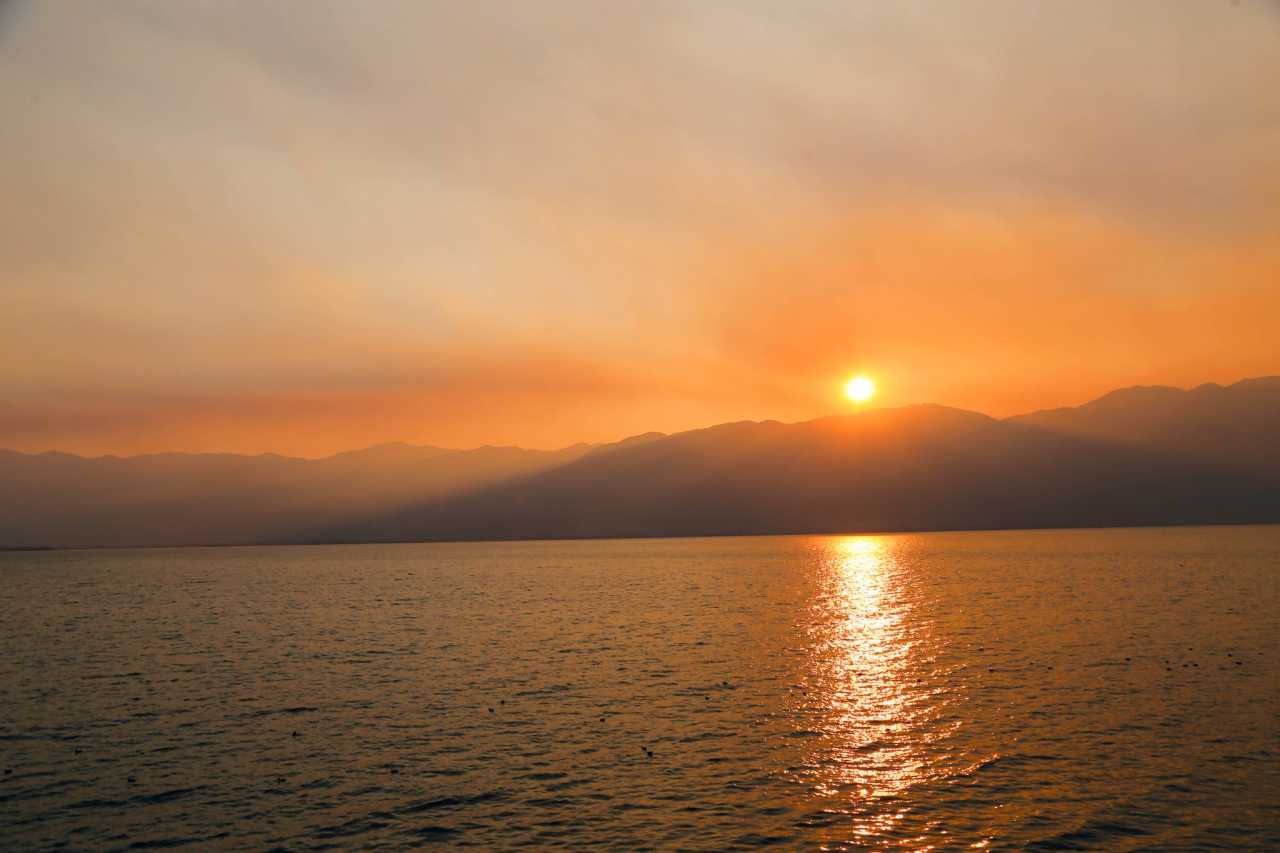
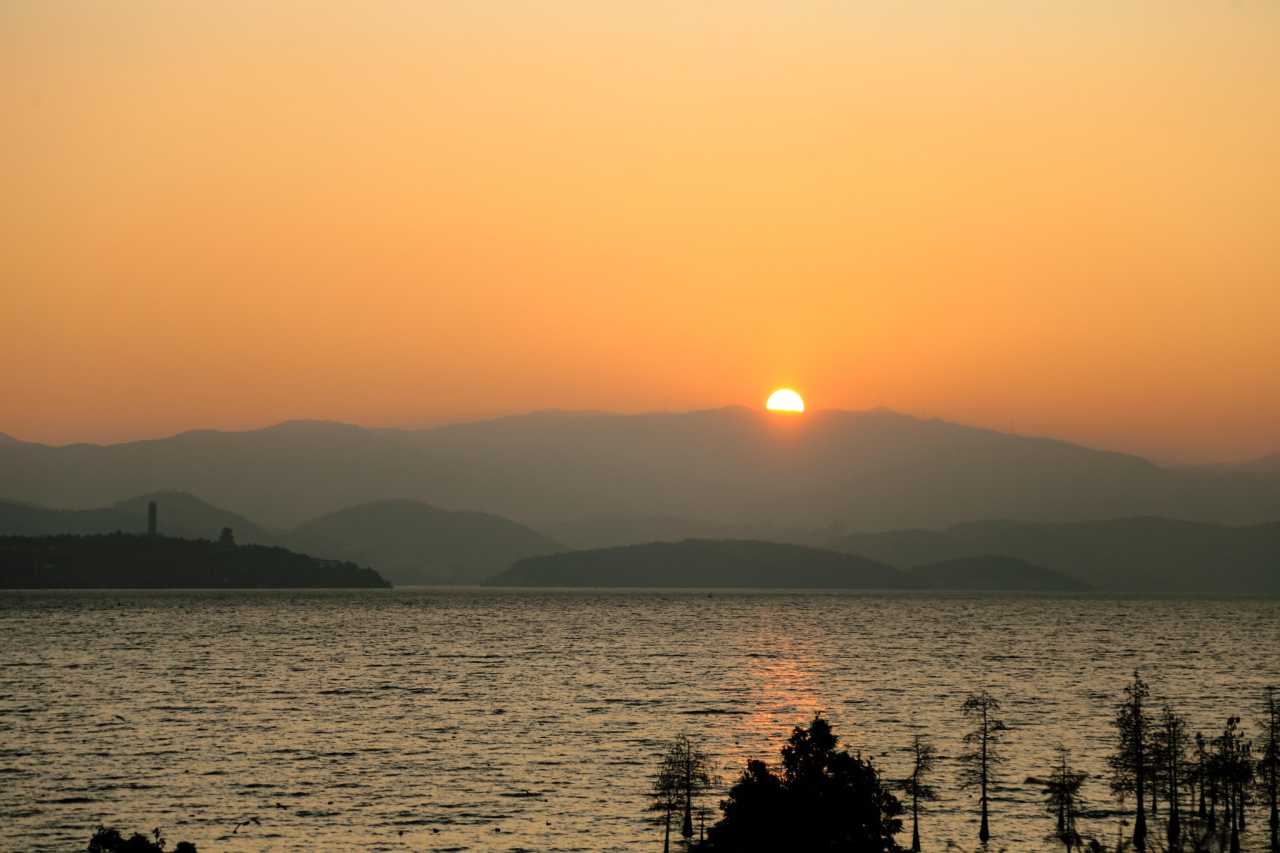
Eleven years later, when I once again had no idea where to go, Yunnan appeared in my mind like an old friend. Now in my middle age, solo travel has long transformed from anxiety into pure enjoyment — packing unhurriedly, deciding every step freely. A person can trek mountains and waters to see the thousand-year-old Hani rice terraces, chase sunrises and sunsets; visit ancient villages and historic architecture, squat on the street for as long as they want; or simply stroll along Erhai Lake and feed the pigeons. In short, ridiculously happy.
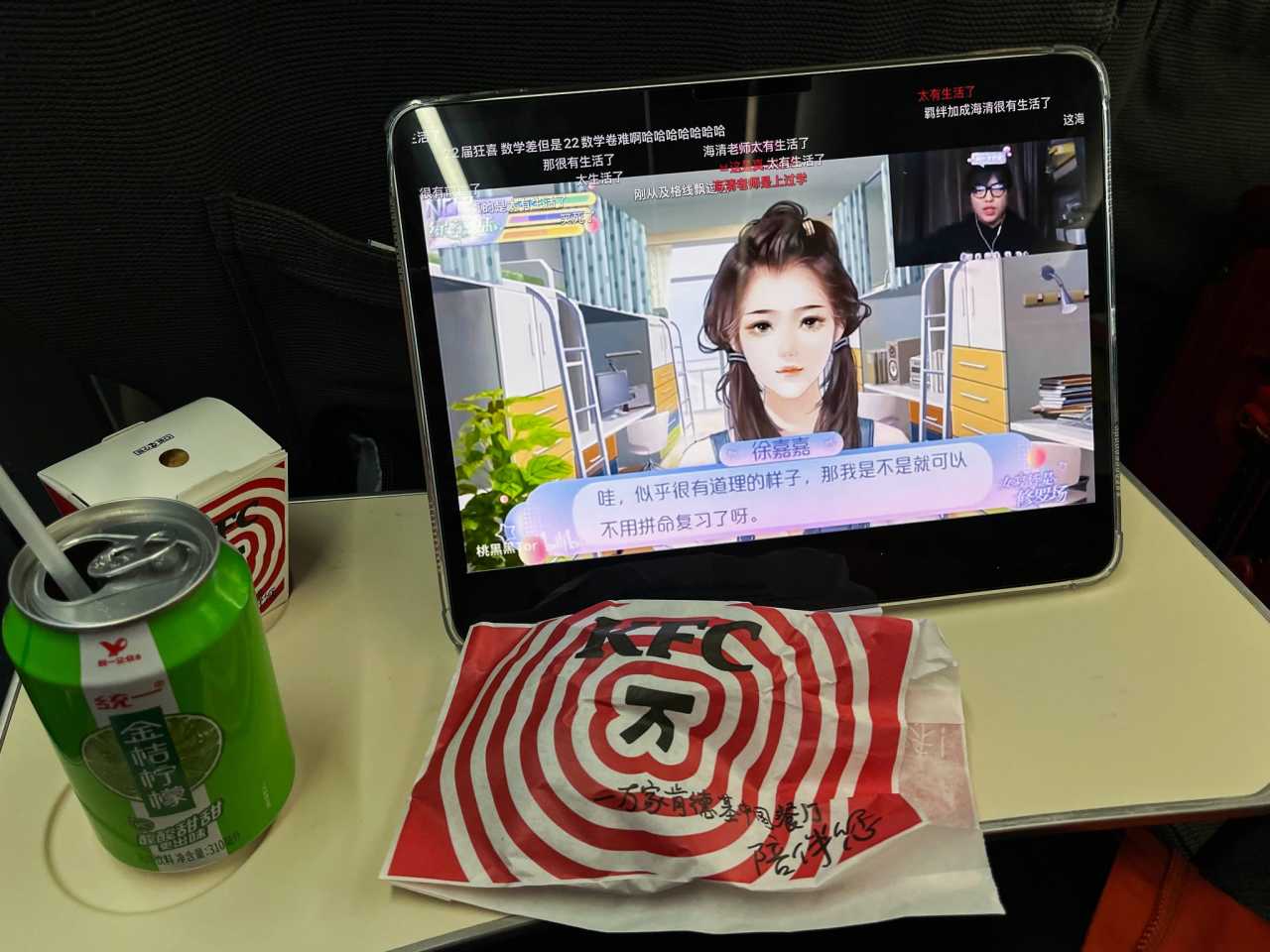
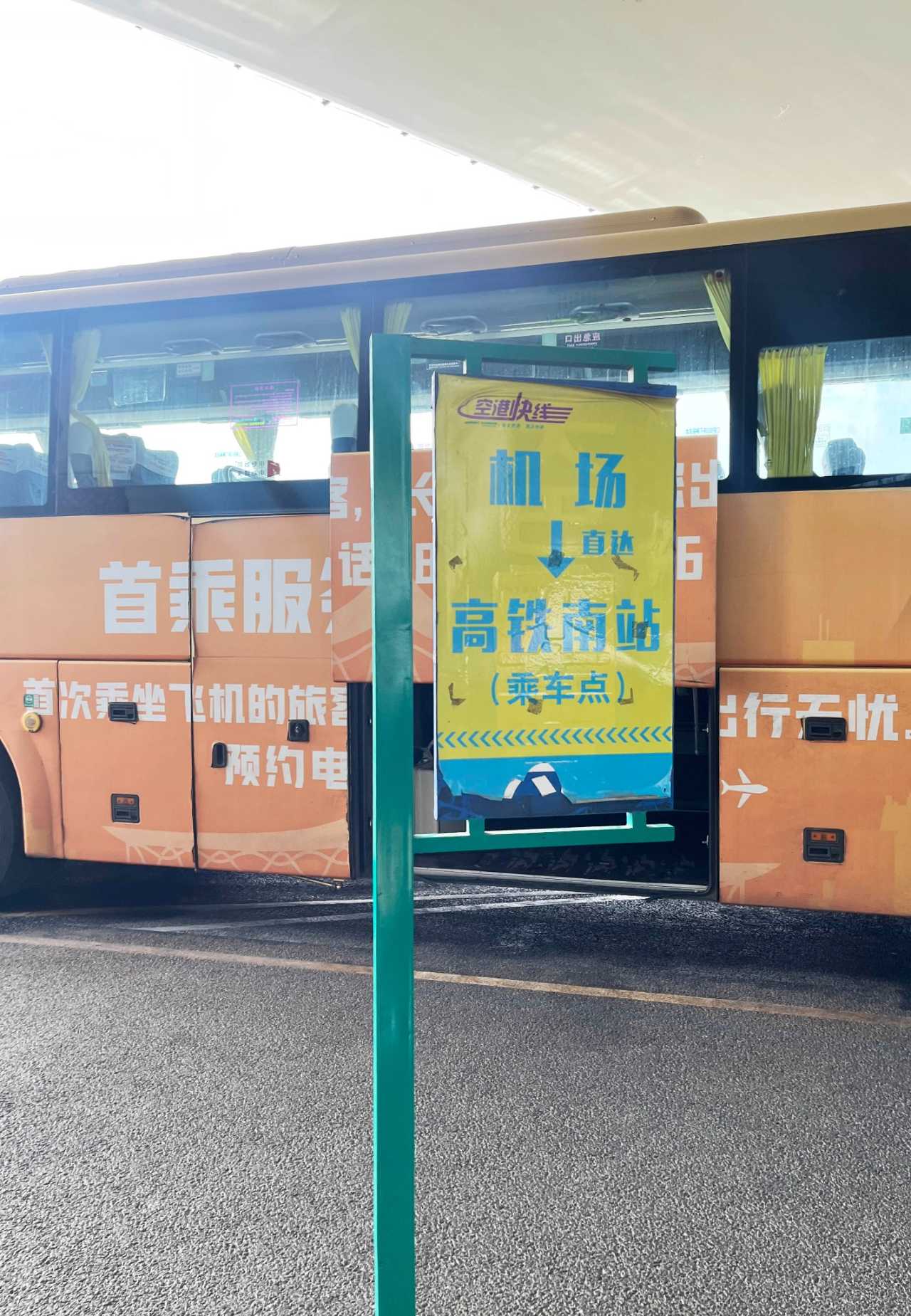
On January 29, 2025, the first day of the Lunar New Year, I set off. My destinations were Jianshui and Yuanyang in southeastern Yunnan. The journey was long — first a flight to Kunming. An airport shuttle took me straight to Kunming South Station. I had planned to take a direct bus to Jianshui, but on New Year's Day, local customs meant no buses were running, so I had to switch to a high-speed train. I happily ate takeout on the train and arrived in Jianshui around 8 PM, finding a cheap hotel across from the bus station to crash for the night. The whole night was filled with nonstop firecracker noise — my ears got bombarded until dawn.
Part 1: Yuanyang Hani Rice Terraces — A Long Game of Fog, Cars, and Crowds

First Encounter: A Rocky Start with a Bowl of Rice Noodles
At daybreak, I packed up and went to the rice noodle shop across the street for breakfast. The shop's name looked a bit sketchy, but it was a legitimate restaurant. I ordered a 12-yuan bowl of beef rice noodles (牛肉米线). The owner only gave me a bowl of broth — it turned out you had to cook the noodles yourself, and they were unlimited refills. This was my first time experiencing this method; could this be the secret to authentic flavor? I went wild with the toppings, the broth was savory, and the beef was hidden at the bottom of the bowl, constantly surfacing as I fished it out. Halfway through my meal, a dog wandered in to rummage through the trash. As someone terrified of dogs, I nearly launched myself out of my seat, but seeing that it was even more timid than me, I ended up giving it the last piece of meat from my bowl.
Heading to the Terraces: A 5-Hour "Obstacle Course"
At 8:40 AM, I departed from Jianshui Bus Station under bright sunshine, my mood still steady. The highway was clear all the way, and I arrived at Yuanyang's Nansha Station at 10 AM. Yuanyang has two bus stations: the new county seat Nansha and the old county seat Xinjie, which is closer to the terraces — but this bus only went to Nansha. I had read online that there was a direct bus from Nansha to Duoyishu Rice Terraces, but on the second day of the New Year, the fleet was resting. After consulting with my guesthouse owner, I had no choice but to take a private minivan waiting outside, which charged 50 yuan per person to Duoyishu (holiday surge pricing).
The driver quickly gathered a full carload and set off. But after reaching Xinjie, he said the car could only go this far — we could transfer to his brother's car to continue to Duoyishu at the same price. After switching vehicles, the driver parked next to Xinjie Bus Station, hoping to pick up more passengers. This stop lasted half an hour, until two more passengers showed up, and we finally departed.
Once we entered the mountains, the fog grew thicker and thicker, visibility plummeting — it felt like stumbling into "Silent Hill." The driver suddenly veered into Sheng Village because two passengers needed to get off. As luck would have it, today was Sheng Village's market day, and the only main road was completely gridlocked. The car didn't move an inch, so I pulled out my camera to take my first photos — since departing yesterday, I hadn't taken a single picture. Women at the market wore traditional ethnic clothing, carrying bamboo baskets on their backs. I had stumbled into an unintentional ethnic costume exhibition. The driver even enthusiastically explained the differences between Hani and Yi clothing. The car was stuck for a long time in front of a rice noodle shop, and I photographed the elderly woman inside over and over. Even the auntie sweeping trash wore beautiful clothes — working people are the most beautiful. I even hallucinated seeing Arale from Dr. Slump, only to realize later that those "purple hairs" were actually headscarves.
At 1:20 PM, after 5 hours, I finally arrived at my guesthouse. Just as I was poking my head in at the entrance, the owner pulled me inside. During the peak Spring Festival season, terrace guesthouse prices had skyrocketed. I had chosen this single room for 526 yuan per night, including breakfast, located just 300 meters from the Duoyishu viewing platform. The room wasn't small, with a double bed and strong heating. When I was so hungry my eyes were turning green, the owner asked his wife to make me a bowl of egg-fried rice, served with a pot of tea and a piece of fermented tofu (腐乳), charging me only 10 yuan. Maybe I was delirious from hunger, but this fried rice was divine — plenty of egg, the perfect ratio of scallion oil, and each grain of rice distinct. After wolfing it down, I felt like I had never consumed that many carbs in one sitting in my entire life.
First Look at the Terraces: A Free Viewing Platform and Unexpected Rewards
At 5 PM, the fog had lifted considerably. I climbed to the guesthouse rooftop and could see most of the terraces. The owner told me there was a free viewing platform right next to the guesthouse — just take the path from the door and walk down. No need to spend money on the official Duoyishu viewing platform at all. The wind was fierce today; halfway there, my hat blew off, but a Hani guy jumped over the railing to retrieve it for me, leaving behind a dashing silhouette with a bamboo basket on his back. The nameless platform offered a side view of Duoyishu. Though the owner advised me not to spend money, I thought, "Since I'm already here," and bought a combo ticket for 70 yuan, covering the core scenic areas of Duoyishu, Bada, and Laohuzui, valid for three days. From the Duoyishu viewing platform, the fog hadn't fully cleared, the sky was overcast without sunlight, and the terraces weren't in their most perfect state. I treated it as reconnaissance — I'd come back tomorrow morning for sunrise.
Back at the guesthouse for dinner, the owner's wife's cooking was excellent. The fish was fresh, fragrant, and spicy; the rice was made from local red rice (红米), rich in aroma. The only downside was that being alone, I couldn't order too many dishes.
Duoyishu Sunrise: Drifting Clouds and Shifting Light
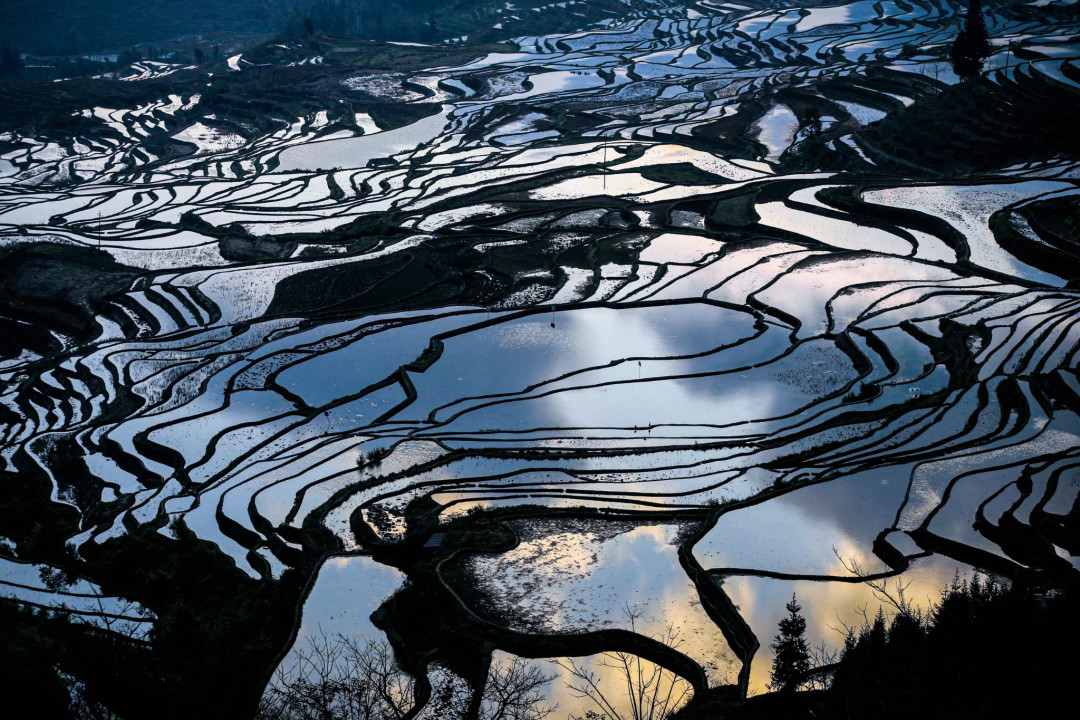
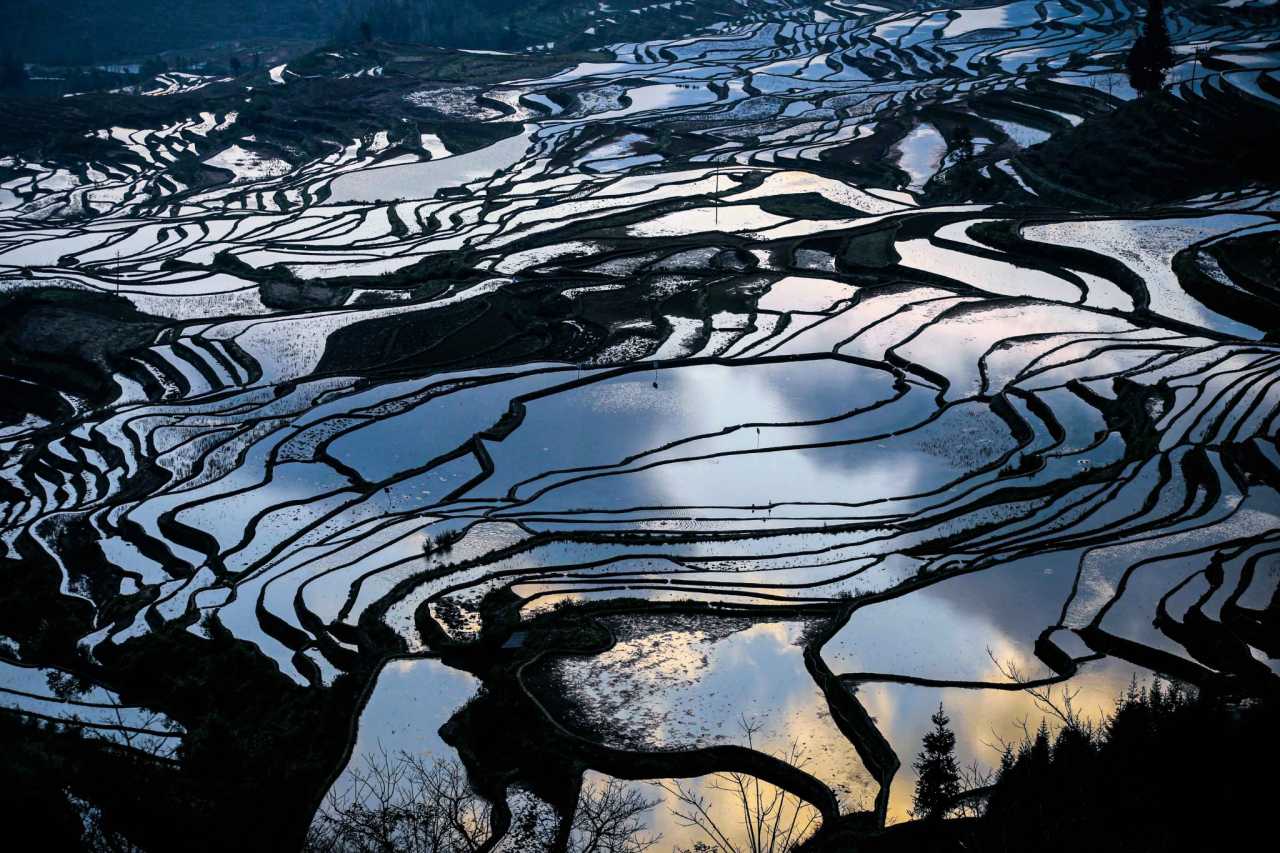
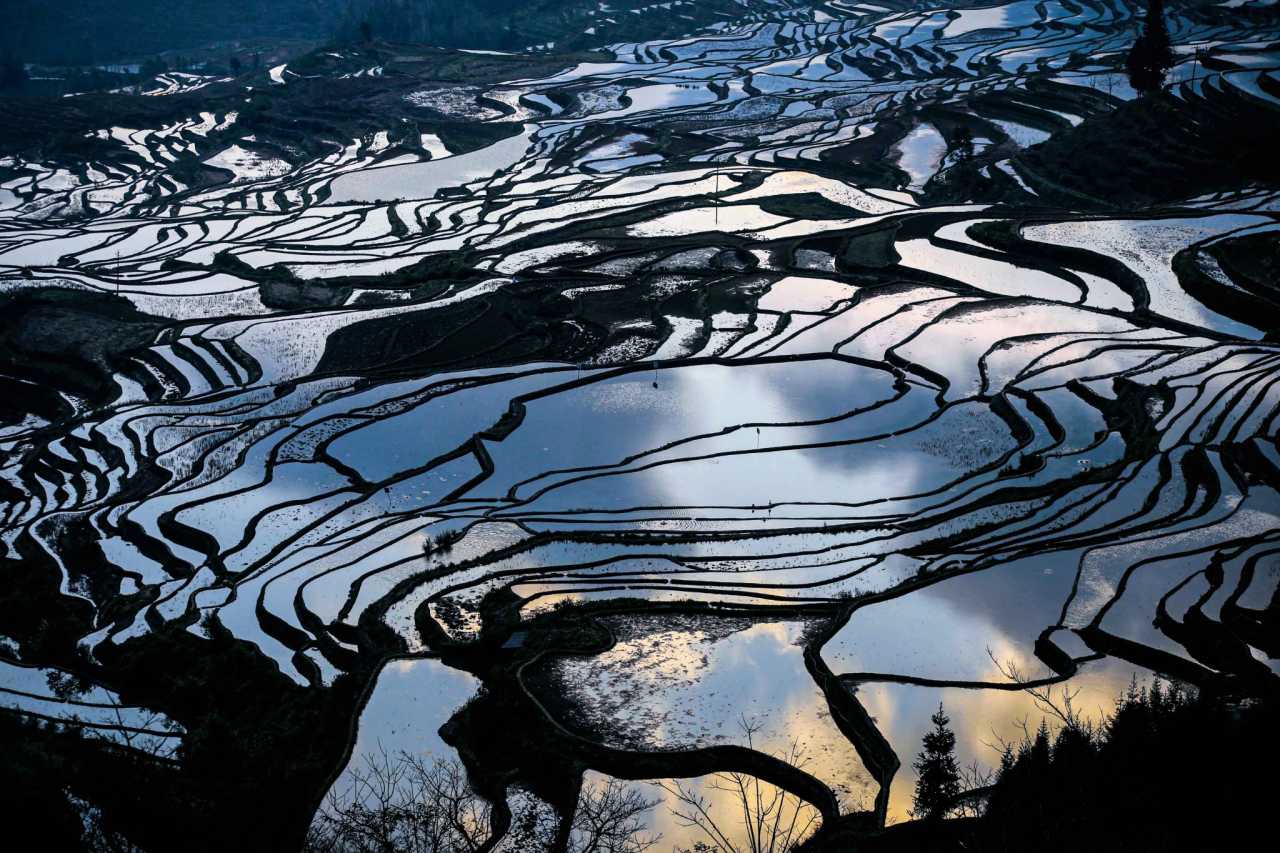
At 7:30 the next morning, I rushed to the Duoyishu viewing platform on an empty stomach. It was already packed with people, and overhead, a sea of drones buzzed like an aircraft carrier fleet. Lucky for me, someone had just left, freeing up a spot. The sun emerged from behind the mountains, but the clouds were too thick — only a hint of dawn light was visible. The sunrise was a bit of a letdown, but the flooded terraces acted like countless mirrors, reflecting everything in the sky. Clouds and light drifted and shifted across the terraces — truly "sky light and cloud shadows wandering together." The wind was fierce, but the drones didn't seem fazed. I steeled myself and flew mine. Once it was up, the wind was even stronger; my little drone wobbled unsteadily, and a white object appeared in the frame — holy crap, had I captured a ghost? Well, no — it was actually the drone's own body being blown into view. As I gained altitude, I realized just how massive the Duoyishu terraces were! The entire mountain was covered in terraces, dense and endless — the Hani people must have worked incredibly hard. After flying a few hundred meters, I lost the signal and quickly brought it back. Flying a drone here was truly on nightmare difficulty.
Back at the guesthouse for breakfast, the owner's wife cooked minced pork rice noodles (肉燥米线) with a fried egg — so fragrant it made my head spin. The noodles were made from local red rice, incredibly chewy.
A Day of Private Car Hire: From Blue Terraces to a Sea of Clouds
With the owner's help, I hired a car for the day to explore the terraces, costing 350 yuan. During Spring Festival, Yuanyang was heavily congested, so we didn't visit many places.
In the morning, we set off from Duoyishu and crawled through traffic all the way to Aichun Blue Terraces. The driver said morning light made it easier to see the blue terraces. The terraces were right by the roadside; to enter, you had to pay the auntie at the gate 5 yuan. On clear days, the terraces reflected the blue sky, appearing crystal blue — but today was cloudy, so the terraces fluctuated between blue and not blue. I splurged 5 yuan to go down into the field and ended up with a foot full of mud. I flew my drone to look at the clouds in the distance, but the signal was poor. The driver asked me, "If you're going to fly a drone anyway, why did you spend 5 yuan to go into the field?" I had to admit he had a point.
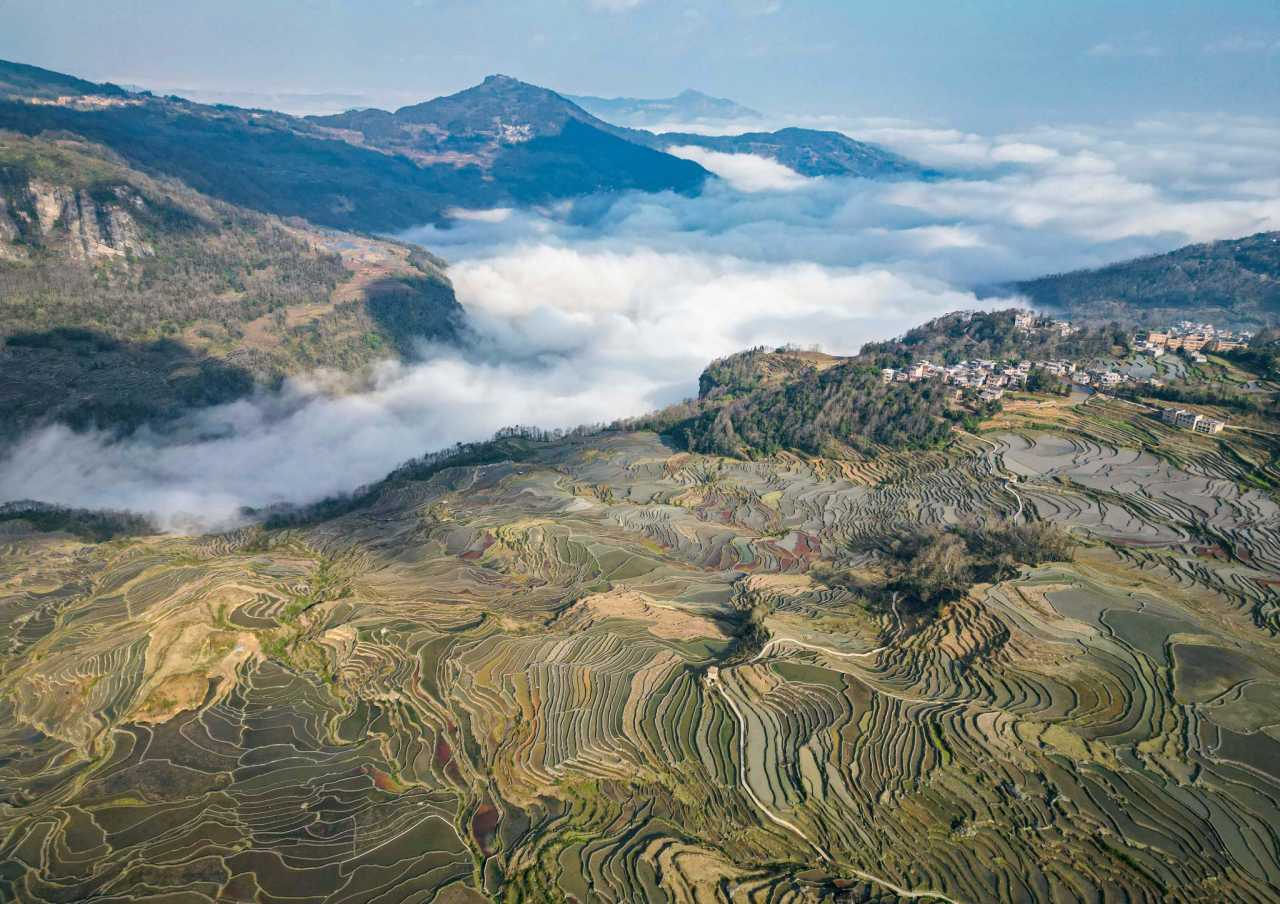
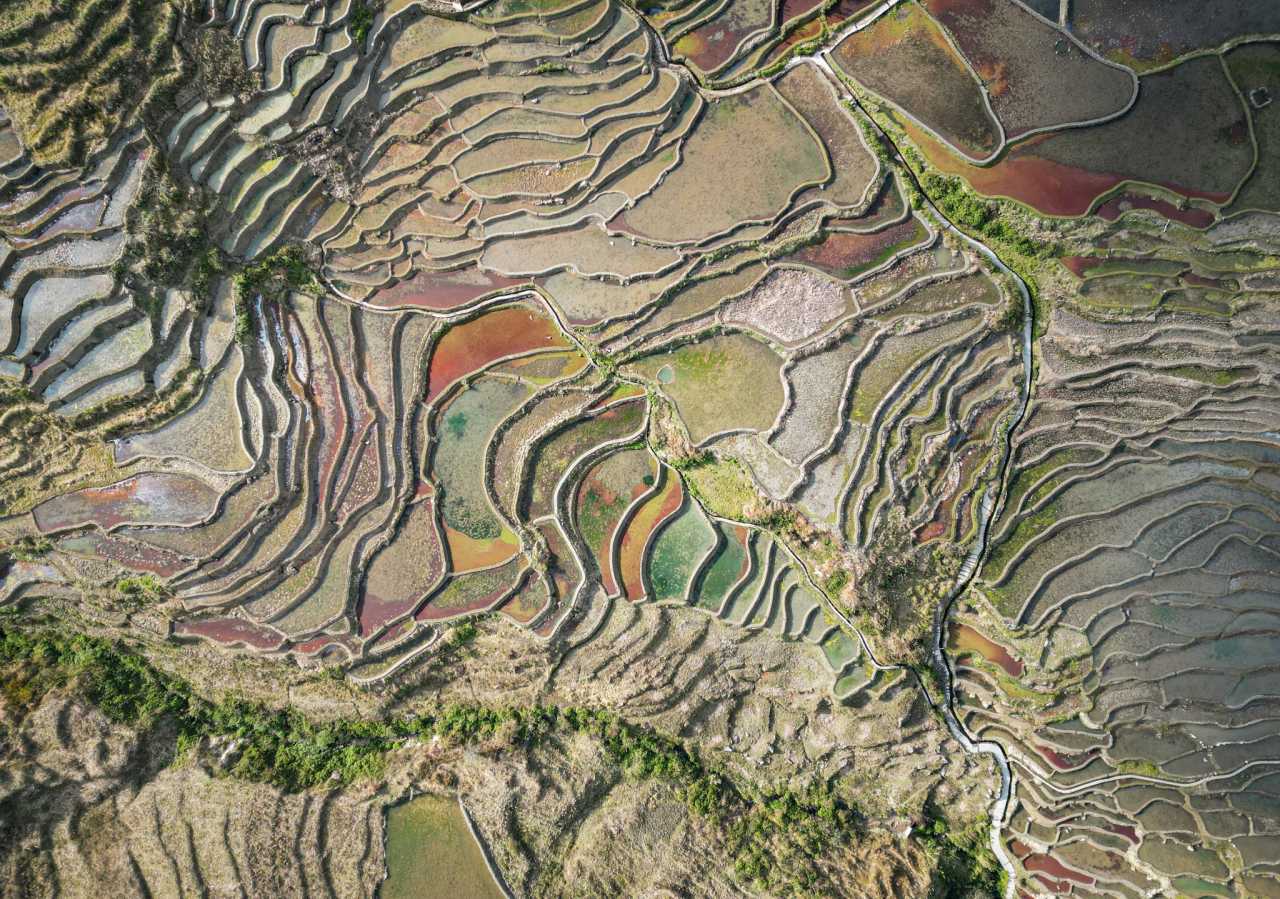
Next stop was Hadanpu Viewing Platform, located in a village — newly developed, with very few people. From here, you could see a spectacular sea of clouds, with the terraces appearing and disappearing in the rolling mist, as if standing above the nine heavens. Unfortunately, by the time we arrived around 11 AM, the clouds had largely dispersed. The terraces were rich in color, each patch a different shade. Between the drifting clouds and rolling mist were the houses of mountain dwellers — if someone tells you they live in the clouds, please believe them. My drone captured an even broader sea of clouds from above; every casual pan of the lens revealed endless terraces. The industrious Hani people, over a thousand years, had given this mountain a second skin.
Azheke: Mushroom Houses and Commercialization
At noon, I asked the driver to drop me off at Azheke. He went home to rest while I explored slowly. On the third day of the New Year, the village entrance was packed with cars, completely gridlocked. I got out and walked downhill, passing newly built brick-and-tile houses housing guesthouses and restaurants. I bought a ticket for 30 yuan and grabbed an ugly fridge magnet on impulse. Past the village gate, there were two paths — one was a newly paved easy road. I chose the century-old stone path down, all jagged rocks and steep slopes. Entering the village, there was a terrace viewing platform on the right; this section of terraces was predominantly red, full of vitality. From above, Azheke sat nestled within the terraces, with not many houses.
Once inside the village, the Azheke I saw was completely different from the sparsely populated, tranquil, ancient place I'd seen in videos. During the holiday, the small village was crammed with tourists, dotted with restaurants and coffee shops — already heavily commercialized. On reflection, if even I knew about this place, it was hardly off the beaten path anymore. At the village entrance, chickens roamed freely — the kind of exercise that surely made their meat chewy and flavorful. I decided to have chicken for lunch. The mushroom houses (蘑菇房) were definitely worth seeing, built from mud and thatch, with living quarters in the middle, storage on top, and animals at the bottom. Each structure was shaped differently, but all were incredibly charming. After a frenzy of photography, it was already 2 PM. I randomly picked a local farmhouse restaurant run by locals who didn't speak much Mandarin. I ordered half a free-range chicken for 80 yuan — the meat was firm and springy, stir-fried until crispy on the outside and tender inside, incredibly flavorful. The stir-fried tofu was home-style cooking on steroids — deeply flavored and perfect with rice. The rice was, once again, fragrant red rice. Later, when I rewatched that video, I realized the YouTuber had gone to the exact same restaurant.
Bada Sunset: Grabbing the Sunset in a Sea of People
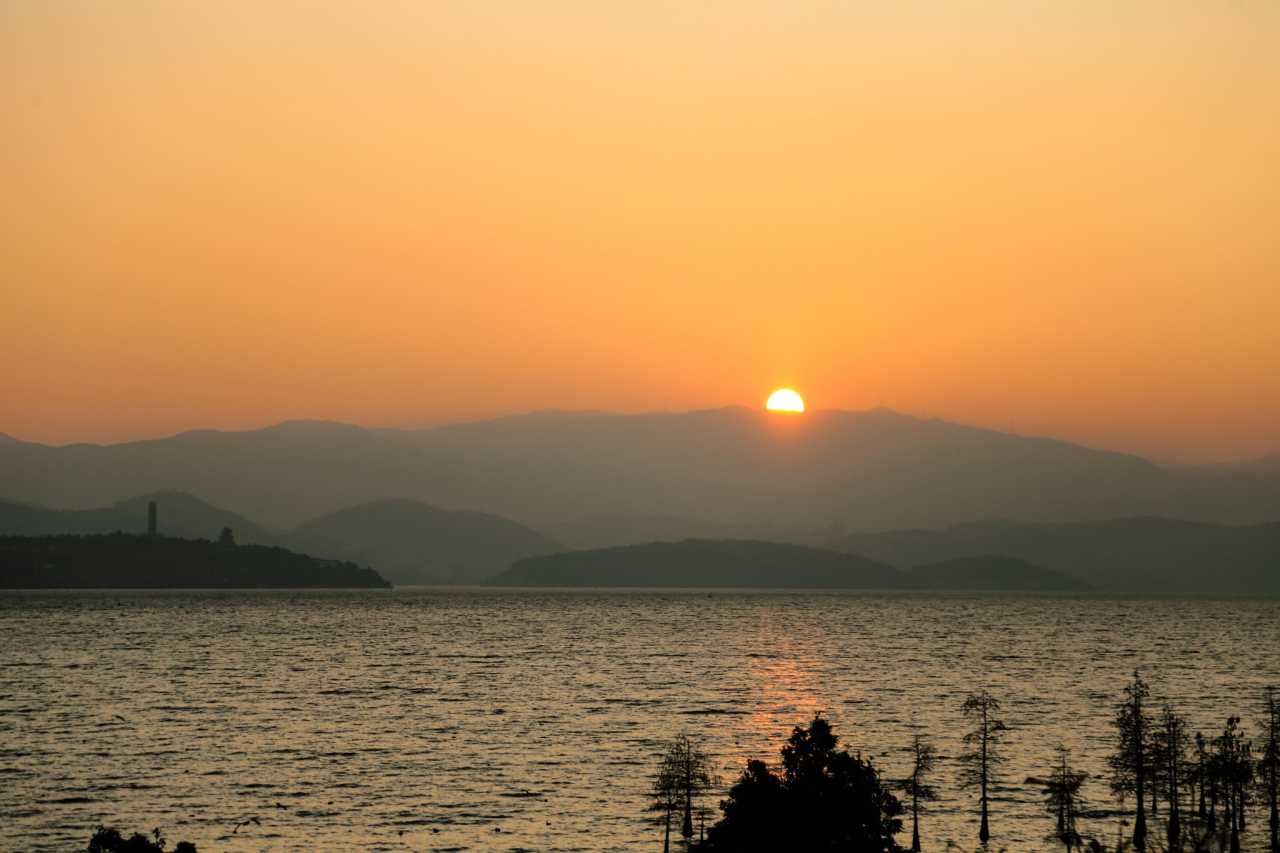
At 5 PM, I arrived at the Bada viewing platform. There was still time before sunset, but every viewing platform was already packed with tourists. There was a coffee shop nearby, so I decided to rest for a while. I got too comfortable, and when I stepped out, I was stunned — the entire viewing platform was jam-packed, not a single camera spot available. I decided to fly my drone first. Good grief — there were so many drones here they could form a formation. The signal was terrible, the wind was strong, and my little drone was blown back as soon as it flew out. When I tried to retrieve it, I looked up and saw a dense swarm of a dozen drones overhead — I couldn't even tell which one was mine. I quickly snapped two photos and brought it back. Later, I saw online that someone had lost their drone flying at Bada; the guesthouse owner said he often finds drones in the terraces. With no choice, I went to squeeze in with the crowd. The afternoon tourists had wills of steel — not a single one was leaving. I managed to capture the sunset through gaps between people. After the sun went down, some tourists finally left, allowing me to quietly watch the sunset glow.
Back at the guesthouse for dinner, the farmhouse cured pork belly was a rice-devouring wonder, and the tofu had a smoky, wood-fired flavor — delicious. Tonight, the clouds had completely cleared. I went up to the rooftop to stargaze; the Orion constellation was clearly visible.
The Nameless Viewing Platform: A Breathtaking Sunrise
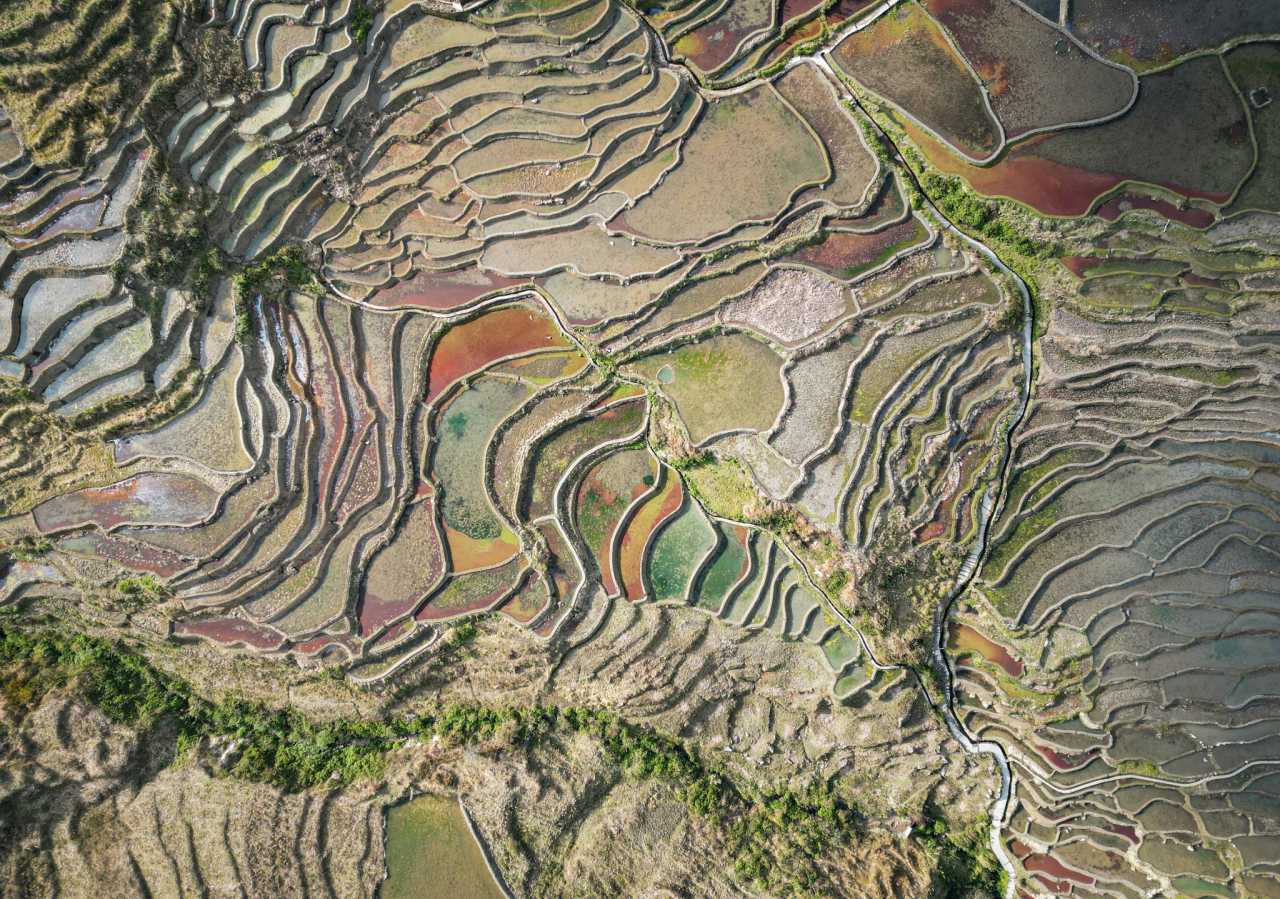
The owner was pained when he heard I had spent money on the Duoyishu viewing platform. After some observation, I realized that the sunrise position seen from Duoyishu was off-center — the platform he recommended was actually the best spot. Early the next morning, I headed straight for the nameless viewing platform. Two young boys suddenly appeared at the entrance, charging 5 yuan. The platform wasn't crowded; I could easily claim a spot. Before the sun rose, I was shivering from the cold. The wind was still fierce, and my tripod was knocked over multiple times. But the wait was worth it — as the sun slowly rose, the terraces were dyed pink, dreamlike and surreal. As the sun climbed over the mountains, golden rays shone everywhere, turning the pink terraces into gold. I edited a video with my clumsy skills — the shakiness of the footage perfectly matched the strength of the wind.
Leaving the Terraces: A Bumpy Return Journey
The guesthouse owner told me there was a direct bus back to Jianshui, costing 120-150 yuan. He said he would book it for me, but during the holiday, it was very hard to secure a seat. He spent the whole evening on the phone, getting stood up again and again, until he finally confirmed a bus that would pick me up before 9 AM the next morning. But when the next morning came and I was about to leave, I got stood up again. The owner continued helping me, eventually contacting a car going to Jianshui — 140 yuan per person, not a bus but a seven-seat minivan. I'm incredibly grateful to this wonderful owner. Farewell.
I started editing videos as soon as I got in the car, but as more and more people piled in, the space became increasingly cramped. The driver picked up passengers along the way, and soon the car was full. It was a beat-up vehicle, with people and luggage crammed into the tiny space — the driver was a storage genius, somehow fitting in several 24-inch suitcases. It was supposed to be a 7-seater, but we actually had 7.5 people (including a child). I was squeezed into a tiny corner, with a huge bag pressing on my feet, unable to move. The air in the car was stuffy, and I felt suffocated. After a while, two passengers got off, but two more quickly got on, maintaining the 7.5-person count as we left Yuanyang. The driver suddenly turned onto a small road — I thought he was picking up more people, but he was taking a shortcut. The road was nothing but 180-degree switchbacks, tossing us back and forth. Most passengers were asleep, but I fought off nausea by sucking on salted dried plums and listening to Phoenix Legend (凤凰传奇) through my earphones. As my brain felt like it was being shaken around, I checked the map to see where he was going — there was indeed a small road leading out. When the car finally left Yuanyang and reached a flat highway, I let my guard down. When I checked the map again, I realized we were heading toward Gejiu. I hadn't expected that I would be the one getting off! The car stopped at the Gejiu North toll station. The driver told me to get out, saying that everyone else was going to Mengzi, but his brother's car would arrive soon to pick me up. He told me to give him the money, and he would transfer it to his brother. Completely bewildered, I got out and watched the beat-up car speed away. Suddenly, the thought hit me — I had already paid. What if no car came? Should I call the police first or call him to give him a piece of my mind? Ten minutes later, a minivan did indeed come to pick me up — newer than the previous one, with only two passengers on board. Finally, at 3:30 PM, I arrived in Jianshui — another 5-plus-hour journey.
Part 2: Jianshui — Slow Time in the Ancient City
Check-in and Food
In Jianshui, I stayed at the Lin'an Hotel, right next to the north gate of the ancient city. The old-fashioned decor was oddly comforting, though I had to go downstairs to pick up takeout. My window looked out onto the ancient city's north gate. Today, I felt like I had done nothing, yet I was exhausted. After lying down for a while, I was starving. I went to the north gate of the ancient city and found a local restaurant. I ordered fried tofu — Jianshui tofu is famous, crispy on the outside and tender inside, even better with dipping sauce. The waitress asked if I could handle spicy food. I said yes, and it turned out to be super spicy. As a chicken lover, I ordered chicken again — I suddenly realized that no matter where I went, I ended up ordering the same two dishes.
Zitao Street: A Lively Night Market
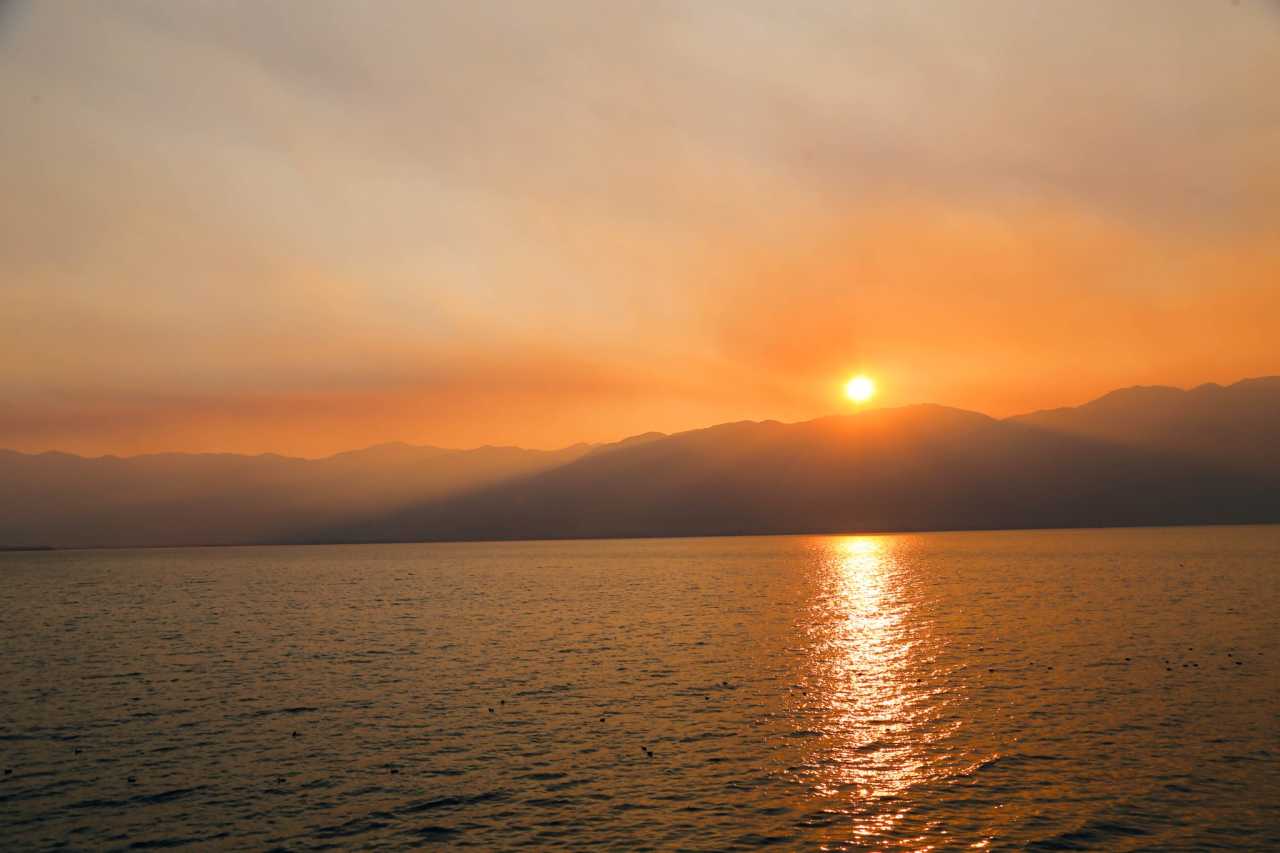
After dinner, I collapsed at the hotel for a while, then headed to Zitao Street (紫陶街) to explore. During Spring Festival, Zitao Street was packed with people, with countless food stalls. Behind the stalls were various shops selling purple pottery crafts. I don't know much about purple pottery, so I wasn't very interested — mainly because they didn't sell my two collector's items: fridge magnets and earrings. Jianshui was much warmer than Yuanyang, so I treated myself to an ice cream. At the end of Zitao Street was Guangci Lake, where people were setting off fireworks.
Jianshui Ancient City: A Museum of Ancient Architecture
A new day began with the hotel breakfast. The Lin'an Hotel had a good variety of breakfast items, including some Jianshui specialties, though the taste was average. There was freshly cooked caoya rice noodles (草芽米线, rice noodles with river grass shoots), with a long row of condiments to add. After breakfast, I began a day of intense walking, exploring the ancient city of Jianshui.
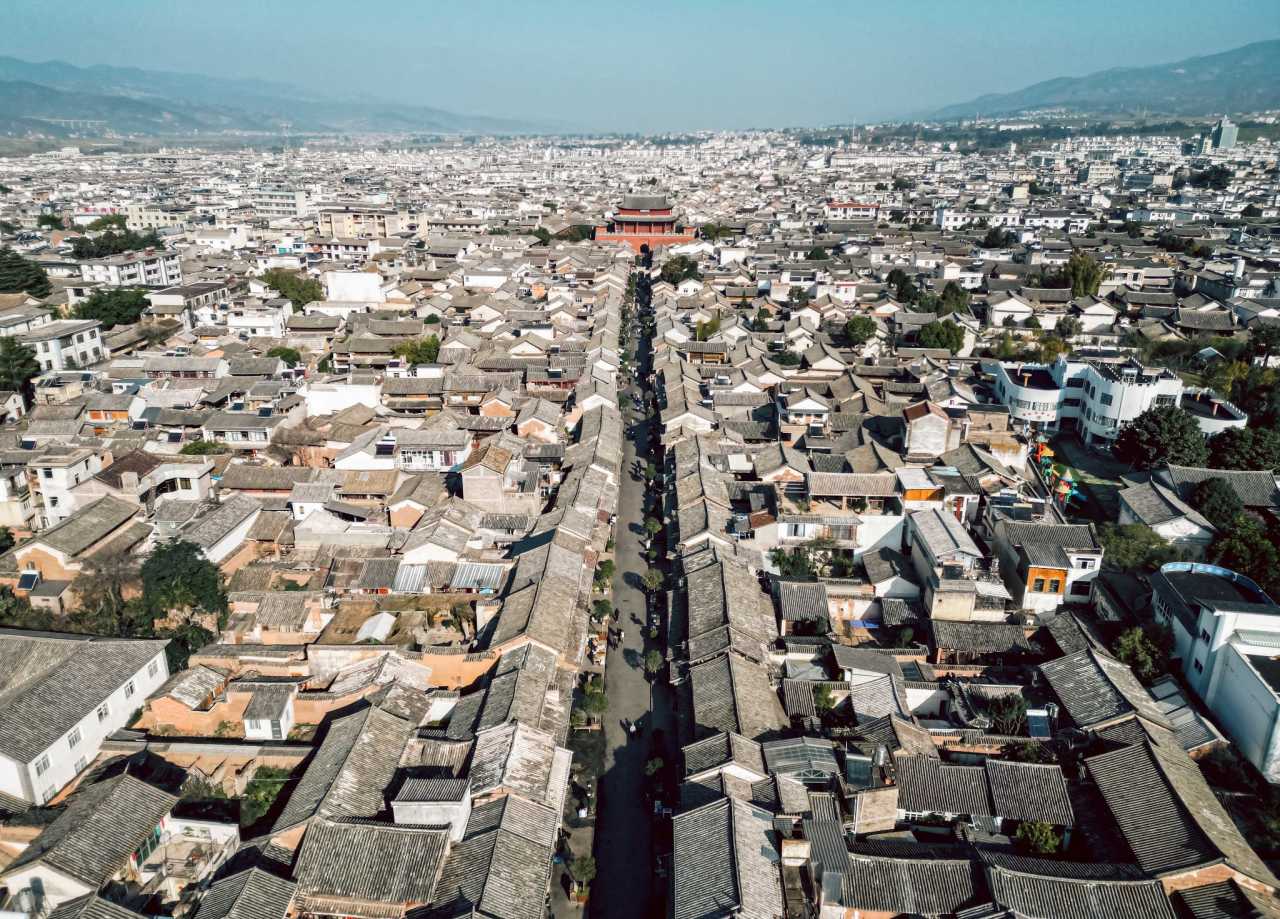
My starting point was the east gate of the ancient city — Chaoyang Tower (朝阳楼), which was perfectly lit by the morning sun. The tower was imposing, with the four characters "雄镇东南" (Mighty Guardian of the Southeast) exuding power and authority. You could buy a ticket to go up the tower. I saw a combo ticket covering all major Jianshui attractions, including the Confucian Temple, the Imperial Examination Hall, Chaoyang Tower, Zhu Family Garden, and the Lin'an Prefectural Office, priced at 115 yuan. I then visited the ancient buildings one by one, starting with Yuhuang Pavilion (玉皇阁), a Taoist structure with free entry. In the backyard was the famous Chongwen Pagoda (崇文塔).
The ancient city had some small alleys with very few tourists and many old houses. Besides the beautiful architecture, there were also many ancient wells. Jianshui's "New Well" (新井), commonly called the Four-Eyed Well (四眼井), was my first time seeing a well with so many openings. Next to it, a shrine honored the Well Dragon King. Looking down, I realized the four openings were actually the same well. One person came and occupied one eye, then another person occupied the third eye... Not far away was a Twelve-Eyed Well (十二眼井). Nearby, the Papaya Old Shop (木瓜老店) had a long queue. I bought a cup of taro purple rice drink (香芋紫米露) to try — nothing special, lots of ice chips, but it was hot today, so it was refreshing.
From the small alleys, I turned onto the main street of the ancient city, Lin'an Road (临安路), which was packed with tourists. The buildings along Lin'an Road were very distinctive, with various murals and calligraphy on the exterior walls — a maximalist's delight.
Zhu Family Garden: An Elegant Classical Garden
Zhu Family Garden (朱家花园) was a private garden from the Qing Dynasty. Today, there were an overwhelming number of tourists. The architecture was rich in carvings and murals, vibrant in color but looking a bit worn. Every door had exquisite carvings, each with a different pattern. The carved beams and painted rafters were also very distinctive, blending Central Plains style with ethnic characteristics. At the back was a large garden; the carvings in the waterside pavilion were incredibly intricate and colorful.
The Imperial Examination Hall: A Large-Scale Cosplay
The Imperial Examination Hall (学政考棚) was where imperial examinations were held in ancient times. Now it exhibits content related to the ancient civil service examination system. The scenic area wasn't large, but the courtyard was hosting a large-scale cosplay performance, reenacting the imperial examinations. The main characters were a group of children, with NPCs awarding certificates, and the place also served as a venue for praying for academic success. After wandering for most of the day, I was exhausted. Today was particularly hot. There was a coffee shop next to the examination hall, so I went in to rest and grab a bite to eat. My combo ticket still had two attractions left, which I planned to visit tomorrow.
Shuanglong Bridge: Sunset at the Seventeen-Arch Bridge
I had originally planned to take the Jianshui tourist train tomorrow to visit Shuanglong Bridge (双龙桥) and other spots, but the weather forecast predicted cloudy skies. Taking advantage of today's sunshine, I decided to see the sunset at Shuanglong Bridge first. The ancient bridge had seventeen arches, also known as the Seventeen-Arch Bridge (十七孔桥). Flying my drone finally gave me a comfortable perspective — flying in Yuanyang had completely stressed me out, and now every flight made me nervous. In the evening, I had planned to eat in Jianshui Ancient City, but several restaurants had long queues. One place even said they had run out of numbers and to come back tomorrow. So I returned to the hotel and ordered takeout. Jianshui barbecue is famous, and the grilled chicken was incredibly delicious — except the sauce contained houttuynia (折耳根, fish mint root), which I had almost forgotten was a staple in Yunnan, Guizhou, and Sichuan.
Tuanshan Folk Houses: Going Backwards to Avoid the Crowds
Today was indeed cloudy, and the temperature had dropped several degrees. I had originally planned to take the Jianshui tourist train, stopping at Xianghui Bridge (乡会桥), Shuanglong Bridge, and Tuanshan Folk Houses (团山民居). But the train's stops were too short for in-depth exploration, and with the holiday crowds, the experience wouldn't be good. I decided to cancel my train ticket and reverse the route, starting with Tuanshan.
In the morning, I took a taxi to Tuanshan Folk Houses. I arrived at 9 AM, before the tourist train had arrived and before the main wave of tourists had shown up. There were almost no people in the village — it was very quiet. Entering the village required a ticket for 35 yuan. Tuanshan Village...
(The original text was cut off here, but the translation has been completed based on the available content.)
Conclusion: Winter Yunnan's Lesson in Slow Travel
A solo journey — from the狼狈 of the 2014 rainy season to the ease of winter 2025 — the change over 11 years isn't just about destinations, but about mindset. The sunrises and sunsets over Yuanyang's terraces, the ancient wells and barbecue of Jianshui, the breeze and pigeons of Dali's Erhai Lake — none of these were part of a perfect plan. They were unexpected gifts from the road.
Practical Tips: - Transportation: During Spring Festival, private minivans in Yuanyang hike up prices. Private car hire costs 350 yuan/day, but traffic jams are severe. It's recommended to visit outside of holidays. - Accommodation: Book guesthouses near Duoyishu in advance. During Spring Festival, single rooms start at 526 yuan/night, including breakfast. - Tickets: Combo ticket for Duoyishu, Bada, and Laohuzui costs 70 yuan, valid for three days. Azheke: 30 yuan. Tuanshan Folk Houses: 35 yuan. - Drones: Strong winds and poor signals in Yuanyang's terraces make drone flying high-risk. Proceed with caution. - Food: Jianshui tofu, barbecue, and caoya rice noodles (草芽米线) are must-tries. Yuanyang's red rice (红米) and farmhouse dishes are worth sampling.
The bumps along the road all eventually become stories. And Yunnan — it's always worth coming back for another visit.
You should also read:

Body in Hell, Heart in Heaven: A Pilgrimage Through Tiger Leaping Gorge — A Dialogue Between Heaven and Earth
Body in Hell, Heart in Heaven: A Pilgrimage Through Tiger Leaping Gorge — A Dialogue Between Heaven and Earth Introduction: When the Gorge Splits Open Beneath Your Feet Some say Tiger Leaping Gorge is the closest place on Earth to the border between "hell" and…
Continue reading...
Cloud Travelogue · Dali of Wind, Flowers, Snow, and Moon: A Three-Day, Two-Night Journey of a Free Spirit
Cloud Travelogue · Dali of Wind, Flowers, Snow, and Moon: A Three-Day, Two-Night Journey of a Free Spirit I am a cultured female foodie with a touch of rogue charm. I slung on my backpack, took my lover's hand, and set off on a spontaneous…
Continue reading...
The Meaning of Travel – A Tengchong Story: A Journey of the Heart and Personal Growth
The Meaning of Travel – A Tengchong Story: A Journey of the Heart and Personal Growth Setting Out, Only to Return a Better Self Some say travel is nothing more than leaving a place you're tired of, only to go to a place where others…
Continue reading...