Spring's Hidden Paradise: A 7-Day Journey Through Southeast Yunnan's Flower Seas and Rice Terraces
Spring's Hidden Paradise: A 7-Day Journey Through Southeast Yunnan's Flower Seas and Rice Terraces
While the north still shivers in lingering winter chill, southeastern Yunnan has already been awakened by warm sunshine. Rapeseed flowers spread out like a golden ocean, and rice terraces mirror the sky's brilliant blue. This treasure of a route, far from the crowds, connects the vastness of earthen forests, the brilliance of red earth, the烟火气 (lively atmosphere) of ancient towns — making it an ideal spring family getaway. If you're tired of the hustle and bustle of Kunming-Dali-Lijiang, follow my footsteps on a seven-day self-drive journey through this land blessed by time.
Why Southeast Yunnan?
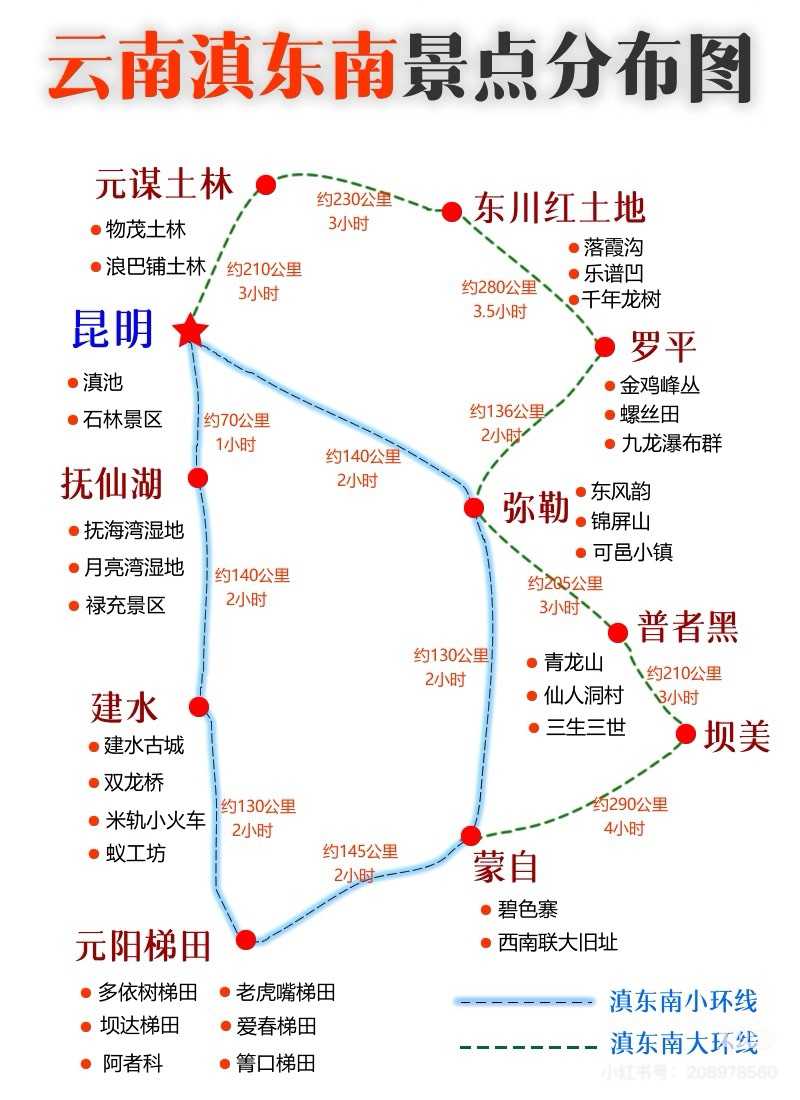
For a Chinese New Year family trip, warmth is the top priority. Yunnan never lacks popular destinations, but southeastern Yunnan is like a low-key hermit, hiding the purest essence of spring. Starting from Kunming, the route passes through Luoping, Mile, Mengzi, Yuanyang, and Jianshui, eventually returning to the starting point — forming a perfect loop. In early spring, rapeseed flowers are in full bloom, the terraces are filled with water awaiting planting, and the temperature is just right — neither too hot nor too cold, with sunshine generously pouring down.
We skipped Puzhehei (which suffers from low water levels in winter, diminishing its scenery) and saved time for more stunning sights. If you're traveling outside the rapeseed flower season, I recommend replacing Luoping with Puzhehei for a better experience.
Pre-Trip Preparation: Making Your Journey Smoother
Route Planning: A full loop of southeastern Yunnan requires 7–9 days. We streamlined it to 7 days, with a relaxed pace suitable for traveling with parents.
Transportation: Self-driving or hiring a car is essential. Although some places have high-speed rail, the attractions are scattered, and "the most beautiful scenery is on the road" is no empty phrase. Mountain roads and rural paths dominate. We chose to hire a car — an economical SUV electric vehicle at 900 RMB per day. The driver knew the roads well, making the trip worry-free and comfortable.
Accommodation Tips: To catch sunrises and sunsets, stay in scenic guesthouses near the attractions. For example, near Yuanyang's Duoyishu, you can open your window to the terraces. But don't expect luxurious conditions — scenery and comfort often don't go hand in hand.
Weather and Gear: In late February, southeastern Yunnan is warm during the day and slightly cool in the mornings and evenings. UV rays are strong, so sunscreen, a hat, and sunglasses are essential. The temperature difference between mountains and valleys is significant, so pack both light and heavy jackets.
Day 1: Nanjing → Kunming → Yuanmou → Dongchuan | From Earthen Forests to Red Earth
Yuanmou Wumao Earthen Forest: Carved by Time Over Billions of Years
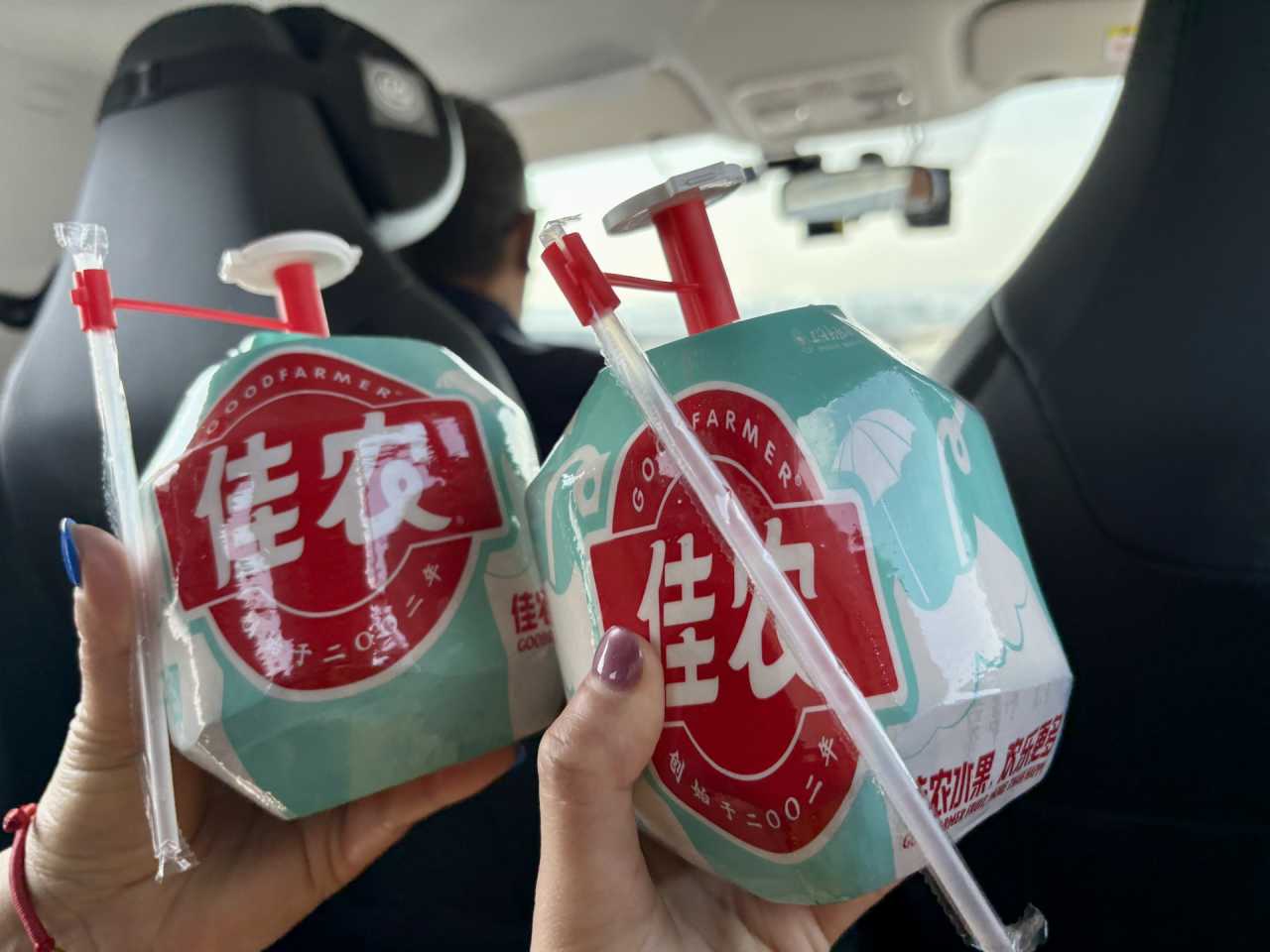
An early morning flight from Nanjing to Kunming felt like traveling through two seasons — plunging straight from winter into warm spring. Our hired driver thoughtfully prepared coconut juice, and we headed south.
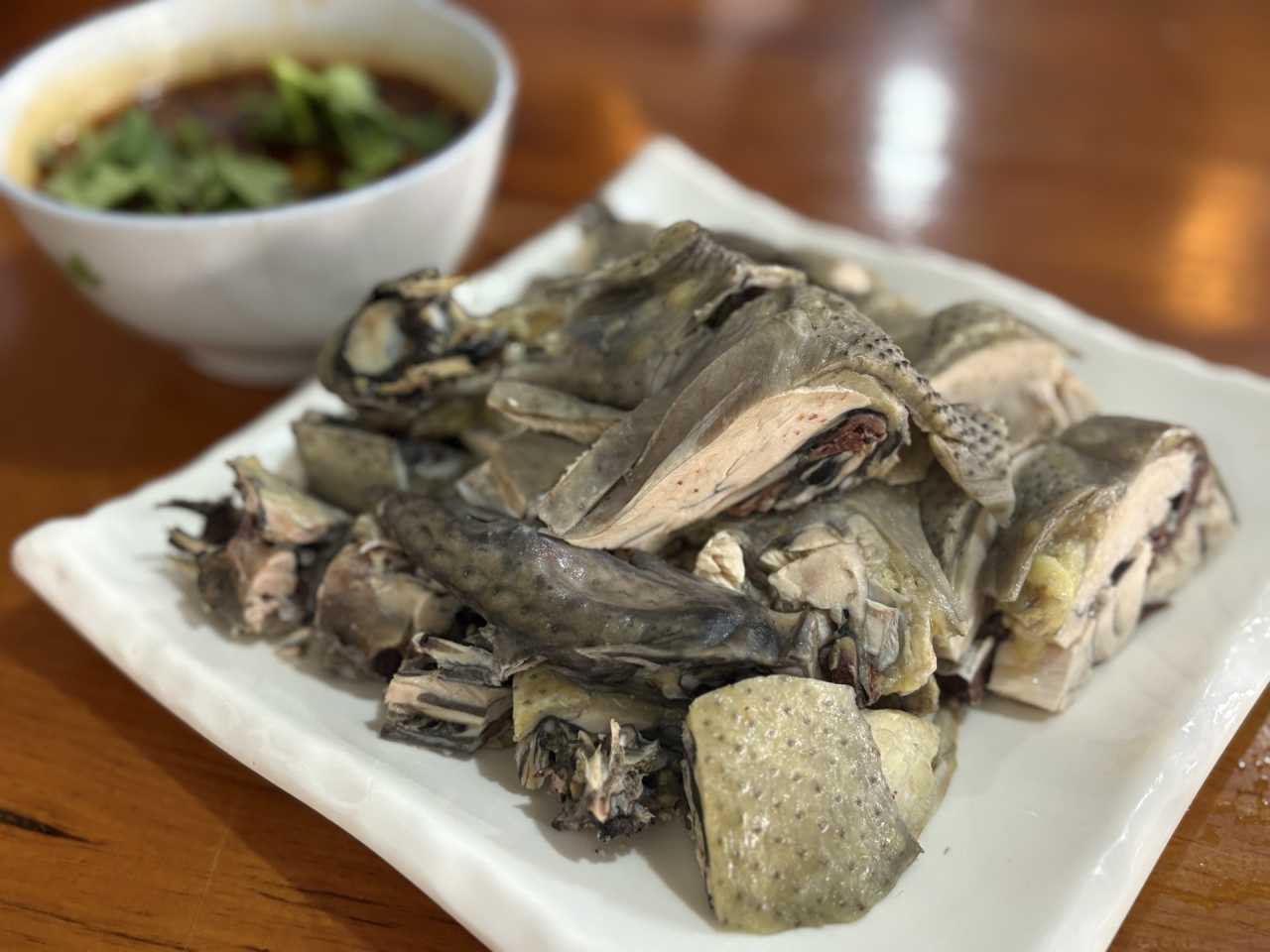
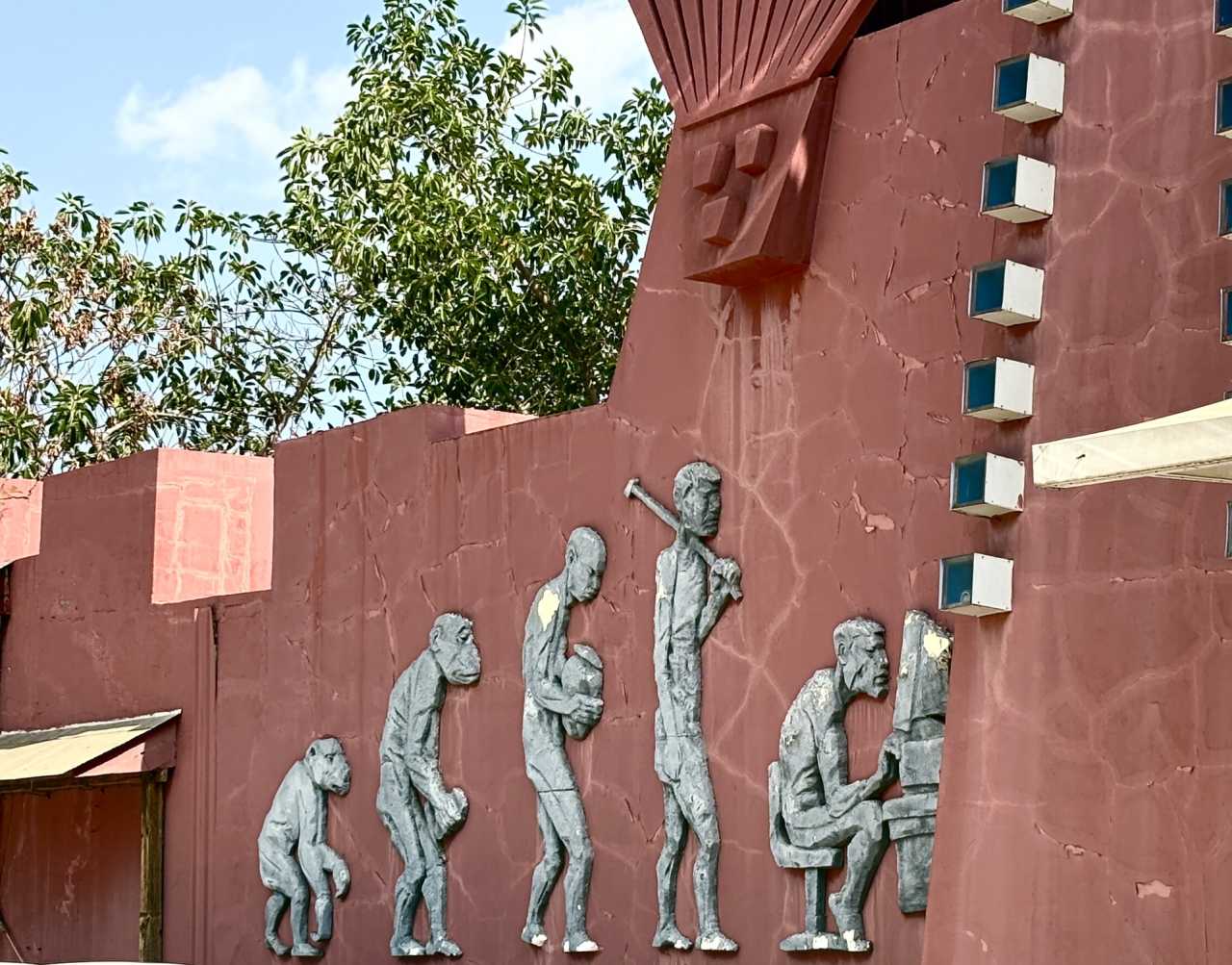
Our first stop was Yuanmou County, famous for the Yuanmou Man fossils. For lunch, we tried the local specialty — Yuanmou cold chicken, similar to Cantonese white-cut chicken, with dipping sauce as the soul. After a satisfying meal, we headed straight to Wumao Earthen Forest.
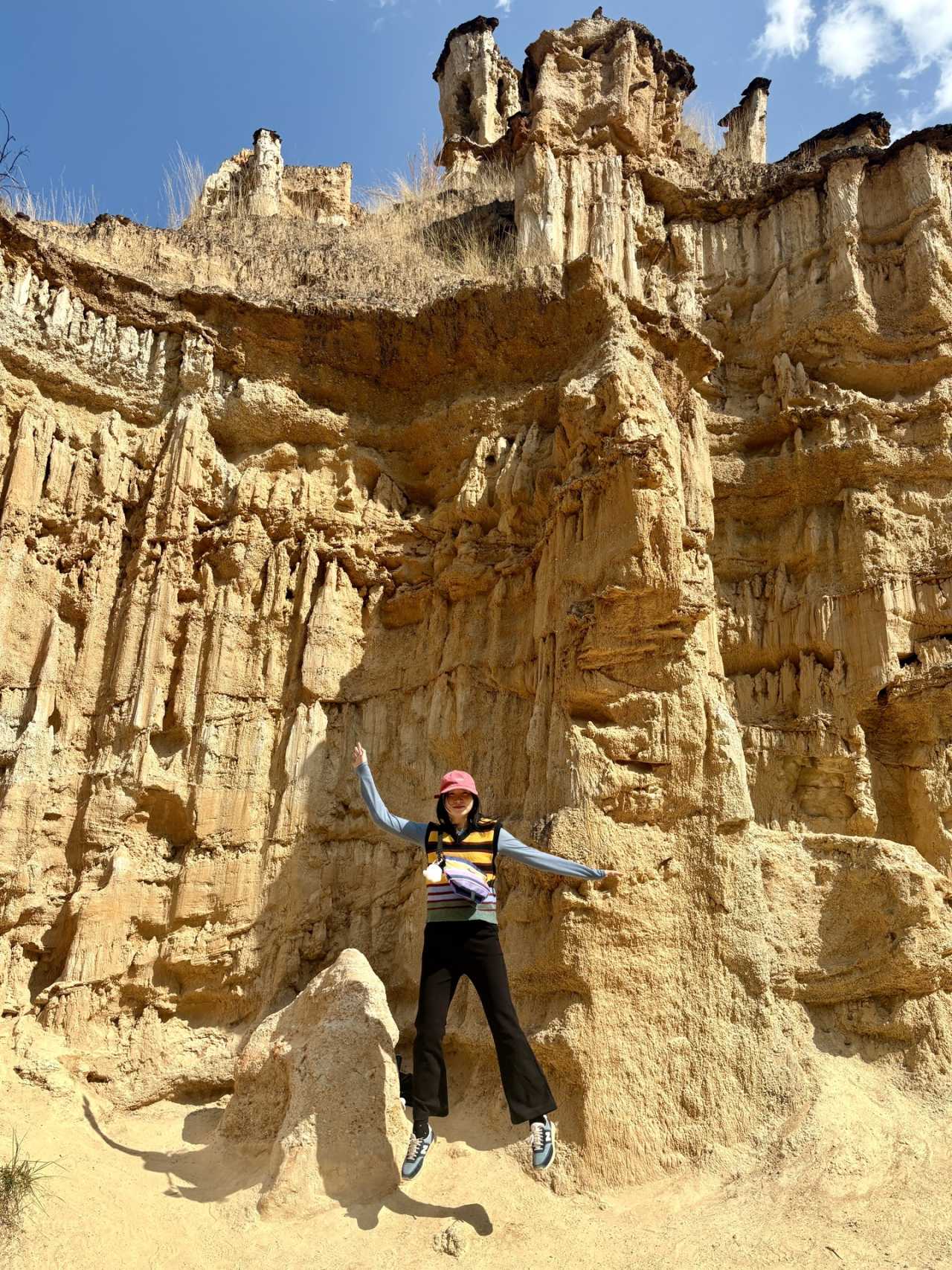
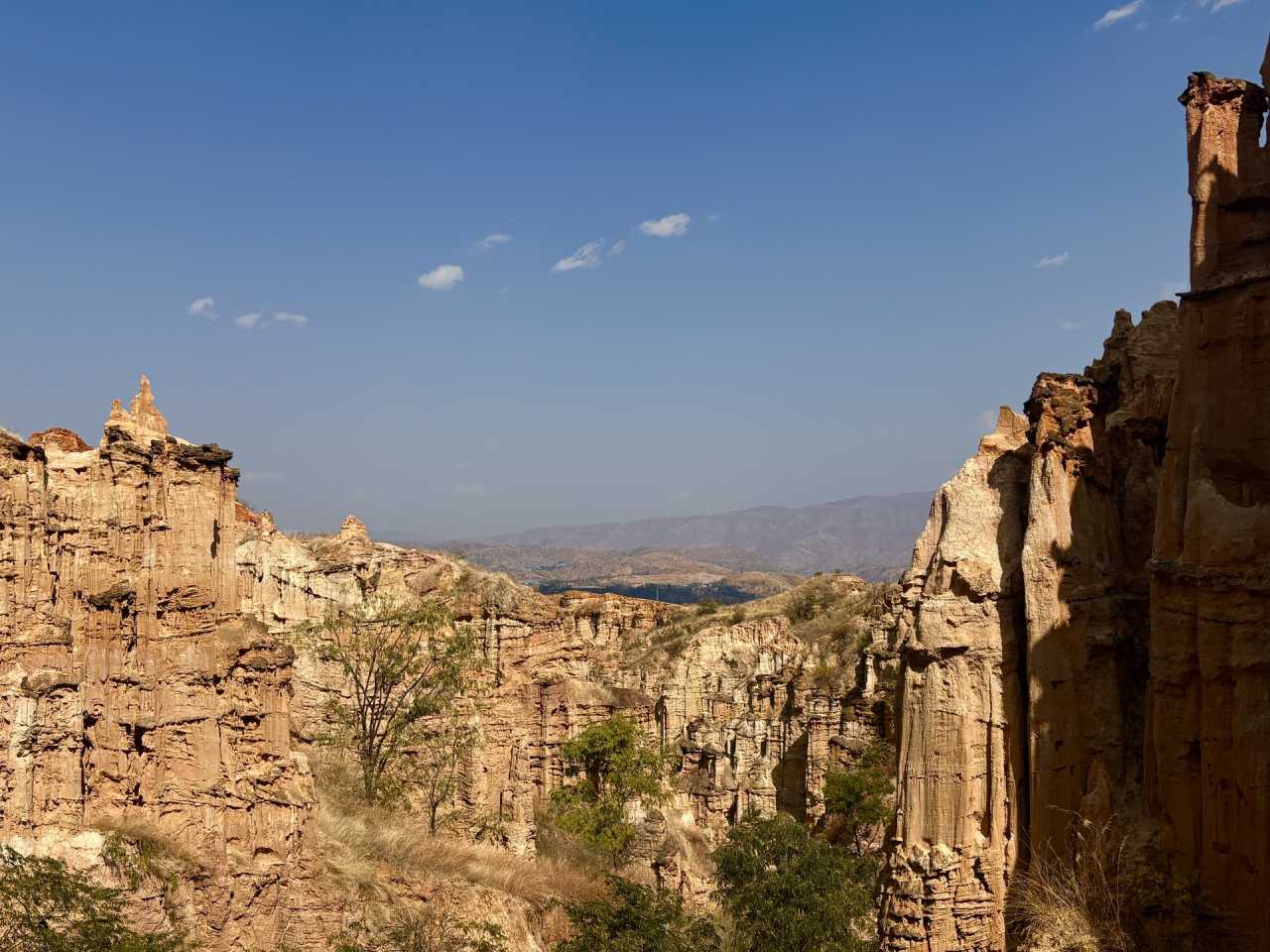
Yuanmou has two earthen forest scenic areas: Wumao and the more primitive Langbapu (with worse roads and farther distance). We chose Wumao. The ticket was 60 RMB (half price for those over 60), and the sightseeing car cost 10 RMB. The area is vast, so we recommend taking the sightseeing car to the top for a panoramic view, then walking down slowly. The earthen forest stands under the blue sky and white clouds like ancient castles. Despite the dust, it's a great place for photos.
Dongchuan Red Earth: Regret and Anticipation at Luoxia Gully
As evening fell, we drove toward Dongchuan Red Earth. The sunset along the way was already breathtakingly beautiful. The Red Earth scenic area is huge; only Luoxia Gully requires a ticket (40 RMB, free after dark or if staying at a nearby guesthouse). We arrived at 8 PM, missing the evening glow of Luoxia Gully, but the platform outside our scenic family room filled us with anticipation for the next morning's sunrise.
Day 2: Dongchuan → Luoping | Morning Light on the Red Earth and a Sea of Rapeseed Flowers
Luoxia Gully Sunrise: Sunlight Spilling on a Palette

At an altitude of over 2,000 meters, sunrise came a bit later, around 7:50 AM. Walking along the scenic boardwalk into the morning light, sunlight gradually spilled over the red earth, as if God had knocked over a palette. Along the way, we saw the Thousand-Year Dragon Tree — a filming location for Zhang Yimou's "Forever Enlightened." You can buy prayer plaques at the roadside to hang on the tree (8 RMB each). Next was Lequ Ao, where a网红 (internet-famous) grandpa charges 5 RMB per person for a photo. Luosi Tian (Snail Field) was layered and picturesque, with sketch artists sitting on the ridges. Waliang Fangzi was also a great spot for viewing the red earth — as long as the weather is good, every shot is beautiful.
Luoping Rapeseed Flowers: A Train to Spring
Bidding farewell to the Red Earth, we drove toward Luoping. On the way, we passed "Shede Service Area," which had an interesting name. The place names along this route were also amusing — Cat Street, Dog Street, Chicken Street... like stepping into a fairy tale.
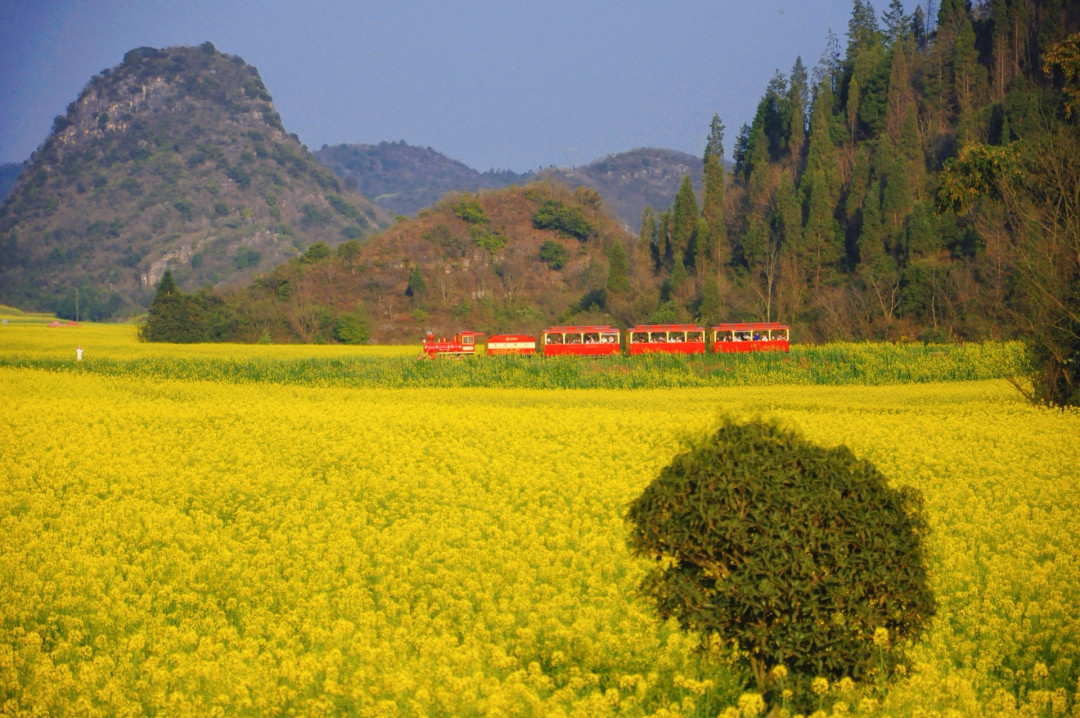
Luoping's Luosi Tian (Snail Field) resembled the Red Earth but was covered in golden rapeseed flowers, making it especially dazzling. The highlight was Jinji Fengcong (Golden Rooster Peak Cluster). The ticket was 30 RMB, the sightseeing car 30 RMB, and the small train 50 RMB. I highly recommend the small train — it travels through the flower sea like a train heading to spring. Along the way, vendors sold flower crowns for 5–10 RMB each — perfect for photos.
The small train had three stops. Remember to get off at the last stop and hike up into the flower sea. We didn't know this and rode back to the starting point, but fortunately, there were also vast flower fields there. The evening sunlight fell on the fields, and climbing to a high platform to overlook the golden waves was so beautiful it brought tears to the eyes.
That night, we stayed at a scenic guesthouse in Jinji Village, facing the main scenic area, where we could enjoy the view from our room. The rooftop terrace offered an even better view, but unfortunately, it was overcast the next day, so we didn't see the sunrise.
Day 3: Luoping → Mile | Waterfalls and an Art Town Collide
Jiulong Waterfall: A Different Kind of Gentleness in the Dry Season
We initially planned to skip Jiulong Waterfall — in winter, the dry season makes it less spectacular. But following the principle of "since we're here," we went anyway. The ticket was 60 RMB. We recommend entering through the west gate and exiting through the east gate, walking from high to low to save energy. Right at the entrance, rapeseed flowers paired with the waterfall created a stunning view — if you have a drone, it would be absolutely gorgeous. Following the boardwalk, nine waterfall groups appeared one after another. Each large waterfall pool offered boat or bamboo raft rides. The water volume was low in winter, but there were few people, and walking in the negative oxygen ions was very pleasant. The entire walk took about 2 hours, from the mountaintop to the east gate. Our hired driver helped move the car from the west gate to the east gate, saving us a lot of trouble.
Mile Dongfengyun: Man-Made Art, Photo Paradise
Mile is the only city in China sharing its name with a Buddha. First, we tried the local braised chicken rice noodles. The braised chicken was a bit tough — not to my taste — but the rolled rice noodles were good. We also drank the local Zhadian Dairy's fresh milk rice pudding — highly recommended.
Dongfengyun Scenic Area is a man-made art attraction. The ticket was 70 RMB, which I felt wasn't worth it. The sightseeing car was 20 RMB round trip; if you're not in a hurry, you can skip it. At the entrance, there was a lake, but unfortunately, the season was wrong, and the flower fields were bare. The main feature was bottle-shaped buildings, crowded with people, suitable for portrait photography. We avoided the crowds and took some close-up shots.
In the evening, we visited Huquan Ecological Park and Honghe Shuixiang (Red River Water Town). The former was good for a walk, while the latter was a typical night market. For dinner, we had Huachun beef hotpot — it looked good but tasted average. Mile is famous for its hot springs. We stayed at a hot spring hotel and soaked to relieve fatigue.
Day 4: Mile → Mengzi → Yuanyang | From a French Train Station to Millennia-Old Terraces
Fochen Shangdu: The Dopamine Market
Mile's Fochen Shangdu is the largest agricultural market in southeastern Yunnan and a网红 (internet-famous) "dopamine market." We arrived at 9 AM, when there were few people, and headed straight to the 4th floor for photo spots. Various wild vegetables, flowers, and strange ingredients made it feel like stepping into another world.
Bisezhai: The Century-Old Station from "Youth"
Mengzi's Bisezhai is a filming location for the movie "Youth" — a century-old French narrow-gauge train station. No ticket is required, but navigating to the visitor center requires a 20 RMB sightseeing car fee. Clever netizens discovered that navigating to "Likui Grocery Store" and paying a 10 RMB parking fee allows you to walk directly there.
Sunlight shone on the weathered platform, making time seem to rewind. The tracks were still in use, and a train happened to pass by. Bisezhai actually has two stations — the Dian-Vietnam Railway and the Bi-Se Railway — 800 meters apart, with French-style buildings, old factories, and train engines in between. It's a continuous photo spot.
After exploring the station, how could we not have a bowl of Mengzi rice noodles? We found a small shop frequented by locals and ordered the "family feast." The rice noodles were cooked in boiling broth by ourselves, with unlimited refills.
National Southwest Associated University: History and Coffee
In the afternoon, we visited the site of the National Southwest Associated University, which has a free memorial hall, and felt the weight of that special period of history. We had a cup of coffee and bought some文创 (cultural creative products). Across the street was Nanhu Park, which houses a beautiful Librairie Avant-Garde (先锋书店).
Yuanyang Rice Terraces: Light and Shadow Magic in the Ailao Mountains
Heading to Yuanyang, the rice terraces — the result of Hani people's millennia of labor — are most beautiful in winter, when they are filled with water but not yet planted, layer upon layer like mirrors. The combined ticket for Duoyishu, Bada, and Laohuzui viewing platforms was 70 RMB (valid for 3 days), but there were also many free viewing platforms. We didn't buy any tickets throughout the trip.
Yuanyang is located in the Ailao Mountains, where the weather is unpredictable. It was clear at the foot of the mountain but overcast on top. After passing the visitor center, the first terrace we saw was Jingkou Terrace. We originally planned to go to Dawa Zhe for sunset, but it started to rain, so we went directly to our guesthouse near Duoyishu. After the rain stopped, clouds drifted through the mountains, and the terraces appeared and disappeared, creating a unique atmosphere. For dinner, we had火塘鸡 (fire pit chicken), with two stoves — one large for stewing ribs/chicken, one small for tea. Wild vegetables and mushrooms were served in large platters, but sitting far from the stove meant we had to stand up to reach the food.
Day 5: Yuanyang → Jianshui | Terrace Sunrise and Ancient City Charm
Duoyishu Sunrise: A Gift of Luck
We heard that there had been no sunrise for several days, but we were very lucky. We took a wild path from our guesthouse to the viewing platform (the core platform cost 5 RMB per person, but the roadside angle was also good). We waited at 7:30 AM, and at 7:50, the sun slowly rose. The mountain morning was very cold, so dress warmly. If the weather is good, you can also see a sea of clouds.
After watching the sunrise, we returned to the guesthouse for red rice noodles. Our hired driver recommended a lesser-known terrace — Hadanpu, which is open and magnificent, perfect for drone flying. Next, we went to Aichun Blue Terrace, which has the best colors under the sun between 9–10 AM, with reflections shimmering blue. For 10 RMB, you can walk into the terraces, but the paths are very narrow, so be careful.
Azheke: Hani Mushroom Houses
Azheke Village preserves the characteristic Hani mushroom-shaped houses. The ticket was 30 RMB, with proceeds distributed among villagers. The village is very rustic. We recommend descending via the stone path and ascending via the boardwalk, forming a loop. In the mushroom houses, the first floor is usually for storage, and the second floor for living. Everywhere, you could see fabrics dyed by ethnic minorities, ancient waterwheels, and Hani people working. What remained constant were the terraces winding along the village.
Jianshui Ancient City: Yi Ethnic Charm and Ancient Well Atmosphere
Leaving Yuanyang, we arrived at Jianshui in the evening. We recommend staying near Chaoyang Tower and Xiaogui Lake, close to the ancient city. From our guesthouse, we could see the entire Xiaogui Lake.
For lunch, we chose the网红 (internet-famous) restaurant "Sizhitang." The ambiance was beautiful, and since it was past meal time, there were few people. The dishes featured flowers as ingredients — water spinach (水性杨花) with pork slices, purple acacia flower omelette, lotus flower with mashed potatoes, and steamed chicken (汽锅鸡) which was a bit oily.
After lunch, we strolled through the ancient city. At the entrance, my mother and I had Yi ethnic-style photos taken at a portrait shop. Makeup and costume cost 189 RMB per person, with an additional 110 RMB for a photographer. The makeup artist was quick, finishing in about an hour. First, we went to Chaoyang Gate to photograph the red walls and white tiles, then walked into the ancient city. The main street was commercial. Passing through a memorial archway, we reached the Zhu Family Garden (ticket 35 RMB), with rockeries, pavilions, and an ancient charm. Across from it was the Twelve-Eyed Well. The ancient city has many ancient wells worth exploring.
In the evening, we went to Yuhuang Pavilion, but it was closed. We took photos by the lanterns at the entrance. Returning to Chaoyang Tower, we admired the night view. The ticket to climb the tower was 15 RMB. After returning our costumes, we headed to a barbecue stall for food — Jianshui tofu, 7 RMB for 10 pieces, grilled fresh on the spot, but a bit tough. The winter melon cold drink was refreshing, and the white sweet wine was fermented rice wine. On the way back to the guesthouse, we unexpectedly saw a light show at Chaoyang Tower and the night view of Xiaogui Lake.
Day 6: Jianshui → Shiping | Narrow-Gauge Train and a Primitive Ancient Village
Jianshui Ancient Wells and the Narrow-Gauge Train
Waking up early, we had grass shoot rice noodles (草芽米线) at a century-old清真 (halal) restaurant. The grass shoots were crunchy, similar to water chestnuts. Jianshui has many ancient wells. Pubo Spring (Daban Well) is still in use today.
The narrow-gauge train runs from Lin'an Station to Tuanshan Station, with two trips a day. During peak season, tickets are hard to come by. We had a hired car, so we drove along the stations, avoiding the crowds. The first stop was Lin'an Station, the second was Shuanglong Bridge (a 17-arch ancient bridge, beautiful at sunrise and sunset), the third was Xianghui Bridge (the station itself was very pretty, with small trains passing by), and the fourth was Tuanshan Station (the terminal, where the train stops for a long time, allowing for photos).
Tuanshan Residence: Simple Times
The ticket for Tuanshan Residence was 35 RMB. The village was rustic, with exquisite old buildings. A grandmother selling straw-woven products and a grandfather with a stylish look seemed to have stepped out of a painting. For lunch, we ate at the "Nostalgia Restaurant" in the village, enjoying cold rice noodles, hot rice noodles,稻田鱼 (rice field fish), and stir-fried wild vegetables — pure countryside flavors.
Yilong Lake and Zhengying Village
Following the train route to Shiping County, we passed Yilong Lake, which is 40 kilometers around — perfect for cycling. We walked the wetland boardwalk, where there were many waterbirds, and we could even feed seagulls. The lake was as blue as the sea, and the trees were covered in bright flowers. It was the first time I saw someone smoking a water pipe — the pipe was huge.
Zhengying Village was even more primitive, with almost no commercialization. The village mainly featured ancestral temples, looking like little houses from an animation.
Shiping Ancient City: The Final Surprise
Shiping Ancient City was more primitive than Jianshui, with no paid attractions. We arrived in the evening and first went to Shiping Railway Station — the terminal of the Bi-Se Railway, with yellow walls and green tiles, very photogenic. The museum next to it was already closed (closing at 5 PM). Tonggong Gate was the city gate, which we could climb to watch the sunset.
For dinner, we ordered randomly — fried pea jelly, peanut soup with抽筋菜 (a local vegetable), and garlicky rolled rice noodles — all delicious. After 8 PM, most shops in the ancient city closed, so we saved our wandering for the next day.
Day 7: Shiping → Kunming → Nanjing | Morning Light, Tofu, and a Flower Market
Shiping Morning Light: History on Bluestone Roads
Waking up early, we had eel rice noodles (鳝鱼米线, starting at 10 RMB). The ancient city felt particularly special in the morning. The bluestone roads reflected the morning light, and every household had beautiful plants at their doorsteps. Yuntai Gate was another city gate. The small attractions in the ancient city were scattered in the alleys, and navigation wasn't very accurate, so we followed the signs. A tofu factory displayed the entire tofu-making process. There were also a beautiful tree-root shop and residents drying chili peppers. Shiping tofu includes not only爆浆豆腐 (exploding tofu) but also large chunks of hand-torn tofu, which is more tender and delicious. Small rolled rice noodles (小卷粉) and bayberry soup (杨梅汤) were also specialties.
Fuxian Lake: Yunnan's Second Largest Lake
On the way back to Kunming, we had to pass Fuxian Lake. We went to Red Sand Beach. There was no need to buy a sightseeing car ticket; we just walked in. The noon sun was dazzling, and the red sand wasn't very visually striking, but the lake surface shimmered with waves, vast like the sea.
Dounan Flower Market: Bringing Spring Home
Our last stop was Dounan Flower Market, Asia's largest flower market. The main building's first floor was enough to explore. A bunch of 8 roses cost as little as 5 RMB, and succulents were 10 RMB per pot. The further in you go, the cheaper it gets. Street vendors offered even better deals. Unfortunately, they weren't easy to take away, and shipping costs might exceed the flower prices.
For our final meal, we had a mushroom hotpot, featuring见手青 (a type of wild mushroom), porcini mushrooms, and various others. We had to cook them for 23 minutes before the chopsticks were handed out. The golden ear fungus sashimi was soft and chewy — quite good.
The flower market was 40 minutes from Kunming Airport. Our boarding gate was at the satellite terminal, requiring the airport subway, so we had no time to browse the airport. I heard there are local snacks and specialties to buy.
Epilogue: Yunnan, See You Next Time
Seven days, neither rushed nor slow, completing the southeastern Yunnan loop. Spring is the best season here — flower seas, rice terraces, waterfalls, and ancient villages, interweaving natural landscapes with history and culture. Compared to the classic Kunming-Dali-Lijiang route and the crowded Xishuangbanna, this treasure route is quieter and more healing.
At this point, the only place in Yunnan I haven't visited is Lugu Lake. Yunnan truly is a place you want to return to again and again.
Yunnan, next time, see you at Lugu Lake.
Practical Tips Summary: - Best Season: Late February to early March, when rapeseed flowers are in bloom and terraces are filled with water - Transportation: Hiring a car is the most worry-free option; SUV electric vehicles cost about 900 RMB per day - Accommodation: Scenic guesthouses near attractions, convenient for watching sunrises and sunsets - Essential Items: Sunscreen, hat, sunglasses, light and heavy jackets - Tickets: Yuanyang Rice Terraces combined ticket 70 RMB (valid for 3 days), but free viewing platforms are also sufficient; Jianshui Ancient City is free, with small attractions charging fees - Food Recommendations: Mengzi rice noodles, Jianshui tofu, Shiping tofu, mushroom hotpot, flower-based dishes - Money-Saving Tips: At Bisezhai, navigate to "Likui Grocery Store" to avoid the sightseeing car fee; free viewing platforms at Yuanyang Rice Terraces are equally spectacular
You should also read:

God’s Abandoned Palette: A Self-Drive Journey Through Yunnan’s Dongchuan Red Land
God’s Abandoned Palette: A Self-Drive Journey Through Yunnan’s Dongchuan Red Land Travel has never been about reaching some distant geographic coordinate. It’s about encountering, along the way, the version of yourself buried beneath the rubble of daily routine. During this May Day holiday, I finally…
Continue reading...
Body in Hell, Heart in Heaven: A Pilgrimage Through Tiger Leaping Gorge — A Dialogue Between Heaven and Earth
Body in Hell, Heart in Heaven: A Pilgrimage Through Tiger Leaping Gorge — A Dialogue Between Heaven and Earth Introduction: When the Gorge Splits Open Beneath Your Feet Some say Tiger Leaping Gorge is the closest place on Earth to the border between "hell" and…
Continue reading...
Cloud Travelogue · Dali of Wind, Flowers, Snow, and Moon: A Three-Day, Two-Night Journey of a Free Spirit
Cloud Travelogue · Dali of Wind, Flowers, Snow, and Moon: A Three-Day, Two-Night Journey of a Free Spirit I am a cultured female foodie with a touch of rogue charm. I slung on my backpack, took my lover's hand, and set off on a spontaneous…
Continue reading...