The Complete Photography Guide to Daocheng Yading: A Senior Photography Leader Reveals the Best Season and Secret Shooting Spots
The Complete Photography Guide to Daocheng Yading: A Senior Photography Leader Reveals the Best Season and Secret Shooting Spots
If you ask a landscape photographer which high-altitude destination in China is most worth visiting, nine out of ten will tell you: Daocheng Yading.
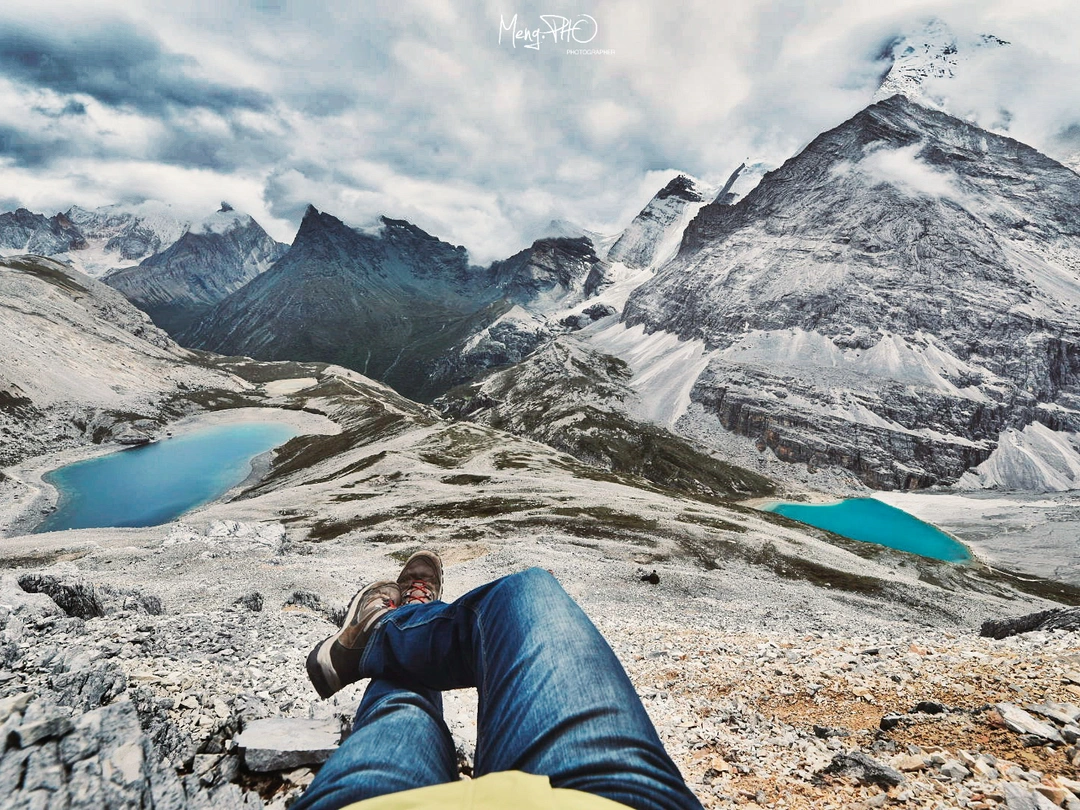
This land, known as "the last pure land on this water-blue planet," reaches its glorious peak every autumn. When the rainy season ends, the snow-capped mountains no longer shyly hide behind clouds. Meadows and forests don their golden coats, and the three lakes—Pearl Lake (Zhenzhu Hai), Milk Lake (Niunai Hai), and Five-Color Lake (Wuse Hai)—shine like gemstones embedded among the peaks. In 1928, American explorer Joseph Rock brought the beauty of this place back to the West, publishing it in National Geographic magazine. Since then, Yading has become the "soul of Shangri-La" in countless people's hearts.
As a freelance photographer and photography leader who has spent years traversing western Sichuan, southern Gansu, and the Sichuan-Tibet Highway, I've walked this route countless times and fallen into countless pitfalls. Today, I'll lay out everything you need to know about Daocheng Yading—transportation, accommodation, hiking routes, and secret shooting spots—in the most practical way possible.
I. Before You Go: Where Exactly Is Daocheng Yading?
Daocheng Yading Scenic Area is located in Shangri-La Town (formerly Riva Township), Daocheng County, Garze Tibetan Autonomous Prefecture, Sichuan Province. Yading Village sits at the heart of the scenic area. Inside, three sacred mountains—Xiannairi, Yangmaiyong, and Xianuoduoji—along with three lakes—Pearl Lake, Milk Lake, and Five-Color Lake—are the ultimate goals for every visitor.
Best Season: Late September to late October. By then, the rainy season has ended, the air is crystal clear, the snow-capped mountains reveal themselves most frequently, and the autumn colors are at their peak.
II. How to Get There? Flight vs. Self-Drive—Full Pros and Cons
1. Flying Direct (Fastest, but High Risk of Altitude Sickness)
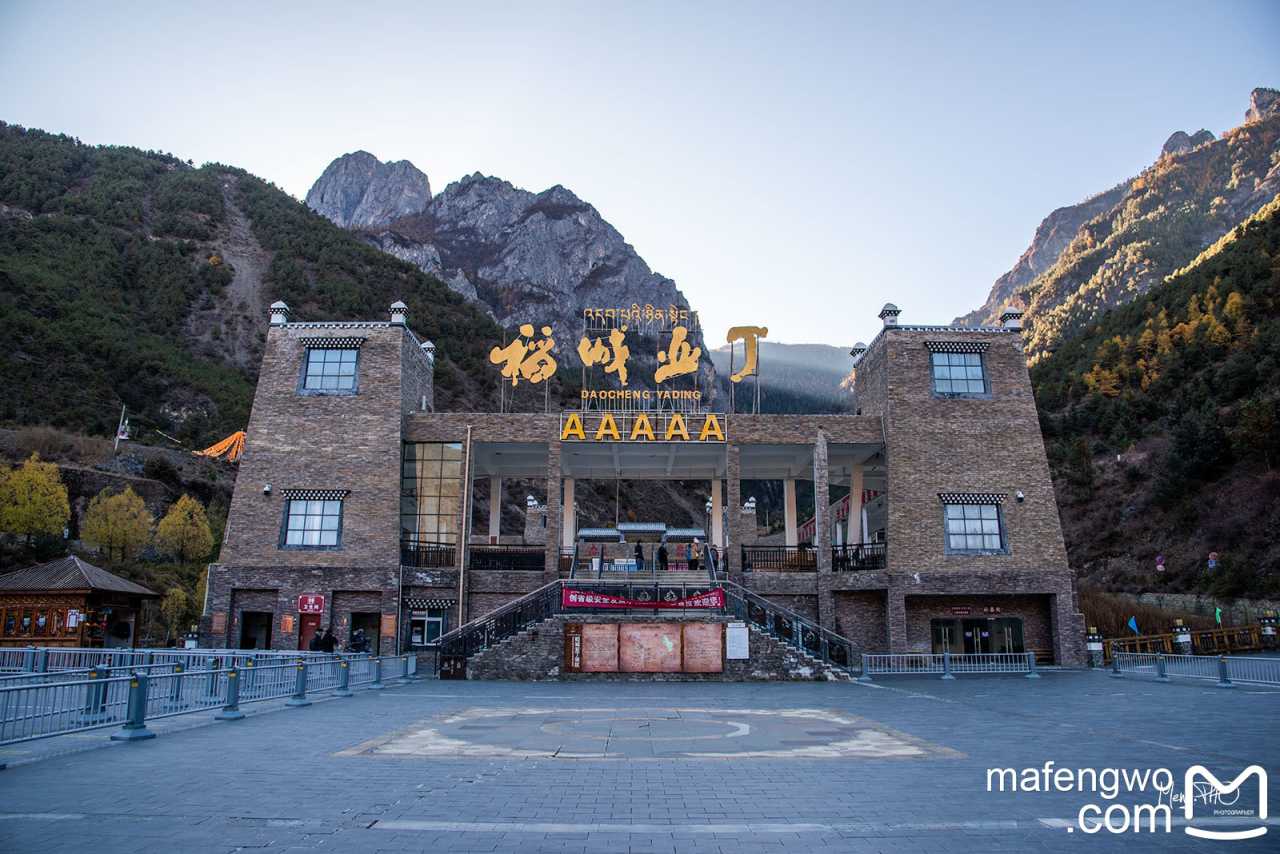
Daocheng Yading Airport is the highest civilian airport in the world, sitting at an elevation of 4,411 meters (14,472 feet). If you fly directly from a low-altitude area, altitude sickness might hit you the moment you step off the plane.
My advice: Take the airport shuttle bus to Shangri-La Town (85 RMB per person). Once there, hop on the local bus (5 RMB per person, just wave it down) to the scenic area entrance. Spend a night in Shangri-La Town—which is at a lower elevation—to acclimate before entering the scenic area the next day.
2. Self-Drive (Scenic Route, but Time-Consuming)
Take National Highway 318 to Litang, then switch to Provincial Highway 217. The advantage of driving is the stunning scenery along the way. However, your car must be parked at the scenic area entrance in Shangri-La Town—private vehicles are not allowed inside the scenic area.
III. Hand-Drawn Map: A Clear View of the Scenic Area's Layout
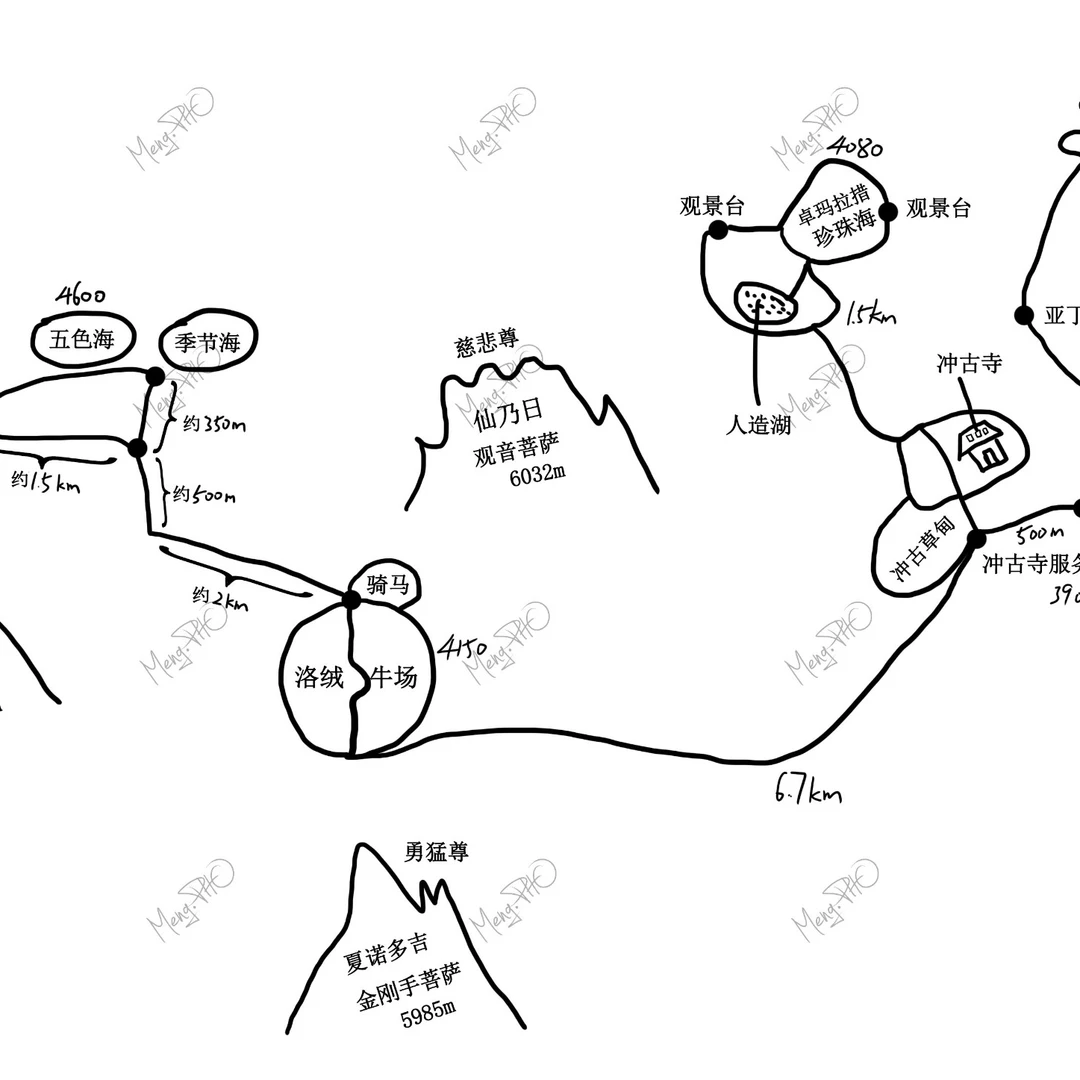
To make things easier to understand, I've drawn a hand-drawn map. All the routes below are based on this map.

Key Point: Inside the scenic area, you must take the scenic shuttle bus. There are two types:
- Mandatory: From the scenic area entrance to Zhaguang Beng, with stops at Yading Village Stations 1-6. Tickets and shuttle bus tickets are purchased together.
- Optional (Highly Recommended): The shuttle from Chonggu Meadow to Luorong Cattle Farm. One-way: 50 RMB, round-trip: 70 RMB. This is essential for the long route to Milk Lake and Five-Color Lake.
IV. Where to Stay? Inside vs. Outside the Scenic Area
Staying Inside the Scenic Area (Yading Village)—The Photographer's Choice
I recommend Station 2 for three reasons: 1. You can see both Xiannairi and Xianuoduoji sacred mountains at the same time. 2. It's the largest station, with the most accommodation, restaurants, and shops. 3. It's the most convenient for transportation.
The biggest advantage of staying inside: You don't need to buy a half-price shuttle bus ticket the next day. It saves both time and money. Plus, when the light is best at dawn and dusk, you're already inside the scenic area—no rushing.
Staying Outside the Scenic Area (Shangri-La Town)—The Budget-Friendly Option
If Yading Village is fully booked or too expensive, Shangri-La Town is a good backup. But note: When you re-enter the scenic area the next day, you can skip the entrance fee by showing your previous day's ticket and a photo taken inside (as proof you were actually there). However, you can only buy a half-price shuttle bus ticket.
V. Short Route Photography Guide: Chonggu Temple, Pearl Lake, Chonggu Meadow
The short route is where most people start. After getting off at Zhaguang Beng, hike 500 meters to the Chonggu Temple service area, then follow a loop.
Chonggu Temple: The Best Foreground for Xiannairi
Heading up from Zhaguang Beng, you'll see two paths: the red arrow marks the vehicle road (occasional work vehicles pass through), and the blue arrow marks the footpath. I recommend taking the footpath. Along the way, you can capture the golden roof of Chonggu Temple framed by Xiannairi's snowy peak.
When you reach the entrance of Chonggu Temple, don't rush inside. First, take the path on the right. This is the perfect spot to photograph the temple's golden roof with Xiannairi behind it. Use the Mani stones in the foreground to add depth and texture to your shot.
Pearl Lake: The Hidden Mirror of Xiannairi's Reflection
After exploring Chonggu Temple, don't go back the same way! Exit through the door directly opposite the statue of Kshitigarbha Bodhisattva inside the temple and follow the dirt path. This route is less crowded, and you might spot squirrels, deer, and blue sheep. After the 2020 renovation, the dirt path now features prayer flags—walk through them, and you'll see an even more spectacular view.
When you reach the first restroom, merge onto the stone steps and continue upward. Along the way, you'll pass an artificial lake where you can capture Xiannairi's reflection. Farther ahead, you'll arrive at the observation deck by Pearl Lake—the classic spot for a shot of Xiannairi and Pearl Lake together.
Chonggu Meadow: The Best Position for Xianuoduoji

After returning from Pearl Lake, head toward Chonggu Meadow on the right. This is one of the best spots to photograph Xianuoduoji, and you can also capture Chonggu Temple and Xiannairi in the same frame. In the evening, when the setting sun hits the summit of Xianuoduoji, the "golden mountain" scene will leave you breathless.
Return Reminder: Make sure you know whether the shuttle bus is heading to Yading Village or the visitor center. If you're staying in Yading Village and accidentally board the wrong bus, you'll have to buy a new ticket to get back in!
VI. Long Route Photography Guide: Milk Lake, Five-Color Lake, and the Double-Lake Shot
The long route is the ultimate challenge of Daocheng Yading—and the ultimate goal for photographers.
Step 1: Take the Shuttle to Luorong Cattle Farm
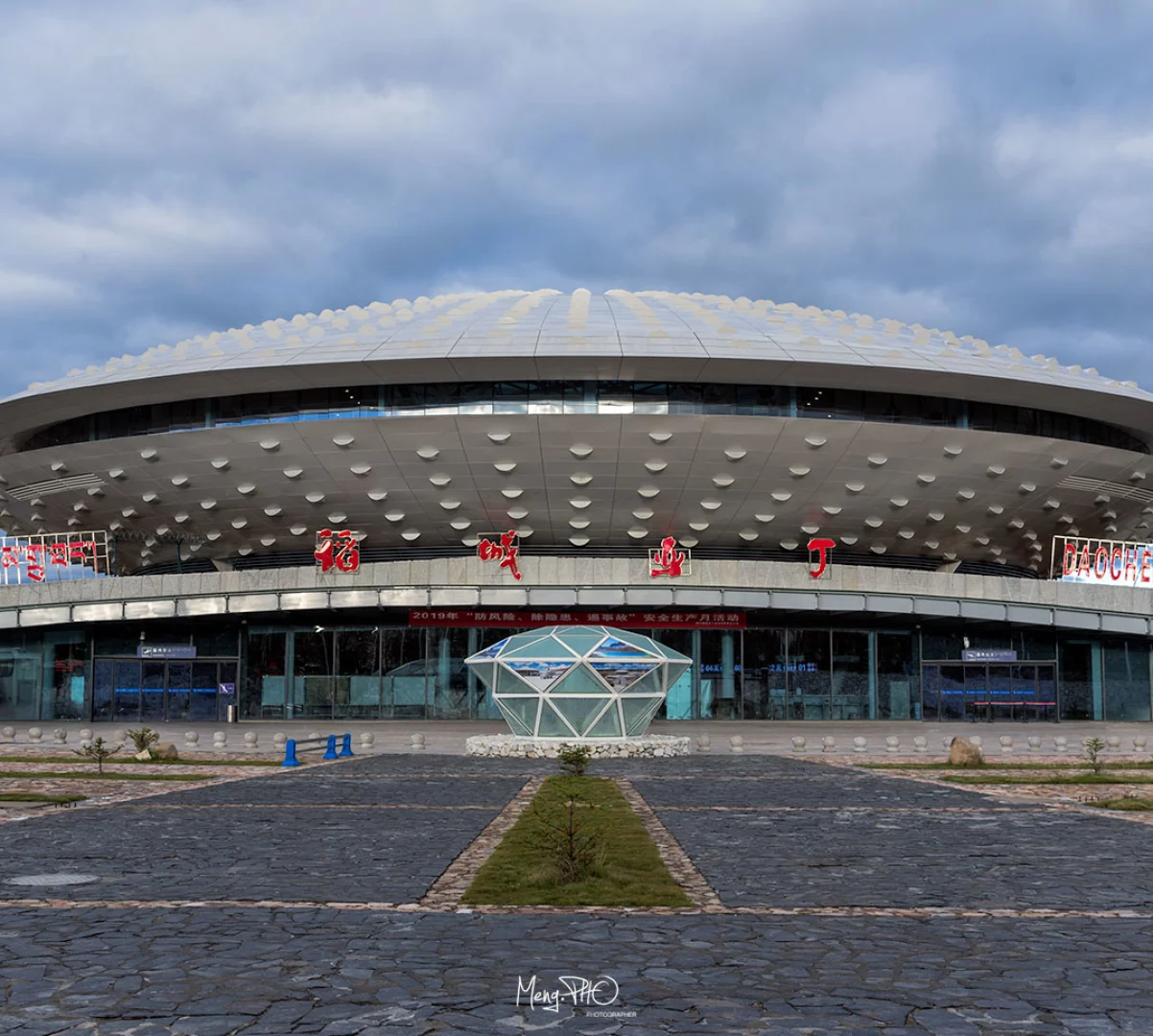
At the Chonggu Temple service area, buy a round-trip shuttle ticket (80 RMB, round-trip recommended) and ride to Luorong Cattle Farm. This section takes 3-4 hours on foot, and the scenery is average, so save your energy by taking the shuttle.
Step 2: From Luorong Cattle Farm to Sheshen Cliff
After getting off, follow the boardwalk. This stretch is ideal for photographing Yangmaiyong. For different angles, you can walk along the horse track (the path used by horse caravans). The horse caravan can take you to Sheshen Cliff—it's not cheap, but it does save energy.
Note: The horse caravan only goes to Sheshen Cliff, not to Milk Lake. Don't be fooled.
Step 3: Sheshen Cliff to Milk Lake and Five-Color Lake
From Sheshen Cliff, the real hard hiking begins. Here, you'll encounter a critical fork in the road:
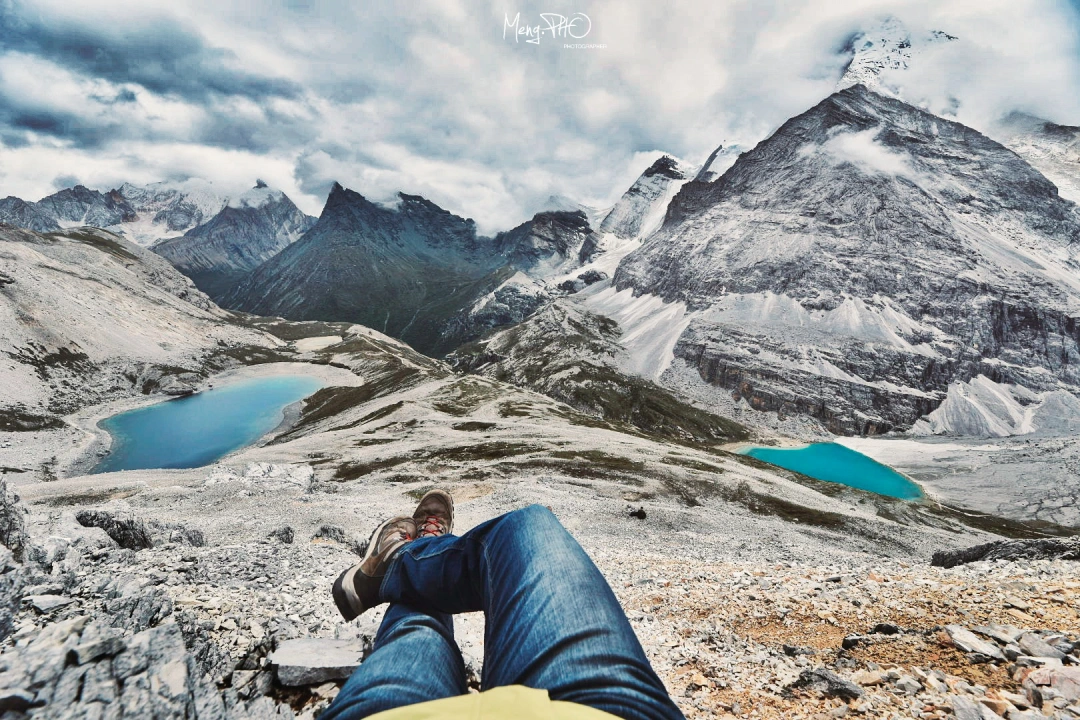
- 350-meter route: Steep! Very steep! Recommended only for ascending, not descending.
- 1.5-kilometer route: Relatively gentle, leading first to Milk Lake.
My advice: - If you're fit: Take the 350-meter route first to reach Seasonal Lake and Five-Color Lake, then continue to Milk Lake, and return via the 1.5-kilometer route. - If you're average: Take the 1.5-kilometer route to Milk Lake first. If you still have energy, climb to Five-Color Lake, then return the same way.
Why this approach? The 350-meter section is extremely steep. Descending puts immense strain on your knees, and the loose gravel surface is slippery and dangerous.
Step 4: The Double-Lake Shot—The Ultimate Position at 4,700 Meters
If you have enough stamina, challenge yourself to capture the "double-lake shot"—both Milk Lake and Five-Color Lake in one frame. This position is at the starting point of the path from Five-Color Lake toward Milk Lake. There's a dirt trail leading uphill. Climb to an elevation of 4,700 meters (15,420 feet), and you'll see it.
Warning: This trail gets steeper and steeper, eventually turning into loose gravel. You'll need to use your hands and feet. Don't push your limits at high altitude! Know your boundaries. Safety first.
VII. Photographer's Insider Tips
- Lens choice: You'll use everything from wide-angle to telephoto, but if you can only bring one, go with an ultra-wide like 14-24mm.
- Tripod: Depends on your stamina. If you bring one, choose a lightweight tabletop tripod.
- Drone: The scenic area has strong magnetic interference. Fly with caution.
- Light: Morning is best for shooting—the snow-capped mountains are usually out. In the evening, shoot the golden mountain of Xianuoduoji from Yading Village; in the morning, capture the golden mountain of Xiannairi.
- The three lakes: To capture their beautiful colors, you need direct sunlight. On cloudy days, the effect is greatly diminished.
VIII. Practical Tips: Avoid Pitfalls, Get Better Shots
- Altitude sickness: Don't be a hero! If it gets severe, descend immediately. Life comes first.
- Gear: Trekking poles and knee braces are essential for the long route. For the short route, the boardwalk is a mesh structure, so trekking poles won't work.
- Luggage: Don't bring a suitcase into the scenic area. A backpack and a carry-on bag are the most convenient.
- Storage: If you're staying in Yading Village, you can leave your luggage at the front desk while hiking the long route.
- Timing: When boarding the shuttle, ask about the last and first bus times. These can change with the season and holidays.
- Environmental protection: All trash in the scenic area is carried out by staff on their backs. Don't litter, and try to minimize waste.
- Cash: The shuttle to Luorong Cattle Farm currently only accepts cash. Don't forget to bring some.
- Monkeys: There may be monkeys along the path from Zhaguang Beng to Chonggu Temple. Don't tease them.
Conclusion: Daocheng Yading Is Worth the Journey
The beauty of Daocheng Yading cannot be captured in a single photograph. It's the golden light of the first morning sun hitting the summit of Xiannairi. It's the tranquil reflection of snow-capped mountains in Pearl Lake. It's the heart-shaped blue of Milk Lake. And it's the awe-inspiring sight of the double-lake shot when you look up, gasping for breath at 4,700 meters.
But the highlands are never gentle. They test every pilgrim who comes here—with altitude sickness, cold, and exhaustion. So prepare well, slow down, and don't fight your body. The most beautiful scenery always belongs to those who respect nature and protect themselves.
If you're planning a trip to Daocheng Yading, or if you want a customized photography route through western Sichuan, southern Gansu, or the Sichuan-Tibet region, feel free to reach out. As a photography leader who has traversed western Sichuan countless times, I hope to help you capture your own "last pure land."
One last thing: On the highlands, safety comes first. Stay alive, and you'll see more beauty.
You should also read:
Fly to Yuanyang! — A Complete Photography Guide
Fly to Yuanyang! — A Complete Photography Guide A Spontaneous Photography Journey Every year after the Spring Festival, airfare to Kunming hits its lowest point. This year, the holiday came unusually early, and February is precisely the most captivating season for the Yuanyang rice terraces.
Continue reading...
Xishuangbanna Self-Drive Tour: Into the Tropical Wonderland at the Edge of the Sky (Complete Guide)
Xishuangbanna Self-Drive Tour: Into the Tropical Wonderland at the Edge of the Sky (Complete Guide) Introduction: A Dream Fulfilled Thirty Years Early Some journeys are destined to happen at a specific moment in time. For me, a self-drive trip to Xishuangbanna was originally the first…
Continue reading...
Big Bear and Little Cat Explore China: [A Self-Guided Tour of the Shangri-La Region: That Sky, So Blue It Feels Unreal!]
Big Bear and Little Cat Explore China: [A Self-Guided Tour of the Shangri-La Region: That Sky, So Blue It Feels Unreal!] Prologue: Why Shangri-La? In September 2011, my friend and I followed the Yunnan-Tibet Highway into the Greater Shangri-La region. Six days of travel, without…
Continue reading...