Wheels Across Western Yunnan: A Self-Drive Journey Through Time, from Lijiang to Xishuangbanna
Wheels Across Western Yunnan: A Self-Drive Journey Through Time, from Lijiang to Xishuangbanna
Prologue: Why Western Yunnan?
When my aunt and uncle pulled up in their familiar SUV and we set off west from Kunming, I sat in the passenger seat, watching the altitude climb and the vegetation shift outside the window. A strange premonition washed over me—this trip was going to be anything but ordinary.
They had already spent half a month exploring Yunnan, visiting Kunming, Jianshui, the Stone Forest, and Wenshan. But the real highlight was just beginning. From Lijiang to Xishuangbanna, this north-to-south route strings together nearly all of western Yunnan's most iconic landscapes and cultures. I call it the "Western Yunnan Grand Loop"—not a rushed checklist of photo ops, but a deep, immersive journey measured in tire tracks and footsteps.
Seventeen days. Over 3,000 kilometers. From a 2,400-meter-high plateau to a humid tropical rainforest. From the Naxi people's Mu Palace to the Dai people's Buddhist pagodas. From the battlefields of the War of Resistance to the songs by Butterfly Spring. This trip felt like flipping open a living, breathing textbook of geography and history.
Chapter One: North to Lijiang, the Roar of Tiger Leaping Gorge

Climbing in Altitude, from Spring City to the Plateau
On the morning of January 12, we left Kunming and headed north. Over 300 kilometers, the altitude rose from 1,900 to 2,400 meters. Outside the window, the vegetation grew sparse and stunted, and the air turned dry—it felt like suddenly being transported from the south back to the north.
By five in the afternoon, we arrived at a guesthouse just outside Lijiang's Old Town. Calling it a guesthouse was generous—it was a converted old apartment block, and the surrounding buildings bore the marks of age. Three bedrooms, a living room, and a fully equipped kitchen. What pleased my aunt most was the kitchen. She and my uncle insist on cooking for themselves wherever they go, so this place felt tailor-made.
A word of advice for anyone planning a winter trip to Lijiang: Air conditioning and electric blankets are lifelines. At 2,400 meters, visitors from lower altitudes can easily experience mild altitude sickness. Yunnan has no central heating, and temperatures plummet at night. If you catch a cold, recovery on the plateau is painfully slow. In severe cases, it can even lead to pulmonary edema (unlikely within Lijiang city itself, but prevention is always better than cure).
Tiger Leaping Gorge: Nature's Brutal Aesthetics
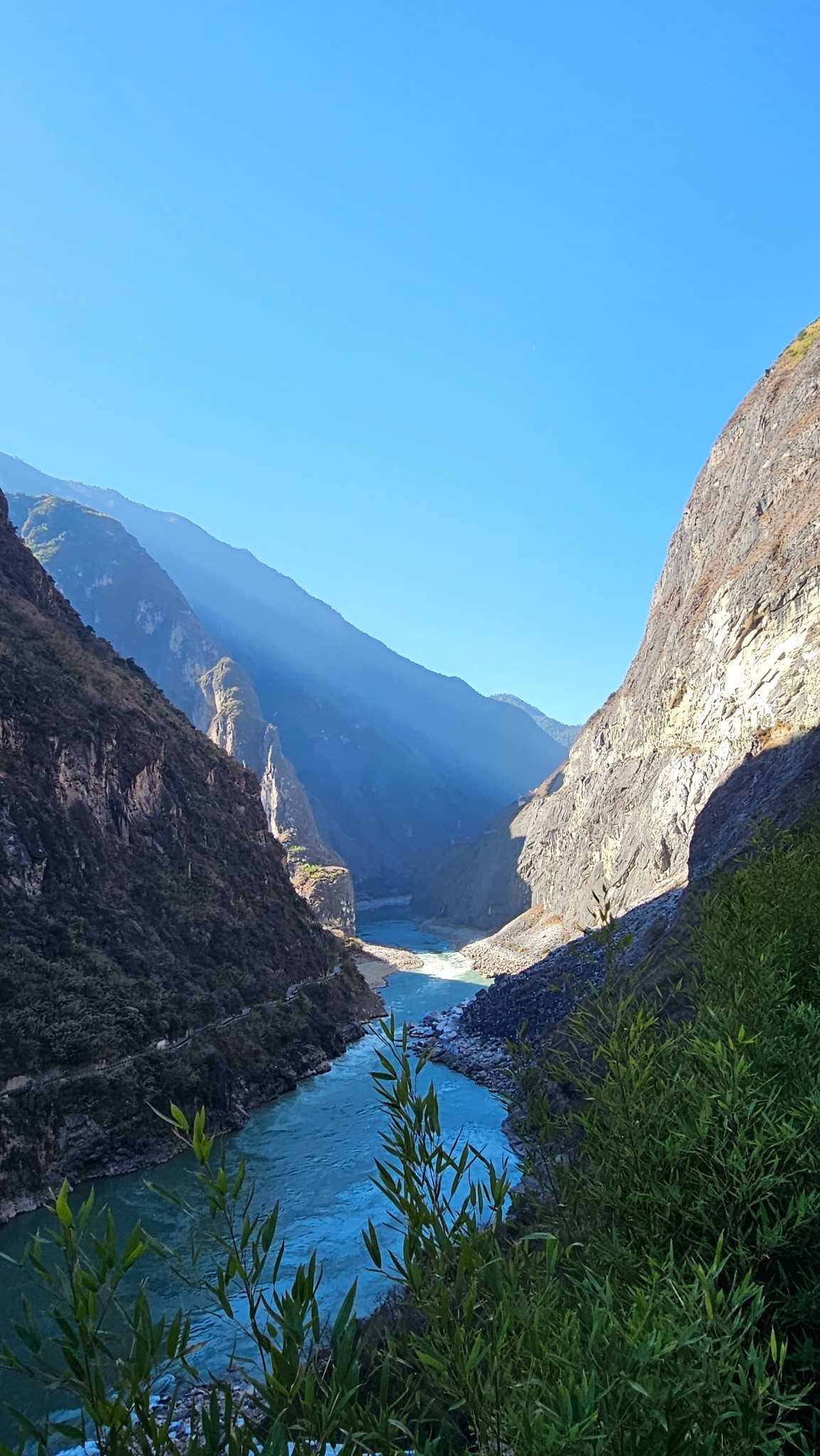
The next morning, we drove to Tiger Leaping Gorge. Located on the upper reaches of the Jinsha River, at the border between Diqing and Lijiang, the gorge has Haba Snow Mountain on the left (Shangri-La side) and Jade Dragon Snow Mountain on the right (Lijiang side). It is divided into upper, middle, and lower sections, stretching about 16 kilometers with a water drop of 220 meters. At its narrowest point, the gorge is just 30 meters wide—legend has it that a tiger once leaped across here, giving the gorge its name.
The entrance fee is 45 yuan. For a 5A-rated scenic spot in China, that's remarkably reasonable. After buying tickets, you can drive directly to the viewing platform. We chose the upper section, which has multi-level platforms descending from the cliff top to the riverbed. Skip the 50-yuan scenic elevator—the climb is just a few hundred steps, and even my aunt with her bad knees managed it easily.
The moment we stepped out of the car, a bone-chilling wind hit us. In winter, the wind in northwestern Yunnan's gorges carries a biting cold that makes you want to keep your hat on. So, a down jacket and a winter hat are non-negotiable. Don't be lazy about it.
Standing at the cliff top, the Jinsha River looked like a turquoise dragon roaring through the canyon. Looking up, the distant snow-capped mountains shimmered faintly gold in the sunlight. Turquoise water, green vegetation, yellow rock, white snow—four colors in a single frame, beautiful enough to leave you speechless.
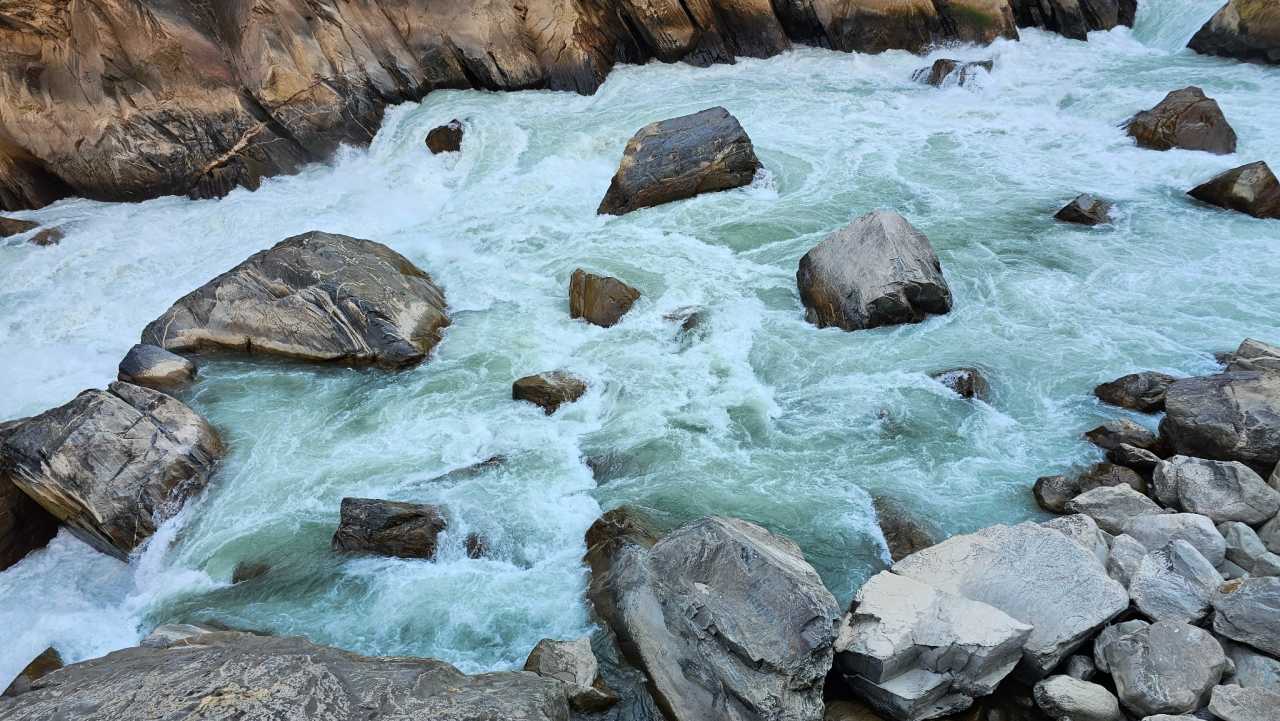
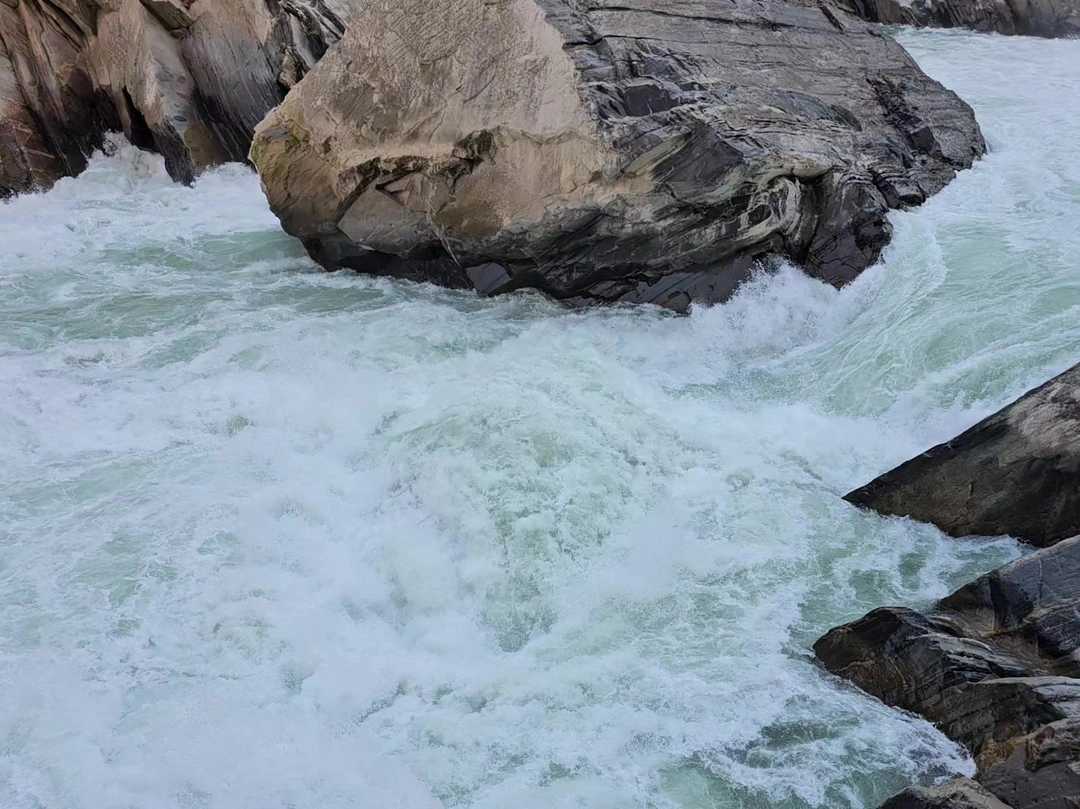
We descended the steps to the riverbed. The sheer power of the scene is something no phone camera can capture. Water crashing against the cliffs, spray flying like snow, the thunderous roar deafening. A tiger sculpture sits in the gorge, symbolizing the legendary leap, and has become an icon of the place.
Standing there, I was reminded of Li Daoyuan's words in his Commentary on the Water Classic: "On the sheer cliffs grow strange cypresses; hanging springs and waterfalls splash among them. Clear, luxuriant, lofty, and steep—truly a place of great interest." The ancients were not wrong.
Chapter Two: Lijiang Old Town, Five Hundred Years of Mu Palace Intrigue
A Walled City Without Walls
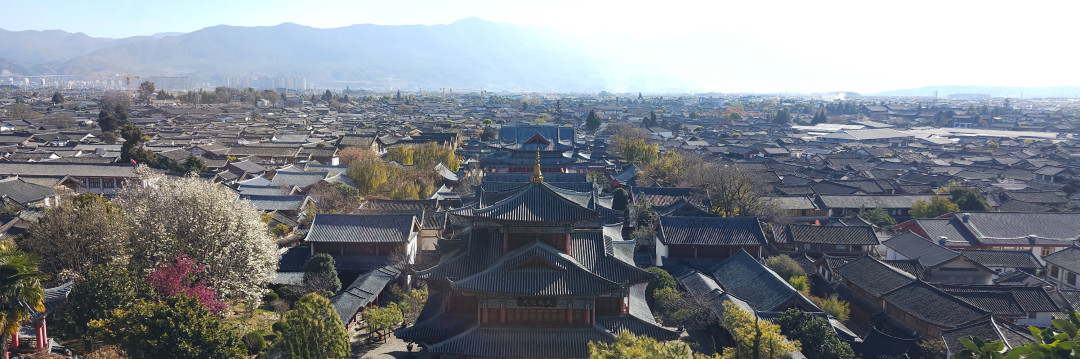
When most people think of Lijiang, two landmarks come to mind: Jade Dragon Snow Mountain and Lijiang Old Town.
The old town's history dates back to the "Sanza City" of the Nanzhao period. It was formally established as a city during the Mongol Yuan dynasty, reached its peak under the Mu chieftains of the Ming dynasty, and became the most important trading hub in northwestern Yunnan and along the Ancient Tea Horse Road after the Qing dynasty replaced the local chieftain system with imperial officials. In 1997, it was designated a UNESCO World Heritage Site.
What makes Lijiang Old Town truly unique is that it has no city walls. Two theories explain this. One is strategic: the town is surrounded by mountains on three sides and connected by a river on the fourth, forming a natural barrier that made man-made walls unnecessary. The other theory is more amusing: during the Wanli era of the Ming dynasty, the Mu chieftain Mu Zeng wanted to build a wall. A scholar advised him: "Your surname is Mu (木, meaning 'wood'). If you surround the character 'wood' with a wall, it becomes 'kun' (困, meaning 'trapped'). That's bad luck!" Mu Zeng dropped the idea.
The Yushui River splits into three streams within the town, creating a landscape of small bridges and flowing water. The streets are paved with uneven stone slabs, said to have been worn down by the hooves of Tea Horse Road caravans. The walls are covered in Dongba script, the cultural code of the Naxi people.
Mu Palace: The Little Forbidden City of the Southwest
The old town is home to many famous residences, such as the former home of historian Fang Guoyu and the Wangjiazhuang Church. But the most magnificent of them all is the Mu Palace.
The Mu Palace was the residence of the Mu chieftains, covering about 30,000 square meters with a central axis 369 meters long. A decade ago, the TV series The Mu Palace Intrigue made it a household name.

The ancestors of the Mu clan were appointed as local officials during the Yuan dynasty. The sixth-generation chieftain, Ajia Ade, submitted to the Ming dynasty and was granted the surname Mu (the character "Zhu" with its top stroke and left radical removed). With the backing of the central Chinese court, the Mu family became the dominant power in northwestern Yunnan. They ruled Lijiang for nearly 500 years, spanning the Yuan, Ming, and Qing dynasties—a true legend.
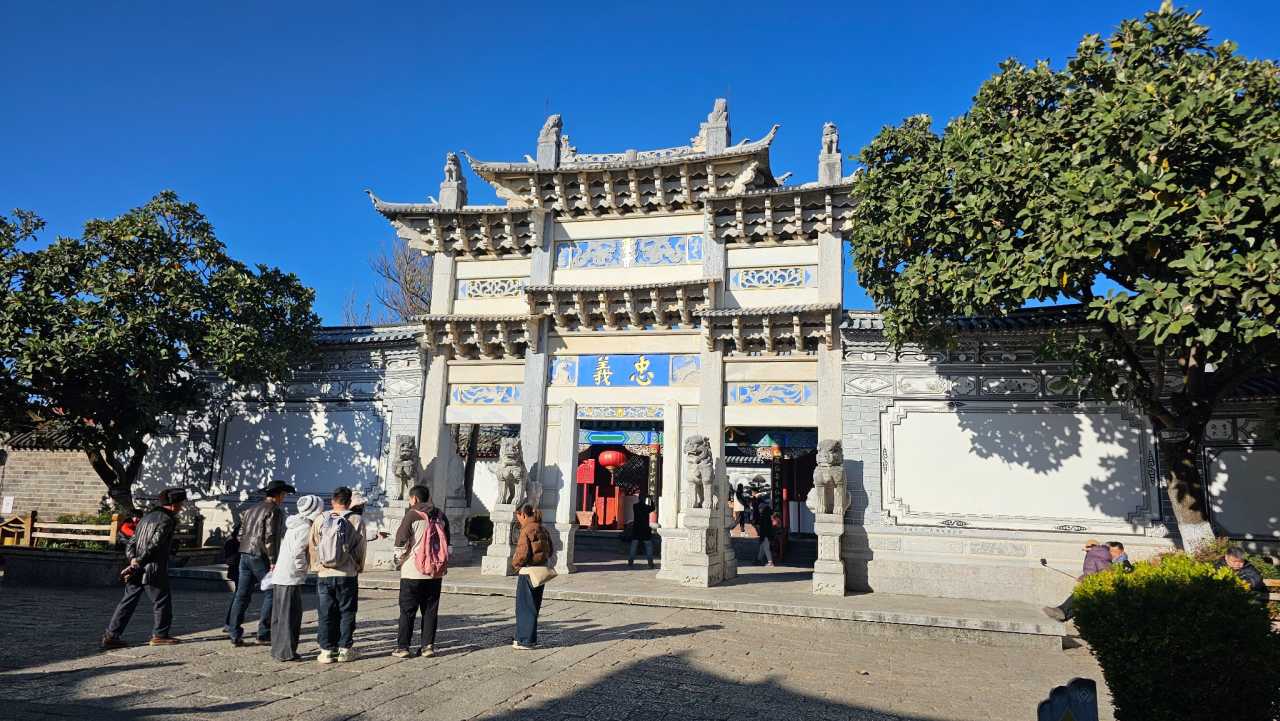
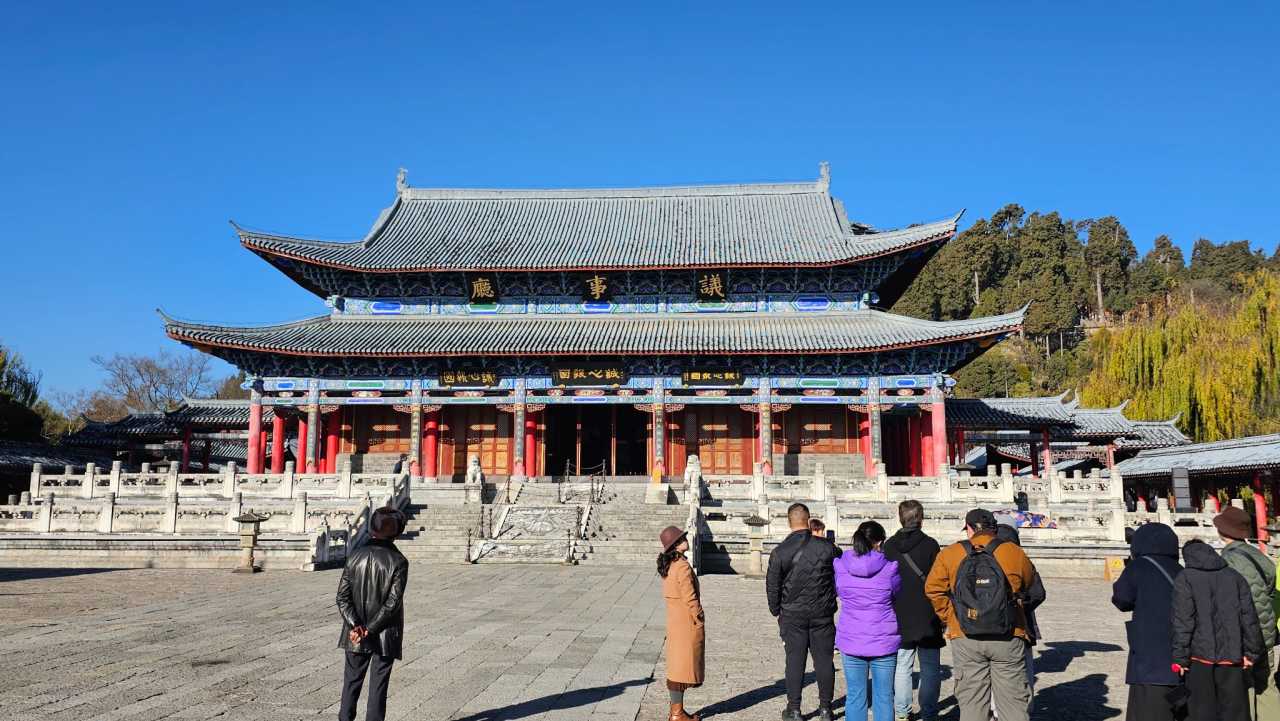
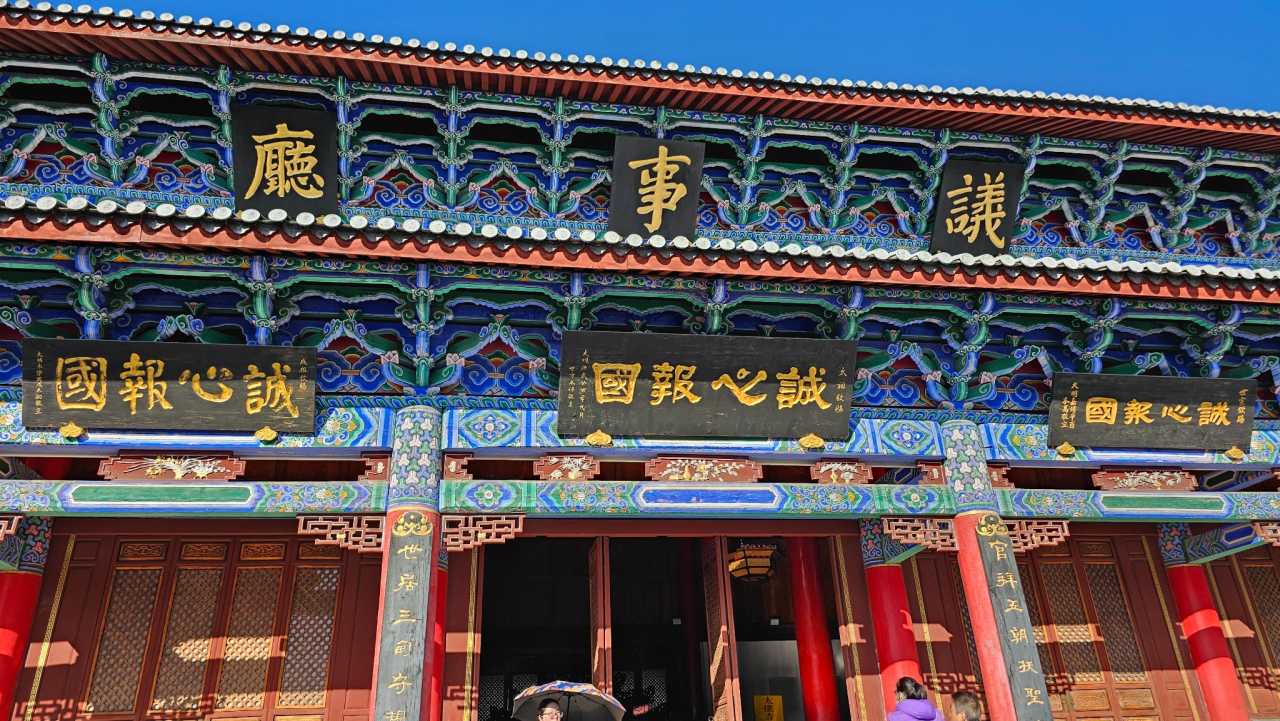
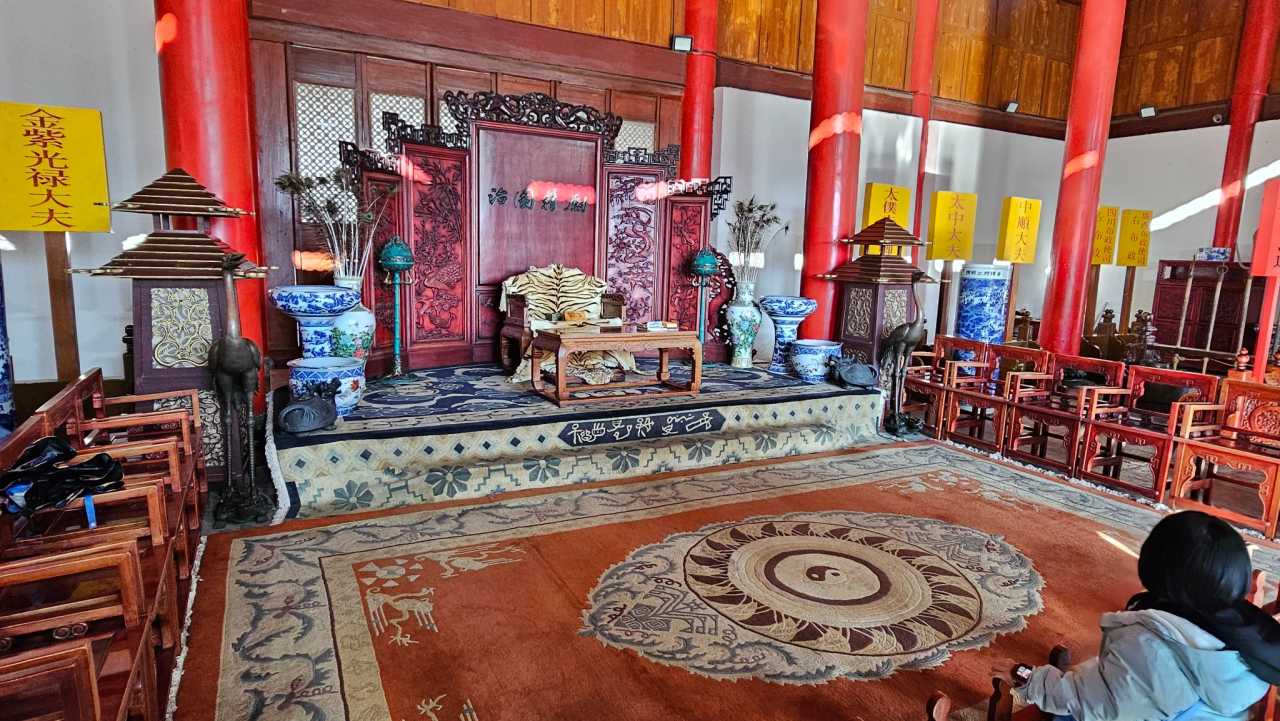
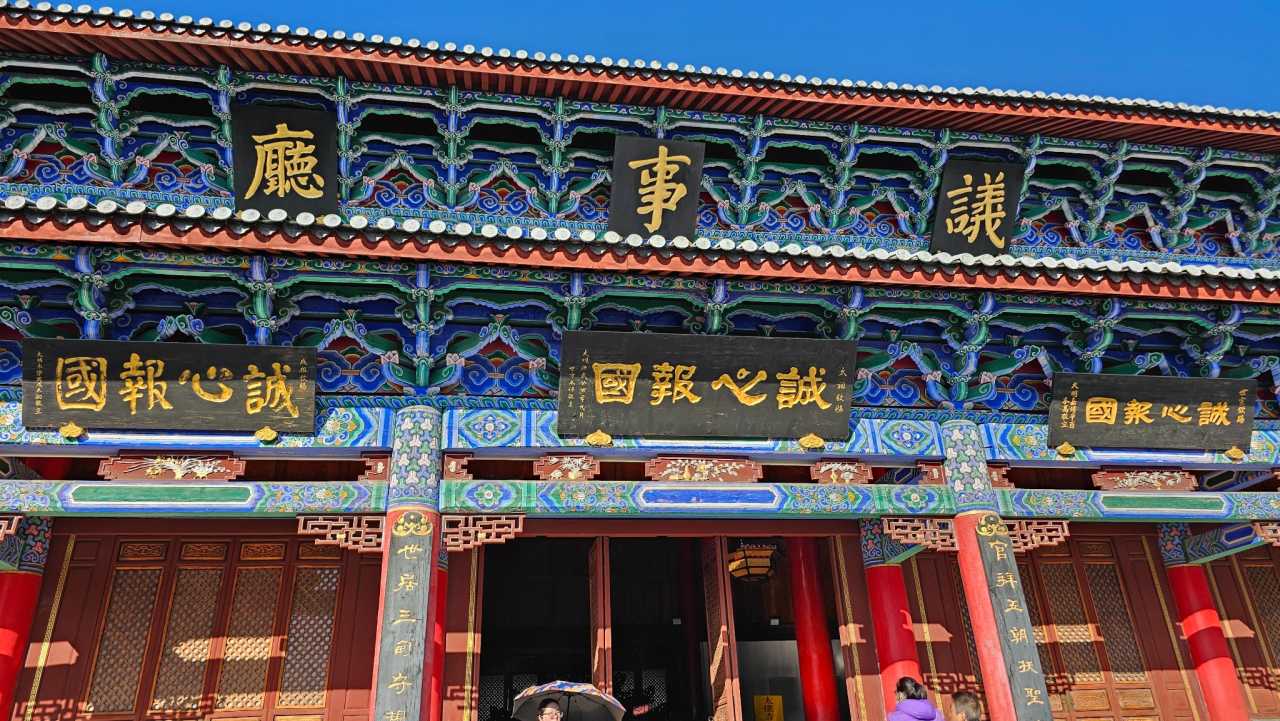
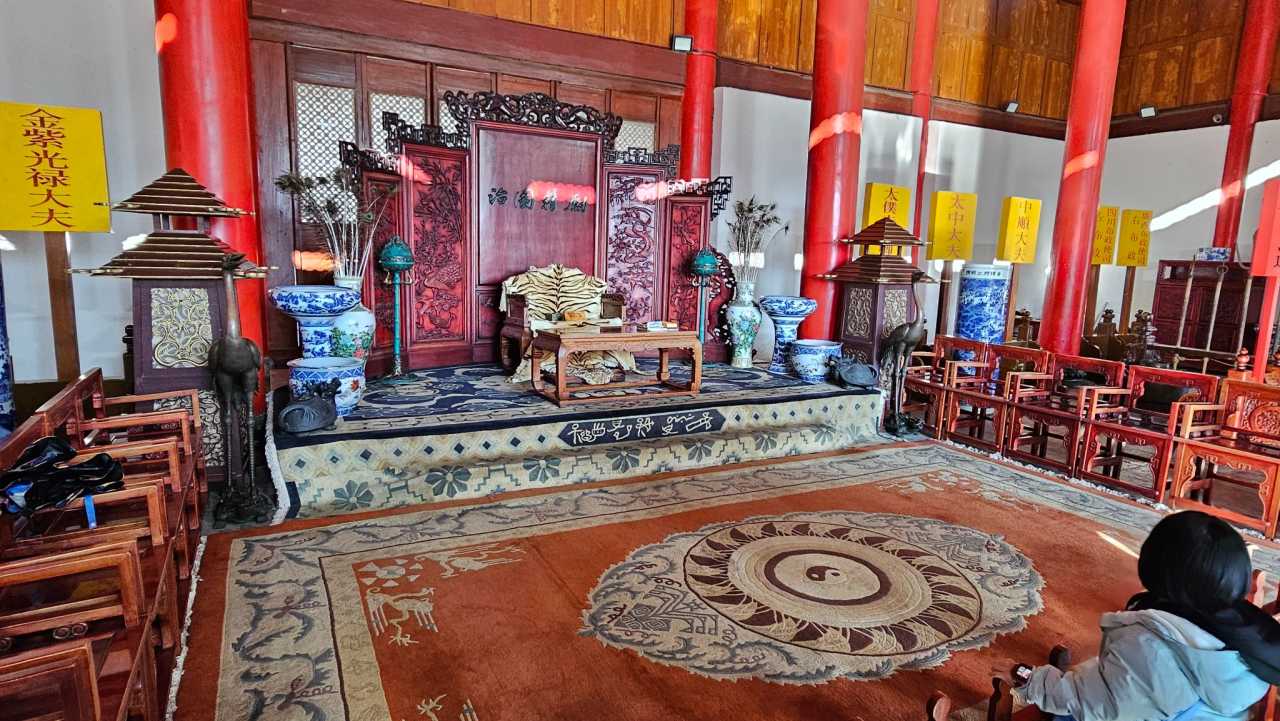
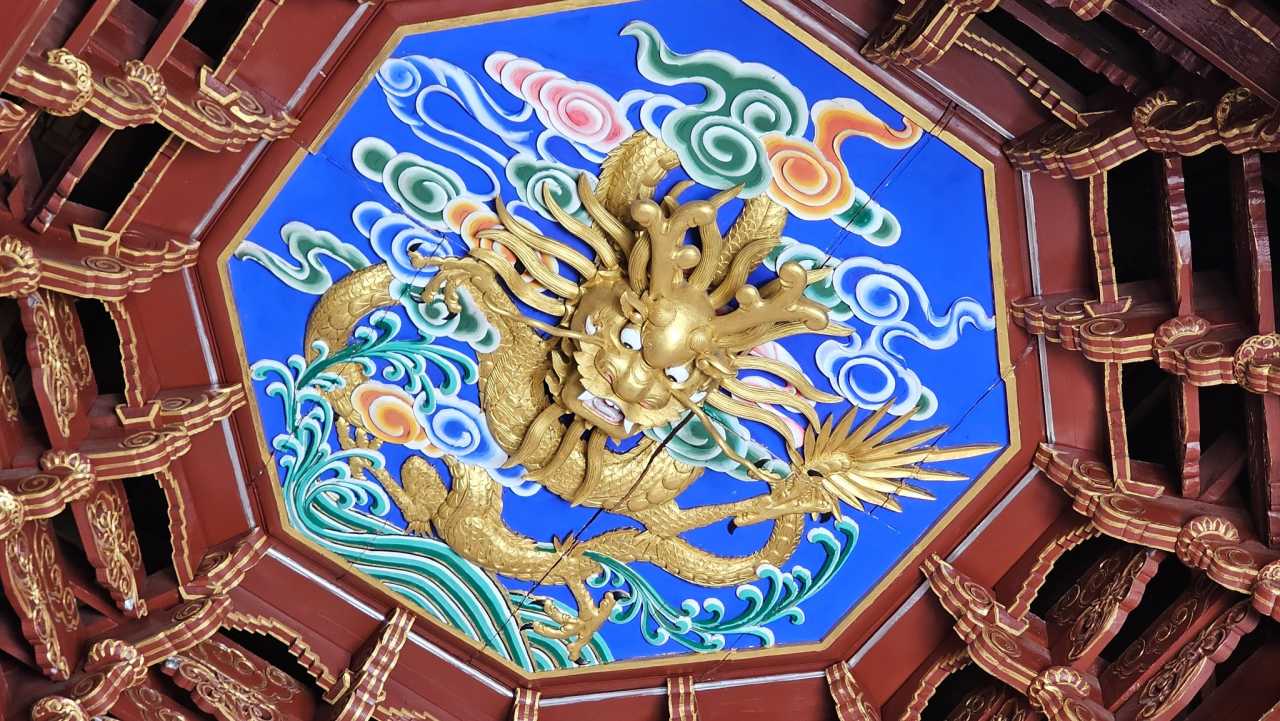
Entering the Mu Palace, the first thing you see is a white marble archway inscribed with the characters "Zhong Yi" (Loyalty and Righteousness)—a gift from the Wanli Emperor to honor Mu Zeng. Inside the议事厅 (council hall), three plaques above the seat all read "Cheng Xin Bao Guo" (Serving the Country with Sincere Heart), granted by Zhu Yuanzhang, Zhu Di, and the Jiajing Emperor respectively. Flanking the seat are various official titles bestowed by the central court. On the ceiling, four-clawed golden dragons are deliberately distinguished from the five-clawed dragons reserved for the emperor. These details reveal the Mu clan's clear awareness of their subordinate status.
The Mu family survived and thrived in the cracks between powers precisely because of this awareness. The Naxi are a small ethnic group, with a population of only 300,000 today. To the north were the fierce Tibetans; to the south, the Bai people, who had established the Nanzhao and Dali kingdoms. To survive, the Naxi had to cling tightly to the central Chinese authority in the east. So the Mu clan not only demonstrated political loyalty but also enthusiastically adopted Han Chinese culture—studying Confucian classics, writing Chinese characters, and building libraries.
The Wanjuan Lou (Ten Thousand Volumes Pavilion) is one of the largest libraries in Yunnan, housing Confucian classics, Dongba scriptures, and the Tripitaka (Buddhist canon). The set of the Tripitaka here was commissioned by Mu Zeng and overseen by Tibetan scholars; it remains an important reference edition in academic circles.
The central axis of the Mu Palace ends at Lion Hill. From the top, you can see the entire old town spread out below. The feeling is a bit like standing on Jingshan Hill looking down at the Forbidden City. No wonder locals proudly say, "In the north, the Forbidden City; in the south, the Mu Palace."
Black Dragon Pool and Shuhe Ancient Town
The UNESCO World Heritage site of Lijiang Old Town includes not only the Dayan Old Town but also the Black Dragon Pool Park to the north and Shuhe Ancient Town.
Black Dragon Pool's most famous sight is the reflection of the snow-capped mountain in its waters—one of the most beautiful mountain reflections in China. The park also contains the Lijiang City Museum. Though it has only one floor, it is built in the traditional Naxi "three rooms and one screen wall" layout and offers a very detailed introduction to Dongba culture.
Shuhe Ancient Town was one of the earliest settlements in the Lijiang Basin, forming as a market town during the Song and Yuan dynasties. At first glance, it seems unremarkable, but the deeper you go, the more you feel an untouched, natural tranquility. At the foot of the mountain lies the Jiuding Longquan (Nine-Ding Dragon Spring), its water so clear you can see fish and aquatic plants. Next to it is the Longquan Temple, which houses both Buddhist and Taoist deities, along with a mysterious little wooden hut that may have been used for Dongba rituals. The temple offers tea tasting for 10 yuan per person, with no time limit (the limit is on the tea leaves, not the water)—an incredible deal.
Chapter Three: Dali, the Millennia-Old Capital of Wind, Flowers, Snow, and Moon
Xizhou Ancient Town and Butterfly Spring
Heading south from Lijiang, it took just over an hour to reach the Dali Basin. Erhai Lake sits in the middle, flanked by the Cangshan and Jizu Mountains, forming a natural barrier—this is why Nanzhao was able to withstand an army of over 100,000 from the Tang dynasty here.
Our first stop was Xizhou Ancient Town. For me, this wasn't just a tourist spot—it was an academic memory. During my first year of graduate school, while researching the Commentary on the Water Classic, I had debated the location of the Han dynasty's Yeyu County seat, and Xizhou was one of the focal points.
As soon as we got out of the car, I noticed the slope of the entire town—it was built into the hillside, tilting westward. The houses were uniformly white, a classic Bai architectural style. The Yan Family Mansion was the home of the famous merchant Yan Zizhen. It combines traditional Han-Bai architecture with a Western-style building, a testament to the cultural fusion of that era.
From Xizhou, we headed to Butterfly Spring. This is one of Dali's most famous landmarks and a filming location for the movie Five Golden Flowers. The entrance fee is 40 yuan. From the gate to the spring is about a kilometer, and you can take a 10-yuan sightseeing car with a guide. Our guide was a young Bai man. Following local custom, we called him "Apeng" (the Bai call young men "Apeng" and young women "Jinhua").
Below Butterfly Spring is the Five Dragon Pool. Apeng explained that washing your hands here can bring good fortune. This year, five zodiac signs are said to be in conflict with the Tai Sui (the Grand Duke of Jupiter), and mine was one of them. We washed our hands three times in the prescribed order—no more, no less.
The spring water is a blue-green color, crystal clear, seeping from rock crevices and sand layers rich in minerals. Beside the spring stands a thousand-year-old night-blooming acacia tree, known as the "Butterfly Tree." Every spring, thousands of butterflies gather here. On the 15th day of the fourth lunar month, the "Butterfly Festival" becomes a grand event where young men and women sing love songs to each other, earning it the nickname "Bai Valentine's Day."
Dali Old Town: Nine Streets and Eighteen Alleys
Dali Old Town was originally the later capital of the Nanzhao kingdom, known as Yangjumie City. During the Ming and Qing dynasties, it developed into a layout of "nine streets and eighteen alleys."
Entering from the west gate, the first thing you see are two banyan trees over 500 years old, known as the "Couple Trees." Behind them is a romantic story: in ancient times, a young lady from the Duan family fell in love with a poor scholar named Zhao. Her father disapproved. The lady swore publicly that she would marry no one else, then threatened to dash herself against a stone. After she was saved, two banyan trees grew facing each other on the spot. Since then, they have become a symbol of love.
The most famous landmark in the old town is the Wuhua Tower (Five-Color Tower), built during the Nanzhao period. It was where the Nanzhao king feasted the leaders of 37 tribes. In middle school history textbooks, the illustration for the Dali Kingdom was this tower. Climbing to the top offers a panoramic view of the old town.
Another worthwhile stop is the "Presidential Military Marshal's Mansion" of Du Wenxiu, now the Dali City Museum. It displays locally unearthed pottery figurines with a flavor reminiscent of Tang dynasty sancai (three-color) ware. The outdoor stele forest features inscriptions in Chinese, Bai, and Tibetan script, from the Dali Kingdom period to the Republic of China.
As for food, most shops offer poor value for money. But I stumbled upon a local residential area, roughly near the Catholic Church and Yu'er Park. The shops there look shabby, but the prices are incredibly reasonable—a bowl of congee with some bread costs just a few yuan, and rice noodles are around ten. The church was built by French missionaries. Its overall structure is Western Christian, but the colors and decorations are distinctly local.
Chongsheng Temple and the Nanzhao Stele of Virtue
Leaving the old town, we visited the Three Pagodas of Chongsheng Temple and the Nanzhao Stele of Virtue. The three pagodas are said to have been built under Tang dynasty supervision, and it's remarkable that they have survived to this day. But aside from the pagodas, the scenic area has almost no other ancient artifacts, yet charges 75 yuan for admission. Plus, you have to walk a long way from the gate to the pagodas. Unless you are deeply passionate about Buddhist history, I'd advise thinking twice.
The Nanzhao Stele of Virtue is preserved in a pavilion at the Taihe City ruins. The inscriptions are now badly worn and difficult to read. During my first year of graduate school, Professor Ma Yong's class on "Selected Readings in Historical Geography Documents" took us through this stele's text. It offers a perspective different from the official histories of the Tang dynasty—it shows that Nanzhao knew it was unwise to be at odds with the Tang and carved the stele to explain its helplessness, leaving an opening for future reconciliation.
Standing before the stele, I thought about the rise and fall of the Nanzhao kingdom. This small state survived and grew between the two great powers of Tang China and the Tibetan Empire. First, it relied on the Tang to unify the six Zhao tribes. Then, as the Tang pressed too hard, it turned to Tibet and conquered all of Yunnan. Later, when Tibetan exploitation became unbearable, it returned to the Tang's side. This survival strategy of "balancing hardness with softness" bears a striking resemblance to how the new China later maneuvered between the United States and the Soviet Union.
Nanzhao's decline began precisely when it abandoned this shrewdness. After joining forces to defeat Tibet, it rashly launched an all-out war against the Tang, ultimately draining its strength.
Chapter Four: Songshan in Longling, Memories of Blood and Fire
Leaving Dali, we arrived in Longling County, Baoshan City. The name might be unfamiliar, but when you see the sculptures, you'll recognize it immediately—this is the Songshan Expeditionary Force Sculpture Group.
Songshan sits on the west bank of the Nu River (Salween River). It was the starting point for the Chinese Expeditionary Force's second Burma campaign during the War of Resistance against Japan. In June 1944, the Expeditionary Force launched the Battle of Songshan here. After three months of bloody fighting, suffering casualties seven times greater than the enemy's, they finally annihilated the Japanese defenders.
The Battle of Songshan was so brutal because the Japanese defensive fortifications were incredibly strong. They had hollowed out the mountain, building three layers of tunnels: the upper layer for shooting and observation, the middle for living and shooting, and the lower for ammunition and food storage. The slopes were as steep as 60-70 degrees. The trees had been burned off, leaving the Chinese soldiers completely exposed to a hail of bullets. The Japanese had also stockpiled enough supplies to last half a year.
The Chinese forces initially tried frontal assaults, only to suffer heavy losses. They then used flamethrowers to drive the Japanese out and cleared the outer bunkers before attempting tunnel demolition. Even then, the Japanese fought to the death, and both sides engaged in brutal hand-to-hand combat. Sixty-three pairs of Chinese and Japanese soldiers were found locked together in death. Body parts and eyeballs littered the ground—a horrifying scene. That slope is now called "Hand-to-Hand Combat Hill."
Today, at the foot of Songshan, the Expeditionary Force Sculpture Group stands, including formations of child soldiers, female soldiers, summer-uniformed troops, autumn-uniformed troops, troops stationed in India, commanders, allied forces, and war horses. Standing before these sculptures, I was silent for a long time. Those child soldiers—some looked barely in their teens—had already shouldered the heavy burden of defending their country.
Final Chapter: The Harvest from the Road
Seventeen days of self-driving through western Yunnan, from Lijiang to Xishuangbanna, from the plateau to the rainforest, from ancient towns to battlefields—every stretch of road felt like a chapter in a book, each page filled with stories.
Some practical tips for those ready to hit the road:
- Seasonal Choice: Winter is an excellent time for a Western Yunnan road trip. The weather is clear and rainfall is low, but temperature differences between day and night are significant. A down jacket and a hat are essential.
- Altitude Sickness Prevention: Lijiang sits at 2,400 meters. When you first arrive, avoid strenuous exercise, drink plenty of water, and keep warm.
- Itinerary Planning: Drive no more than four hours a day. Leave enough time for deep, immersive experiences.
- Ticket Strategy: Skip the scenic elevator at Tiger Leaping Gorge. The Three Pagodas of Chongsheng Temple offer poor value for money. The sightseeing car at Butterfly Spring depends on your personal needs.
- Food Exploration: In Dali Old Town, find the local residential areas. Prices there are more than half cheaper than in the tourist zones.
This journey made me deeply realize: Western Yunnan is not just a geographical concept; it is a cultural melting pot. The Naxi people's Dongba culture, the Bai people's "three rooms and one screen wall" architecture, the Dai people's pagodas, the Han Chinese Confucian tradition, the Tibetan Buddhist murals—they all coexist and blend on this land, forming one of China's richest and most diverse human landscapes.
And traveling by car is precisely the best way to feel this richness. You can go from a cup of tea in Lijiang Old Town to a soak in a Tengchong hot spring. From the tragedy of the Battle of Songshan to the romance of Butterfly Spring. From the political wisdom of the Mu Palace to the survival philosophy of the Nanzhao kingdom.
This is the charm of self-driving through Western Yunnan. It is not just a trip. It is a dialogue across time and space.
You should also read:

Body in Hell, Heart in Heaven: A Pilgrimage Through Tiger Leaping Gorge — A Dialogue Between Heaven and Earth
Body in Hell, Heart in Heaven: A Pilgrimage Through Tiger Leaping Gorge — A Dialogue Between Heaven and Earth Introduction: When the Gorge Splits Open Beneath Your Feet Some say Tiger Leaping Gorge is the closest place on Earth to the border between "hell" and…
Continue reading...
Cloud Travelogue · Dali of Wind, Flowers, Snow, and Moon: A Three-Day, Two-Night Journey of a Free Spirit
Cloud Travelogue · Dali of Wind, Flowers, Snow, and Moon: A Three-Day, Two-Night Journey of a Free Spirit I am a cultured female foodie with a touch of rogue charm. I slung on my backpack, took my lover's hand, and set off on a spontaneous…
Continue reading...
The Meaning of Travel – A Tengchong Story: A Journey of the Heart and Personal Growth
The Meaning of Travel – A Tengchong Story: A Journey of the Heart and Personal Growth Setting Out, Only to Return a Better Self Some say travel is nothing more than leaving a place you're tired of, only to go to a place where others…
Continue reading...