Winter Escape Plan: Taking a Child to Dali, Rediscovering the Warmth of Life Between Cangshan Mountain and Erhai Lake
Winter Escape Plan: Taking a Child to Dali, Rediscovering the Warmth of Life Between Cangshan Mountain and Erhai Lake
Shanghai winters are bone-chillingly damp and cold. The gray sky hangs like a dirty dishrag that can never be washed clean, pressing down on you until you can barely breathe. I stared at the photos of Dali on my phone screen — that eternally blue sky, those perpetually green Cangshan Mountains, that endlessly clear Erhai Lake — and suddenly made a decision: Let's go to Dali!
This trip evolved from an initial "birthday getaway" into a "New Year's Eve adventure," transforming from a solo journey into a boisterous expedition of three adults and two children. And as it turned out, some places are worth visiting with all your uncertainties, just packing up and going.
The Chaos Before Departure
Dali had been sitting on my travel list for a full two years. The biggest obstacle keeping me from going? I couldn't find anyone to share a room with.
At this stage in life, all my friends and relatives are either married or have kids. Finding a single travel companion is harder than climbing to heaven. I finally convinced my best friend to abandon her husband and child for a "weaning trip," but at the last minute she backed out: "I can't bear to leave my son behind; I have to bring him along." That meant her husband would have to come too.
So there I was, back at square one.
In the end, I couldn't suppress my restless heart any longer. I decided to stop waiting. Can't afford a sea-view room? Then I'll take a regular room — I can always hang out in my friend's sea-view room anyway. On a tight budget? Then I'll be careful with spending. Travel is never about waiting until everything is perfectly ready before setting off; it's about setting off, and then everything naturally falls into place.
Day One: Escaping the Magic City, Embracing Dali's Sunshine
The 7:35 AM flight was tough on sleep, but arriving in Dali by noon and starting the first day's journey made it worth the sacrifice.
My little princess, Wan, has a natural gift for flying. No matter how long the flight, she entertains herself perfectly — eating when it's time to eat, sleeping when it's time to sleep. When she saw the flight attendants distributing food, even before our turn, she kept calling out, "Thank you, auntie flight attendant!" One attendant was so charmed by her cuteness that she promised to give her a little bunny toy. Unfortunately, the attendant got busy and accidentally gave the bunny to a little girl in the row behind us. Wan had already fallen asleep, blissfully unaware of this tiny disappointment.

After arriving in Dali, we chose to rent a car and drive ourselves. With three adults and two children, public transportation was just too inconvenient. Dali Airport is very small — the car rental pickup point is just 200 meters to the left after exiting, very convenient. The entire trip's rental car plus gas cost us only 710 RMB, much cheaper than hiring a driver. The only hiccup was that the car wasn't fully fueled when we picked it up, and since we didn't know the area, we had to find a gas station first and fill up, wasting some time. But they said if there's leftover fuel when we return the car, they'd refund us, which was fair enough.
The guesthouse we stayed at was called Sofar (遠), located in Xiadeng Village. Without a car, it would be a bit far from Dali Old Town. But the area around the guesthouse was very quiet, right next to Erhai Lake, with plenty of similar B&Bs nearby. Parking cost 20 RMB during the day and 30 RMB overnight.
After settling our luggage, we had lunch near the guesthouse. Four dishes cost only 89 RMB — we were shocked by Dali's prices. Using Dianping (a review app) gave us even more discounts. Truly great value for money.
By the time we slowly made our way to Dali Old Town in the afternoon, the sun was already dipping westward. We went looking for a dessert shop called "Mint Sugar," rumored to have amazing red velvet cake. We finally found the place, but it looked desolate — just two tables downstairs and an empty upstairs. The owner said most of their stuff had been moved to their guesthouse. We reluctantly sat down and ordered some drinks and light cheesecake, which were just average. Later we found out we had indeed found the right place; they'd just shifted their focus to their guesthouse business. I suppose that's the norm in Dali — many beautiful things are quietly changing.
Dali Old Town is now heavily commercialized. Streets lined with shops, bars, and restaurants make it hard to feel any ancient atmosphere anymore. I bought a few pretty postcards at a souvenir shop, wanting to mail them to friends, only to be told: "Postcards from Dali can't be mailed with stamps directly attached; they have to be put in envelopes." If you want to send official postal postcards, you have to buy them at the post office, but those are much less attractive. In the end, the postcards I sent felt like they were missing some soul.
Day Two: Lazing Around the Guesthouse, Wandering Along the West Erhai Lake Road
In Dali, the most luxurious thing you can do is — nothing at all.
Wake up naturally in the morning, have a nutritious breakfast at the guesthouse, then zone out on Sofar's terrace. There's a beautiful sunroom with lovely views, soft and cozy corners perfect for lounging, a bank facing Erhai Lake where you can sit, a balcony overlooking Cangshan Mountain's sunrise and sunset, and a large terrace bathed in the golden light of dusk. And so we spent an entire morning doing nothing, just letting the waves of Erhai Lake wash over us.
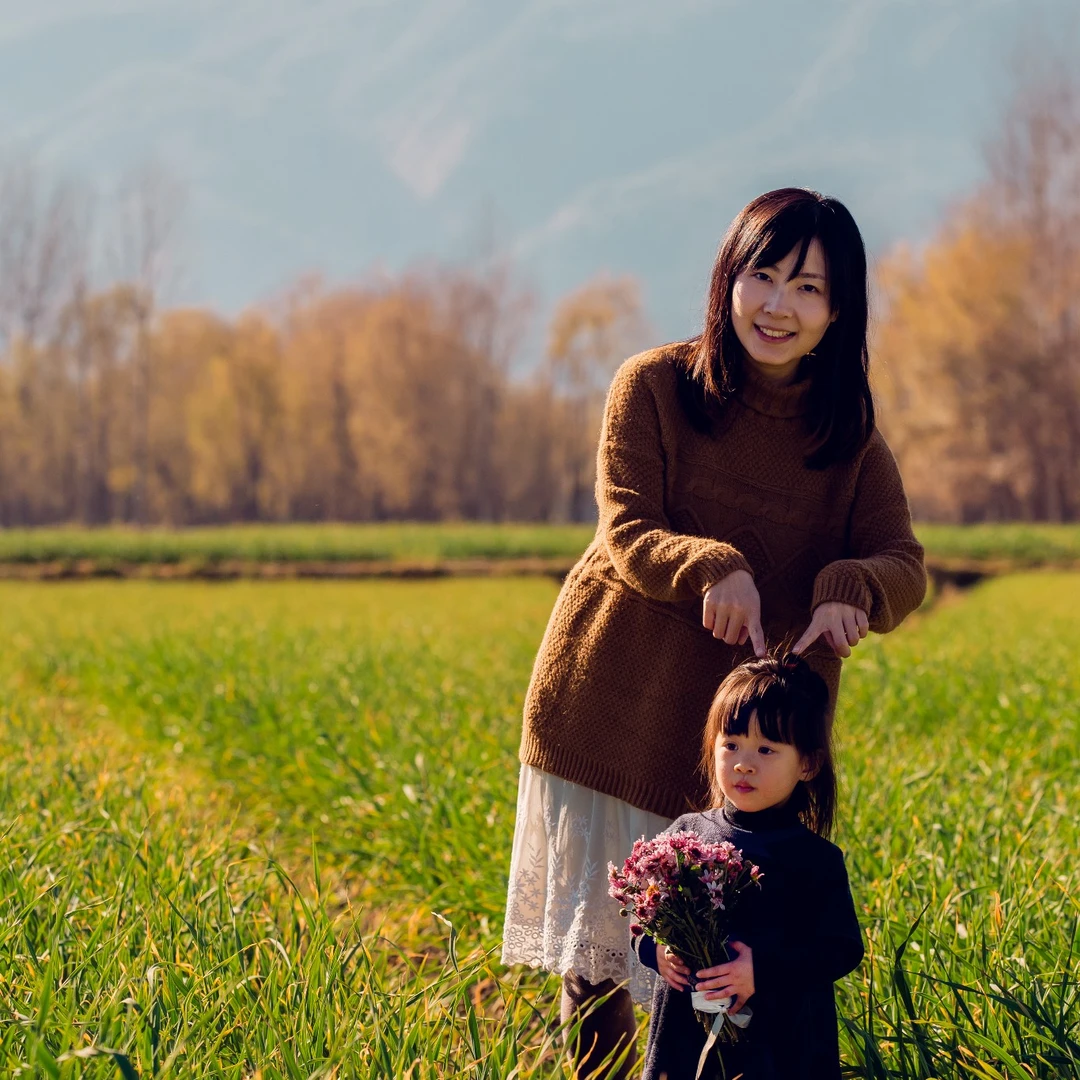
After lunch, we finally decided to head out to the West Erhai Lake Road. Along the way, we passed through Caicun Village and made a quick tour. The village center had some guesthouses, and at the end was a dock — nothing special. But the farmland at the foot of Cangshan Mountain on the outskirts of the village had much more charm.
Leaving Caicun, we drove along the West Erhai Lake Road, stopping whenever we saw something beautiful, taking it in, taking photos. In my mind, Erhai Lake meant trees growing out of the water, a solitary boat, and flocks of seagulls. The first place that made us stop was a row of small fishing boats moored at the shore. Once Wan got on a boat, she refused to come down, clutching the oar and not letting go. People waiting in line behind us got impatient and just boarded other boats. In the end, we had to coax her by saying, "There are even more fun boats ahead," before we could resolve the situation peacefully.
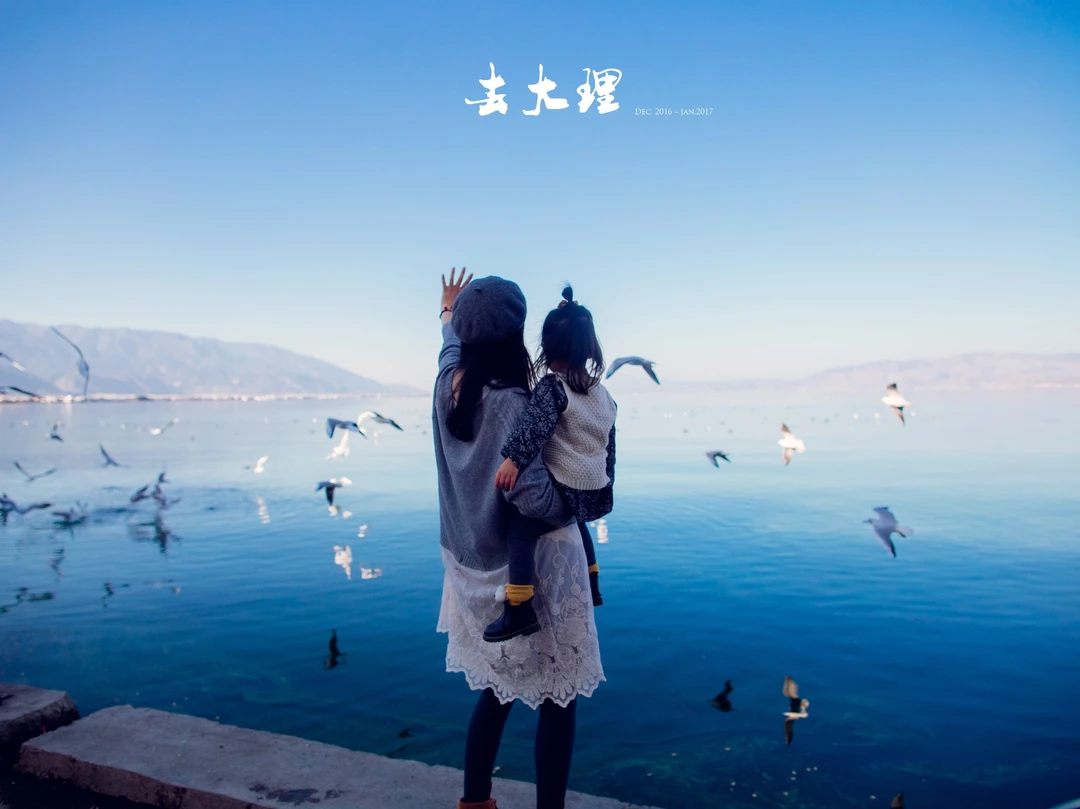
The highlight of our stop was Majiuyi Village. There were flocks of seagulls! Wan was absolutely thrilled when she saw them. But the terrain there was dangerous — cars parked along the road, very little standing space, with traffic behind us and the risk of her leaning too far forward while feeding the birds and falling into the water. I didn't dare let her get down, but she was stubborn, insisting on getting off, and once down, she refused to hold hands properly. At that moment, I couldn't help but think: Maybe I'm overprotecting her? She probably knows her limits, but I just can't bring myself to let go.
By the time we finished watching the seagulls, it was getting dark, and the kids fell asleep on the way back. Returning to the guesthouse, we found a group of musicians playing and singing on the terrace in the sunset. I was drawn by the guitar music and sat down with sleeping Wan in my arms. In that moment — the music, the sunset, the child in my arms — everything felt unreal, too beautiful to be true.
The night sky in Dali was so beautiful it made you want to cry. Living in the city, how long had it been since we'd seen so many stars? Probably since childhood. Do kids today still learn to count stars in their textbooks? They probably can't understand what there is to count — because you can barely see any stars in the night sky.
Day Three: Sunset at Haishe Park, Missing the Daytime of Xizhou
We reluctantly checked out of Sofar and arrived in Xizhou in the afternoon.
Xizhou is an important town for the Bai ethnic group, preserving the largest and best collection of traditional Bai residential architecture. The private homes we saw along the way were stunningly beautiful — true mansions. But my travel companion said they only cost about 100,000 RMB to build. In Dali, beauty and money don't seem to be that closely related.
The guesthouse we stayed at was called "己已巳" (Ji Yi Si), located in Chengbei Village. After settling in, we went to "Moshang" for lunch. By the time we finished eating, it was already two or three in the afternoon. We decided to head to Haishe Park first, since it wouldn't be fun after dark, while Xizhou Old Town could still be explored in the evening.
On the way to Haishe Park, we discovered a large tree leaning against Cangshan Mountain, with the tree beside us as we strolled through the fields, holding hands — this was the scene I had dreamed of.
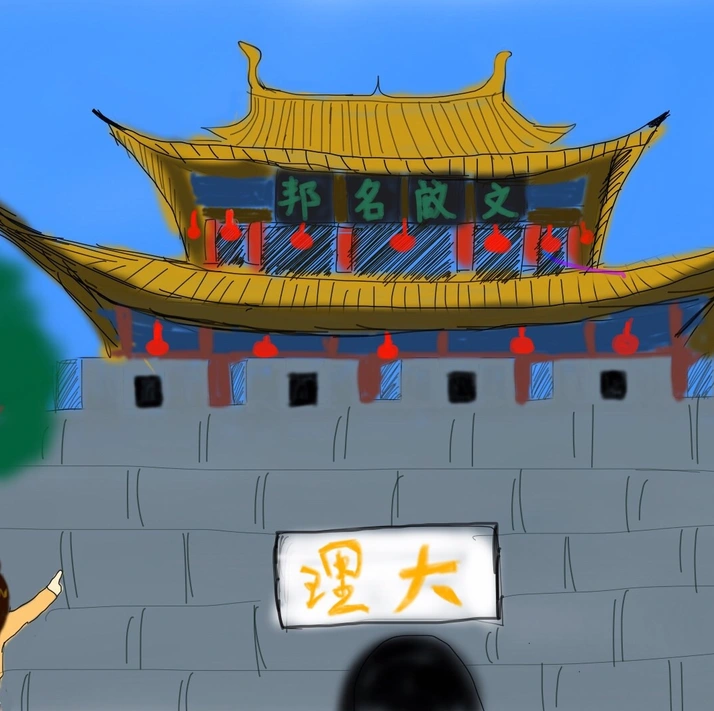
Cars heading to Haishe Park could only park at the entrance lot. Walking in wouldn't have been a problem normally, but with two kids it was too tiring, and since it was New Year's holiday, there were lots of tourists. Even the horse-drawn carriages on the path to Haishe were stuck in traffic. We had to take a carriage in. Wan chose a white horse and called it "White Dragon Horse." It was her first time on a horse-drawn carriage, and she was ecstatic. For three adults and two children, the carriage only charged us 10 RMB — such honest, simple folk in Dali.
Haishe Park is huge. With limited time, we only covered about half the distance and didn't make it to the actual "tongue" part. But even that half was beautiful enough. We brought a picnic blanket and spread it out under a big tree by Erhai Lake, sitting on the ground. Of course, Wan wouldn't sit still — she ran around in the grass, kicking up clouds of dust. Luckily, my travel companion came up with a game of throwing pebbles to distract her. And so I ended up spending another afternoon looking for pebbles with her.
Time slipped away without us noticing. The sun was setting, and we had to head back. On the way, we caught the last rays of sunlight of 2016, and clouds edged with gold.
By the time we reached Xizhou Old Town, it was completely dark. The town was dimly lit, and many shops had already closed. Compared to Dali Old Town, it was much quieter here. I actually preferred this ancient peacefulness. The only regret was that we never got to properly explore Xizhou Old Town during the day — it hasn't been overdeveloped yet, everything is still in its original state, which is the true essence of an ancient town.
We had dinner at Sifang Street Restaurant. The owner was incredibly honest. When we wanted to order fried milk fan (a local cheese dish), he advised us not to, saying many out-of-towners don't like it. If we really wanted to try, he could make us a half portion. As it turned out, the fried milk fan didn't disappoint us at all — it actually suited our taste perfectly.
The starry sky over Xizhou that night was so beautiful words couldn't describe it. Even more beautiful than the previous two nights at Sofar. That was when I truly understood what "vast starry sky" meant. It was the third day of the lunar month, and we could see a bright crescent moon, and even the full circular outline of the moon. How clean must the air be to see such a sight?
Day Four: The Most Beautiful Stretch of Erhai Lake
Woke up in the morning and played around the guesthouse for a while. Ji Yi Si is an old residence built in 1949 (the 38th year of the Republic of China), originally owned by one of the four major merchant families of Xizhou. The courtyard still retains remnants of old relief carvings and murals. After sitting abandoned for over forty years, it was restored and given new life. Banana trees and bamboo complement each other, flowers and trees are lush, carrier pigeons fly over black-tiled roofs, and fish play among lotus leaves under the half-moon pavilion. Every corner reveals thoughtful design touches, full of artistic flair.
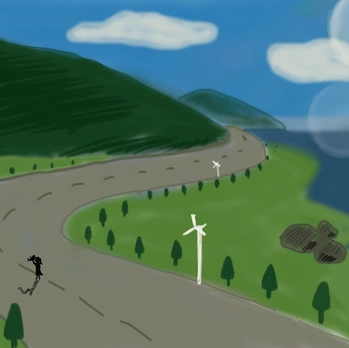
Today's plan was to have lunch in Shuanglang, then go to Wase to watch the sunset. From Xizhou to Shuanglang, we took the East Erhai Lake Road. I'd read travel guides before, and most people cycled along the West Erhai Lake Road; I rarely saw recommendations for the east road. But I think the scenery on the East Erhai Lake Road is even more beautiful than the west! Everything the west road has, the east road has too, plus winding S-shaped mountain roads. Unfortunately, we didn't have a drone to capture the stunning effect. If I hadn't had the kids with me, I might have climbed a hill for that perfect shot.
But as always, plans change. When we got close to Shuanglang, we found the road blocked; we had to park and switch to electric scooters to enter the town. Moreover, the road to Wase was also closed, not opening until 6 PM. All our plans were thrown into chaos.
But that's travel — full of unknowns. A trip without taking a wrong turn isn't a real trip. That's how I comforted myself.
Shuanglang wasn't really a must-see anyway — just a place to eat. No big loss giving it up. But the road closure to Wase was the real headache — what should have been a short distance now required a long detour on the highway. It added so much time that we had to settle for lunch at the Shuanglang service area.
By the time we reached Wase, the kids were asleep. Wase town has a dike that extends into Erhai Lake, reaching all the way into the water. If Wan hadn't been asleep and insisted on coming along, it would have been quite dangerous. There were people there specifically calling seagulls, but when we arrived, there were very few seagulls. Many people were queuing up for photos, and to take them you had to take off your shoes and socks — the water was very cold. But the effort paid off: even without seagulls, the photos turned out great, with a hint of Bolivia's Salt Flats (Salar de Uyuni) mirror effect.
Next stop was Xiaoputuo (Little Putuo Island). There were lots of seagulls here, and the terrain was much safer than along the West Erhai Lake Road. I could finally relax and let Wan feed the seagulls. She had a blast, chatting with them: "Seagulls! I have cookies here, come and eat!" We bought three bags of crackers, which weren't nearly enough, so we got three more. She even had her quiet moments — sitting by the shore watching the seagulls, she started reciting a poem: "Goose, goose, goose, singing to the sky with arched neck, white feathers floating on green water, red paddles stirring clear waves." Even though they weren't geese, the scene was fitting enough for her to recite that poem.
The stretch from East Erhai Lake Road to Xiaoputuo — I think this is the most beautiful part of Erhai Lake. If I only had one day to spend in Dali, I would choose to spend it here without hesitation.
After watching the sunset, we went back to Xizhou for dinner. The night before, we'd stumbled upon a restaurant that was the filming location for a Ruby Lin TV drama, with a three-person set meal for only 100 RMB — great value. But by the time we got there, they were about to close. We had to settle for something nearby.
Once again, we never got to see what Xizhou looks like during the day.
Day Five: The Return Journey, Back into the Smog's Embrace
Today we had to go back. Our flight was at 12:45 PM, which meant we didn't even have time to linger in Xizhou.
Get up, have breakfast, pack luggage. But I still had one important thing left undone — mailing my postcards. I'd asked at Sofar if they could mail them for me, but every night I was busy putting Wan to sleep and never had time to write them. I thought I'd do it at Ji Yi Si instead. But Ji Yi Si couldn't mail them, and the nearest postbox was at Sifang Street in Xizhou town center. You can't drive in the old town, so I got off at the nearest intersection and ran to the post office. I asked a local how long it would take to walk there — 10 minutes. Twenty minutes round trip, and we were already pressed for time to catch our flight. I had to give up and head straight to the airport, hoping to find a post office along the way.
Luckily, I really did spot a post office by the roadside. Finally, one worry off my mind.
Arrived at the airport, returned the car, checked luggage, went through security, and by the time we reached the boarding gate, boarding was just starting. Perfect timing.
Goodbye, Dali. Until we meet again one spring when the flowers bloom.
Afterword: On Growth
This was Wan's fifth trip. Every previous time, she had been commendable, making me proud. But this time, she was fussy and prone to tantrums. At one point, I didn't want to bring her out anymore.
When I calmed down and thought about it, I found the reason. There was also a little boy traveling with us, and the adults naturally paid more attention to the younger child. She felt neglected, and that made her act out — she was just seeking attention. But I didn't understand her; instead, I scolded and criticized her for being difficult, which only made things worse.
I have my shortcomings too. Traveling alone with her was physically and mentally exhausting, making it hard to control my own emotions.
Dear little Wan, on our next trip, Mommy will grow and improve together with you.
Practical Tips
- Must bring sunscreen! We didn't this time, and Wan got tanned.
- Must bring hand cream! Not sure if it's the water quality, but our hands felt extremely dry the whole time.
- Renting a car for self-driving: Dali Airport is very small, and picking up the car is convenient. I recommend choosing a rental company that provides a full tank and expects a full tank on return, to save the hassle of refueling.
- Accommodation choices: If you want to watch the sunrise, stay on the west bank of Erhai Lake; if you want to watch the sunset, stay on the east bank. For this trip, we spent the first two nights at Sofar on the west bank, and the last two nights at Ji Yi Si in Xizhou — two completely different experiences.
- Postcards: Postcards from Dali can't be mailed with stamps directly attached; they have to be put in envelopes. If you want to send official postal postcards, you have to buy them at the post office.
- The East Erhai Lake Road is more beautiful than the West Erhai Lake Road. If you have time, you must drive it.
This trip to Dali had its regrets, surprises, exhaustion, and moments of emotion. But the most important thing — we accomplished it: between Cangshan Mountain and Erhai Lake, we spent a beautiful time doing nothing at all.
You should also read:

Body in Hell, Heart in Heaven: A Pilgrimage Through Tiger Leaping Gorge — A Dialogue Between Heaven and Earth
Body in Hell, Heart in Heaven: A Pilgrimage Through Tiger Leaping Gorge — A Dialogue Between Heaven and Earth Introduction: When the Gorge Splits Open Beneath Your Feet Some say Tiger Leaping Gorge is the closest place on Earth to the border between "hell" and…
Continue reading...
A Spiritual Journey to Lugu Lake in Lijiang: Experiencing the Legend of the Kingdom of Women! (Reproduction and Hotlinking Prohibited)
A Spiritual Journey to Lugu Lake in Lijiang: Experiencing the Legend of the Kingdom of Women! (Reproduction and Hotlinking Prohibited) Off-road自驾, food, hotel and民宿 reviews, Featured Traveler, Tank 300 owner, 200,000 km of self-driving experience. WeChat: y01294987 Ninglang Yi Autonomous County 2010.11.08 · 7 days…
Continue reading...
Hiking Around Lugu Lake: Measuring This Mysterious Highland Pearl on Foot
Hiking Around Lugu Lake: Measuring This Mysterious Highland Pearl on Foot Introduction: A Date with the Lake At the border between Yunnan and Sichuan provinces lies a highland lake embraced by mountains, embedded like a sapphire in the folds of the Hengduan mountain range. Here,…
Continue reading...