Yunnan Upside Down: A Journey Through the Ancient Nanzhao Dream
Yunnan Upside Down: A Journey Through the Ancient Nanzhao Dream
When the summer heat wave swept in with the student crowds, I quietly pulled out the Yunnan summer escape map I had been hiding in my heart. This time, I chose to skip the hustle of Lijiang, the sacredness of Shangri-La, and the romance of Lugu Lake—those popular destinations trampled by countless travelers were all crossed off my list. My eyes settled on the depths of Dali, those hidden corners tucked within the folds of Cangshan Mountain and Erhai Lake: Nuodeng, Shaxi, Xizhou, Taoyuan, Haishe, Shuanglang, Caicun... And so, I embarked on a journey I called "Yunnan Upside Down," drifting back through the cracks of time into the dream of the ancient Nanzhao Kingdom.
Foreword: I'm No Guidebook Writer
To be honest, I can't write those meticulously detailed systematic guides, nor can I produce those authoritative "must-see" lists. This travelogue is more like a scattered travel journal—images, words, and random tips pieced together to form the Yunnan I saw. If you find anything too vague or confusing, just ask, and I'll explain slowly.
1. Nuodeng: The Flavor of a Thousand-Year-Old Salt Village Far Surpasses Ham
First Impressions: Temptation on the Tongue
Most people know about Nuodeng for the same reason I do—the bite of Nuodeng ham featured on A Bite of China. Initially, I added this thousand-year-old mountain village to my itinerary just to taste the legendary ham. But when I actually set foot in Nuodeng, I realized the village's flavor is far richer than its famous ham.
Nuodeng is located in Yunlong County, Dali, an ancient village renowned for salt production for a millennium. Its history is better explained online than I could ever manage, so I won't repeat it. But one thing I must say: Nuodeng's "salt" is more than just a seasoning—it's the soul of this village. It once made Nuodeng shine on the Ancient Tea Horse Road, and it has infused every brick and tile here with the salty fragrance of time.
Getting There & First Sight: The Tai Chi Diagram in the Rain
How to get to Nuodeng: Take a minibus from Dali Xingsheng Road Bus Station to Yunlong. The fare is around 40-50 RMB, the journey takes about 3 hours, and there are more departures in the morning. Upon arriving in Yunlong, transfer to a three-wheeled motorbike (20 RMB per vehicle) to reach Nuodeng.
On the way to Yunlong, I was anxious. Counting from the train from Kunming to Dali the night before, it had been raining for over ten hours. But just as we neared Yunlong, the rain miraculously stopped. I flagged down a three-wheeled motorbike and negotiated 50 RMB with the driver—first to see the Tai Chi Diagram, then to Nuodeng.
The motorbike bounced along a gravel mountain road for nearly 20 minutes before reaching the hilltop viewing platform. I had just set up my tripod to take photos when rain began drifting in from the other side of the mountain. And so, I captured "Rain Over the Tai Chi"—amid swirling clouds and mist, the Bijiang River wound into a natural Tai Chi pattern, breathtaking enough to make you hold your breath.
Accommodation: Nuoyan Bieyuan, A Reborn Bai-style Courtyard
Upon arriving in Nuodeng, the first thing was to find a place to stay. There isn't much information online about accommodations in Nuodeng; most travelogues recommend "Fujia Liufang Yuan." But I'm a bit peculiar—I always like to go against the grain and dig up something fresh. So, I chose the newly opened "Nuoyan Bieyuan."
Weibo: @NuodengNuoyanBieyuan Inn
Price Range: 158-228 RMB (when I booked, there was also a 50 RMB special room; the owner, Brother Deng, said it might be discontinued later)
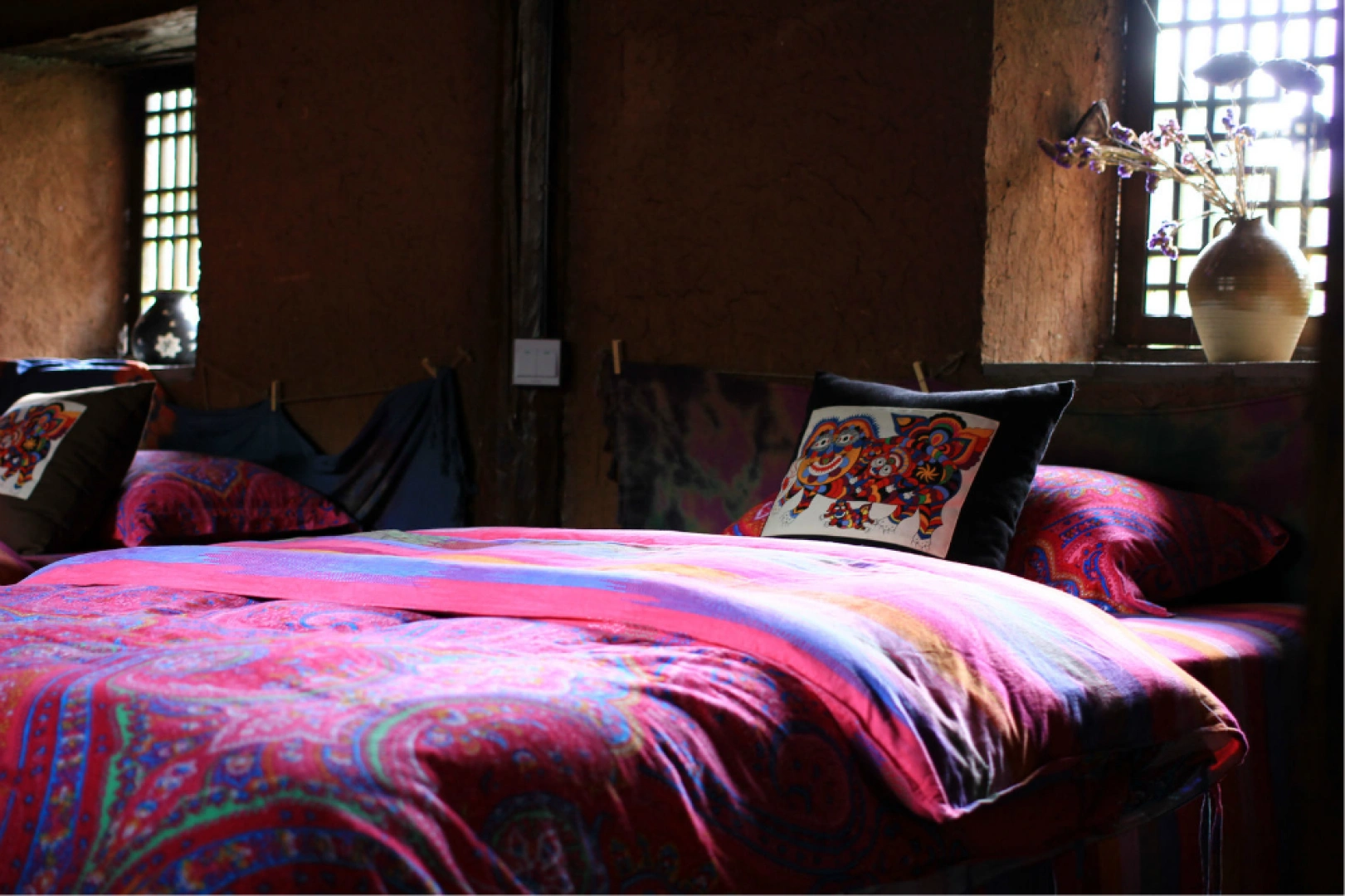
This inn is a typical Bai-style "five-drip" courtyard house, preserving the original ancient charm while boasting tasteful renovations. I was very satisfied with my stay—opening the window, I was greeted by Nuodeng's tranquility and peace, far from the city's noise.
Strolling Through Nuodeng: Dragon King Temple, Stone Carvings, and Time

After dropping off my luggage, I began to wander through Nuodeng. Every corner here exudes the flavor of time:
- Old Salt Bureau: Now converted into a senior activity center, where elderly folks play chess and chat, as if time itself has slowed down.
- Dragon King Temple: This is China's only temple dedicated to praying for drought. I'm not superstitious, but that day I sincerely paid respects to the Dragon King, asking for good weather for the rest of my trip. And it worked—the weather afterward was fantastic! If I ever return, I'll definitely pay my respects again.
- Exquisite Stone and Wood Carvings: In Nuodeng, these artworks seem to be everywhere. Every chisel mark bears the traces of time, every stroke tells of former glory.
- "Five Drips": Water droplets pass through four layers of eaves before reaching the ground, making exactly five drips. This architectural ingenuity is truly admirable.
- Mules and Cacti: The only means of transport in Nuodeng are pack animals like mules, so don't be surprised if you step in droppings. Cacti grow along the walls on both sides, and you can freely pick their fruit—unlike in Dali or Shuanglang, where you'd have to pay.
Yuhuang Pavilion: The Best-Preserved Ancient Wooden Archway in Western Yunnan
Nuodeng's most famous ancient building complex is Yuhuang Pavilion (Jade Emperor Pavilion)—it was listed as a county-level protected cultural relic as early as 1987, and upgraded to a prefecture-level protected site the following year. The Lingxing Gate within it is the best-preserved ancient wooden archway in western Yunnan, with lifelike carvings of superb craftsmanship.
The mountain path leading to Yuhuang Pavilion passes by a school. It was summer break, but the children seemed to still be in class, and some college students were there as volunteer teachers. Following the path to its end, you reach the Confucius Temple. Although Nuodeng is a small village, the salt production in ancient times brought substantial tax revenue, granting it county-level treatment—the presence of both a Civil Temple and a Martial Temple within Yuhuang Pavilion testifies to its former glory.
Teacher Yang: Nuodeng's "Legend"
At the Confucius Temple, I met the local celebrity, Teacher Yang. I later learned from friends and locals that Teacher Yang is a legend—his spiritual depth is beyond what ordinary people can grasp. If you have something to say, go find Teacher Yang.
Teacher Yang is incredibly talented. His guestbook is filled with inscriptions from travelers all over the world. He enthusiastically introduced me to Nuodeng's history and treated me to tea. His catchphrase was: "This old man of mine, %……&&." Visiting his living space, it was simple—really simple. On the wall hung a calligraphy scroll: "Dao Fa Zi Ran" (The Way Follows Nature)—inscribed by a calligrapher for Teacher Yang.
Food: Nuodeng Ham, A Thing of the Past?
After wandering around for a while, it was dinner time. Nuodeng has no restaurants; meals are eaten at the inns you're staying at. That day, the auntie at Nuoyan Bieyuan had taken leave, so I went to Fujia Liufang Yuan for dinner.
As for Nuodeng ham—I can only say it's a thing of the past. I asked a local大叔 (uncle) if there were still any two-to-three-year-aged hams that could be eaten raw. He replied: "Long sold out! Back then, they sold for over 30 RMB a catty, then rose to over 40, and everyone thought, 'We can make money,' so they sold them all." (Now they're 50-60 RMB.)
I asked again: "What about those vacuum-packed ones on Taobao that claim to be three-year-aged?" The uncle answered: "Those are made in the ham factory down in the county town."
Seeing a leg of ham lying there, I said: "Brother, can this be eaten raw? Cut me a little piece to try." The brother said: "We generally don't recommend eating it raw." But at my insistence, he cut a small piece for me. And then I knew—all that talk about eating it raw was a lie. It's nothing like Spanish ham. What a disappointment!
Still, dinner was decent. I shared a meal with a couple from Beijing: - Bean Cake (Doubing): A Nuodeng specialty, but I found it average—like a deep-fried rice cake. - Sour Papaya Ham Free-Range Chicken Soup (Suan Mugua Huo Tui Tu Ji Tang): Genuine ingredients! The free-range chicken was caught and slaughtered on the spot. The originally greasy soup was refreshed and enhanced by the addition of sour papaya. Downside: a bit pricey! - Stir-fried Wild Bamboo Shoots with Ham (Ye Sun Chao Huo Tui): This was my favorite dish. The stir-fried ham released its excess fat, and the aroma was absorbed by the bamboo shoots—incredibly fragrant! - Cold Mixed Tree Flower (Liang Ban Shu Hua): Refreshing and appetizing. Tree flower is a type of wild fungus with little flavor of its own, paired with the crunch of cucumber—very nice. Much better than the "tree bark" (Shupi) I would encounter later!
2. Shaxi: The Last Living Market on the Ancient Tea Horse Road
First Impressions: Lijiang Twenty Years Ago?
Shaxi Ancient Town is the only surviving living market on the Ancient Tea Horse Road. In 2001, it was listed on the World Monuments Watch list of 100 Most Endangered Sites. Some people jokingly call it "Lijiang twenty years ago"—though I've never been to Lijiang, I know that Shaxi will always be Shaxi.
I arrived on the day of the Qixi Festival (Chinese Valentine's Day). Walking through the small Sideng Market Square, it was unexpectedly lively. The hostel I booked was called "Maquan 46" (Horse Stable 46). I liked the name, and I loved its location—right next to the ancient stage.
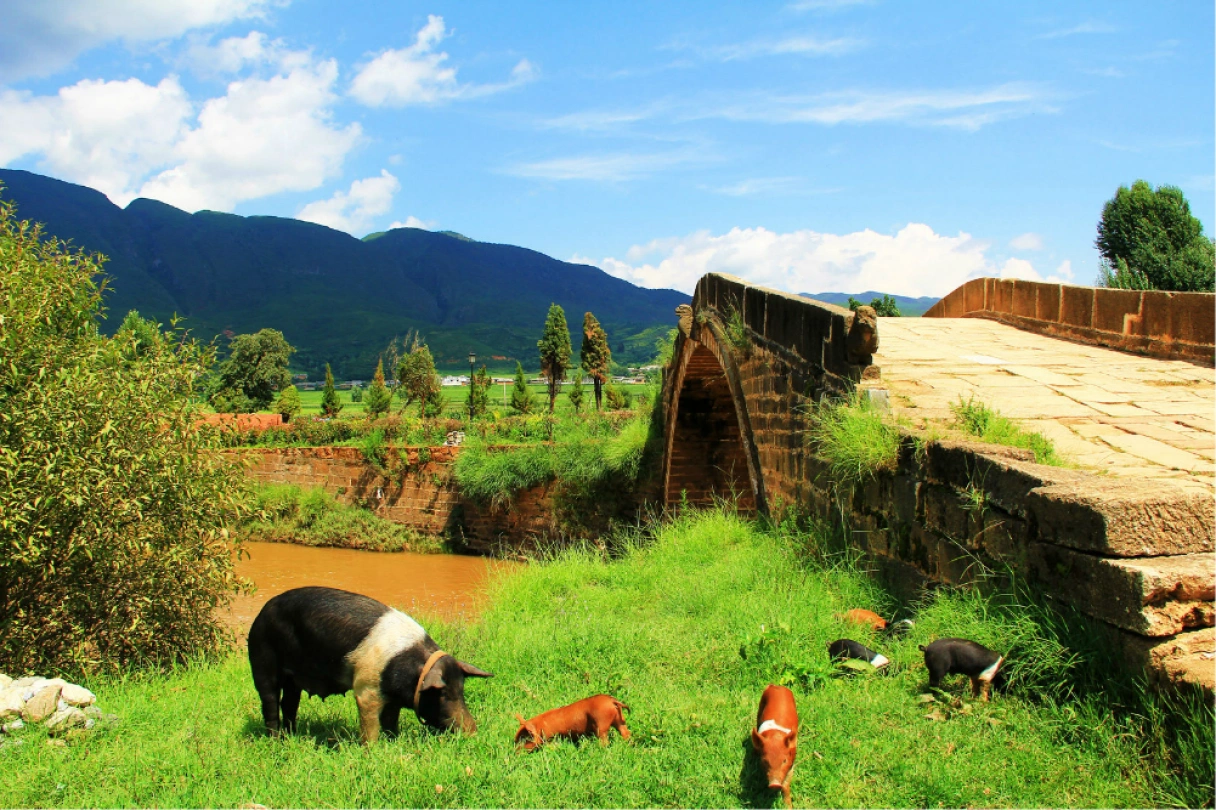
While waiting to check in, I overheard a few people talking about how amazing the previous night's meteor shower was. My heart sank—I had gotten the date wrong; the meteor shower was actually in the early hours of that morning. Oh well, missed it. But Shaxi's pastoral scenery was beautiful enough—starring Yujin Bridge, with supporting roles played by a big sow and her piglets.
Getting There: From Nuodeng to Shaxi
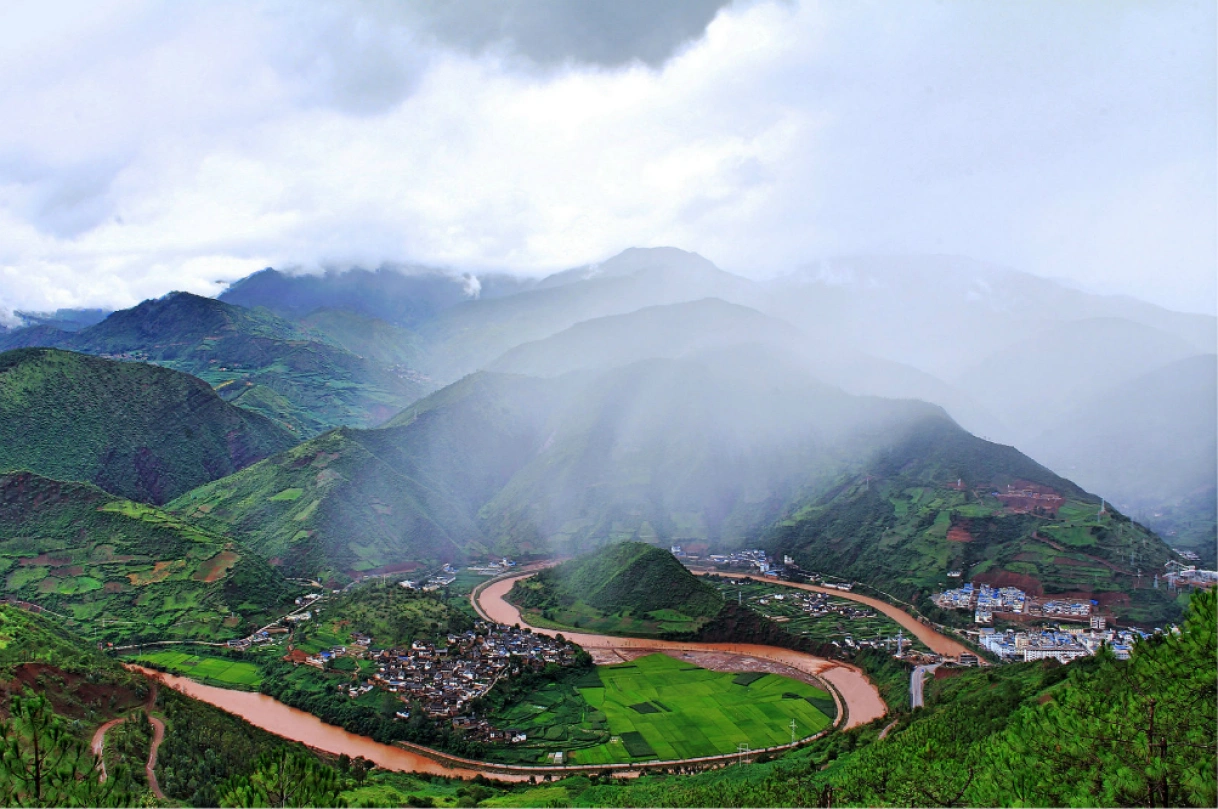
Take a motorbike from Nuodeng to Yunlong County Bus Station. There are many minibuses heading to Lanping at the station entrance, costing about 30 RMB and taking over 2 hours. The scenery along the way is nice, following the Bijiang River through the mountains. Upon arriving at Lanping Bus Station, buy a ticket directly to Jianchuan (20-30+ RMB, about 3 hours). At Jianchuan Bus Station, there are minibuses outside to Shaxi, 10 RMB per person.
Strolling Through Shaxi: People in the Painting, Painting of the People
My first impression of Shaxi was like stepping into a painting. It felt unexpectedly lively that day, but I later learned it wasn't because of Qixi—a school had brought over a hundred students here to sketch. How lucky!
Shaxi is small; I walked the main streets back and forth several times. I would stop from time to time beside those focused students, looking at their paintings and then at the real view. By Yujin Bridge, there was a beautiful girl (though she had her entire face covered like a Muslim woman), and I lingered the longest. I passed by and walked on, until the sun set, and she was still there. Her sketching style was different from the others—fun!
Oil paintings, watercolors, gouache, pen drawings—every single one, in my layman's eyes, was brilliant.
Sideng Street: The Ancient Stage and Xingjiao Temple
Wandering back to the town center, a large locust tree had stood there for over a hundred years. The ancient stage was right there, and the Maquan 46 where I stayed was at the far right end. Next to it was a grocery store. Thank you to the Bai ethnic auntie there, and thank you for the peaches she gave me—we had only just met.
Xingjiao Temple is the core area of Sideng Street. The entire temple is ancient yet retains a grandeur. The wood carvings and painted beams inside are worth savoring. Turning into a small path, it felt like I could encounter those long-sleeping ancient buildings at any moment. The marks of time give them an extraordinary beauty.
Food: Jiao Sanmei and Her Bossy Attitude
As a foodie, my absolute reason for choosing to visit Yunnan in August was—mushrooms! Unfortunately, my eyes were bigger than my stomach, and I only got to taste a few things.
Shaxi doesn't have many distinctive food options. You can choose to skip the restaurants in the main commercial area—they're all run by outside merchants, charging uniform tourist prices. Where to eat? Leave Sideng Street, head to the road outside, turn left, and there's a path leading to the town, where restaurant prices are more reasonable.
A friend recommended a place called "Longfeng Ruiying Restaurant" (Dragon and Phoenix Auspicious Restaurant) for beef hotpot, said to be excellent, but it was closed. So I randomly found a small eatery called "Youyi Cun" (Another Village).
Remember this face—her name is Jiao Sanmei (her bangs are quite stylish). Actually, restaurants in the Dali area are very simple; there are basically no menus. You calmly walk in, head straight to the fridge, see which meats and vegetables catch your fancy, and then imagine them cooked with a ton of chili peppers.
"Stir-fried peppers with pork, please!" — Fragrant! Goes great with rice! Super appetizing!
"And some porcini mushrooms (Niuganjun)!" "Sis, how much for the porcini?" "Fifteen RMB a plate." "OK." "Here, go wash them yourself."
Wash them myself? Have me wash them myself? The sister said: "Yeah, I'm too busy, no time." Fine. So I washed the porcini mushrooms clean at the outdoor sink in front of the shop before handing them back to her. The texture? Tender, super tender!
The next day, I went back to Jiao Sanmei's. The mint-fried spare ribs I wanted to try the day before were available today.
"Sis, do you have the ribs today?" "Yes." "Do you have any matsutake mushrooms (Songrong)?" "No, they'll be available tonight. If you want some now, go buy them yourself!"
Alright, you're bossy. So I actually went over to a sister selling matsutake and chatted with her. She said: "You've come at a good time. These two days are the cheapest for matsutake; they're selling for 80 RMB a catty recently." I felt so lucky and didn't hesitate to have her weigh out 20 RMB worth.
Back at Jiao Sanmei's, she said: "That fast? Bought them already?" "Yeah." "Go wash them."
Without a second thought, I grabbed the basket and ran to the outdoor sink to work—no hesitation at all. The sister praised my matsutake, saying they were firm enough, white enough, and fresh enough. Matsutake is all about its original flavor—that rich, satisfying piney aroma.
Then came the classic Bai ethnic dish—mint-fried spare ribs, full of wok hei! Yunnan people even use flowers as ingredients—how interesting. It was my first time having fried mint. The ribs were deep-fried to a crisp, infused with the aroma of chili and mint—delicious!
Recommended Shop: 58 Xiaoyuan (58 Small Yard)
58 Xiaoyuan is run by a Taiwanese sister who has been in Shaxi for quite a few years. The whole environment is warm and comfortable, and the accommodation is also very nice. The shop offers light meals: - Homemade Yogurt: Topped with plum jam. - Osmanthus Dongding Oolong Tea: Mellow and refreshing.
The dogs in Shaxi are all particularly happy, completely lazy. The dog at 58 Xiaoyuan, the giant dog at Maquan 46—they are the true masters of Shaxi.
Morning: Chasing the Sunrise
The next morning, I chased the sunrise. Unfortunately, I wasn't strong enough to break through the clouds and see the sun rise. From Shaxi Ancient Town, cross Yujin Bridge, and there are vast rice paddies. Beyond the paddies, there are a few villages. I stopped in front of one village and asked a local brother: "Brother, what's the name of this village?" "Ah, Xiaononghe Village." Hmm, thanks! Then I looked at the village's house number—Xianglong'e Village. Alright... But this village is really nice, full of ancient charm!
Looking back at the road I came from, Shaxi was waking up.
3. Dali Ancient City & Caicun: Disappointment and Surprise
After writing about Nuodeng and Shaxi, I felt much lighter—those were my favorite places on this trip. Now, I can slowly write about the section around Erhai Lake. There was disappointment, but also surprise.
Dali Ancient City: Renmin Road, A Palette
When it comes to Dali Ancient City, many people say: "It's too commercialized, nothing worth seeing." Indeed, as one of China's first developed tourist destinations, Dali's commercialization is undeniable. Especially if you unfortunately step onto Bo'ai Road or Fuxing Road, you'll instantly feel like you've fallen into a tacky hell.
But in my view, Dali, like any city, has both good and bad. Those familiar with it can always find one or two small shops that bring joy—shops that stand independent from the world.
Walking on Renmin Road, you feel like the street is a disrupted palette. All kinds of people, shops, and stalls test your eye and personal taste. You can stop at those stalls selling trinkets supposedly "imported from some country on the other side of the Himalayas," while I can walk past, seeing them diligently stringing and weaving beads bought wholesale from Taobao. There's nothing wrong with it, and nothing particularly good either—we need to encourage diversity.
Accommodation Recommendation: Tuibi Yishe (TO BE ASH) I quite liked the hostel I stayed at in Dali—a tiny single room with the simplest possible decor. Yet waking up and opening the window, I could glimpse Cangshan Mountain through the narrow window or gaze at the clouds in the sky. I also liked its name—"Tuibi Yishe" (Retreat One House), so fitting, a feeling of being detached from the world. Hidden behind Erhai Gate, a short walk leads to the lower section of Renmin Road, which hides many interesting little shops. Price: 50 RMB per day, or 600 RMB for a monthly rental in the off-season.
Dali's Little Joys
- Handmade Shoe Stall: The stallholder was an old foreign man; I forgot his name. I saw him early in the morning while wandering around, sitting outside a café drinking coffee and reading a book. His shoes were unique, with different colors on left and right. When I wandered back later and saw him at his stall, I didn't ask the price—it probably wasn't cheap.
- "Haofeng Guan" (Good Wind House): A small shop on Yeyu Road. I walked past it three or four times, stopping each time to look. Some small shops win me over with their name alone.
- Self-Service Stalls: The most common sight on Renmin Road. Life should be free and wonderful—youth is good, go for it, young people!
- Fruit: Yunnan's fruit is quite good. Some may look ugly or shriveled, but they taste exceptionally sweet.
Dali's Food
Xidoufen (Pea Jelly Porridge): A Yunnan morning starts with a bowl of xidoufen. Made from ground peas, it looks very plain, but one bite reveals its magic. Cooked to perfection—neither too thin nor too thick—accompanied by red chili flakes and green scallions, it leaves a lingering fragrance in your mouth! Just like Shanghainese dip youtiao (fried dough sticks) in soy milk, or Beijingers dip jiaoquan (fried dough rings) in douzhi (fermented bean juice), Yunnan people pair xidoufen with youtiao—cut into pieces, rolled in the porridge, and popped into your mouth—very satisfying!
Kaoru San (Grilled Milk Fan): One of Yunnan's "Eighteen Oddities"—milk made into skewers to sell. The milk fan is grilled over charcoal until slightly charred, then brushed with a bit of rose jam. Eating it fills your mouth with sweetness. Chew a few times, and a rich milky flavor emerges—excellent!
Zhenhua Restaurant: There are countless restaurants on Renmin Road. According to intelligence, "Zhenhua Restaurant" has a good reputation. I like these small shops with a bit of a "rustic" name—local enough!
- Liang Ban Shu Pi (Cold Mixed Tree Bark): This "tree bark" isn't real bark, but moss that grows on rocks or trees. The taste? Well, it tastes like tree bark—astringent, bitter, dry. A bit hard to get used to.
- Sha Guo Erhai Yu (Clay Pot Erhai Fish): Zhenhua Restaurant's signature dish. In Shanghai, I often drink crucian carp and tofu soup, and this clay pot fish tastes just like that. After eating so many days of salty, spicy, heavy flavors, having a bowl of this was truly delightful.
- Yan Cai Chao Rou (Pickled Vegetable Stir-fry with Pork): A great dish to go with rice! The homemade pickled vegetables are sour and crisp, paired with chili peppers—yum!
In the evening, I even played the hipster and went to a bar—drinking cocktails with poor value for money, smoking a hookah with poor value for money. None of that was the point; the point was chatting with friends, shooting the breeze, having fun! The bar was called "Sun Island," located on the middle-lower section of Renmin Road. It's much better than those noisy bars on Bo'ai Road and was quite popular. Unimaginatively, I ordered a MOJITO—a safe choice, didn't want to mess it up too badly.
Caicun: Muba Herb Garden & Xinghu Ecological Farm
Caicun is a pier along Erhai Lake. As for Erhai Lake itself, I prefer the Haishe or the cycling route from Shuanglang to Wase, so I won't rush into introducing it. What made Caicun memorable for me were "Muba" Herb Garden and "Xinghu" Ecological Farmland.
Muba Herb Garden: Run by a Taiwanese couple, featuring lavender fields. A large windmill seemed to transport me to some distant country. When I went, due to the heavy rain from the previous days, most of the lavender had passed its peak viewing period (reportedly, it's stunning when in full bloom in late June). I had to use camera angles to deceive your eyes—but honestly, it was still quite beautiful!
The herb garden has a minimum consumption requirement—I'm quite against that, but since there were items to consume, I gave it a try. The herbal tea, brewed from various herbs, had a light fragrance. I also have to praise their pizza—baked in a wood-fired oven, very professional! The salami pizza was excellent, both in terms of the cheese pull and the texture of the crust.
Xinghu Ecological Farmland: While enjoying my pizza in the sunroom of the herb garden, I unexpectedly spotted a sunflower field across the way. And so, I stumbled upon "Xinghu" and met Brother Li. The owner of this nearly 20-acre piece of land, Brother Li, wanted to create a pure ecological farmland between Cangshan and Erhai. It had only just started this year, with plans to plant more flowers in the future. I chatted for a long time with Brother Li, who was carrying a hoe in the field. As for his vision, I can only offer respect and admiration. It was a pity that it was nearly 7 PM when I arrived, and the sun was setting. Imagine—a large field of sunflowers bathed in sunlight, set against Yunnan's blue skies and white clouds—what a wonderful scene that would be!
Epilogue: An Unfinished Dream
This travelogue has been written piece by piece, on and off, up to this point. Nuodeng's salt, Shaxi's stage, Dali's烟火 (bustling life), Caicun's sunflowers—each place is like a fragment of a dream, pieced together to form the "Yunnan Upside Down" in my heart.
I didn't walk every path, nor did I taste every flavor. But I know that the meteor shower I missed, the mushrooms I didn't get to eat, the postcards I never sent—they all remind me that this dream is not yet over.
Yunnan, until we meet again.
Key Takeaways: 1. Nuodeng: A thousand-year-old salt village. The ham is now a thing of the past, but the village's ancient charm and Yuhuang Pavilion are worth seeing. Accommodation recommended: Nuoyan Bieyuan. Transportation requires a transfer to a three-wheeled motorbike from Yunlong county town. 2. Shaxi: The last living market on the Ancient Tea Horse Road, much quieter than Lijiang. Recommended hostels: Maquan 46 and 58 Xiaoyuan. For food, try local eateries in the town (e.g., Youyi Cun) and remember to wash your own mushrooms! 3. Dali Ancient City: Avoid Bo'ai Road and Fuxing Road; the lower section of Renmin Road and Yeyu Road have more character. Accommodation recommended: Tuibi Yishe. Must-try foods: xidoufen, grilled milk fan (kaoru san), and Zhenhua Restaurant's clay pot fish. 4. Caicun: Muba Herb Garden's lavender and wood-fired pizza are worth a try; the sunflower field at Xinghu Ecological Farmland is a pleasant surprise.
You should also read:

Body in Hell, Heart in Heaven: A Pilgrimage Through Tiger Leaping Gorge — A Dialogue Between Heaven and Earth
Body in Hell, Heart in Heaven: A Pilgrimage Through Tiger Leaping Gorge — A Dialogue Between Heaven and Earth Introduction: When the Gorge Splits Open Beneath Your Feet Some say Tiger Leaping Gorge is the closest place on Earth to the border between "hell" and…
Continue reading...
Cloud Travelogue · Dali of Wind, Flowers, Snow, and Moon: A Three-Day, Two-Night Journey of a Free Spirit
Cloud Travelogue · Dali of Wind, Flowers, Snow, and Moon: A Three-Day, Two-Night Journey of a Free Spirit I am a cultured female foodie with a touch of rogue charm. I slung on my backpack, took my lover's hand, and set off on a spontaneous…
Continue reading...
The Meaning of Travel – A Tengchong Story: A Journey of the Heart and Personal Growth
The Meaning of Travel – A Tengchong Story: A Journey of the Heart and Personal Growth Setting Out, Only to Return a Better Self Some say travel is nothing more than leaving a place you're tired of, only to go to a place where others…
Continue reading...