A 2,525-Kilometer Road Trip: Chasing a Colorful Dream in Yunnan
A 2,525-Kilometer Road Trip: Chasing a Colorful Dream in Yunnan
Some places, just by saying their names, stir a longing deep within. Yunnan is exactly that kind of place. This time, my companion Feifei and I set off from Chengdu, driving 2,525 kilometers over seven days to visit Lugu Lake, Shaxi Ancient Town, and the Jiayang Steam Train in Qianwei County. We lived out a colorful dream.
If you're craving a spontaneous getaway or planning a road trip of your own, this article might offer some inspiration. After all, some landscapes only reveal their true beauty when you stand right before them.
How It Began: A Snowstorm Changed Everything
Originally, we had planned to visit Langmusi Temple. I've always had an inexplicable pull toward the northwest—even after visiting multiple times, I can't shake the obsession. On the first day of the Lunar New Year, our bags were packed, but a heavy snowfall hit. Roads were closed, and our trip was postponed.

But a restless heart refuses to stay still.
I opened my phone's map and scrolled endlessly, eventually locking my gaze on Lugu Lake—a place I'd been dreaming of for years. If the northwest wasn't happening, Yunnan it was. So we rerouted: starting from Chengdu, taking the Yaxi Expressway to Xichang first, then heading to Lugu Lake.
First Stop: Xichang – Fire Pit Barbecue and Unexpected Warmth
The drive from Chengdu to Xichang took about six hours. As soon as we entered Xichang, the weather transformed completely—blue skies, bright sunshine, as if we'd jumped straight from winter into spring. We'd planned to visit Qionghai Scenic Area, but a glance at the navigation showed roads clogged in deep red. We decisively scrapped that plan and headed straight for Xichang's famous fire pit barbecue.
The barbecue tasted good, no doubt. But cooking it ourselves was a hassle, and sitting outdoors with smoke and flames left us covered in soot by the end of the meal. Honestly, the experience was just average.
What caught us off guard was how warm Xichang was. We'd only packed heavy winter clothes. That evening, we strolled along Aviation Avenue hoping to find a light jacket, but nothing fit the bill. Oh well—our photo plans at Lugu Lake would have to rely on fate.
Lugu Lake: 200 Kilometers of Mountain Roads, 7 Hours of Trekking
The next morning at 9 a.m., we left Xichang and headed for Lugu Lake via Yanyuan Town. The 200-plus-kilometer drive took a full seven hours. The mountain roads twisted and turned, with our average speed barely reaching 50 km/h. But the scenery along the way was stunning, so boredom never set in.
At the entrance gate, we paid 100 yuan per person for tickets. Rolling down the window, handing over the tickets, we officially entered Lugu Lake. From the gate to our booked guesthouse was another 10 kilometers, and at first, there was no sign of the lake at all. We grumbled about how far the entrance was from the actual lake, all while eagerly waiting for that first glimpse of blue.
First Sight of Lugu Lake: The Transparent Swing Chair at Tinghuatang
We arrived at the Tinghuatang Guesthouse just before 5 p.m., with the sun still blazing intensely. The guesthouse was built halfway up a hillside, a row of connected cottages, each with a lake view. Outside was a garden featuring an infinity pool and a transparent swing chair—exactly the kind I'd sat in at Dali, where no one took my photo. This time, I had my chance.
I curled up in the swing chair and made Feifei take pictures of me. The evening wind was strong; without a hat, my hair whipped around so wildly I looked like a character from a kung fu movie. I just stayed there in the swing, gazing at the distant mountains, the lake, the islands, listening to voices from afar—time seemed to slow down.
After 5:40 p.m., the light softened, perfect for portraits. We found an old bamboo chair by the lake. It looked weathered, but somehow it fit the scenery perfectly.
The Blue of Lugu Lake: Deep and Intoxicating
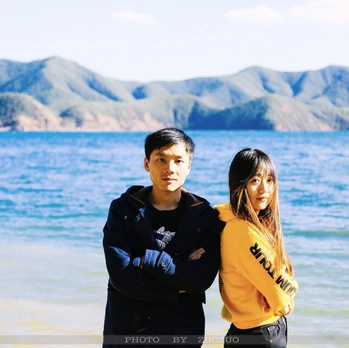
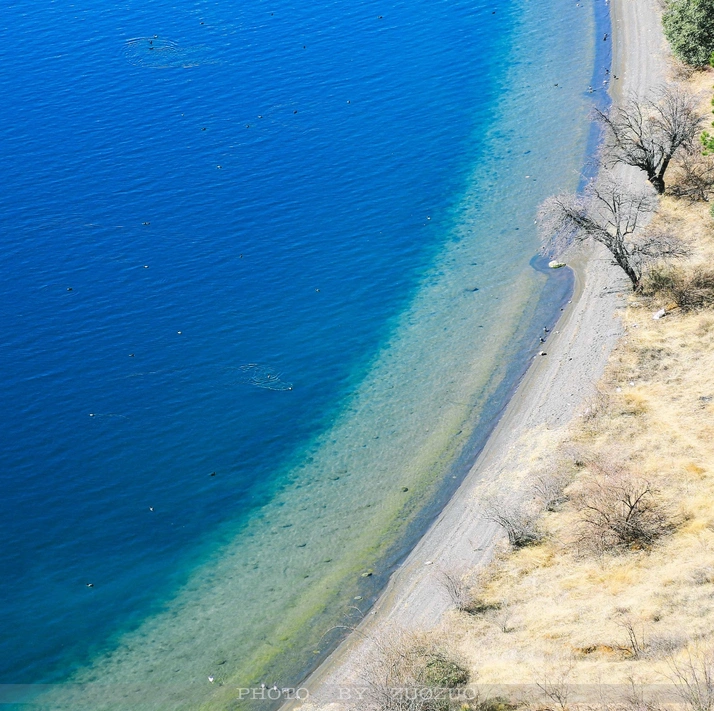
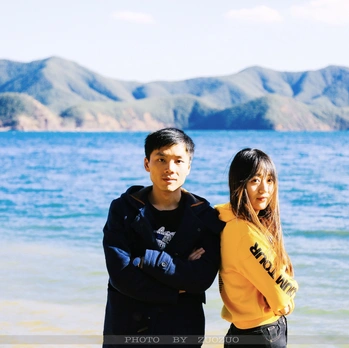
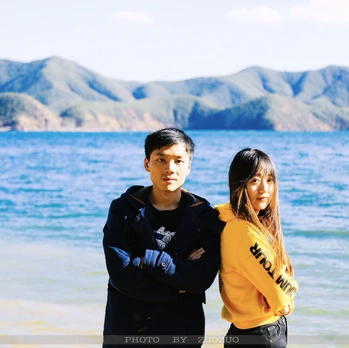
When I first arrived at Lugu Lake, I was completely overwhelmed by the scenery. The lakeshore near the guesthouse wasn't even the most spectacular part, but it was already breathtaking. The lake surface was a deep, pure blue. Along the shore, guesthouses and restaurants had sprung up—for a moment, I felt like I was seeing Erhai Lake from two years ago.
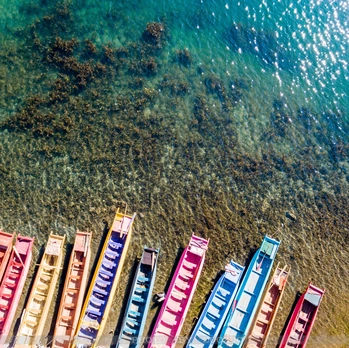
An unpainted pig trough boat—a traditional wooden vessel—was moored by the shore, becoming a perfect prop for my photos. Since we'd spent the whole day driving, we were starving and wandered along the lake looking for food. But many restaurants had fixed opening hours. The Sichuan restaurant we wanted didn't open until 5:30 p.m. Perfect—that gave me time to take more photos by the lake.
Daytime temperatures reached over 20°C (68°F), but mornings and evenings were chilly. The withered branches along the shore reminded me that it was still winter. Yet somehow, I still felt a sense of vitality. Spotting a fallen, horizontal tree trunk by the road, I pointed and said, "I like this—I want a photo." I sat on the trunk, putting on a cool expression. Feifei wrinkled her nose and said it didn't look good, but I was happy—that's all that mattered.
Prayer Flags and Faith: Another Side of the Mosuo People
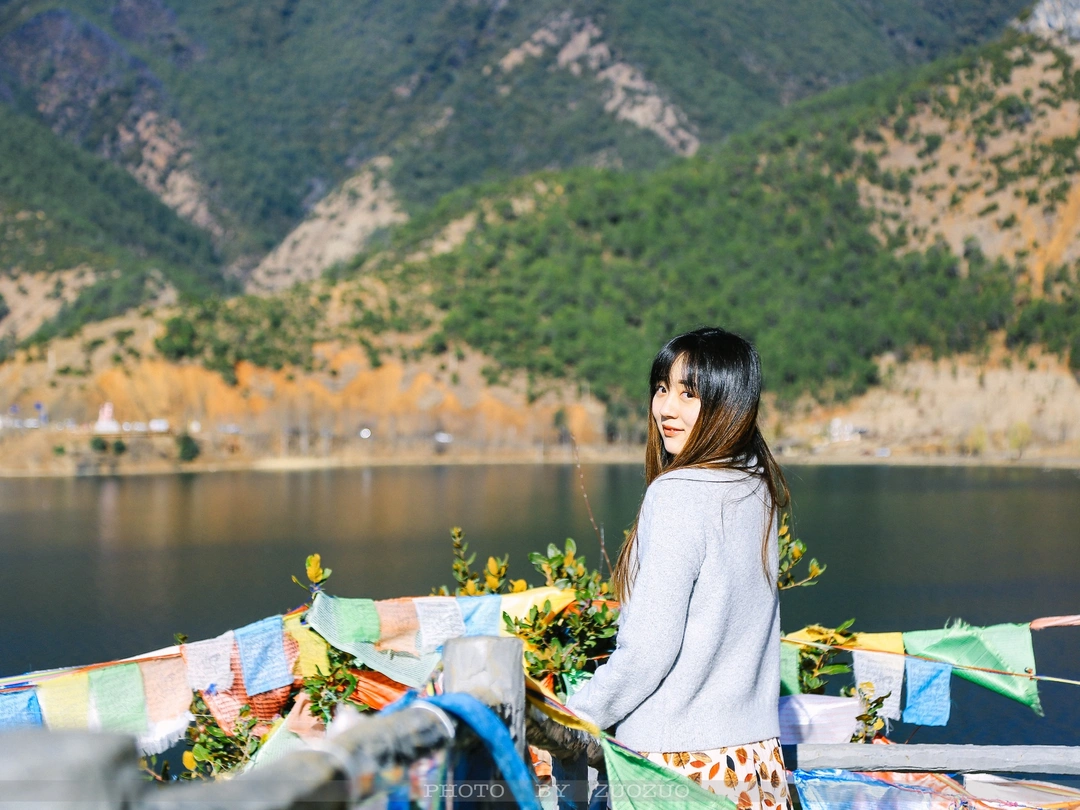
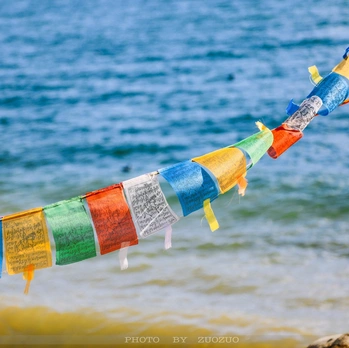
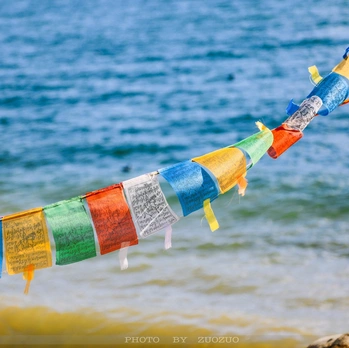
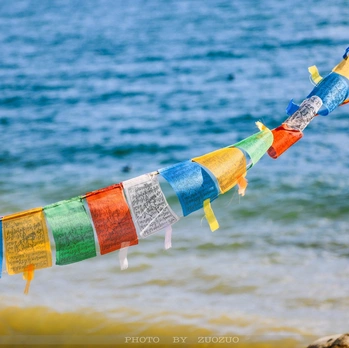
By the shores of Lugu Lake, I spotted fluttering prayer flags. It turns out the Mosuo people also practice Tibetan Buddhism. Although the area looked similar to Tibetan regions—with white stupas, mani stone piles, and five-colored prayer flags—the Mosuo still preserve their own customs and unique ethnic identity.
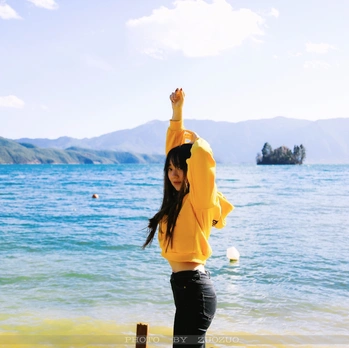
The evening wind grew stronger, my hair flying wildly in every direction. In the background of my photos was a small island. I gazed at it for two whole days, took countless pictures with it in the frame, but never set foot on it. Maybe the connection just wasn't meant to be.
A Full Day Circling the Lake: 8 Hours, 50 Kilometers
The highlight of the Lugu Lake trip was all packed into this one day.
We asked the guesthouse front desk for a map and set off counterclockwise to circle the lake. Lugu Lake isn't huge—the full loop is about 50 kilometers. Driving alone would take just two hours, but with stops at scenic spots and photo sessions, it took a full eight hours.
When people mention Lugu Lake, many immediately think, "That's in Lijiang." In reality, the lake straddles the border between Sichuan and Yunnan, with most of the scenery actually falling within Sichuan. The Mosuo people who live here are the only ethnic group in China that still practices a matrilineal system. The "Walking Marriage Bridge" is one of their most iconic traditions.
Grand Viewing Platform: A Panorama of Lake and Mountains
Starting from the guesthouse and heading counterclockwise, the first stop was the Grand Viewing Platform. The scenery was beautiful, and there weren't too many tourists yet. Climbing to higher ground, the distant lake and mountains stretched out before us. Prayer flags fluttered in the wind, each movement said to be equivalent to chanting scriptures a thousand times. I leaned against the railing and took several photos. Though not a famous spot, it was still crowded.
By 10 a.m., the sun was already strong, and the lake surface wasn't calm. The five-colored prayer flags represent blue sky, white clouds, fire, green water, and yellow earth—Tibetan Buddhism sends blessings to all beings in the world.
A woman with a Shanghai accent asked me to take her photo. "The scenery here is so beautiful—warm, with blue skies and white clouds. So much more comfortable than the city," she said. "Yeah, it's getting harder and harder to stay in the city," I replied with a smile.
Xiaoluoshui Village: Pig Trough Boats and Seagulls
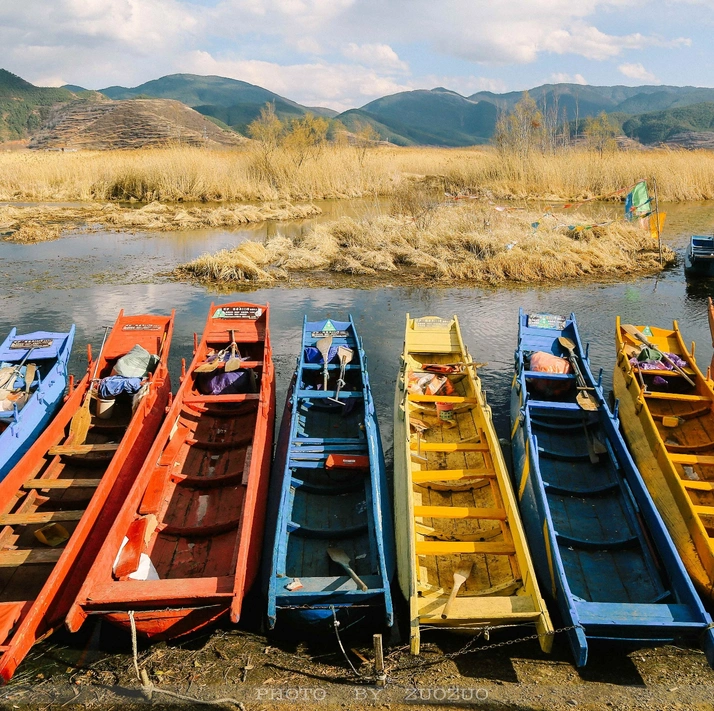
Driving along the road, I spotted a dock filled with pig trough boats below—it was stunning. I insisted we go down. We missed the turn on the left side of the road and had to take a dusty path ahead. After checking all windows and the sunroof were closed, we drove down, kicking up clouds of yellow dust.
This was Xiaoluoshui Village, the first named spot we encountered on the trip. Geese swam around near the water, and farther out, seagulls rested on small wooden boats in the middle of the lake. These seagulls became the backdrop for most people's photos. Feed was sold by the shore—10 to 15 yuan per bag. Kids hopped around with the feed, but the seagulls seemed already full and mostly ignored them.
Lige Peninsula: Breathtaking from a Drone's Perspective
Driving along the winding road, viewing platforms on two hilltops offered views of Lige Peninsula in the center of the lake. You could walk onto the peninsula, but it was mostly filled with guesthouses. If you're short on time, you can skip going ashore.
The most beautiful angle was from above. When the drone lifted off, distant sights suddenly came close. Lige Peninsula was covered with guesthouses, with scattered pig trough boats by the water. The lake surface was as calm as a mirror, disturbed only by the trails of passing boats.
The Walking Marriage Bridge: Reed Marshes and Withered Branches
In the afternoon, we visited the Walking Marriage Bridge. Even though the peak Spring Festival holiday had passed, there were still plenty of tourists. Getting an empty shot was basically a dream. In winter, the reed marshes were all yellow, looking somewhat desolate—but there was a unique, stark beauty to it.
A pavilion stood beside the bridge. I joked that it needed a woman in traditional ethnic costume standing there quietly—it would be perfect. The reed marsh is naturally formed and supposedly can support the weight of an average adult, but no one was testing it in winter. Better to be cautious.
On the bridge, we held hands and looked out at the world. I don't know how long we'll hold hands, but in that moment, the scenery was beautiful—and that was enough.
Reed Marsh Dock: A Sea of Pig Trough Boats
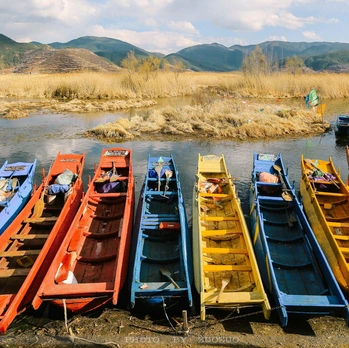
The dock by the reed marsh was packed with pig trough boats, tightly clustered together. These boats are mainly used for touring the marsh, but few people seemed interested—probably because the withered yellow grass didn't inspire much enthusiasm. Yet the dense cluster of boats actually looked better that way. In the soft evening light, with the sun hiding behind clouds, the scene had a vintage feel—absolutely wonderful.
The foxtail grass by the lakeshore swayed left and right in the wind. With a little battery left on the drone, I launched it one more time to capture a few more shots. The evening wind picked up again; without a coat, it was getting cold. Sure enough, the high plateau felt like winter again after dark.
A full loop around the lake: 50 kilometers, 8 hours, over 300 photos and countless videos. Why do I love traveling? Probably because I love being on the road—and I love recording it all.
Lijiang: Basking in the Sun, Revisiting Old Memories
The drive from Lugu Lake to Lijiang was even more winding than the Sichuan section. Anyone who says it takes three and a half hours is lying—we drove a full five. But the scenery was beautiful.
Going to Lijiang was a last-minute decision. Passing through, the sun was shining, and I suddenly remembered the days I'd spent basking in the sun there four years ago, and that preserved rib hotpot restaurant near the south gate. I have quite a few memories of Lijiang. Passing through this time felt like revisiting old haunts.
We booked a room at the Lanqituju Guesthouse on the spot. I chose it not because it was particularly beautiful or perfectly located, but because of a story about a chance encounter.
Final Thoughts: A 2,525-Kilometer Dream
Seven days, 2,525 kilometers. From Chengdu to Lugu Lake, then to Lijiang, and finally to the Jiayang Steam Train in Qianwei County. Along the way, I saw the blue of Lugu Lake, the red of Shaxi Ancient Town, and the yellow of the Jiayang fields. By Lugu Lake, the wind tangled my hair; in a small bar in Shaxi, I felt the echo of love songs; at Jiayang, I watched a steam train chug across golden plains.
Memories from an average altitude of 2,000 meters—I'll take my time recording them all.
If you ever make it to Lugu Lake, don't forget to come back and share your story with me.
Practical Tips: - Route: Chengdu → Xichang (6 hours) → Lugu Lake (7 hours) → Lijiang (5 hours) - Ticket: Lugu Lake – 100 yuan per person - Accommodation: Recommended: Tinghuatang Guesthouse – lake-view rooms, transparent swing chair, infinity pool - Lake Loop: Counterclockwise direction, 50 km – allow at least 8 hours - Best Time to Visit: Spring and autumn – pleasant temperatures, most beautiful scenery - Things to Note: Many winding mountain roads – drive safely; large temperature difference between day and night – bring a jacket
You should also read:
Yunnan Travel Mastery: From Beginner to Pro-Level Player – A Complete Guide
Yunnan Travel Mastery: From Beginner to Pro-Level Player – A Complete Guide "Either travel or read, but your body and soul must be on the road." This quote has been repeated countless times, but very few people truly manage to be "on the road" and…
Continue reading...
Escaping Nanning, Falling Under Lijiang's Spell: Our Four-Person, Ten-Day Yunnan Dream
Escaping Nanning, Falling Under Lijiang's Spell: Our Four-Person, Ten-Day Yunnan Dream Before We Set Off: No Pain, No Obsession Have you ever had that impulse—suddenly tired of the office fluorescent lights, the crush of the subway, the endless parade of identical takeout boxes, and just…
Continue reading...
God’s Abandoned Palette: A Self-Drive Journey Through Yunnan’s Dongchuan Red Land
God’s Abandoned Palette: A Self-Drive Journey Through Yunnan’s Dongchuan Red Land Travel has never been about reaching some distant geographic coordinate. It’s about encountering, along the way, the version of yourself buried beneath the rubble of daily routine. During this May Day holiday, I finally…
Continue reading...