A Dreamlike Snow Mountain Journey — Meili, Daocheng, Yulong
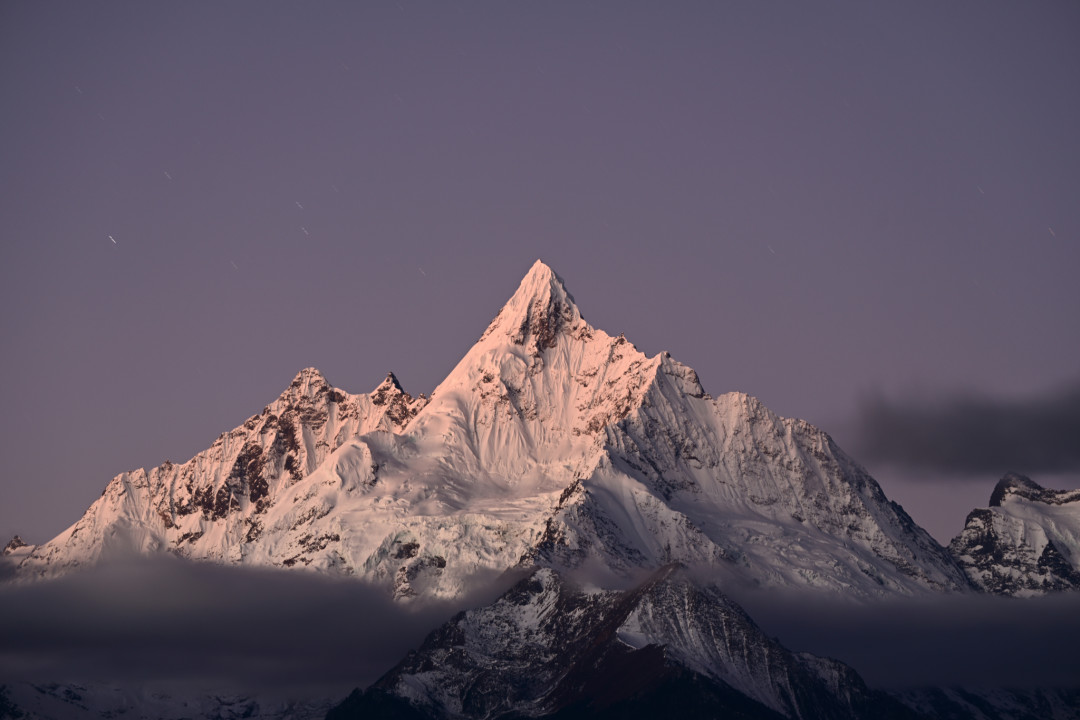
A Dreamlike Snow Mountain Journey — Meili, Daocheng, Yulong
I love photography, drone filming, and capturing landscapes.
Where should I begin? Though the trip has ended, scenes from those days keep surfacing in my mind — that incredibly enjoyable week, that week filled with passion. It was a plan I had dreamed of for years, a feast for photographers, a pure and simple journey.
My good friend Lao Cai and I are photography enthusiasts and longtime confidants. For years, we had fantasized about taking a trip dedicated solely to photography — driving a car, hauling all kinds of gear, even if it meant roughing it, sleeping in the wild, just to capture the images we wanted. Over the years, our lives kept changing — work, marriage, children — and we never found the right opportunity. Finally, as Lao Cai was about to move to the UK, we made up our minds to fulfill our dream.
In the depths of winter, we chose Meili Snow Mountain and Daocheng Yading, embarking on a snow mountain journey. One of the most mysterious and magnificent spectacles on Earth would become the protagonist of our adventure.
Highlights
Day 1: A Day of Travel — Beijing to Lijiang to Deqin Meili
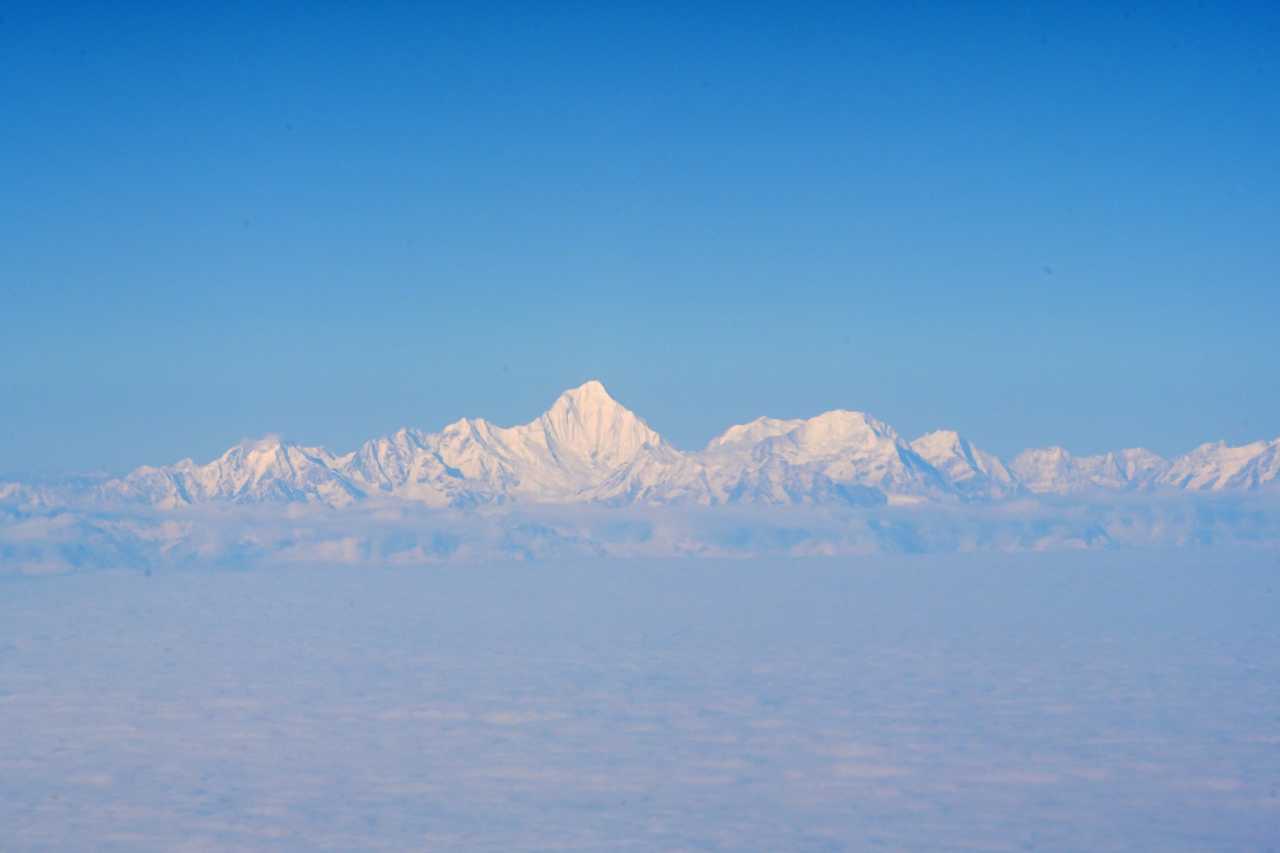
The departure day finally arrived. To make the best use of our time and have enough daylight to reach Deqin, we booked the earliest flight. We woke up at 4 a.m., arrived at the airport by 5 a.m., and took off at 6:40 a.m. As the plane flew near Meili Snow Mountain, we saw thick clouds below and worried that the entire region might be covered. Even from the vast sky, Meili Snow Mountain stood out prominently.
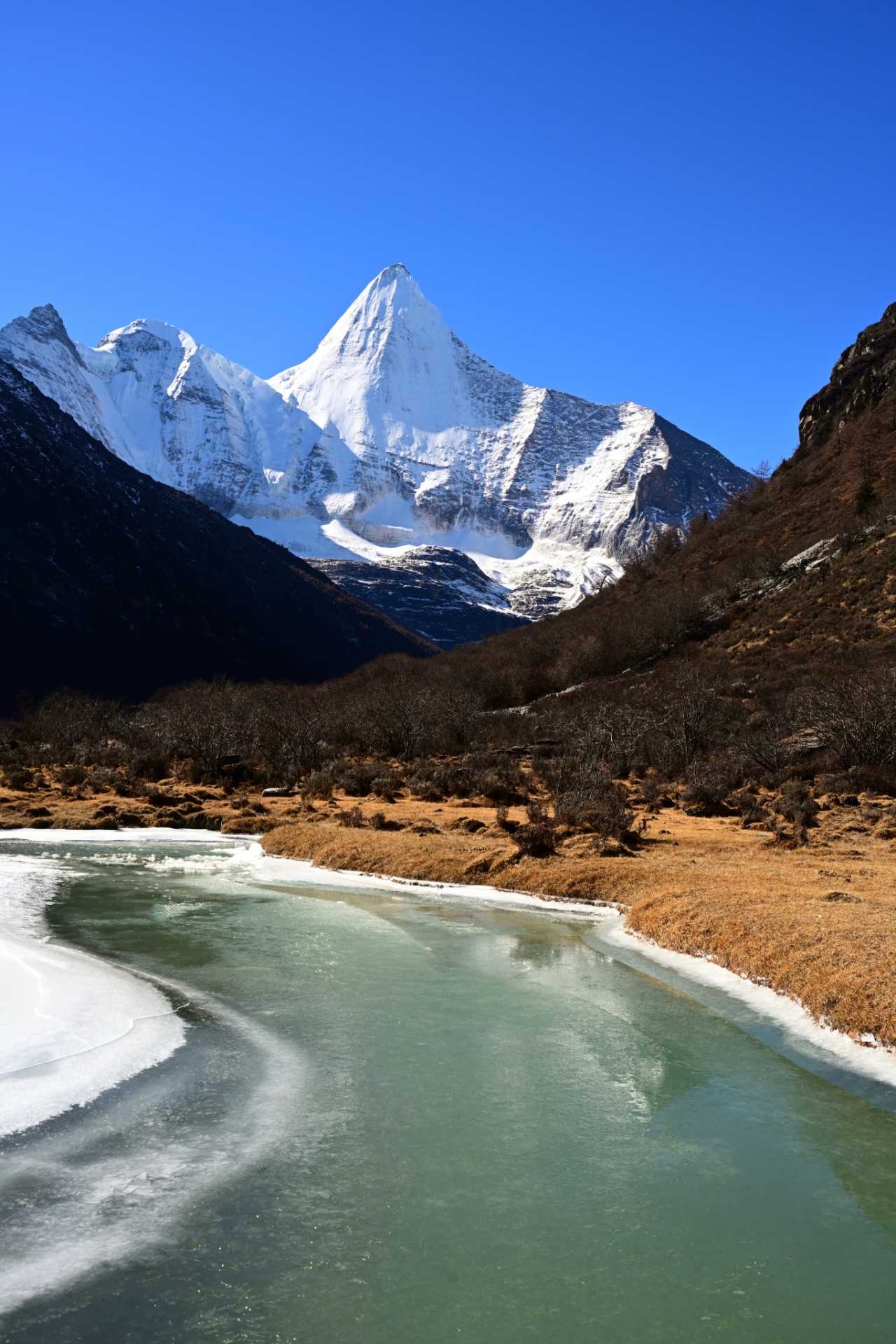
One of our destinations, the Three Sacred Mountains of Daocheng Yading, was clearly visible from the air. The three massive peaks truly looked like three bodhisattvas overlooking and blessing the land below.
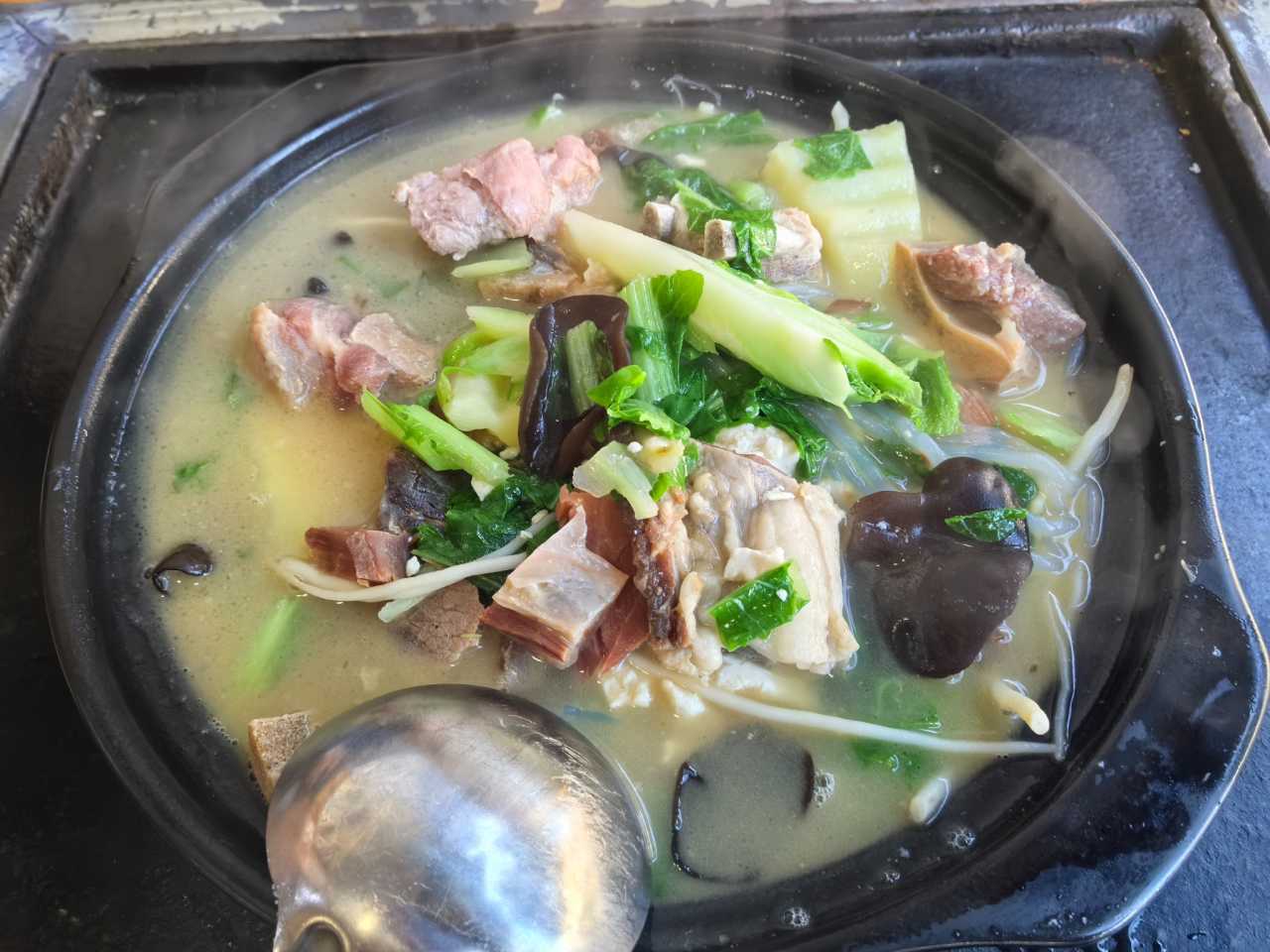
It was already past 11 a.m. by the time we got our rental car at the airport. This car would be our transportation for the next few days and our temporary base camp. We needed supplies, so our first stop was Lijiang city to find a large supermarket and grab a proper meal. To our surprise, we found a huge two-story warehouse-style supermarket in Lijiang where we bought all the supplies we needed. The street next to the supermarket had many restaurants, and one caught our eye immediately. The place was decorated wall-to-wall with cured pork ribs and cured ham, and featured a traditional fire pit. In the cold winter, sitting by the fire, a steaming pot of cured pork rib hotpot arrived, served with homemade dipping sauce and rice. After the early morning and hours of flying, this meal filled our stomachs, warmed our hearts, and filled us with confidence and fighting spirit for the days ahead. One pot wasn't enough, so we ordered another pound of cured ribs to throw in. Between the two of us, we finished a whole bowl of rice, half-satisfying our dinner appetite too.
On the road from Lijiang Airport to Lijiang city, we could see Yulong Snow Mountain the entire way. The mountain looked like a giant dragon coiled above Lijiang city — the contrast between this massive presence and the city below was overwhelming, giving us a profound sense of the mountain's grandeur. A cloud hung over the summit like a hat, or perhaps like wind-blown hair. We had a mission, so we didn't enter Lijiang city or stop for photos. After eating, we continued on. Following the Xiangli Expressway, we quickly reached Shangri-La. To our left was the surging Jinsha River, to our right the magnificent Yulong and Haba Snow Mountains. Racing through this landscape lifted our spirits immensely. After Shangri-La, the expressway ended. Passing by Napahai Lake and glimpsing Sumtseling Monastery from afar, the atmosphere of Tibet washed over us. The road from Lijiang to Shangri-La had been expressway with many tunnels, but now we entered National Highway 214, winding through mountain gorges. The canyons were so deep we couldn't see the Jinsha River at the bottom; the towering mountains on both sides seemed to pierce the clouds. This was the ruggedness of the Hengduan Mountains — building a road here must have been an incredible challenge. As the altitude climbed, we finally spotted Baima Snow Mountain, an appetizer before reaching Meili and the closest snow mountain visible from the road. Though it stands 5,400 meters tall, Baima has gentle slopes without a distinct peak. Since we were observing from nearly 4,000 meters, it didn't feel as imposing.
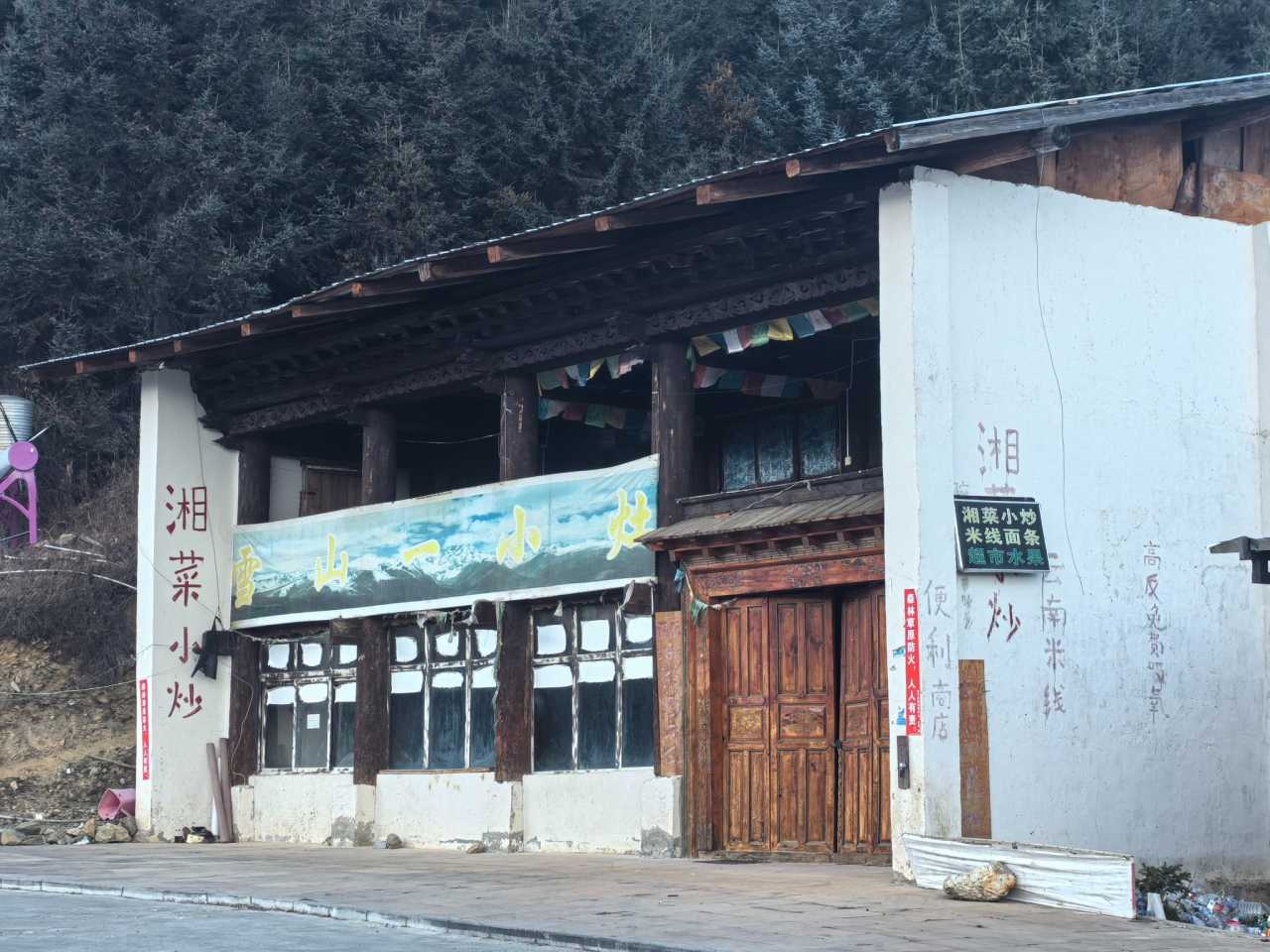
At a rest stop overlooking Baima Snow Mountain, there was a small Hunan-style restaurant. I remembered it vividly from passing by two years ago. Seeing it again now felt strangely nostalgic. Perhaps because it was winter, the place was closed both times.
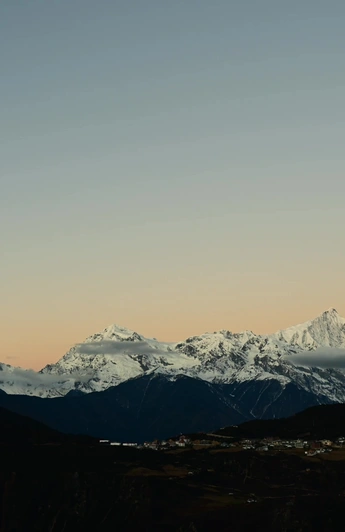
Driving through the Baima Snow Mountain Tunnel, we passed right through the middle of the mountain, crossing from the Jinsha River watershed to the Lancang River watershed. After a few more winding mountain roads, Meili Snow Mountain appeared before us, completely unobstructed — an entire row of massive, snow-white peaks rising into the clouds. No words can fully describe the feeling of seeing it. The sun was about to set, and we stopped at a viewpoint to capture the last rays of light on the peaks.
Our destination for the day wasn't just to see Meili Snow Mountain — we wanted to reach a small village northeast of Meili to explore a different perspective. The village was called Shuoda, and the spot we were looking for was Xueda Lake. Finally, we turned off National Highway 214 onto the village road. The road suddenly narrowed, and we began climbing uphill. Following the navigation through winding mountain paths, we arrived at the village and then Xueda Lake. By then, it was dark — the lake was pitch black. There were signs warning of bears in the area, and since it was the 30th day of the lunar month with no moonlight, we couldn't photograph anything. We gave up on night shooting and decided to rest well for sunrise. We hadn't booked accommodation, so we slept in the car. After a full day of travel, we both slept soundly.
Day 2: From Meili Xueda Lake to Daocheng Yading
Sunrise was at 7:50 a.m., but we were both awake by 6:30 a.m. Sleeping in the car wasn't as comfortable as a bed, but we were rested enough. The sky was already starting to brighten. At the end of the drivable road, there was a small gate. Through the gate lay Xueda Lake — a lake that barely qualified as one. Many fish ponds were bigger. It was just a small circular pool maybe a few dozen meters across.
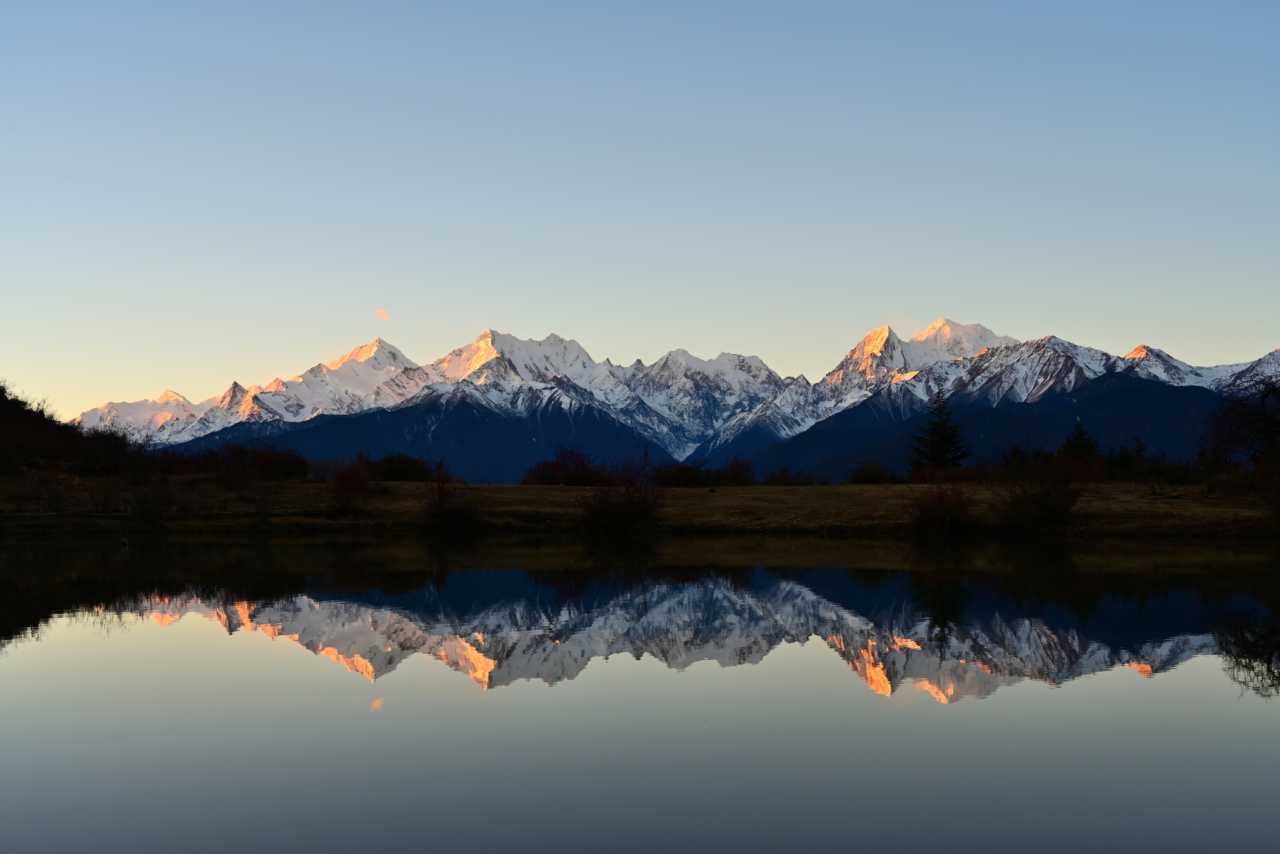
But on the plateau, any lake is precious, and this was a sacred lake for the locals, so there must be a reason. Most importantly, this small body of water gave us a reflection of the Thirteen Peaks of Meili — a rare sight in the rugged Hengduan Mountains. We set up our gear and began shooting. The sky shifted from blue-purple to pink-white, growing brighter.
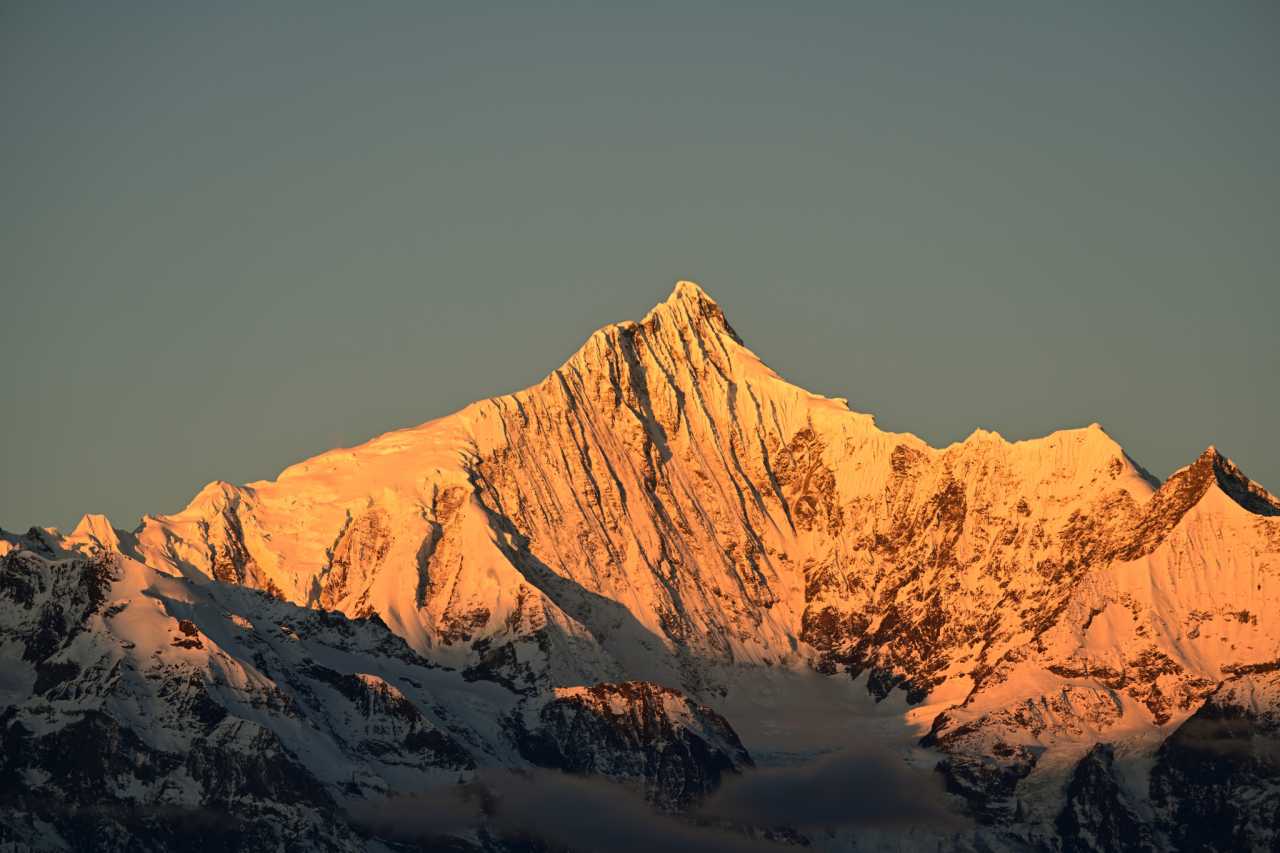
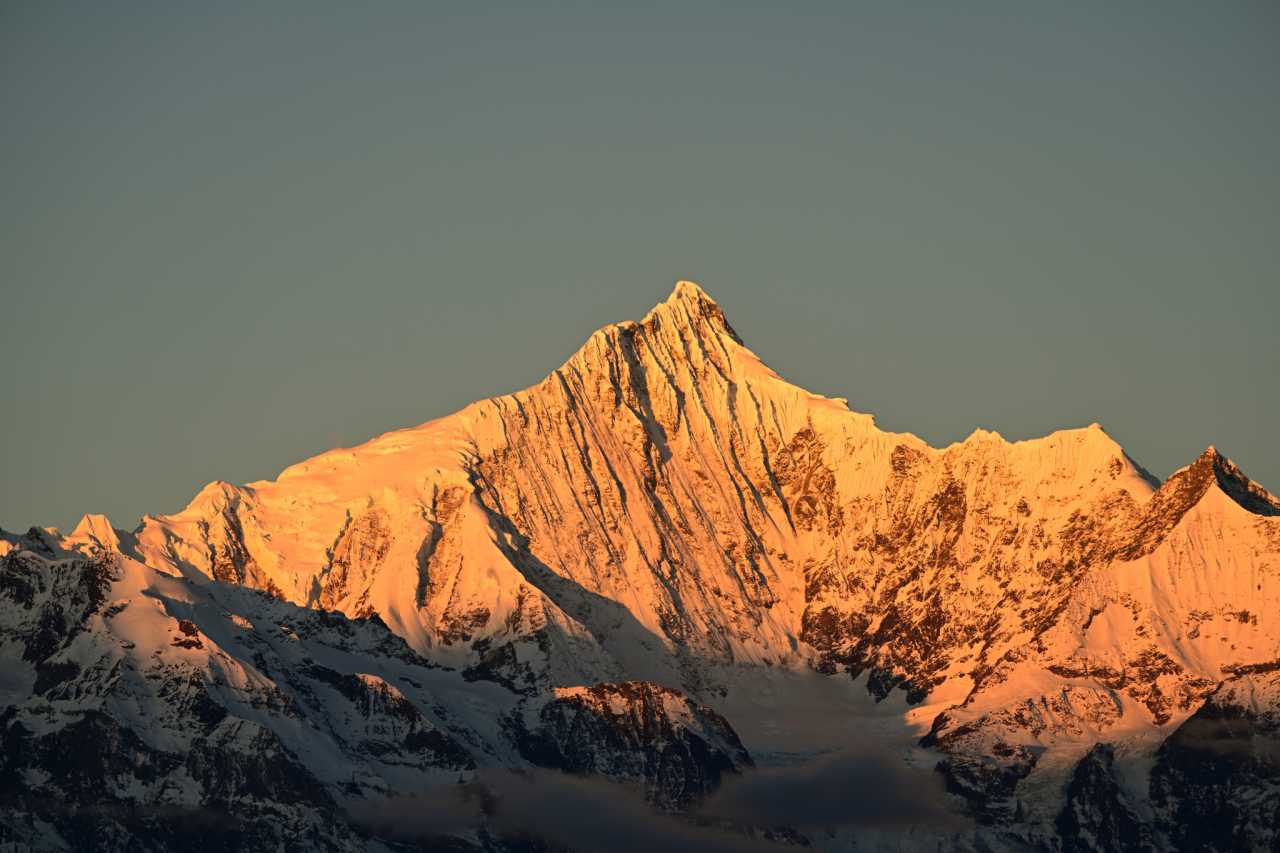
Finally, the tip of the main peak, Kawagebo, caught a hint of gold. The gold spread downward, and other peaks gradually turned golden. The magnificent "Golden Sun Illuminating the Snow Mountain" appeared before us. The water of Xueda Lake was calm, only rippled by a gentle breeze, reflecting the golden scene from below to above. Just the day before at this time, we were still on the plane to Lijiang. Seeing this now felt surreal, but the mountain was right there, constantly changing before our eyes — a great start to our photography journey. The gold gradually covered the entire mountain body, even the snowless lower slopes bathed in a red glow. As the sun rose higher, the gold faded, revealing the purer white of the mountain.
We packed up and drove down the mountain. The road was the same as the night before, but with better visibility and familiarity, we descended much faster. Soon we reached the foot of the mountain, arrived at the Lancang River, and headed south along National Highway 214 toward Daocheng Yading.
Along the way, we stopped at several viewpoints to photograph Meili under a cloudless blue sky from the closest and most direct angle. The 6,740-meter peak stood before us. Mingyong Glacier hung like a scarf around the mountain's waist, each block of ice a mark of time and age. The wind rustled prayer flags, and the Lancang River rushed endlessly below. Without saying a word, nature deeply moved our hearts. Standing there, I truly felt like an ephemeral mayfly in the vast universe, a single grain in the immense ocean. Thank goodness for the clear weather that allowed us to witness Meili's true face.
From Xueda Lake to Daocheng Yading, we had to backtrack through the previous day's route, cross the Jinsha River at Benzilan Town, and then head northeast. Having just driven this road yesterday, it felt familiar, and we soon reached Benzilan. The crossing point over the Jinsha River was a somewhat makeshift bridge that could only accommodate one car at a time, but its tall pillars on both sides made it look grand. Construction was visible nearby — later I learned it was for a water conservancy project.
After crossing the Jinsha River, we entered National Highway 215, which runs along a river. On the map, this river was called the Dingqu; later I learned it's also known as the Songmai River or Derong River, another river cutting through the Hengduan Mountains. We followed this river all the way, passing through Derong, crossing another mountain in the Hengduan range, and arriving at Xiangcheng County in the Shuoqu River basin. After Xiangcheng, the altitude gradually rose from 3,500 to 4,000 meters. The landscape shifted from high mountain gorges to alpine meadows. A small stream accompanied us through the meadows, and occasionally we saw herders' houses and livestock. The scenery here already looked like pictures of Daocheng Yading, just without the snow-capped mountains in the background. On this road, there were almost no other vehicles. Just the two of us, one car, traveling through this vast land — it felt like truly experiencing the world.
After crossing this alpine meadow, the altitude dropped again, and we arrived at Shangri-La Town. This small town belongs to Daocheng County, just outside the Daocheng Yading scenic area. We decided to rest well here tonight and enter the scenic area tomorrow.
Day 3: First Exploration of Daocheng Yading
Today we entered Daocheng Yading, planning to stay inside the scenic area for two days to thoroughly explore it.
To reach the actual starting point of the hike, Zhaguanbeng, you need to take a scenic area bus from Shangri-La Town — about an hour's ride. For convenience, we stayed in Yading Village, just over ten minutes from Zhaguanbeng, so we wouldn't have to take the long bus ride every day and could stay longer to shoot more. We dropped our luggage at the guesthouse in Yading Village and took the bus directly to Zhaguanbeng. From there, we walked a few hundred meters, climbing about a few dozen meters in elevation, to reach the starting point of the electric cart at Chonggu Meadow. The area was full of monkeys, accustomed to harassing tourists. They would grab any plastic bag they saw, and exposed snacks were certainly not safe. Lao Cai and I both carried large camera bags with tripods attached, looking bulky enough that no monkey dared bother us. We witnessed tourists getting their food snatched and watched the monkeys eat the stolen cookies, sausages, and instant noodles. A local guide told us about a female tourist whose camera was snatched — several people searched the mountain but never found it. From Chonggu Meadow, we could see Xiannairi and Chonggu Monastery. The golden Tibetan-style monastery was surrounded by forest, with Xiannairi glittering beside it in the sunlight.
The heart of Daocheng Yading is its three sacred mountains: Xiannairi, Yangmaiyong, and Xianuoduoji. These three peaks form a triangle, and between them lies a U-shaped valley carved by glacial erosion, now an alpine meadow. Through the meadow flows the Gongga River, dotted with several lakes: Gongga Co, Milk Lake, Five-Color Lake, and Zhuomala Co. The scenic area has two hiking routes. One is the short route from Chonggu Meadow to Xiannairi and Zhuomala Co — steep but short, offering views of only Xiannairi. The other is the long route, following the U-shaped valley from Chonggu Meadow past Shengshui Lake, Luorong Pasture, and Gongga Co, with a final steep climb to Milk Lake and Five-Color Lake. Since this summer, the last section of the long route has been closed due to geological issues, so visitors can only go as far as Gongga Co. The short route is open normally. Although we had plenty of time, we worried about sudden weather changes, so we decided to tackle the long route first while the weather was good, leaving more flexibility for the next day.
The long route has an electric cart that takes visitors directly to Luorong Pasture. Along the way, we could see Xianuoduoji Snow Mountain, which looks very different from various angles. Up close, it wasn't as impressive as the steeper view from Yading Village and Zhaguanbeng.
As the electric cart moved forward, we gradually saw Yangmaiyong Snow Mountain. I think it's the most beautiful of the three — solid, pure white, like a sword piercing the sky. We had plenty of time and preferred to walk and discover different scenery, so we got off at Shengshui Lake and started our hike from there. Walking on the wooden boardwalk through the meadow, with Xianuoduoji to our left, Xiannairi to our right, and Yangmaiyong ahead, the three mountains truly surrounded us like three immortals. It was impossible not to think this was the work of gods. The locals call them three bodhisattvas — a fitting name. Trees lined the mountain slopes, and a few solitary trees dotted the meadow. We stepped off the boardwalk and walked through the grass, soaking in the pure natural atmosphere.
We walked and photographed all the way to Luorong Pasture, meeting only a few fellow hikers along the way. Most tourists seemed to take the electric cart directly to Luorong Pasture, which in our view meant missing the changing scenery along the route.
The walk from Shengshui Lake to Luorong Pasture took us about two hours, including plenty of time for photos. At Luorong Pasture, we rested. I pulled out my telephoto lens to photograph wildlife — blue sheep, wild ducks, red-billed crows, pigeons.
By then, we were both feeling tired, so we decided to head back to Yading Village. The electric cart took us back to Chonggu Meadow. On the way down to Zhaguanbeng, we noticed small birds in the Gongga River swimming upstream against the current to catch food — a fascinating sight. A boardwalk followed the river, and due to the steep drop, the river formed many small waterfalls.
Back at the guesthouse in Yading Village, we ordered three dishes, a soup, and a bowl of rice for dinner — and nearly finished everything, recharging our energy. As evening fell, we grabbed our tripods and bags and headed to the Yading Xiangbala Cultural Museum in the village to photograph Xianuoduoji at sunset. From Yading Village, Xianuoduoji faces west, so only at sunset does the mountain take on a golden hue — a different kind of "Golden Sun Illuminating the Snow Mountain."
Day 4: Second Day in Daocheng Yading
Yading Village sits at 3,900 meters. After a few days, we had mostly acclimated to the high altitude. The guesthouse had oxygen dispersion, which could raise the oxygen level in the room for better sleep. We slept well that night. After breakfast at the guesthouse, we caught the first bus to Zhaguanbeng.
During yesterday's hike, we noticed that Yangmaiyong's visible face faces east-north, so by noon, the sun no longer directly hits the mountain, and in the afternoon, it's backlit. So we decided to enter the scenic area early and spend the morning admiring Yangmaiyong. The first bus was indeed early. By the time we climbed from Zhaguanbeng to Chonggu Meadow, the electric carts weren't running yet. Yesterday, we had walked from Shengshui Lake to Luorong Pasture. Today, we took the cart directly to Luorong Pasture, planning to walk from there to Gongga Co and cover the entire long route. On the first electric cart to Luorong Pasture, Lao Cai and I didn't stop — we headed straight for Gongga Co. The entire boardwalk had only the two of us. We launched the drone to follow and film us.
Sure enough, most of Yangmaiyong was lit from the front in the morning. Along the way, we passed a small waterfall. After a slight climb, we saw Gongga Co. This lake lies at the foot of Yangmaiyong. Here, besides the sword-like white mountain body, we could also see its entire black base, emphasizing how towering Yangmaiyong is. We were at 4,200 meters at Gongga Co; Yangmaiyong rises to 5,900 meters — a nearly 2,000-meter drop. The massive mountain was almost too big to fit even in a wide-angle lens. We rested here and flew the drone to take a look at this sacred peak.
For the return trip, we took another boardwalk along the mountain's base. This path didn't offer mountain views but wound through the forest, which was more interesting. We encountered small squirrels that weren't too afraid of people — the bolder ones would come to your hand for food when called, very cute.
Back at Luorong Pasture, we took the electric cart to Chonggu Meadow and then tackled the short route. At the start of the short route stood Chonggu Monastery, a magnificent golden Tibetan temple. We went inside for some instant noodles to refuel. Though the short route was brief, it involved a lot of climbing — up and down stairs. Walking on flat ground at high altitude already consumes a lot of energy; climbing is even more draining. We stopped frequently to rest. We met a few more squirrels along the way and eventually reached Zhuomala Co. Another small lake at the foot of a snow mountain, this time we were closer to the peak. Xiannairi, the highest mountain in Yading, stood right before us, seemingly blocking all the view and most of the sunlight.
A fierce large monkey lurked here, always ready to snatch food from tourists. The nearby birds and squirrels, however, were quite friendly with people.
Day 5: Daocheng to Meili Snow Mountain
Today we left Daocheng Yading and returned to Meili Snow Mountain. We caught the earliest bus out of the scenic area, got in our car, and drove straight back to Meili. By now, it was our third time driving this route in a few days — very familiar. This time, we viewed Meili Snow Mountain from Wunongding, a platform halfway up the mountain just as you enter Deqin County. We were pleasantly surprised to find that this spot was much closer than Deqin County town, meaning our driving time over the next two days would be shorter — no need to detour through the county.
Wunongding is relatively farther from Meili Snow Mountain, which means you can see more of the peaks — all Thirteen Peaks of Meili are visible. We checked into a guesthouse, found a restaurant to eat, then returned to the viewing platform, set up our cameras, and photographed the starry sky over Meili at night.
During the night shoot, some clouds briefly appeared among the peaks, making us a bit worried about tomorrow's weather.
Day 6: Meili Golden Sunrise + Lijiang Yulong Snow Mountain
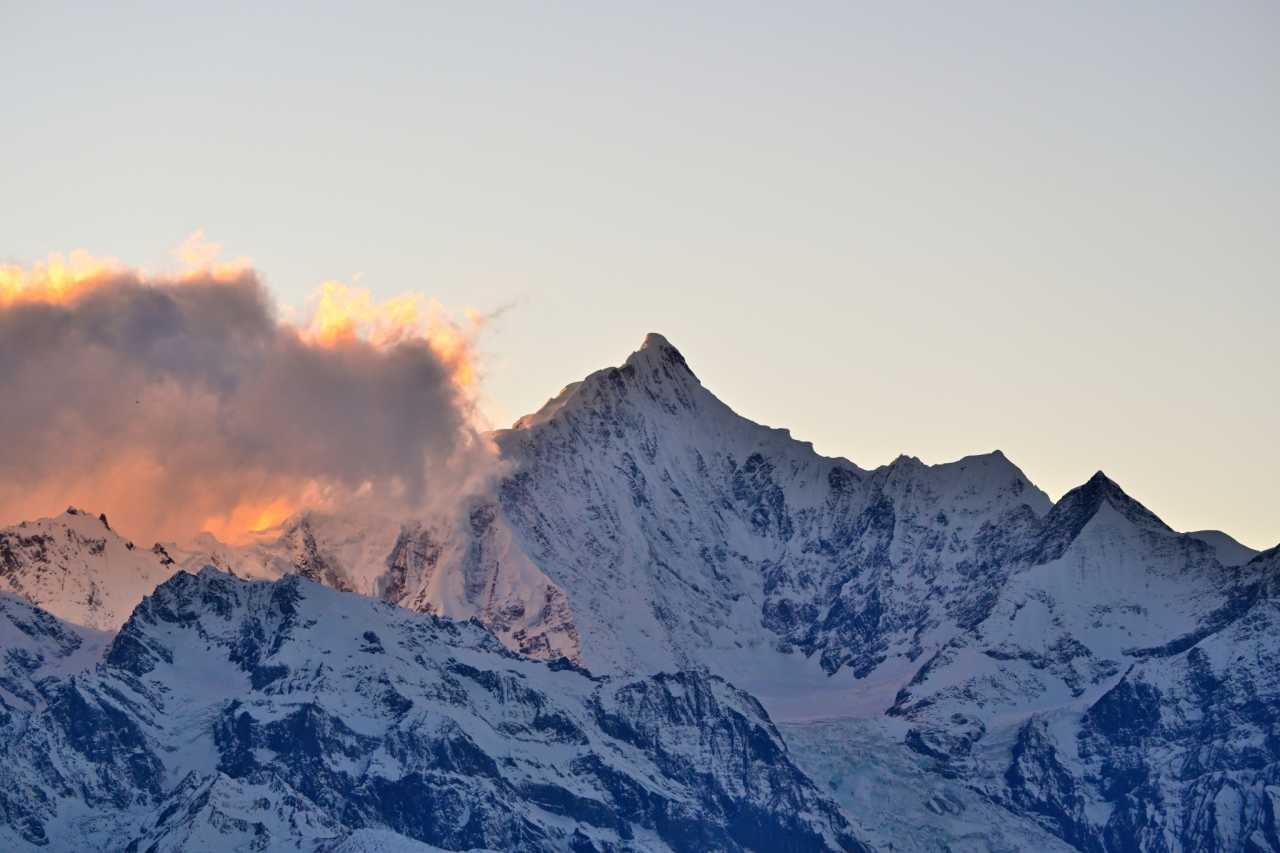
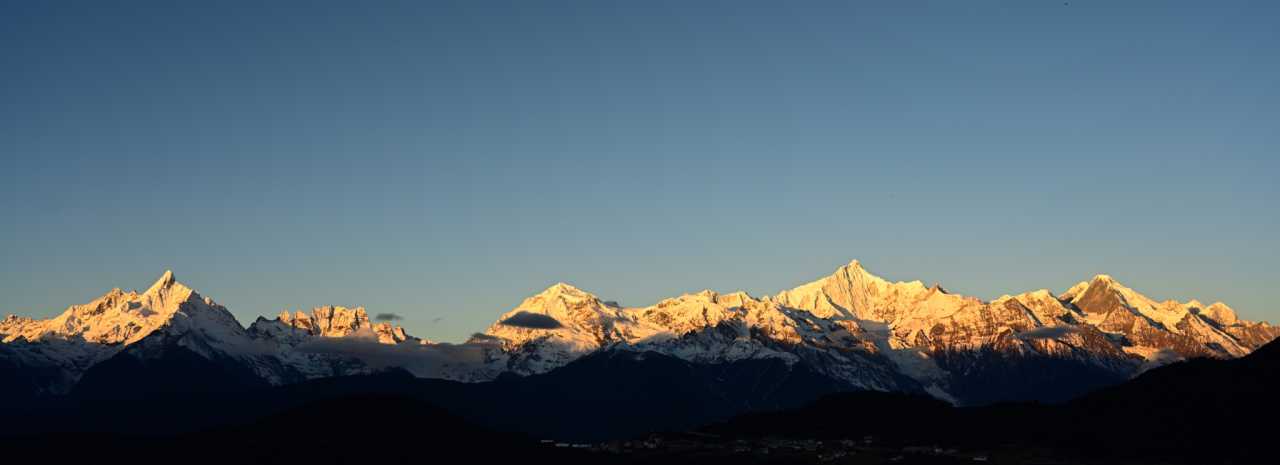
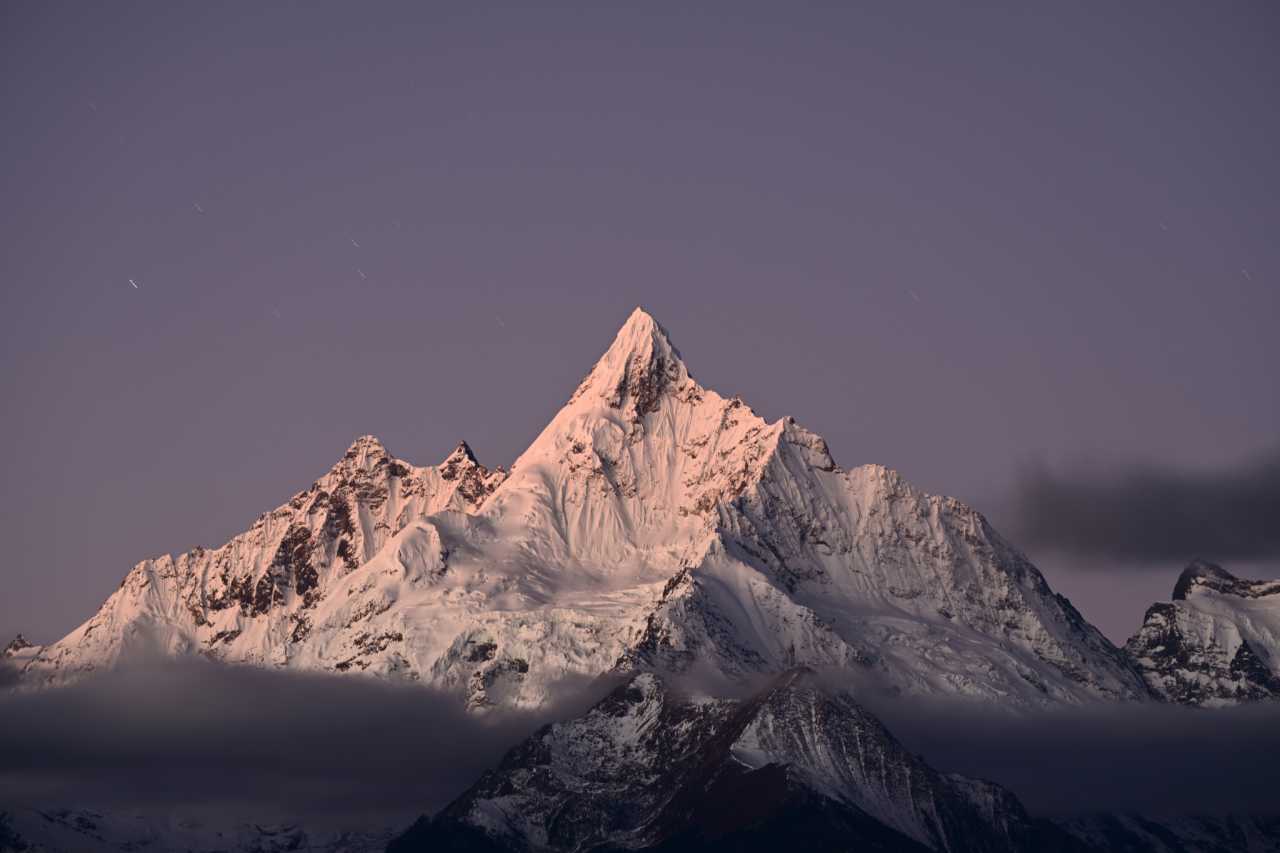
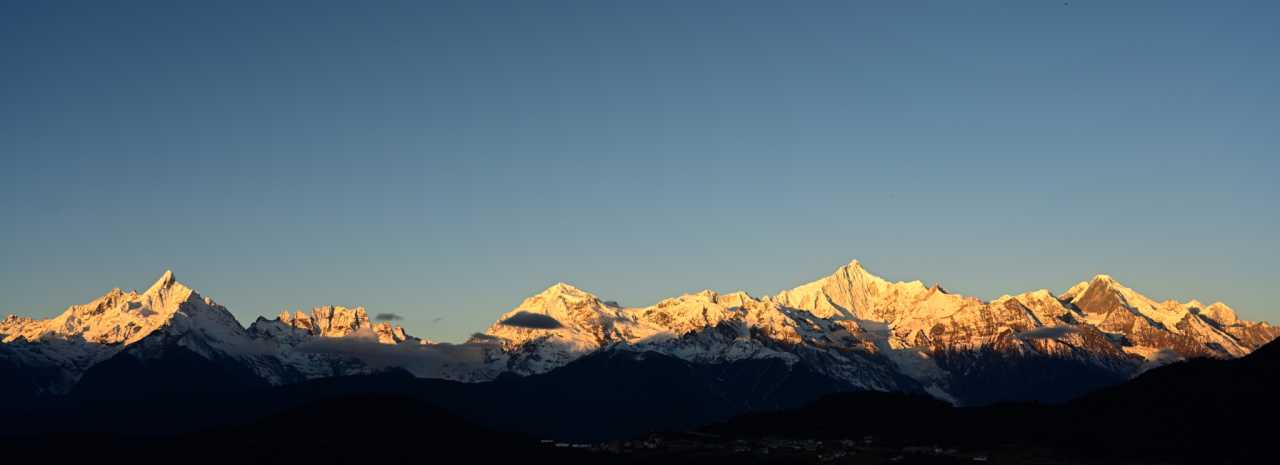
We woke up at a little past 6 a.m. and were at the viewing platform before 7 a.m. Two people were already there. We quickly grabbed the best spot and set up three tripods. Thin clouds hung among the peaks but wouldn't block the mountain, so we relaxed — the golden sunrise was guaranteed, and the clouds might even add some interesting elements to the scene. By around 7:30 a.m., the platform had filled with people. Lao Cai kept switching between subjects and lenses, while I started time-lapse photography on both my cameras — one wide-angle capturing the entire Thirteen Peaks panorama, the other telephoto focused on Kawagebo. With both cameras on time-lapse, I was free to truly and wholeheartedly watch the golden sunrise. The sky grew brighter, colors shifting constantly, until that beam of golden light touched the tip of Kawagebo. Another perfect "Golden Sun Illuminating the Snow Mountain." I think at that moment, I perfectly solved the dilemma from The Secret Life of Walter Mitty — I could both record with my camera and focus on watching with my eyes.
Golden Sunrise Time-Lapse
A hint of pink appeared at the horizon
A perfect golden sunrise
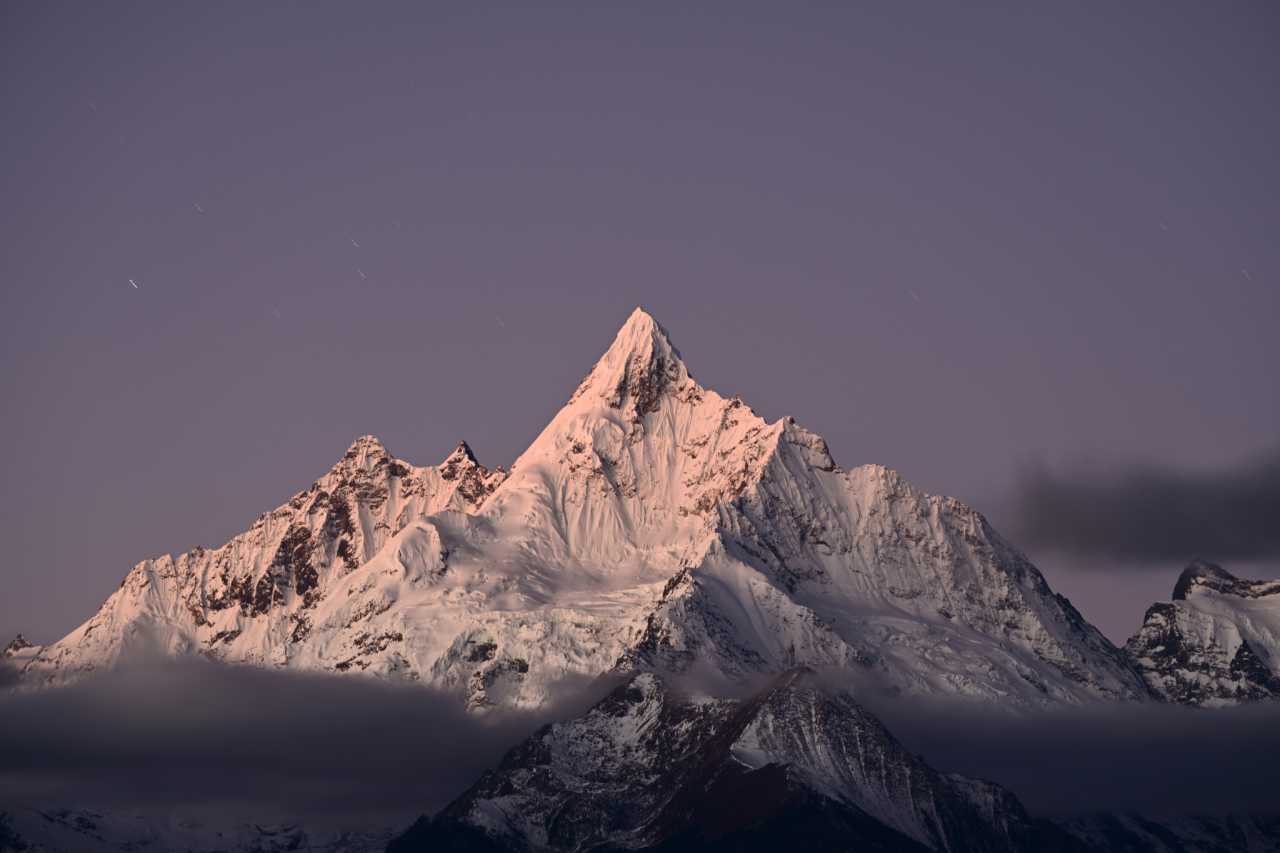
Full view of Meili
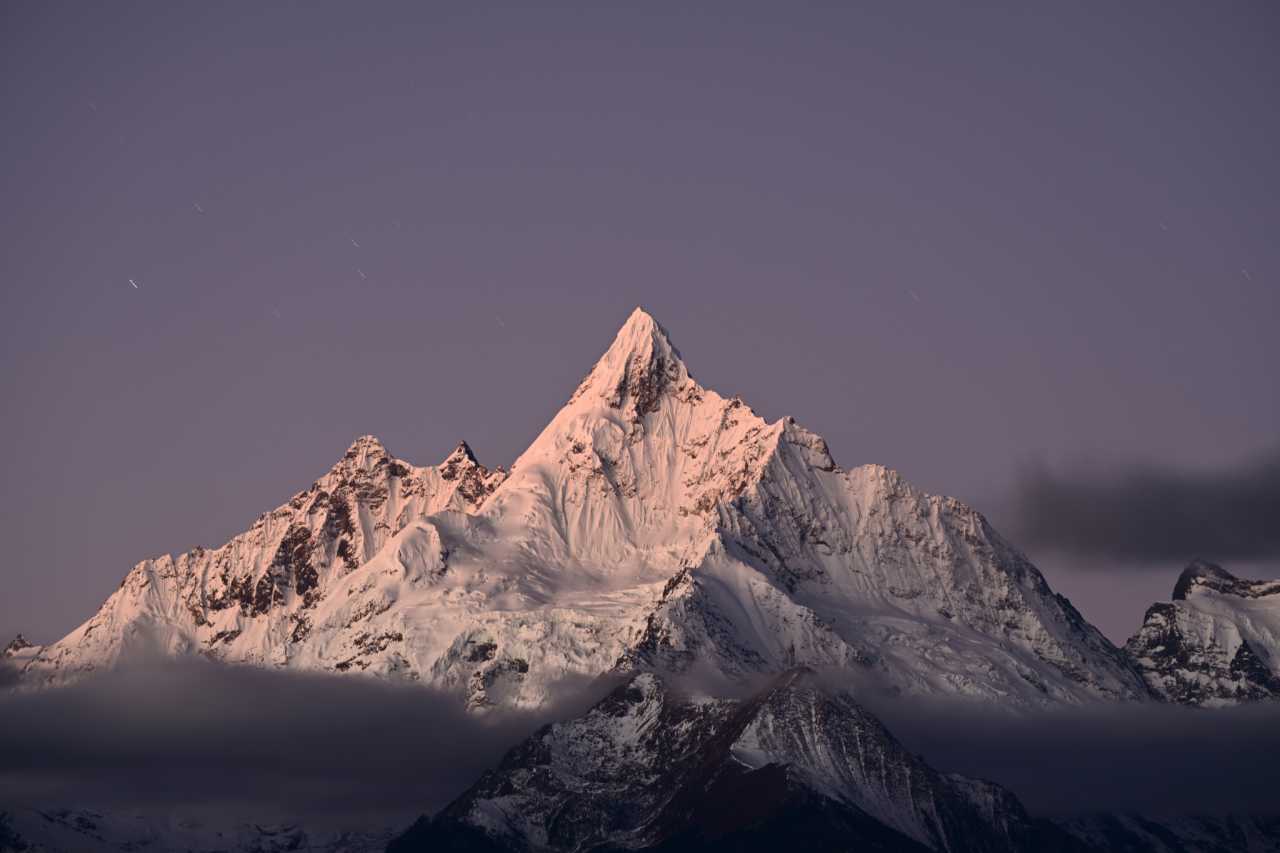
And of course, the beautiful Goddess Peak — Miancimu
After watching the golden sunrise, we packed up, had breakfast at the guesthouse, and hit the road back to Lijiang. By 3 p.m., we were in Lijiang. First, we went to that same restaurant, "You Yi Guo" (One Pot), for one last meal of cured pork rib hotpot. We ordered a large pot and ate to our hearts' content.
Then we visited Black Dragon Pool Park.
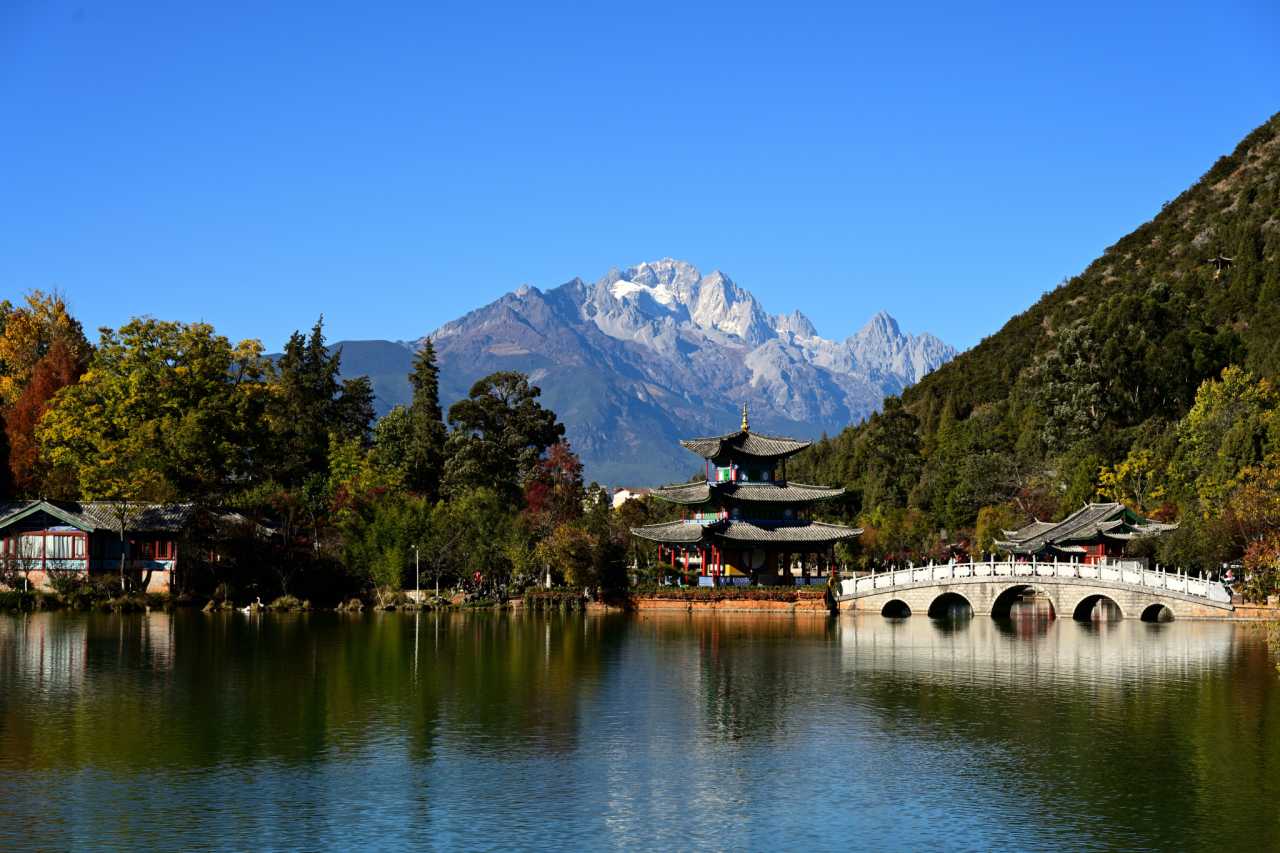
Black Dragon Pool Park is a beautiful park in Lijiang city, offering a distant view of Yulong Snow Mountain. The park's lake and traditional Chinese architecture formed a harmonious scene with the snow mountain. The weather was still perfect. Unlike the cold of Meili and Daocheng, Lijiang's temperature was pleasant. The trees still held their green or yellow leaves, creating an autumn atmosphere — at times, the sunlight even felt like spring. We took many satisfying photos at Black Dragon Pool, a perfect ending to our trip.
Afterword
Six days of shooting. We photographed Meili Snow Mountain from various angles and times, witnessed two golden sunrises, and covered all the routes in Daocheng Yading. Most importantly, the weather was clear the entire time — blue skies accompanied us throughout. The heavens were on our side for this rare photography journey.
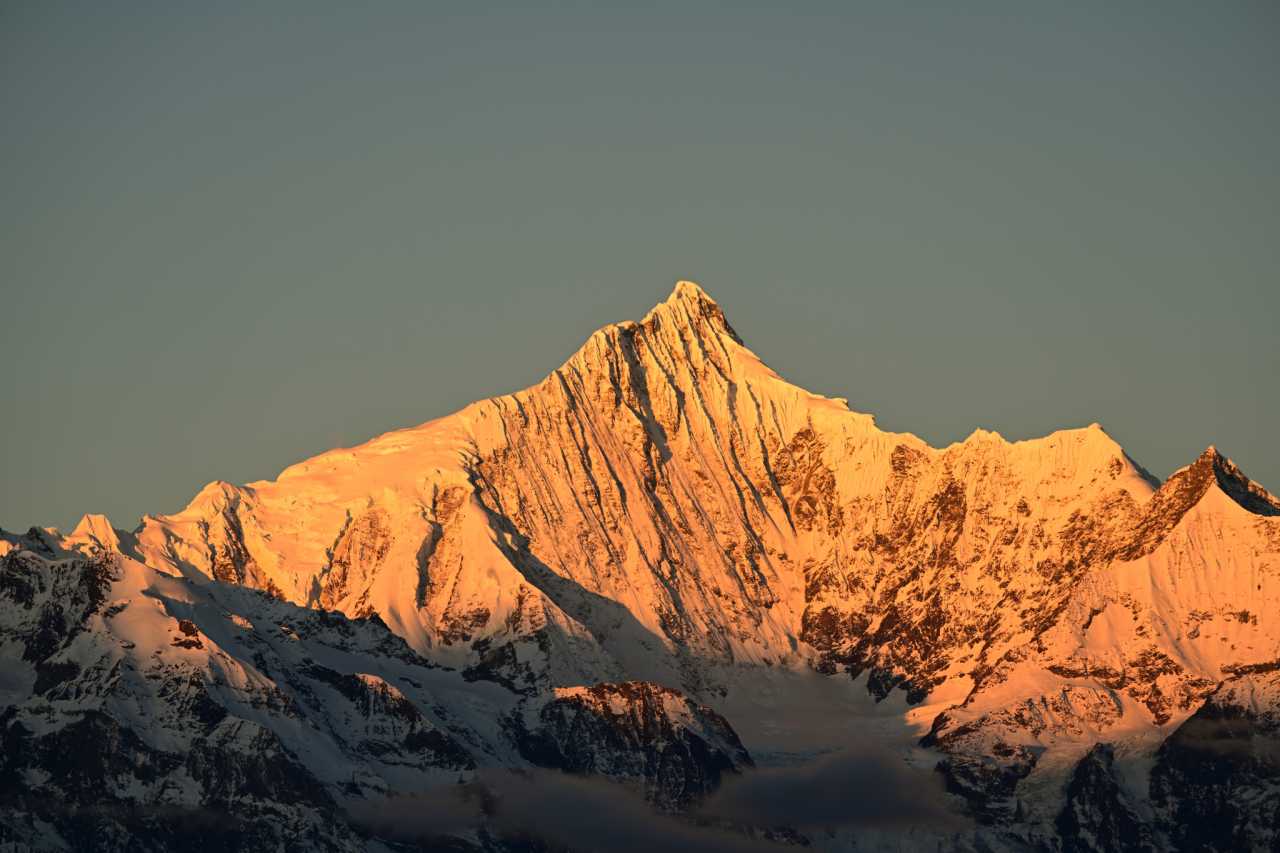
We returned to Beijing with a hard drive full of images and a heart full of memories. Everything about this trip felt like a dream — both real and surreal, replaying in our minds. Lao Cai and I talked about how, ten years ago, we had nothing. Over these ten years, we've grown and experienced so much. Let this journey mark the end of one era and the beginning of the next. And we can make a pact: in the next era, continue to live our lives well and take even better photos.
Load more content
This travelogue is copyrighted by Lao Ding. Reproduction in any form requires the author's permission.
© 2026 mafengwo.cn
Report
Recommended Travelogues
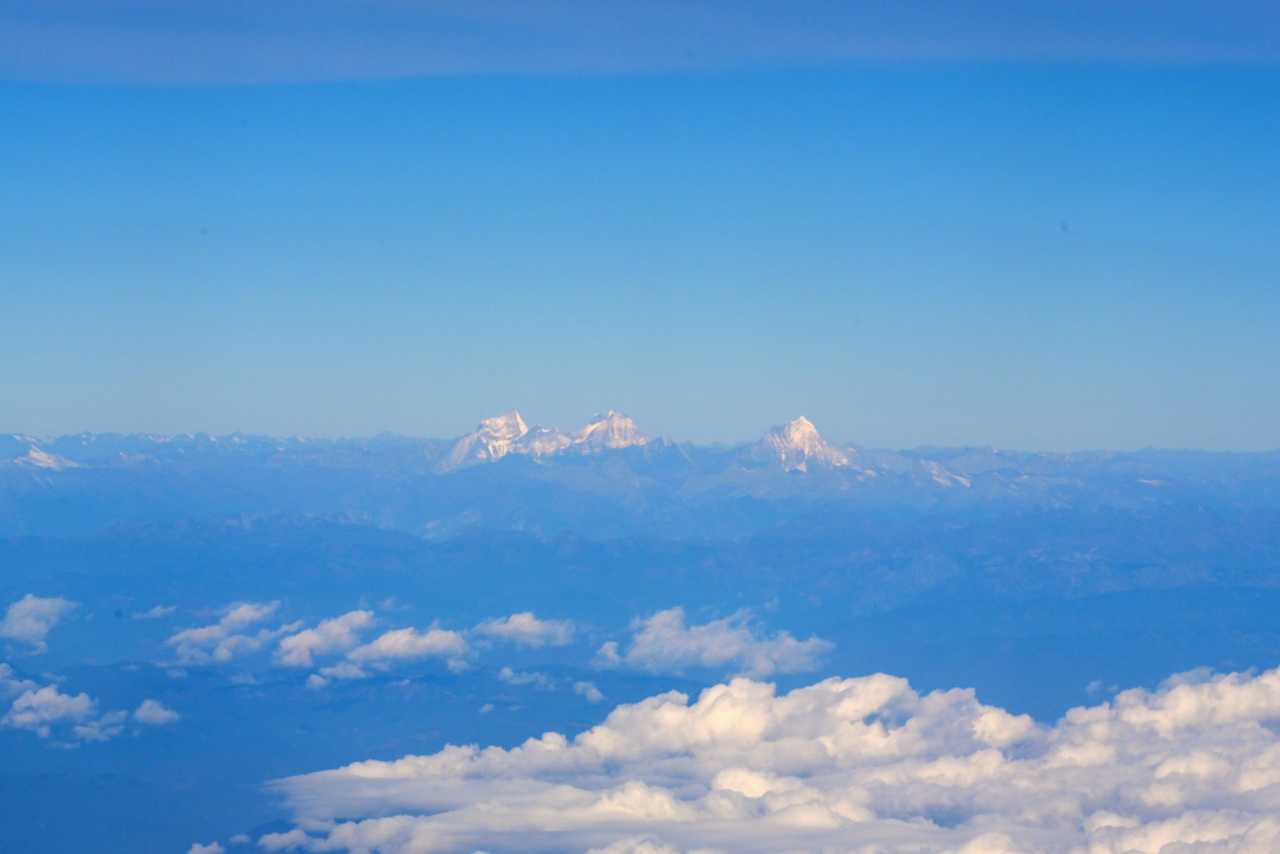
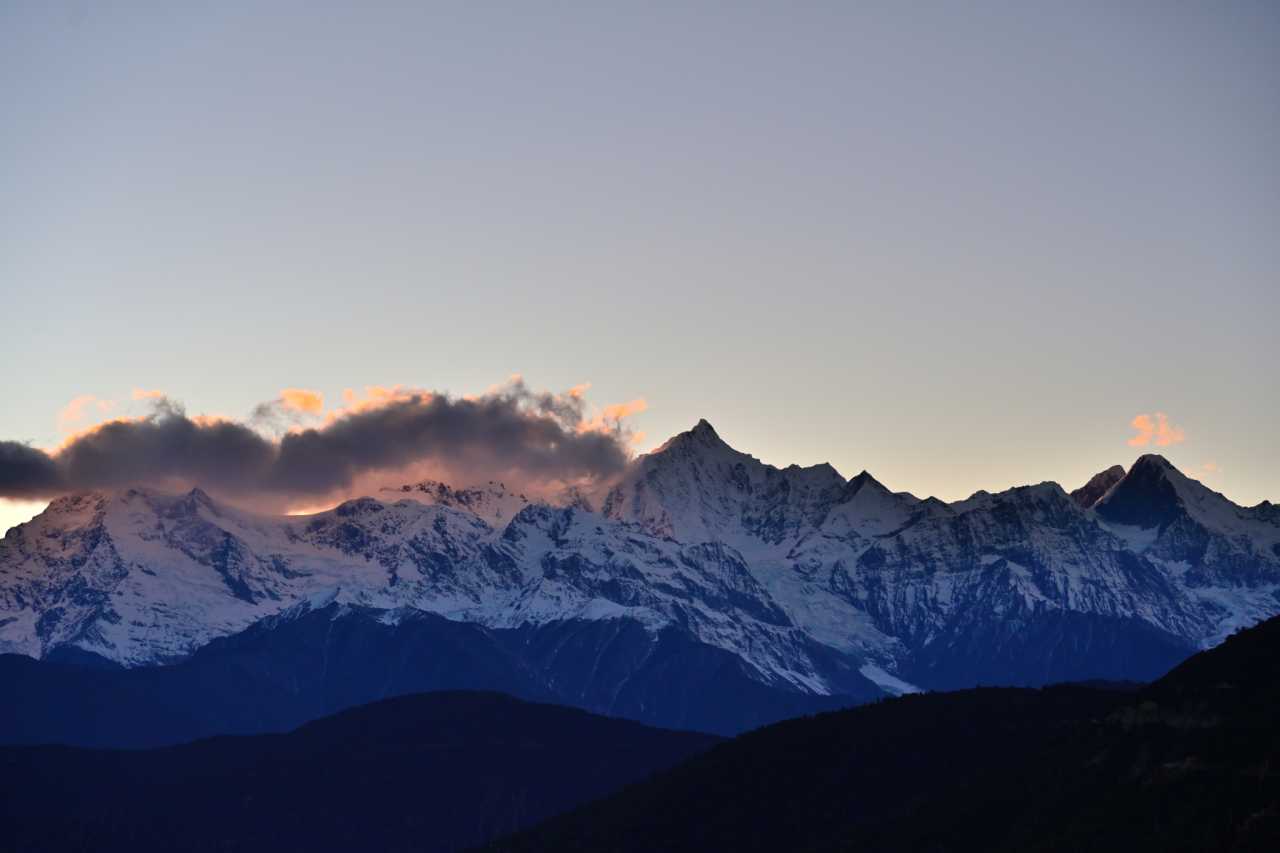
Meili Snow Mountain 69-Day Volunteer Trip — This Is My Meili Story
Not writing a travelogue, just telling a story. I've always wanted a working holiday — a few months long. Even though I'm no longer young, I still want to find ways to make life bloom. It's not about longing for distant places; it's about truly feeling alive, being able to genuinely perceive everything new around me. Time waits for no one. In late March 2019, while browsing posts online, I found too many overly romantic, impractical entries. Only one post caught my attention — its volunteer work description was meticulous and detailed. I thought, this is it. From researching online, communicating with the owner, getting hired, to booking the flight and finalizing the itinerary — the whole process took just two days. Why Meili Snow Mountain? Maybe just wanting to escape city life and go somewhere remote. Yunnan Province — Diqing Tibetan...
You should also read:
Two Girls' Graduation Trip: Dali and Shuanglang – A Poetic Farewell to Mountains and Sea
Two Girls' Graduation Trip: Dali and Shuanglang – A Poetic Farewell to Mountains and Sea Preface: Catching the Tail of Youth, Heading South During our senior year of college, my roommate and I – two girls studying in Beijing – decided to bid farewell to…
Continue reading...
Cloud Travelogue · Dali of Wind, Flowers, Snow, and Moon: A Three-Day, Two-Night Journey of a Free Spirit
Cloud Travelogue · Dali of Wind, Flowers, Snow, and Moon: A Three-Day, Two-Night Journey of a Free Spirit I am a cultured female foodie with a touch of rogue charm. I slung on my backpack, took my lover's hand, and set off on a spontaneous…
Continue reading...
The Meaning of Travel – A Tengchong Story: A Journey of the Heart and Personal Growth
The Meaning of Travel – A Tengchong Story: A Journey of the Heart and Personal Growth Setting Out, Only to Return a Better Self Some say travel is nothing more than leaving a place you're tired of, only to go to a place where others…
Continue reading...