Basking in the Winter Sun, Chasing the Yunnan Blue — My Three Journeys to Yunnan
Basking in the Winter Sun, Chasing the Yunnan Blue — My Three Journeys to Yunnan
Memory is like a book turned by time. Those yellowed pages never truly disappear; they simply wait for an unguarded moment to be opened once more.
In 2009, I unexpectedly set foot on Yunnan soil twice. That year, my friend Xiao Jie and I were still students when, on impulse, we bought round-trip tickets from Shanghai to Lijiang. The day of our departure happened to coincide with a total solar eclipse. Daylight turned to night, our plane took off in the rain, pierced through endless darkness and lightning, and finally broke through the clouds to reveal a brilliant blue sky — that experience felt like a strange journey into another dimension. Apart from the overcast weather in Shangri-La and the terrifying turbulence on the return flight (Xiao Jie cried so hard her makeup was ruined, and I lost my wallet), it was almost a perfect trip.
That same autumn, I became deeply infatuated with the Greater Shangri-La Circuit but couldn't find a single friend willing to join me. By chance, I assembled a group online. Telling my parents I was traveling with friends, I flew alone to Chengdu to meet my teammates. As the youngest member of the group, I was looked after by the older brothers and sisters and successfully completed the route from Daocheng Yading to Meili Snow Mountain and Shangri-La. I still remember our last meal together in a small restaurant in Zhongdian on the way to Lijiang. The others were worried and urged me to go back to Lijiang with them. But there were things I had to do alone — the Napahai at dawn, old friends in Shangri-La. In the end, I flew from Shangri-La back to Kunming, alone when I arrived, alone when I left.
Ten years later, Xiao Jie has settled in Australia with a family and a baby of her own. A few days ago, she had someone bring me a blessing sachet, worried about the situation at home. Meanwhile, she herself is enduring the environmental consequences of the Australian bushfires. I believe everything will slowly get better. The same goes for those brothers and sisters — their lives have followed the paths we imagined.
Though those two Yunnan trips were a decade ago, the memories remain as clear as yesterday. Because of Yunnan, I came to know him and her indirectly. We each live our own lives now, rarely in touch, but they remain the most beautiful rhythms of my youth.
Ten years later, my life includes five-year-old Tongtong. Every year, I plan to take him to places I've visited and loved. This time, the destination was Yunnan, the land of colorful clouds.
Departure: From Shanghai to Kunming
A Small City's Winter, Warm as Spring
On the morning of our departure, I was washing up in the bathroom when the door suddenly swung open and an excited little head poked in. Tongtong said to me, "Go to Yunnan, go to Yunnan, go to Yunnan." This little guy was full of anticipation for the upcoming trip.
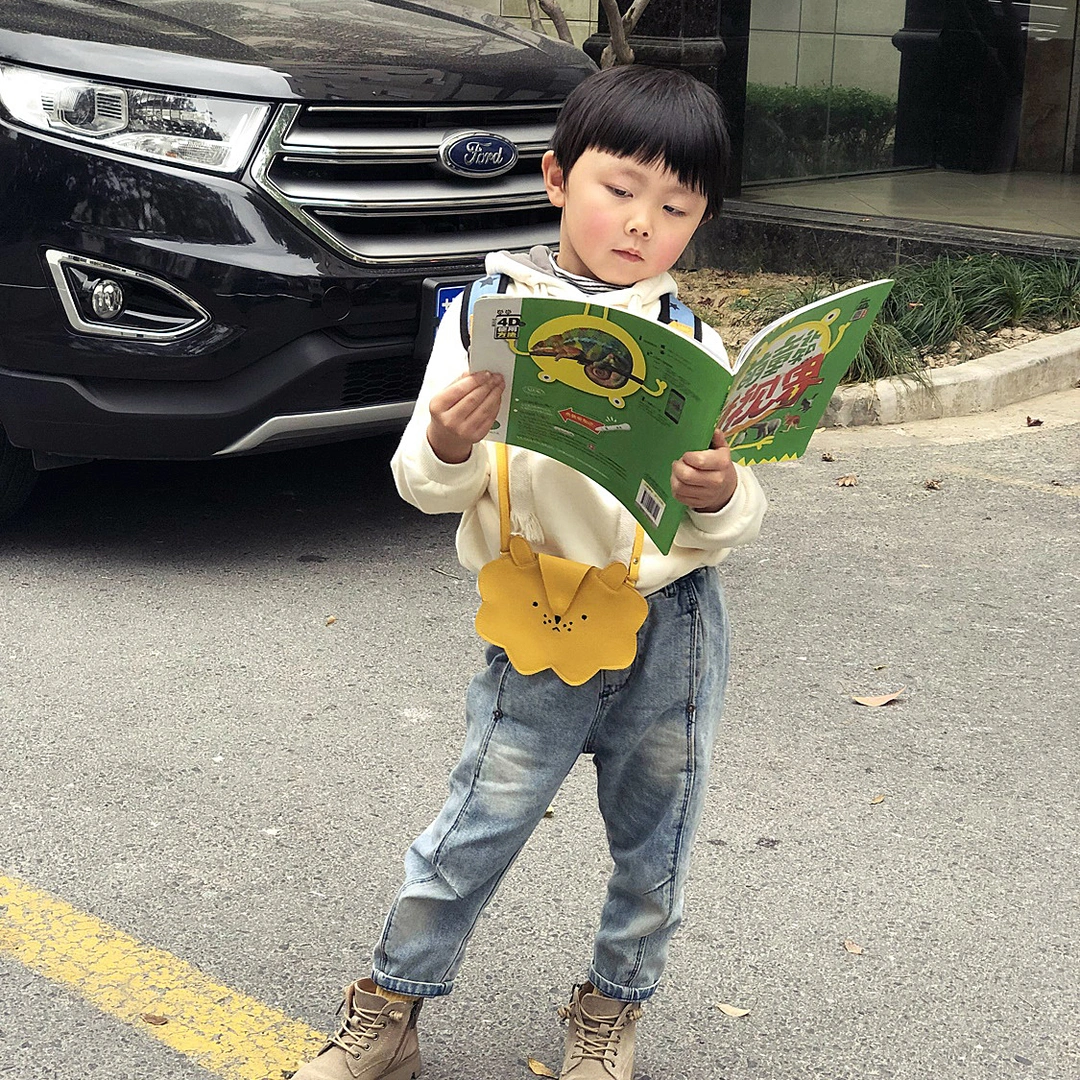
He put on his little backpack, grabbed the animal books the courier had just delivered, and dashed off to Grandpa's car. Grandpa, our designated airport escort, drove us to the airport once again, holding his beloved grandson with immense reluctance and showering him with instructions before finally letting go.
Our flight from Shanghai to Kunming was delayed. Since it wasn't a direct flight, we had to transfer in Bijie and didn't arrive in Kunming until evening. After picking up our rental car at the airport, we followed the GPS to our预订 hotel, the Guyu Hotel — located in a dense residential area, a cluster of modern apartment-style hotels. Exhausted, hungry, and tired, we had dinner at a popular barbecue place near the hotel. Back in the room, Tongtong expressed his love for the place, refusing to get out of the comfortable hanging chair.
Originally, if the flight had arrived on time, we would have headed straight to Lugu Lake — Kunming is about 500 kilometers from Lugu Lake, and we planned to stop at the halfway point, Panzhihua, for the night. But with the flight delayed, we abandoned the idea of rushing and stayed overnight in Kunming. Traveling with young and old alike, rest comes first.
Kunming: Continuing a Winter Reunion with Old Friends

Haigeng Dam: A Rendezvous with Black-headed Gulls
Early winter in Shanghai isn't cold, and early winter in Kunming is even more heartwarming. The streets are lined with green trees and blooming flowers. If not for the occasional ginkgo tree signaling the change of seasons, it would be hard to imagine it's early winter.
I never have enough time in Kunming, and this trip was no exception. My choices were clear: Haigeng Dam and Green Lake Park stand out this season. As for places like Dounan Flower Market, I'll save them for another time.
The closer we got to Haigeng Park, the harder it was to find parking. We decided to try our luck at the parking lot across from the park and were fortunate to snag a precious "gap between teeth" spot. So, the best way to get to Haigeng Park is by taxi or bus.
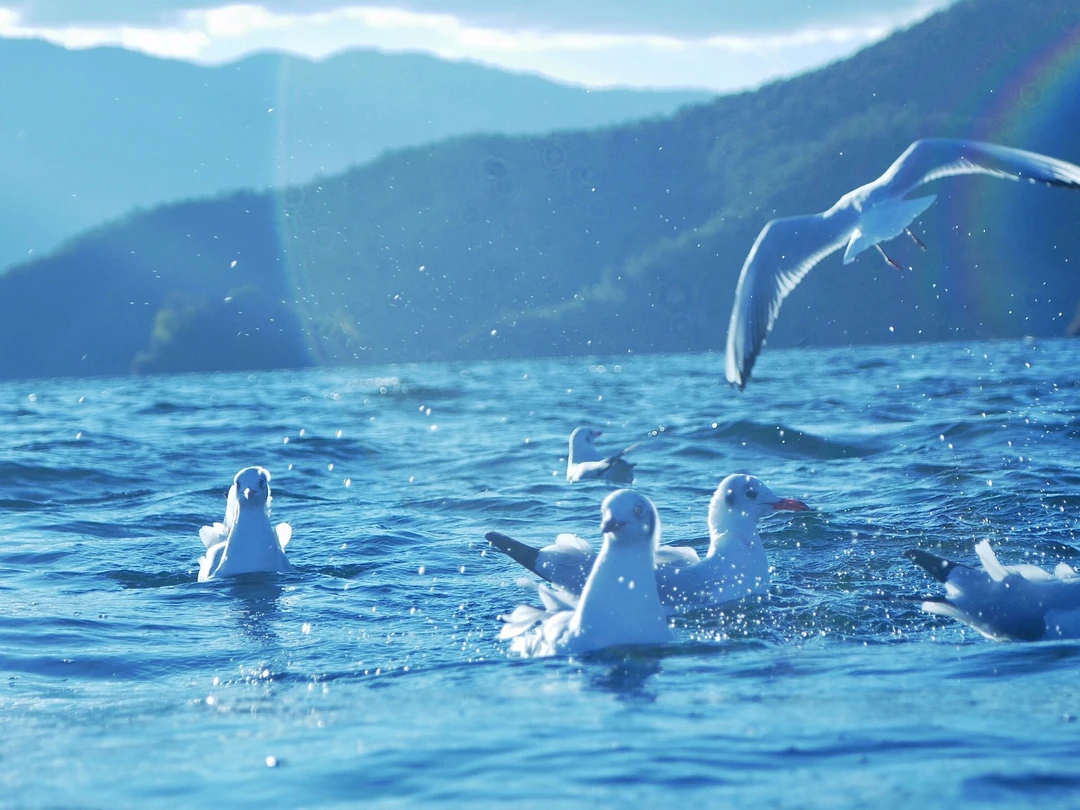
Every November, the people of Yunnan eagerly await the reunion with their "old friends." And these "old friends" have never missed their appointment in the past 34 years. We came to Yunnan at the end of November just to catch a glimpse of these aerial spirits — the black-headed gulls.
They are symbols of intelligence and resilience. Braving a arduous journey, flying thousands of miles — this tenacity and perseverance command respect. These spirits first appeared in Kunming in 1985, and their winter date with the city has continued for 34 years. From late October to the end of March each year, they can be seen in Kunming. Black-headed gulls belong to the gull family, with white feathers, black wingtips, and red beaks and feet. They resemble pigeons and are also called "water pigeons."
Most of them come from Russia, Mongolia, and China's Xinjiang region. After the breeding season, the birds follow different migration routes back to their home countries to reproduce. The black-headed gulls that winter in Kunming concentrate in busy parks in the main urban area, such as Haigeng Dam, Green Lake, and near Dianchi Lake. Their daily routines are similar to humans', which indirectly shows their dependence on human feeding.
People buy seagull feed, bread, dried fish, and other food, tossing it enthusiastically into the air. The daily feeding by different tourists and residents ensures that tens of thousands of black-headed gulls have ample food for the winter. Naturally, the business opportunities brought by the gulls aren't missed by entrepreneurs, leading to boat tours around Dianchi Lake and trips to the lake's center to feed the gulls.
After a whole morning of feeding the gulls without tiring, Tongtong was reluctant to give up any opportunity to interact with them, so we had to accompany him onto a boat. When the boat reached the center of the lake, the vendor called out to the gulls, and flock after flock gathered and circled overhead. Then, at just the right moment, he pulled out a pack of bread for ten yuan and started selling it. Having already fed away all our own bread, with a persistent child in tow, we were instantly the vendor's "captive audience." I told myself: Well, as long as Tongtong is happy. After all, you can't just conjure up a flock of gulls to feed any time.
Green Lake Park: The Boiling Life of the Common People
I'm not sure if it's due to subway construction, but Kunming's road signs and urban planning can be a bit confusing. Parking difficulties are a problem every big city faces, and Kunming is no exception. To avoid parking hassles at Green Lake Park, we left the car in a mall garage not far from the park and walked over.
The ginkgo trees on both sides of the road were at their peak, leaves transitioning from green to yellow, a mix of yellow and green adorning the streets beautifully.
Don't let the little guy's sweet smile fool you. The next second, he threw a tantrum because we refused his request to go boating. I lost my temper with him on the very first day. After cooling down, I pulled him aside and explained again: we couldn't go boating because it was too late, and we still had to hit the road that night. He came over to me and whispered, "Sorry, Mom." I patted his head, took his hand, and we made up.
Autumn parks hold the colors of all four seasons, and Green Lake Park is no exception, especially since it's a large, free park. Even before entering, we caught glimpses of colorful trees from the outside. A group of students was sketching on the opposite shore — truly a great vantage point.
Green Lake Park was originally a small bay outside the city wall of Dianchi Lake, filled with vegetable fields and rice paddies, hence its old name "Cai Haizi" (Vegetable Sea). Later, as the water level of Dianchi Lake dropped, it was cut off from the lake and became a lake of its own. Surrounded by green weeping willows and emerald waters, it became famous for its "Green Embankment Spring Dawn." Starting from the Ming Dynasty, the beautiful environment of Green Lake attracted many scholars and artists to build pavilions and towers here. Today, the numerous pavilions, terraces, and towers left in the park span multiple dynasties, complementing every tree and blade of grass.
The red brick and tiles, yellow ginkgo leaves, and green foliage create a delightful contrast. Green Lake Park in autumn is not only great for a stroll but also for photography, making it easy to find frame-worthy angles.
A special note: To find seagulls for Tongtong, I scoured almost every nook and cranny of the park without success. By afternoon, most of the gulls in the park had flown away. If you want to see gulls at Green Lake Park, you should go in the morning.
Perhaps because it was Saturday, the bustling crowd at Green Lake Park didn't deter us. Instead, it drew us in, step by step, into that world full of life's vibrant energy. We've visited many parks in Shanghai, and they're not lacking in talented middle-aged and elderly people, but compared to Green Lake Park, they fall short in both scale and variety. Along the way, I saw various interest groups: dancers, singers, martial artists, chess players, opera performers, and more. As the province with the highest number of ethnic minorities in China, Yunnan's ethnic diversity and cultural richness are vividly displayed in Green Lake Park.
We passed a folk dance group. The somewhat catchy, hypnotic melody was so immersive that newcomers could instantly join in. With simple, rhythmic steps, strangers and friends, you, me, and everyone — singing, dancing, holding hands.
Finally, a shout-out to Green Lake Park: a people's park that combines beauty and passion.
Around six in the evening, we left Green Lake Park and set off for our transfer point to Lugu Lake — Panzhihua. The entire route from Kunming to Panzhihua was on expressways, and my husband and I took turns driving through the night. I don't like driving on expressways, let alone at night, but to lighten the load for the next day, we decided to brave the darkness and reach Panzhihua. Late at night, we arrived safely at Nanshan Hotel.
The hotel's restaurant, "Lotus Pond Night," is an open-air eatery with a lotus pond and lanterns. Starving, we shivered in the cold night wind with nowhere to hide. After checking Panzhihua's annual average temperature, I finally understood why the restaurant only had outdoor seating. Never mind — a full stomach and a good drink ward off the cold. We returned to our room with bulging bellies to rest, knowing a tough battle awaited us the next day.
Panzhihua to Lugu Lake: A Grueling Journey
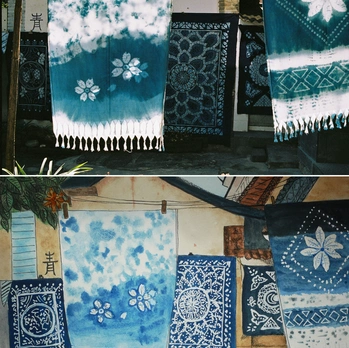
During breakfast, my mother-in-law and aunt had already struck up a conversation with some elderly guests at the hotel restaurant. From them, we learned that Nanshan Hotel houses quite a few seniors who come here to spend their retirement. One elderly couple was from Xinjiang. Because the husband's leg pain flared up every winter, their children would send them to Panzhihua for recuperation before winter set in and pick them up when spring arrived. From this, we deduced that Panzhihua is a suitable city for convalescence.
How enviable the southwest is, with no harsh winter.
Lugu Lake: The First Glimpse of Blue
The road from Panzhihua to Lugu Lake consists entirely of provincial roads with no expressway, making the journey arduous. We were constantly climbing mountains, encountering countless switchbacks and sharp turns, which managed to make my mother-in-law, who claims she never gets carsick, and my aunt, who gets sick from spinning around, throw up multiple times. For me, who never gets seasick or carsick, it wasn't a problem. Tongtong clearly inherited his mother's anti-nausea genes and was in a state of high excitement the whole way, except when he was sleeping.
It took us about six and a half hours to reach Lugu Lake. It shouldn't have taken that long, mainly for these reasons: 1. The elders kept getting carsick and vomiting, so we stopped frequently to rest. 2. We hit a medium-sized rock on the road that we couldn't avoid, and it got stuck under the car, taking a while to remove. 3. A small minivan forced its way into traffic, causing a three-car collision, and all vehicles had to queue on the mountain for about half an hour.
Still, we were quite lucky that day. It was overcast when we set out in the morning, but the moment we arrived, the sky turned a brilliant blue, and sunlight broke through the clouds.
The first sight of Lugu Lake was a blue that pierced the heart.
Lugu Lake is shared by Sichuan and Yunnan provinces, with Sichuan's portion being much larger. However, because Yunnan's tourism industry developed earlier, people often have the impression that Lugu Lake belongs to Yunnan. At an altitude of about 2,700 meters, Lugu Lake is the highest lake in Yunnan. On its shores live the Mosuo people, the only existing matrilineal society in China. The Mosuo regard Lugu Lake with the same reverence as the Chinese regard the Yellow River. They describe mountains (Gemu) and waters (Mother Lake) in female imagery, having written a vivid and enchanting culture of the "Kingdom of Women" amidst this secluded landscape of lakes and mountains for centuries.
The setting sun leaped over the mountain peaks, casting its light obliquely across the lake surface. Birds soared in the twilight.
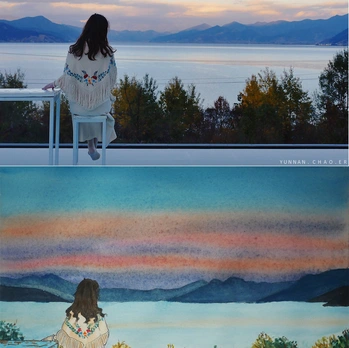
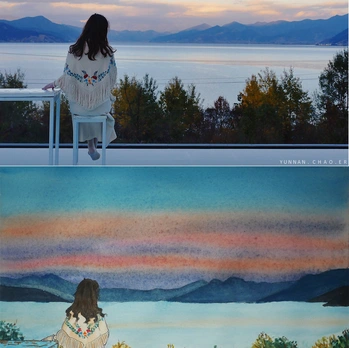
I had booked the Lugu Lake Irvine Water Luxury Resort Hotel in the village of Daluoshui, which had vacancies that night. The hotel staff member Sanqiu, who greeted us, kindly helped arrange our luggage. Although the hotel was separated from Lugu Lake by just one road, we couldn't walk directly to the lakeshore. However, the view from the room was even better.
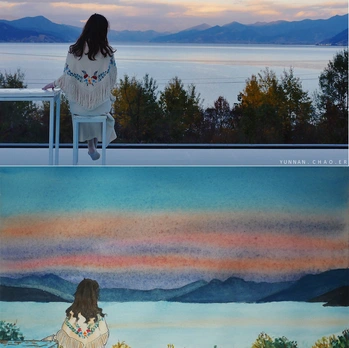
Every room in the hotel faces Lugu Lake, with the most expansive view at the "Sky Mirror." The Sky Mirror has become a must-have viewing spot for every guesthouse around Lugu Lake. It's a bit cliché, but you can still appreciate the symmetrical beauty of different times of day through the constantly changing light.
The distant mountains turned a dark blue, with colorful clouds lingering around the peaks. The lake, having lost its blue hue, shimmered with a pink glow. The leaves glittered with gold in the faint light. I just wanted to watch it all quietly until the sky was completely dark.
One night, I dreamt. You were gray-haired, saying you'd take me wandering.
The hotel's public area had a rest platform. Close to midnight, I carried my tripod and brought Tongtong out to stargaze. There, we met two young women from Guangdong who joined our stargazing group. During our conversation, I learned that the weather at Lugu Lake had been overcast for the past few days, and only this evening had they seen the sun. They lamented their bad luck and wished us continued good weather.
I brought Tongtong, who should have been sleeping, just to let him see the starry sky he can't experience in the city. I had a chance to see the stars in Xinjiang last time, but it was too cold at midnight for a young child. The mild climate of the southwest is much more friendly to stargazers. The earlier-developed Daluoshui Village isn't the best place for stargazing due to some light pollution, but we could still glimpse a faint Milky Way in the sky. Winter in the Northern Hemisphere isn't the best time to see the Milky Way, but that didn't stop Tongtong from jumping for joy at the sight of the star-filled sky.
Despite all the twists and turns, overall, the day treated us kindly.
Lugu Lake Circumnavigation: Finding the Most Beautiful Angles
Pulling back the thick curtains and sheer drapes, I found myself in a room where I could enjoy the stunning view just by lying in bed. Bliss.
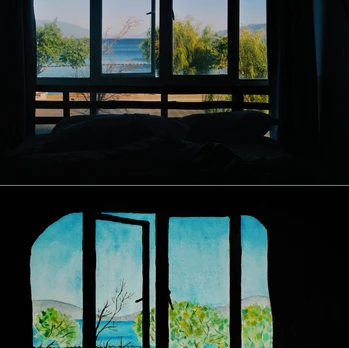
The morning low temperatures and sunlight created rising mist over the lake. This pure, ethereal scene always reminds me of Sayram Lake. A friend who traveled with me to Xinjiang in May once said that her teammates wouldn't even bother getting out of the car at Sayram Lake. When asked why, they said they didn't find it particularly beautiful, not as beautiful as Lugu Lake, which one of them had visited before. At the time, having never been to Lugu Lake, I just laughed it off. Is Sayram Lake really less beautiful than Lugu Lake? I would have to complete the circumnavigation to answer objectively.
For the Lugu Lake circumnavigation, there were no must-see spots. I followed the principle of "stop wherever it looks good," searching for beautiful angles along the way. Chartering a car or self-driving are the best ways to circle the lake, in my opinion.
We set off from Daluoshui, going clockwise, with our first stop at Lige Peninsula. On the way from Daluoshui to Lige Peninsula, we passed a viewpoint where the sky and lake were an impossibly brilliant blue. From this viewpoint, we could see layers of distant mountains and clouds wrapped around their waists.
Lover's Beach (Yunnan Side)
We skipped the small and large Yuba fishing grounds. The first place we officially stopped was Lover's Beach. Attentive readers will notice there are two Lover's Beaches on the map — one in Yunnan, where we were, and the other in Sichuan. From a photography perspective, the Yunnan Lover's Beach is better for sunrise, while the Sichuan one is better for sunset. In June, the Sichuan Lover's Beach also features the "watery and flighty" flower (a local aquatic plant, Ottelia acuminata).
It seems every place has its local myth. People use myths to express emotions and longings. Behind the Sichuan Lover's Beach lies a poignant legend — the goddess Gemu fell in love with a mortal named Houlong, but this unequal love was opposed by the gods. The gods turned Gemu and Houlong into two great mountains on the shores of Lugu Lake, forever separating the lovers with the lake, forbidding them from approaching each other. Only on the 15th day of the seventh lunar month each year were they allowed to meet at Lover's Beach.
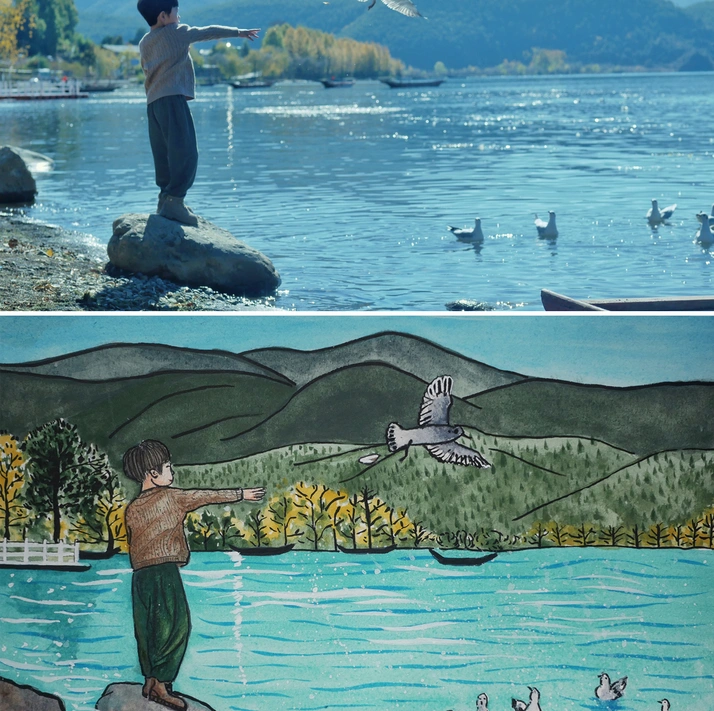
The morning sunlight danced on the lake at 9:30 AM, each touch with the water leaving a trail of sparkling stars. In the morning, many black-headed gulls circled the shore at Lover's Beach, diving into the world of light waves one after another, facing the rising sun. Compared to Haigeng Dam in Kunming, here you can get right by the lake, much closer to the gulls. These birds, unafraid of people, turned the place into a children's fairy-tale paradise. Tongtong couldn't tear himself away, once again experiencing the joy of close contact with the gulls. This joy was so powerful that for the rest of the trip, he would propose a "feed the seagulls" itinerary every single day.
Lige Peninsula
On the way to the parking lot for Lige Peninsula, we encountered a stretch of tall, golden trees. The autumn scene of golden leaves against the blue lake is one of the most captivating sights of Lugu Lake this season.
It's just a few minutes' walk from the parking lot to the lakeshore. The silhouettes of large trees and branches provide a natural foreground frame for the lake. Walking slowly along the shore, approaching the pig trough boats moored in the shallows and the shimmering golden lake surface, with the hazy mountains in the sunlight — everything we encountered and captured was the perfect expression of Lugu Lake's beauty.
In the past, pig trough boats were the essential tools for the Mosuo people living around Lugu Lake for fishing and the "walking marriage" custom. People relied on these boats for fishing and labor, setting out at sunrise and returning at sunset. These boats, imbued with the imprint of Mosuo life, have become a symbol of their culture. The old pig trough boats were actually made from a single, thick, round log with both ends sharpened, shaped like a pig trough, hence the name. They had a simple and clumsy appearance. The pig trough boats we see today are painted in all sorts of bright colors, having lost their original charm.
A few pairs of black-headed gulls rested on the pig trough boats, carefree in the gentle sunlight. The chattering light spots created the most brilliant backdrop, forming another set of iconic images. The lake water was crystal clear, with aquatic plants swaying with the current, like a head of hair flowing in the water.
The little boy, picking up stones by the water's edge, lingered for a long time. Tongtong is a child who loves nature. He never refuses it and always manages to find his own joy in it.
After wandering around, walking from the high point to the tip of Lige Peninsula, I noticed that the few guesthouses on the peninsula have excellent locations, truly offering lake-view rooms by the water. I consider it one of the best choices for lakeside accommodation during this circumnavigation.
Lige Peninsula exists as the iconic representative of Lugu Lake, bearing a great reputation and enjoying unique favor. All this has meant the end of the quiet, primitive Lige Peninsula. The same fate befalls every hidden paradise when it connects with the outside world — flights arrive, roads are built, locals stop farming and fishing, and everyone seems to be doing the same things, all thinking about how to use the gifts of nature to make more money. The commercialization of Lugu Lake has inevitably arrived. Improving living conditions is understandable. I only hope that everyone who visits Lugu Lake will take their trash with them, and that the park management will effectively control pollution, protecting the lake water from further contamination, so that we can still have a clear Lugu Lake.
Viewing Lige Peninsula from the opposite shore, the narrowest part in the middle of the lake is only about 2 meters wide. From a drone's aerial perspective, this causeway island looks like a teardrop. To get a bird's-eye view of Lige Peninsula, you can climb to the viewpoint on the peninsula, or if you don't want to hike, you can photograph it from the roadside.
Dayuba Fishing Ground and the Golden Forest
We didn't continue the circumnavigation right away. The elders were hungry and tired, and it was approaching midday with harsh lighting, no longer good for photography. So we turned back, first heading to the Daluoshui parking lot for lunch, then returning to the hotel for an afternoon nap.
On the way back, we spotted a golden forest from afar, located in the woods to the right of the Dayuba scenic area.
From around mid-to-late October, Lugu Lake enters its most colorful season of the year. The weather is mostly sunny with little rain, bringing a brilliant blue sky and turquoise lake, while the trees are tinged with autumn colors. This rich palette should last until early December. From my observations, I found that the best viewing period for the lakeside forests is a bit earlier than in the villages, probably around mid-November. The end of November still offers good viewing, but the leaves by the lake were already showing signs of withering as temperatures dropped.
While playing, Tongtong picked a small wildflower from the bushes, saying it was for his mother. I carefully held the little yellow flower, almost shedding tears of joy... haha.
The deserted Dayuba area has wide, unobstructed open spaces, perfect for flying a drone. A great spot to see Lugu Lake from above.
We had lunch at the "Taste of Lugu Lake" eco-restaurant near the Daluoshui parking lot. The atmosphere was very elegant, the dishes were a bit pricey, but the taste was excellent. The elders' favorite dish was called "Shuǐxìng Yánghuā" (literally "watery and flighty flower," referring to Ottelia acuminata). This became a dish we ordered at almost every meal in Lugu Lake — it looks like kelp, has a texture that's both crunchy and soft, and tastes great whether in soup or stir-fried.
"Shuǐxìng Yánghuā" is just a touristy nickname. The plant's real name is Ottelia acuminata, and it has extremely high requirements for water quality. Even slight pollution can kill the entire plant. It is a wild plant unique to China, mainly distributed in lakes in the Yunnan-Guizhou region. Like other plants, Ottelia acuminata needs photosynthesis to grow, so the clear waters of Lugu Lake provide a suitable environment. When water is polluted, algae grow rampant, blocking normal photosynthesis. Once endangered, the Ottelia acuminata in Lugu Lake now faces two main threats: over-harvesting by humans and increasing pollution from construction. I hope people can find a balance between maintaining the species population and satisfying their appetites.
Back at the hotel, the elders took a nap. I bought a milk tea from the only tea shop in the village, lay on the bed, and greedily savored the wonderful feeling of milk tea and sunshine, while also teasing my colleagues who were currently at work. In retaliation, those guys had already started counting down the days until I went home!
This season, sunset at Lugu Lake is around 7 PM. Around 4 PM, we set out again to circle the lake, this time counter-clockwise. On the county road 023 heading to Miwa Pier, we encountered a stretch of golden forest stretching about 2 kilometers. I was completely defenseless against it.
Tongtong kept pestering us, reminding us not to forget to find a place for him to feed the seagulls. Just as the best light was approaching, the Mosuo people waiting at Wuzhiluo Pier called out to us...
Epilogue: The Yunnan Blue Dream, To Be Continued
Three trips to Yunnan, spanning a decade. From the impulsive college student in 2009 to the mother revisiting with her five-year-old son, Yunnan has witnessed the most important growth and changes in my life.
Those blues in my memory — the blue sky of Kunming, the blue waters of Lugu Lake, the arcs traced by the wings of black-headed gulls — are like unfading paintings, treasured deep in my heart. And this time, I brought Tongtong, passing on this blue to the next generation.
What Yunnan has taught me goes beyond the meaning of travel. It has shown me that some beauties are worth waiting for, and some promises are worth keeping. Like the black-headed gulls that return year after year without fail, like the friends scattered across the world who have never truly left.
Life may not always be smooth sailing, but as long as we have light in our hearts and a path under our feet, we will surely find our own piece of Yunnan blue.
Practical Tips: - Best Season: November to March. Kunming and Lugu Lake have clear weather, ideal for bird watching and autumn scenery. - Transportation Advice: The self-drive from Kunming to Lugu Lake takes about 6-7 hours. It's recommended to stop and rest in Panzhihua. - Accommodation Recommendation: The lakeside guesthouses on Lige Peninsula in Lugu Lake offer the best views but are more expensive. - Must-Do Experiences: Feed the black-headed gulls (best in the morning), self-drive around the lake, stargaze (avoid light-polluted areas). - Food Recommendations: "Shuǐxìng Yánghuā" (Ottelia acuminata), Lugu Lake grilled fish.
May everyone who comes to Yunnan bask in the winter sun and chase the Yunnan blue all the way.
You should also read:
Escaping Nanning, Falling Under Lijiang's Spell: Our Four-Person, Ten-Day Yunnan Dream
Escaping Nanning, Falling Under Lijiang's Spell: Our Four-Person, Ten-Day Yunnan Dream Before We Set Off: No Pain, No Obsession Have you ever had that impulse—suddenly tired of the office fluorescent lights, the crush of the subway, the endless parade of identical takeout boxes, and just…
Continue reading...
Solo in Yunnan: A Wanderer’s Guide to the Land of Eternal Spring
Solo in Yunnan: A Wanderer’s Guide to the Land of Eternal Spring There’s something magical about traveling alone. No compromises, no schedules to keep, no one to please but yourself. I’ve been on the road for nearly three months now, and not once have I…
Continue reading...
God’s Abandoned Palette: A Self-Drive Journey Through Yunnan’s Dongchuan Red Land
God’s Abandoned Palette: A Self-Drive Journey Through Yunnan’s Dongchuan Red Land Travel has never been about reaching some distant geographic coordinate. It’s about encountering, along the way, the version of yourself buried beneath the rubble of daily routine. During this May Day holiday, I finally…
Continue reading...