Chasing the Sun and Moon in Our Hearts – A 10-Day Yunnan Road Trip in the Rain (Shaxi, Lijiang, Shangri-La)
Chasing the Sun and Moon in Our Hearts – A 10-Day Yunnan Road Trip in the Rain (Shaxi, Lijiang, Shangri-La)
Destination: Yunnan
Travel Dates: June 6, 2022 · 10 Days
Cost per Person (CNY): [Not specified in source]
Travel Companions: Friends
Our Story Begins in Dali, Yunnan
Hello everyone! It's Lulufei, the travel enthusiast who loves to write travelogues, back again!
There are actually two big travel stories sitting in my draft folder waiting to be finished, but with my slight procrastination habit, I'm now eager to share this Shangri-La journey with you instead. I hope my account can offer some small help to those planning trips to Lijiang and Shangri-La.
By June 2022, Xiao Geng and I had already been living in Dali for three months. We'd witnessed Dali's romantic "wind, flowers, snow, and moon" and experienced the rich tapestry of life here. When many people told us that June is the most beautiful time in Shangri-La—with azaleas blooming everywhere, sacred mountains to admire, alpine meadows, lakes, stunning scenery, and herds of cattle and sheep—we simply couldn't contain ourselves. It seemed to have everything our imaginations could conjure.
They say Dali is a magical place where you constantly meet new friends. The two companions who joined us on this trip were people we clicked with instantly in Dali, and we decided to embark on this journey together. Their addition brought even more joy to our road trip!
So in early June, the four of us began our own story, setting out to find the most beautiful Shangri-La.
👧 Jun Jun: A level-10 landscape enthusiast from Shenzhen, a southern girl with long legs.
👧 Qing Qing: A social butterfly from Chengdu, a happy girl who makes sure you never feel lonely.
👧 Me: A Sichuan girl who breaks away from conventional life and bravely pursues love!
👧 Xiao Geng: My travel companion for every trip, driver and photographer, the incredibly capable and cool girl in my eyes.
Plans Change on the Fly – Why "Traveling in the Rain"?
First, let's look at our planned itinerary versus the actual one.
Before departure, we checked the weather forecast, which showed prolonged rain. But as travelers, we clung to a sliver of hope—we all know how unpredictable Yunnan's weather can be. Maybe we'd get lucky with sunny days. But reality slapped us hard. From the very start, at our first stop in Shaxi, the long stretch of cloudy and rainy weather began.
Because of the bad weather and unfamiliar road conditions, our trip was cut from 15 days to 10. We missed out on the most important destinations—Meili Snow Mountain and Lugu Lake—leaving us with regrets.
But every journey has its regrets, which become expectations for the next time. So let's pull ourselves together and reminisce about the beauty and surprises of this rainy trip.
Unforgettable Moments
Every trip has a few surprising moments.
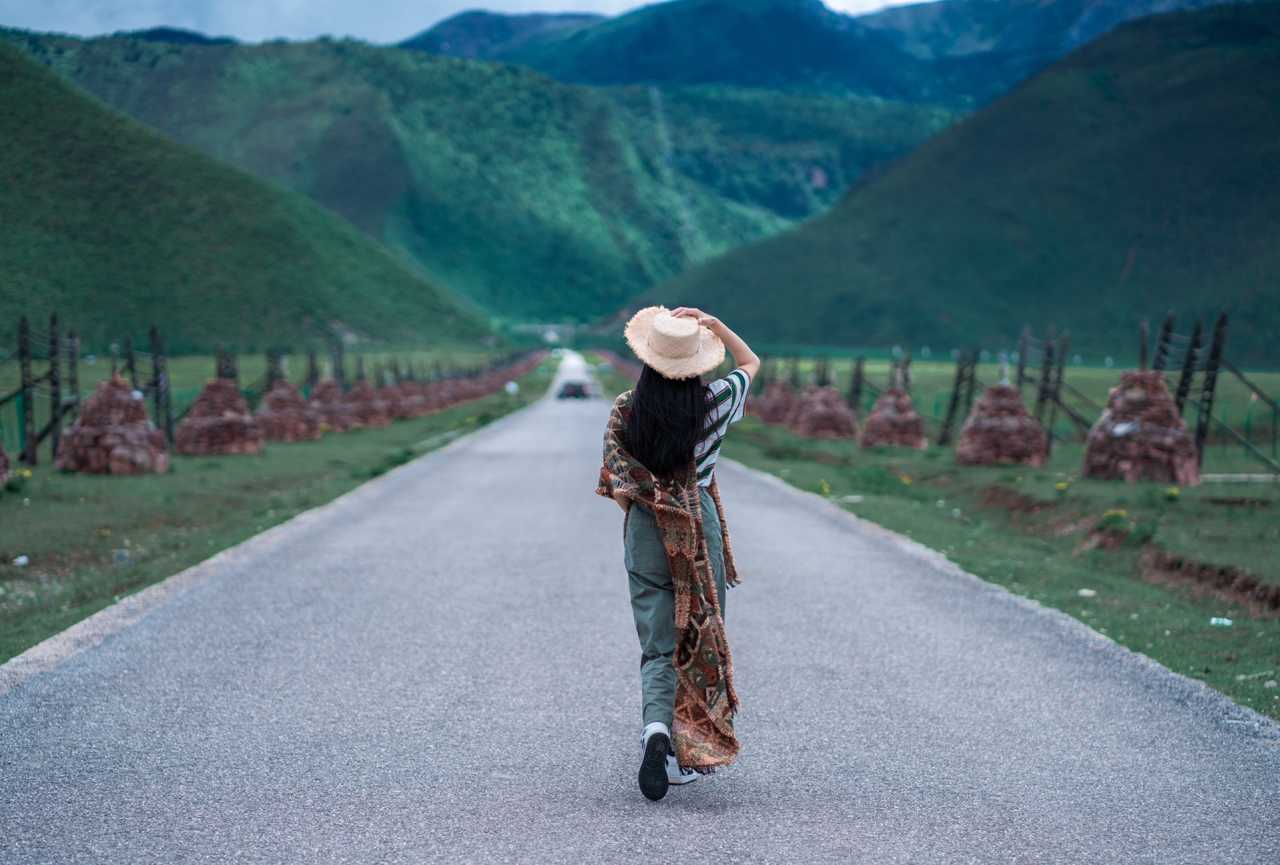
During our few days in Shangri-La, we visited Napahai Lake twice. The first time we circled the lake in heavy rain, unable to get out of the car the entire time. So on the day we left, unwilling to give up, we went back to Napahai. The regret of the first time led to the surprise of the second. Under a half-clear sky, this road stretched straight into the distance, and the grasslands and mountains brought us endless joy.
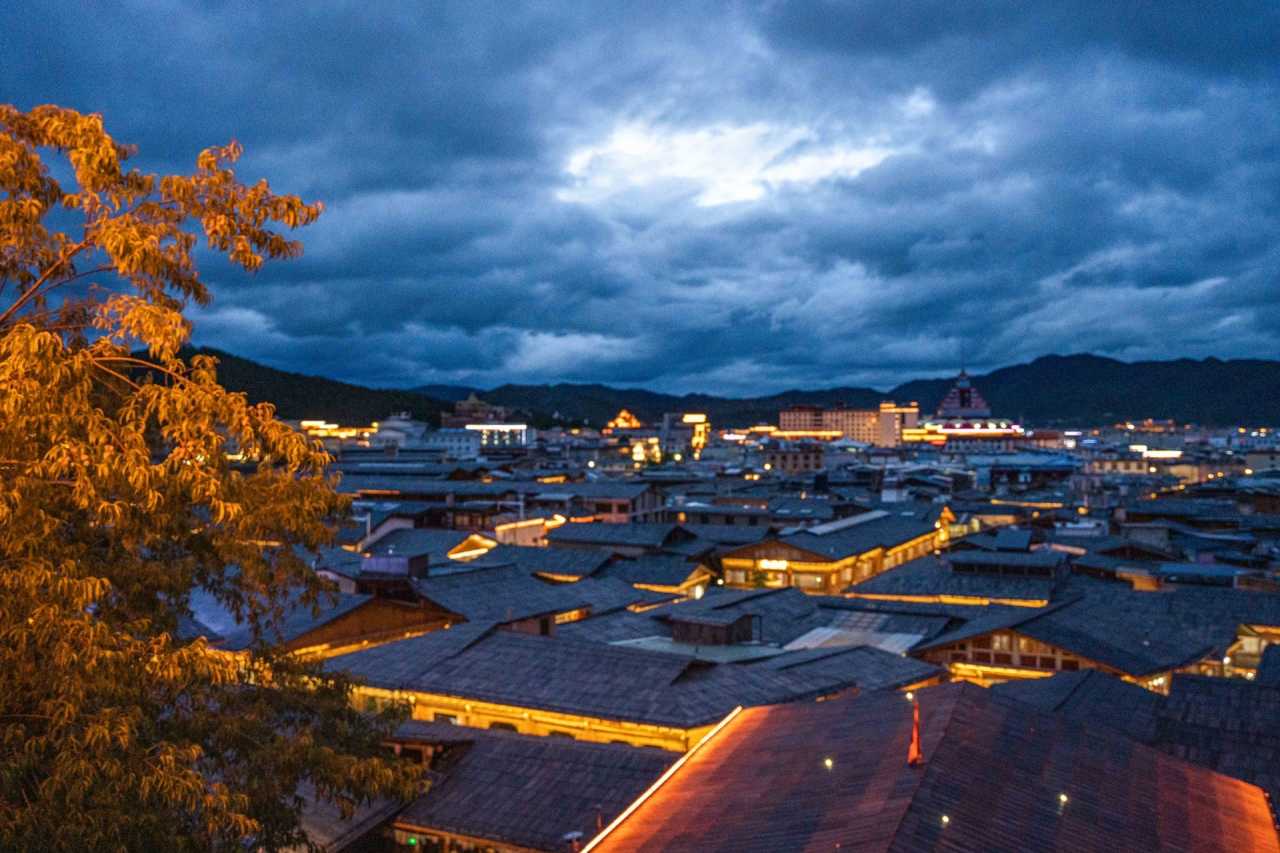
The night view of Dukezong Ancient Town wasn't the most beautiful, but it left a deep impression. On our first day in Dukezong, Qing Qing, Jun Jun, and Xiao Geng were all experiencing varying degrees of fatigue and altitude sickness, so they stayed in the hotel to rest. I was the only one who went out to explore the ancient town. Without a destination or a schedule, I climbed to the highest point, Guishan Park, at night. Under the dark sky, thick black clouds covered the heavens and the earth, but a single beam of moonlight pierced through the clouds, as if punching a hole in the sky. It was incredibly surreal.
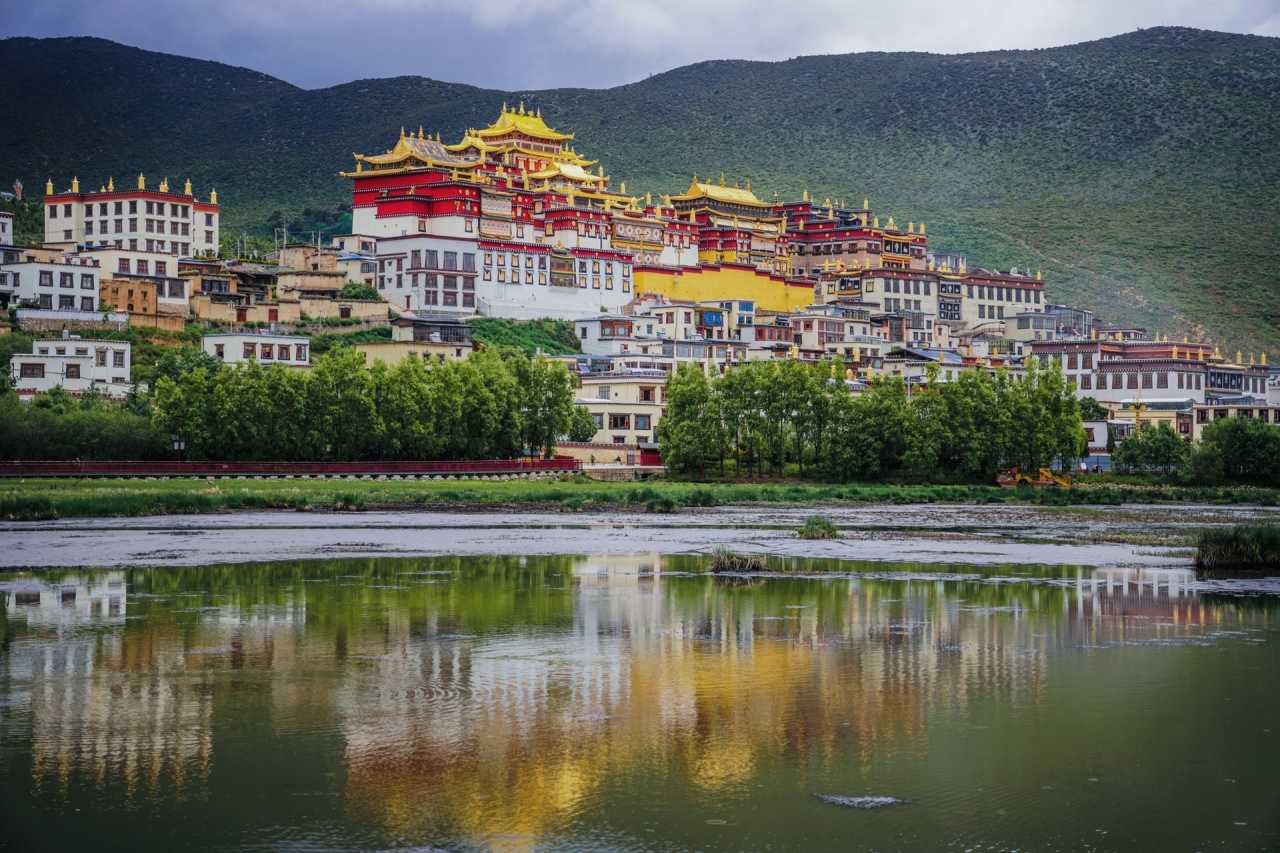
Unable to escape the rain curse, we went to the wooden boardwalk at Lamayangcuo Lake before visiting Songzanlin Monastery. We encountered construction and the dry season. Just as we were about to lose hope, we still found a spot where reflections appeared.
Only here could we get a glimpse of this magnificent Tibetan Buddhist monastery, the largest in Yunnan, built into the mountainside. Its layered layout, majestic grandeur, and the beauty of Tibetan architectural art all left a deep impression on me.
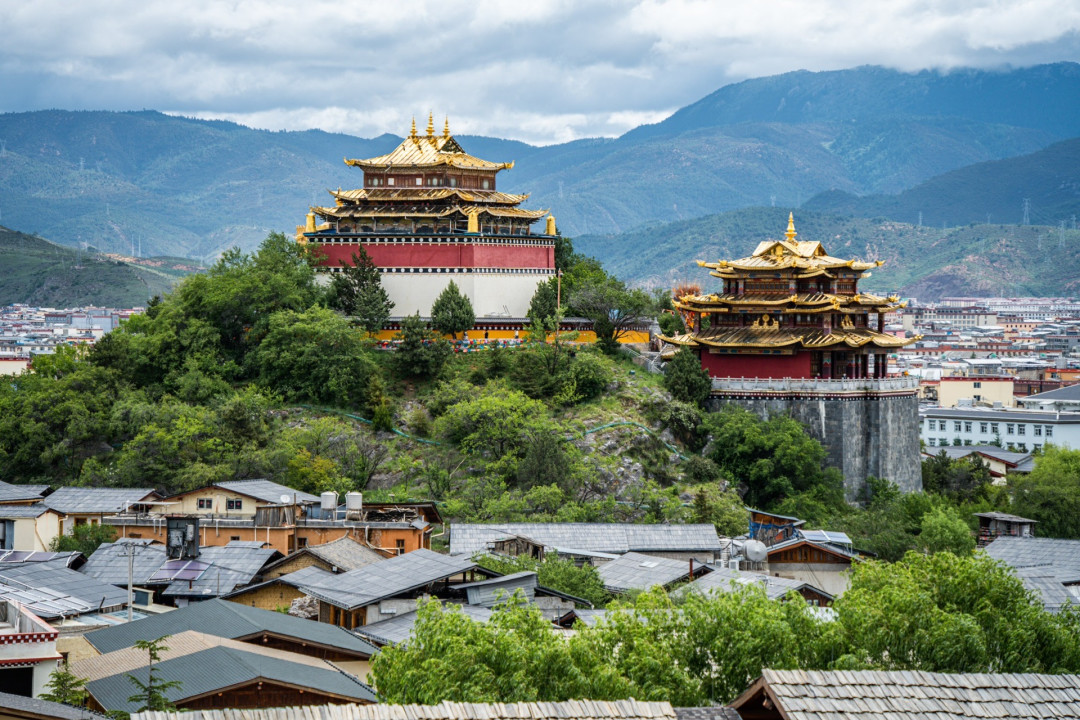
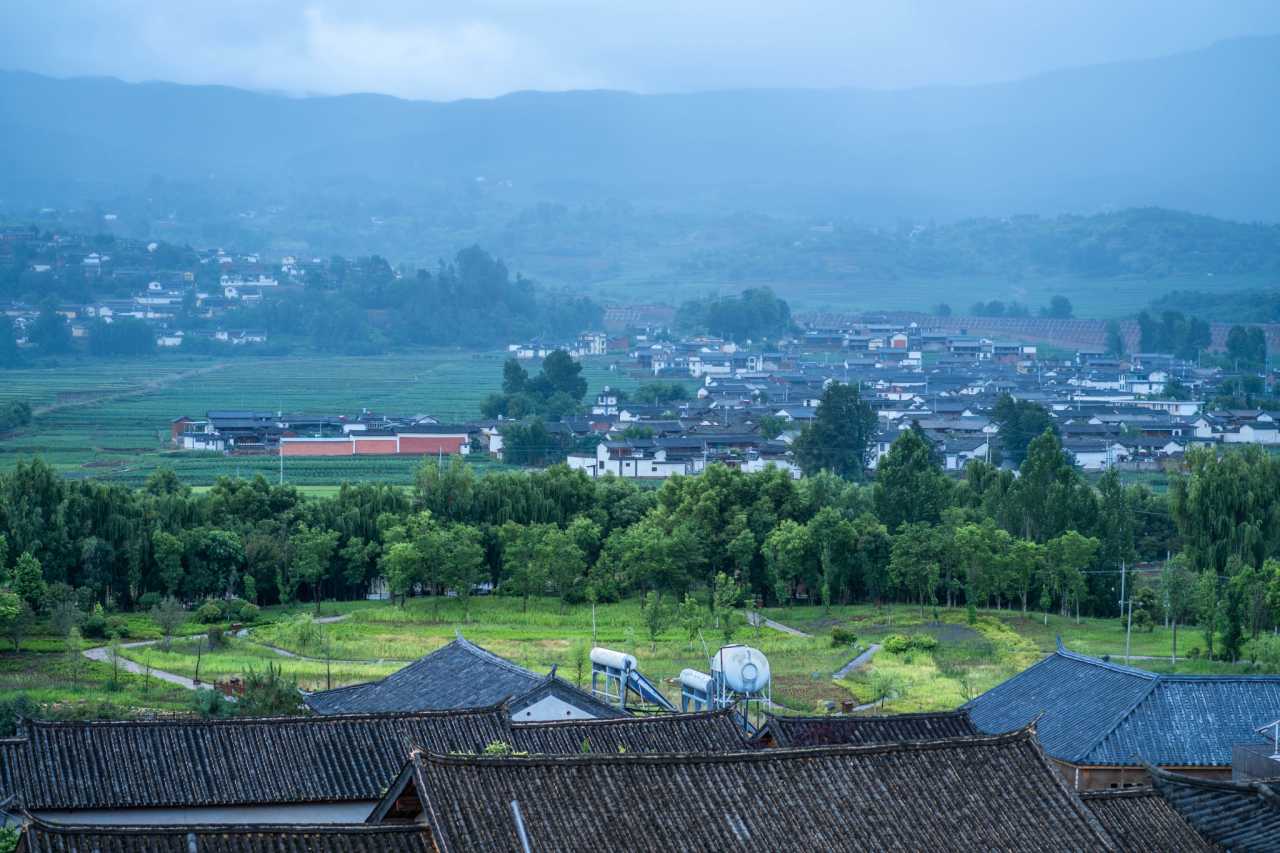
During our two days in Shaxi, the rain came and went intermittently. We found a café on higher ground in the ancient town, both to take shelter from the rain and to enjoy the view.
Xiao Geng and I had actually visited this ancient town before. On our first visit, we saw the picturesque landscape. For Jun Jun and Qing Qing, it was their first time. Aside from the time spent sheltering from the rain, this was our most comfortable moment. Below us were small Bai-style houses; in the distance, a village at the foot of the mountain and peaks that appeared and disappeared through the mist. Standing there, we were left with nothing but silence and complete relaxation.

They say the best scenery is on the road, and the stretch from Lijiang to Shangri-La was truly surprising. Alpine meadows, wildflowers everywhere, villages and terraced fields—at least for Xiao Geng and me, it was a real delight. Along the way, we passed the Haba Snow Mountain viewing platform at an altitude of 3,068 meters.
We still couldn't see the snowy mountain, but the village hidden in the mountains and the layered farmlands were what I really loved.
For all of us, it was our first time in Lijiang, so we were full of curiosity about Dayan Ancient Town. Before finding the best spot to overlook the ancient town, we had already climbed stairs for an hour. The ancient town's streets are all uneven stone slabs, slippery in the rain. We trudged through the drizzle, both joyful and disheveled. So when we finally sat down, we were genuinely happy. The view from halfway up the mountain was refreshing.
After about an hour, I noticed a patch of clear sky on the horizon—just one small corner. It perfectly illustrated the saying, "Yunnan has eighteen oddities, one of which is rain in the east and shine in the west."
In the past, Xiao Geng always took photos of me. But ever since I learned photography, I've been the one behind the camera more often!
In Baisha Ancient Town, it was the same—rain with a hint of sun. The three of us ran into a small post office shop, and I captured this moment of "Sending a Letter to Your Future Self." I hope we can always stay happy!
Longnu Lake in Yuhu Village was a place we had been longing to visit. Legend has it that this is the "last pure land" of Lijiang—a healing, ancient village with snowy mountains, a lake, and grasslands.
That day, braving the fierce wind and rain, I managed to take a few shots with my camera, capturing one landscape I really liked. The distant snowy mountain had already lost its snow, with misty peaks and swirling clouds, presenting a different kind of artistic conception.
When in Shangri-La, you should try being a Zhuoma (a Tibetan girl) for a day and wear Tibetan clothing for photos. After changing clothes and putting on makeup, everyone said I looked just like a Tibetan girl. It was the best souvenir for our 10th anniversary!
How could you visit Shangri-La without trying yak meat? In Dukezong, when it rained, the temperature dropped. We were shivering in the teens (Celsius). That's when a hot pot was just what we needed to warm our hearts and stomachs! Big chunks of beef with a bold flavor—our first yak hot pot was absolutely delicious!
Dali Chapter
During our time living in Dali, Xiao Geng and I truly experienced what Dali's slow life is all about. Dali has many stories, and its scenery is beautiful. The song "Go to Dali" once drew countless people here, and many have given their poetry and distant dreams to this place. For the four of us girls, we all arrived in Dali at different times this year but became good friends.
Because we had plenty of time, we savored Dali's beauty slowly. Before setting off for Shaxi, Xiao Geng and I took a trip around Erhai Lake.
You have to go and feel the wind of Erhai Lake – The Erhai Lake Journey
Facing Erhai Lake, enjoying the sea breeze, under the trellis bridge is one of my favorite spots. The "Couple Trees" at Haishuo Park have witnessed many people's love stories. In Shuanglang Ancient Town, spread your arms and welcome the oncoming sea breeze. On Luwo Mountain, overlook Erhai Lake and enjoy freedom. Wenbi Village is a truly niche spot, with a view of Erhai Lake from halfway up the mountain. The unforgettable sunrise and seagulls at Longkan Pier. The exotic charm of Ideal Village in Dali.
All of these are the beautiful memories Erhai Lake has left me. This is the beginning of a dream about wind, flowers, snow, and moon. Some people fly thousands of miles just to meet Erhai Lake. So come to the shores of Erhai and feel the breeze. Let your heart dance with the wind, and let the wind blow away your worries.
The Beauty Lies in "Stillness" – Shaxi Ancient Town
Located between Dali and Lijiang, Shaxi Ancient Town was our planned stopover for just one day. But the continuous heavy rain made the mountain roads slippery. For safety, we stayed an extra night, which gave us more time to explore this ancient town.
Xiao Geng and I had already visited Shaxi back in April this year. As the only surviving ancient market town on the Tea Horse Road, its "uniqueness" makes it feel unmissable. Shaxi Ancient Town is quiet, simple, ancient, and leisurely—that's why we fell in love with it back then.
It retains many ancient marks: the ancient stage, ancient shops, ancient lanes, ancient village gates, all bearing traces of the Ming Dynasty horse caravans.
This is a photo I took of the ancient stage in April. When we came in June, the century-old tree in front of the stage was lush with foliage. After the heavy rain passed, I came here alone, sat on the stone steps. There were very few pedestrians on Sideng Street. The ancient stage felt even more silent at that moment. I actually really enjoyed that quiet feeling. I wondered if this was how Shaxi was meant to be?
As time passes, these ancient buildings haven't been buried by the wind and rain—that alone deserves our admiration.
Grandma Arui's shop is right next to the ancient stage. The shop is full of handmade items by the grandmother. Luckily, I went in last time and even chatted with her. Unfortunately, Grandma Arui's shop wasn't open this time.
Around 6 PM, the rain finally eased. If you were in Shaxi at this time, you might feel a different sensation—a feeling of traveling back in time. Walking through these alleys, it felt like I was the only one there. It was so quiet that even the shop owners were nowhere to be seen. After the heavy rain, the bluestone paths were slippery and difficult to walk on, and the eaves were still dripping with raindrops. Slowly, a few shops opened, and pedestrians who had been waiting for a long time emerged.
Because the streets of Shaxi Ancient Town are so ancient and artistic, everything looks good in photos. In the evening, the sound of singing began to drift from small taverns, bringing a touch of vitality to the ancient town.

In Dali or Shaxi, locals really like to use bamboo baskets for shopping. On market days, it gets truly lively. I looked up inadvertently and saw a patch of dark clouds clearing on the horizon, revealing a stretch of blue sky. My mood instantly improved!
The first time I came to the East Gate, someone was painting. Although both are forms of recording, pressing the shutter on a camera takes a second, while painting takes a long time. We each use our own way to remember Shaxi's stories.
At that time, the Heihui River was as smooth as a mirror. The semicircular reflection of the Yujin Bridge formed a complete circle. I remember there wasn't as much water then, and we could go down to take photos. It was incredibly beautiful. On clear days, the distant mountain peaks were clearly visible, and together with the reflections in the water, they formed picturesque landscapes.
After the storm, the Heihui River looked like this: murky and turbulent, floating debris from upstream. At first, I was disappointed by the unclear water and gray sky. But as I stood on the bridge for a while, I began to feel differently. The distant, ethereal thin clouds were ever-changing, while the nearby river flowed swiftly. These different scenes all belong to Shaxi.
Xiao Geng wasn't feeling well, so she spent most of our two days in Shaxi resting. Jun Jun and I, however, couldn't stay still. We took our umbrellas and cameras and walked around Shaxi village—a kind of aimless wandering. We left the village and headed into the fields. I remember when I was young, I only wanted to go to big cities, loved skyscrapers and bustling streets. But after growing up and struggling in the city for a few years, I've come to prefer this simple pastoral life.
Jun Jun and I are both flower lovers. Passing by a guesthouse entrance, we saw the remaining few roses, lonely yet beautiful. We really liked them; there was a kind of poetic, tranquil beauty.
The next day, it was still raining in Shaxi. The distant views were still hazy and beautiful. Some might find it ordinary, others a fairyland on earth. We deliberately found a café on higher ground, hidden in the backyard of a guesthouse. When I stood at the highest point and looked out, this was the very definition of peaceful times. It reminded me of last year's trip to Yubu Miao Village in Liuzhou, where I saw the same quiet, simple village.
A cup of coffee, a book, a gentle breeze—it was so comfortable, a perfect way to experience Shaxi's tranquility and beauty.
Of course, we had to take photos to remember the moment. Some places you might only visit once, so I asked Jun Jun to pose for a background shot.
Shaxi Ancient Town was once an important post station on the Tea Horse Road. Although the horse caravan culture has long since faded from the stage, many cultural relics of the Tea Horse Road remain. Compared to Dali and Lijiang, it's truly quiet here. I think people who love Shaxi love it for its ancient houses, natural scenery, and its plain, quiet goodness.
Lijiang Chapter

Before coming to Lijiang, some praised it as a fairyland, others scoffed at it. These mixed voices gave us both expectations and concerns about Lijiang.
Lijiang Ancient City actually consists of three parts: Dayan Ancient Town, Shuhe Ancient Town, and Baisha Ancient Town. Lijiang Ancient City, also known as Dayan Town, is located in the middle of the Lijiang Basin. It is the only ancient city among China's historical and cultural cities without city walls. Legend has it that because the hereditary ruler of Lijiang was surnamed Mu (木), building a wall would trap the "Mu" character inside a frame, forming the character "kun" (困), meaning "to trap." I wouldn't have known this if I hadn't been told, but when we arrived, we indeed found no city walls!
Our first stop in Lijiang was, naturally, Dayan Ancient Town.
Happiness Comes from "Prosperity" – Dayan Ancient Town
When you walk inside Dayan Ancient Town, you might not realize how big it is. But when you climb Lion Hill and look down, you can truly feel the grandeur of this historically rich ancient city!
Arriving in Lijiang was joyful. Even asking someone to film a short video for us was fun. Girls didn't want to, couples didn't want to, kids didn't want to. Finally, a young guy agreed.
To capture the layered panorama of the ancient city, the best spots are almost all occupied by bars and guesthouses. This photo was taken from the viewing platform of a café. Surrounded by green mountains on all sides, the tiled roofs of the ancient city were arranged in a pleasingly irregular yet orderly pattern.
Our arrival in Lijiang was also greeted by a heavy downpour. We had just ducked into a bookstore when the rain poured down outside. While browsing the bookstore, I saw a book titled "Views of Jade Dragon Snow Mountain." Little did I know that this would be as close as we'd get to it—we later had to cancel our trip to Jade Dragon Snow Mountain due to bad weather.
This Dayan Ancient Town feels magical. As you wander through the streets and alleys, you realize that every inch of land here is used to its fullest. Built into the mountainside, the ancient town is beautifully layered. You never know which corner you'll turn to find a courtyard full of flowers, making you stop to take photos.
The roads in the ancient town are all uneven stone slabs. Climbing the hills gave me a strange feeling of being in Chongqing. But the difference is that Dayan Ancient Town has both the charm of a mountain city and the appeal of a water town, with a simple, natural, and historically rich atmosphere. Sifang Street, the Big Waterwheel, Wangu Tower—these are all iconic landmarks. The ancient town is crisscrossed by gurgling streams, with willows on the banks and flowers everywhere. The narrow waterways run through every street and lane, winding around houses, as if constantly telling the story of the city's changes.
The long alleys paved with bluestone, with faint traces of cooking smoke—this is the real Lijiang Ancient City.
Inside the ancient town, you can only walk. So you often see people carrying heavy goods up and down the hills, truly bearing heavy burdens.
The café was quite quiet in the afternoon, but the resident singer was very good. A cup of coffee, a wide view, the fresh voice of the young singer—even though the prices weren't low, the four of us were very happy!
I wonder how many people, like me, come here just to take photos. The young man in the café was playing and singing, and the four of us were the atmosphere group!
Since leaving Shaxi, we seemed to have developed a habit of wanting to stand on high ground and look out. Opposite Lion Hill, there's another high point called "Lijiang's Eye."
From the viewing platform of "Lijiang's Eye," the view wasn't as good as from Wangu Tower. Maybe it was because of the bad weather, but the sky had lost its color, a uniform gray.
The next morning, there was a small surprise. The sky had cleared up. Under the blue sky and white clouds, the ancient town looked fresh and transparent. This was one of the few sunny moments we had.
Under the blue sky and white clouds, Dayan Ancient Town began another day. No noise or clamor, just an ancient, quiet city full of poetry and romance.
Many people say that mature commercialization has eroded Lijiang's tranquility. But Lijiang's success has set an example for many other places. This development model, where "culture finds money in tourism, and tourism finds its path in culture," seems inevitable. As a traveler, I rarely think deeply about the ultimate pros and cons of commercialization. What I think about more is the convenience and comfort we can enjoy in the present.
The ancient town truly comes alive at night. The sound of music rises from the bars, crowds flow through the streets, and the colorful lights of "wine and luxury" create a scene of prosperity. Most people come out to find their fun at this time. There's a joke: "One person goes to Lijiang, two people go to Dali." That captures the idea.
Under the small bridges of the ancient town, the water flows gently. At night, various bars light up with neon signs, filled with laughter and song, a scene of bustling activity.
This ancient city, with over 800 years of history, has been eroded by the passage of time and over-commercialization, losing some of its historical traces. It now presents itself to us in a vibrant, prosperous form.
I think no matter how its form changes, Dayan Ancient Town still tells the stories of its vicissitudes and experiences.
When we returned to Lijiang from Shangri-La, we had originally planned to visit Lugu Lake and Jade Dragon Snow Mountain. But the weather simply didn't cooperate. In the end, we didn't go to either, which actually gave us two extra days in Lijiang. Now, there are fewer touts in the ancient town, and the chaos in the scenic areas has subsided. Everything is moving in a positive direction. Just like the feeling the ancient town gave me, its happiness comes from its prosperity!
Simplicity Comes from "Oldness" – Baisha Ancient Town
Unlike the crowds, noise, and bustle of Lijiang Ancient City, Baisha, located north of Lijiang city at the foot of Jade Dragon Snow Mountain, is Lijiang's most Naxi-style thousand-year-old ancient town. It was also where the great traveler Xu Xiake once stopped to discuss poetry and philosophy. This simple, quiet little town was once the capital of the Naxi people and their earliest political, economic, and cultural center. It's an important part of the Lijiang World Heritage Site.
The archway inscribed with "Baisha" is the town's landmark. From here, you can also see the snow mountain in the distance. But that day, the sky was overcast, and we missed the snow mountain again.
Baisha Ancient Town feels like a hidden paradise at the foot of the mountain. It's unique and beautiful, with a strong local culture, peaceful and serene. The occasional bark of a dog or chirp of a bird adds life to the tranquility.
People say that the shopkeepers here are more laid-back. They're not just trying to make money; they open their shops to live here. The streets have shops selling copperware, jewelry, textiles, embroidery, and tie-dye. But you can barely see anyone in them.
Occasionally, you see elderly people in traditional Naxi clothing slowly setting up their stalls.
Baisha Ancient Town gives a feeling of unhurried, tranquil daily life, which is the poetry and distant dreams in a traveler's eyes. I once read someone who grew up in Baisha say that even living there, they envied the leisurely dogs. Ha!
This retro café was Xiao Geng's favorite. She took a lot of photos there. I remember a slogan: "Coffee isn't as bitter as working." It struck a chord with so many office workers!
On the main street of Baisha Ancient Town, cafés, small taverns, jewelry shops, restaurants, and guesthouses are all concentrated here. Every shop is charming. We were taking photos in front of a unique small tavern when we met the owner, who even lent us their cute dog, "Grape," for a photo!
Some people say Baisha's charm lies in the unique character of each shop, with their stories hidden in the historically rich old buildings. And I, too, used my lens to record my story with Baisha.
I made a note: "We carve our past lives into the shape of our souls, and the knife in our hands injects new soul and hope."
It seems every shop is carefully decorated by its owner.
On both sides of the quiet alleys, wooden old houses exude a strong Naxi ancient charm.
In the distance, the Naxi sacred mountain, Jade Dragon Snow Mountain, remained mysterious, its true face hidden.
During our half-day in Baisha, I truly fell in love with it. Time moves slowly here. People live peaceful lives, gathering to drink tea and chat, lazily selling vegetables and fruits. Even the tourists walk at a slow pace. It has a completely different feel from Dayan Ancient Town. The ancient houses, the flowing water, the blooming flowers—all these beautiful elements are in Baisha. No wonder many people come and don't want to leave.
Many people say Baisha is what Lijiang was like ten years ago. In fact, Baisha Ancient Town is the predecessor of Lijiang Ancient City, the birthplace of Lijiang. Historically, Baisha was the capital of the Naxi people. The Mu chieftain regime originated here. The rulers of the time accumulated valuable town planning experience here. In the early Ming Dynasty, they moved en masse to the location of today's Lijiang Ancient City. So, from another perspective, Baisha has a longer history than Lijiang. Its simplicity and tranquility come from this "oldness."
Emptiness Comes from "Desolation" – Shuhe Ancient Town
Shuhe is an important part of the Lijiang World Heritage Site and the last ancient town we visited.
"Desolation" means deserted and bleak. Please forgive me for describing Shuhe Ancient Town this way. As one of Lijiang's three major ancient towns, Shuhe felt like an abandoned, man-made ancient town to us. Maybe we didn't go to the right place? The entrance to the scenic area was very grand, but there were very few people.
Most of the shops in the ancient town were closed. Walking on the stone paths, we saw nothing special, so none of us felt like taking out our cameras.
This was Shuhe Ancient Town, the most disappointing part of our Lijiang trip. Maybe it was because of the pandemic, but the ancient town was almost empty. This wasn't what we wanted to see, so we hurried through it and went back.
The Sacred Mountain's Beauty in a Downpour – Yuhu Village & Longnu Lake
In Lijiang, you can indulge in the slow life or immerse yourself in the abundance of flowers. Either way, it's captivating.
From Baisha Ancient Town, we went to Yuhu Village, closer to the snow mountain. For me, the regret of not visiting the Jade Dragon Snow Mountain scenic area was somewhat compensated here.
Jade Dragon Snow Mountain is actually a group of snow-capped peaks. In the Naxi language, it's called "Oulu," meaning "Heavenly Mountain." Its thirteen snow peaks stretch continuously, like a "jade dragon" soaring and dancing, hence the name "Jade Dragon." It is the sacred mountain of the Naxi people, said to be the incarnation of their protector god, "Sanduo."
The Longnu Lake we were heading to is hidden in Yuhu Village at the foot of the mountain. By June, the snow on the mountaintop had already melted. When we arrived, it was pouring rain. The mountaintop was wrapped in thick clouds, and the mist among the peaks was ever-changing. The gray sky lacked luster, presenting a completely different scene.
While sheltering from the rain, we saw the mist changing very quickly. The key was that it felt like it was right next to us. It was quite stunning, a sight I had never seen before.
The clouds were very thick, giving a sense of dark clouds pressing down.
The water in Longnu Lake wasn't clear, and there were none of the blue skies and white clouds we had hoped for. Some people were camping by the lake, which gave us a place to shelter from the rain. I like rain, but this was the first time I encountered such a fierce storm on a grassland. We were both joyful and disheveled, shivering under the canopy. Whenever the rain eased a bit, I carefully took out my camera to take photos. This is a picture of Jun Jun and Qing Qing walking away in the strong wind.
Normally, the lake water would submerge this tree, making it look like it grew out of the water. But when we went, the water had receded, revealing the entire lonely tree as you see it now. Comparing it to the barbecue grill next to it, the tree itself isn't actually that tall.
The towering mountain right in front of us, the quiet wooden houses at its foot, and the rainy sky—it's a different flavor from the snowy mountain scenery in other people's photos. Summer had arrived, the grass had turned green, and even in the heavy rain, the horses seemed to graze leisurely.
Whenever the rain let up a little, people who wanted to ride horses would come out. You could see horses galloping, but more often, tourists were just leading them for photos.
I only took two photos here, secretly snapped by Xiao Geng. This one shows me trying to get closer to the lake for a better view when the rain suddenly intensified, and I hurriedly ran back.
For almost two hours, we were mostly sheltering from the rain. When it started to get dark, we had no choice but to drive away reluctantly.
On the way back, the rain got even heavier—a rare sight. I couldn't help but record it.
If I had had more time, I would definitely have waited for the rain to stop. If I had another chance, I would definitely come back. Experiencing the beauty of the sacred mountain in such a storm only made me long for the winter snow-capped scenery even more.
After finishing our trip to Longnu Lake, our Lijiang itinerary was almost over. Next, we set off for Shangri-La.
Shangri-La Chapter
Shangri-La, meaning "the sun and moon in the heart" in Tibetan, is a place that sounds captivating just by its name. Recommended by all travel bloggers, it was the final destination of our road trip. The originally planned 8-day trip was shortened to just 3 days due to the weather—the biggest regret.
In Shangri-La, we mainly visited Tiger Leaping Gorge, Dukezong Ancient Town, Songzanlin Monastery, and Napahai Lake.
The Best Scenery is on the Road – Haba Snow Mountain Viewing Platform
On the way to Shangri-La, what left a deep impression, besides the weather that was half rain and half clear, was the scenery at the viewing platform over 3,000 meters above sea level.
The scenery along the way was like this: rain one moment, clear the next. Occasionally, we even encountered a flock of black goats.
This was a complete surprise. The four of us got out of the car to find a restroom and discovered this free viewing platform. We wanted to see what the view was like. Although it was just a simple, fenced-off platform, the distant scenery truly amazed us. The altitude here is 3,068 meters. The distant mountains should be Haba Snow Mountain. "Haba" means "flower of gold" in the Naxi language. The distant peaks were still shrouded in mist, and we couldn't tell if there was snow on the summit.
You should also read:

Solo in Yunnan: A Wanderer’s Guide to the Land of Eternal Spring
Solo in Yunnan: A Wanderer’s Guide to the Land of Eternal Spring There’s something magical about traveling alone. No compromises, no schedules to keep, no one to please but yourself. I’ve been on the road for nearly three months now, and not once have I…
Continue reading...
God’s Abandoned Palette: A Self-Drive Journey Through Yunnan’s Dongchuan Red Land
God’s Abandoned Palette: A Self-Drive Journey Through Yunnan’s Dongchuan Red Land Travel has never been about reaching some distant geographic coordinate. It’s about encountering, along the way, the version of yourself buried beneath the rubble of daily routine. During this May Day holiday, I finally…
Continue reading...
Two Girls' Graduation Trip: Dali and Shuanglang – A Poetic Farewell to Mountains and Sea
Two Girls' Graduation Trip: Dali and Shuanglang – A Poetic Farewell to Mountains and Sea Preface: Catching the Tail of Youth, Heading South During our senior year of college, my roommate and I – two girls studying in Beijing – decided to bid farewell to…
Continue reading...