Cookie in Yunnan | My Seven-Color Yunnan Picture Book
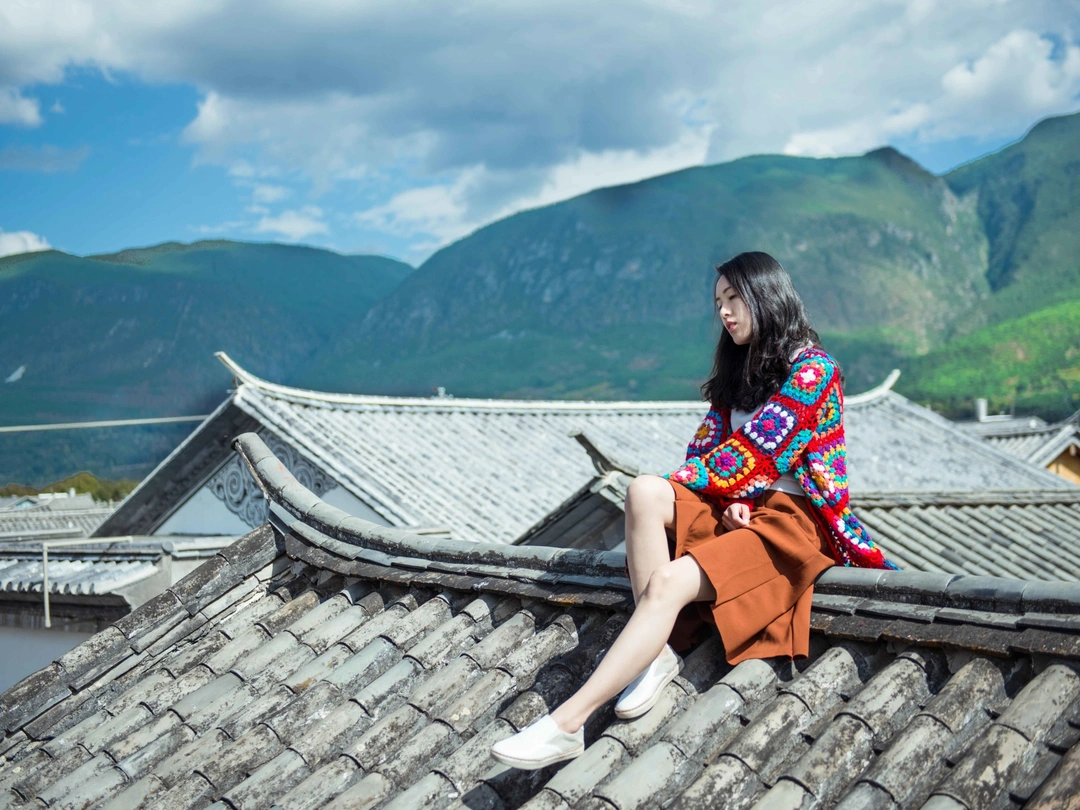
Cookie in Yunnan | My Seven-Color Yunnan Picture Book
Weibo: @Cookie大曲奇
WeChat Official Account: Cookie's Little World
WeChat ID: cookiexianzhi
Destination: Yunnan
Travel Dates: October 23, 2017 · 10 days
Cost per person: Approximately 5,000 RMB
Travel Companions: Couple
Prologue: A Love Letter to Yunnan
Hunan TV seems to have an inexplicable fondness for Yunnan. The laughter of children from Where Are We Going, Dad? still echoes through the valleys, and Dear Inn has flooded social media with misty morning shots of Lugu Lake. To be honest, I'm not surprised at all — this land of stunning landscapes has a way of captivating anyone who sets foot here.

Earlier this year, while chatting with a friend, I suddenly realized that the keyword for my travels had become "goodbye again." The first meeting with unfamiliar places, the reunion with familiar ones. Two years ago, I first set foot on Yunnan's soil, and even then, I silently vowed: I must come back. Not to conquer anything, but to walk the paths I hadn't yet explored, to visit those "old friends" I'd brushed past — the yogurt shop on the corner with its enticing aroma, the big rock where I once rested, the towering tree that wandered into my camera frame. They've all stayed with me, never leaving.
Everyone knows the phrase "Colorful Yunnan," but in my eyes, Yunnan has far more than seven colors. On this trip, I assigned a dominant color to each place I visited, piecing together my very own Yunnan picture book.
The itinerary gets more exciting toward the end. I recommend saving this post; practical tips are at the bottom.
Departure: A Comedy of Errors — Weather and Luggage, a Fair Trade
The idea of visiting Lugu Lake had been on my mind for ages. When I heard it was a six-hour bus ride from Lijiang, I gave up immediately. But once the road was finally completed, and with the buzz around a certain internet-famous inn, I could no longer find excuses to put it off.
Lugu Lake sits on the border between Yanyuan County in Sichuan and Ninglang County in Yunnan, jointly administered by both provinces. When choosing accommodation, I'd see locations listed as Yanyuan one moment and Ninglang the next. Many people assume Lugu Lake is entirely in Yunnan, but when the driver and innkeeper called me, their numbers showed up as Sichuan — I thought they were spam calls and hung up several times. Even stranger, in the time it took to snap a photo after getting out of the car, I'd crossed from Sichuan into Yunnan. The airport, however, is still in Yunnan.
Dusty and tired, we stepped off the plane and spotted our driver waiting.
"Hello, you must be tired. Huh, where's your luggage?"
I looked dejected: "The airline lost it. It didn't make it on the flight. There's only one flight a day, so we'll have to wait until tomorrow…"
Even though I'd already learned the bad news during our layover in Kunming, mentioning it again dampened my spirits. My husband and I each had a large backpack, filled entirely with electronics, plus one coat. Thinking back to the 30°C weather in Guangzhou when we left, compared to the 10°C here, I felt a small relief — at least I'd packed a coat in my carry-on.
"You're really lucky! It rained nonstop around Lugu Lake the past two days. Planes couldn't land and had to turn back to Kunming. But you made it down just fine today."
I looked up at the crystal-clear sky and thought: Well, I guess it's a fair trade. And just like that, my mood lifted.
Blue | Lugu Lake: Dear Inn, Dear Lugu Lake
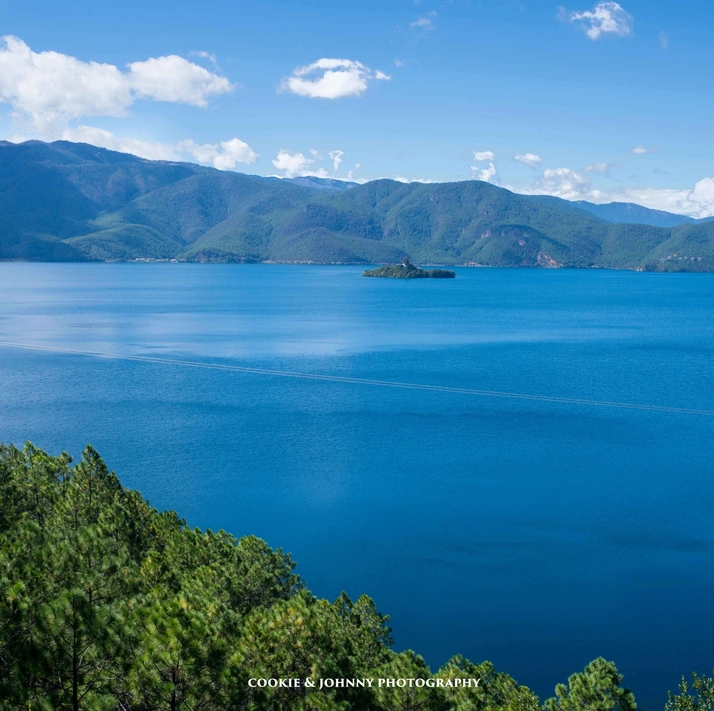
Whenever I think of Lugu Lake, an endless expanse of deep indigo washes over me. Its clarity and vastness are unforgettable.
We'd gotten up early to catch our flight, so after exchanging a few pleasantries in the car, we dozed off. I was roused from my haze — we'd arrived at the scenic area entrance. A large gate blocked the way: local vehicles passed freely, but tourists had to get out, buy tickets, and go through inspection.
Ticket: 100 RMB each. Once inside, no additional fees are needed except for boat rides and the cable car.
I looked up and saw a sign: "Student ID eligible for discount." Ah… last time I was here, I could still take advantage of that. I sighed wistfully for my student days while pulling out my wallet.
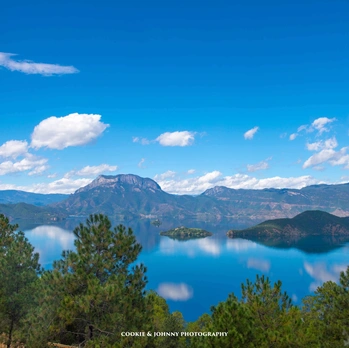
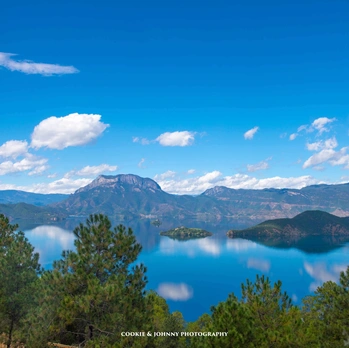
As soon as we entered the scenic area, a viewing platform came into sight, offering a panoramic view of the lake from above. I gasped: "So beautiful!" I took a deep breath of the slightly thin but fresh air — yes, my trip had truly begun!
That first glimpse was breathtaking, comparable to anything in Scandinavia. Every photo could pass for a computer wallpaper. Thank goodness I still had my camera — even though I looked haggard without makeup and couldn't bear to be in photos, I happily snapped away at the scenery.
The van crawled along, slowing to a halt — the road ahead had collapsed due to heavy rain and was under emergency repair. So began an endless wait as we inched forward in a convoy. What touched me was how disciplined the local drivers were — almost no one crossed into the oncoming lane despite the road closure. Big thumbs-up.
We'd landed at noon, and the drive to the inn was supposed to take nearly an hour. With the luggage delay and road closure, lunch was out of the question. I got a message from the innkeeper on the road — worried we'd be hungry until dinner, he was even more anxious than we were, constantly checking on our progress.
When we finally arrived and dropped off our bags, the innkeeper said, "There's nothing to eat right now. No delivery here, no big supermarkets either. I'll take you out for duck."
"Wait, the inn is gorgeous — let me take a few photos first. Just one minute! Quick!"
This time I'd learned my lesson: photograph the beautiful room the moment you arrive. I used to wait until I was leaving, by which time the room was always a mess. Ten minutes passed… Thank heavens I was too disheveled to want my photo taken, or we'd never have left.
Sizzle, sizzle — steam billowed upward. I'd never seen this cooking method before and instinctively leaned back, afraid something might go wrong. The innkeeper seemed unfazed, clearly used to such reactions from guests.
Whether it was sheer hunger or genuinely good food, I wolfed it down with immense satisfaction. Over the next few days, every time we had steamed pot dishes, they came with potato rice. Fragrant and filling, I often couldn't put down my chopsticks even when I was stuffed.
The portions were huge. During a break, I stepped outside and used my phone to snap a few photos by the lake. It looked like a half-finished painting blessed by nature — fishermen had moored their boats haphazardly, a line of wild ducks swam past in formation — scenes that would delight any photographer.
By the time we finished eating, it was already 5 PM, and dinner seemed out of the question. With no hope of circling the lake, we decided to head back and take photos.
"Boss, your inn has so many flowers!"
"Well, the gardener comes every day to water them — from 9 AM to 7 PM, tending to the plants before he can call it a day."
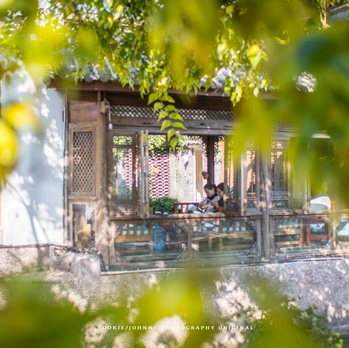
I was secretly shocked — no wonder my own plants never lasted long. I was far too careless.
Walking back to the inn, I was out of breath. The altitude seemed to force us to slow down, step by step, shedding the hurried pace of city life, taking deep breaths, and truly looking at the scenery.
Not long after we returned, the sky darkened and raindrops began to fall… Had our luck run out that quickly? What a comedy of errors.
I immediately asked the innkeeper if I could borrow some makeup for the next day. Moisturizer, foundation, eyebrow pencil — all set. It would have to do.
"No stars tonight, but the inn looks nice. Want me to take your photo?"
"No, I'm feeling the altitude. I'm miserable. You go ahead. I'm going to sleep."
That night, I slept deeply.
The next morning, I pulled open the curtains. Wow! A clear, sunny day! Losing that luggage was worth it! I hurried to make up for the lost time, taking photos around the inn. There was no rush, but unfortunately, Wang Feng's public service film crew was arriving that day to shoot, and they'd booked the entire inn. I had to find somewhere else to go.
With good weather, everything looked photogenic. It was such a pity I didn't have the right clothes — I felt like I'd wasted half the room rate! (Prices start at 400 RMB)
Circling the Lake: One Day, Plenty of Wonder
The highlight of Lugu Lake is undoubtedly the loop around it. One day is usually enough. Yunnan has long daylight hours — in November, it doesn't get dark until after 7 PM. That said, after 6 PM the light isn't great for photos. I'd suggest heading out around 9 AM.
Yunnan has many mountain roads in poor condition, so we gave up on renting a car. And since no one could tolerate our habit of stopping constantly to take photos, we skipped sharing a ride too. A friend recommended a good private driver — let's call him Master Ye! He's the cousin of the famous Lugu Lake driver Master Zhao, who's popular on Weibo. We didn't have to think about a thing; we just followed him.
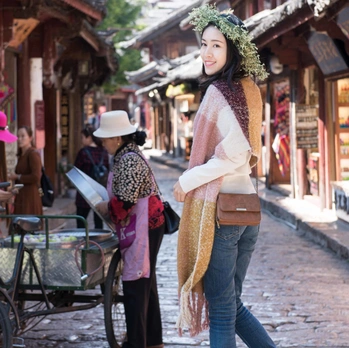
Here's a map of Lugu Lake's attractions, showing the layout clearly. (Image source: internet, delete if infringement)
We started near Dazui and circled clockwise. The sights were mostly strung along the lake, with stunning lake and mountain views at every turn.
At one point, the driver said, "This is where Liu Tao rowed a boat for Dear Inn."
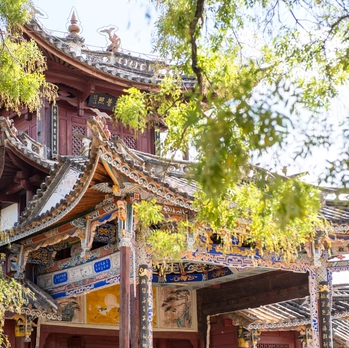
"Stop the car!!" I jumped out to take photos.
I couldn't figure out why the grass here was all bent outward. Back in the car, busy reviewing my fresh shots, I forgot to ask. When we spotted cosmos flowers, I naturally asked the driver to pull over again.
Among all the sights, a few left the deepest impression and were the most beautiful — they deserve special mention.
The Marriage Bridge: Walking Through a Painting
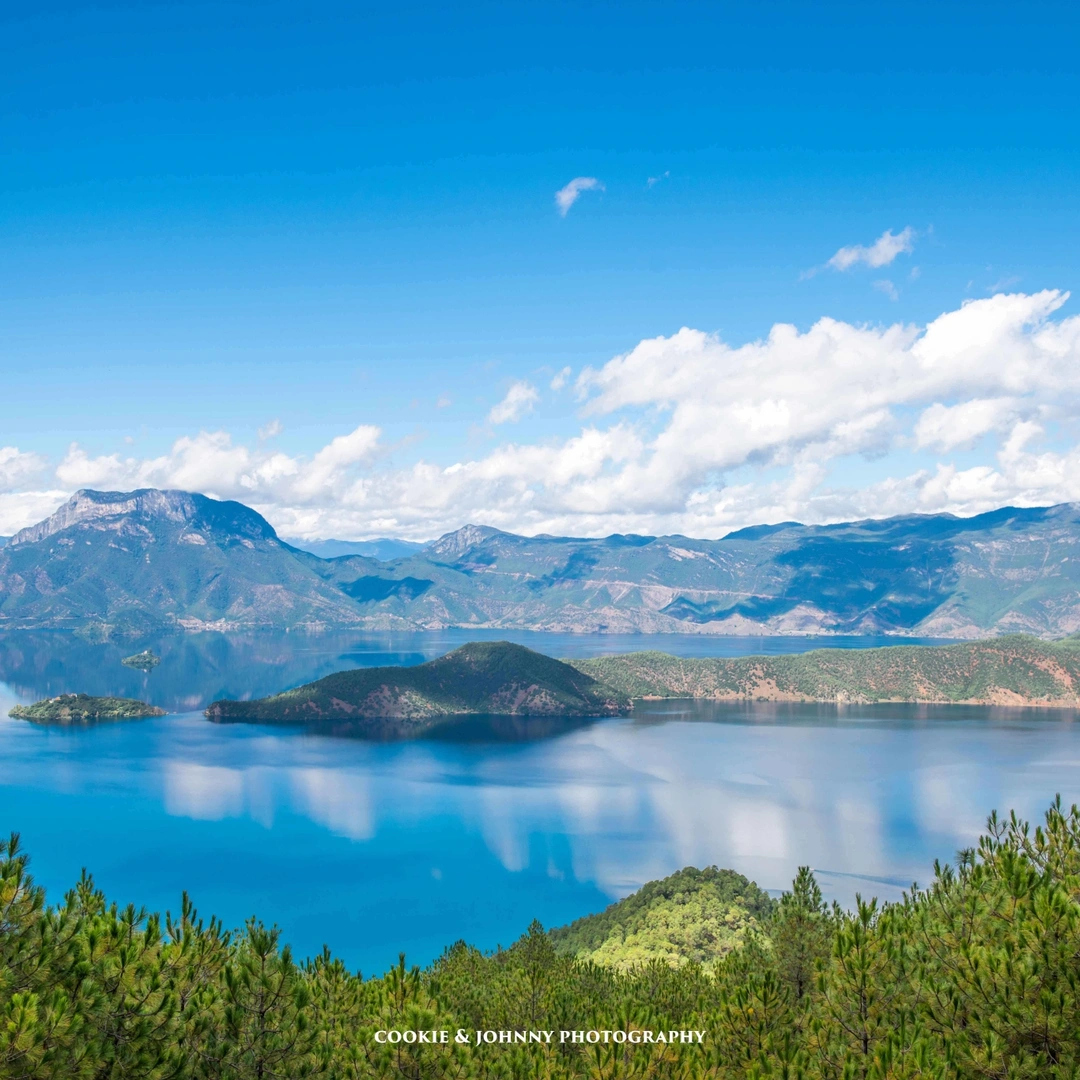
A walk across the Marriage Bridge takes about an hour. Along the way, besides the beautiful scenery, there were small stalls selling ethnic clothing and local snacks, with various grilled foods being especially popular.
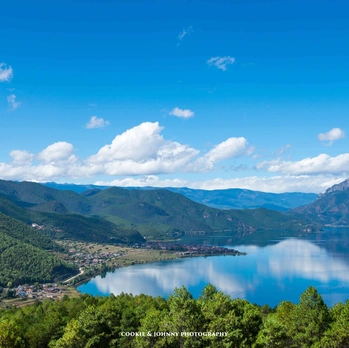
Looking out from the far end, the scene was as beautiful as a painting. On one side, lush water plants thrived; on the other, it was desolate and barren. The bridge is very long, and from a distance, you could still see crowds of people. Gazing at the lake water and yellow reeds on both sides, I thought how perfect it would be to get an aerial shot with a drone. Unfortunately, our little drone hadn't been charged before we left — the battery was under 40%, and with our lost luggage, we couldn't charge it. We didn't dare risk flying it. Frustrating!
Goddess Bay: A Perfect Spot for Sunrise and Sunset
Goddess Bay, also known as Zhao Family Bay, is said to be named after the large number of Han Chinese surnamed Zhao in the area. The driver said it's a stunning place to watch sunrise and sunset, which is why many tourists book nearby accommodation.
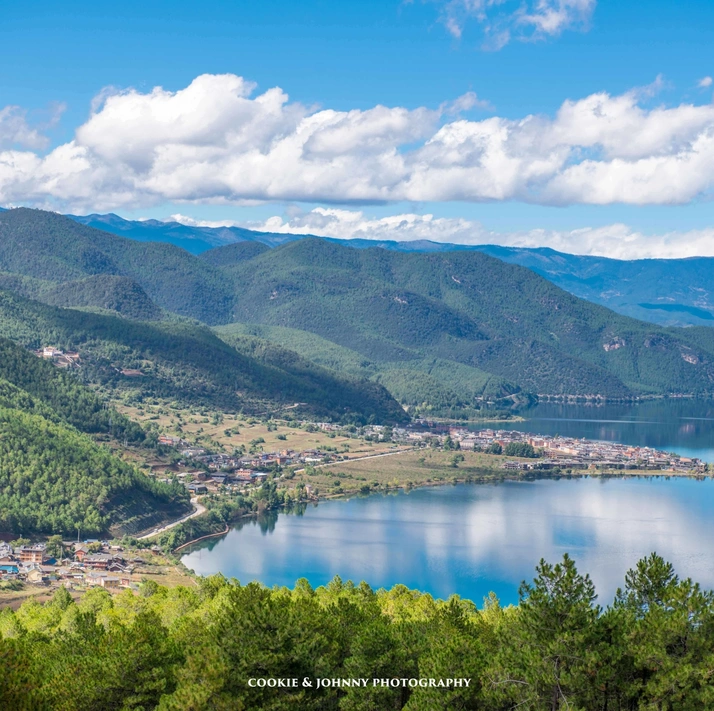
Getting to Goddess Bay requires navigating a steep downhill road that really tests your driving skills. Even from the passenger seat, we marveled at the driver's expertise. Then came a short walk to the lakefront. The sun was so blinding that I just closed my eyes and snapped photos.
When we arrived at Lugu Lake, autumn hadn't fully set in yet — the scenery was mostly blue and green. So when we finally spotted some red and yellow maple trees, I was overjoyed — finally, a touch of autumn! The lake bottom was also fascinating, covered in long, slender aquatic plants. Peering down, it felt deep and a little mysterious.
The Viewing Platform Panorama: Climb High, See Far and Wide
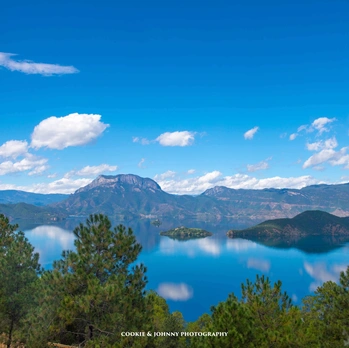
I don't remember the exact location, but any private driver would know it well. The scenery was already stunning from down low, but only when you climbed high and saw the full panorama did it feel truly magnificent. The lake surface looked like silk — smooth, luminous.
Climbing a few dozen steps left me exhausted. Moving around was already a challenge at this altitude, and climbing stairs meant two steps up, three steps of rest. When I finally made it to the top, even though I was out of breath, I still posed for a weary photo.
Master Ye: The Warmth of Simplicity
Finally, a call from the airport — my luggage had arrived at the bus station. But the staff wouldn't hold it for us, and we were a 40-minute drive away. We were stuck. Master Ye said, "I'll drop you off at a restaurant to eat. While you have dinner, I'll go get your luggage…"
My husband and I looked at each other.
"No charge. I'll bring it back for you."
"That makes us even more uncomfortable! It's too much trouble! You won't get to eat dinner."
We thought about hiring another driver to bring it over and pay them properly. Master Ye's face lit up: "I have a friend who just finished a drop-off near there. He can bring it back on his way!"
After thanking him profusely, we could finally relax and eat. The steamed pot duck from yesterday had left a good impression, so today we tried a matsutake steamed pot fish. We were already familiar with the process and dug in quickly. It was a huge fish, incredibly fatty and delicious.
"Hey, why didn't the owner put the matsutake in for you? Let me go ask." Master Ye fished around in the pot and went to argue with them. "This is a specialty of Lugu Lake — you have to try it. It's expensive outside."
What a朴实 (down-to-earth) driver, so thoughtful toward his guests. Beyond thanking him, I didn't know what else to say.
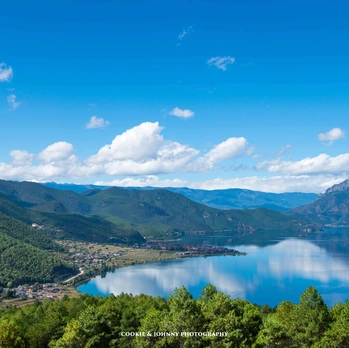
By then, all our electronic devices were on the verge of dying. We waited anxiously, and finally, the suitcase arrived! A lifesaver! The driver said we could charge our devices at his place. Even though we felt terrible for constantly imposing on him, we were desperate, so we went along.
"Wow, Master Ye, your place has a big courtyard! It's lovely!"
"We all live like this. Our home isn't great — we'd love to build a proper house, but we don't have the money."
"So what do you do in the off-season when you're not driving?"
"I do renovation work."
I fell silent. Honestly, it seemed like making a living here was tough. I've been to many places, and every time, I feel like I'm getting a lesson. It sounds sentimental, but it really does make me appreciate what I have a little more.
"Here, walnuts from our own tree — for you!" Master Ye shoved a big bag of walnuts into my hands, insisting despite my protests. I shot my husband a look and said in Cantonese, "What do we do? He's helping us and giving us gifts… We've never met such a朴实 (down-to-earth) person at a tourist spot before."
"Just come back and hire him again next time."
While charging, I quickly changed clothes and put on some makeup. Finally, I could take proper photos!
Lige: The View I Was Most Excited For
Next stop: Lige! The sight I was most looking forward to. There were lots of little goats on the hillside along the way. As I admired their surefootedness, I asked the driver, "If they're let out like this, won't they get lost?"
"No, the ducks and goats around here all find their way home on their own. They come back when it's time."
That thought made me a little sad… After all, they'd eventually be eaten…
"It feels like they're walking step by step to the slaughterhouse…"
"You're overthinking it! You've eaten plenty yourself," my husband teased.
To see Lige properly, you need to take a panoramic shot from above. The lake was a vast, brilliant blue — grand and moving. Down by the water, there were many small boats called "pig trough boats." The fishermen had painted them in a riot of colors, full of childlike charm.
Finally, the little drone got its moment. We'd upgraded to a new model and were still getting used to it. The battery was too low, so it returned after just a short flight. One precious aerial shot.
As the sky darkened, I silently cursed myself for not waking up earlier and heading out sooner. Still, I was grateful we'd already visited all the sights we wanted. On the way back, the sun sank lower, casting a different kind of charm. The same stretch of water looked completely different when the wind picked up versus when it was calm. The photo below looked like an ancient bronze mirror — hazy and vintage.
There was a table and chairs by the roadside, clearly placed there for tourists to take photos. Naturally, I couldn't pass up the opportunity. Though this kind of setup is quite common in Yunnan.
We got back to the inn after dark. A quick dinner, and another night of deep sleep.
Surprise: I Stayed at the Real-Life Dear Inn
The next morning, I pulled open the curtains and proudly boasted, "See how good the inn I found is? Right on Lugu Lake! Beautiful, right?"
"You just came here to take photos…"
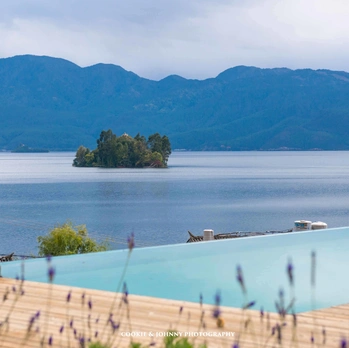
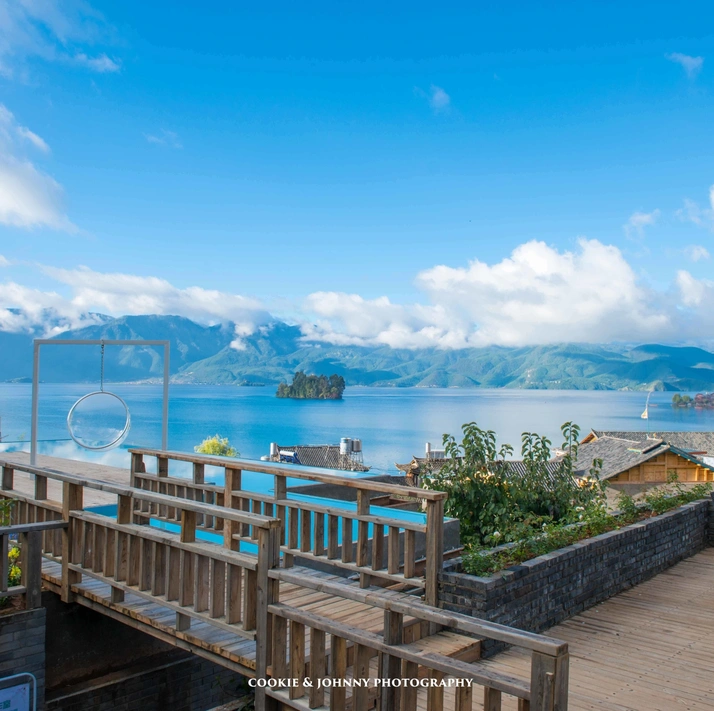
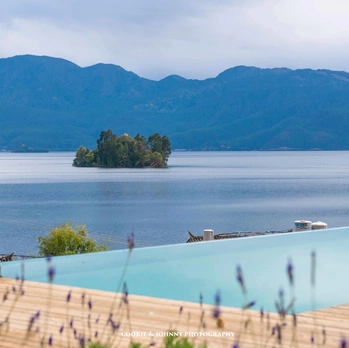
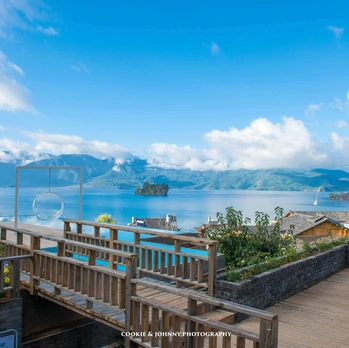
As I looked, something seemed familiar. Was it just a coincidence? I'd stumbled upon the real-life inspiration for Dear Inn! This inn and the one from the show belong to the same owner, situated across the lake from each other with stunning views. (More info at the end.)
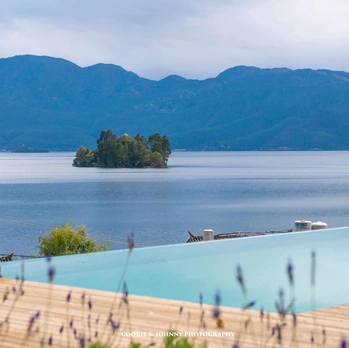
Waking up to the lake and mountains spread out before me — bliss! I imagine everyone who books this place comes for this view of the water so close at hand. Sitting on the inn's front porch, basking in the sun, daydreaming, playing with the dog.
After breakfast, we waited for a shared ride to Lijiang. Before leaving the inn, we took a stroll through the nearby village. There was so much rustic charm! After spending so long in the city, coming to this lovely countryside made me want to touch and smell everything.
Taking photos was fun, but after crawling through bushes and woodpiles, I was covered in seeds — I'd turned into a little hedgehog!
Bonus Easter egg in the text: I swear, I didn't put this leaf on myself. It was stuck firmly to my scarf and wouldn't come off no matter how much I shook it.
Gold | Lijiang: A City of Flowers, Where Seasons Blur
Lijiang has too many colors to count — a dazzling array that overwhelms the senses. Especially the endless flower-lined alleys, bursting with vibrancy. It's hard to pick just one color. After much thought, perhaps Lijiang is gold.
The ever-present, abundant sunshine turns even the cobblestone streets golden. Light and shadow dance on walls and eaves, illuminating the uniform black signs with gold lettering that line the ancient town — an unforgettable sight. The brown wooden beams, touched by sunlight, are gilded in gold.
Countless travelers have written about Lijiang's attractions and routes; I can't add anything new. There's not much to guide either — it's essentially a "city within a city" enclosed by modern urban sprawl. Just find a place to stay and wander at your leisure.
Many people criticize Lijiang for no longer being what it once was, calling it disappointing. But I've had great experiences both times I've visited. The crowds, the uniformly renovated brick walls that no longer tell stories, the identical, assembly-line shops… I could complain about it for five hundred years.
But if Lijiang could speak, I imagine its monologue would be: "I love how you tourists complain about my commercialization all day, yet you still scramble to visit me."
We'd planned to stay two days in Lijiang, but we were so comfortable that we extended by another day. Luckily, it was the off-season, and the innkeepers for our subsequent stops were understanding, so we guiltlessly lingered.
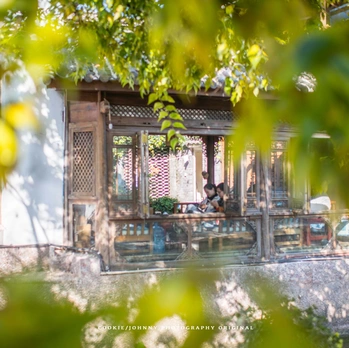
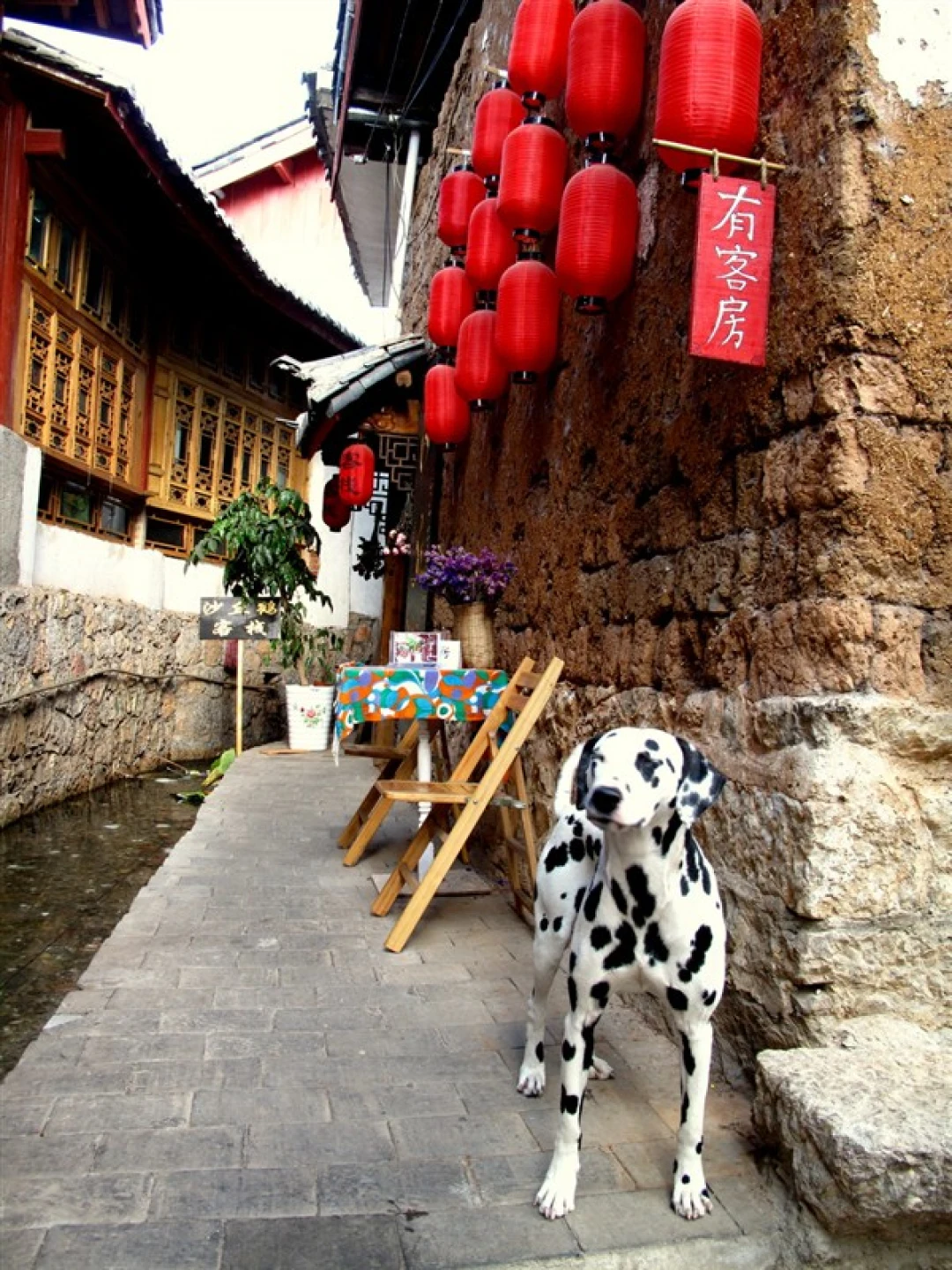
In Lijiang, we stayed at Tinghuatang (Listening to Flowers Hall). The inn lived up to its name — every day, we woke up surrounded by blooms. The underfloor heating kept my sweater warm; when I pulled open the curtains, sunlight streamed through the plants, warm even through the glass. After breakfast, I didn't want to leave the courtyard — just reading a book, taking photos, and finally embracing the slow life.
The owner truly understood what tugs at a girl's heart. A little wooden horse placed among the flowers — passersby of all ages couldn't resist touching it or sitting on it for a while. And the entrance, a tunnel of dense ivy, practically begged for a photo in a red coat. If Lijiang is a city of flowers, then this place is a private garden.
In the off-season, especially in the southern part of Dayan Ancient Town, there's a rare peace and tranquility, as if it were still the untouched paradise of years past.
The area along the waterways in Dayan is the most beautiful. Though they're just small streams and creeks, sometimes barely flowing in the dry season, they're still my favorite corners. The layout of small bridges and flowing water, the scattered folk houses — for a moment, I felt like I was in a water town in Jiangnan.
My eyes collected countless flowers along the way. If not for the heavy winter coat reminding me, I'd have thought I was walking through spring. The mottled light and shadow on the walls shifted with the breeze and the vines, a quiet pleasure to watch. The glass windows reflected the red beams and weeping willows along the riverbank — I captured them all in my camera, my eyes, my memory.
Walking along, I stumbled upon a large inn. Business was slow in the off-season, so the staff didn't stop us from looking around — they even welcomed us. Though Dayan is often criticized, I was genuinely stunned when I first saw the Dayan Flower Alley. I heard it was an artificial installation created this year, perhaps to boost Lijiang's competitiveness in the tourism market… But whether artificial or natural, whatever its purpose, as a tourist, I found it simply delightful.
Following Sifang Street, the flowers grew more abundant, and I knew I'd reached Flower Alley. Here, I can honestly say: "Photos really can't capture its beauty and scale!" A flower sea that no woman can resist! Too bad it was winter, and I was bundled in heavy clothes, hating the cold. If I'd been wearing a white dress in summer, it would have been perfect.
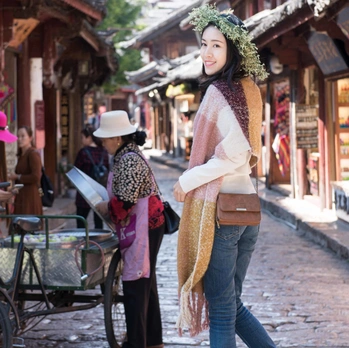
Sifang Street was still packed with people. The shops were mostly the same: ethnic clothing, handicrafts (homemade soap, embroidered shoes, fine musical instruments), snack shops (dried milk curds, flower cakes, fried dough twists…), restaurants, travel agencies… No different from most ancient towns, so shopping wasn't my main focus.
Walls covered in Dongba script — I stared for ages but couldn't figure it out. If anyone knows, please tell me! By the roadside, a fruit vendor had arranged fresh fruits beautifully. I took a photo for inspiration.
I'll probably come back to Lijiang again. Next time, I'll choose a different season — I want to see the "roses climbing over the eaves" that the locals talk about.
Green | Dali: A Complicated Love
Most travelers have heard about the pollution in Erhai Lake. I chose green for Dali — partly because the sight of invasive green vegetation spreading across the lake is heartbreaking, and partly because the green fields along the way offer hope. Erhai has been damaged, and Lugu Lake has risen in its place. I hope everyone will protect the environment and cherish nature. (Cookie pushes up her glasses, speaking seriously.)
In the afternoon, we walked to the bus station. As usual, my husband went to buy tickets while I waited outside with the luggage. Soon, a man approached: "Going to Dali? We leave when there are four people. I've got one already. How many are you?"
I was about to reply when my husband came back and stopped me. The tout slunk away.
"Are you an idiot? You'd take an unlicensed cab? What if they demand more money halfway, throw you out, or rob you?!"
I was scolded thoroughly, and he wasn't entirely wrong. Once we were on the bus, there was a notice on the seatback from the police warning against unlicensed cabs. My husband gave me another lecture.
"Then I'll warn everyone in my travelogue not to take unlicensed cabs."
"Who would be stupid enough to need that warning?"
After a bumpy ride of several hours, we finally reached Dali Ancient Town. Cars aren't allowed inside, so we dragged our suitcases over the cobblestones to find our inn. Luckily, it was well-located, right at the entrance. Thank goodness — we checked in quickly.
After dinner, we strolled down Foreigner Street. It felt similar to Lijiang — wider streets, more knockoff shops. Boring, boring. We headed back early. We'd get an early start tomorrow!
Chongsheng Temple: A Jin Yong Fan's Obsession
Chongsheng Temple is about a kilometer from Dali Ancient Town, and most visitors start their day here. I wasn't particularly interested, but the Jin Yong fan beside me was thrilled. Since Dali is the setting for the Duan family in The Demi-Gods and Semi-Devils, he was full of enthusiasm. History and culture were irrelevant — in his eyes, this site only meant one thing: "This is Tianlong Temple from The Demi-Gods and Semi-Devils! The pagoda where Zhao Min imprisoned the six major sects was based on this one!"
(I'm pretty sure that's not accurate…)
Oh well. Traveling together requires compromise. I accompanied him through the temple, still not particularly engaged, but treating it as a scenic walk. It wasn't disappointing, at least.
Erhai Lake: A Painful Reunion
Leaving Tianlong Temple, we finally headed to Erhai.
I'd visited Yunnan once before, at the end of 2015, following the classic Dali-Lijiang route. Back then, Erhai was so enchanting, so clear. We'd stayed in a lake-view room at a hotel right on the water. Waking up and pulling open the curtains to see the lake and mountains sparkling in the morning light — it felt like the day had just begun and I already didn't want it to end. (Photo taken at Erhai in 2015.)
Before this trip, I'd mentally prepared myself for the damage to Erhai. Even though I'd shortened my itinerary, I still wanted to revisit old haunts. What I saw was truly heartbreaking.
The hotels lining the lake were being demolished, renovated, or left in ruin. The merchants along Erhai clung to their last shred of hope, still trying to do business. The lake water was covered in green algae — forget seeing the bottom, you couldn't even find the roots of the plants.
I decided to take a photo anyway. Though it lacked the beauty of my first visit, at least I was witnessing it at its worst. And I hope this is its worst — that every day from now on, it will get better.
A photo with no post-processing: that green is all pollution. Heartbreaking.
We barely made it halfway around the lake before losing the will to continue. We turned the car around and headed for the main road. After seeing so much destruction and pollution, the sight of vast farmlands and scattered little houses in the distance felt incredibly endearing. Even as the sky threatened rain and grew dim, I cherished this view.
White | Xizhou: A Monochrome Ink Painting
Xizhou's color was the easiest to decide. Known for its Bai ethnic folk houses, the town is filled with white walls and gray tiles. It's impossible not to associate it with white.
Forty kilometers, stopping along the way, and we finally reached Xizhou! Famished, we parked and headed straight for Xizhou Flavors on Sifang Street. Despite the modest décor, it was packed with diners.
"I don't think the food lives up to the crowd here!"
"You never had high expectations for local cuisine anyway. Count your blessings!"
You should also read:
Yunnan Travel Mastery: From Beginner to Pro-Level Player – A Complete Guide
Yunnan Travel Mastery: From Beginner to Pro-Level Player – A Complete Guide "Either travel or read, but your body and soul must be on the road." This quote has been repeated countless times, but very few people truly manage to be "on the road" and…
Continue reading...
Escaping Nanning, Falling Under Lijiang's Spell: Our Four-Person, Ten-Day Yunnan Dream
Escaping Nanning, Falling Under Lijiang's Spell: Our Four-Person, Ten-Day Yunnan Dream Before We Set Off: No Pain, No Obsession Have you ever had that impulse—suddenly tired of the office fluorescent lights, the crush of the subway, the endless parade of identical takeout boxes, and just…
Continue reading...
Solo in Yunnan: A Wanderer’s Guide to the Land of Eternal Spring
Solo in Yunnan: A Wanderer’s Guide to the Land of Eternal Spring There’s something magical about traveling alone. No compromises, no schedules to keep, no one to please but yourself. I’ve been on the road for nearly three months now, and not once have I…
Continue reading...