Deep in the Rainforest, Together as a Family: A Four-Day, Three-Night Nature Exploration of Xishuangbanna and Pu'er
Deep in the Rainforest, Together as a Family: A Four-Day, Three-Night Nature Exploration of Xishuangbanna and Pu'er
When the noise of the city is filled with traffic jams, and your child's childhood is dominated by screens, don't you long to take them into a real wonderland? In the summer of 2025, we set out with our two children—Huasheng and Jiami—on a journey to the northernmost tropical rainforest in China. This wasn't a rushed sightseeing trip, but an immersive family exploration. From the pristine secrets of Pu'er to the vibrant human warmth of Xishuangbanna, we spent four days redefining the meaning of "togetherness" within the embrace of an Asian tropical rainforest.
Why Choose This Rainforest?
Tropical rainforests, the green jewels of our planet, don't only exist in the distant Amazon. The world's three major tropical rainforest regions—Central and South America, Africa, and Asia—have their northernmost point right here in Xishuangbanna, Yunnan, China. This area preserves one of the most intact tropical rainforest ecosystems on Earth. It stands alongside the Korean pine and broadleaf mixed forests of Changbai Mountain, the Maolan karst forests of Guizhou, and the Jianfengling tropical rainforest of Hainan, yet it boasts a unique biodiversity and ethnic culture all its own.
Our destination wasn't the typical Xishuangbanna scenic spots. Instead, we focused on Pu'er—a more pristine, nature-immersed heartland of the rainforest. Xishuangbanna was just our transit point; the real adventure began the moment we stepped into Pu'er.
Day 1: First Forest Encounters by the Sun River
Pu'er Sun River National Forest Park: A Breakfast Date with Rhinos and Red Pandas
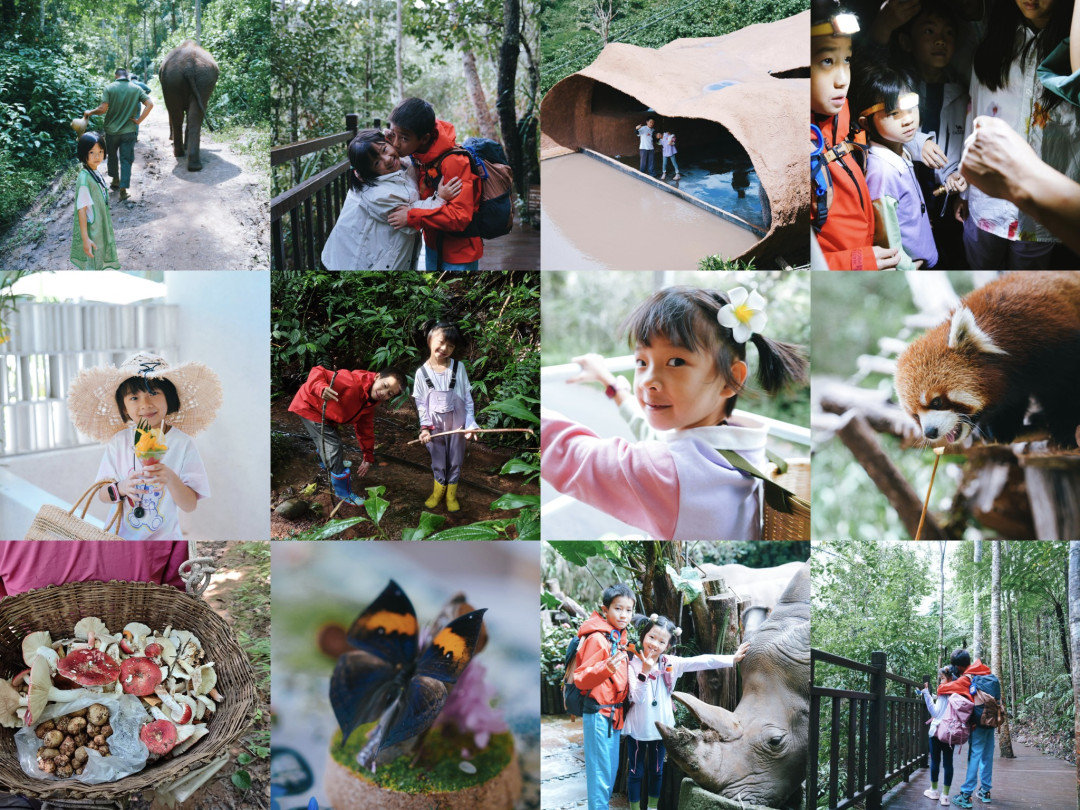
Our first stop was Pu'er Sun River National Forest Park. It's not just a natural oxygen bar; it's a paradise for kids. The first activity we chose was the jungle zip-line—the most worthwhile experience in the entire park. We were so caught up in the moment, enjoying the children's laughter as they zipped through the treetops, that we completely forgot to capture it on camera.
The main sightseeing area is connected by wooden boardwalks, taking about 2–3 hours to complete. The kids had a blast feeding the animals all along the way. Every feeding station costs 20 yuan per portion, from the rhinos at the start to the red pandas at the end, each stop filled with anticipation. At the end of the boardwalk, we had a special breakfast in the restaurant at the Red Panda Manor—dining alongside the red pandas. It was probably one of the most magical scenes of the children's childhoods.
Red Panda Manor: The Magic Hour of Night Insect Watching
As night fell, the Red Panda Manor shed its daytime bustle and ushered in a mysterious celebration. A professional forest guide led us, headlamps on, cautiously into the dark forest theater.
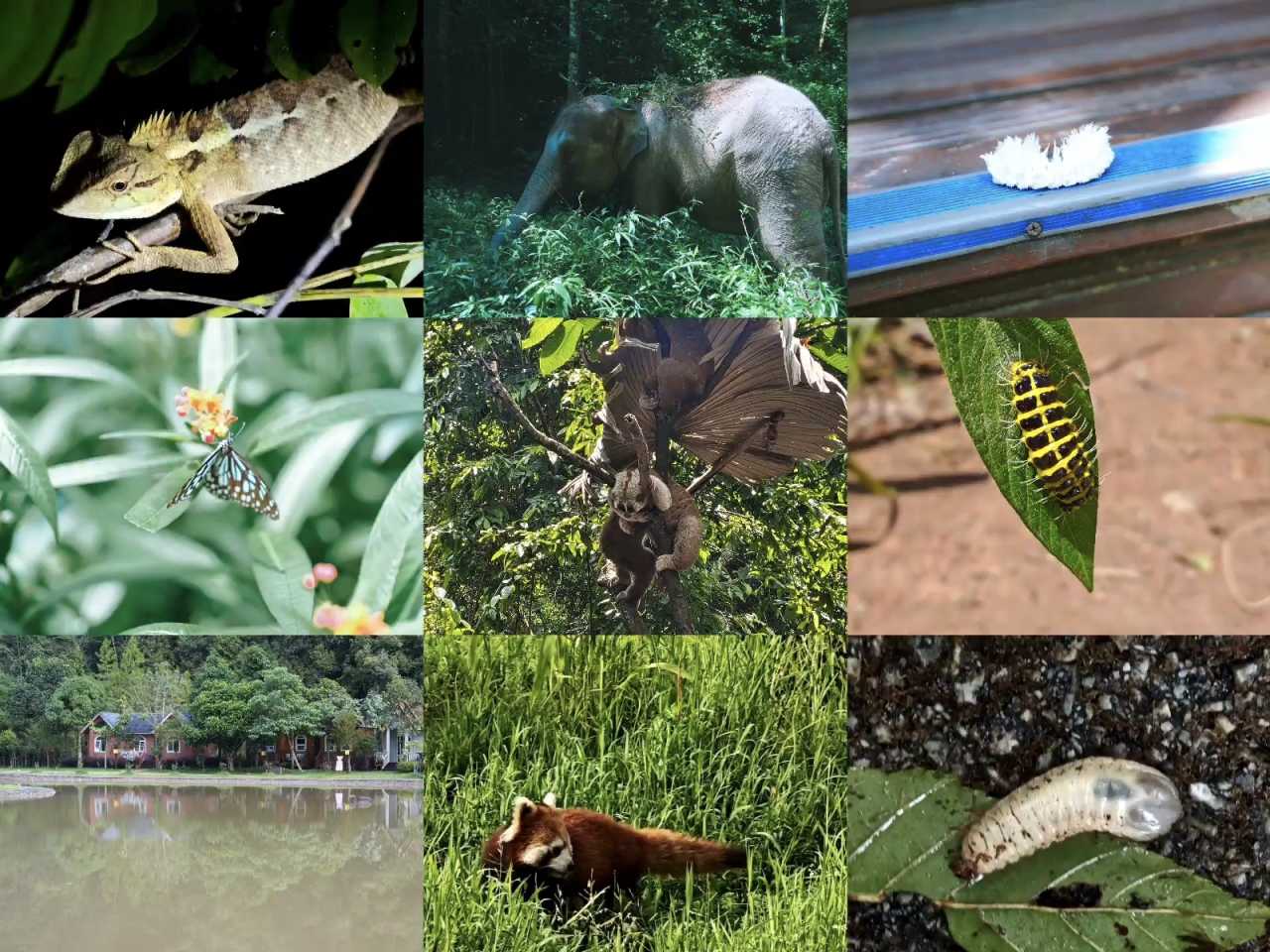
Just as we stepped into the forest, we encountered a stick insect. It was perfectly still on a branch, blending in so seamlessly that without the guide's warning, we would have completely missed this master of disguise. As we moved on, we saw harvestmen, peacock mantises, katydids, frogs... each tiny creature revealed its unique beauty under the light.
The highlight of the night insect watching was releasing fireflies. We held breathable glass jars in the dark forest, the fireflies inside dimming their light, like a handful of scattered stars trapped within. Gently, we unscrewed the lid. First, two fireflies hesitantly crawled out, their tails flickering on and off, as if checking that the night was safe. Then more took flight on their thin wings—at first just a few scattered points, but soon a flowing river of light. They drifted unhurriedly, pausing on our fingertips for a moment, their tails glowing warmly, before flying off again, leaving delicate trails of light in the darkness.
Releasing them wasn't an ending. It was returning the stars in the jar to the forest, letting them carry their little lanterns to light the paths for insects in the tree hollows, to edge the dew on the leaves, and to leave us standing there with soft light clinging to our clothes.
Day 2: A Mushroom Adventure Deep in the Rainforest
Finding Mushrooms in the Rainforest: An Intimate Conversation with Nature
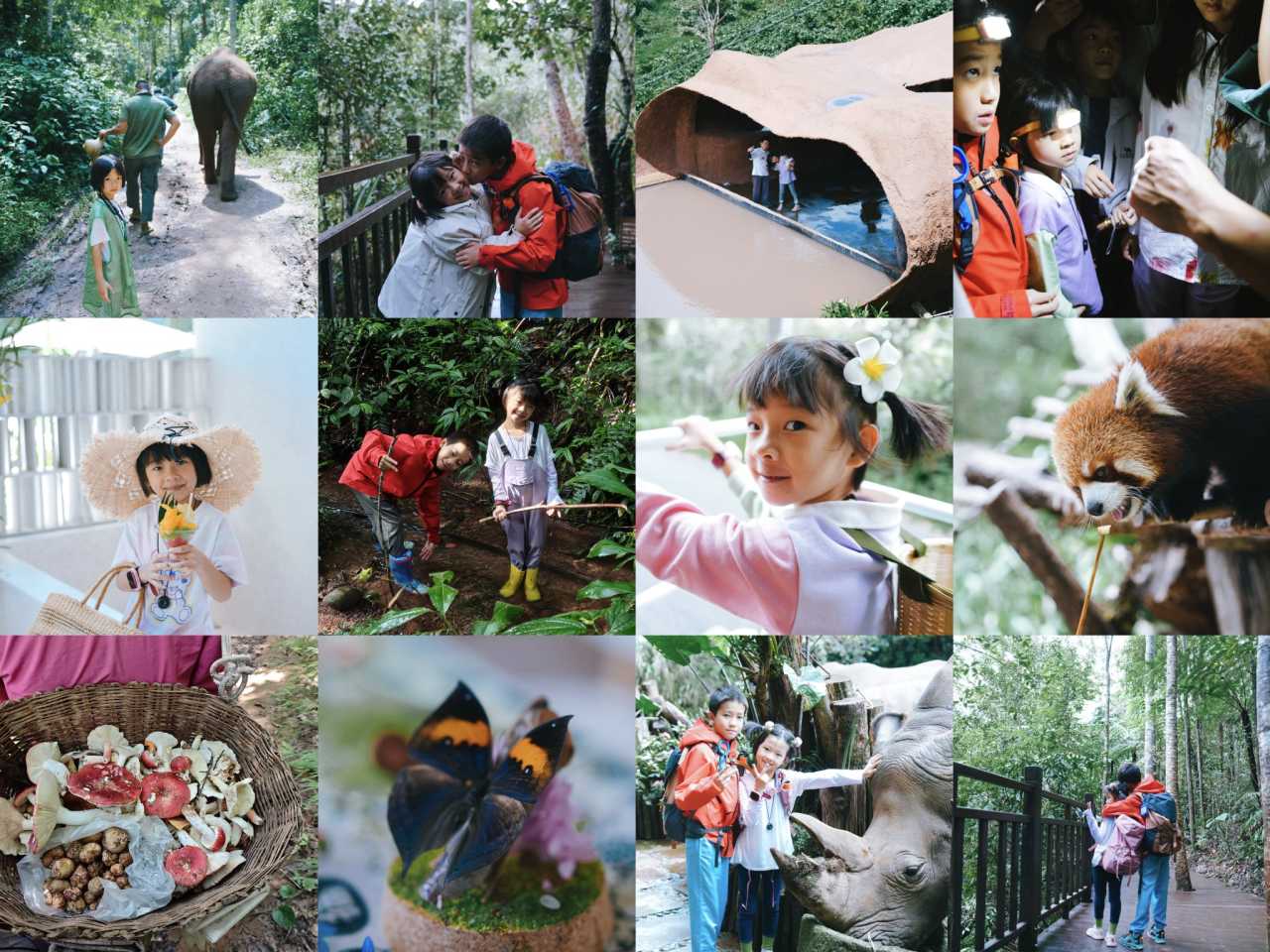
After a morning breakfast with the red pandas at the Red Panda Manor restaurant, the kids put on their rain boots and followed the forest guide into the rainforest for a mushroom-hunting adventure.
At first, my eyes were spinning—I couldn't find anything and started to wonder if we'd come to the wrong place. But just a few steps in, the sharp-eyed guide pointed at a tree root and shouted, "Look, there's a cluster!" We leaned in, and sure enough, there they were: delicate, coral-like mushrooms with soft yellow gills, incredibly cute. The guide said they were coral fungi, edible and delicious. Along the way, we discovered all kinds of strange mushrooms: some like little umbrellas with ring patterns on their caps, others flat and pressed against tree trunks, and some tiny, round ones dotted through the grass like pearls.
The mushroom foraging lasted about two hours. Afterward, the guide helped us sort the species, telling us which were poisonous and which were edible. Through this process, the children not only learned valuable knowledge but also felt nature's generosity and wonder.
Da Kaihe Meizi Coffee Manor: A Coffee Break
After checking out of the Red Panda Manor, we drove 18 kilometers to Da Kaihe Meizi Coffee Manor. It had a delicious farm-style lunch and a popular photo spot—how could little sister Jiami miss a nine-pose photo shoot? The lunch was a bit slow because of the crowd, but strolling around the manor made the time fly.
Day 3: The Emerald Wonderland at the Asia-Pacific Forest Organization Base
Making Insect Specimens: Taking Nature Home
In the afternoon, we arrived at the Pu'er Asia-Pacific Forest Organization Base. Tucked away in the Simao Wanzhang Mountain Forest Farm, just 4 kilometers from the city center, it boasts an 82% forest coverage rate, an explosion of negative oxygen ions, and over 2,000 species of plants and animals hidden in the woods.
We stayed in a standalone wooden cabin named after an Asia-Pacific country—ours was "Malaysia." After settling in, the kids joined an insect specimen-making activity. Dad, big brother, and little sister each made one, putting their hearts into it. The activity center also had many reptiles; little Jiami wasn't scared at all and touched every single one.
Rainforest Hike: Stumbling into a Wonderland
On the last day in the tropical rainforest, how could we miss a proper rainforest hike? As soon as we stepped into the forest, it felt like magic. The dense canopy shut out all worldly noise. Beneath our feet was soft, decaying leaves; above, sunlight filtered through in dappled spots. All around were countless rare plants—tree ferns, golden-haired fern, and more. The guide gave us a running commentary, a walking encyclopedia of botany.
Along the way, there were babbling streams with crystal-clear water. We couldn't resist dipping our hands in—cool and refreshing. If we were lucky, we'd spot various small animals: lizards hopping on branches, birds flitting through the trees. The entire hike was about 4 kilometers, moderate in difficulty, easy for both adults and kids. Just remember to wear non-slip shoes and bring mosquito repellent, or you might have an "intimate encounter" with the local bugs.
Day 4: Rainforest Elephant Walking at Wild Elephant Valley and the Bustling Dai City
Wild Elephant Valley: A Rainforest Stroll with Elephants
Stepping into Wild Elephant Valley Forest Park felt like entering a mysterious rainforest kingdom. And the rainforest elephant walk was undoubtedly the most unique experience here. When we saw those elephants up close, we were filled with awe. Their bodies were massive, yet their movements were light, as if they were one with the forest.
The elephants walked slowly, occasionally using their trunks to pick branches or leaves from the roadside and chew them. Their steady steps seemed to tell the ancient stories of this rainforest. We followed cautiously behind, careful not to disturb these gentle giants. Along the way, the mahout gave us some fruit to feed them. The rainforest elephant walk wasn't just an encounter with elephants; it was a magical journey of deep dialogue with nature.
New Dai Show and the Star Night Market: From Seclusion Back to Bustle
As we returned from the forest to the city of Xishuangbanna, the aroma of lemongrass from street-side barbecue stalls reminded us that we had emerged from the secluded world back into everyday life. After a short rest, we attended the New Dai Show. When the stage lights dimmed, water curtains and光影 wove together the waves of the Lancang River. The Dai girls' tube skirts bloomed like water lilies, and the elephant-foot drum beats pulsed with our heartbeats—the ancient legend of the Peacock Princess came alive before us in such a vibrant way.
At night, the Star Night Market was ablaze with lights. When the lantern strings of Gaozhuang Night Market hung down, an elderly painter's stall was glowing with warm yellow light. The kids, clutching two newly bought toy dragons, stood before the easel. With a flick of his brush, the painter captured the sweet smiles of both children on paper. It turns out that night market portraits don't need to be realistic; the painter always manages to blend the joy in a child's eyes into those few warm brushstrokes.
Finally, we settled at the Wan'an Tinglan Wild Luxury Design Homestay. Opening the courtyard gate, we were greeted with a delightful surprise: moonlight filtered through the eucalyptus trees, spilling onto the rattan chairs by the pool. The homestay was full of clever design details—rammed earth walls paired with Dai pottery ornaments, rustic yet elegant. The butler arranged a rose petal bath for us, and the kids soaked away the day's fatigue in the tub.
Comparison and Recommendations for the Two Bases
Pu'er Red Panda Manor vs. Asia-Pacific Forest Organization Base
Red Panda Manor: - Best for families seeking fun, interactive experiences + immersive rainforest ecology - One-stop trip (combining animal interaction/accommodation) - Safe and convenient night-walking routes - Recommended activities: releasing fireflies, jungle zip-line
Asia-Pacific Forest Organization Base: - Focuses on insect ecology and conservation knowledge - Appeals to those interested in niche, research-oriented experiences - Prefers pristine environments; hiking and mushroom foraging offer greater species diversity - Can be combined with daytime study at the Pu'er Subtropical Botanical Garden
Practical Tips
- Both locations require advance booking for night activities; may be canceled in heavy rain
- Wear long sleeves, long pants, and non-slip shoes
- The Red Panda Manor's nighttime open areas are limited; it's recommended to stay at the manor hotel
- If visiting Wild Elephant Valley, it's best to stop by on the way back from Pu'er, as it's only 30 kilometers from downtown Xishuangbanna
Itinerary and Accommodation Suggestions

Self-Drive Route
- Xishuangbanna → Pu'er Red Panda Manor: 130 km
- Pu'er Red Panda Manor → Da Kaihe Meizi Coffee Manor: 19 km
- Da Kaihe Meizi Coffee Manor → Asia-Pacific Forest Organization Base: 38 km
- Asia-Pacific Forest Organization Base → Xishuangbanna Wan'an Tinglan Homestay: 131 km
- Wan'an Tinglan → Peacock Princess Grand Theater (New Dai Show): 4 km
Recommended Accommodation
- Yu Ye UOYENHOTEL (Gaozhuang Shuangjing Star Night Market) : Opened in 2025, kids love the family rooms
- Pu'er Red Panda Manor : A family paradise close to nature, with excellent facilities and activities
- Pu'er Asia-Pacific Forest Organization Base Hotel : Standalone wooden cabins named after Asia-Pacific countries, 15 minutes from downtown
- Wan'an Tinglan Wild Luxury Design Hotel : Located by the Lancang River, attentive butler service, includes afternoon tea + turndown service + bedtime sweet soup
Final Thoughts: The Rainforest's Lingering Charm
As you and your child head home, the memories of this Xishuangbanna-Pu'er family trip will stay warm in your hearts, like the sunlight filtering through the tropical rainforest. The mushrooms your child picked by hand, the interactions with insects, the intimate moments with elephants—these become the most vivid stories of their childhood. The flavors of the local specialties you tasted at the night market linger on your tongue, unforgettable.
These beautiful moments will become stars lighting the way as your child grows, and they will draw your family closer together. We look forward to the next chapter, continuing our own unique family story.
Travel Tips: Tickets can be booked through certain online platforms for affordable prices and to avoid the hassle of snatching them up. The chance of encountering wild elephants on the Wild Elephant Valley boardwalk is higher in winter. In summer, when it's too hot at midday, the elephants usually hide away. The boardwalk is divided into two sections—one 800 meters long, the other 1.1 kilometers. You can enter from the South Gate, walk the boardwalk to the North Gate, and take the cable car back to the South Gate. The Elephant School and the rainforest elephant walk are both at the South Gate.
May every departure be a return of the soul.
You should also read:
Xishuangbanna: Heading South to Embrace 28°C Sunshine and Freedom
Xishuangbanna: Heading South to Embrace 28°C Sunshine and Freedom When the bitter winds of the north swept in with snow, wrapping the entire city in a gray winter shroud, I scrolled through the steadily dropping temperature forecasts on my phone. Suddenly, a number struck me—Xishuangbanna,…
Continue reading...
The Hidden Paradise Under the Stars: A Borderland Expedition Through Pu'er, Ximeng, and Xishuangbanna
The Hidden Paradise Under the Stars: A Borderland Expedition Through Pu'er, Ximeng, and Xishuangbanna Introduction: While Everyone Rushed to Lijiang, I Chose Another Path On China's tourism map, Lijiang and Dali have long become pilgrimage sites for "artsy youth"—swarming with tourists and heavy with commercialization.
Continue reading...
Crossing Mountains, Seeking a Different Kind of Beauty: A 7-Day Deep Dive into Lijiang and Lugu Lake
Crossing Mountains, Seeking a Different Kind of Beauty: A 7-Day Deep Dive into Lijiang and Lugu Lake Some trips are long-planned romances; others begin with the impulsive words, "Let's go." In August 2014, my "nemesis"—someone I'd known for six years but only been with for…
Continue reading...