Dian Blue · Kunming-Dali-Lijiang: A Winter Healing Journey by the Blue Waters of Erhai
Dian Blue · Kunming-Dali-Lijiang: A Winter Healing Journey by the Blue Waters of Erhai
Foreword: From Concrete Jungles to Colorful Yunnan
This was my first real journey, and my first time writing a travelogue—yet it unexpectedly landed on the front page of Mafengwo. That's the magic of travel: you never know what's coming next.
I grew up in Beijing. As a child, I could look up and see a vast blue sky, with clouds drifting freely and air filled with freshness. But as I grew older, those beautiful moments were gradually swallowed by towering buildings and the relentless pace of life. Work pressure surged in like a tide, leaving me gasping for air. So I decided to give myself a trip far away, and chose Yunnan—that legendary land of vibrant colors.
In winter, Erhai Lake brought an unexpected deep blue with the cold front. The sky was blue, the water was blue, and even my mood was tinged with blue. This journey wasn't so much a vacation as it was an escape—a reconciliation with myself.
So many people pack their bags and head to distant places because of a song, a poem, or a line. I'm no exception. As they say in I Belonged to You: "Even if I have to go back in a few days, back to work, back to the noise, back to the frustration—at least I see the world differently now. Even if nothing has changed, life is like a book, and my book has a few more colorful pages than others." That's the meaning of travel.
Trip Essentials
Route: Beijing → Kunming (flight) → Dali (train) → Lijiang (bus) → Beijing (direct flight from Lijiang)
Duration: 9 days (January 21–29, 2015)
Cost per person: Approximately 5,500 RMB (including round-trip flights, train tickets, accommodation, meals, shopping, and all other expenses)
Travel companion: My best buddy-in-training (Dong Qi). Most photos featuring me as the model, as well as the landscape shots, were taken by him.
Accommodation: - Kunming: Yuanhe Hotel (1 night) - Dali: Qinglan She in Caicun Village (4 nights) + Maishui Theme Seaview Inn in Caicun (1 night, temporary transition) - Lijiang: Tinglan Ju (2 nights)
Camera gear: Canon 5D3 (17-40mm lens), Nikon D7000 (24-70mm lens), Coolpix A compact camera, iPhone
Purpose: Half sightseeing, half photography. I didn't plan much before departure—just booked the round-trip flights and the first two nights of accommodation.
Day 1: Arriving in Kunming in the Early Morning, First Glimpse of the Spring City
Night Flight and the Milky Way
China Eastern Airlines flight MU5720, Beijing to Kunming, took off at 10 PM. We arrived in Kunming at 1:30 AM. I always carry a compact camera with me. Bored on the plane, I snapped a photo of the Milky Way through the window. Later, many people asked me how I took that shot and whether I Photoshopped it. All I can say is: some beauty can't be captured by a camera, but the feeling of that moment stays with you forever.
Yuanhe Hotel: Great Value
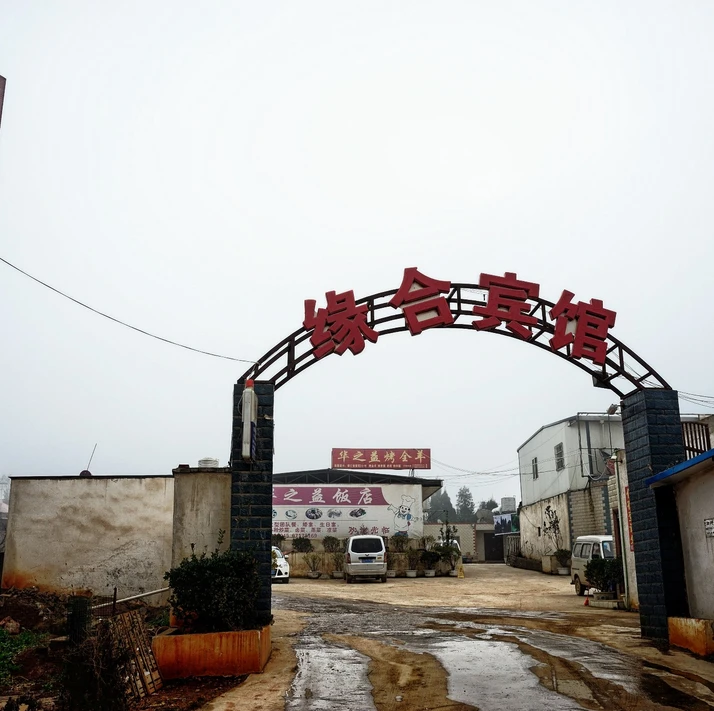
I booked the Yuanhe Hotel on Taobao in advance—118 RMB per night, including airport transfer. The owner was a straightforward guy, and the hotel had just been renovated—clean and tidy. But the location was a bit remote, and the roads weren't great. I'd recommend it to those who don't mind a little adventure.
First Impressions of Kunming: Disappointment and Surprise in the Fog
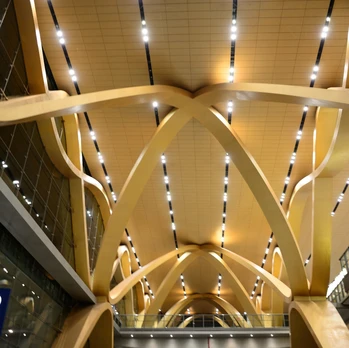
Waking up to thick fog was a letdown—this wasn't the Yunnan I'd imagined. But when we got to Kunming Airport, I was amazed by the roof design—its winding, flowing lines were striking.
We lingered outside the airport for a while, and as the clouds gradually parted, my mood lifted. I pulled out my camera to take photos. My friend joked that my jump shots made it look like I had two-meter-long prosthetic legs—well, jump high enough, and your spirits soar too.
Golden Horse and Jade Rooster Archways: Kunming's Icon, Also a Sea of People
The Golden Horse and Jade Rooster Archways are located in downtown Kunming. The eastern arch faces Golden Horse Mountain, and the western arch faces Jade Rooster Mountain. They are Kunming's landmark structures, built during the Xuande reign of the Ming Dynasty, nearly 400 years ago. The golden horse and jade rooster symbolize good fortune, and locals consider them the city's emblem.
But honestly, the reality might shock you—it's a sea of people, thick with commercialism. Street vendors line the sidewalks, and women in silver jewelry shops busily attend to customers. If your impression of Kunming isn't great, it's probably because this place is just too lively.
Xiangyun Street Snacks: A Foodie's Self-Cultivation
Locals recommended the Xiangyun Street snack alley. I don't consider myself a foodie, but before I knew it, I'd ordered a whole table: grilled fish, pineapple rice, spring rolls, "shuaishou baba" (hand-tossed flatbread)… Wait, "baba"? Why do Yunnan people love naming things "baba"? I rolled my eyes and kept eating.
Kunming truly lives up to its name as the Spring City. For a northerner used to four distinct seasons, seeing coconut trees planted along the streets was a pleasant surprise.
Kunming to Kunming Train Station: Direct Subway, Very Convenient
The subway in Kunming goes directly to the train station—very convenient. At 10 PM, we boarded the train to Dali. A hard sleeper berth for 9 hours cost about 100 RMB. Sleep through the night, and wake up in Dali.
Day 2: Dali, First Encounter with the Blue of Erhai
7 AM, Dali Train Station
We arrived in Dali at 7 AM and took bus No. 8 to the ancient town. Getting off at "Feng Hua Xue Yue Hotel" stop, we could see the east gate of the ancient town.
I have to give a shout-out to the owner of Qinglan She. We called to ask if we could drop off our luggage before heading back to explore the ancient town. She readily agreed and arranged for a driver to take our bags from the ancient town to the inn—free of charge. That kind of trust made us stay in Caicun Village, Dali, for five full days.
Dali Ancient Town: The Intersection of Commerce and History
Dali Ancient Town is large, and like most popular tourist spots, it's overrun with visitors, foreigners, wandering musicians, artists, and countless bars, inns, and shops. The noise is deafening, and the commercial vibe is intense. What's more frustrating is that, aside from a few pedestrian streets, motor vehicles can drive freely within the ancient town—causing irreversible pollution and damage. But I heard that starting next year, vehicles will be banned inside the town. That's a relief.
Still, as the former capital of the Nanzhao and Dali Kingdoms, Dali Ancient Town remains a historically and culturally significant city—imposing on the outside, refined within. A few recommended spots: - The ancient city gate towers, Wuhua Tower, and Foreigner Street (must-sees for tourists) - The farmer's market (for local snacks) - The Chinese-style Christian and Catholic churches (worth a visit)
Cangshan Snow and Erhai Blue

Cangshan Mountain had just had a snowfall, and the snow hadn't fully melted yet. Combined with the later sunrise and sunset times, we arrived just as the morning sun hit the mountain, turning the snow-capped peaks golden.
Sunrises in Dali are late, and locals live on a different schedule. City people are rushing around at 7 or 8 AM, but in Dali, most people are still tucked in bed, waiting for the sun to climb higher before starting their day. How I envied that laid-back lifestyle.
The Everyday Charm of the Ancient Town
We stumbled into a park within the ancient town. A child was probably there exercising with family. At the market, an older woman sold vegetables, and a vendor offered wax apples—20 RMB for three. I'd recommend trying them with Taiwanese jujubes; they're crisp, sweet, and juicy.
Exiting the west gate of the ancient town and crossing the road westward, we found a village with many inns built in Bai ethnic architectural style, nestled against Cangshan Mountain, with quiet streets. I highly recommend "Zaohuishou Cold Chicken Rice Noodles" on Renmin Road—6 RMB a bowl, absolutely delicious.
Dali Ancient Town Tips
- The best way to explore the ancient town is by bike; electric carts are also an option. I chose to walk, avoiding the crowds and venturing into quiet alleys, where unexpected discoveries often await.
- Wuhua Tower is a landmark—climb it for a panoramic view of the ancient town. Free entry.
- From the south gate, you can climb the ancient city wall. Watching the sunset over Erhai from there is stunning.
- If driving, I recommend parking at the municipal government compound outside the north gate—free of charge.
- For postcard lovers, the post office is in the center of the ancient town. You can buy Dali scenery postcards with postage and get a special Dali Ancient Town commemorative stamp.
- Heading straight south from the south gate, you'll find Wenxian Tower—worth a visit.
Qinglan She: A Home by Erhai Lake
Once we arrived at the inn, we shamelessly started taking selfies. We stayed in a fourth-floor room with a 270-degree sea view, so close to Erhai that it felt like a single misstep would drop us straight into the water.
In winter, Erhai Lake is breathtakingly blue—utterly, completely blue. Climbing to the rooftop of the neighboring 1969 Inn, with the bright sunshine, the azure lake, the snow-capped Cangshan Mountain, and the blue sky, something deep inside me was ignited.
The 1969 Inn is built entirely over Erhai Lake, giving you the feeling of living on the water. There's a bar and café at the entrance, along with a wall full of leisure books. If you have time, you can sit here leisurely for an entire afternoon.
A Night for Two Brothers

Back at the inn, we put on our "prosthetic legs" and kept taking photos. We brewed some tea in the courtyard and enjoyed the warm winter sunshine. Dali has a plateau climate with abundant sunlight—don't forget to bring sunglasses and sunscreen.
After settling in, we realized our stomachs were empty. Dali beer and "Feng Hua Xue Yue" are local specialties. Strolling around the inn, surrounded by the blue of Erhai and the blue of the sky, it felt like being in a painting.
My travel buddy was exhausted after two days of travel and went to bed. I stayed on the third-floor balcony until sunset. The inn owner, Sister Meiwen, came up to hang laundry, and we chatted for a while. Qinglan She truly is an inn full of life.
A Sleepless Night Under the Stars
After watching the sunset, I went to rest, planning to get up later to photograph the stars. Back on the balcony outside my room, Erhai lay below, and I could faintly see the stars reflected in the water. We didn't say much—just drank and gazed into the distance.
On the third-floor balcony, the view was even wider. To shoot the stars, we completely rearranged the furniture. The next day, the owner almost pulled my ear: "What were you clattering about in the middle of the night?!"
Surrounded by stars on such a beautiful night, how could I bear to sleep? I stayed out until 6 AM, and the sky was still full of stars—absolutely stunning. But before the sun rose, my body gave out, and I went back to bed.
Day 3: The Erhai Seven-Person Group Forms
Adjusting the Pace, Sleeping Until Noon
Two days of travel had made the itinerary too rushed. On top of that, I'd been up since 2 AM shooting stars the night before, so I decided to adjust and sleep until noon.
A note: flying to Kunming and then taking the train to Dali is more economical but also more time-consuming. Direct flights to Dali are pricier but let you relax sooner. If your budget allows, I'd recommend flying directly to Dali.
The Erhai Seven-Person Group
Heading out at noon, we met a group of interesting people by Erhai near Caicun Village. The first of the Erhai Seven-Person Group I encountered was Sister Ze—when I went to the third-floor balcony to look for a quick-release plate that had fallen into Erhai, she was there drinking red wine. We exchanged smiles, and then I went searching for the plate in the lake (that metal plate sank but didn't hit the bottom—what was I even looking for?).
There was also Xiao Pan, a beautiful nurse. At sunset, at the Caicun Village dock by Erhai, a shepherd dog named Guo Guo often came to play in the water. As we were taking a group photo on the small dock, it charged into the lake, splashing water that seemed frozen in time, as if time had stopped.
The door lamp of the 1969 Inn caught the evening sunlight. As the sun was about to set behind Cangshan Mountain, the lamp lit up in response.
The only group photo of the seven of us. Brother Zhong said, "That's Qinglan She up ahead!"
Even if the internet bombards you daily with images of every corner of the world, even if communication devices and transportation make the world feel within reach, you can't truly feel a place without experiencing it in person. And the unexpected surprises along the way are beyond imagination.
Day 4: Cycling Around the Lake, Discovering Xizhou
Heartfelt Breakfast
Waking up early, the uncle and aunt had prepared a heartfelt breakfast for us—a special treat not everyone gets. The porridge was made from eight kinds of flour-based ingredients. The scallion and egg pancake is only truly delicious fresh off the pan—one batch per pan, made with eggs from their own free-range chickens. Crispy, fragrant, and unforgettable.
Sister Meiwen called us eight times to come downstairs for breakfast. She also tried to help me arrange to stay closer to the girls—she really went out of her way for me.
Cycling Around the Lake: Caicun to Xizhou
We rented an electric scooter, costing 60–80 RMB. The route was Caicun to Xizhou, then to Haishe Park, and back. We'd decided on this distance in advance, and later, when we took a car to circle the lake, we confirmed that this stretch had the best scenery.
The Dali Erhai Lake Ring Road is 115 kilometers long. The western section from Xiaguan to Jiangwei is about 50 kilometers. If you're driving, you can go farther. Popular spots like Caicun, Xizhou, Haishe, Shuanglang, Wase, and Xiaoputuo are mostly on the northern half of the lake, while the southern half has more of a local urban vibe.
Dali is on a plateau with abundant wind energy. Many surrounding villages rely on wind turbines for electricity. The streetlights along the western ring road are also powered by wind energy.
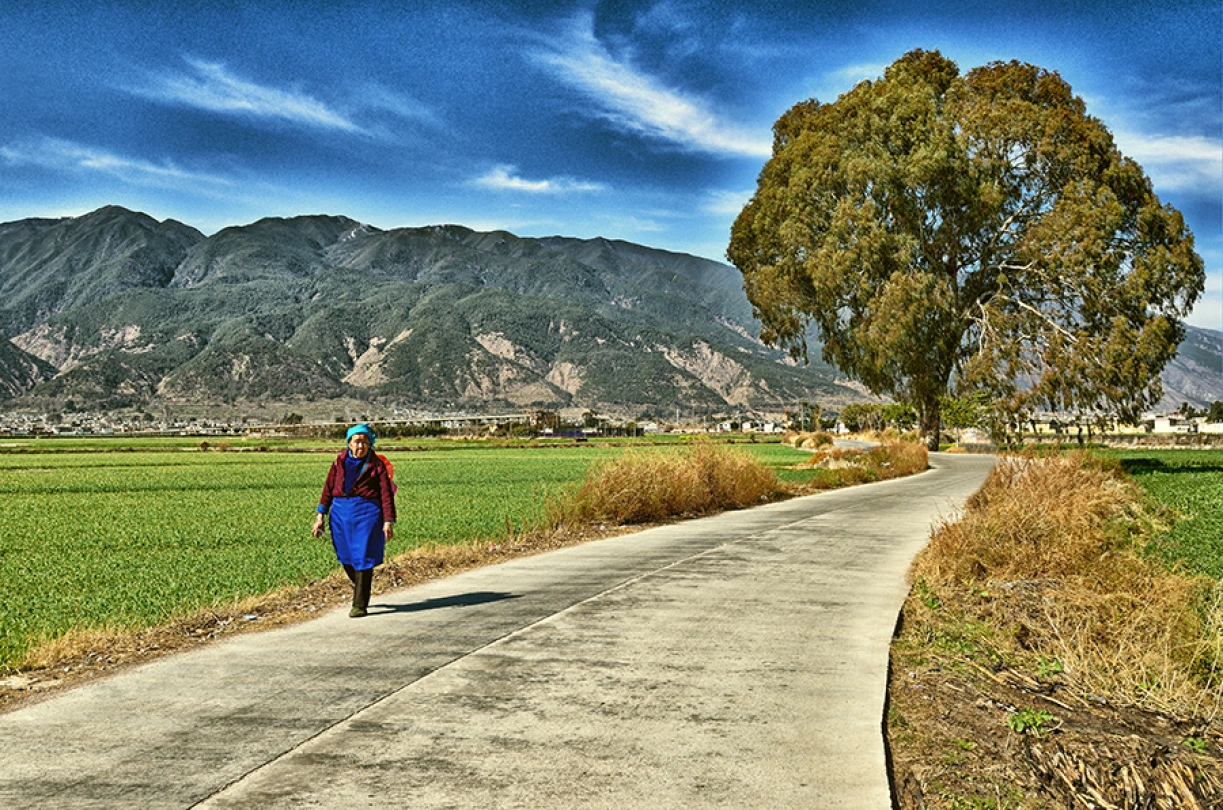
In the distance, an older woman walked toward us. It was midday, so she was probably heading home for lunch. The breadth of life—without travel, would I ever see such a scene? Me, the old woman, the tree, the mountain, the universe…
The pure blue of Dali's sky, the vivid green of Cangshan and Erhai, and that spotless white—these things make countless visitors to Dali reluctant to leave.
Xizhou Ancient Town: Authentic Bai Ethnic Charm
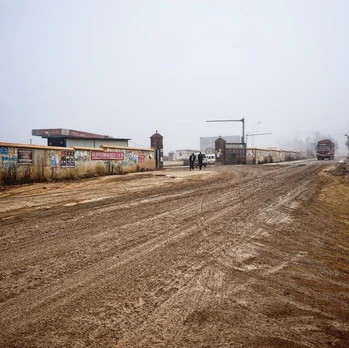
The central square of Xizhou, Sifang Street, is a small plaza surrounded by shops, with a stone archway—the recently built "Wenming Archway." The original archway was called "Timing Archway," built during the Ming Dynasty after several local scholars passed the imperial examinations. The names of villagers who achieved scholarly honors could be inscribed on it.
Historically, Xizhou had the scale of a city. Before the Nanzhao Kingdom moved to the area around Erhai, this was a settlement of the Bai ancestors, known as the "He Man" people, and was called Dali City. Legend has it that a general under Emperor Wen of the Sui Dynasty once stationed troops here, so it was also known as Shi City. During the Nanzhao period, a palace was built here.
Farmers at work, winter boats on Erhai, shade under the trees—every frame is a picture.
A Perilous Return Trip
The electric scooter was almost out of battery. Some newer models can handle this distance, but I got unlucky—it died halfway. On the way back, I had to charge it twice just to make it to Caicun, which made me late for the owner's dinner invitation.
But on that night, with a dead scooter and the owner urging me to come back for dinner, I encountered such stunning rays of light—absolutely beautiful.
Day 5: Driving Around the Lake, Discovering Shuanglang
Erhai Sunrise
On the fourth morning in Dali, I finally saw a beautiful sunrise over Erhai. As the sun leaped over the mountain peak, the still-dark surface of the lake was suddenly bathed in golden light from the rising waves. Everything was breathtakingly beautiful. Time seemed to stand still; all I could hear was the excited pounding of my own heart.
Too bad there was no one I loved to share it with me. It felt a bit lonely. If there's a next year, I hope you'll be on the road with me.
Driving Around the Lake: Caicun to Shuanglang
We hired a car to circle the lake—seats for six people, 360 RMB total, split evenly. Our companions were four young women from Fujian (not from the Erhai Seven-Person Group; their group of five had one member who wasn't feeling well). They were lovely, and we took plenty of photos along the way.
We hired a car because we wanted to go farther to see Shuanglang. Before going, we'd heard that Shuanglang was one big construction site, with building everywhere, so we didn't book accommodation there. After visiting Shuanglang, I found it wasn't for me—too noisy, more suited for romance and chance encounters. My friend and I were there to unwind, and the peace of Caicun was what kept us there.
Chongsheng Temple and the Three Pagodas
Heading north along National Highway 214, past Dali Ancient Town, you'll find the famous Chongsheng Temple and its Three Pagodas. This is a large-scale Buddhist temple complex built during the Nanzhao and Dali Kingdoms. Admission is 121 RMB, which includes a combined ticket for the Three Pagodas Park and the Three Pagodas Reflection Park.
The ticket was too expensive, and the place was packed with tourists. I tend to avoid popular paid attractions. So we took some tourist photos outside with the four Fujian girls and moved on. The Three Pagodas and Chongsheng Temple, known as the "Buddhist Capital," add a solemn dignity to Dali, a blessed land of fragrant Buddhism. If you're interested in the architecture and the history of the Nanzhao Kingdom, I'd recommend spending half a day there.
Haishe Peninsula: Pristine Wetland Scenery
Haishe Peninsula is the most pristine spot on Erhai Lake. It's currently undeveloped, with untouched plateau lake and wetland scenery. The views are beautiful, the crowds are sparse, and it's incredibly peaceful. Across the lake lies Shuanglang.
In winter, Haishe Peninsula is surrounded by deep blue Erhai on three sides, with leafless trees creating a sense of openness and beauty. Standing here, looking up at the vast sky, with a gentle breeze that doesn't feel too cold, and admiring the deep blue water unique to winter—the lake is so clear you can see the bottom, reflecting the surrounding mountains. It's stunning!
Xizhou: An Authentic Ancient Town
Compared to the noisy, chaotic Dali Ancient Town, I prefer the authentic, unspoiled Xizhou Ancient Town. No other ancient town has ever made me so reluctant to leave. From the moment I entered Xizhou, I fell in love with this peaceful town.
Xizhou Ancient Town faces Erhai Lake to the east and rests against Cangshan Mountain to the west, with over a thousand years of history. It's still relatively primitive, not as bustling or lively as Dali or Lijiang. Xizhou still preserves many Bai ethnic residential buildings from the Ming, Qing, and Republican periods. The most common architectural style is "three houses and a screen wall" and "four courtyards with five skywells." Some buildings also show foreign influences. Bai residences are almost always two stories or more, with main halls, facing halls, and side rooms all having three rooms on two floors. The Bai people call this three-room structure a "fang."
Final Thoughts: The Meaning of Travel
This trip to Yunnan taught me something: each of us lives on this earth, each with our own life. Yet among these seven billion tiny individuals, he is my brother, and we went to Yunnan together.
Along the way, we had some fierce arguments. Looking back now, I can only say thank you for those arguments—they made us understand each other better, grow closer, and appreciate each other more. Maybe couples travel to confirm their love; we traveled to confirm our bond.
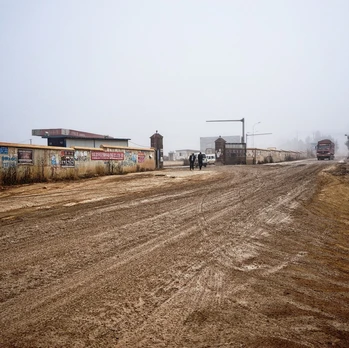
The people I met on this trip pieced together this wonderful journey. In no particular order: - My best buddy-in-training (Dong Qi) - Dali Qinglan She owner: Meiwen; Meiwen's parents: Uncle and Aunt; Meiwen's child: Yitong; Qinglan She volunteer: Haozi - Lijiang Tinglan Ju owner: Sister Baihe; Baihe's daughter: Doudou - Erhai Seven-Person Group: Brother Zhong and Sister Ying from Beijing (we've kept in touch since returning); Sister Ze (actually a northern girl—you know why we call her "brother"); Big Pan and Little Pan from Guangdong (sisters, two flowers) - Five Fujian girls: haezu, Zhang Qian, Da Niao, A Fei, Zhu Zhu (some things only people our age understand. Even if you're our age, looking at our photos and reading our stories, you still won't fully grasp the "entanglements" between us brothers) - Dali Caicun's excellent chef, boatman, and scooter rental boss: Master Du (highly recommend his pickled cabbage stir-fried pork—no explanation needed) - Our lake tour driver: Yang Dan
On this Yunnan trip, I found a lot of valuable information on Mafengwo, and by the end, I had developed my own understanding of the place. I hope this post can help more friends who want to take a leisurely trip there.
Travel isn't about escape—it's about coming back better. Even if I have to go back in a few days, back to work, back to the noise, back to the frustration—at least I see the world differently now. Even if nothing has changed, life is like a book, and my book has a few more colorful pages than others.
That's the meaning of travel.
Practical Tips Summary
Recommended Itinerary
- Budget-friendly: Fly to Kunming → train to Dali → bus to Lijiang → fly back (approx. 5,500 RMB)
- Comfortable: Direct flight to Dali → car to Lijiang → fly back (more expensive, but more relaxing)
Recommended Accommodation
- Dali Caicun: Qinglan She (highly recommended, the owner is wonderful)
- Lijiang Ancient Town: Tinglan Ju (Sister Baihe is very welcoming)
Must-Try Foods
- Zaohuishou Cold Chicken Rice Noodles (6 RMB/bowl)
- Pickled Cabbage Stir-Fried Pork (at Master Du's place)
- Wax Apples (20 RMB for 3)
- Taiwanese Jujubes
Essential Items
- Sunglasses, sunscreen (strong UV on the plateau)
- Compact camera (to capture moments anytime)
- Power bank (essential for electric scooter rides around the lake)
Cycling Around the Lake Tips
- Newer electric scooters can handle the Caicun to Xizhou round trip
- Battery might die mid-journey—bring a charger
- Most scenic section: Caicun → Xizhou → Haishe
Notes
- Motor vehicles can enter Dali Ancient Town—stay alert
- Shuanglang is noisy, better for those who like excitement
- Caicun is peaceful, ideal for relaxation
- Kunming is crowded—half a day is enough
Finally, regarding the use of photos in this article: Please respect the photographer's copyright. If you need to use any images from this article, contact me for permission.
My first real journey, and my first travelogue. Thank you to the platform for its support and recognition, and thank you to everyone I met along the way.
Dian Blue, Kunming-Dali-Lijiang—this shade of blue, I will always remember.
You should also read:
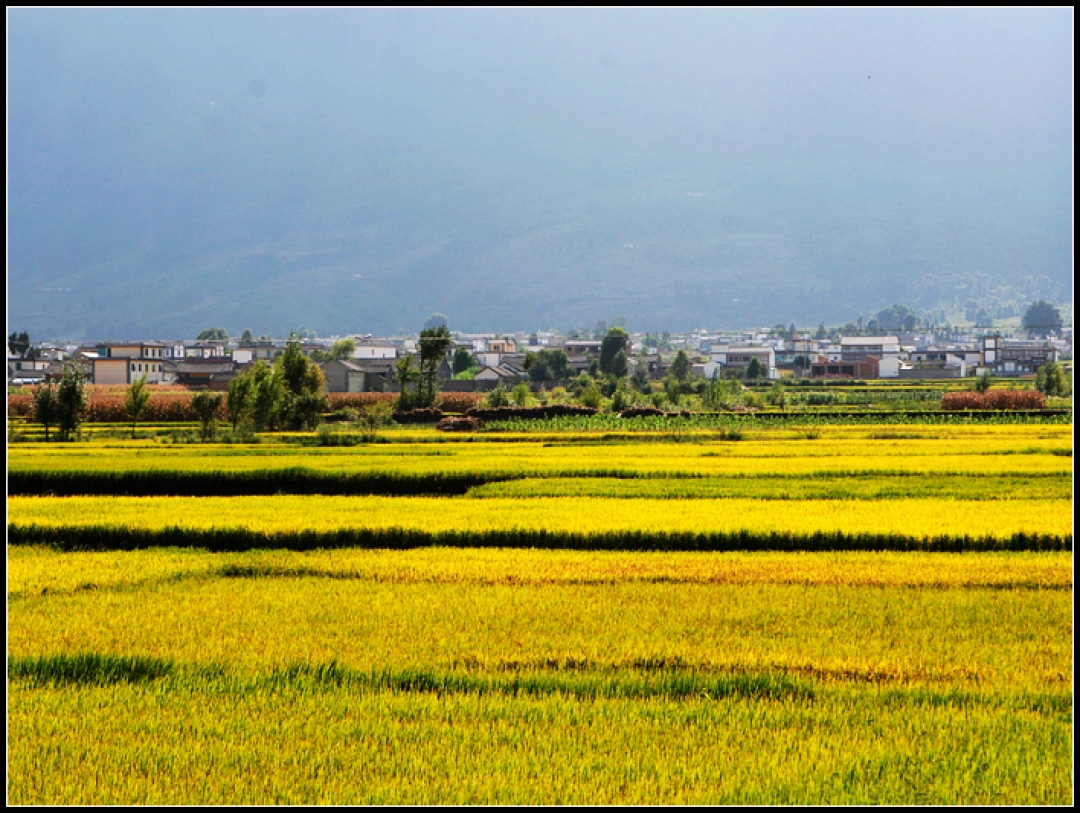
A 9-Day Yunnan Journey: From Lijiang to Dali to Tengchong – A Trip Toward Self-Reconciliation
A 9-Day Yunnan Journey: From Lijiang to Dali to Tengchong – A Trip Toward Self-Reconciliation Some say travel is simply going from a place you're tired of to a place other people are tired of. It stings to hear, but it's painfully true. Yet there's…
Continue reading...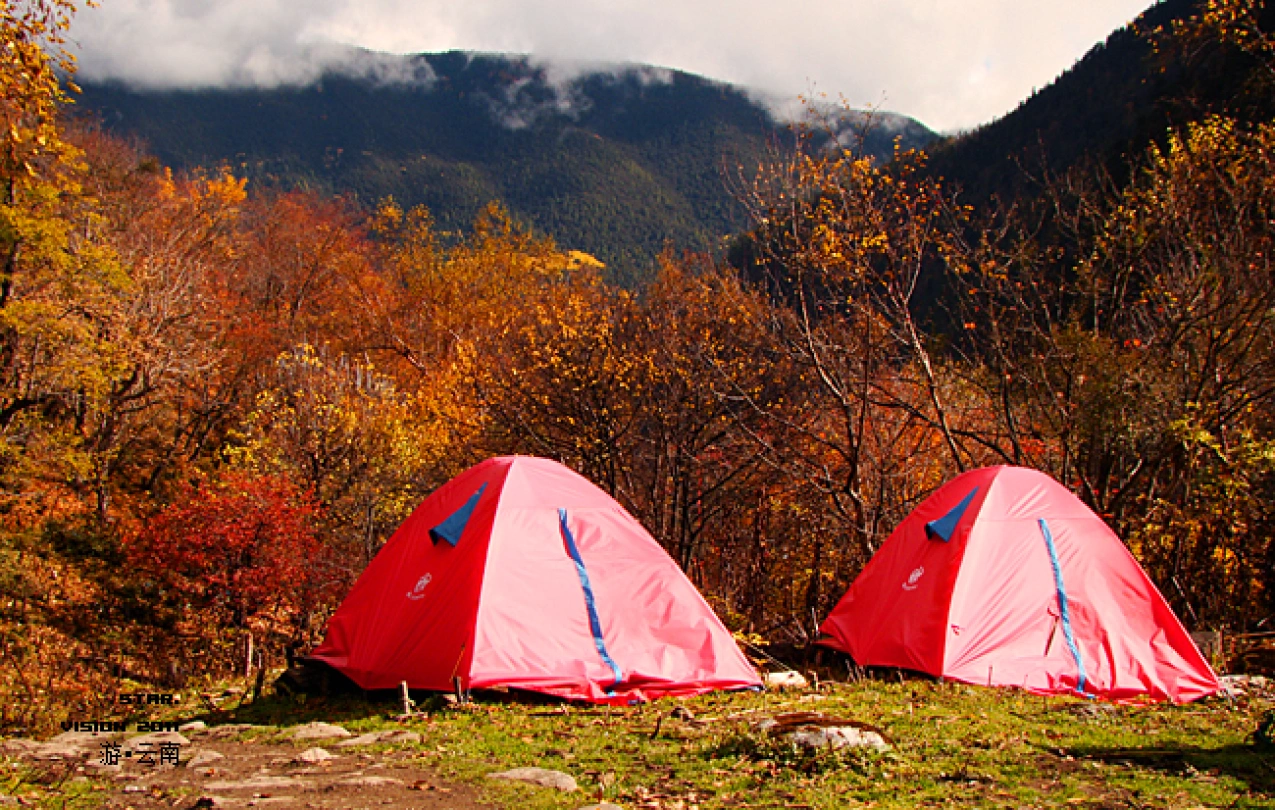
Yunnan! Paradise on Earth – The Yubeng Chapter: A Soul-Cleansing Journey into Seclusion
Yunnan! Paradise on Earth – The Yubeng Chapter: A Soul-Cleansing Journey into Seclusion Prologue: Why Yubeng? If you ask me which place in Yunnan is most worth hiking to, I would answer without hesitation: Yubeng. This is not an answer I give lightly. As a…
Continue reading...
God’s Abandoned Palette: A Self-Drive Journey Through Yunnan’s Dongchuan Red Land
God’s Abandoned Palette: A Self-Drive Journey Through Yunnan’s Dongchuan Red Land Travel has never been about reaching some distant geographic coordinate. It’s about encountering, along the way, the version of yourself buried beneath the rubble of daily routine. During this May Day holiday, I finally…
Continue reading...