Entering Shangri-La, Meeting the Snow Mountain God—Meili
Entering Shangri-La, Meeting the Snow Mountain God—Meili
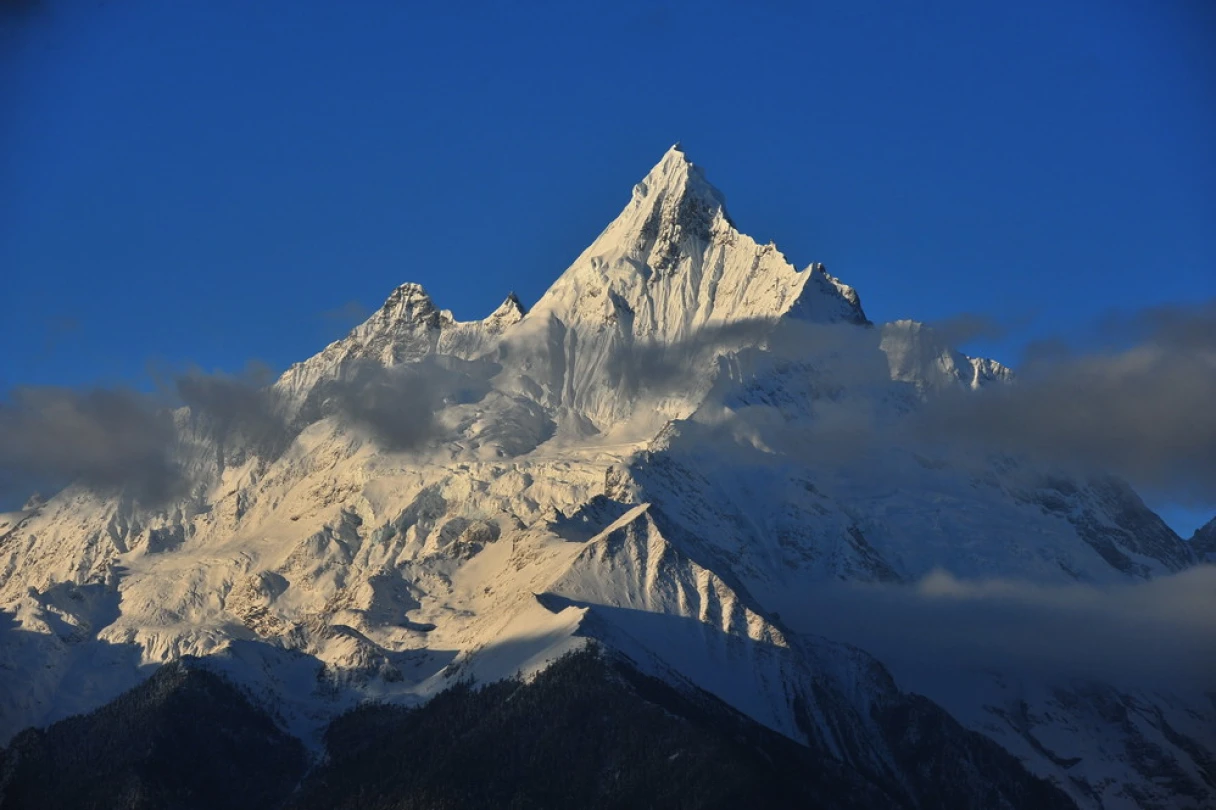
Before setting foot on this land, I had pored over countless photos taken by seasoned travelers—those majestic snow-capped peaks, the azure skies, the prayer flags fluttering in the wind. They had already painted vivid images in my mind. I thought I was fully prepared, emotionally and mentally, until the moment I stood face-to-face with Meili Snow Mountain. That's when I understood: some awe simply cannot be captured by any lens. The emotion that surged from the depths of my heart made my eyes well up uncontrollably. Meili possesses that kind of magic.
Departure: From Beijing to Shangri-La, a First Encounter with the Highlands
An Unexpected Detour
During the 2012 Spring Festival, I had booked a direct round-trip flight from Beijing to Diqing, but due to a flight cancellation, I was forced to reroute through Kunming. By the time the plane finally touched down in Shangri-La under the cover of night, it was already past eight in the evening. The high-altitude plateau at 3,200 meters gave me a less-than-gentle welcome—mild altitude sickness made me feel as if I'd downed three shots of baijiu (Chinese liquor), a tipsy haze tinged with hunger.
Stepping off the plane, I quickly stuffed two chocolate bars into my mouth and headed straight to a halal restaurant in Dukezong Ancient Town. A steaming pot of maoniu huoguo (yak hotpot) arrived, its aroma filling the air. But I only dared to eat until I was about seventy percent full—this is the first rule of high-altitude survival: don't burden your heart and brain.
That night, I checked into the Happy Garden Inn. The Tibetan-style room had underfloor heating, plenty of hot water, and bedding so clean it felt reassuring. Traveling in southern China during winter, indoor heating is no small matter—cold can directly worsen altitude sickness, a lesson I would later learn the hard way.
Survival Rules for Altitude Sickness
As someone with a medical background, I have my own understanding of altitude sickness. Dizziness, headaches, heart palpitations, fatigue—almost everyone experiences these symptoms. The key is how to adapt quickly. My experience boils down to two principles:
Reduce oxygen consumption: Rest more, avoid strenuous activity, don't eat or drink anything too hot, and try to stay calm when you see stunning views—though that's incredibly hard.
Increase caloric intake: Drink plenty of brown sugar water (a local tip that I tested and found effective), and stock up on chocolate, beef, vegetables, and eggs. Eat smaller, more frequent meals.
Of course, if you experience severe dizziness, vomiting, diarrhea, difficulty breathing, or high fever, don't try to tough it out—this isn't something rest can fix. Getting to a lower altitude as soon as possible is the smart move.
First Glimpses of Shangri-La: Napa Lake in Winter and Potatso's Stillness

Napa Lake: A Song of Life in a Frozen World
On the second day, we chose to start our acclimatization at a lower altitude and lower intensity. Napa Lake and Potatso National Park became our first stops in Shangri-La.
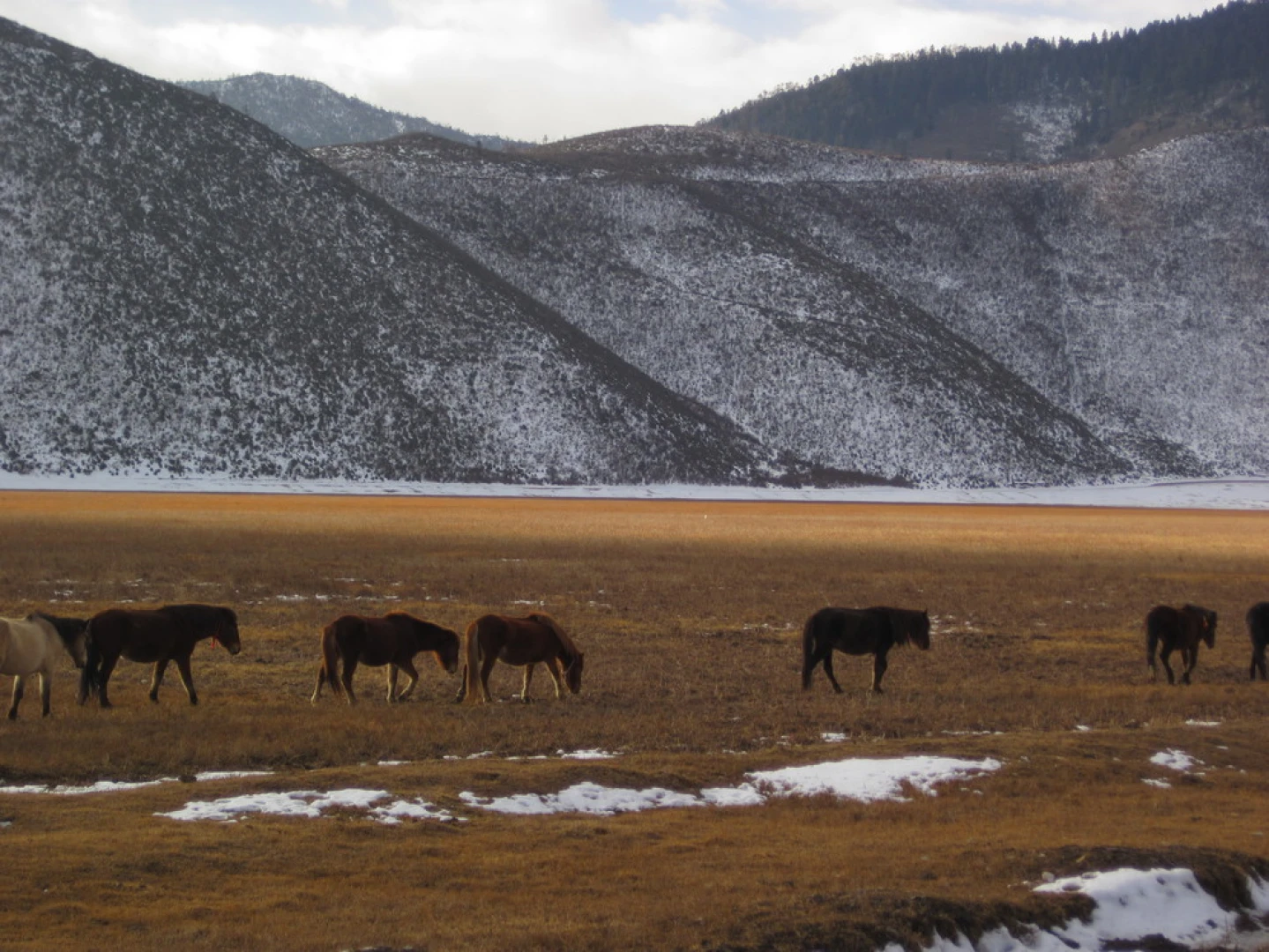
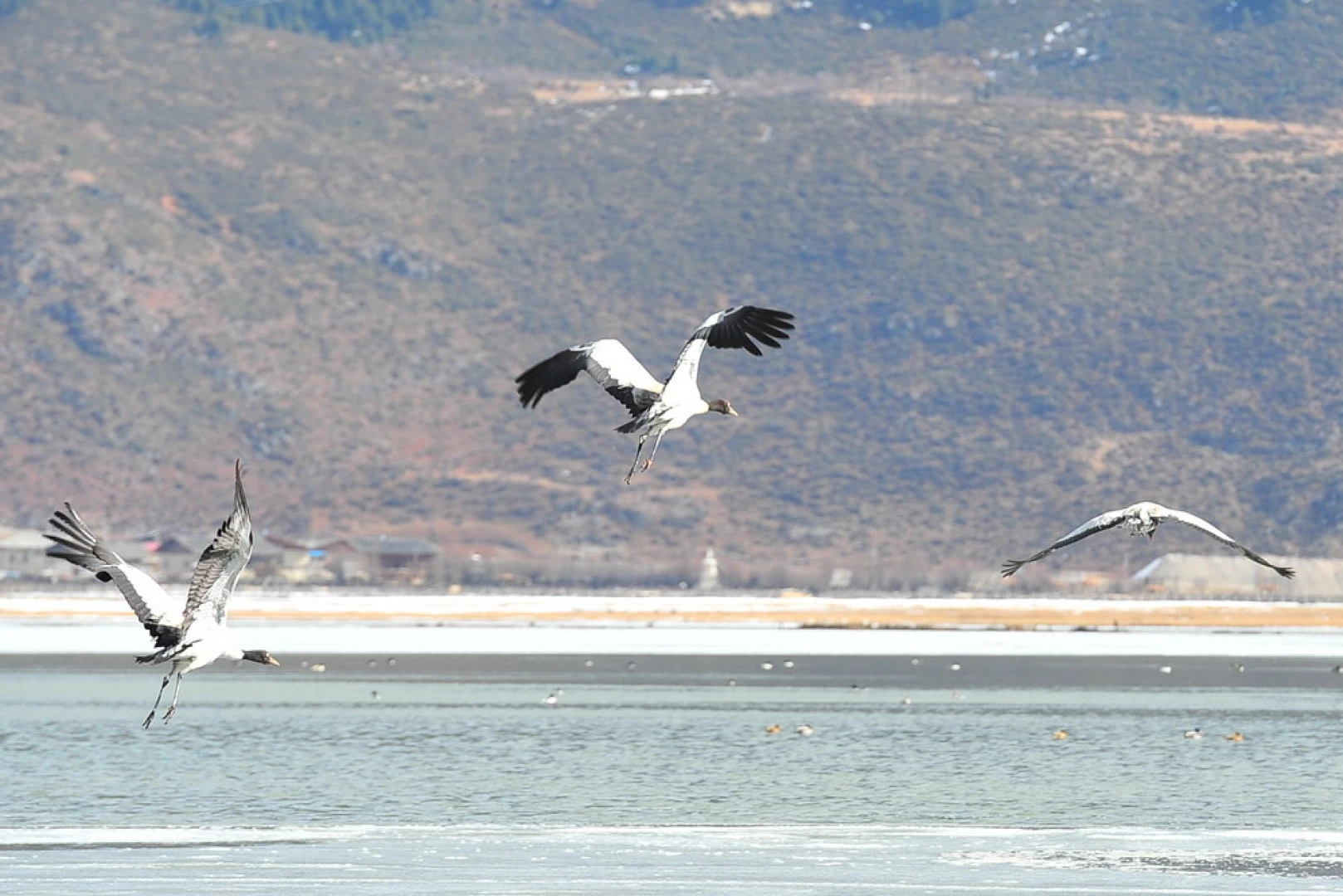
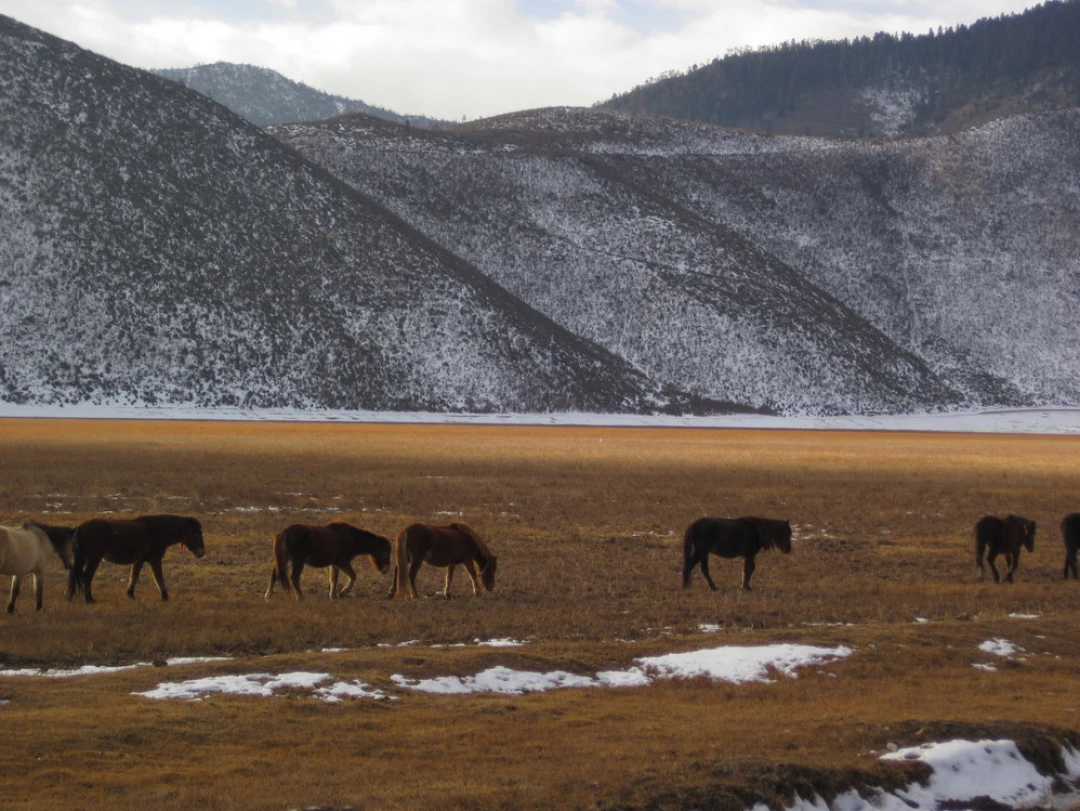
In winter, Napa Lake sheds its summer green and dons a frozen silver coat. The icy wetlands and the partially frozen lake surface have a unique charm. This is also a paradise for migratory birds—cranes, wild ducks, and mandarin ducks gather here in flocks to spend the winter.
I raised my Canon point-and-shoot, trying to capture those nimble figures. But these little creatures were so alert it was almost comical—the moment I lifted my camera, the distant black dots vanished without a trace. After walking for most of the day, I had nothing to show for it. I could only laugh bitterly. Clearly, photographing birds requires both equipment and patience.
But Napa Lake's beauty goes far beyond its birds. The freely roaming piglets, the wooden racks for drying hay, the mottled patterns on the frozen lake—every detail tells the story of this land's unique charm.
Potatso National Park: The Still Beauty of Winter
Potatso National Park is located about 22 kilometers east of Shangri-La, comprising two major ecological tourism areas: Bita Lake and Shudu Lake. In winter, the lake surfaces are completely frozen. Without the reflections, you lose some of the liveliness, but you gain a serene solemnity. The park has eco-friendly shuttle buses for transportation, and the walking sections are limited. Taking it slow, we experienced almost no altitude sickness.
Heading to Meili: A Thrilling Mountain Road Journey
Choosing a Reliable Tibetan Driver
On the third day, we set off for Deqin County. Through a friend's introduction, we contacted a Tibetan driver named Qilin. He was a down-to-earth, warm-hearted man with two vehicles—a small minivan for ordinary sightseeing (economical) and a Mitsubishi Pajero 4x4 for the rugged roads to Deqin.
Here are a few tips on hiring a private driver:
- Choose an off-road vehicle: The Xianggelila-Deqin road is almost entirely winding mountain roads, covered in ice and snow in winter, prone to landslides in summer, and has many sections under construction. A 4x4 is essential for safety.
- Choose a Tibetan driver: They all know each other and will help one another in trouble. This mutual support is crucial in high-altitude areas.
I still have Qilin's phone number (13170790202). If you're planning a trip to Meili, feel free to contact him.
The Icy Mountain Road: A Heart-Pounding Test
This road made me fully understand why a 4x4 and a Tibetan driver are non-negotiable. Ahead of us was a convoy of expensive off-road vehicles, each worth a fortune, but their drivers didn't dare to move. They were stuck behind us and eventually had to let us pass. Driving on icy mountain roads isn't just about skill—you need years of experience navigating such terrain.
We crawled along behind them for a long time, at a speed of just 5 kilometers per hour. The thrill was unforgettable.
Yet the scenery along the way made us forget the danger. The Moon Bay of the Jinsha River, lunch in the small town of Benzilan, the snowy views at Baima Snow Mountain Pass—every spot begged for a camera click. At the 4,300-meter pass, the light was so intense that even a polarizing filter struggled to cope.
First Sight of Meili: The Moment I Almost Cried
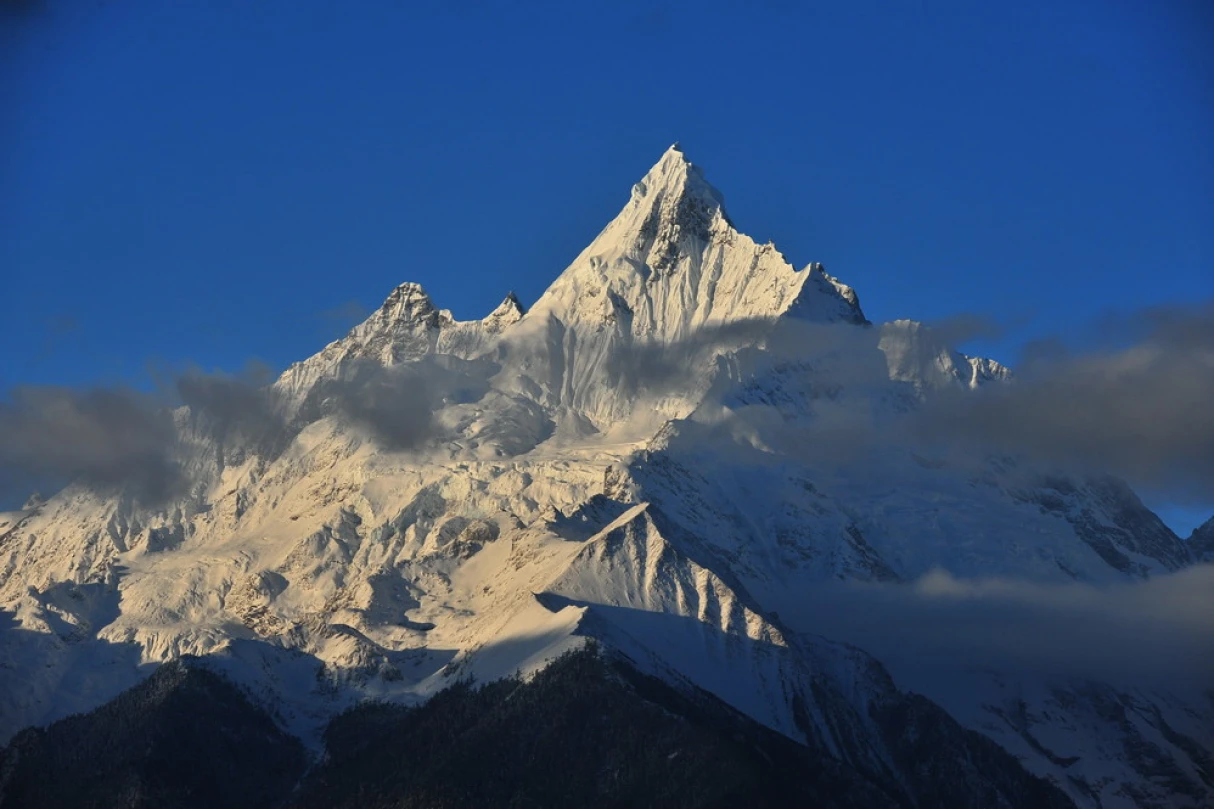
The moment we arrived at the Meili Snow Mountain viewing platform, I was completely stunned. The mountain before me seemed to stand in a celestial palace—clouds, white and swirling, wrapped around its waist, while all the main peaks were fully visible. Behind us stood thirteen white stupas; before us, countless prayer flags fluttered. In the deep blue sky, black eagles soared—only eagles are worthy of such a sky, such sanctity.
For the first time in my life, faced with a landscape, I felt so moved I wanted to cry. Meili stands there; she is a goddess—majestic, solemn, holy. I think that human faith is born spontaneously in the presence of such a mountain. She looks down at you from above, making you dare not be arrogant, dare not err.
In that moment, I knew that all I could bring back to Beijing was a photograph. The spiritual shock I felt simply couldn't be conveyed through a small picture. I can only say that I have truly experienced Meili, and that awe can only be felt by standing there.
Morning at Meili: Missing the Golden Sunrise
Lucky and Extremely Lucky
Seeing Meili Snow Mountain and capturing its "日照金山" (sunlit golden peaks) are two entirely different things. One is luck; the other is extreme luck. Unfortunately, we waited two mornings in a row but couldn't capture it. We had to leave with only a "cloudy version" photo.
Today, the main peak of Meili Snow Mountain is officially named Kawagebo, though historically, Tibetan tradition was different. The true "Meili Snow Mountain" was originally a smaller peak north of today's Kawagebo. Due to various reasons, today's Meili (also known as Prince Snow Mountain) consists of three main peaks—essentially a family of father, mother, and son. The "Thirteen Peaks of the Prince" is an approximate number; in Tibetan, "thirteen" is an auspicious number meaning "many."
- Main male peak: Kawagebo
- Main female peak: Miancimu Peak
- Main child peak: Bujiong Songjie Wuxue Peak
- Another important peak: Jiwu Ren'an Peak (Five Buddha Lotus Crown)
The Nu River, Jinsha River, and Lancang River run parallel among these snow-capped peaks, forming the famous Three Parallel Rivers. Every morning, large amounts of water vapor form clouds—this is precisely why these peaks rarely appear clearly all at once. As for the golden sunrise, it refers to the moment just before sunrise when golden-red light bathes the mountain in a dreamlike glow. The entire spectacle lasts only three to five minutes. Once the sun is fully up, the snow-capped peaks turn from gold to white.
We only managed to capture the "cloudy version of the golden sunrise," but even those clouds sweeping across the peaks were breathtaking.
Mingyong Glacier: Youth at the Foot of the Glacier
Meili Snow Mountain has four major glaciers: Mingyong, Sinong, Niuba, and Nongsong. They are among the world's rare low-latitude, low-temperature (-5°C), low-altitude (2,700 meters) modern glaciers. The longest and largest is Mingyong Glacier. It descends from Meili's 6,740-meter summit in an arc down to the primeval forest at 2,600 meters, making it the southernmost modern glacier in China with the lowest ice tongue. However, due to global warming and excessive tourism, Mingyong Glacier is retreating at about 50 meters per year.
Exploring Mingyong Glacier took a full five hours—one and a half hours riding a mule uphill, one hour downhill, and two and a half hours of hiking. After the mountain path, there were boardwalks. We walked all the way to the Prince Temple, where we first glimpsed the glacier. Most tourists turned back at this point, but we didn't give up. We continued along a small path until we reached the end of the boardwalk.
Along the way, fearless little squirrels, nature's ink-wash paintings, the lines of snow—the glacier grew closer and closer, finally revealing its dreamlike blue. Sapphires scattered across the slope made us pause in wonder.
The boardwalk had collapsed under the weight of the snow, and we could go no further. At that moment, we were walking alongside the glacier. Beneath the snowy mountain, there was no one else—just the four of us. We set up a tripod for a group photo, and with eggs, fish sausages, and bread, we enjoyed a delightful picnic. Isn't youth meant to be enjoyed this way?
The Return Journey: Songzanlin Monastery and Shika Snow Mountain
Songzanlin Monastery: Faith in the Wind
On the return from Deqin to Diqing, the road was covered in ice. Qilin's driving skills were nothing short of impressive. He handled the Mitsubishi Pajero on such treacherous roads as if it were smooth pavement. Countless cars were stuck in snow or ice ruts along the way, but we passed them all with ease.
Back in Diqing by afternoon, we visited Songzanlin Monastery. Its grand scale, exquisite architecture, and prayer flags dancing in the wind—every element conveyed the power of faith.
Shika Snow Mountain: A Final Gaze
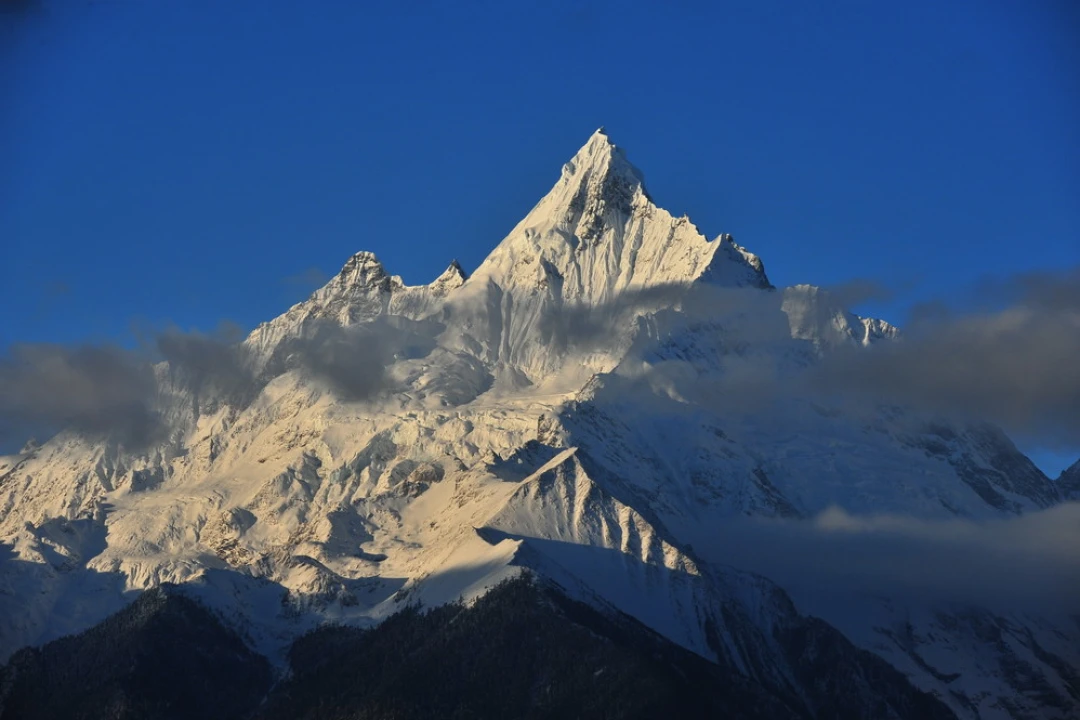
This was the last day of the trip. The cable car at Shika Snow Mountain has two stops. The first stop is at a high-altitude meadow halfway up the mountain, which had little to see in winter except a large stage for Tibetan song and dance performances. The second stop reaches the summit at 4,500 meters. On clear days, you can see Meili Snow Mountain and the Three Holy Mountains of Yading in the distance.
We tied all the hada (ceremonial scarves) we had received along the way to the summit of Shika Snow Mountain as a memento. With one last look, we said goodbye—farewell, beautiful and holy Meili Snow Mountain.
Cost Breakdown: A Trip Worth Every Penny
Transportation
- Beijing-Diqing round-trip airfare: 3,000 RMB/person (tax included, no extra charge for flight change)
- Full trip private driver fee: 3,500 RMB (200 RMB/day for minivan at Napa Lake, 1,000 RMB/day for 4x4 to Deqin, 300 RMB voluntary extra for Shika Snow Mountain)
- Per-person share of driver fee: 875 RMB/person
Entrance Fees
 - Napa Lake: 60 RMB/person - Potatso National Park: 190 RMB/person - Mingyong Glacier: 83 RMB/person - Songzanlin Monastery: 85 RMB/person - Shika Snow Mountain: 220 RMB/person - Total: 638 RMB/person
Other Expenses
- Mule ride: 180 RMB/person
- Accommodation: Happy Garden Inn 328 RMB/night (3 nights), View Paradise Hotel 280 RMB/night (2 nights), per-person share: 772 RMB/person
- Meals: About 30 RMB/meal per person, ate very well
Grand total: Approximately 6,000 RMB/person
Note: All prices are for the Spring Festival golden week. They would be significantly lower during off-peak times.
Final Thoughts
Meili Snow Mountain is not just a place; it is a faith. She stands there, witnessing the arrival and departure of every pilgrim. Photos can capture her appearance, but they cannot convey the shock she gives to the soul. If you too want to go, remember this: bring a sense of reverence, bring patience, bring respect for the high altitude. Then, stand there and feel it in silence—and you will understand why someone would cry for a mountain.
Because it is not a mountain. It is a god.
You should also read:
A Solo Journey to Yunnan: Shuanglang Chapter — Meeting Your Truest Self by the Erhai Lake
A Solo Journey to Yunnan: Shuanglang Chapter — Meeting Your Truest Self by the Erhai Lake Introduction: When a Dream Finally Becomes Reality Some say Yunnan is a place meant for solo travelers. It took me three full years to truly understand that. Two years…
Continue reading...
Meili Snow Mountain: A Soulful Journey of Dialogue with the Sacred Mountain
Meili Snow Mountain: A Soulful Journey of Dialogue with the Sacred Mountain Prologue: When Travel Becomes Faith Some journeys are forgotten as soon as they end. Others carve themselves into your bones. The trip to Meili Snow Mountain belongs to the latter. Waking up in…
Continue reading...
Two Girls' Graduation Trip: Dali and Shuanglang – A Poetic Farewell to Mountains and Sea
Two Girls' Graduation Trip: Dali and Shuanglang – A Poetic Farewell to Mountains and Sea Preface: Catching the Tail of Youth, Heading South During our senior year of college, my roommate and I – two girls studying in Beijing – decided to bid farewell to…
Continue reading...