February in Kunming|Those Gentle Days Dancing with Seagulls

February in Kunming|Those Gentle Days Dancing with Seagulls
Prologue: A Healing Migration
Every winter, when the city's noise leaves me exhausted and the creases in my soul need smoothing out, I find myself thinking of one place—Kunming. There, warm sunshine awaits, the turquoise waves of Dianchi Lake ripple gently, and a flock of white spirits from Siberia descends like snow.
Truth be told, there's no shortage of places to see seagulls. They appear at Jing Lake in Deyang, linger by the Qingyi River in Ya'an, and grace the stunning Qionghai Lake in Liangshan and Lugu Lake. But when it comes to scale, sheer numbers, and that fearless intimacy with humans, Kunming stands absolutely unmatched.
I'd originally planned to go during the Spring Festival. But when I opened the booking app, hotels and guesthouses near Haigen Dam were either shockingly expensive or already fully booked. Oh well—let the anticipation simmer a few more days. Avoiding the crowds and setting off after the holiday was the smarter move.
In the end, we embarked on our journey seven days after the Spring Festival. Everything fell into place perfectly—some seagulls had already flown off, but plenty remained, and the interaction was just as engaging. There were still plenty of tourists (it seems watching seagulls has no true off-season), but it was far more relaxed than during the holiday peak. Best of all, accommodation options were plentiful, and prices had returned to reason.
We stayed by Dianchi Lake for three nights, dedicating every dawn and dusk to these little white sprites. I don't know how others view "seagull-watching," but for me, it's a way of life—a life brimming with healing power.
Itinerary Snapshot: A Leisurely Wander Through Central Yunnan
To be honest, I didn't have a detailed plan before leaving. Just a simple wish: bring my beloved pet Doudou along, stay by Dianchi Lake for four days, watch seagulls, feed them, and photograph them.

The extra stops I added later were purely to fill the gaps after the seagulls flew away and to occupy the extra days I had left. So, as we watched the seagulls, we'd casually figure out what else was worth visiting nearby, piecing together a complete route bit by bit.
In the end, the trip stretched from the original four days to eight. We bonded with seagulls at Haigen Dam, Haigen Park, Haihong Wetland, and Daguan Pavilion. We also climbed Western Mountain, strolled through Kunming's Old Street, explored Jiuxiang and the Stone Forest, and even ventured south to Mile.
Now, let me take you through this journey with words and memories.
Part One: The Seagull Rendezvous – An Intimate Dialogue with White Sprites
Every year from November to March, tens of thousands of black-headed gulls cross mountains and rivers, flying from distant Siberia to winter in Kunming. This has become the city's most iconic seasonal spectacle, drawing countless visitors to keep the appointment.
The main gathering spots for black-headed gulls in Kunming include Haigen Dam, Haihong Wetland, and Haigen Park along Dianchi Lake, as well as Cuihu Park and Daguan Pavilion in the city center. During our three days in Kunming, we visited all of these except Cuihu.
Before the trip, I was genuinely tired—both physically and mentally. But after three days of watching seagulls, I felt completely rejuvenated. That's no exaggeration. Just watching seagulls has a healing effect, and feeding and photographing them amplifies that power several times over.
The most thrilling moment? When you hold food high, call out to the gulls, and one suddenly swoops straight toward you, snatching the morsel from your hand with pinpoint accuracy. In that instant, you become the happiest person, and the luckiest in everyone else's eyes. During those days by Dianchi Lake, I was wrapped in such happiness, carefree and relaxed.
Haigen Dam: Morning Hours with the Seagulls
Among all the spots for watching black-headed gulls, Haigen Dam is unquestionably the best—no contest.
We dedicated all three mornings in Kunming to this place. The dam stretches over 2,400 meters along the lakeshore, serving as the largest waterside platform for viewing Dianchi Lake and the gulls. For convenience, we chose a guesthouse less than a hundred meters' walk from the dam. Every day before dawn, with the moon still hanging in the sky, I'd already be standing on the dam, waiting for the gulls to return.
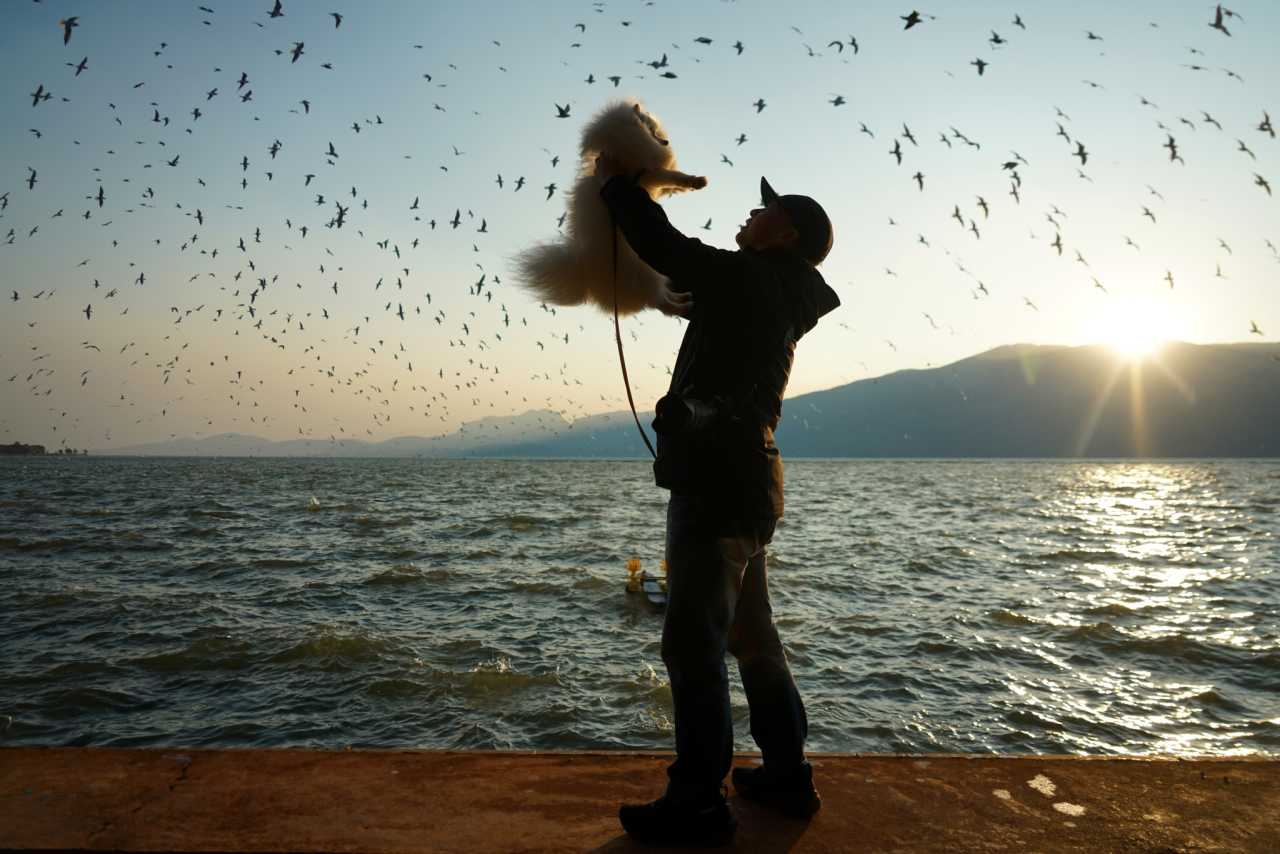
At 7:25 AM, the lake was calm, not a single gull in sight. The moon still hung high, as if reminding me it was too early. By 7:40, a few appeared—first just two or three, then a small flock, a large one, more and more. After 8:30, black-headed gulls covered the entire lake surface, and the dam came alive with energy.
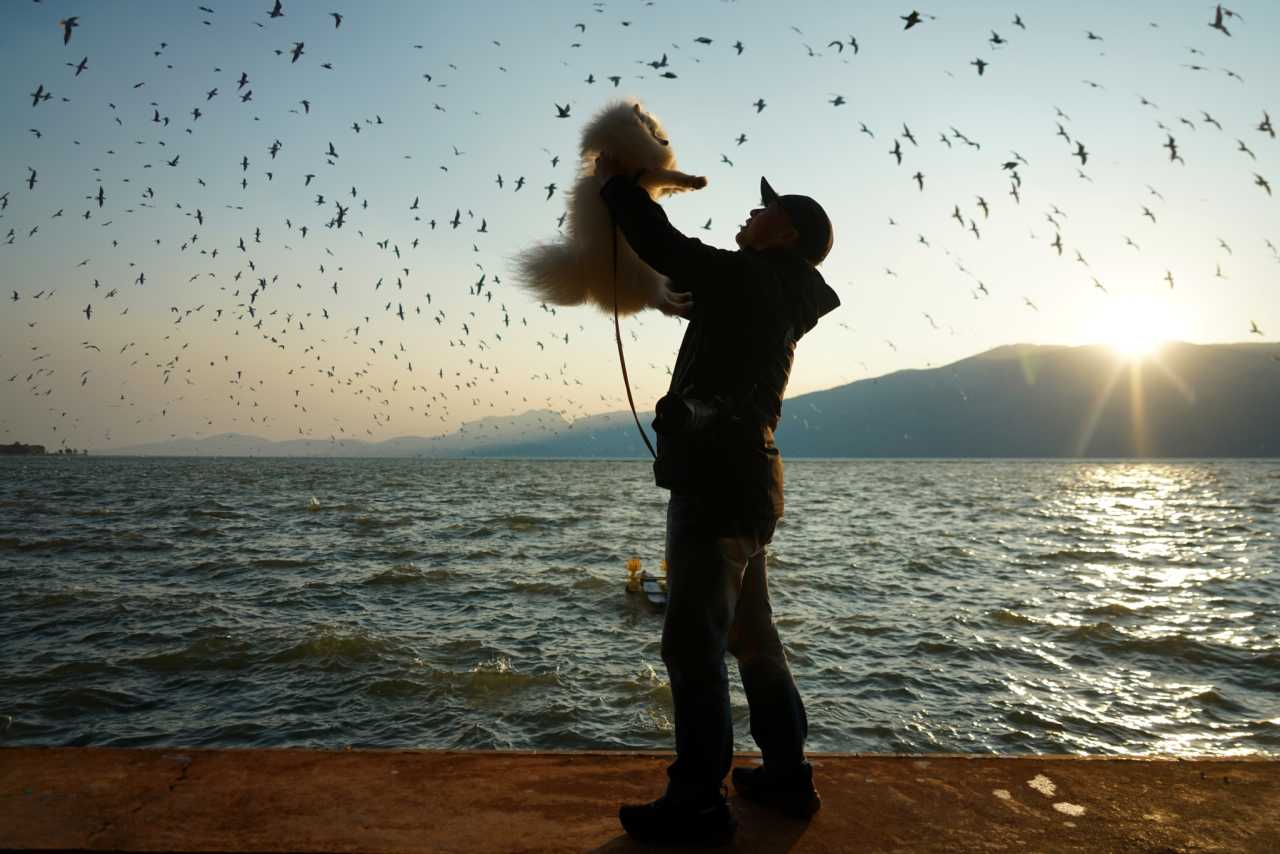
Haigen Dam is open to the public for free all day. If you want to feed the gulls, go early—they're most numerous and hungriest in the morning, making it easy to feed them and capture stunning shots of human-gull interaction. There are gulls in the evening too, but noticeably fewer. The worst time is around noon, when the gulls, having been fed, head off to rest. Based on my observation, they start flying away after 10 AM and don't gradually return until after 4 PM.
Don't think tourists' feeding alone keeps the gulls full. In fact, every morning and evening, staff take motorboats onto the lake to feed them. At those moments, flocks of gulls trail behind the boats, forming a breathtaking, fast-moving tableau.
On the dam, I noticed a black-headed gull with a blue ring on its leg. At first, I thought it was a device for tracking flight paths. Later, a local told me it was a gull raised by people in Siberia—like how pigeon fanciers put rings on their birds' legs, with numbers and contact information written on them.
The gulls' interactions were fascinating too—some queued up to sunbathe, others squabbled over food, some sat alone in a daze, while couples shared their meals. I even spotted a black-headed gull whose head had turned black. After looking it up, I learned this is a sign of sexual maturity, meaning it's about to return to its breeding grounds to reproduce. Come September and October, when the breeding season ends, they'll put on their white "winter coats" again and fly back to Kunming for the winter.
The dam isn't just a seagull-watching hotspot—it's also a live-streaming hub. Many streamers keep the same schedule as the gulls—they come when the gulls come and leave when they go. After walking the dam, don't forget to stop by the "Home-Style Snacks" shop for some local specialties. This shop once received a calligraphy inscription from Premier Li Keqiang: "Snacks are big eats; everyone must eat them; only with snacks can there be big eats." We had breakfast there all three mornings.
Haigen Park: A Leisurely Afternoon by the Lake

Haigen Park was our second stop for seagull-watching, separated from Haigen Dam by just a ridge—a ten-minute walk away.
"Haigen" literally means "a ridge across the sea." Kunming locals call Dianchi Lake "the sea," and this naturally formed causeway stretches from Hongjia Village at the mouth of the Panlong River all the way west to Longmen Village at the foot of Western Mountain. Haigen Park sits on the eastern shore of Dianchi Lake in Hongjia Village, with a cable car to the west connecting the park to the Dragon Gate on Western Mountain.
In the afternoon, Haigen Park becomes a favorite gathering spot for seagulls, with a 2.5-kilometer shoreline. Strolling along the lake, you'll see flocks of gulls everywhere, the water shimmering under the sun, willow branches drooping low by the shore—a scene straight out of a painting.
Haihong Wetland: A Stunning Canvas at Sunset
Haihong Wetland Park is another excellent spot for seagull-watching, best visited between 4 PM and 6 PM. During this time, the gulls are quite dense, lining nearly a kilometer of the Dianchi Lake shoreline.
Because Haihong Wetland sits on the northern shore of Dianchi Lake, it's an ideal place to watch the sunset over the lake. If you pick the right spot, you can enjoy the spectacular fusion of "water scenery, sunset, and black-headed gulls." Beyond the gulls, this is also a popular Instagram spot for photographing dawn redwoods. You can paddle a small boat through the neatly arranged redwood forest, and every snapshot is frame-worthy. If you're lucky, a few black-headed gulls might fly by among the trees, making your shot even more perfect.
We visited Haihong Wetland on the third day after returning from Kunming's Old Street. The wetland is free to enter. Once inside, walk straight ahead, pass through the redwood forest, and you'll reach the Dianchi Lake shore. From 5 PM until sunset, we spent two hours there, mainly watching and photographing the gulls against the setting sun. We also took quite a few portrait shots of Doudou—he looked absolutely stunning.
Daguan Pavilion: A Unique Blend of History and Nature
Daguan Pavilion Park is located about two kilometers west of downtown Kunming, on the shores of Dianchi Lake. It's named after the Daguan Pavilion, a famous historical and cultural landmark in China. We came here both to see the gulls and to admire this renowned pavilion.
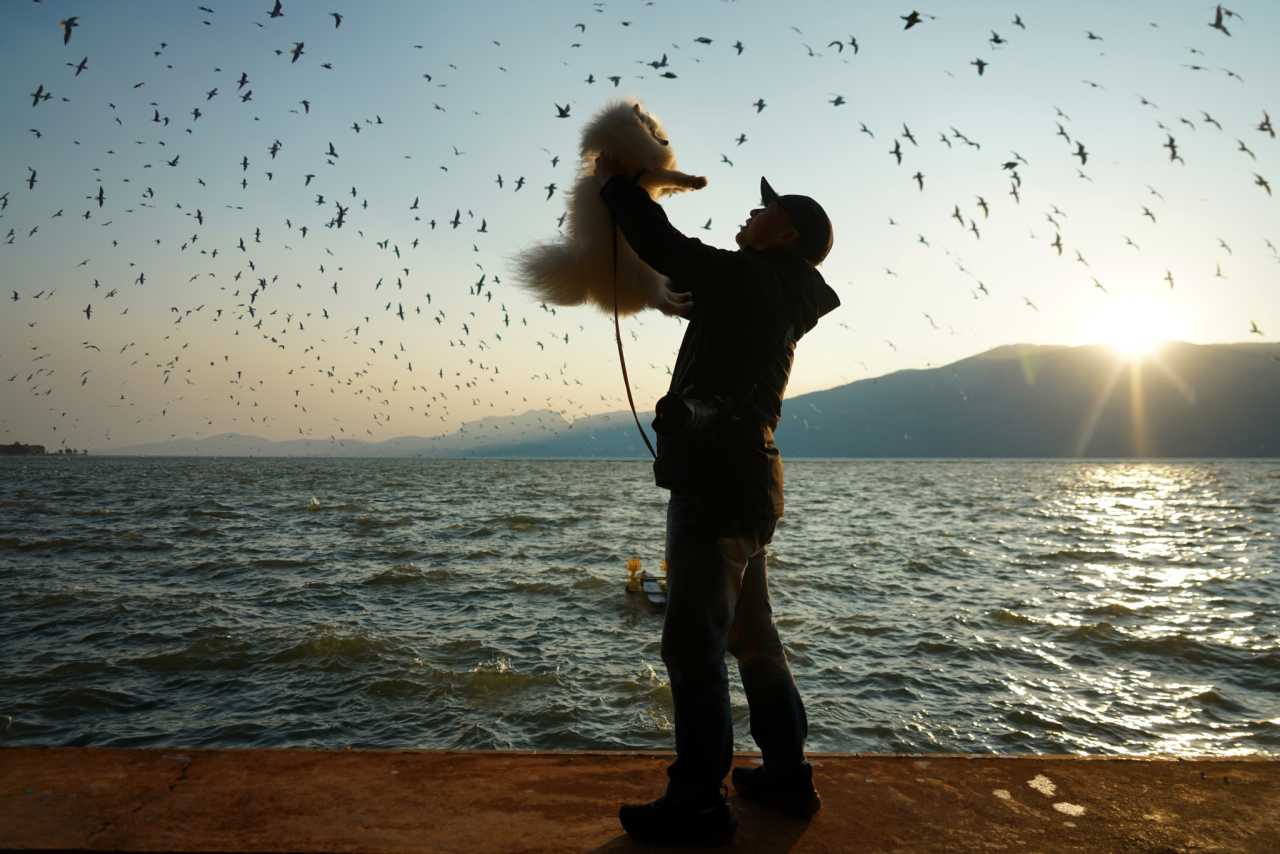
The Daguan Pavilion was first built in the 29th year of the Kangxi reign of the Qing Dynasty (1690). It was destroyed and rebuilt multiple times, with the current structure largely reflecting the style after restorations during the Tongzhi reign. The pavilion is famous for housing the "world's longest couplet" (180 characters), composed by the Qing Dynasty scholar Sun Ranweng. The first half depicts the scenery of Dianchi Lake, while the second half recalls Yunnan's history, earning it the title "the finest long couplet under heaven."
Besides the Daguan Pavilion, the park also features pavilions and towers like Jinhua Pu, Cuigeng Guan, Mumeng Ting, Yongyue Ting, and Lansheng Ge. Plum blossoms were in full bloom during our visit, their beauty enhanced by the ancient architecture. The park also serves as the venue for Kunming's traditional festival celebrations—lantern festivals for the Lantern Festival and moon-viewing events for the Mid-Autumn Festival. We visited on the third day after the Lantern Festival, which was also the last day of the lantern display, so the crowds were still thick.
Part Two: Scaling Western Mountain – A Panoramic View of Dianchi's Grandeur and Zen
Western Mountain is the highest peak in Kunming's urban area, located on the western shore of Dianchi Lake. Also known as Biji Mountain or the Sleeping Beauty, it faced our guesthouse and Haigen Dam across the lake. Every day, as we photographed seagulls by the lakeshore, it served as a steadfast backdrop.

The Western Mountain Scenic Area integrates natural landscapes, historical relics, and cultural depth, earning the reputation of "the finest scenic spot in central Yunnan" since ancient times. Key attractions include the Dragon Gate, Huating Temple, Taihua Temple, and Sanqing Pavilion. Between Taihua Temple and Sanqing Pavilion lies the resting place of the people's musician Nie Er.
We climbed Western Mountain on our second day in Kunming, after watching the gulls at Haigen Dam, spending most of the day there. Our route was: the guesthouse dropped us at the North Gate Service Center → took the scenic bus to the North Gate → visited Huating Temple, Taihua Temple, and Nie Er's tomb → had lunch near the North Gate → took the cable car up the mountain → walked to Lingxu Pavilion → descended to tour the Dragon Gate → took a sightseeing car to the North Gate → took the cross-lake cable car to Haigen Park.
The ticket price at the gate is 80 yuan, which includes the scenic bus (round trip), the Dragon Gate cable car (one way), the electric car (one way), and the Dragon Gate Scenic Area admission. Buying online a day in advance costs 75 yuan. We bought ours at the guesthouse for the same price, but the guesthouse offered free drop-off at the North Gate Service Center, saving us the hassle of taking a taxi or retrieving a car after the visit.
Huating Temple: The Poetic Charm of a Chan Monastery
Huating Temple was the first stop on the scenic bus heading to the North Gate and the first attraction we visited on Western Mountain. This famous Buddhist monastery in Yunnan was originally a family villa for Gao Zhisheng, a marquis of the Dali Kingdom. It was later converted into Yuanjue Temple by the eminent monk Master Xuanfeng and gradually expanded into a center for Buddhist propagation in Kunming.
The temple is surrounded by lush pines and bamboos, with ancient trees reaching for the sky. From the front, you can gaze out at Dianchi Lake in the distance. Inside, rare camellias, magnolias, and plum blossoms are planted, creating the poetic atmosphere of "a Chan monastery deep in flowers." We arrived at just the right time—various flowers were in full bloom, their colors complementing the temple's architecture, creating a scene of profound Zen beauty.
Taihua Temple: The Solemnity of a Millennia-Old Monastery
Taihua Temple, also known as Foyan Temple, is located halfway up Taihua Mountain, the highest peak on Western Mountain, at an altitude of about 2,155 meters. It is the oldest surviving temple on the mountain. Built during the Dade reign of the Yuan Dynasty (1306), it was founded by the Yunnan Chan master Xuanjian and has a history of over 700 years.
The temple is renowned for its lush flowers and trees, especially the purple magnolias and camellias in spring. Inside, there's a ginkgo tree said to have been planted by Emperor Jianwen himself, over 500 years old and still thriving. Taihua Temple combines the solemn grandeur of a millennia-old monastery with the beauty of natural landscapes. Whether admiring flowers, viewing the lake, or exploring historical relics, you can feel the unique charm of "Zen resonating with the mountains and waters."
Nie Er's Tomb: The Brief Life Behind the National Anthem

You may not know Nie Er, but you certainly know and can sing "The March of the Volunteers," the national anthem of the People's Republic of China. This anthem was composed by Nie Er, and he rests on the hillside near the North Gate of Western Mountain.
After having a bowl of Guandu small-pot rice noodles at a restaurant near the North Gate, we made a special trip to Nie Er's tomb to pay our respects. The white cherry blossoms along the roadside were in full bloom, creating a serene and solemn atmosphere. Next to the tomb stands a small Nie Er Museum, which uses text and images to concisely and completely introduce the process of the national anthem's creation and Nie Er's brief life. He tragically drowned while swimming at Kugenuma Beach in Fujisawa City, Kanagawa Prefecture, Japan, on July 17, 1935, at the age of just 23—truly a case of heaven's jealousy.
The Dragon Gate: "If You Haven't Visited the Dragon Gate, You Haven't Been to Western Mountain"
After descending from Nie Er's tomb, we passed through the North Gate's archway and entered the Dragon Gate Scenic Area. First, we had to take the Dragon Gate cable car up the mountain—only to find a 30-minute queue. It dawned on me later: today was the Lantern Festival.
As the cable car climbed into its second half, the scenery gradually unfolded, with Dianchi Lake and the cityscape slowly revealing themselves. The "road" that splits Dianchi Lake in two is the "Haigen" causeway—a natural formation that divides the lake into the Grass Sea and the Outer Sea, earning the poetic description "a line that splits the autumn colors equally."
After exiting the cable car's upper station, we decided to head straight to Lingxu Pavilion—the highest point in Kunming. Standing there, I truly felt the vastness of Dianchi Lake. Gazing into the distance, I couldn't see its edge. A photo was a must, to commemorate the expanse and height before us.
After visiting Lingxu Pavilion, we descended the same path and arrived at the Dragon Gate Grottoes. Carved between 1781 and 1853, over 72 years, the Dragon Gate Grottoes stretch about 66.5 meters from Sanqing Pavilion in the north to Datian Pavilion in the south, all chiseled along sheer cliffs. They are the largest and most exquisite Taoist grotto complex in Yunnan. Known for their perilous,奇特, unique, and secluded nature, the grottoes are celebrated with the saying, "If you haven't visited the Dragon Gate, you haven't been to Western Mountain." Another saying goes: "Once you enter the Dragon Gate, your status multiplies a hundredfold."
At the entrance to the Dragon Gate Grottoes, the characters "Dragon Gate" are carved. Legend says touching them brings good fortune. So, everyone passing through tries to touch them. The cliffside path, less than a meter wide, was packed solid. Taking a photo of the Dragon Gate without people was harder than climbing to heaven. Only by squeezing through the Dragon Gate and shooting upward from the cliffside plank road could I ignore the crowds.
Standing on this hand-carved cliffside plank road, looking down at Dianchi Lake and the city, the view was expansive and magnificent. As we descended, we passed Datian Pavilion, Tiantai, Yuhuang Pavilion, Zhenwu Hall, and Sanqing Pavilion.
The Cross-Lake Cable Car: A Perfect Aerial View of Dianchi

After finishing the Dragon Gate Scenic Area, a free sightseeing car took us to the North Gate. From there, we took the cross-lake cable car to Haigen Park. This cable car spans Dianchi Lake, offering an unparalleled aerial perspective of the lake's scenery. I strongly recommend experiencing it at least once—it might even be the highlight of your Western Mountain tour.
Epilogue: The Perfect Ending to a Healing Journey
Eight days of travel—starting with the seagulls by Dianchi Lake and ending at the Eastern Vibe in Mile. We witnessed the agility of the seagulls, climbed the grandeur of Western Mountain, explored the depths of Jiuxiang, marveled at the strange beauty of the Stone Forest, and felt the tranquility of Mile.
But what lingers most in my memory are those dawns and dusks spent with the seagulls. They taught me one thing: no matter how busy life gets, always set aside time for yourself—time to do those seemingly useless things that heal the soul. Watching seagulls, feeding them, photographing them—these simple little acts can recharge a weary body and mind.
If you're feeling tired, go see the seagulls in Kunming. There, you'll find your own way to heal.
Travel Tips: - Best Time: November to March each year, with February being the golden period for seagull-watching - Recommended Spots: Haigen Dam (early morning), Haihong Wetland (evening), Haigen Park (afternoon) - Accommodation: Choose a guesthouse near Haigen Dam—walking distance - Feeding Tips: Go in the morning when the gulls are hungriest and most active - Nearby Attractions: Western Mountain, Daguan Pavilion, Kunming Old Street, Jiuxiang, Stone Forest, Mile
You should also read:

Traveling with the Soul: Yunnan Under My Feet, My Heart in the Clouds
Traveling with the Soul: Yunnan Under My Feet, My Heart in the Clouds Prologue: A Spontaneous Escape Have you ever had that moment—sitting in a noisy city, staring at a screen full of dense text, suddenly yearning for a complete escape? As the K159 train…
Continue reading...
Dreaming of Nanzhao: A Gentle Encounter with Erhai Lake in Dali Shuanglang, July
Dreaming of Nanzhao: A Gentle Encounter with Erhai Lake in Dali Shuanglang, July Every summer, a voice whispers softly from the depths of my heart: it's time to go. No matter how tight the budget, no matter how precious the annual leave, the ritual of…
Continue reading...
Yunnan's Colorful Clouds: Touching Shangri-La — A Dialogue with the Sky
Yunnan's Colorful Clouds: Touching Shangri-La — A Dialogue with the Sky If you ask me where in China is closest to heaven, I would tell you without hesitation: Shangri-La. The name itself carries a mysterious magic, as if every syllable whispers tales of distant lands.
Continue reading...