First Glimpse of Yucun: Bitterness and Sweetness Lingering — Shangri-La, Yunnan
First Glimpse of Yucun: Bitterness and Sweetness Lingering — Shangri-La, Yunnan
The Sun and Moon of the Heart, More Than Just a Legend
Yunnan, a land blessed by heaven, holds countless secrets that stir the soul. From the grace of the Dai to the wildness of the Yi, from the romance of the Bai to the devotion of the Tibetan, every ethnic group has left its unique mark here. And I, a native Yunnanese, finally decided to embark on this long-overdue journey of discovery, to see the place that has haunted my dreams for seven years — Yucun (Rain Collapse Village).
Seven years ago, when I first heard the name "Yucun," I couldn't help but chuckle: Did it get its name because it rains so much that the mountains collapse? Later, I heard it was as beautiful as a paradise, but you could only get there on foot or by donkey, and just entering the village took an entire day. So I tucked it away in my heart. Now that I hear you can drive in, I've finally made up my mind to see Meili Snow Mountain — which stands at just 6,740 meters yet remains unclimbed — and the mysterious village at its feet.
Day 1: Setting Off, Rushing Toward a Bittersweet Journey

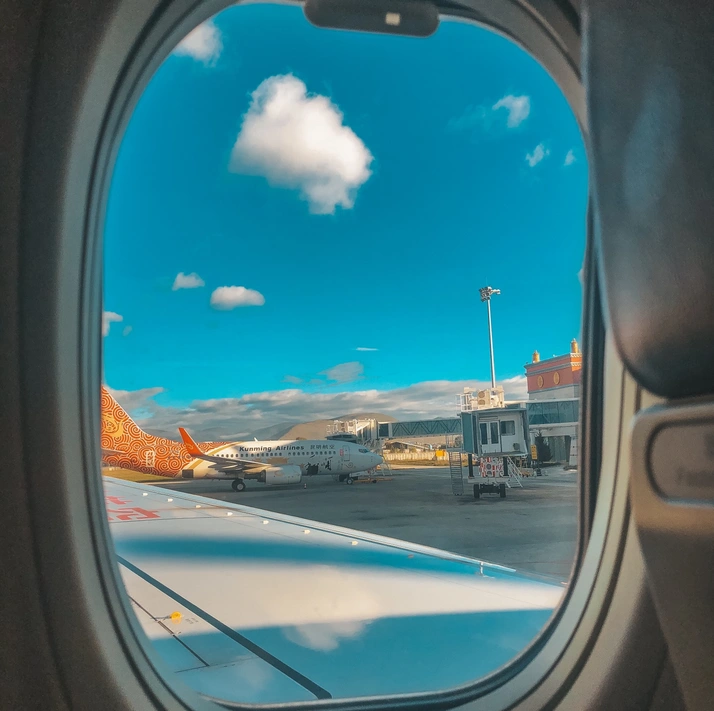
Flying from Kunming to Shangri-La, the sun arrived as promised. The air on the plateau was exceptionally fresh, making you want to take deep breaths. This was my second visit to Shangri-La; the first was eight years ago, with the same person — back then we were just colleagues, and now we've traveled together to over a dozen countries. Time is a strange thing.
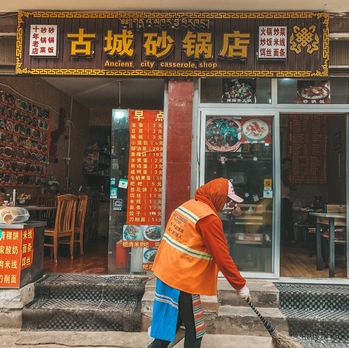
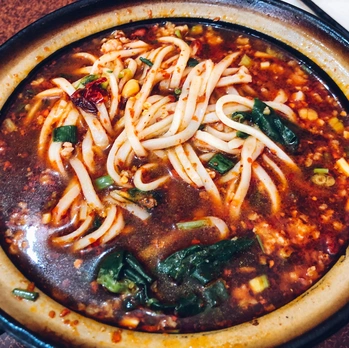
After picking up our rental car in Dukezong Ancient Town, a steaming bowl of clay-pot rice noodles (砂锅饵丝) downed, the exhaustion from the early morning flight vanished. This breakfast joint run by locals was incredible — every bite carried the smoky warmth of the plateau.
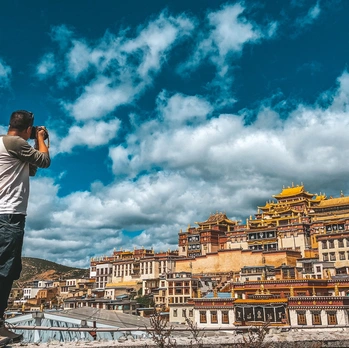
Revisiting Ganden Sumtsenling Monastery
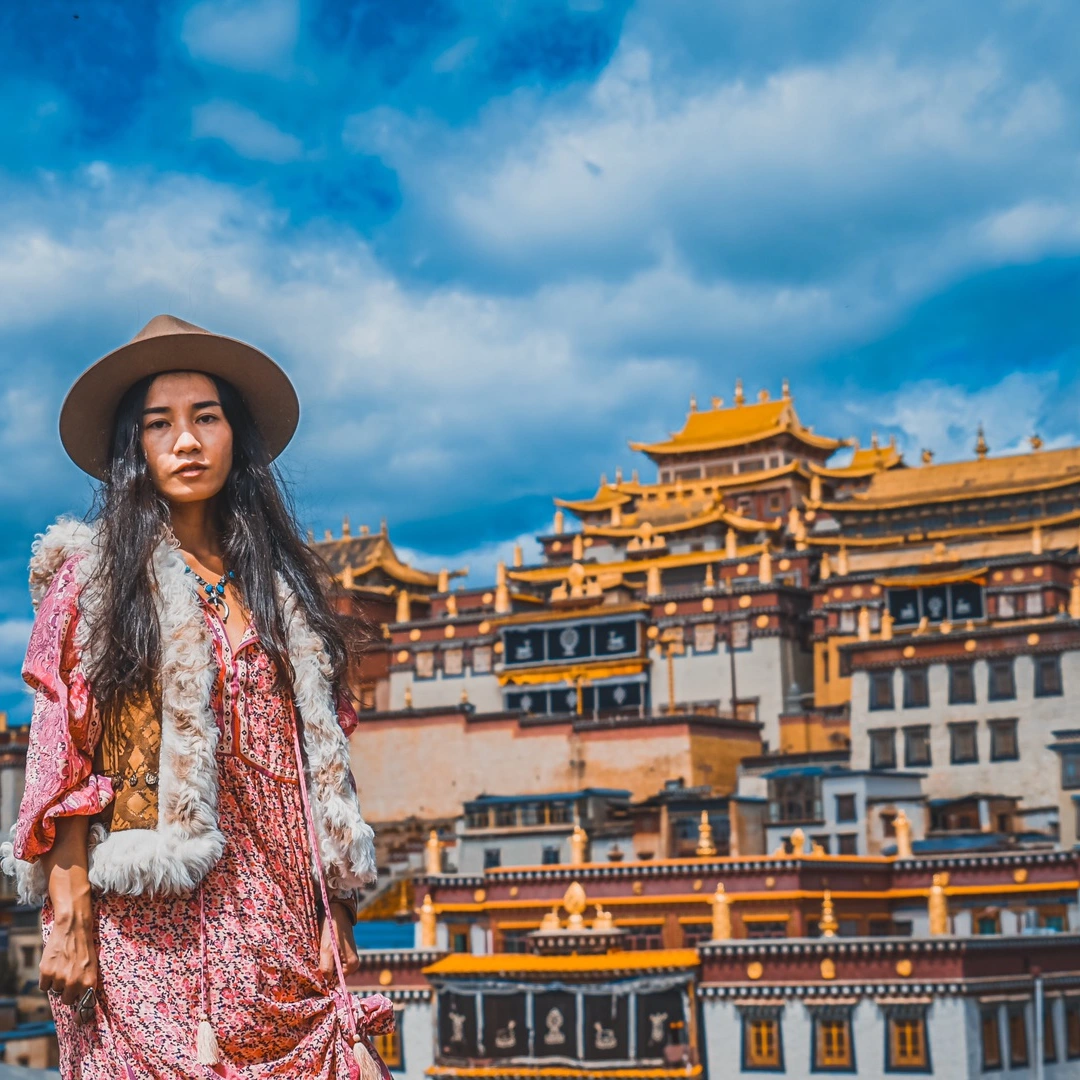
After getting the car, we headed straight to Sumtsenling Monastery. Perhaps due to the pandemic, vehicles can no longer drive directly in; you need to buy tickets at the hall and take a shuttle bus.
This is the largest Tibetan Buddhist monastery in Yunnan Province. Named "Ganden Sumtsenling" by the Fifth Dalai Lama himself, it was built in 1679, with over 300 years of history. The monastery is built into the mountainside, resembling an ancient fortress, and is known as the "Museum of Tibetan Art." The two main halls — Zhacang and Jikang — stand tall, surrounded by eight colleges and monks' quarters, layered and three-dimensional. The gilded copper tiles and beast-shaped ornaments on the eaves tell stories of the essence of Tibetan religious culture.
Large patches of marigolds swayed in front of the solemn monastery, adding a touch of tenderness to this sacred place. We sat for a long time on the stairs opposite the main hall, gazing at the deep blue sky, the silky clouds, and the birds gliding by. Everything was so peaceful, as if our souls had been cleansed.
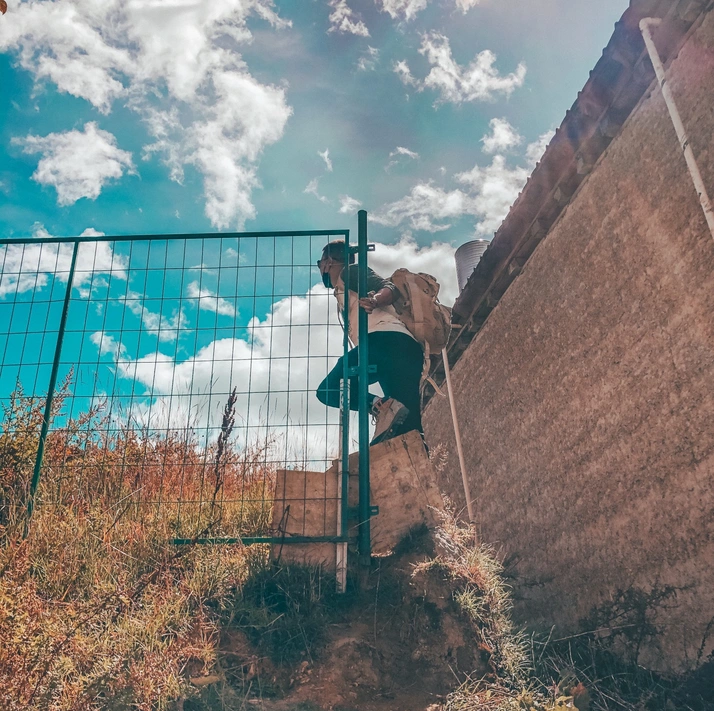
To capture the full view of Sumtsenling Monastery, you need to go to the opposite side. Exit the main gate and walk along the road to the left. Pass a few guesthouses, and you'll see a hillside fenced off. The fence isn't tightly sealed — just step over it, climb a small slope, and you'll find the perfect photo spot.
The Changing Face of Napahai
Napahai Prairie didn't surprise me much this time. The beauty I experienced on my first visit seven years ago was too profound, and now it felt different. Walking along the road to Shika Snow Mountain, you could see patches of red, unknown grass — great for photos. A herd of yaks grazed leisurely, as if time had slowed down here.
After circling Napahai, we headed straight to Potatso.
Day 2: A Spiritual Journey — Potatso National Park
My longing for Potatso wasn't about its core scenic area, Shudu Lake, but about the scenery along the way. That feeling of walking through a painting can truly be called a "spiritual journey."
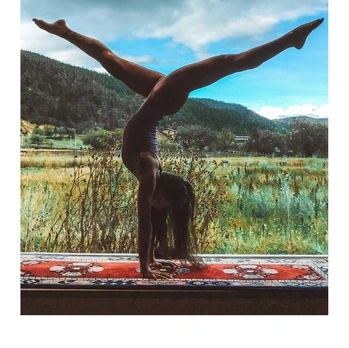
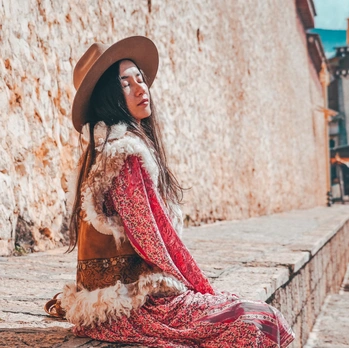
The only hotel inside the park was so nice that we didn't want to leave the room. It had large floor-to-ceiling windows and a bay window seat. Sitting there drinking tea and watching the scenery, time became soft. It happened to be Mid-Autumn Festival, and the hotel thoughtfully gave us two mooncakes. With such beautiful scenery, how could we not take a set of yoga photos?
The yak hotpot at the hotel was generous in portion and delicious — we ate to our hearts' content.
Hiking Is the Only Way to Go
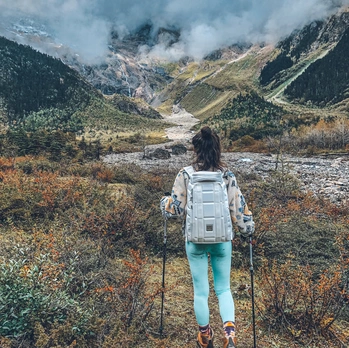
There are two options for entering the park: take the bus directly to Shudu Lake, or hike for two hours on a primitive dirt trail. I chose the latter without hesitation — the scenery along the way is the real highlight.
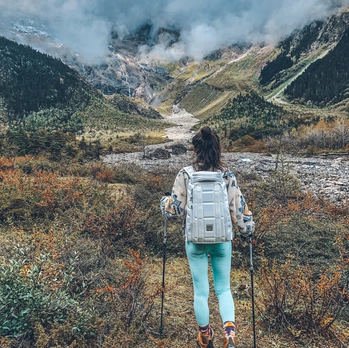
Walking alongside a stream, the autumn colors were at their peak. The trees were a riot of color, layers of red and gold, like a fairyland. Strolling slowly by the creek, feeling the coolness of early autumn and the warmth of the morning sun, the contrast of hot and cold was just right.
The trees were covered in pale gray-green "tree beards," which locals say are food for the Yunnan golden snub-nosed monkey. This plant only grows in places with excellent air quality; if the air gets worse, it naturally dies off. The place was already magical enough, and with these floating tree beards, it felt even more like a fairyland.
Piles of mani stones were stacked by the stream. Tibetans believe stones have spirits, and they build these stone piles at crossroads, by lakes, or on mountains as prayers. I built one too, hoping only for the health and happiness of my family.
After crossing a small bridge, the trail along the stream ended. In front of us appeared colorful mountains — photos simply couldn't capture that awe; you had to experience it yourself.
Shudu Lake: The Core of a World Natural Heritage Site
After the waterfall, we reached the bus stop. We took the bus to the final stop — Shudu Lake. Here you can either walk the boardwalk or take a boat. With such beautiful scenery, taking a boat would be a waste.
The Shudu Lake boardwalk is about 3.3 kilometers, and two hours is enough to walk it. On the way, I saw a kid eating gummy candy, and I almost asked him for some — I was so craving it. Luckily, there was a small shop ahead, and I immediately bought two big bags.
Without hiking, how could you see those cute little animals? They weren't afraid of people at all. If you put sunflower seeds in your palm, they'd come and take them themselves. Part of the boardwalk goes directly through the primeval forest, allowing you to immerse yourself in its deep mystery.
Jinsha River Big Bend and Scenery Along the Way
The Jinsha River Big Bend looks a bit like Horseshoe Bend. The color of the river changes with the seasons; some people have captured it in green, which is incredibly spectacular. Unfortunately, it's been fenced off and you have to pay for tickets. Ten yuan isn't expensive, but it feels a bit ridiculous — it's just a natural landscape you pass by, and suddenly it's turned into a tourist attraction.
Along the way, we stumbled upon a farmhouse restaurant built on the edge of a cliff. Seeing that five-star red flag, my heart swelled with emotion. This is our motherland. This is China.
Deqin and Feilai Temple: Hotpot and Queues
After a five-hour drive from Shangri-La, we finally arrived in Deqin County. We quickly went to Feilai Temple to find a hotpot place to fill our stomachs. Traveling during holidays is a disaster. There was a long queue outside the restaurant, and the owner had no sense of order. The number we got was literally a corner torn off an invoice. We waited over half an hour before we got to eat a steaming pot of yak hotpot.
Day 3: Meili — The Loneliness of "Golden Sun Over the Snow Mountain"
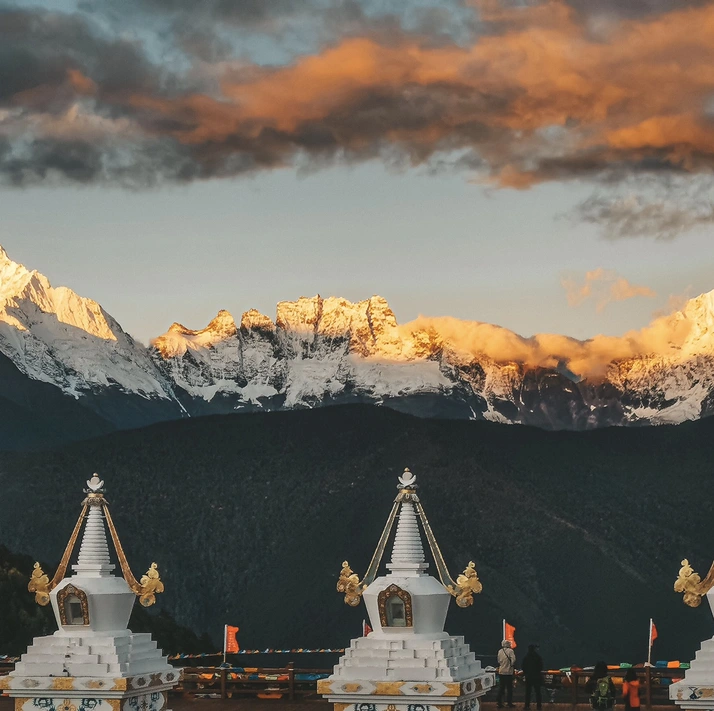
To see the "Golden Sun Over the Snow Mountain" (日照金山), I specifically booked a hotel with a balcony facing the snow mountain. I was so excited I couldn't sleep well, getting up three times in the middle of the night to check if there were stars in the sky — stars mean no clouds, and no clouds mean you can see the golden sun.
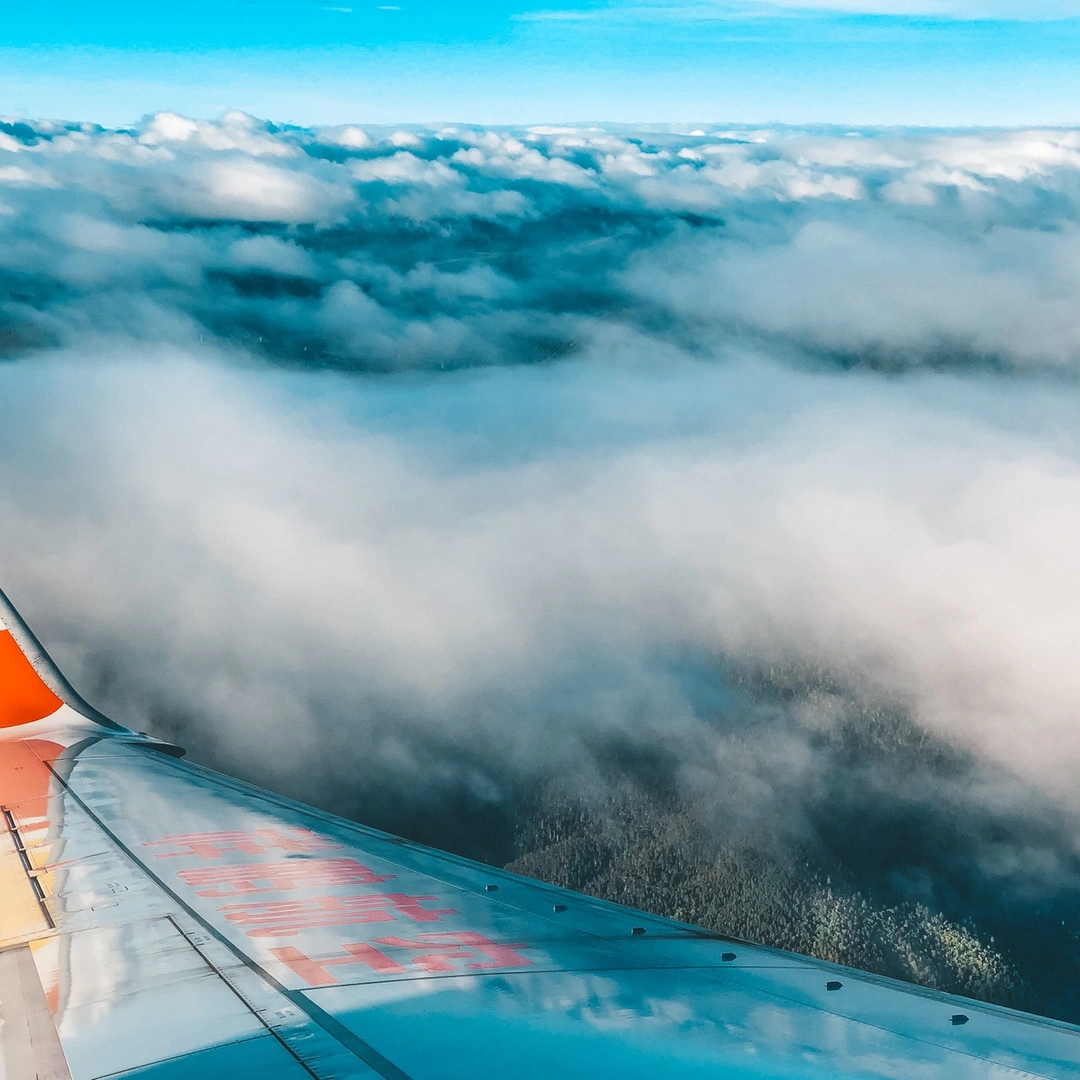
And the result? The view I woke up to in the morning did move me to tears — because I couldn't see anything! I had booked a mountain-view room, but outside the window there was only a sea of clouds. Where was the mountain? Left? Right? Middle? I saw nothing but emptiness.
The only consolation was that I hadn't booked the Jixia Mountain Hotel, otherwise spending thousands of yuan on this view would have made me cry to death at Feilai Temple. My mother-in-law came around the same time last year and saw Meili Snow Mountain in all its glory. I could only look at her photos and imagine.
Meili Snow Mountain, also known as the Snow Mountain Prince, is regarded as a "sacred mountain" by local Tibetans. The highest peak in Yunnan, Kawagebo Peak, has never been stepped on by humans. The snow-capped peaks stretch for hundreds of miles, covering 34.5% of Deqin County. Mingyong Glacier is the longest glacier at the foot of Kawagebo Peak, stretching about 5 kilometers north-south and 3 kilometers east-west.
First Glimpse of Yucun
Yucun Village, at an altitude of 3,000 meters, is surrounded by mountains on all sides. In the past, you could only enter on foot or by mule — 12 kilometers uphill, 6 kilometers downhill, crossing a 3,700-meter pass. Now that the road is open, off-road vehicles run back and forth, and entering Yucun is no longer a dream.
From Feilai Temple, it's a little over an hour's drive, heading in the direction of Xidang Hot Spring. Traveling during holidays is torture. We had to drive over an entire mountain just to reach the entrance. Because there were too many cars, the parking lot at the ticket office was full, so we had to park along the mountain road. We dragged our small suitcases, which were full of photography equipment, up the winding mountain path.
The ticket to enter Yucun costs 200 yuan per person, and an extra backpack costs another 200 yuan — so we ended up buying a 200-yuan one-way ticket for our equipment case. After a bumpy 40-minute ride, we finally arrived at Upper Yucun Village. After getting off, we had to walk a long dirt slope — dragging a suitcase was definitely the wrong choice.
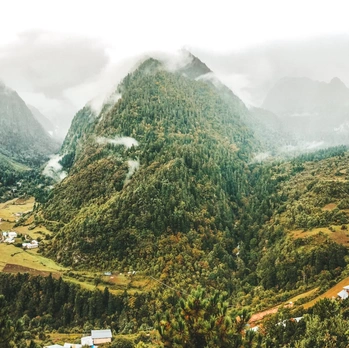
But when I saw such captivating scenery, the exhaustion instantly melted away. Clouds and mist swirled around, as if we were in a fairyland. Behind the clouds was the snow mountain, perhaps too shy to show me its true face.
Day 4: Ice Lake Hike — Body in Hell, Eyes in Heaven
Woke up at 7 a.m., had breakfast, and set off. You have to eat a full breakfast because there are no shops to replenish supplies along the way. Bringing energy bars and drinking water is a must.
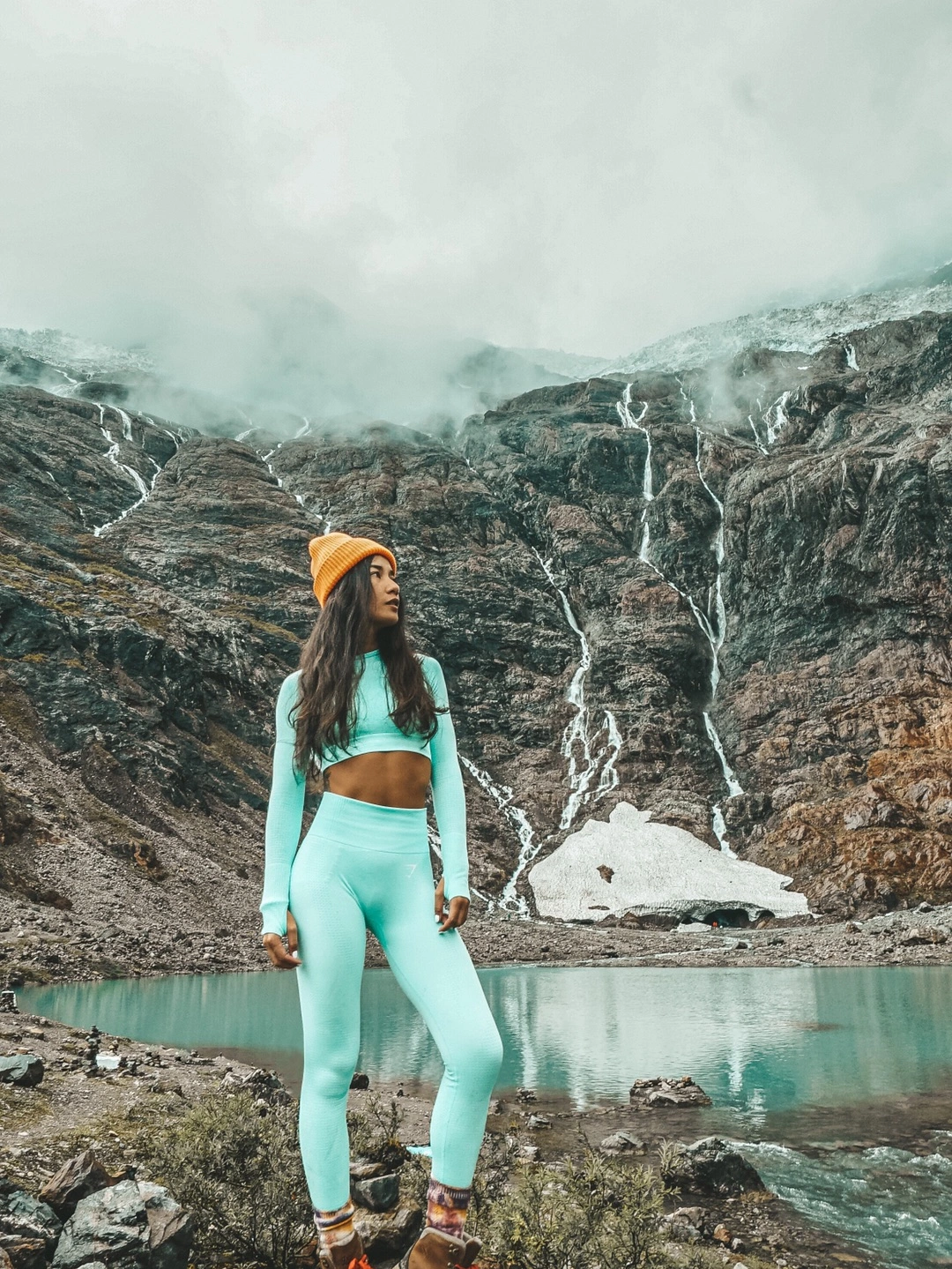
As soon as we entered the forest, fog enveloped us, and it instantly felt like a fairyland. The yellow fallen leaves of early autumn matched perfectly with my little hat. This river should be the one flowing down from Ice Lake; it was visible along the way. I was glad I hadn't worn too many layers — otherwise, I'd have to take them off when I got hot, and carrying them would be a burden.
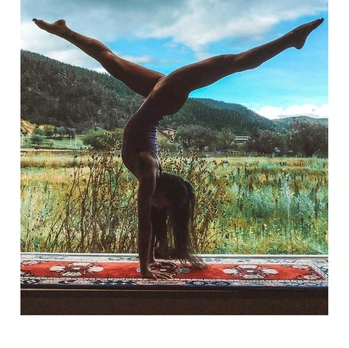
In a place like this, like a green wonderland, how could I not show off some skills? Handstand time! But I overestimated myself — my shoes were too heavy, and I couldn't find my center of gravity. This primeval forest was so beautiful; the fragrance of the trees helped relieve the fatigue. I was the one carrying all the photography equipment; my partner couldn't handle the physical strain.
The mud path was slippery, so we had to be careful. After nearly 4 hours of hiking, we finally reached Xiaonong Pass. Crossing mountains and ridges, suddenly catching a glimpse of the snow mountain at a turn made me scream, my scalp tingling — only those who've experienced it can understand that feeling.
Xiaonong Base Camp and the Secret of the Snow Mountain
Arriving at Xiaonong Base Camp, there were Tibetans selling yak meat and fried rice. We bought a plate of fried rice for 50 yuan. Eating with such a view, the fatigue from nearly 5 hours of hiking disappeared instantly.
Xiaonong Base Camp was built for the 1991 Sino-Japanese joint mountaineering team — a team that now lies forever asleep on the snow mountain. Why has no one ever reached the summit of Meili Snow Mountain? Let me explain: Kawagebo's towering height and its lofty status in religion have attracted countless mountaineers. But from the early 20th century to the present, every large-scale climbing attempt has ended in failure.
In 1991, the Sino-Japanese joint team launched an assault on the main peak. When they reached an altitude of 6,400 meters, the weather suddenly turned bad, so they had to descend and prepare to try again the next day. But on the evening of January 3rd, after the team made their last voice contact with base camp, they were hit by a massive avalanche. All team members perished, buried forever on Kawagebo. A single avalanche claimed 17 lives. Years later, herders occasionally found the remains of some of them. No matter how well-equipped the team, they were no match for the power of nature.
Arriving at Ice Lake
Moving on, crossing one more mountain would bring us to our destination. At this point, only one line from a song could fit the moment: "I've crossed mountains and seas, and walked through crowds of people."
After nearly 5 hours of hiking, we finally reached Ice Lake. As for Ice Lake itself, it might not leave you completely stunned or overwhelmed by beauty, but the meaning of the journey lies in the process, not the destination. That feeling of being physically exhausted yet having your scalp tingle and eyes well up with tears at the sight of beauty — it's something you don't experience in everyday life.
The awe of all beautiful scenery, compared to photos, can never match your own eyes. The white patch was ice, and inside it was an ice cave — extremely dangerous, as it could collapse at any moment.
We spent over half an hour at Ice Lake. Looking at the time, it was already past 2 p.m. We had to head back as soon as possible; it would be too dangerous after dark. It had rained several times in the afternoon, turning the dirt paths into mud. We slipped and stumbled all the way. My hiking pole even managed to stab itself into my boot — what kind of trick was that?
Halfway down the mountain, my knees started hurting, and I hadn't brought knee pads. We didn't get back to the hotel until 6:30 p.m. It was really tough. On the way back, my partner, carrying my white backpack, even took a fall — who should I feel sorry for first?
Back at the hotel, I took a shower, changed into clean clothes, had a big meal, and went out for a foot soak. There were one or two foot-soaking shops on the street in Yucun, run by Tibetans. At the one we went to, the elderly couple could only speak a little Mandarin. The small, dark room was packed, and there was a power outage — we had a candlelit foot soak. There was only one foot basin left, so my partner got a feed bucket — I almost died laughing.
Day 5: A Leisurely Day in Lower Yucun
Today was a rest day. I did some morning exercises in the morning — it felt great.
From Upper Yucun to Lower Yucun, there's a small dirt path you can take, which is basically climbing a mountain. Along the way, I saw some strange and interesting plants. After a little over half an hour, we reached Lower Yucun. We found a cold drink shop, sat down, and ordered a juice while enjoying the misty scenery.
Although we never saw the snow mountain's true face throughout the trip, it was really worth it — this place was so pure. On the way back, the clouds parted a little, revealing a tiny bit of the snow mountain.
Back at the hotel, I ordered a cup of milk tea and some fries, and enjoyed this quiet time to the fullest.
Day 6: Leaving Yucun, Entering Ren'an Valley
It was raining when we left Yucun. We waited for the car from 9 a.m. to 11 a.m. before we could get on. Traveling during holidays really means suffering some unnecessary hardships. Not only was it expensive, but we also wasted time we shouldn't have — that's the pain of being a salaried worker.
The ticket to leave the village was cheaper — 150 yuan per person, and they didn't charge for the suitcase. I felt like I'd gotten a little bit of a bargain, which gave me some psychological comfort for the 2-hour wait.
Unless you're a hardcore hiking enthusiast, I'd recommend taking the car in and out. The scenery inside requires hiking, so saving your energy for exploring the village is key. The road in and out is muddy, with cars coming and going, making it very uncomfortable for pedestrians — dusty on sunny days, muddy on rainy days.
On the way back, we caught a glimpse of Baima Snow Mountain. It was so beautiful — photos simply couldn't capture its grandeur.
We arrived back in Shangri-La around 5 p.m. and headed straight to the Ren'an Valley Tent Hotel.
Day 7: Healing Time in Ren'an Valley
Coming to this valley was entirely for the purpose of staying at this tent estate. After a tough journey, you have to treat yourself.
As soon as we arrived at the hotel, a yak hotpot was already prepared for us. The guesthouse only had a few Tibetan waitresses, but the service was excellent — from carrying luggage and introducing the room facilities, to serving food and cleaning the rooms, they did it all. Being so busy yet maintaining such good service is rare in Chinese guesthouses.
The room had a foot-soaking basin and herbal medicine prepared — perfect for relaxing after hiking. I slept a warm, sound sleep.
The interior details were impeccable! No matter how cold it was outside, the room was warm — thanks to the underfloor heating. You could lie in bed and watch the sunrise, but due to the weather, we didn't see it. The misty clouds were nice too.
I had originally planned to hike to Abuji, but my knees still hurt from the Ice Lake hike, and the weather was bad — it kept raining. Was heaven telling me I'd have to come a second time? Having fun in the warm room was good enough.
Breakfast was very generous: free-range eggs from the Tibetan family, homemade milk tea, Ran Noodles (燃面 — the owner was from Yibin, and the noodles she made were delicious), and highland barley cakes (crispy on the outside, soft and chewy on the inside). Breakfast was served until 11 a.m., so you could sleep in and eat, saving one meal.
In the afternoon, it drizzled, so I wandered around the estate for a while. The estate had two dogs — a golden retriever named Simba and a corgi, I think named Qiqi. They were both very friendly; when I sat down, they'd come play with me.
In the afternoon, you could also have afternoon tea. The milk tea here was excellent. We had to catch a flight in the evening, so we had dinner at the estate before leaving. There weren't many dishes, but they were all delicious.
About the Itinerary and Practical Information
Itinerary Overview
- Day 1: Kunming → Shangri-La → Pick up car → Sumtsenling Monastery → Napahai Prairie → Potatso
- Day 2: Potatso National Park → Moon Bay → Deqin Feilai Temple
- Day 3: Watch the Golden Sun Over the Snow Mountain (if you're lucky) → Xidang Hot Spring → Enter Yucun
- Day 4: Hike to Ice Lake
- Day 5: Roam Lower Yucun
- Day 6: Leave Yucun → Ren'an Valley
- Day 7: Leisure day → Return to Kunming
Transportation Tips
Other than flying, driving is the only option — but only experienced drivers should choose it. We rented a Chevrolet SUV for 7 days at 2,200 yuan. The car just sat parked on the mountain for the days we were in Yucun — a bit wasteful.
Accommodation Recommendations
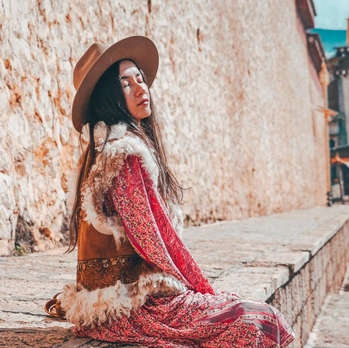
Potatso · Youyou Manor (444 yuan/night) - Pros: Inside the park, great environment, room with bay window, picturesque view outside - Cons: Inconvenient without a car, shower water pressure too low, slow food service
Deqin · Tengyue Hotel (677 yuan/night) - Pros: Clean and tidy, Japanese-style, terrace room with view of the Golden Sun Over the Snow Mountain - Cons: I was unlucky and saw nothing
Final Thoughts
This journey, tinged with bitterness and a hint of sweetness, has come to an end. Seeing the world with your own eyes, feeling everything nature gives you with your heart — that's the meaning of travel.
The bitterness of Yucun was the pain in my knees while hiking, the embarrassment of slipping on muddy paths, the anxiety of waiting. The sweetness of Yucun was the tingling scalp in front of Ice Lake, the awe of the swirling clouds and mist, the laughter from the feed bucket during the foot soak.
If you want to come too, remember: save your energy, be prepared, and bring a good mood. As for the Golden Sun Over the Snow Mountain? That's a matter of fate.
You should also read:
Escaping Nanning, Falling Under Lijiang's Spell: Our Four-Person, Ten-Day Yunnan Dream
Escaping Nanning, Falling Under Lijiang's Spell: Our Four-Person, Ten-Day Yunnan Dream Before We Set Off: No Pain, No Obsession Have you ever had that impulse—suddenly tired of the office fluorescent lights, the crush of the subway, the endless parade of identical takeout boxes, and just…
Continue reading...
Solo in Yunnan: A Wanderer’s Guide to the Land of Eternal Spring
Solo in Yunnan: A Wanderer’s Guide to the Land of Eternal Spring There’s something magical about traveling alone. No compromises, no schedules to keep, no one to please but yourself. I’ve been on the road for nearly three months now, and not once have I…
Continue reading...
God’s Abandoned Palette: A Self-Drive Journey Through Yunnan’s Dongchuan Red Land
God’s Abandoned Palette: A Self-Drive Journey Through Yunnan’s Dongchuan Red Land Travel has never been about reaching some distant geographic coordinate. It’s about encountering, along the way, the version of yourself buried beneath the rubble of daily routine. During this May Day holiday, I finally…
Continue reading...