Flying to the Aegean: A 14-Day In-Depth Greek Honeymoon Journey
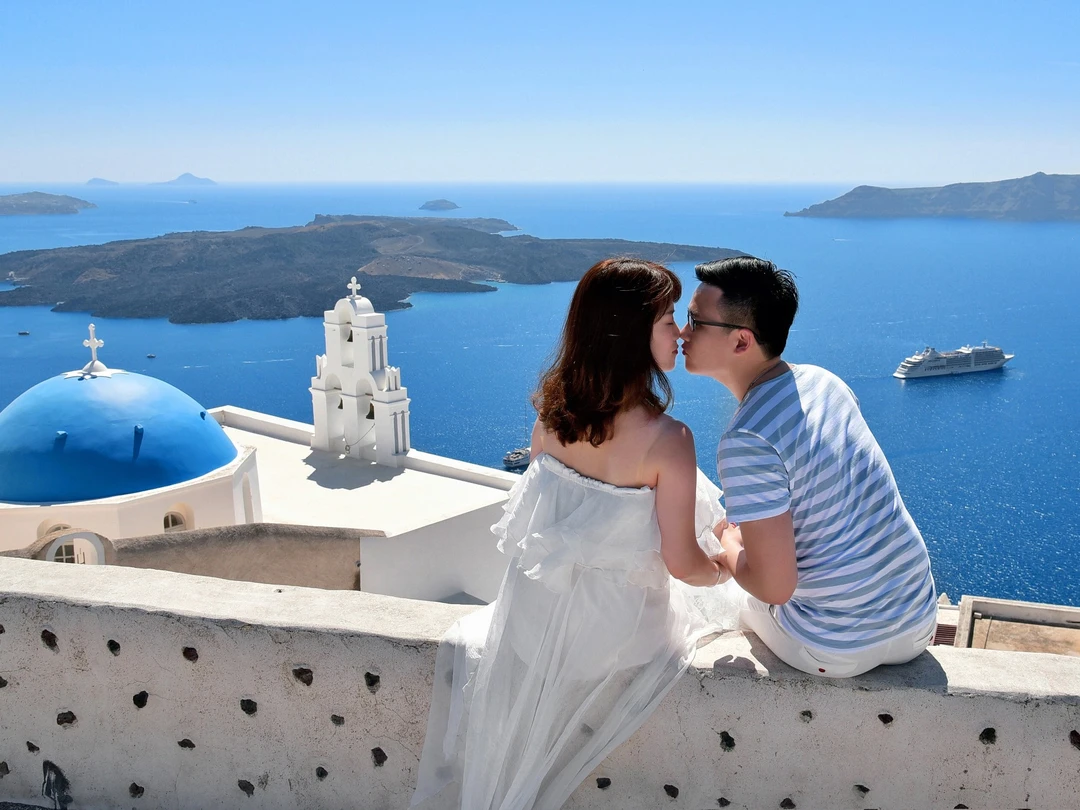
Flying to the Aegean: A 14-Day In-Depth Greek Honeymoon Journey
Some places captivate you with their name alone. The Aegean Sea — just those three words feel like a romantic filter, the blue-and-white imagery lingering in your mind. For me, Greece was never just one option among many honeymoon destinations. It was the only choice.
I still remember when we were first dating, I made a promise to my other half: "When we get married, our honeymoon has to be in Greece." She just smiled at the time, probably thinking it was a throwaway comment. Little did she know that from the moment we got our marriage certificate to actually setting foot on this land, we spent an entire year preparing. No rushed sightseeing, no side trips to other European countries. We wanted to dedicate this precious time entirely to this country of love.
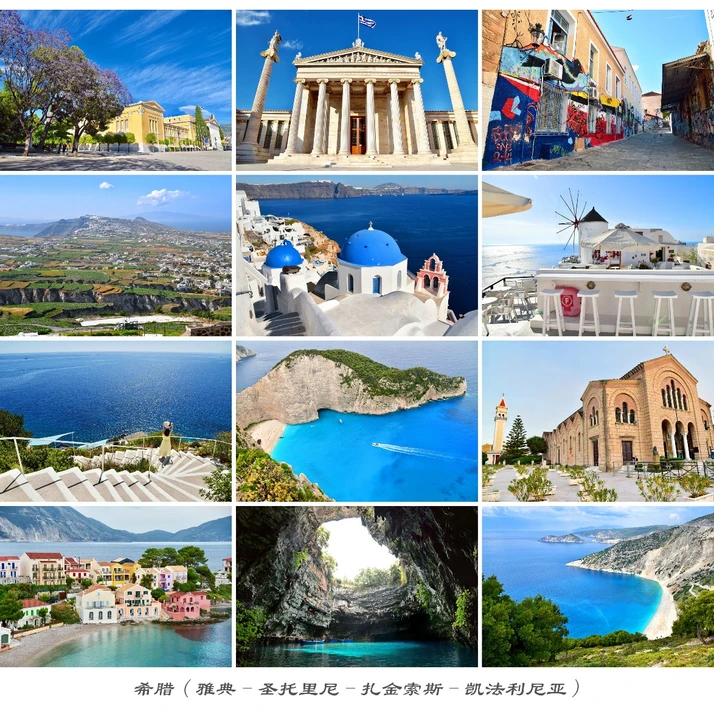
Beyond the classic destinations of Athens and Santorini, we unlocked two hidden gems: Zakynthos and Kefalonia. Over 14 days, we journeyed from ancient ruins to island paradises, from cliffs to caves. Every stop left us in awe: the cities and islands of Greece are so remarkably diverse in character.
Pre-Trip Preparations: A Carefully Planned Romantic Expedition
Visa Application: Prepare Early, Secure Your Spot
Greece is part of the Schengen Area, which requires fingerprint collection. We submitted our documents at the visa center in Fuzhou on February 17 and received our visas by February 24 — remarkably fast. The fee was 680 RMB per person. For honeymoon couples, as long as your documents are complete, approval is almost guaranteed.

Required documents include:
- Copies of all pages of your household registration booklet
- Hotel booking confirmations
- Flight booking receipts and itinerary plan
- Bank statements from the last 3 months (avoid making large lump-sum deposits right before)
- Company business license copy with official stamp
- Employment verification letter (bilingual in Chinese and English, including company info, applicant info, leave approval, etc.)
- Insurance policy (medical coverage of at least 30,000 euros; we bought a 115 RMB/person package on Taobao)
Special reminder: When booking hotels, make sure to include the names of ALL guests staying. We only listed the booker's name, and ended up spending 50 RMB at a shop downstairs from the visa center just to modify the booking — printing over a dozen pages. It hurt.
Research Resources: Websites That Saved Us
We scoured countless resources for this trip. Here are the ones that actually proved useful:
Daododo (Island Duoduo) — China's most professional island travel website. If you want to understand the characteristics of each Greek island, how many days to spend, and main attractions, start here. Based on its recommendations, we skipped Mykonos (which is somewhat similar to Santorini) and chose Zakynthos for its Shipwreck Beach and Kefalonia for Melissani Cave.
Qyer (Qiongyou) — Its "My Itinerary" feature is incredibly practical. You can integrate your schedule, attractions, transportation, and hotels all in one place, and even export it as a printable booklet. Paired with the mobile app "Trip Assistant" and Google Maps, it's unbeatable.
TripAdvisor (Chinese version) — When we couldn't find information about obscure attractions elsewhere, this site always had answers.
Mafengwo — A treasure trove of Greek travelogues. We bookmarked everything with great photos and detailed guides, trying to solve every possible problem in advance.
Lonely Planet — We bought a brand new Chinese edition of "Greece" on Xianyu for 50 RMB including shipping. Honestly, aside from the Athens section being quite detailed, the island chapters didn't make much sense before the trip. It was more relatable after we returned. Not essential, but worth picking up if you're interested.
Best Travel Season: Spring and Autumn
Greece is a tourist hotspot. July and August are peak season with overwhelming crowds and significantly higher transportation and accommodation costs. From December to March, winter storms cause ferry cancellations, and many restaurants close for the season. So spring and autumn are the best choices.
We settled on May for our departure — pleasant temperatures, perfect sunshine. Swimming was still a bit chilly, but our last day happened to fall on May 20th, which made it especially meaningful.
Flight Booking: Strike When the Iron is Hot
International flights: There are no direct flights from China to Athens, Greece. All routes require a transfer. Five-star airlines typically cost 5,500–6,000 RMB per person during regular times, dropping to around 4,000 RMB during promotions. Aeroflot prices are relatively stable, around 4,000 RMB per person. We caught a Singles' Day deal where a travel company offered discounted Turkish Airlines round-trip tickets to Europe, covering our May travel dates. We secured them at 3,498 RMB per person including taxes. We were over the moon.
Domestic flights: There are no direct flights between Greek islands; all require a connection through Athens. For most of our itinerary, we chose flights over ferries. More expensive and slightly more complicated, but time-saving. Santorini is popular with multiple daily flights, but Zakynthos and Kefalonia have very limited flights in the off-season. Sometimes flights wouldn't even show up when we searched early, and the same flight number could be listed at 9 AM one day and 7 PM the next — incredibly frustrating.
We took four domestic flights total, using Aegean Airlines, Olympic Air, and Sky Express, costing 366.5 euros per person. Olympic Air has been acquired by Aegean Airlines, and they operate jointly. I recommend booking through the Olympic Air website — no registration or VPN needed. Even if you don't receive the confirmation email after payment, you can download it directly from the site. Very convenient.
Note: When purchasing tickets, make sure they include baggage allowance. Choosing "Flex" (Aegean Airlines) or "All in" (Sky Express) gives you the baggage-inclusive price. Otherwise, paying for luggage later will be expensive.
Ferry Tickets and Car Rental: Island Transportation Guide
The only ferry we took was from Zakynthos to Kefalonia. The two islands are very close, with short crossings and frequent departures. However, we couldn't find ferry schedules online in advance. After emailing the ferry company, we learned that summer schedules typically aren't updated until around May 16th. So we bought our ferry tickets after arriving in Zakynthos. Large ferries had plenty of available seats, so there was nothing to worry about.
Public transportation on the islands is inconvenient, so renting a car is the best option. In Santorini, we had our hotel arrange a car for us on the spot. For Zakynthos and Kefalonia, we booked in advance through Zuzuche (a Chinese car rental platform) with Sixt and Avis.
Since China hasn't joined the United Nations Convention on Road Traffic, Chinese citizens cannot obtain an International Driving Permit. The International Driver's License Translation Certificate (commonly called the "Little White Book") provided by Zuzuche is the solution. It's certified by the Australian National Accreditation Authority for Translators and Interpreters and the New Zealand Transport Agency. Used together with your original Chinese driver's license, it allows you to pick up cars at rental counters. It was free when we registered, but now costs 750 RMB per person.
Note: Sometimes Zuzuche shows a red warning saying "International Driver's License Translation Certificate not accepted" and asks you to download a separate rental company translation. We prepared that too, but the counter staff didn't accept it — they only wanted the Little White Book. So the Little White Book is the real key.
Accommodation Booking: Money-Saving Tips
Except for our last two nights in Athens (which we booked through Airbnb), everything else was reserved on Booking. Here's a money-saving trick: Most room types on Booking offer two price options — free cancellation and non-refundable. Start by selecting the free cancellation option to hold the room. Once your visa is approved and travel is confirmed, cancel the original booking and immediately rebook the non-refundable price. This reduces risk while saving a decent amount. But be careful with popular Santorini hotels — if you cancel, someone else might snatch the room.
Note: Island hotels are mostly apartments. They provide shower gel and soap, but not slippers or toiletries — bring your own. Also, rooms have very few power outlets. Bring a multi-port adapter along with your travel plug adapter.
Communication and Currency
We bought SIM cards instead of renting portable Wi-Fi. We chose Vodafone, purchasing a 138 RMB 4GB data-only plan and a 135 RMB 2GB data + 200 minutes European calls + 100 minutes China calls plan on Taobao. Signal was strong throughout the trip. We used navigation daily and scrolled social media, but only used 1GB by the end — much more reliable than domestic carriers.
We exchanged 2,240 euros (equivalent to 17,965 RMB at the time), covering attraction tickets, transportation tickets, dining, shopping, car rental, and some hotel balance payments. We ended up with only 100 euros left over — pretty good financial management, I'd say.
First Turkish Airlines Experience: From East to Aegean
With excited hearts and brand-new suitcases, we first flew from Xiamen to Shanghai, picked up our Turkish Airlines boarding passes, and waited for the 22:35 departure from Pudong.
Seeing the massive Boeing 777 gave us a sense of reassurance. Out of professional habit, I found myself comparing service differences between domestic and international airlines — it was interesting to note that Turkish Airlines flight attendants are allowed to wear glasses.
The plane took off on time. Turkish Airlines thoughtfully provided amenity kits containing slippers, socks, toothbrush, toothpaste, earplugs, an eye mask, and even lip balm. Such thoroughness — no wonder they've been named "Best Airline in Europe" for six consecutive years.
What's a long night flight without a movie? I picked the highly-rated Hidden Figures. I initially thought a biographical film might not be that engaging, but by the end I was nearly in tears. Five-star recommendation.
There were two in-flight meals before landing in Istanbul, with Chinese-language menus. My wife thought the food was just okay, but I quite enjoyed the tomato and green pepper scrambled eggs served with the midnight meal. Special praise for Turkish Airlines serving the main dish, side dishes, and drinks all together — unlike domestic airlines that serve them separately, disrupting the dining rhythm.
After nearly 12 hours of flight, we finally landed. Istanbul's Atatürk Airport terminal was large and beautiful, but we were just passing through and didn't have time to explore.
As the sun rose, we boarded again — this time an Airbus 330. The safety video featured "visual magician" Zach King, invited by Turkish Airlines. It was incredibly creative; I replayed it several times. The promotional effect was outstanding.
On a bright, sunny morning, we had a hot dog for breakfast. Watching through the window as the plane slowly flew over the deep blue Mediterranean, I thought to myself: Greece, we've really made it.
Ancient Athens: A Symphony of Old and New
We arrived at Athens Airport and cleared customs without any issues. There are two ways to get to the city center: the express bus X95 or the Metro Blue Line. We chose the bus because it was right outside the terminal. Tickets cost 6 euros per person, running every 10–15 minutes, and we got off at Syntagma Square.
Remember to tap your ticket on the validation machine when you board — no one supervises, it's all on the honor system. But inspectors do random checks, and fare evasion results in a fine double the ticket price.
In ancient Greek, "Athens" is the name of the goddess Athena. As one of the EU's commercial centers, the city is filled with high-rises and has advanced transportation. Although Greece went bankrupt due to the imbalance between low industrial output and a generous welfare system, Athens on the surface still maintains the prosperity of a modern metropolis, with no signs of decline.
The streets are clean. Men wear suits and ties, women dress fashionably and elegantly — a pleasing sight. Who would guess this is a place struggling fiscally?
National economic hardship is one thing; quality of life is another. Shop windows display an array of tempting food and goods. Whether it's street dancers full of youthful energy or a family of four smiling warmly at the camera, the city exudes vitality.
Athens is also ancient. Over two thousand years of history have left countless monuments here. Syntagma Square, the Temple of Olympian Zeus, the National Historical Museum, Roman baths... a casual glance while walking might reveal a landmark or precious ruin.
For those of us born in the 80s, Athens' ancient sites have always existed in some corner of childhood memory. From the Acropolis to the Ancient Agora to the Neoclassical Trilogy, we searched everywhere for the real-life settings of scenes from Saint Seiya.
Ancient Athens was the fountainhead of Western culture, making outstanding contributions to world art and philosophy. Today's Athenians, carrying this cultural legacy, continue to create diverse forms of art for their city. They may not achieve grand artistic dreams, but they are all great "urban artists."
Hotel Arethusa: A Perfectly Located Transit Hub
On our first day in Athens, we checked into Hotel Arethusa. A double room cost 64.8 euros per night, including breakfast (which we missed due to an early flight). The hotel was average — the rooms were a bit dated — but its location was unbeatable, just a few minutes' walk from Syntagma Square, literally one street away.
We originally planned to eat at a restaurant we'd found during research, but even though the door was open at noon, they told us they wouldn't start serving for another hour. Athenians really are both laid-back and seemingly not worried about money. Out of options, we grabbed some ice cream and chips that caught our eye at a convenience store. We unexpectedly discovered that the Magnum Classic "Crunchy" flavor became our favorite — highly recommended.
Syntagma Square: Pigeons, Guards, and History
Syntagma Square is the heart of Athens, named after the first constitution promulgated here in 1834. Most attractions in the city are within walking distance, so we made it our first stop.
We didn't take the Metro, so we avoided the notorious luggage theft, but while waiting at a crosswalk in Syntagma Square, my wife's backpack zipper was mysteriously opened. Fortunately, nothing was missing — especially our cash, which was like our lifeline. A close call.
I'd always envied photos of people surrounded by flocks of pigeons abroad. Finally, at Syntagma Square, we experienced it ourselves. Scatter some bread crumbs on the ground, and countless pigeons come flying toward you — quite a spectacle.
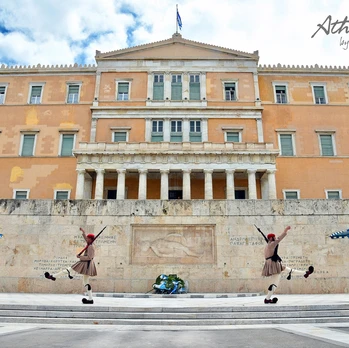
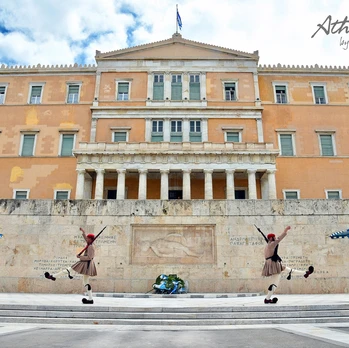
One side of the square features the Tomb of the Unknown Soldier, built to honor those who died in the War of Independence of 1832. Soldiers in traditional Greek national costumes stand guard in sentry boxes on either side. The monument bears two inscriptions from the ancient Greek historian Thucydides, which translate to "Here lies a hero whose bones are buried in the earth" and "The clouds are his funeral shroud."
Every hour on the hour, the Changing of the Guard takes place at the tomb. Unlike the solemn, awe-inspiring image I had in mind, the Syntagma Square guards are famous for their peculiar marching style. As they move forward, their kilts flutter in the wind, their boots click loudly — the strange movements contrasting sharply with their serious expressions. It's highly distinctive.
Soon, three more soldiers joined the changing procession from the roadside, with officers in camouflage and berets helping adjust their uniforms and hat ribbons. Though the ceremony has a slightly theatrical quality, the soldiers' synchronized movements — soft yet strong — naturally command respect from onlookers. The longer you watch, the more solemn it becomes.
Behind the Tomb of the Unknown Soldier stands the orange-yellow neoclassical Parliament Building. Consequently, Syntagma Square often serves as a venue for celebrations, memorials, protests, and even strikes. It was May 9th, and we happened upon a gathering commemorating Victory in Europe Day. Both adults and children wore orange-and-black striped "St. George" ribbons on their chests. This symbol was created by Russia to mark the 60th anniversary of the victory in the Great Patriotic War and has been promoted to other countries since 2006 — Greece being one of them. Every year on this day, Athenians gather here to honor their fallen heroes and express pride in the victory over fascism.
Metropolitan Cathedral of Athens: A Byzantine Masterpiece
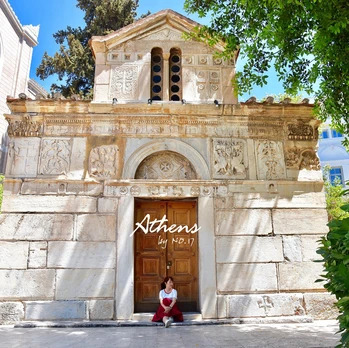
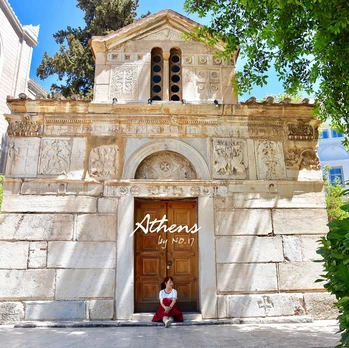
Leaving Syntagma Square, we arrived at the Metropolitan Cathedral of Athens, located on the main street of the Plaka district. This Eastern Orthodox church, construction began in 1842, masterfully blends Byzantine traditional style with European classical elements, exuding an air of noble elegance. It's arguably Athens' most beautiful cathedral. As the current cathedral of Athens and all of Greece, it hosts major national events — from presidential inaugurations to funerals of important figures.
The interior is equally stunning. Every inch, from ceiling to walls, is covered in exquisite, colorful paintings — a scene of opulence. In Eastern Orthodox churches, no statues of any figures are allowed except for angels. This is the biggest difference from Catholic churches. All biblical stories and figures are presented through flat frescoes and mosaics. Almost every surface except the columns is painted, showcasing the rich, colorful style of Byzantine art.
Eastern Orthodox clergy wear black robes and cylindrical hats — another distinguishing feature from Catholicism.
Outside the cathedral, in the square, stands the last emperor of the Byzantine Empire...
(Note: The original text cuts off here. But by now, you can already sense that Athens' ancient ruins, Santorini's romance, Zakynthos' drama, and Kefalonia's ethereal beauty are all waiting to be discovered.)
Final Thoughts: Some Lessons Worth Remembering
This 14-day in-depth Greek honeymoon taught me one thing: a truly wonderful trip isn't about ticking off a checklist of attractions. It's about discovering surprises in unfamiliar places with the person you love, feeling history beneath ancient structures, and simply sitting quietly by the deep blue sea.
From Athens' ancient ruins to Santorini's blue-domed churches, from Zakynthos' Shipwreck Beach to Kefalonia's Melissani Cave — every stop had its unique charm, every moment was worth remembering.
If you're also planning a Greek honeymoon, keep these things in mind:
Prepare in advance, but don't overthink it — Visa, flights, and accommodation can all be sorted early, but some details (like inter-island flight times) are better confirmed locally.
Renting a car is the way to go — Public transportation on the islands is inconvenient. Driving gives you the freedom to explore those off-the-beaten-path spots.
Spring and autumn are the most comfortable seasons — Avoid peak-season crowds and winter ferry cancellations. May and September are ideal.
Bring enough cash, but not too much — Some places only accept cash, but card payments are common. We brought 2,240 euros and had only 100 left over.
Enjoy the journey, don't rush — The most important thing about a honeymoon is the time you spend together. You don't need to hit every attraction. Leave some things for next time — that's your excuse to come back.
Finally, thank you to my wonderful wife for her meticulous planning and constant companionship throughout the trip, and thank you to Mafengwo for the recognition. May every couple in love find their own piece of the Aegean Sea.
You should also read:
A 9-Day Yunnan Journey: From Lijiang to Dali to Tengchong – A Trip Toward Self-Reconciliation
A 9-Day Yunnan Journey: From Lijiang to Dali to Tengchong – A Trip Toward Self-Reconciliation Some say travel is simply going from a place you're tired of to a place other people are tired of. It stings to hear, but it's painfully true. Yet there's…
Continue reading...
Yunnan! Paradise on Earth – The Yubeng Chapter: A Soul-Cleansing Journey into Seclusion
Yunnan! Paradise on Earth – The Yubeng Chapter: A Soul-Cleansing Journey into Seclusion Prologue: Why Yubeng? If you ask me which place in Yunnan is most worth hiking to, I would answer without hesitation: Yubeng. This is not an answer I give lightly. As a…
Continue reading...
Into the Hidden Valley: A Solo Journey Through the Mysterious Dulong River
Into the Hidden Valley: A Solo Journey Through the Mysterious Dulong River Deep in the northwestern corner of Yunnan Province, tucked away from the modern world, lies a place that feels like a secret whispered among mountains. The Dulong River Valley is not just a…
Continue reading...