Heavy-Pack Trekking Under Meili Snow Mountain (East Slope + North Slope): Beauty in the Grand and the Minute
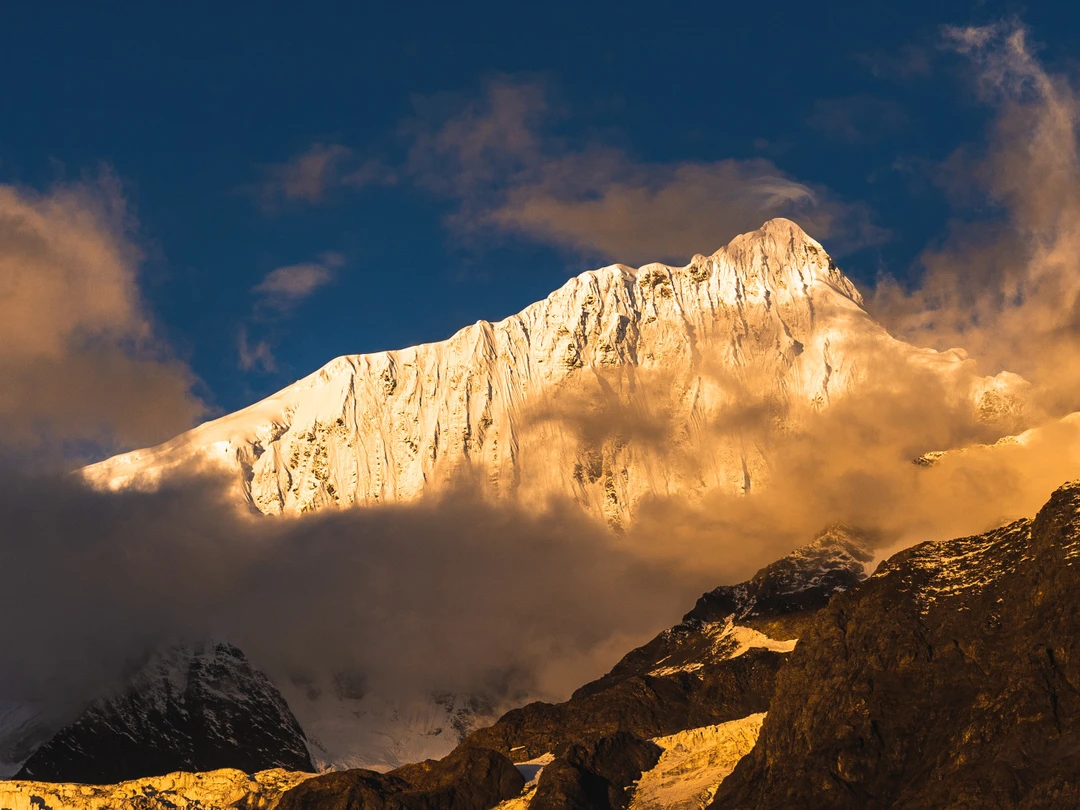
Heavy-Pack Trekking Under Meili Snow Mountain (East Slope + North Slope): Beauty in the Grand and the Minute
Prologue: When the Distance Ceases to Be Imagination
The most moving moments in travel are often not the breathtaking landscapes, but a quiet corner, an unremarkable moment, that suddenly awakens deep memories—those childhood imaginings of distant places, arriving softly across the years, bringing back a familiar sense of wonder.

In late September 2022, my partner and I set out for Deqin County in Yunnan. The destination was clear: Meili Snow Mountain. But where we ultimately arrived was an unexpected answer.
The Sunshine of Deqin: Warmth and Stillness in a Small Town
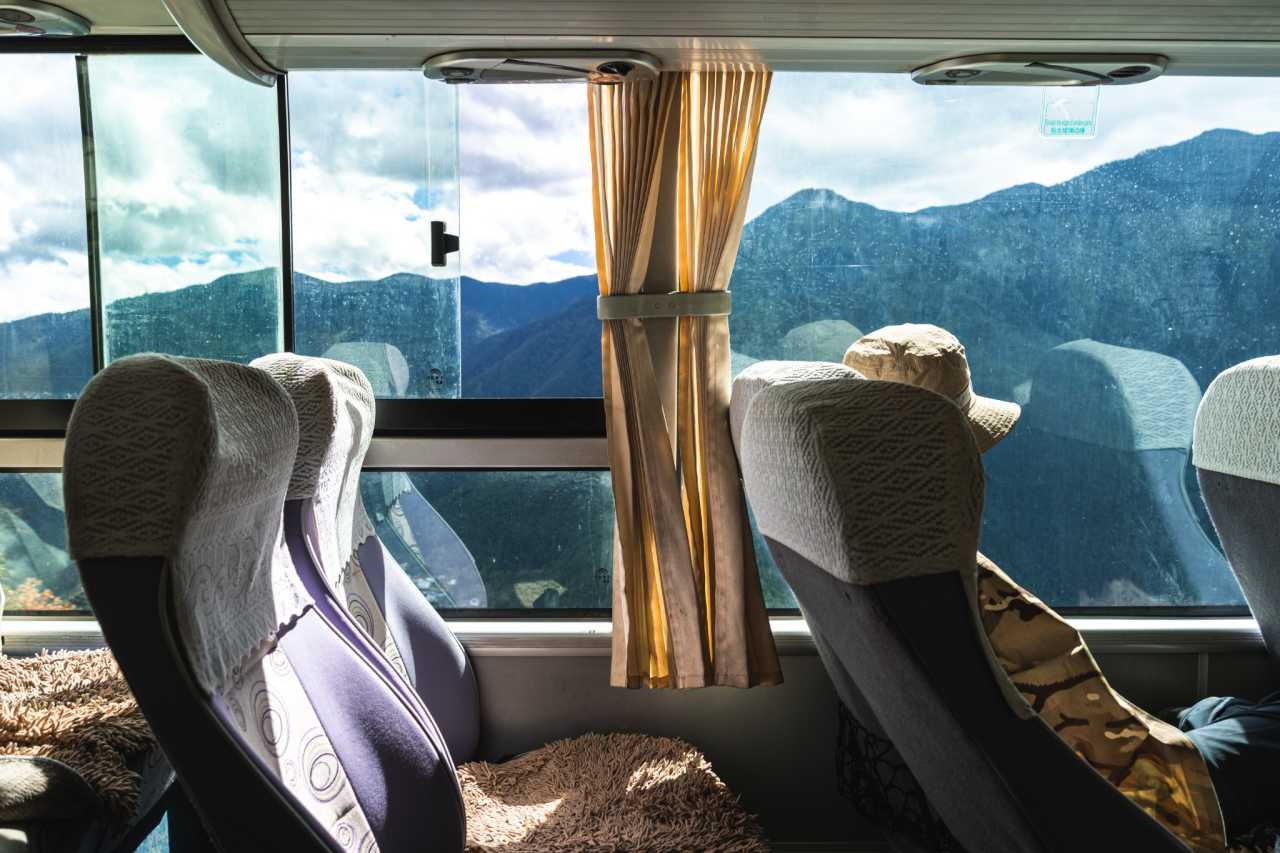
The bus from Shangri-La headed north along roads we had traveled two years before. The scenery outside the window was both familiar and strange—Napa Lake, Benzilan, the vehicle climbing through the mountains. The difference was that we no longer needed to cross the Baima Snow Mountain pass at over 4,000 meters. A new tunnel had connected the north and south sides of the mountain range, and after twenty minutes, we emerged on the northern side.
The sun was brilliant, but the distant Thirteen Peaks of Meili lay sleeping beneath thick clouds, revealing only a few silvery glaciers on their mid-slopes. The scene was reminiscent of the film Kora, where two cyclists first encounter Meili.
The Deqin bus station was tiny. Passengers quickly dispersed, leaving silence behind. We took out our backpacks and began organizing. A Tibetan driver, learning we were heading to the North Slope, voluntarily offered a cheaper option—take a minibus to the river near Yagong Village, then hire a car into the village.
This kind of selfless helpfulness has become rare in domestic travel today. But the Tibetan areas seem to preserve this tradition—though not universally, most Tibetans still maintain their质朴 (simple and honest) character.
Deqin town stretches along a steep slope. We walked downhill to find our inn. Inside, Tibetan incense was burning, its scent similar to the incense of Nepal and India. At the front desk sat a large Tibetan man with thick, curly hair, resembling a temple guardian deity—intimidating at first glance.
"Where do you want to go?" he asked.
"Feilai Temple."
"You know how to drive, right? Take my car!"
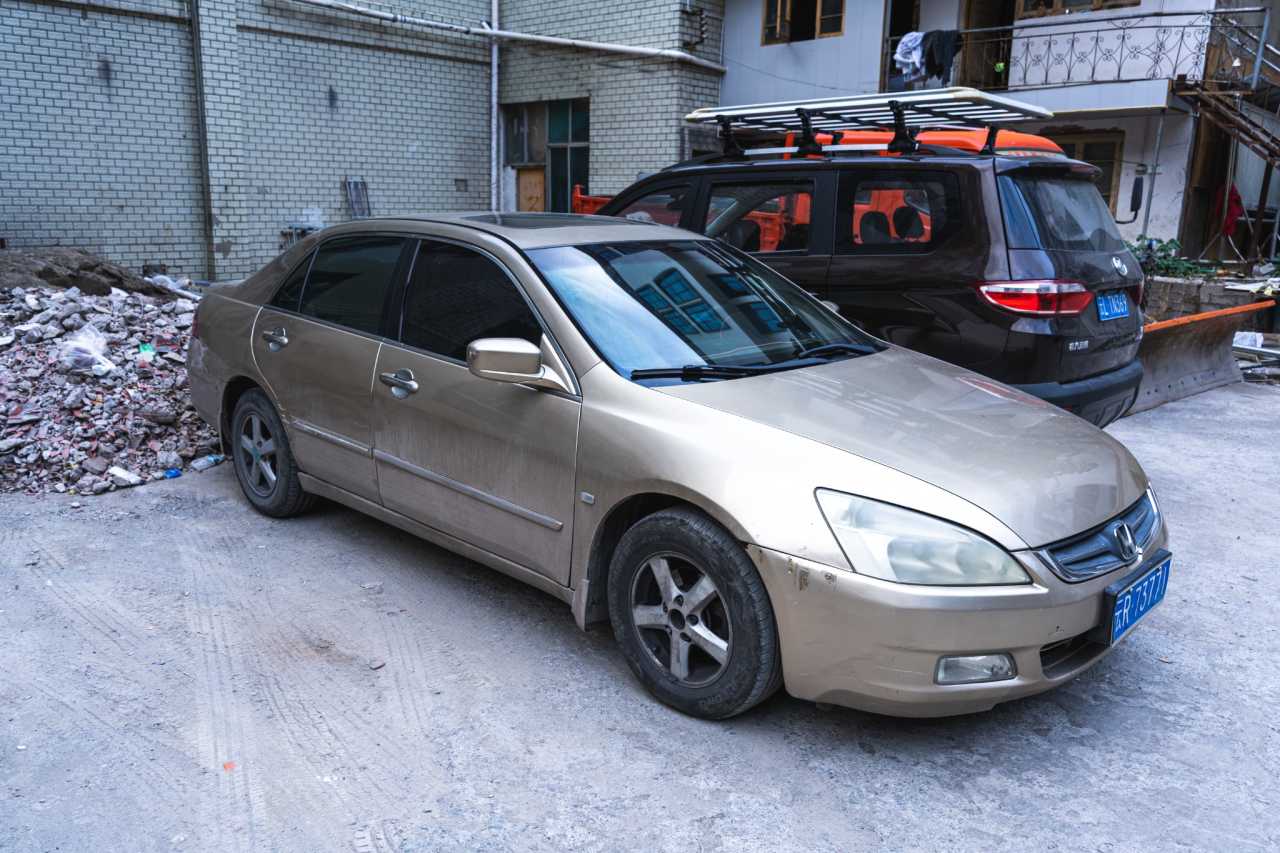
And so, that afternoon, we became "car owners"—a Honda sedan whose doors wouldn't lock, with various minor issues. But in the Tibetan region, nobody cares about such things. As long as the car runs and the brakes work, nothing else matters.
Feilai Temple was eerily quiet. All hotels and restaurants were closed. No tourists. We later learned it had recently been used as a quarantine site. The empty road stretched along the mountainside, while the Meili Snow Mountain opposite still slumbered in clouds. Sunlight streamed through glass windows into deserted restaurants and guest rooms, like a post-apocalyptic movie scene.
I've never been fond of popular tourist spots, but Feilai Temple was an exception. Perhaps because the view of Meili from here is incomparable, or perhaps because I first encountered this place through others' words and images in my youth, and later met it again at different stages of life—it carries so many stories, others' and my own, all woven into my memory.
But walking here now, everything from the past seemed to have vanished like smoke. The things that anchor memories—whether scenes or people—were nowhere to be found. People come and go; in the end, we are all just passing through.
With the convenience of the car, we stocked up on trekking supplies in Deqin, got our COVID test done, and enjoyed a lamb hotpot dinner. Everything was ready.
Accidents Always Happen: The Twist from North Slope to East Slope
"The Meili North Slope is off-limits."
Early in the morning, our driver Zha'an called. Two close contacts of confirmed cases had appeared among the North Slope trekkers. The entire scenic area was closed. Several hundred people who had already entered were being expelled and quarantined near the village.
This National Day holiday was even tougher than the previous two years. Tibet and Xinjiang were completely locked down. Most of China was either impossible to leave or impossible to enter. After finally making it to Yunnan, the whole journey felt like racing against time—we had nearly been quarantined during our transfer in Kunming. Unexpectedly, we were still one step too slow.
Long-distance travel these days requires lottery-level luck.
But the arrow was already on the string; there was no turning back. Fortunately, I had prepared several backup plans before departure. After weighing the options, I asked Zha'an: "Can we go to Sinong Village now?"
"Probably."
"Then take us to Sinong Village."
And so, the Meili East Slope—originally ranked third on our list—became our first destination by accident.
Compared to the North Slope, the East Slope is far less known. Online, there are only a handful of photo-and-text reports, the earliest being a heavy-pack route-finding post from two years ago on the 8264 forum. The summary: deep forest, steep slopes, long distances, large elevation changes, and greater difficulty than the North Slope. Moreover, because the entire route runs along exposed, precipitous ridges, no mules or horses can be used. All of this ensures the East Slope will never become a网红 (internet-famous) trekking destination like the North Slope.
Later, we learned from a guide that fewer than ten teams trek the East Slope each year. By contrast, the North Slope saw thousands of visitors during last year's National Day holiday alone.
But the East Slope offers a unique landscape—it is probably the closest you can get to Kawagebo Peak without actually climbing the mountain (which has been banned since the 1990s). For that reason alone, it is worth the effort.
Sinong Village: A Paradise in the Canyon
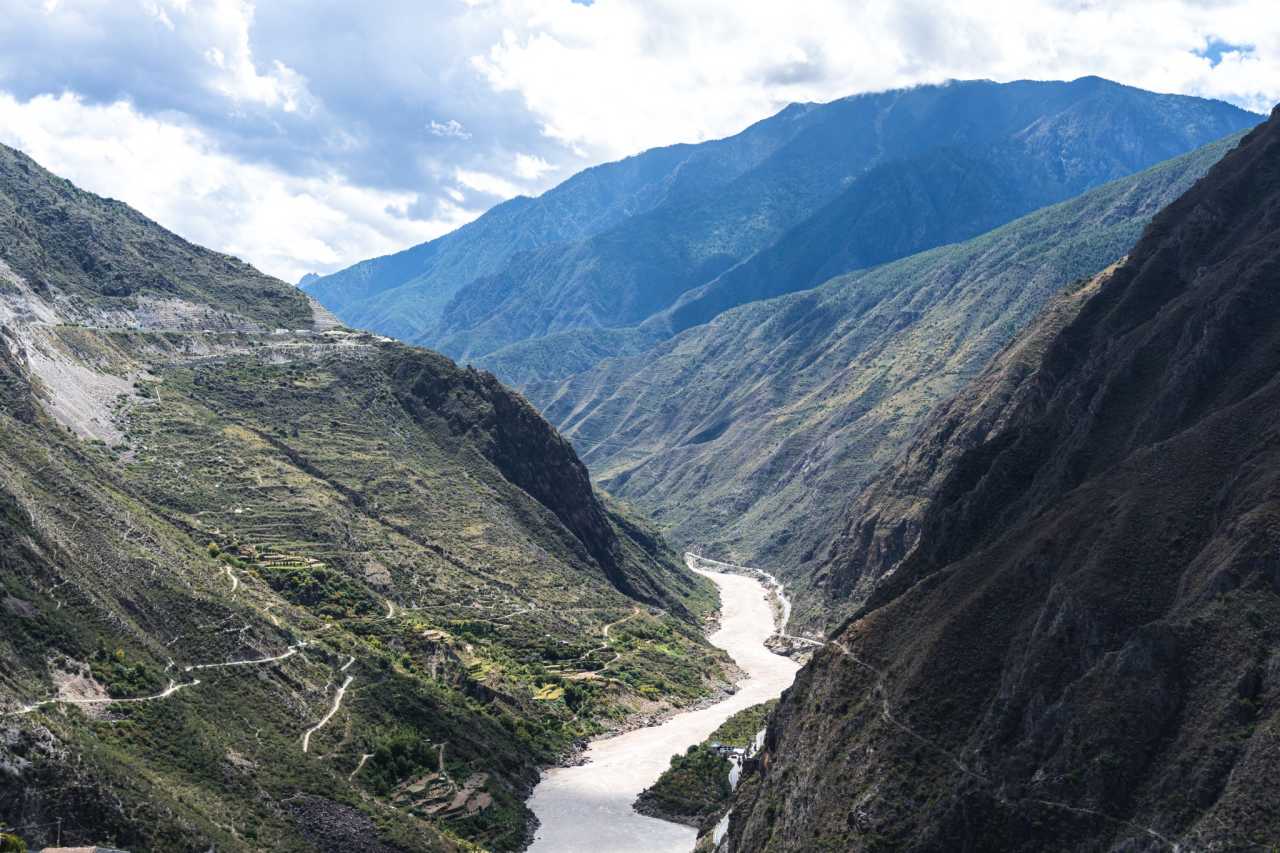
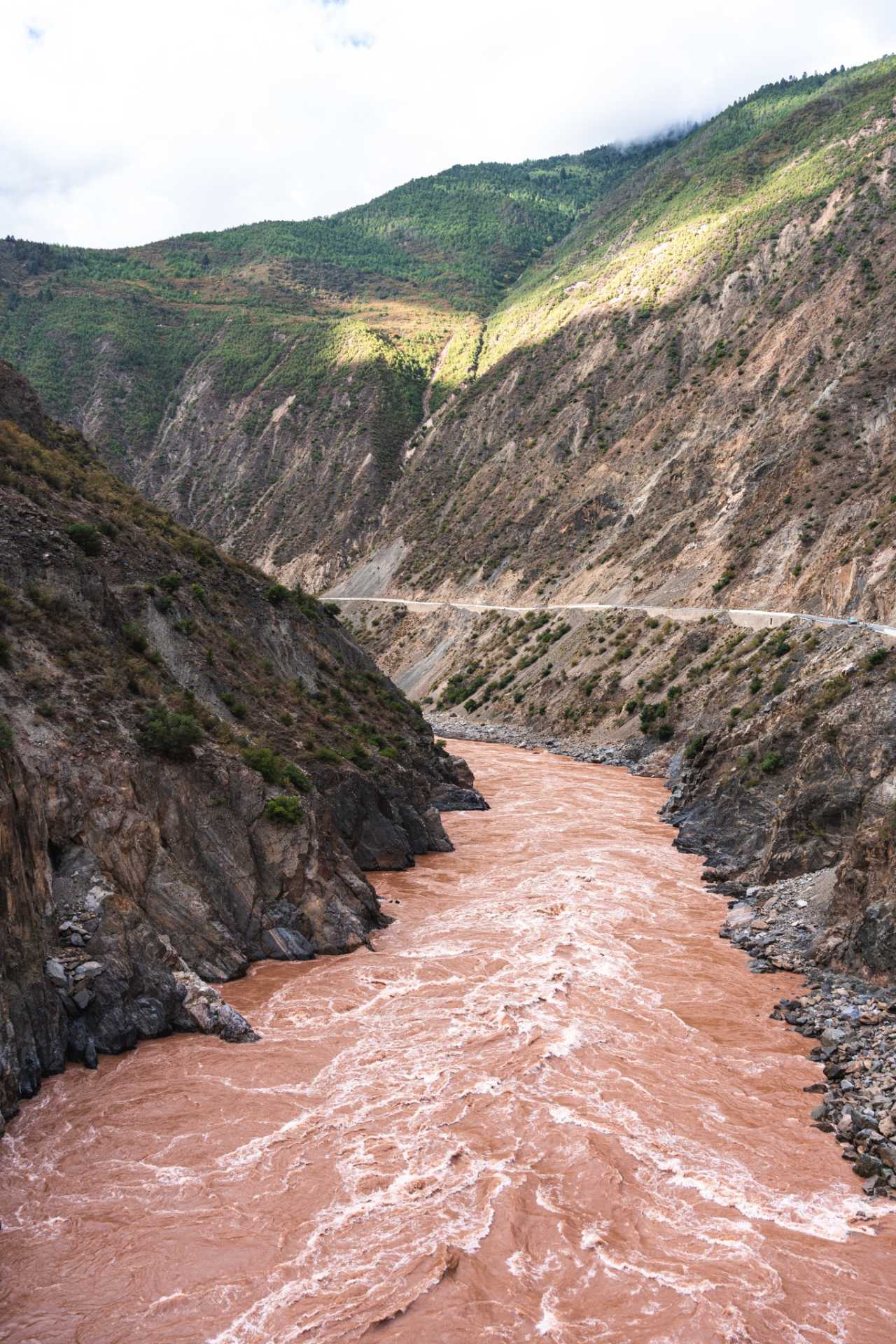
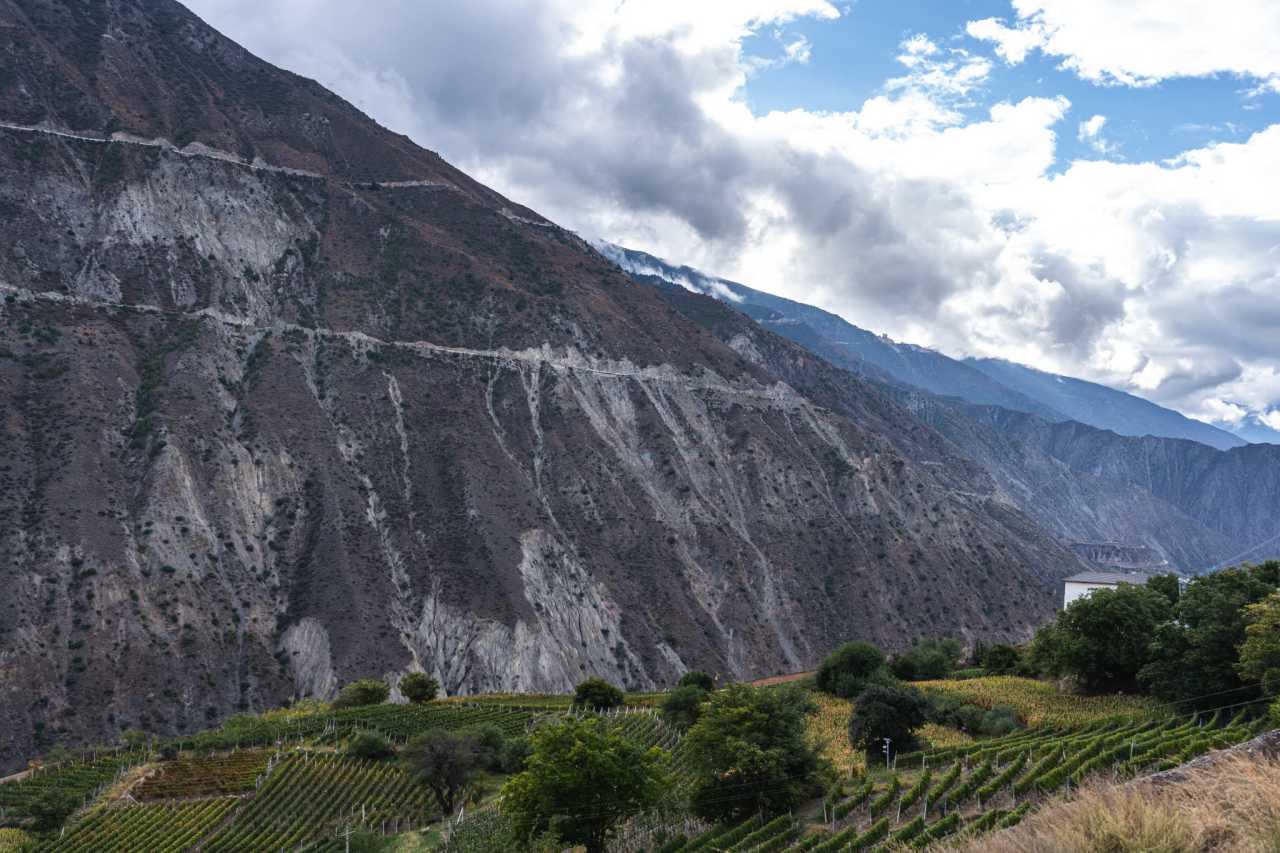
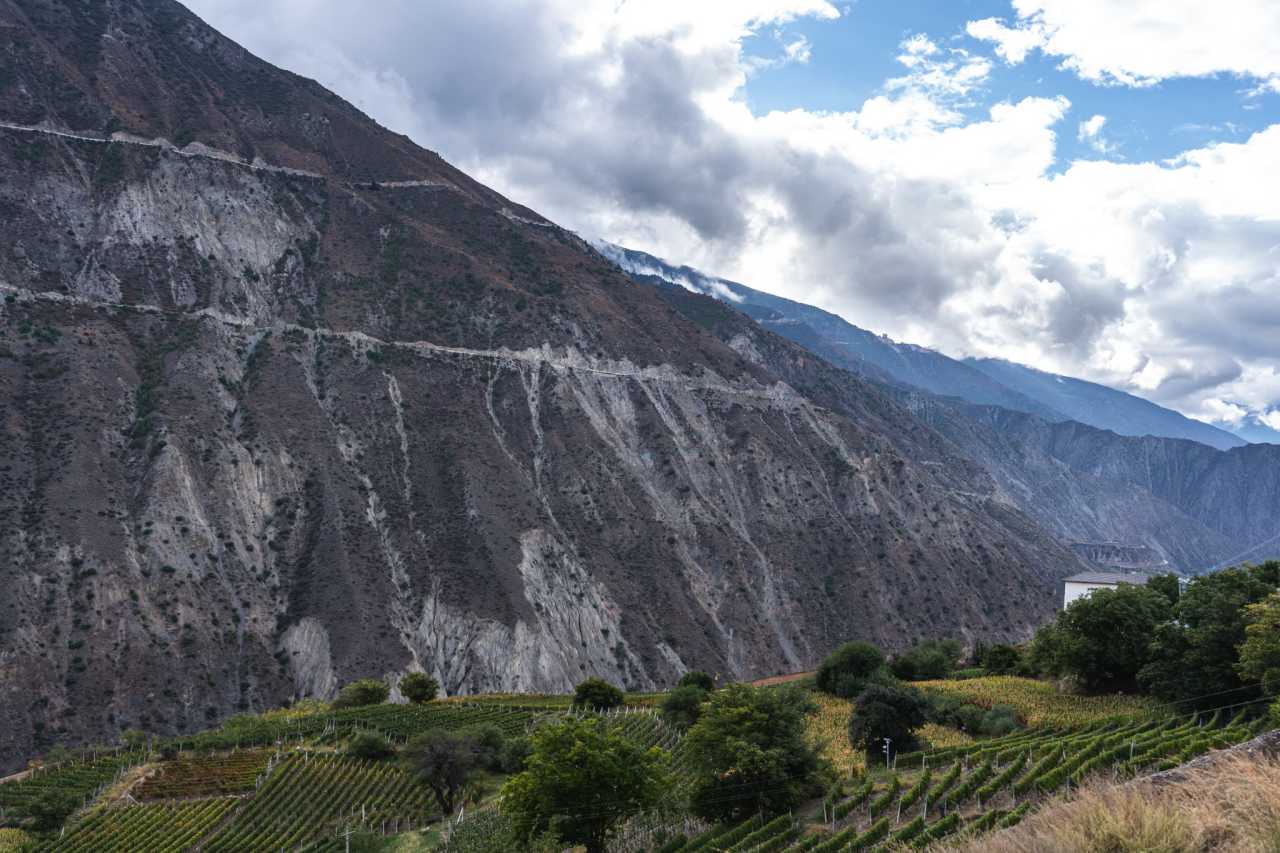
The Lancang River (Mekong) flows at an elevation of just 2,000 meters, more than 1,000 meters lower than Deqin and Feilai Temple. This area has a dry, hot valley climate—warm and arid. On both banks, bare, sand-yellow rock faces rise steep and towering toward the sky.
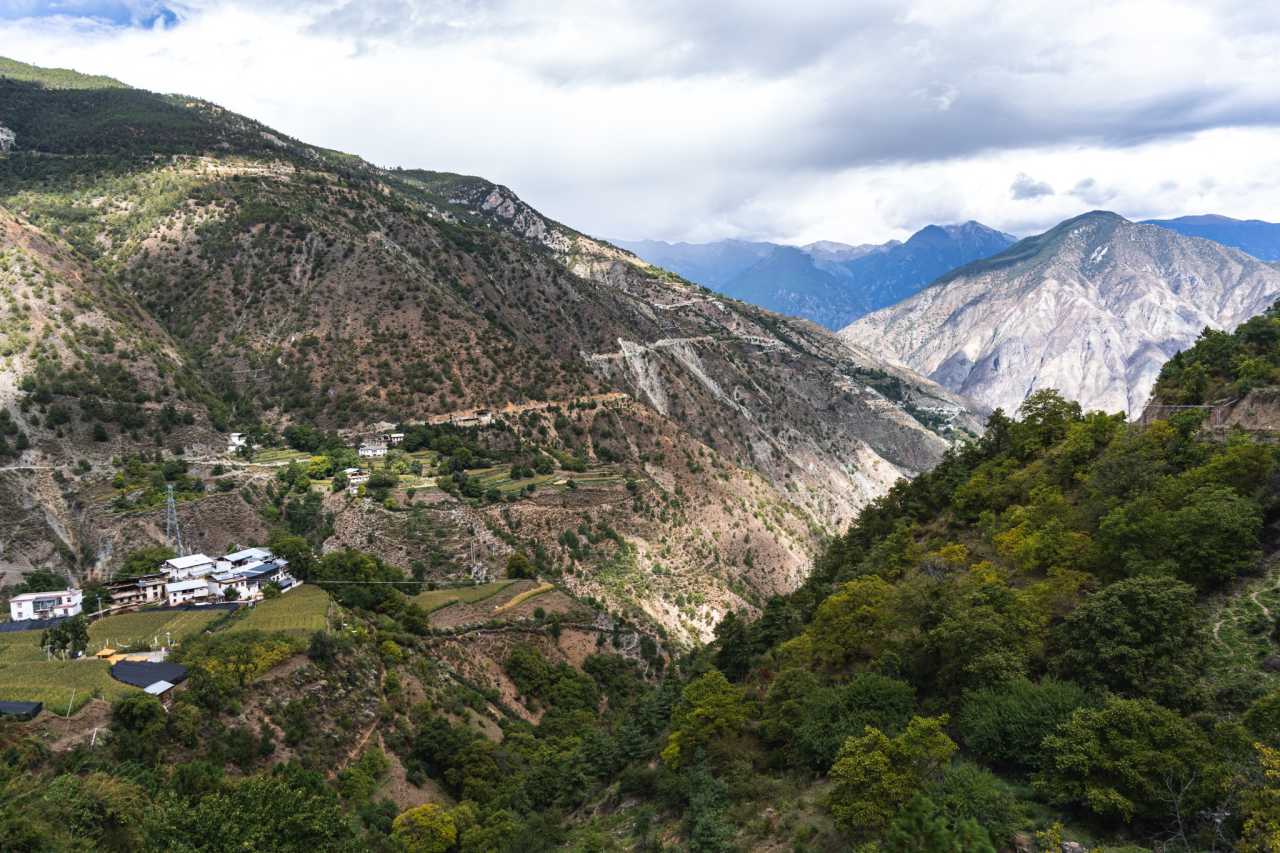
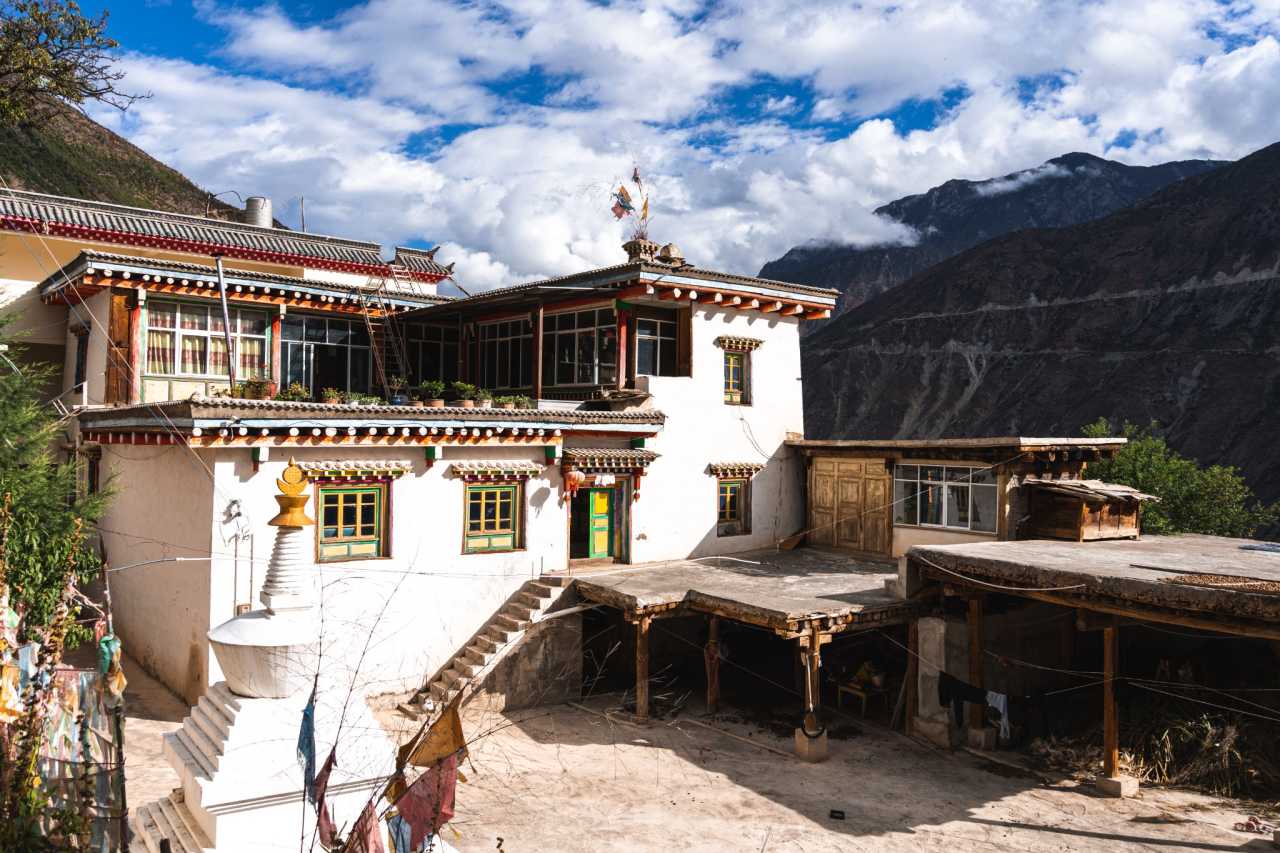
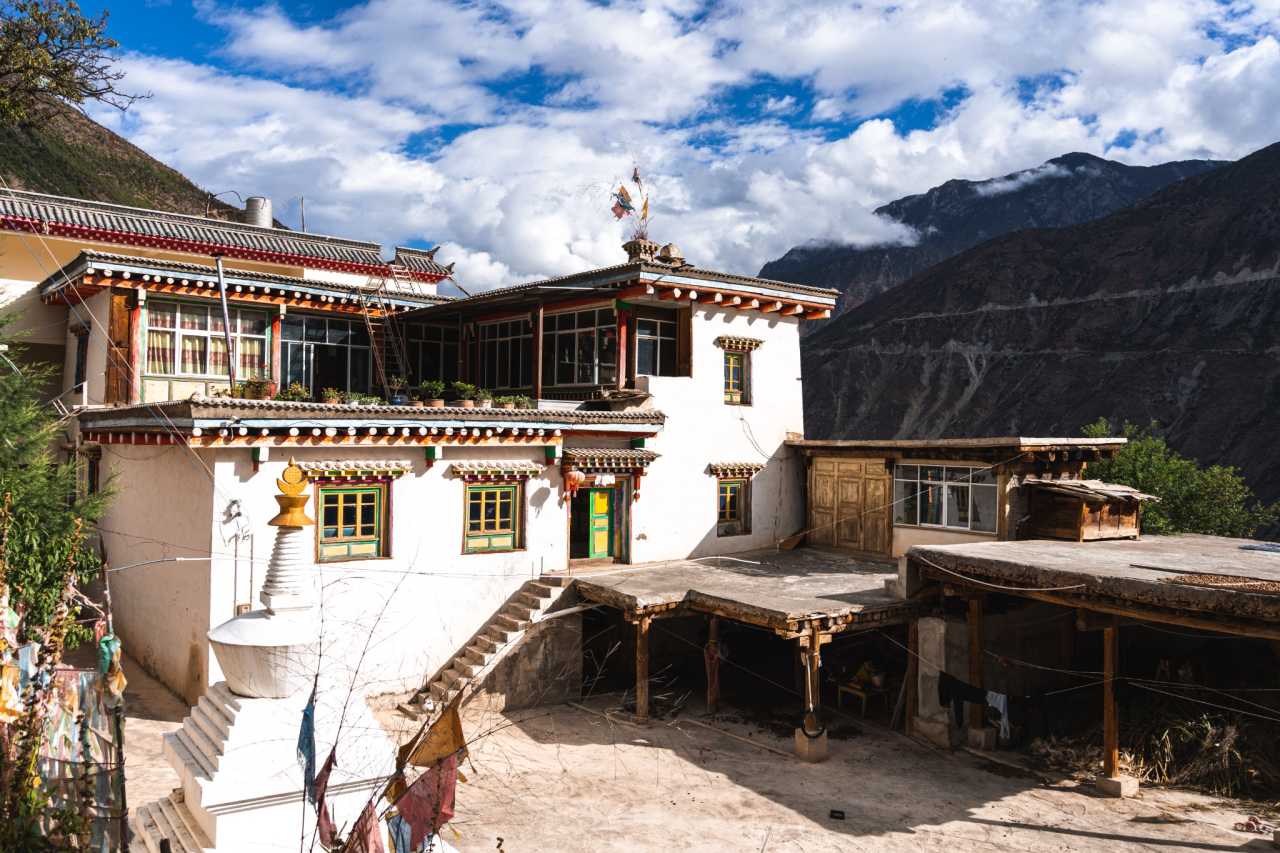
Sinong Village sits on a rare gentle slope within the canyon, an oasis in this dry, barren world. Verdant walnut trees shade beautiful fields and vineyards, with white Tibetan houses scattered among them—a paradise straight out of James Hilton's imagination.
Zha'an parked the car in the village and helped us contact the village chief. The chief said that hiring a local guide was mandatory for going up the mountain. Although we later learned it was possible to enter without a guide, objectively speaking, having a guide on the East Slope is very useful—it greatly reduces the difficulty and danger of the crossing and increases your sense of security, especially if you find a reliable and responsible one.
Furthermore, the road leading into the mountain from Sinong Village is locked by a village gate. Only by hiring a guide can you open this gate and drive to the end of the road at around 3,000 meters elevation. Without a guide, you would have to hike up from the village at 2,000 meters, adding nearly 1,000 meters of climbing.
While waiting for the guide, we wandered around the village. Sinong is different from Yubeng and Mingyong, which also lie at the foot of Meili Snow Mountain—there are almost no tourists here, no traces of commercialization. It is a Tibetan village preserved in its original state. This peaceful scene immediately captivated me: this is my ideal version of a distant place—a quiet, beautiful, unadorned village encountered unexpectedly along the way.
Guide Jiaduo: The Mohican with a Knife
Guide Jiaduo was a Tibetan uncle in his fifties, wearing a military-style cap, his square face expressing both toughness and kindness. He had no professional outdoor gear—just an ordinary black backpack and soft-soled leather shoes. The most striking thing about him was the large chopping knife at his waist, reminding me of the old Indian hunter in The Last of the Mohicans. Seeing him and that knife gave me an inexplicable sense of safety.
Zha'an drove his taxi, carrying us away from Sinong Village, climbing upward along a narrow dirt road.
We passed many white Tibetan incense burners. Every morning, Tibetans light juniper branches in them, praying for the protection of the various spirits of this land. At one incense burner on a turn of the dirt road, facing the magnificent canyon—the Lancang River and the village were already far below in the gorge.
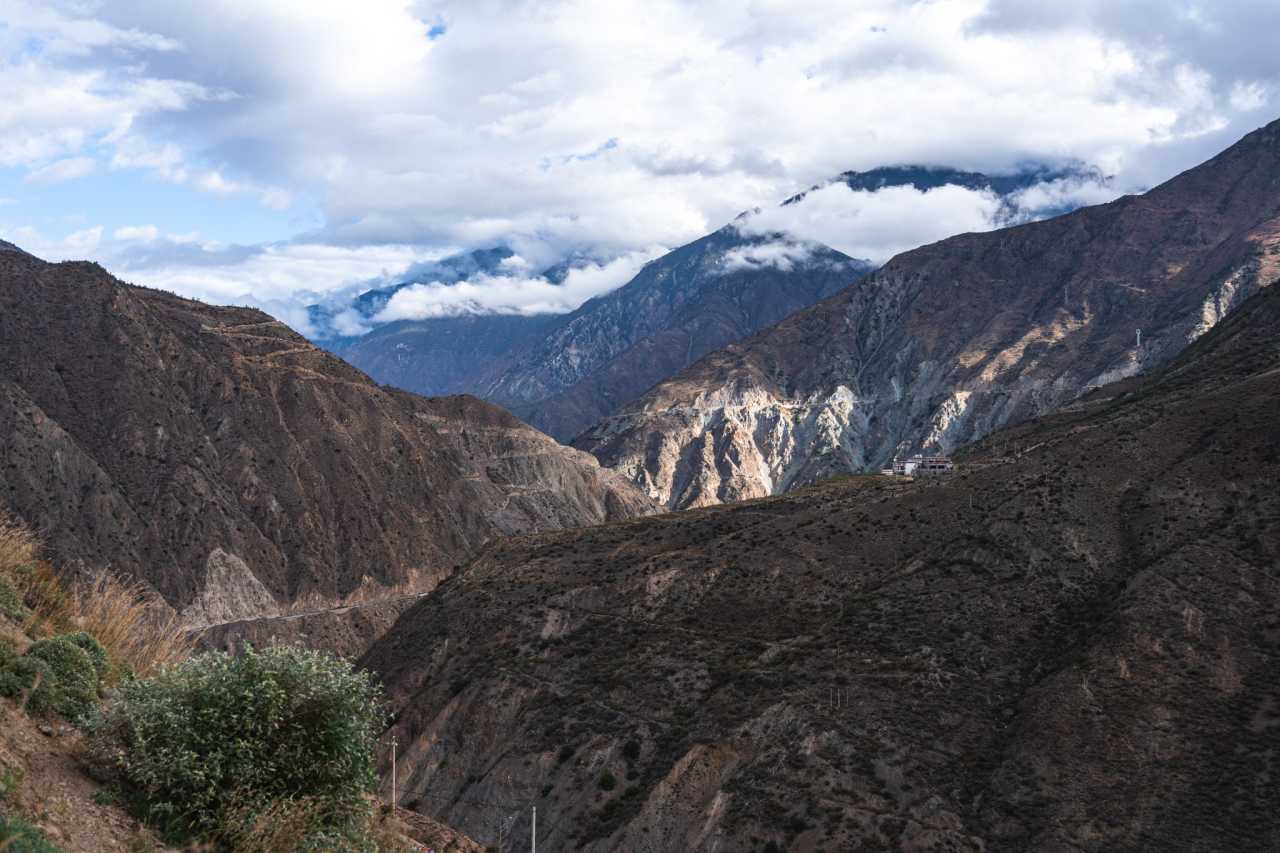
After that, the dirt road left the dry river valley and entered the forest on the mountainside. The vertical distribution of landscapes in the Meili Snow Mountain region is remarkably distinct—you can pass through four seasons in a single day, experiencing the strange transitions from dry-hot valley to subtropical jungle to snowy highlands.
The road conditions worsened, but Zha'an seemed unconcerned, still driving quickly over scattered rocks. I warned him about puncturing a tire or scraping the undercarriage, but he continued as he pleased, as if believing everything was in the hands of fate.
The primitiveness of this forest revealed itself in every aspect. Tall fir trees were draped with hanging moss (usnea), like gauze curtains woven by the Creator—this parasitic plant, a type of lichen, grows only in wilderness with exceptionally pure air. A white pheasant dashed across the road in panic. The branches on both sides grew denser, occasionally scraping the car, showing that this road had not been used for a long time.
A tilted tree blocked the path ahead. Jiaduo said, "Let's cut it down." I was wondering how long it would take to cut a tree when Jiaduo pulled out his knife and, in a few swift strokes, chopped it down.
Another fallen tree blocked the way. Jiaduo kept cutting...
And so, this city taxi, relying on a chopping knife to clear the way, traveled through the primitive forest road—a somewhat surreal scene.
Until we encountered a tree too thick to cut, lying diagonally across the road. The car could go no further.
We were near the end of the dirt road, at an elevation of about 3,000 meters. We shouldered our packs, said goodbye to Zha'an, and under Jiaduo's guidance, plunged into the dense forest.
The Grueling Climb: Peak Difficulty from the Start
Since the East Slope was not our primary destination, I hadn't researched it thoroughly. The online trip reports were brief, giving me the illusion that this route simply required crossing a stretch of forest to reach a ridge.
But thinking about it, I knew it couldn't be that simple. From the end of the road at 3,000 meters to the ridge campsite at 4,200 meters—anyone with outdoor experience knows what 1,200 meters of elevation gain means, especially on such rugged terrain.
The entire route was steep uphill, with almost no flat sections. Some parts required scrambling over boulders with hands and feet.
From 3,000 to 4,000 meters (most of the journey), we were in the forest, with little distant scenery visible. However, the forest also concealed the steepness on both sides of the ridge—later, when we reached the terrifying exposed ridge, we often missed the security of the forest.
The air in the primeval forest was extraordinarily pure. Every breath felt like a lung cleanse. The plants provided enough oxygen—at least below 4,000 meters, even carrying heavy packs, we weren't particularly out of breath. It felt similar to hiking in the mountains around Hangzhou.
The forest's appearance changed interestingly with altitude. Initially, from the roadside to about 3,200 meters, it was autumn-colored deciduous forest, with yellow leaves drifting in the wind, including many birch trees.
Then, from about 3,200 to 3,700 meters, it felt like entering the subtropics—the dominant plants became bamboo, everything was green, the air was more humid, tree trunks were covered in moss and strange fungi, and the constant chirping of insects filled the air, like being in Southeast Asia.
Logically, lower elevations should be more tropical. But from the Lancang River to here, the scenery had changed from highland desert to temperate, then to subtropical—this reverse change was truly strange. The dominant factor might be moisture rather than temperature. At the mid-slopes of the Meili region, air rising along the terrain produces abundant rainfall, making this elevation extremely humid. Combined with the still relatively low altitude and warm air, it creates a subtropical landscape.
Continuing upward, the bamboo finally disappeared, replaced by uniform pine trees—straight, tall trunks arranged neatly on the slope.
As darkness fell, a light rain began. We arrived at a forest campsite with a water tank carved from a log, containing some relatively clear water. We carefully filled a few bottles, trying not to disturb the sediment at the bottom.
On the East Slope ridge, water was the biggest problem. The only natural water source was a small pond at about 3,300 meters, but the water was murky, and we didn't use it at all. Higher up, we could only rely on two artificial water tanks at the campsites—limited in quantity and poor in quality.
We had been careless about the water issue. We kept thinking that on such a large mountain, there had to be water somewhere—but in fact, there wasn't. Moreover, at this season, there was no ice or snow on the entire route. To reduce pack weight, we had only brought a few small bottles of water. If Jiaduo hadn't carried water for us every day from those distant campsites, we couldn't have stayed on the ridge for so many days.
Physical exhaustion crept in quietly and swiftly, like dusk. The effects of altitude had become pronounced. Combined with the rain, we were showing signs of hypothermia and energy depletion. I took out the tent and distributed the flysheet, inner tent, and groundsheet among the three of us as rain ponchos, making a final push toward the campsite.
Above 4,000 meters, the forest finally receded, leaving only low rhododendron bushes on the ground. The surroundings finally opened up—ahead, Meili Snow Mountain remained hidden in clouds, with only the Mingyong and Sinong glaciers cascading down on either side of the ridge.
This trek might have been the least physically prepared one I'd ever done. In fact, we had done almost no training, directly challenging high-altitude heavy-pack trekking with the physique of "zero-altitude couch potatoes." We had originally planned to start on the North Slope, where the trail is easier, allowing us to acclimatize first. Now—"peak difficulty from the start." The East Slope route was truly too challenging.
We were also carrying four days of food originally prepared for the North Slope. Despite our efforts to go lightweight, my pack still weighed about 18 kilograms.
On the final stretch, I couldn't go any further. I sat on the slope, facing the vast valley in the twilight. Beyond the mist and clouds was a distant patch of brightness—the direction of the Lancang River and Feilai Temple, now so far away. Reflecting on the day, eight or nine hours of trekking, from clear skies to rain, I felt somewhat dazed, unsure where I was or why I had come.
Long processes easily make one forget the original intention, getting lost in the mindset of overcoming obstacles. Yet overcoming obstacles is not the fundamental purpose of travel—it is merely a means or a secondary goal. Only experiences that create deeper connections with life truly move me; that is the fundamental purpose of travel.
Such experiences are not necessarily accompanied by hardship—often, they can be encountered casually during easy, relaxed walks. The reason I choose heavy-pack trekking is simply to reach places inaccessible to modern transportation, to see landscapes untouched by industrial civilization. These landscapes are what I yearned for in my youth, and they have become a lifelong passion.
Jiaduo turned back and asked if we wanted him to carry our packs. We both declined—at this final stage, we couldn't break the honor of completing the trek fully self-supported. Though this honor was ultimately just a self-affirmation, it still held meaning.
In the dim light after dusk, we finally reached a small flat area high on the ridge. It was just big enough for a few tents. Jiaduo had no tent or sleeping pad, only a sleeping bag. He said he would go to another campsite ahead, where there was a ready-made tent. He offered to help us set up camp, but seeing how late it was, we urged him to go on. The rain-slicked ridge was slippery and dangerous. He held a bamboo stick in one hand and a flashlight in the other—even as a local, it was worrying. I put my headlamp on his head and gave him my groundsheet as a rain poncho.
Waiting for Kawagebo: Days of Living in the Sky
For the next two days, we stayed on this ridge, waiting for Kawagebo Peak.
The weather improved day by day. Kawagebo's body was often visible, but the highest summit was always blocked by clouds.
The sea of clouds before dawn was magnificent—covering the valleys below the Sinong and Mingyong glaciers, spreading all the way to the eastern horizon. After sunrise, the clouds began to churn, crashing against the mountain like giant waves, sometimes rushing toward us.
This bare, treeless ridge offered a perfect viewpoint. We felt like we were living in the sky, watching the clouds below us, beside us, near and far, changing shapes every minute.
In the days following rain, even with good weather, it was hard to see the high snow mountains—because the mountain contained too much moisture. The clouds generated by sunlight heating the moisture would quickly cover the peaks. It took several days of sun, wind, and river flows to disperse this moisture.
For snow mountains like Meili and Namcha Barwa, which stand at the gateway of the Indian Ocean's moisture, the probability of maintaining sufficiently good weather for any length of time is very low, except during the dry winter season. So often, they are "visible ten times, hidden nine."
On the afternoon of the second day, we moved our camp to a ridge platform closer to Kawagebo. This position was higher, at about 4,400 meters, directly facing the Mingyong Glacier.
The move involved walking along the exposed ridge—infinite views on the perilous peak. Far to the east was Feilai Temple; we were in the very scenery they gazed upon.
The new campsite was more spacious, with a small slope on one side for wind protection. Opening the tent revealed a magnificent view.
On the third morning, we saw the golden sunrise on Jiangjun Peak (General Peak), but Kawagebo's summit remained shrouded in clouds.
The Mingyong Glacier flows from the vast ice field below Kawagebo's peak, plunging over 2,000 meters down the steep cliff. Small collapses constantly occurred on the glacier, ice and snow falling vertically with rumbling sounds. From the unseen ice field above, similar sounds came—as short as a few minutes apart, as long as half an hour, continuing day and night.
This is a typical maritime glacier, one of the most climatically complex and most active ice layers in the world. For those who dare to approach it, it means great risk.
In 1991, a joint Sino-Japanese expedition attempting to climb Kawagebo was hit by a massive avalanche. The entire camp was buried, and seventeen team members died. It was only years later that some of the climbers' remains and belongings were discovered below the Mingyong Glacier.
I had watched a documentary about this disaster long ago and was deeply shocked at the time. Now, I was probably as close to the scene of that catastrophe as I would ever be—yet I felt no particular emotion. Perhaps because I'm older and have seen many strange things. On the other hand, up close like this, unlike from Feilai Temple, the disaster seemed to have shed its mystery, becoming concrete and real.
I talked with Jiaduo about the disaster. He was a teenager back then, probably around the same age as those climbers. The expedition had started from Yubeng Village; living in Sinong, he had no first-hand experience. He only knew that two Tibetan porters had also died. He said that in the 1980s, Americans had already attempted to climb Meili—"They went up along that ridge over there, but it got too steep, and they couldn't go further." He pointed to the ridge line on the north side of the Sinong Glacier. From here, the ridge near the peak did look exceptionally treacherous.
The ridge we were on connected to Kawagebo Peak. But going further was not possible on foot. Even for climbers, challenging this extremely fragile terrain was gambling with their lives.
"What did you think of those climbers back then?" I asked Jiaduo. I knew that for Tibetans, Kawagebo is a sacred, inviolable mountain. The Tibetans of that time had collectively tried to block the expedition.
"What could we do?!" Jiaduo sighed.
It wasn't until 2001 that the government passed regulations banning the climbing of Meili Snow Mountain, finally ending the Tibetans' concerns.
In my mind, two voices have always existed. One tells me that those who challenge limits and explore the unknown are heroes. The other tells me that achieving one's goals by offending others' beliefs is immoral. In the end, the second voice prevailed—after all, climbers can climb many peaks that don't offend others. Why insist on this one?
Jiaduo's Camp: Daily Life in the Wilderness
Every day, Jiaduo brought us several large bottles of water from his camp. The water was murky and contained impurities. Even after boiling, it had a taste of decaying wood and made our stomachs uncomfortable. But it was our only source of life.
Most of our meals were instant noodles. But no matter how we varied the flavors, the noodles became nauseating. Only once, when Jiaduo brought rice and we combined it with our dried shiitake mushrooms, did we cook a mushroom rice porridge—that was the most delicious memory. Even though at over 4,000 meters, the lower boiling point made it hard to cook the rice thoroughly. By the North Slope, we had switched to dry noodles (gua mian)—which proved far more stomach-friendly than instant noodles and didn't become tiresome even over time.
On the third day, I offered to go with Jiaduo to his camp to fetch water. His camp was on a small platform on the side of the ridge, with cliffs on three sides. The path there was terrifying for someone with a fear of heights like me. But Jiaduo was completely accustomed to it. The day before, during the camp move, he had taken a shortcut in front of us, walking directly along a section of ridge as narrow as a blade, with cliffs on both sides—I was speechless with shock. It was hard to imagine that this was a man in his fifties. I thought, the difference between us was probably like the difference between sheep and goats as species.
When I saw Jiaduo's camp, I couldn't help but feel a pang of guilt. There was no tent here—just a piece of plastic sheeting tied to a piece of wood, barely providing shelter from rain, with a fire of firewood beneath for warmth. For some reason, this sleeping spot was built right on the outermost edge of the platform's cliff—as if it couldn't be slept in without some danger. Jiaduo said this was an old hunters' temporary camp. They came here to hunt an animal resembling a roe deer, which could be used for medicine.
What seemed to us like advanced wilderness survival or bushcraft camping was, in Jiaduo's world, daily life since childhood. Still, making a fifty-something-year-old man stay away from home for several nights in a place like this made me feel guilty—I felt that his daily wage of 300 yuan was truly hard-earned money, earned with his body and even his life at risk.
The water in the log trough at the camp was almost gone, nearly used up by us. What remained was even murkier. We barely filled two bottles. I said that was enough, we could make it last a day. But Jiaduo insisted I go back first, while he would go to the camp we had passed on the first day to fetch more water—that required traversing nearly a kilometer of exposed ridge. "I've got nothing else to do anyway," he said with a smile.
Kawagebo's Revelation: The Grand Finale
At sunset on the third day, Kawagebo finally revealed itself completely.
From this distance, you could clearly appreciate every detail of the snow mountain—the beautiful patterns of ice and snow, as if you could never tire of looking at them.
The weather was improving. I hoped that on the final morning, we would see the golden sunrise on the peak.
That evening, our first companions arrived on the mountain. Despite lockdowns everywhere in the country and the temporary closure of the North Slope, the Meili East Slope remained almost deserted, which surprised me. The companions were a Han Chinese woman and her Tibetan boyfriend, along with their local guide.
That night, we gathered around a fire, burning rhododendron branches from the mountain. The new companions, like us, had originally been heading to the North Slope and had diverted here.
"Don't publicize this place," the woman said to us.
I understood what she meant. Though it might seem selfish, I had to admit she had a point—this rare, pure place, once it became popular, might become the next Yubeng or North Slope, invaded by commerce and transformed beyond recognition.
But I couldn't suppress the desire to share the beauty. I comforted myself: the terrain here is extremely rugged, no mules or horses can pass, the climb is intense—suitable only for those willing to make great efforts for beautiful scenery. Because of the small numbers, it won't attract capital.
Kawagebo's Blessing: Golden Sunrise on the Peak
On the morning of the fourth day, Kawagebo finally staged its grand finale.
Amid the birdsong in the valley, the first ray of sunlight illuminated its summit. Just as you marveled at that initial touch of gold, the golden light rapidly spread downward—in almost a minute, it had illuminated the entire main peak. It was as if someone had removed an invisible curtain covering the mountain.
There could be no more ritualistic start to a day. The last time I had seen such a sight was the previous year at Kula Kangri—when I watched the snow peaks being lit one by one, I said it was like a lama lighting a row of butter lamps for the Buddha.
Seeing this scene, I instantly felt—the long climb, the three days of waiting—it was all worth it.
This stunning peak, combined with the surrounding valleys, clouds, and birdsong, fulfilled all my imaginings of the Himalayan foothills.
This magnificent drama unfolded silently, truly embodying the meaning of "great sound is silent."
Compared to Feilai Temple, the view of Kawagebo from the East Slope was more frontal—a direct blow to the soul.
Epilogue: Beauty in the Grand and the Minute
After descending from the East Slope, we continued to the North Slope and completed our originally planned trek. But the East Slope experience became the most profound memory of this journey.
Reflecting on this trip, what moved me was not just the golden sunrise on Kawagebo—those grand, breathtaking sights. What I cherished even more were the small, ordinary moments—Jiaduo carrying water for us every day, the warmth of the fire on the ridge at night, the simple meal of mushroom rice porridge, the quiet company of strangers who understood our shared secret.
These are the things that stay with you long after the magnificent landscapes have faded into photographs. The grand and the minute—both contain beauty. You just have to be open to receiving it.
You should also read:
Two Girls' Graduation Trip: Dali and Shuanglang – A Poetic Farewell to Mountains and Sea
Two Girls' Graduation Trip: Dali and Shuanglang – A Poetic Farewell to Mountains and Sea Preface: Catching the Tail of Youth, Heading South During our senior year of college, my roommate and I – two girls studying in Beijing – decided to bid farewell to…
Continue reading...
Cloud Travelogue · Dali of Wind, Flowers, Snow, and Moon: A Three-Day, Two-Night Journey of a Free Spirit
Cloud Travelogue · Dali of Wind, Flowers, Snow, and Moon: A Three-Day, Two-Night Journey of a Free Spirit I am a cultured female foodie with a touch of rogue charm. I slung on my backpack, took my lover's hand, and set off on a spontaneous…
Continue reading...
Xishuangbanna: Encountering an Ideal and Magical Paradise in the Green Wonderland at 21° North Latitude
Xishuangbanna: Encountering an Ideal and Magical Paradise in the Green Wonderland at 21° North Latitude If you ask me which place in China most resembles Southeast Asia, I would answer without hesitation: Xishuangbanna. This is not Thailand, yet it possesses an even richer Buddhist ambiance…
Continue reading...