Hiking and Lounging: My Holiday Was Half Goat, Half Sloth
Hiking and Lounging: My Holiday Was Half Goat, Half Sloth
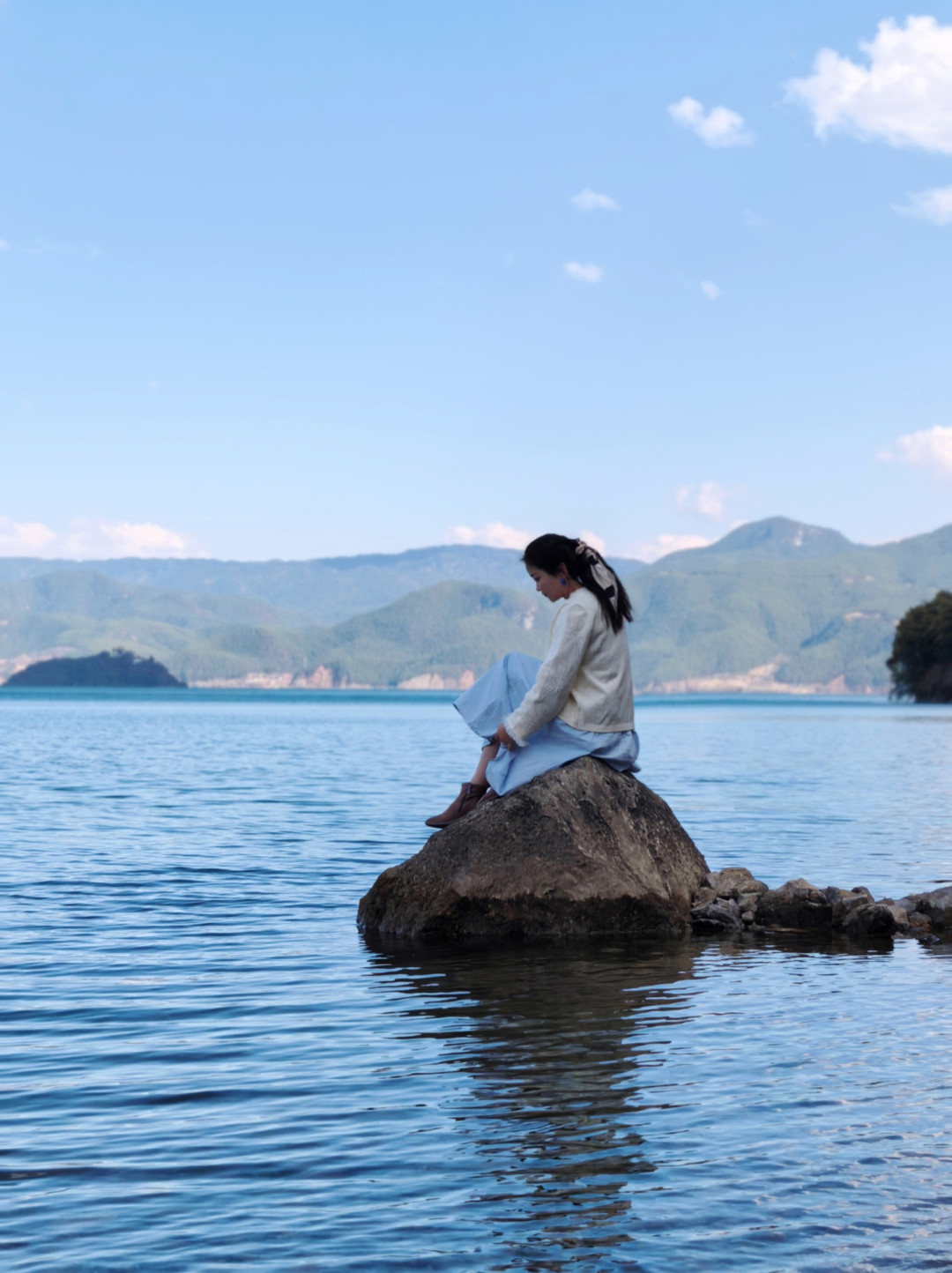
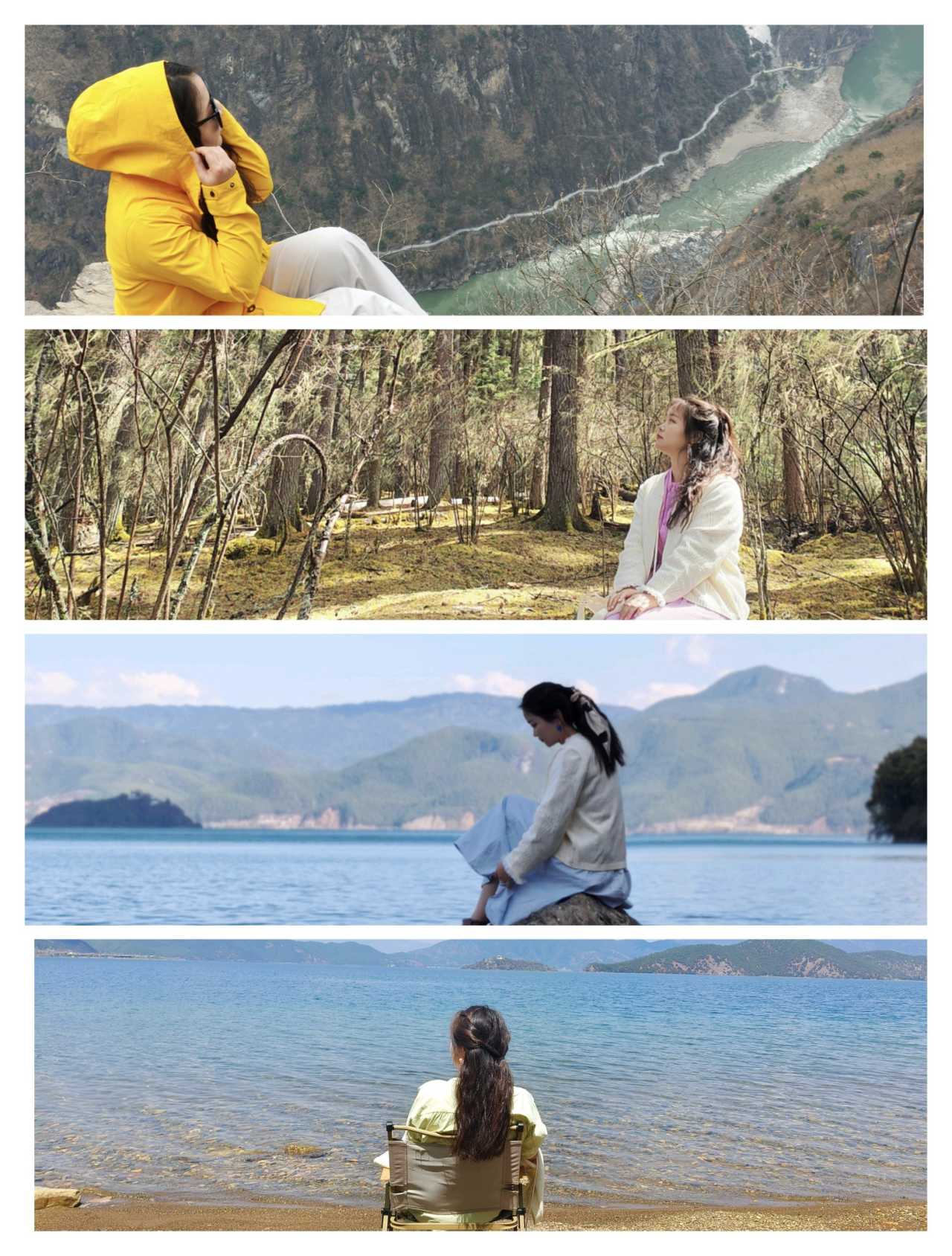
The wind whispers past my ears, light dances between my fingers, pages turn on my lap, and a cat dozes at my feet — this is what my ideal holiday looks like. But reality often has a better sense of humor than imagination: I'd just finished trembling through the craziest hike of my life along a cliff edge, and the next moment I was sprawled in a pig trough boat on Lugu Lake, completely empty-headed like a sloth. This holiday, I climbed along jagged ridges like a goat and lazed around in the lake-and-mountain scenery like a sloth. Two completely different rhythms somehow coexisted perfectly in the same journey.
From Plan to Chance: A Last-Minute Reschedule
I had originally circled April 8 to 13 on my calendar, already picturing the exhaustion from hiking Tiger Leaping Gorge being washed away by the frenzy of the Water Splashing Festival in Xishuangbanna. But the endless gray clouds in the weather forecast, plus the extra day off for Qingming Festival, dropped like two pebbles into the still lake of my mind, stirring ripples of rescheduling.
My friend Wency casually mentioned, "I've been to Yunnan many times, but I've never had the chance to go to Lugu Lake." That sentence was like a key, instantly unlocking the door to a new plan. The next three days, my life was fast-forwarded: booking flights, choosing hotels, planning the itinerary... By the time my suitcase wheels traced arcs across the airport's polished floors, my schedule had been completely rewritten — from April 1 to 6, the steep cliffs of Tiger Leaping Gorge and the shimmering waves of Lugu Lake would take turns starring in my short six-day break.
Even more surprising, three other girls spontaneously策划 a late-night raid on Shangri-La on top of the existing itinerary. Thinking back, the most beautiful encounters in life are like this — five people who had never met before, brought together by the Tiger Leaping Gorge hike, and then had this bond quietly continue in the spring breeze of Shangri-La.
My Itinerary: When Leisurely Strolls Meet Power-Walking Mode
Originally, I planned a slow, easy-going trip, but after meeting a few like-minded companions on the trail, the itinerary unexpectedly launched into a frantic "catch-the-bus challenge" alongside the "power-walking mode."
DAY 1: Xiamen → Chengdu → Lijiang Old Town
DAY 2: Lijiang Old Town → Tiger Leaping Gorge Hike Day 1
DAY 3: Tiger Leaping Gorge Hike Day 2 → Lijiang Old Town → Shangri-La
DAY 4: Songzanlin Monastery → Potatso National Park → Guishan Park
DAY 5: Shangri-La → Lijiang Old Town → Lugu Lake
DAY 6: Lugu Lake → Kunming → Xiamen
My Companions: The Mysterious Pull of the Northwest
The northwest landscape seems to have a strange magic, always pulling like-minded people together in unexpected yet perfectly fitting ways. It was true on the Qinghai-Gansu loop, true on the northern Xinjiang trip, and true for the Tiger Leaping Gorge hike. How lucky was I to meet four such compatible companions — Wency, whose laughter is incredibly infectious; Xiaoyi, so kind and beautiful that you can't help but like her; and the subtle, introspective photography masters Lao Shen and Xiao Juzi. Two days of hiking together, plus the late-night surprise in Shangri-La, all carved warm and deep memories into this journey.
Tiger Leaping Gorge: Scared and Weak, But Serious About Hiking

The Hengduan Mountains are crisscrossed by rivers and deeply cut gorges. Almost every major river flowing out of the Qinghai-Tibet Plateau has formed a north-south trending deep canyon. Among these canyons, Tiger Leaping Gorge, while not the deepest in terms of cutting depth, is the most turbulent and narrowest. Every summer during the high-water season, the Jinsha River swells, and the muddy yellow water roars through the narrow gorge, its sound shaking the heavens and its momentum magnificent.
Tiger Leaping Gorge makes everyone who sees it's heart race. In the winter of 2018, I came here for the first time, wearing high heels. During the dry season, the Jinsha River had shed its usual ferocity, like a tired beast letting out a low growl deep in the canyon. Although I didn't see the spectacular sight of crashing waves, I became intensely interested in the hikers walking on the narrow path on the opposite cliff. I thought: How cool. I hope one day I can swap my heels for hiking boots and measure this dangerous path hanging on the cliff with my own feet.
Over the years, I've hiked quite a few trails — some more treacherous, some at higher altitudes, some longer — but the seed planted here back then had already taken root and sprouted. So, in the spring of 2025, I came back with a small backpack to walk this dangerous path, known as one of the "World's Top Ten Classic Hiking Trails."
Sticking to my travel creed of "since we're here, let's make the most of it," coupled with my stubborn refusal to leave any regrets, this time I chose the Tiger Leaping Gorge High Trail:
DAY 1: Naxiyage → 28 Bends → Chama Inn → Halfway Guesthouse
DAY 2: Halfway Guesthouse → Longdong Waterfall → Yixiantian (A Thread of Sky) → 168-Step Brave Ladder → Zhang's Inn
Day 1 of Hiking: A Severe Acrophobe's Continuous Trembling
How afraid of heights am I? I don't dare ride the carousel at the amusement park. Standing even slightly high and looking down makes my legs go weak and the soles of my feet tingle. Logically, an activity like hiking along cliff edges in Tiger Leaping Gorge shouldn't have much to do with me. But what can I do — I'm deeply in love with nature's mountains and waters!
At 6:30 AM, Lijiang Old Town was just waking up. Sifang Street, stripped of the previous night's noise, now had neither the crowds of tourists nor the blaring music of bars. Only the town's unadorned, gentle face remained.
At 7:30, we took a bus from the South Gate of the old town. In less than two hours, we arrived at an outdoor equipment supply station. They offered trekking pole rentals and sold various hiking gear like shell jackets, hats, gloves, and energy bars. If you hadn't brought everything, you could stock up here.
Special Note: Friends starting the hike from Naxiyage, pay attention — the bus can't go directly to the trailhead. It only stops at a parking lot at the bottom of the hill. While you can walk up, this cement road is monotonous and tiring. To save energy for the main hike, it's recommended to take transportation. There are shared minivans from the parking lot to the trail entrance (about 20 yuan per person). This is where we met the lovely Xiaoyi.
At 10:30 AM, I officially began my long-awaited hike. It was the peak of cherry blossom season, and the clusters of blossoms on the branches were so vibrant they brought joy. Before setting out, I'd checked the weather and picked a sunny day, but the stubborn plateau weather had other plans. Thick cloud layers completely blocked the distant Jade Dragon Snow Mountain, leaving only a hazy outline.
After walking less than five minutes, we reached the entrance of the ancient Tea Horse Road's 28 Bends. The next long stretch was a continuous uphill dirt path with quite a bit of dust. For those without plateau hiking experience, this would be the first small challenge of the two-day trip.
I admit it — I overestimated myself. I thought this altitude would be no big deal, but as soon as I set foot on this so-called "beginner-level" trail, I got a proper reality check. The constant uphill made my breathing erratic, each heartbeat like a heavy drumbeat, the air I inhaled feeling like an invisible weight pressing on my chest. Fortunately, as I gradually found a rhythm with my steps, my breathing slowly synchronized, and that uncomfortable pressure eased.
Tips: Controlling your pace is important for plateau hiking. Don't force yourself to keep up with others. Adjust your breathing and steps to find a speed that suits you.
Most supply stations along hiking trails sell instant noodles, sausages, drinks, and fruit. But this trail was different. From the very first 28 Bends to the final Zhang's Inn, countless supply points along the way were filled with the rich aroma of freshly ground coffee. Apparently, these coffee stations hidden in the mountains aren't just for show — each cup uses quality coffee beans, professionally ground and brewed, carrying the unique, rich flavor of the Yunnan plateau. They perfectly blend the wildness of hiking with the chic vibe of coffee culture — truly a unique romantic experience.
After a few steps and a few short breaths, I finally reached the mountain waist turning point at 11:30. I stopped for a short rest and looked up. To my left, Jade Dragon Snow Mountain appeared and disappeared among the sea of clouds. The sun, unable to break through the clouds, scattered its light into thousands of silken threads, piercing through the gaps in the clouds to fall upon the earth, sketching Tyndall light pillars in the deep canyon.
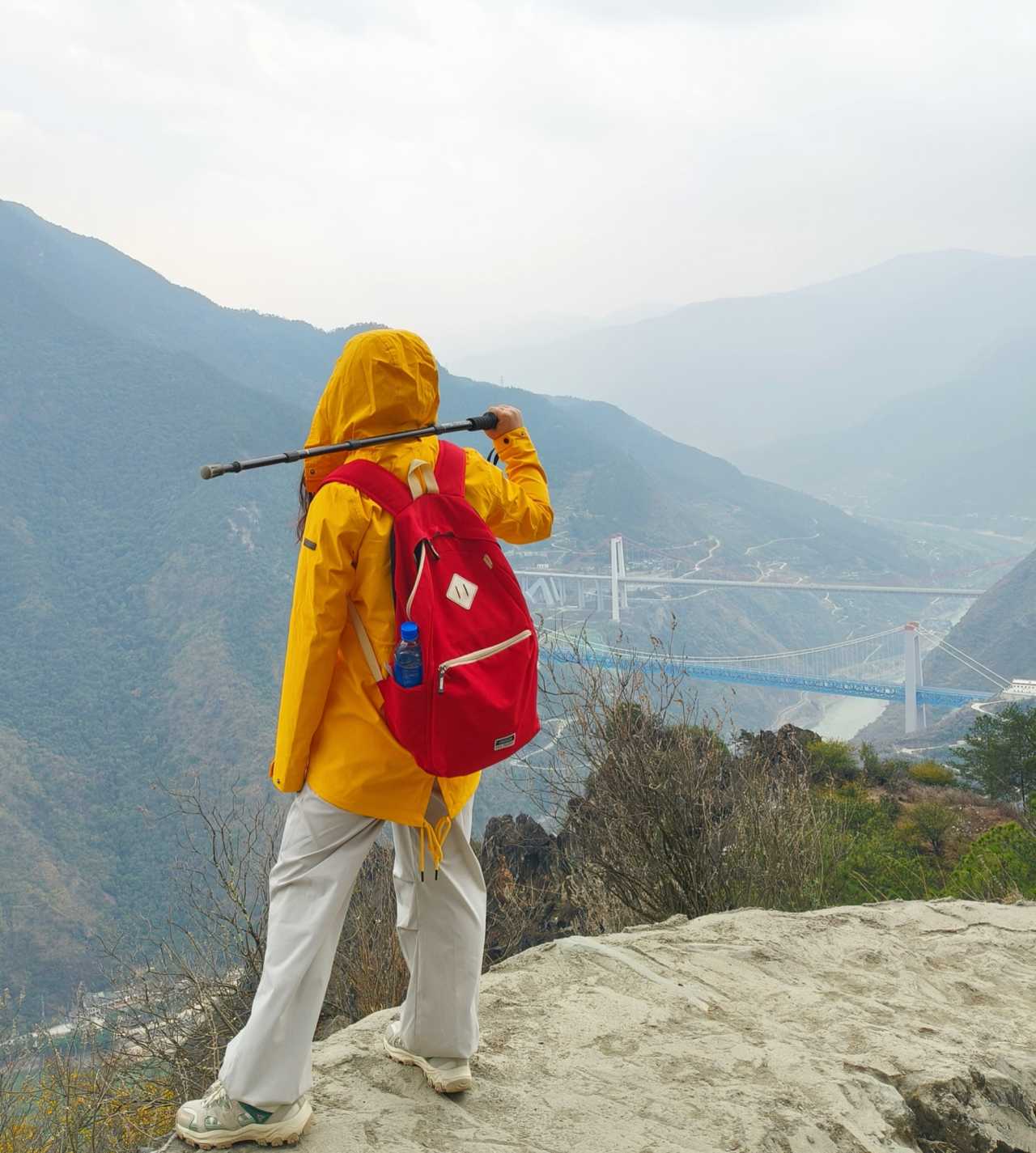
Down to the lower right, in the Jinsha River gorge, two magnificent cross-river bridges stood majestically. The particularly striking blue steel truss bridge was the one that carries the Lijiang-Shangri-La bullet train. Two days later, when our train sped across that very bridge, we felt a strange sense of temporal dislocation — just a while ago, we were hiking through here, looking down at this imposing bridge from the mountain top.
If the continuous steep slopes of the 28 Bends were the first test of physical fitness, then the recurring calls of "Want to ride a mule?" along the way were the second, more grueling trial — the first tempered your muscles and bones, the second tested your willpower.
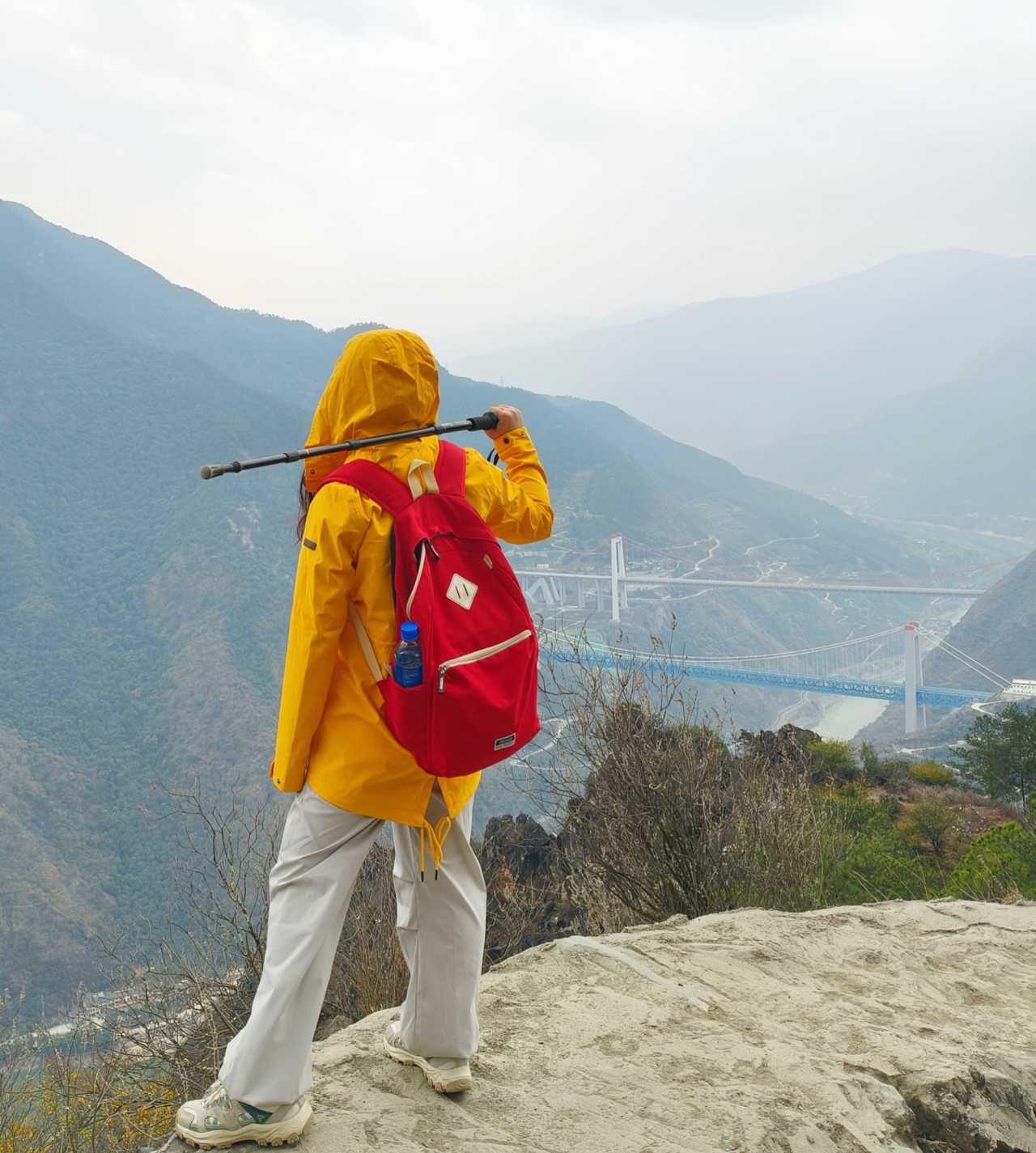
From the entrance, the mule handlers were like shadows: grandmothers with blue headscarves, uncles with sun-darkened skin. They deliberately slowed their mules' pace, weaving an invisible net just three steps behind you. Every time you stopped to catch your breath or stepped aside to let someone pass, you'd be greeted by a question laced with mountain mist: "Want to ride a mule? The summit is still far." These mind-readers of the mountain path were masters at catching the unsteady gait of hikers — the heavier your steps, the brighter the expectation in their eyes. I was asked three times, and I refused three times. The tap of my trekking pole against the rocks sent out nothing but stubborn signals.
Friendly Reminder: When you see the supply point in the picture below at the summit, be careful. There's a grandmother who set up a viewing platform with a "carrot and stick" approach: She says, "Free to look, 10 yuan to take a photo," but her real logic is "going down there equals taking a photo." I didn't think much of it, following the "since I'm here" mindset to go down for a look. Because of my fear of heights, I only went halfway and stopped to wait for my friends. But when I came back up, the grandmother blocked my way, demanding payment: "You went down there, so you must have taken photos!" No matter how we explained, even showing her our photo albums as proof, she insisted that "going down means taking photos." It was a frustrating feeling, like an intellectual meeting a soldier. Just a heads-up for future hikers.
When we saw the sign saying it was still 1.5 hours to Chama Inn, the several-hour uphill slog finally came to an end. From here to Halfway Guesthouse, it was almost all gentle downhill and flat ground, and our steps immediately became much lighter.
For the five of us, the cliffside coffee stop was undoubtedly the most magical intersection of this journey. The footprints of those before us had just faded in the wind, and the travelers behind us hadn't yet rounded the mountain bend. In this perfect gap, all five of us happened to stop at this terrace.
"Could you take a photo for us?" "Want some cantaloupe?"
Simple conversations flowed as naturally as the mountain breeze. Wency's cup of coffee inadvertently opened the first page of our friendship. Sunlight filtered through the dappled tree shadows, falling obliquely onto that small terrace. And just like that, amidst the aroma of coffee and the sweetness of melon, we met Lao Shen and Xiao Juzi.
It's strange how adult friendships often come so unexpectedly — no groundwork needed, no rehearsal required, no forced pleasantries, and no cautious probing. It felt like we were meant to meet here, like the mountain clouds naturally gathering and dispersing. By the time we realized it, the five of us were already walking together on the mountain path.
My favorite part of the 28 Bends was the winding path through the dense forest. Spruce and fir trees on both sides interlocked overhead, blocking the plateau's intense ultraviolet rays. The humid air was filled with the clean scent of pine resin and the rich smell of humus soil. The thick fallen leaves crunched crisply under our feet. The heat from the hike was gradually soothed away by this cool greenery, and even my breathing became clearer. The five of us even had fun staging a "passing by" scene here.
The whole country is blowing "the wind of missing you," and the wind at Tiger Leaping Gorge lives up to its fierce reputation. Naturally, we couldn't miss the photo op.
Along the hiking trails in Tibetan areas, you often see Mani piles, stacks of stones carrying blessings. When passing by, you can pick up a small stone and gently place it on top, or rebuild a new pile, as a way to express good wishes for family and friends.
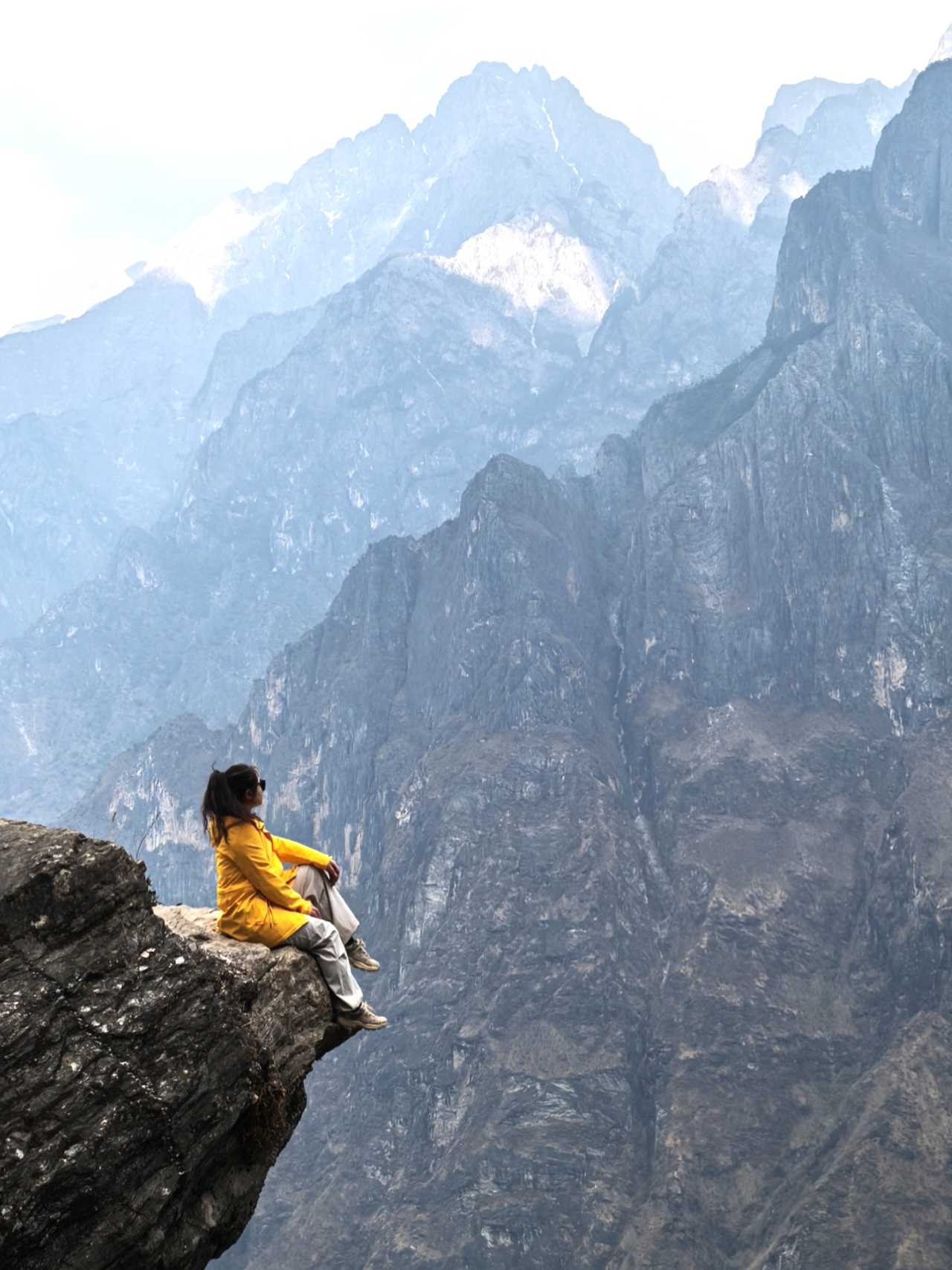
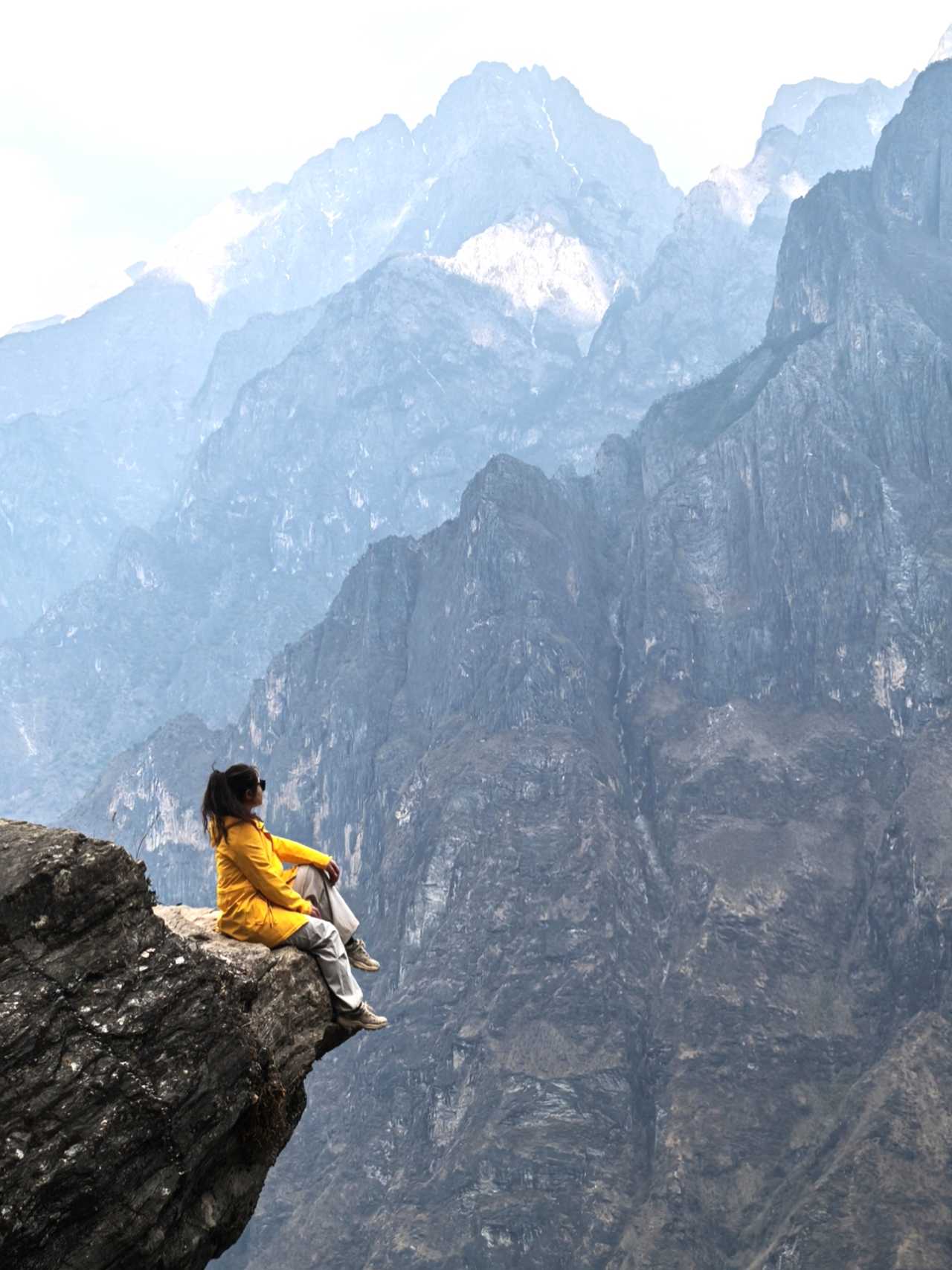
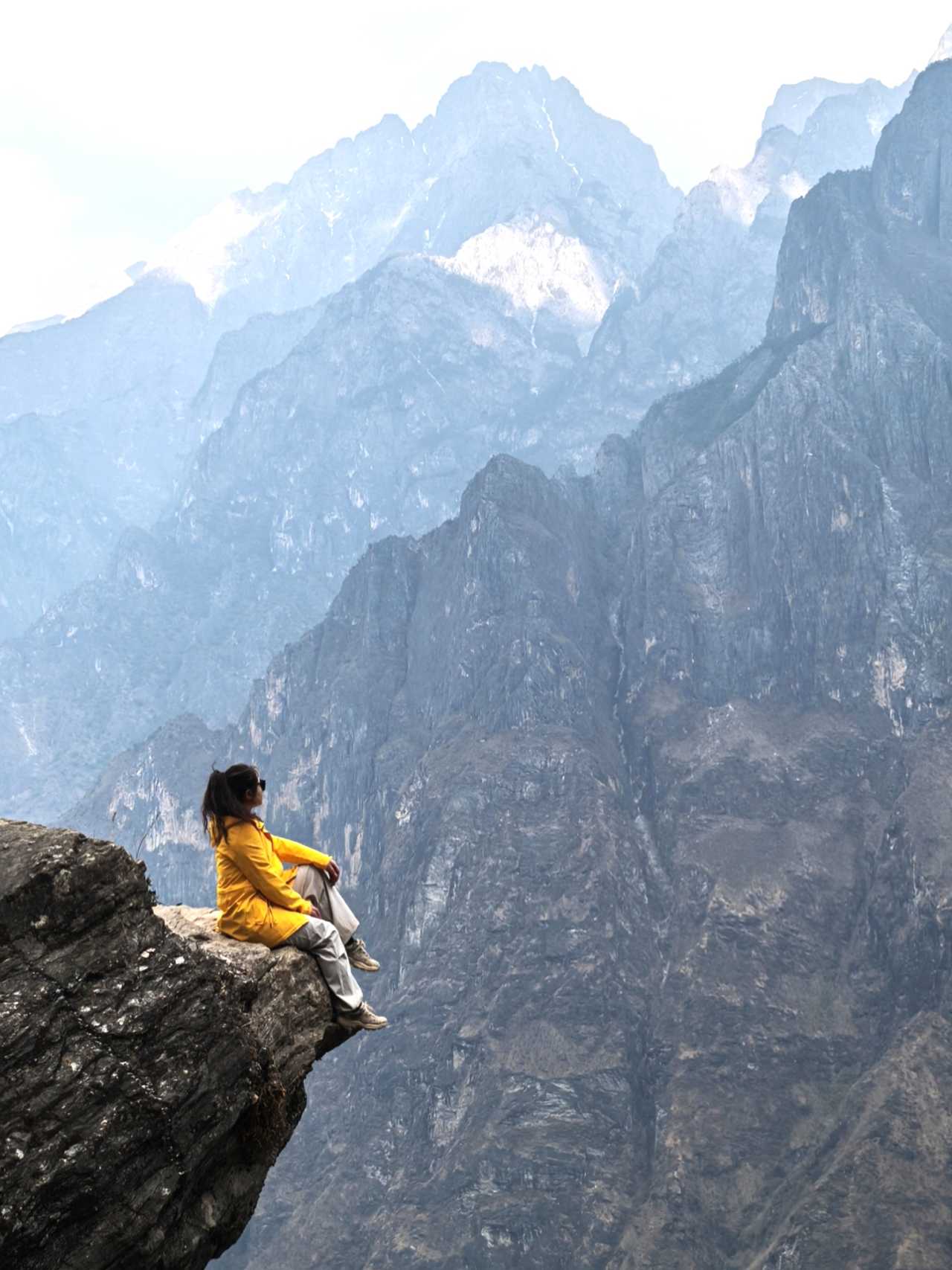
The hike was never boring; photo spots came one after another. How far will people go for a picture? Below my feet was a bottomless cliff, with the Jinsha River roaring and surging in the valley. I grabbed onto the rock with both hands, inching my feet out towards the edge of the precipice. Heaven knows how I, someone who doesn't even dare ride a pirate ship, was now tremblingly hanging on the edge of life and death, tearfully doing the craziest thing of my life.
As a world-class hiking trail, people often joke that "there are more foreigners than Chinese on the trail." Tiger Leaping Gorge's fame in the West dates back to the 1920s and 1930s. Explorer Joseph Rock traveled through China, covering the Yunnan, Sichuan, and Tibet regions extensively. He wrote extensively for National Geographic Magazine and later authored The Ancient Na-Khi Kingdom of Southwest China. British writer James Hilton, inspired by Rock, used his photos and articles as material to create the famous novel Lost Horizon. With its magnificent scenery, Tiger Leaping Gorge sparked a wave of searching for Shangri-La in the West and became the first stop in China for many Western tourists.
Besides Western faces, the most common language we heard on the trail was Korean. Around 2014, hiking Tiger Leaping Gorge became a craze in South Korea. Trail signs are everywhere in Chinese, English, and Korean, showcasing the appeal of this international hiking route.
If sitting on the edge of a cliff for a photo was a test of courage, then standing on that lone boulder suspended over the abyss was the stubbornness of a Chinese woman who "must get the shot for life"! The mountain wind whistled in my ears; the camera lens captured a carefree smile, but outside the frame was a wildly racing heart. The pounding was so loud it drowned out the howling wind. The cold feeling from my fingertips — was it the temperature of the stone, or an illusion of my blood freezing? After the photo, the bravest thing was always my mouth: "Yeah, it was fine." What no one knew was the midnight dream of falling off the cliff, jolting me awake.
Before reaching Chama Inn, we stopped at a high-hanging viewing platform. From here, looking down, the small village looked like a miniature sand table scattered on the mountainside. In recent years, many new guesthouses have been built. While these modern buildings offer convenience for travelers, they have also gradually blurred the original appearance of this former post station on the Tea Horse Road amidst the changing times. The sound of caravan bells seems to still echo in the valley, but the brand-new buildings before us are drifting further and further away from that history.
Haba on the left, Jade Dragon on the right — got the iconic Tiger Leaping Gorge hiking photo spot! There were many similar mirrors along the way, but some had lost their luster, worn by flying sand and gravel.
We walked, stopped, looked, and took photos, finally arriving at Chama Inn at 3:00 PM. As soon as we entered the village, we were greeted by the Tiger Leaping Gorge Tea Horse themed wall. Further in, we saw the graffiti wall of Chama Inn. These two art walls, blending old and new, have become must-photograph landmarks for hikers.
Chama Inn is a favorite lunch stop for hikers. The four characters "茶马客栈" (Chama Inn) outside the door seem to tell stories of the past. The inn serves simple meals like rice with toppings and noodle soups. What I found interesting was that the inn, inside and out, even in the nooks and crannies, was covered in dense scribbles — on tables, white walls, windows, and even that high ceiling... There were "Tomorrow will be better" written in black pen, "Happiness forever in the new year" carved with a knife, and heart shapes doodled with lipstick... Sunlight slanted through the glass windows, dust dancing in the light beams. Those layered layers of writing transformed into images in the light and shadow. Every inch of this inn carries the stories of travelers.
The rooftop of Chama Inn is also an excellent viewing platform. Holding a cup of aromatic coffee, gazing at the distant snowy mountains, overlooking the deep gorge — this is the epitome of a leisurely half-day. Unfortunately, the clouds and mist lingered, and the snow-capped peaks never posed for a photo with us, leaving only a touch of misty poetry lingering outside the frame.
The distance between Chama Inn and Halfway Guesthouse isn't that far, but the connecting trail is narrow and almost entirely hugs the cliff edge, so we still had to stay extremely alert. Just outside the village, there was still some greenery, with a few wildflowers dotting the roadside. But rounding a bend, the view turned cold and severe again, with jagged rocks standing like they were carved by knives and axes, their shadows even having sawtooth-like sharp edges.
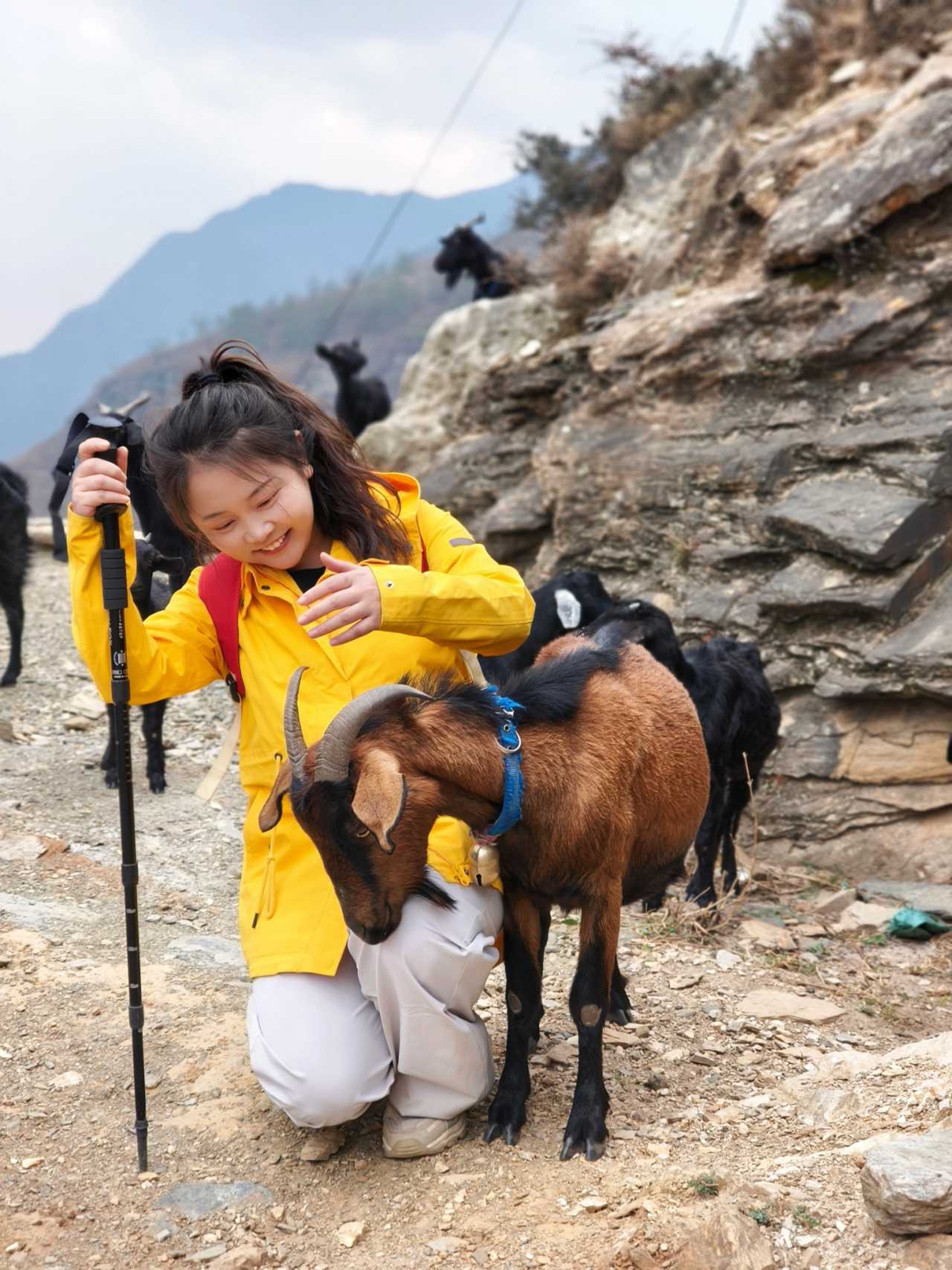
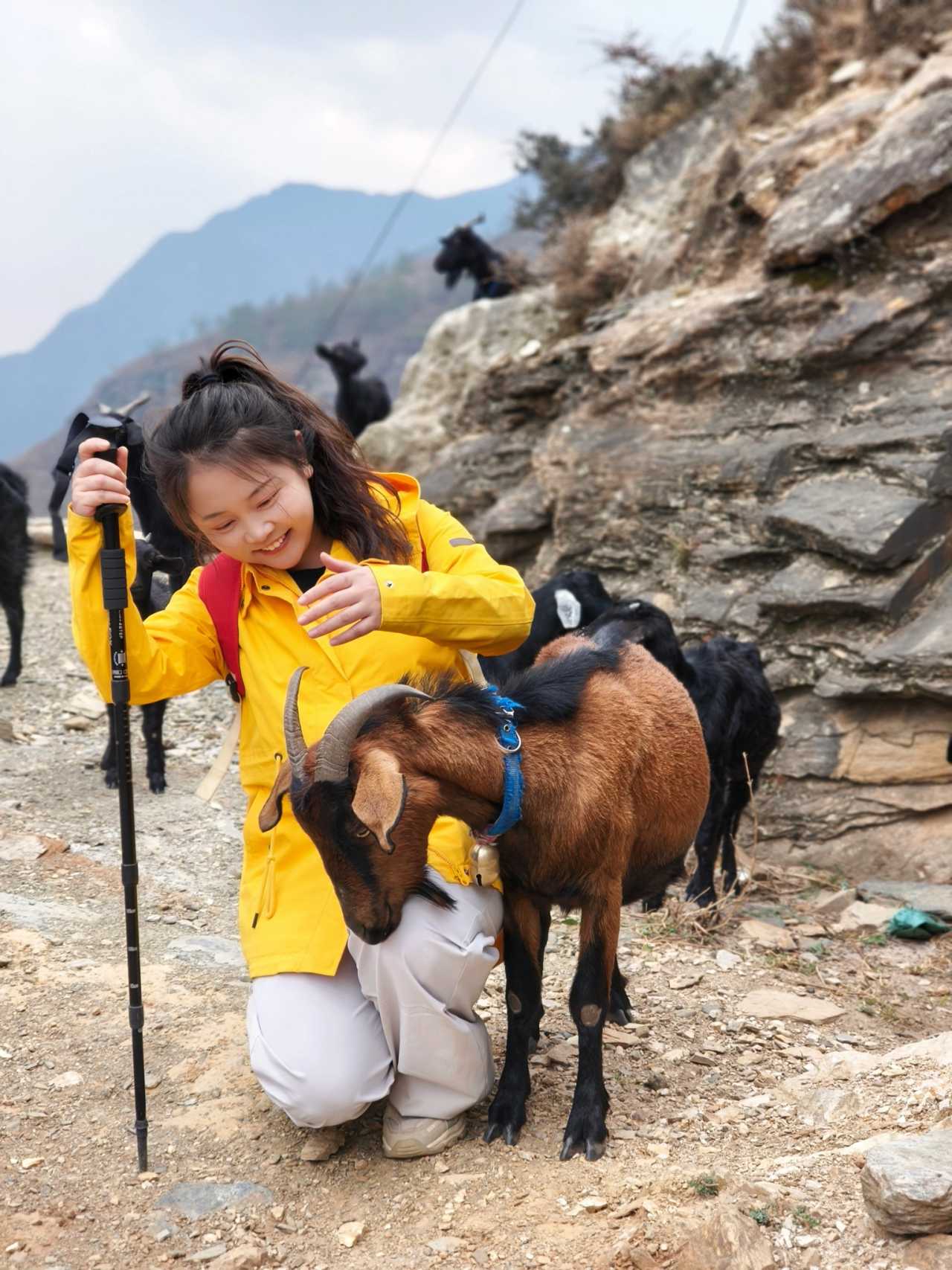
Speaking of the most common little creatures on the cliff edge, they have to be the goats. They walk in groups along the precipices, treading over the jagged rocks as if on flat ground. These "local residents" are long accustomed to hikers. Not only are they not afraid, but they'll curiously come closer to check you out. The funniest thing is, they seem to understand photography, lifting their heads and puffing out their chests in front of the camera, striking the most photogenic poses — truly "professional models" living on a popular hiking trail.
Just as we were walking, the sun that had been hiding all day finally broke through the clouds, pouring down onto the jagged ridge. In that fleeting play of light and shadow, we had already rounded the last mountain bend, and the inn for the first day of hiking was in sight.
At 6:00 PM, we arrived at Halfway Guesthouse in the twilight. The lead-gray clouds pressed heavily over Jade Dragon Snow Mountain. The hoped-for "sunshine on the golden peak" never materialized. Still, the five of us excitedly rushed to the inn's famous photo spot — the "F**king Awesome Terrace." During peak season, you might have to queue for half an hour for a photo, but even in the off-season, we had to wait a short while. By the railing, hikers were striking poses: some with arms wide open "embracing the snowy mountain," some in sunglasses striking a "conquering the peak" pose, and some slumped in chairs acting out a "totally exhausted" comedic scene. Amidst the laughter, this ancient Tea Horse Road was injected with youthful energy.
We had dinner at Halfway's viewing restaurant. The two glass walls offered a panoramic view of the Jade Dragon Snow Mountain's magnificent body and the deep gorge scenery. Dining here was undoubtedly a treat for both taste buds and eyes. The restaurant served hotpot and various stir-fries, which was very convenient.
As dusk settled, the five of us went to the inn's bar, ordered a honey and passionfruit drink, and curled up into the soft sofas. The day's fatigue quietly melted away with the soft fizz of the bubbles. In the warm, dim light, the lingering Tibetan flush on our cheeks still held the warmth of the UV rays, creating a feeling of temporal dislocation. "Little White," "Little Red," "Little Orange," "Little Dark," "Little Yellow" — we had been calling each other by our jacket colors all day. It wasn't until we sat down together that we exchanged our real names amidst laughter. We talked about our hometowns and the scenery we'd seen, with Minnan dialect colliding with Ningxia, Sichuan, and Jiangxi accents under the lights. Water droplets condensed on the glass rims, falling onto the table, and against the orange-red lamplight, they turned into a river of stars in our fireside chat.
Speaking of stars, that's an unforgettable topic from this trip. At 11 PM, when most hikers had already drifted off to sleep, I was sorting through the group photos on my phone. Wency pushed open the door, bringing in the cold night air: "They're going to take photos of the stars. Want to join?" As a devoted fan of starry skies and the Milky Way, I immediately grabbed my coat and went. Four figures shivered in the biting spring chill as we crossed the pitch-black night to reach our companions' inn.
The rooftop of the inn wasn't ideal for shooting, so the five of us moved to a completely empty road. Far from artificial light sources, the stars overhead were dazzlingly brilliant. The three photography masters quickly got into the zone: setting up equipment, finding angles, adjusting parameters. In the silent night, under the fine starlight, their focused and serious backs were truly endearing.
Did we get the shots? Of course. When the camera tilted up at a 45-degree angle, starlight from billions of light-years away poured into the viewfinder. The night wind swept past the tripod, and our held breaths resonated subtly with the camera shutter — "Click." The starry sky of that night was frozen into our shared memory.
Day 2 of Hiking: Scared and Weak, But Step by Step, We Made It
Pushing open the creaky wooden door, the cool morning air rushed in. I had fallen asleep to the sound of pine trees the night before, and now the mountains were still filled with lingering clouds and mist. After breakfast sitting by the glass window, we started the second day of hiking at 9 AM.
After a night's rest, my steps were much lighter. The mountain path still wound along the precipice, but it wasn't difficult. Before long, we arrived at Shenpu Waterfall Coffee. The café was built right on the cliff edge, with an extended viewing terrace offering a distant view of Longdong Waterfall and facing directly towards Jade Dragon Snow Mountain. Taking a break here, you could savor a rich cup of coffee while enjoying the magnificent scenery of the snowy mountain and flying waterfall.
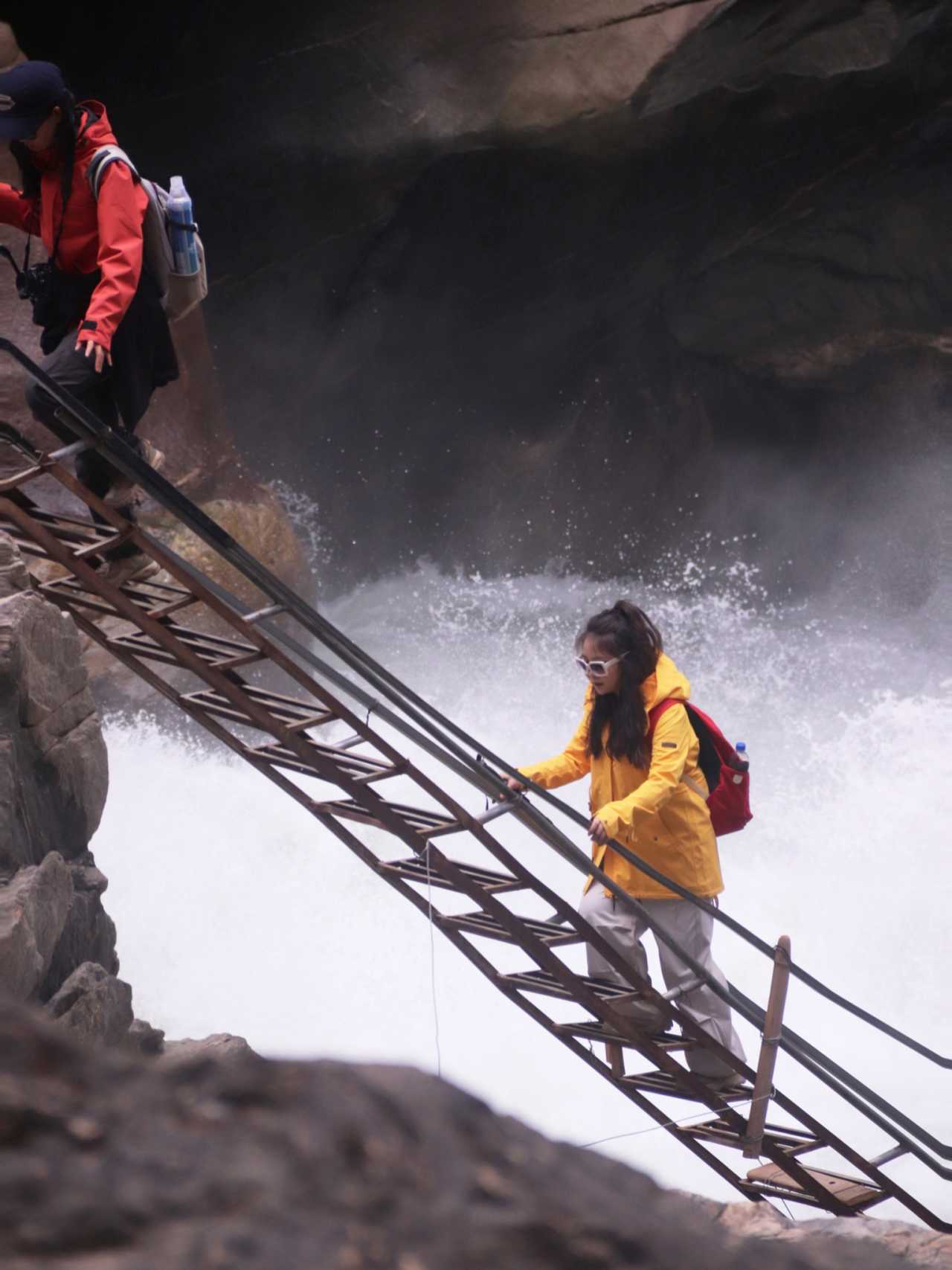
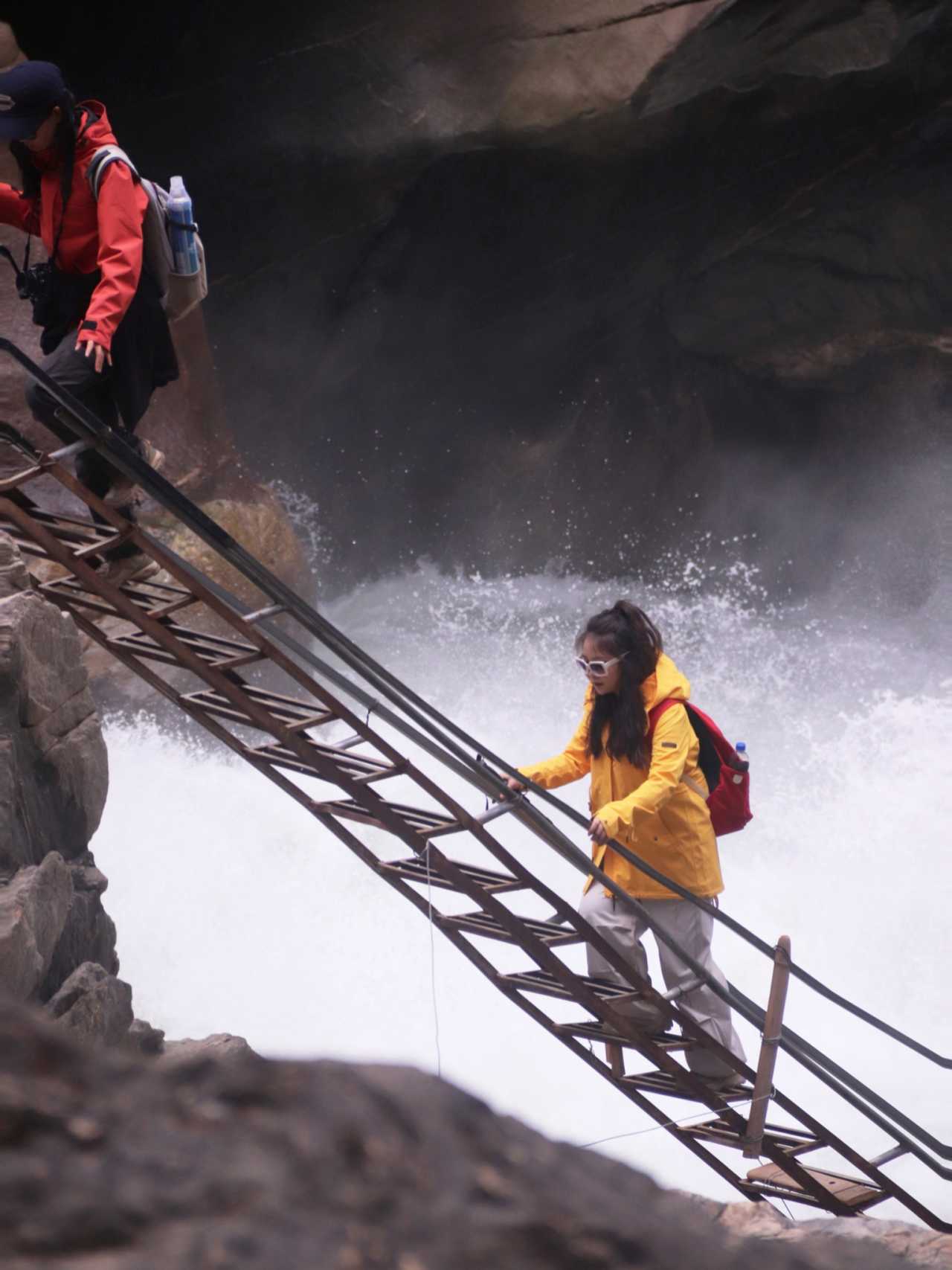
Longdong Waterfall was closer than expected, only about an hour's walk from the inn. Standing a hundred meters away, we saw a silver ribbon of a waterfall cascading straight down from the mountain peak, shimmering with white light. The rushing water crashed against the dark rock face, splashing up mist like shattered jade and flying foam, eventually turning into thousands of sparkling drops that merged into the surging Jinsha River below the cliff.
While taking photos, don't forget to make way for the sheep out for their morning stroll — they are incredibly photogenic!
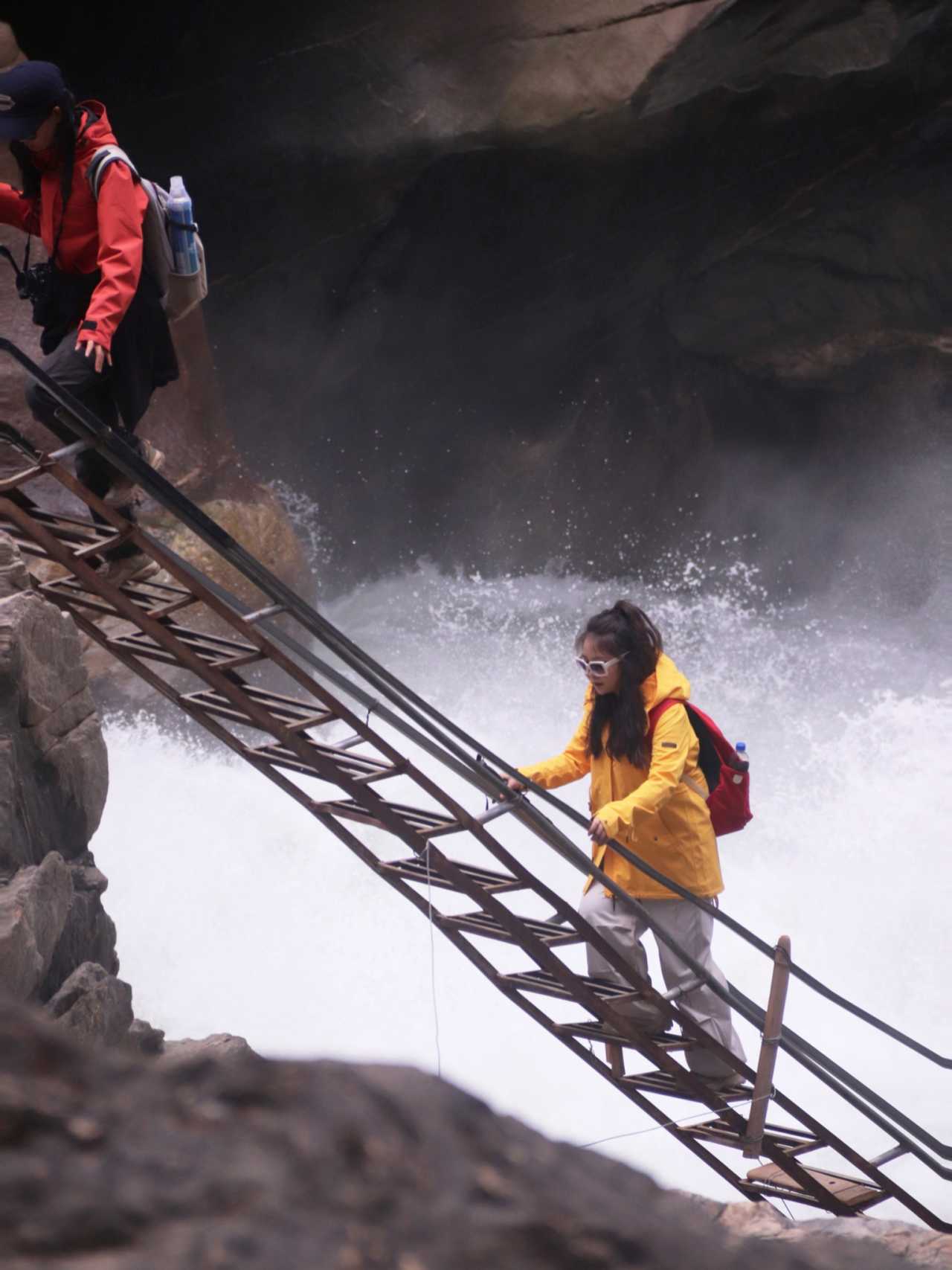
Walking down to the base of the waterfall, we were met by a refreshing dampness. Fine, mist-like water droplets gently brushed against our faces. Looking up, the water rushed down from the cliff top, transforming into countless flying pearls and splashing jade on the rugged rock face. The five of us braved the wetness to take photos beneath the waterfall. The splashing water soaked everyone's shoes and pants, a cold sensation creeping from our feet up to our calves. As the mountain wind swept by, the chill climbed all over our bodies.
From Longdong Waterfall, after rounding a few mountain bends, we reached the Waterfall Holy Spring Coffee station. The aroma of coffee filled the air, and they also sold spring-chilled sodas and fruit.
After the "reality check" of the 28 Bends the day before, the mere sight of a winding uphill path now made me want to turn back. Passing the supply station, I looked up — and sure enough, another uphill section! I took a deep breath. The mountain wind, carrying the scent of grass and trees, filled my lungs, but my heart was still pounding like a drum. "You can do this!" I encouraged myself silently, gritted my teeth, and started walking. Luckily, this uphill section was much shorter than I expected. Before the heaviness could even set into my legs, the turning point was already in sight.
Rounding the ridge, a steep, winding downhill path suddenly dropped before our eyes. Everyone lined up and slowly descended, the sharp tap of trekking poles against the rocks echoing around the mountains. How difficult was it? Not very, I suppose — just look at the little girl ahead with a ponytail, only about six or seven years old, slowly making her way down with her parents' encouragement.
After this steep section, we reached a fork in the road. The left path wound towards the Sky Ladder and Yixiantian (A Thread of Sky), while the right led to Zhang's Inn. The sun was still high, and not wanting to miss the riverside scenery, we chose to continue forward.
If the first half of yesterday was a long, drawn-out uphill battle against gravity, then every step this morning was a dangerous dance with inertia. Climbing Mount Tai back then, hiking Yubeng... my knees had been strained time and again, the burning pain still fresh in my memory. To avoid repeating that mistake, I gripped my trekking pole tightly, searching for footholds on the gravel path. My kneecap trembled slightly in its joint capsule, like a warning pendulum, reminding me to be extremely careful.
After the gravel slope came a dirt slope. The ochre-colored hillside hadn't yet shed its winter dryness, glowing with an oil-painting-like texture in the sunlight. Xiaoyi said the scene looked like something out of an American movie. My mind conjured images from Brokeback Mountain and Legends of the Fall — unexpectedly, in this wilderness of northwestern Yunnan, we had stumbled upon a touch of Wyoming's charm. The tinkling bells of sheep wandering on the hillside added a touch of reality to this exotic encounter.
The cherry blossoms were in full bloom down in the valley, while the grass on the mountain was just sprouting — one hike, spanning two seasons.
Arriving at the foot of the mountain, we were at the entrance of Zhongxia Hotel. The ticket office and bus stop were both in the parking lot below the hotel. If you wanted to go to Yixiantian, you just needed to go into the hotel and tell the owner, who would arrange a free shuttle minivan. The hotel offered food and accommodation, suitable for hikers to take a short break and have a hot lunch before continuing. We had spent a bit too much time taking photos along the way, and worried about missing the return bus, we quickly bought some dry snacks at the hotel and hurried on.
The distance from Zhongxia Hotel to the Yixiantian entrance was short, less than a 10-minute minivan ride. This section was a flat road, not very interesting to walk. If time was tight, taking a ride was more convenient.
At the entrance to the downhill path, a grandmother wrapped in a headscarf collected a 15 yuan "road maintenance fee." After paying, a winding downhill path appeared before us. As someone who doesn't exercise regularly, I struggled going uphill and was worried about straining my knees going downhill, so I had to descend slowly in various awkward positions.
All the way down, we arrived next to the Middle Tiger Leaping Gorge stele. The Jinsha River below looked like a winding emerald silk ribbon, entwined between the two sacred mountains, Haba and Jade Dragon. The cliffs on both sides, almost perpendicular to the river, stretched from the top to the water's surface. The emerald green water sparkled with fine silver light, churning up layers of snow-white waves at the rapids, like the flying tassels on the edge of a ribbon. The river meandered from the distant mountains, twisting and turning between the jagged cliffs, before finally disappearing into the folds of the overlapping peaks.
The "Yixiantian" (A Thread of Sky) I had imagined was a narrow gap between two cliffs, just wide enough for one person to squeeze through sideways, looking up to see only a sliver of sky leaking through the rock crevice. But the Yixiantian at Tiger Leaping Gorge had a different character — it was a narrow path carved into the cliff face right by the river, with menacing overhanging rocks above and the roaring Jinsha River below.
You should also read:
River Takes Herself to Yunnan! A Half-Month In-Depth Travel Guide: Dali, Shuanglang, Lijiang, Tiger Leaping Gorge, Shangri-La
River Takes Herself to Yunnan! A Half-Month In-Depth Travel Guide: Dali, Shuanglang, Lijiang, Tiger Leaping Gorge, Shangri-La Setting Off Never Needs an Excuse "The moment a thought dies, a world away feels like next door. The moment a thought arises, the far end of the…
Continue reading...
Under the Clouds, a Sweet Secret: A Honeymoon Journey for Love and Hiking
Under the Clouds, a Sweet Secret: A Honeymoon Journey for Love and Hiking Before We Set Off: From Mount Kailash Pilgrimage to Yubeng Trek In May 2012, I boarded a bus bound for Ngari Prefecture alone, driven by a single obsession—to perform the sacred circumambulation…
Continue reading...
Proceed with Caution! Hiking Around Lugu Lake: A Soul Journey Across the Clouds
Proceed with Caution! Hiking Around Lugu Lake: A Soul Journey Across the Clouds Shanghai → Chengdu → Lugu Lake → Lijiang → Jade Dragon Snow Mountain → Lashihai Lake → Kunming → Shanghai | Soul Notes · Extensive Photo & Text Documentary Have you ever…
Continue reading...