May Day Journey Through Sichuan and Yunnan: From the Romance of Jacaranda to the Passion of Flame Trees
May Day Journey Through Sichuan and Yunnan: From the Romance of Jacaranda to the Passion of Flame Trees
Panlong River
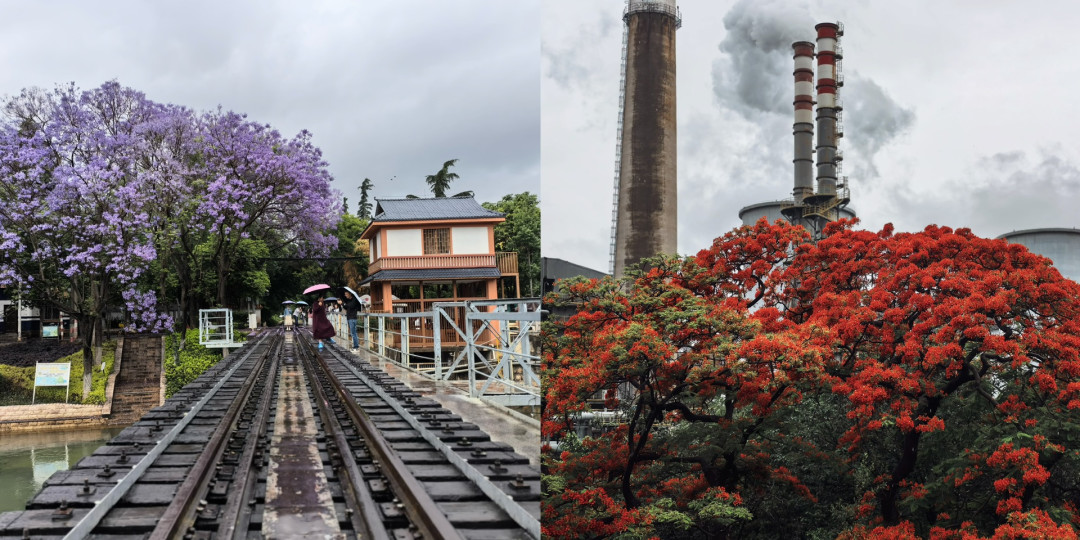
During this rare five-day May Day holiday, I chose to reward myself with a journey. My destination was clear: Kunming and Panzhihua. Not for anything else, but to witness with my own eyes the legendary "Double Flower Feast." Kunming's jacaranda weaves a dreamy purple canopy, while Panzhihua's flame trees ignite a red, fiery passion. This trip was destined to be filled with these two极致 colors. Here is my on-site record of this flower-chasing journey.
Trailer
About the Itinerary
May 1: Sichuan Airlines flight 3U3161, Hangzhou to Kunming. Afternoon: Jiaochang Middle Road → Wenlin Road → Green Lake → Cuihu North Road.
May 2: Daytime: Haigeng Dam → Kunming Old Street → Panlong River (Youguan Bridge section) → Xunjin Street → Tiepi Alley. Evening: High-speed train D264 to Panzhihua.
May 3: Dahuadi → Yongxiang Alley → Eastern District Flame Tree Park → Chuncheng Road → Chuxin Garden.
May 4: Eastern District Talent Apartment Park. China Eastern Airlines flight MU 6462, Panzhihua to Shanghai Pudong. After exploring and eating in downtown Shanghai, high-speed train back to Hangzhou.
About the Jacaranda
The jacaranda is a tree species native to Brazil, Bolivia, and Argentina in South America. In 1984, it was first introduced to China from Algeria by the Kunming Institute of Botany, Chinese Academy of Sciences, and then began to be planted scatteredly in Kunming and surrounding areas of Yunnan. Forty years have passed. Every April and May, when the blooming season arrives, half the streets of Spring City Kunming are immersed in purple romance. In its native habitat, jacaranda can bloom for over two months, but in Kunming, the flowering period is generally only about a month, with the peak bloom lasting only about a week, making it even more precious.
"Waiting for love in despair": This is the most well-known flower language of the jacaranda. Originating from a South American legend, although the jacaranda's blooming period is short, its flowers will continue to bloom until an appointed time, symbolizing hopeless yet persistent waiting and anticipation. The blue-purple flowers give a sense of calm and stability, representing inner peace and tranquility.
InterContinental: First Glimpse of Jacaranda
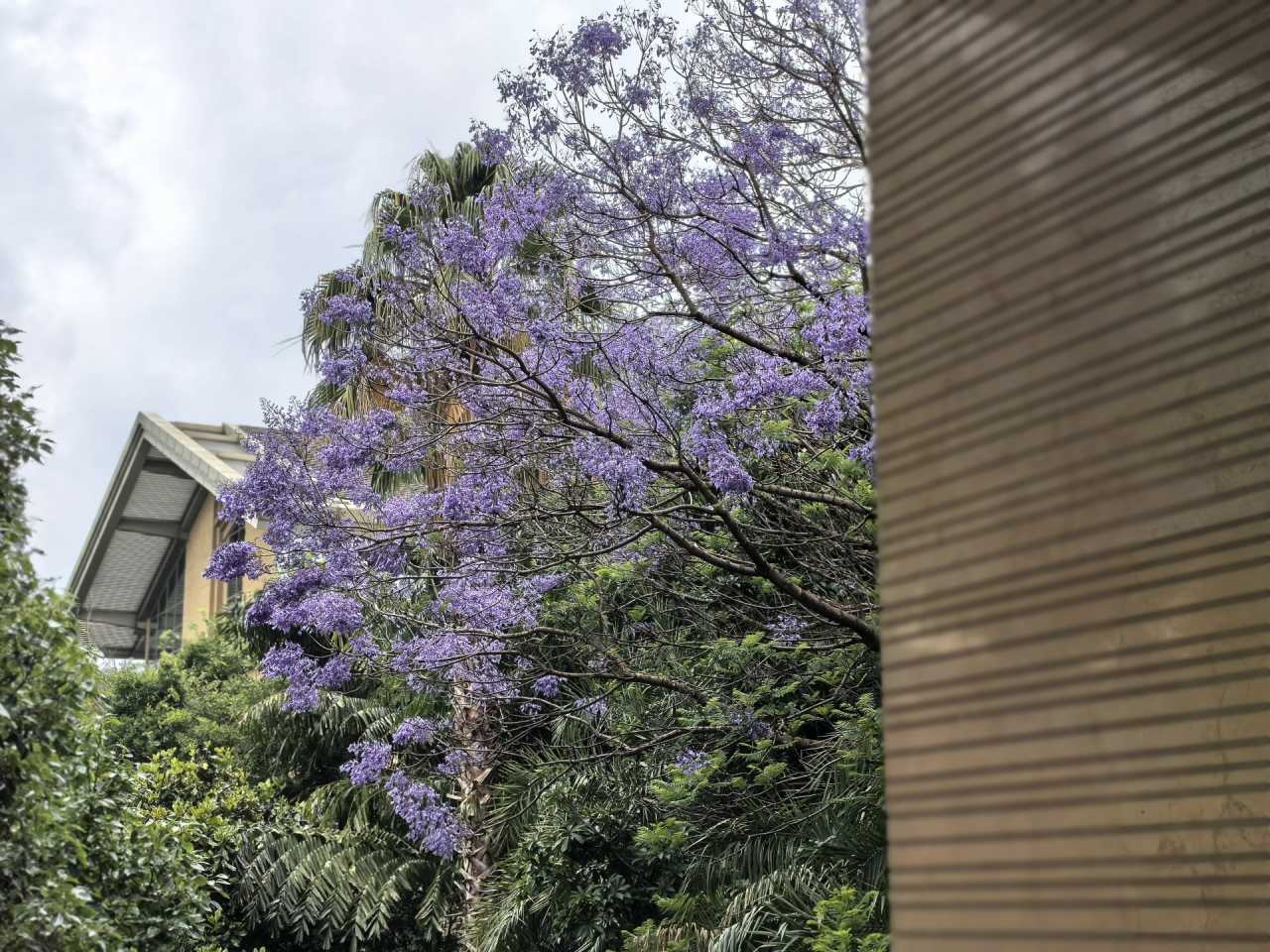
The hotel I chose in Kunming this time was the InterContinental. The main reason for choosing it was that it is the five-star hotel with the most jacaranda trees in Kunming. Although it is located near Dianchi Lake, relatively far from the city center, I didn't hesitate to book it. After getting off the plane and checking in, there was a jacaranda tree extending from the side at the front desk window, and thus I had my first encounter with the jacaranda.
In Spring City, flowers are everywhere; half the city's spring scenery is tinged with purple. The purple of the jacaranda has a grayish texture, not the high saturation seen on social media. It is subtle and gentle, paired with tall, sparse branches, creating a unique sense of tranquility and romance that captivates at first sight.
Looking directly out from the lobby's fountain pool, there is a tall jacaranda tree on each side, complemented by Thai-style pavilions and green spaces, forming the hotel's main landscape. A couple was taking couple photos there.
Walking into the courtyard, one side of the entrance avenue is lined with jacaranda, while the other side has palm trees. Two trees at the corner were in full bloom, with fresh, dense flowers and tall, straight branches, standing like two quiet, handsome men, aloof and independent.
The hotel thoughtfully added some small decorations to enrich and add interest to the photos. The hotel also kindly offered each guest five complimentary photo shoot sessions. I must say, it was very fitting and considerate. On a side note, the service attitude at the Kunming InterContinental was excellent. The front desk proactively offered breakfast and lobby bar drinks, and during turndown service, they added extra fruit. During the May Day holiday, at a price of 1,200 RMB, buying one and getting four freebies was quite cost-effective. Below are the photos from the InterContinental's complimentary shoot. I think they are better than the 20 RMB per photo ones at Jiaochang Middle Road. What do my fellow travel enthusiasts think?
Jiaochang Middle Road
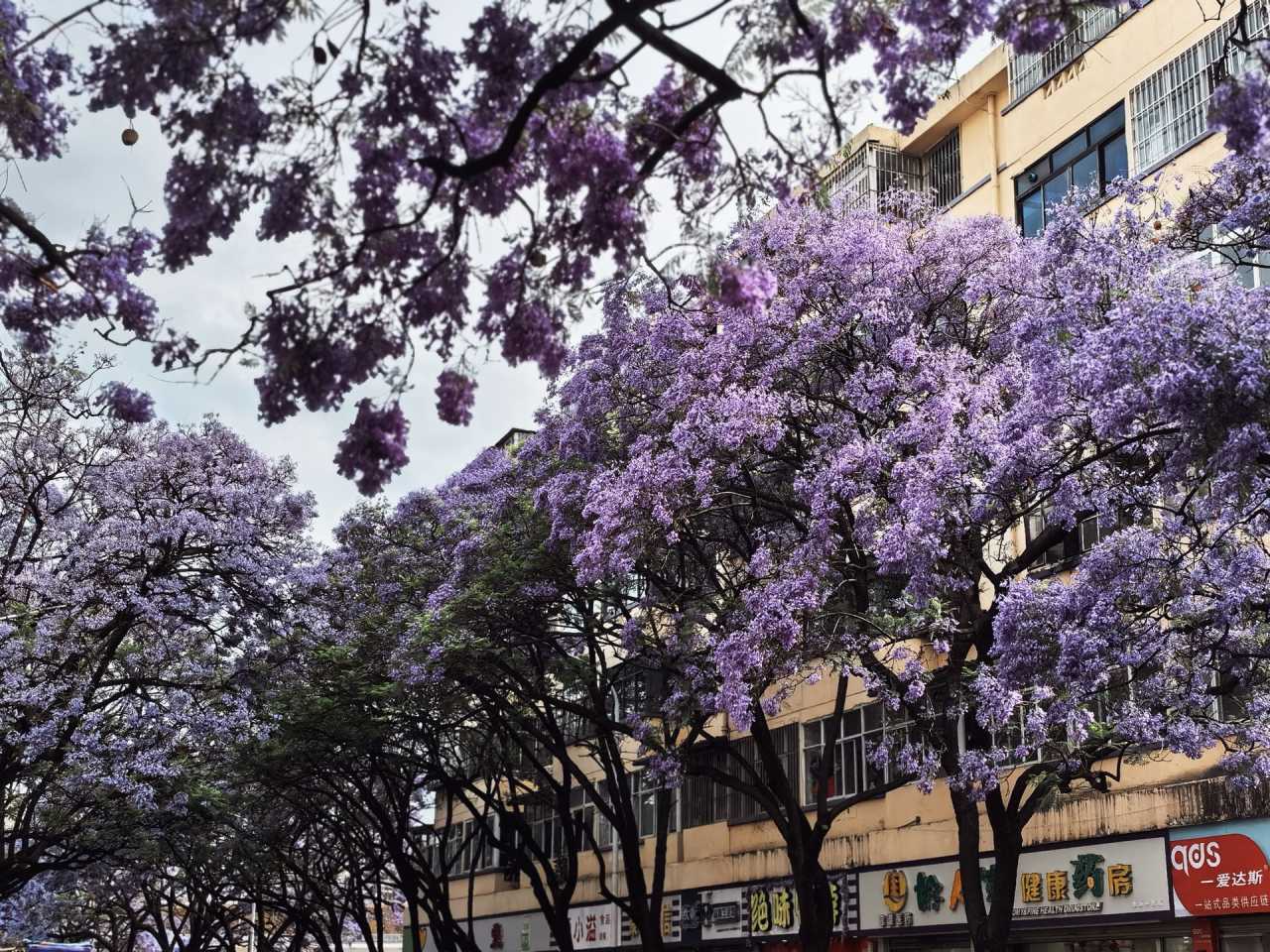
When it comes to the top jacaranda spot in Kunming, it has to be Jiaochang Middle Road. The jacaranda here were among the first batch planted in Kunming. Having been there for a long time, they have the fewest leaves and the densest flowers. The two-kilometer-long road is lined with tall jacaranda trees, and during the peak blooming season, the street looks like a sea of purple. Take a taxi and navigate directly to "Jiaochang Middle Road." If taking the subway, get off at Line 4's "Sujiatang Station," Exit C, which is the closest. The northern end of Jiaochang Middle Road intersects with Jiaochang North Road, and the southern end intersects with Xuefu Road, forming a core flower-viewing area about two kilometers long. The street becomes a pedestrian zone, with various stalls and photo services everywhere. A double-decker flower-viewing bus route has also been opened, starting at the intersection of Xuefu Road at the southern end.
It is said that the jacaranda this year are not blooming well. Especially after a hailstorm a few days ago, many flowers were knocked down, and the leaves have grown abundantly, resulting in a mix of flowers and leaves, a blend of blue and green. On-site observation confirmed that the flowers were indeed somewhat sparse, especially in the northern section, which was incomparable to the splendid scenes of previous years.
At the northern section of Jiaochang North Road and Jiaochang Middle Road, the flowers here bloom sparsely, with many having grown green leaves, affecting the overall effect of a purple sea of flowers.
After passing the first traffic light intersection and entering the southern section, the flowers here bloom denser and more beautifully.
The double-decker jacaranda sightseeing bus slowly weaves through the crowded masses. People on the top deck can enjoy close-up views and take photos.
Businesses are innovating with various colorful parade vehicles as props for photo shoots, parked under the flowers, waiting for tourists. But do they distract too much from the artistic conception of the flowers themselves?
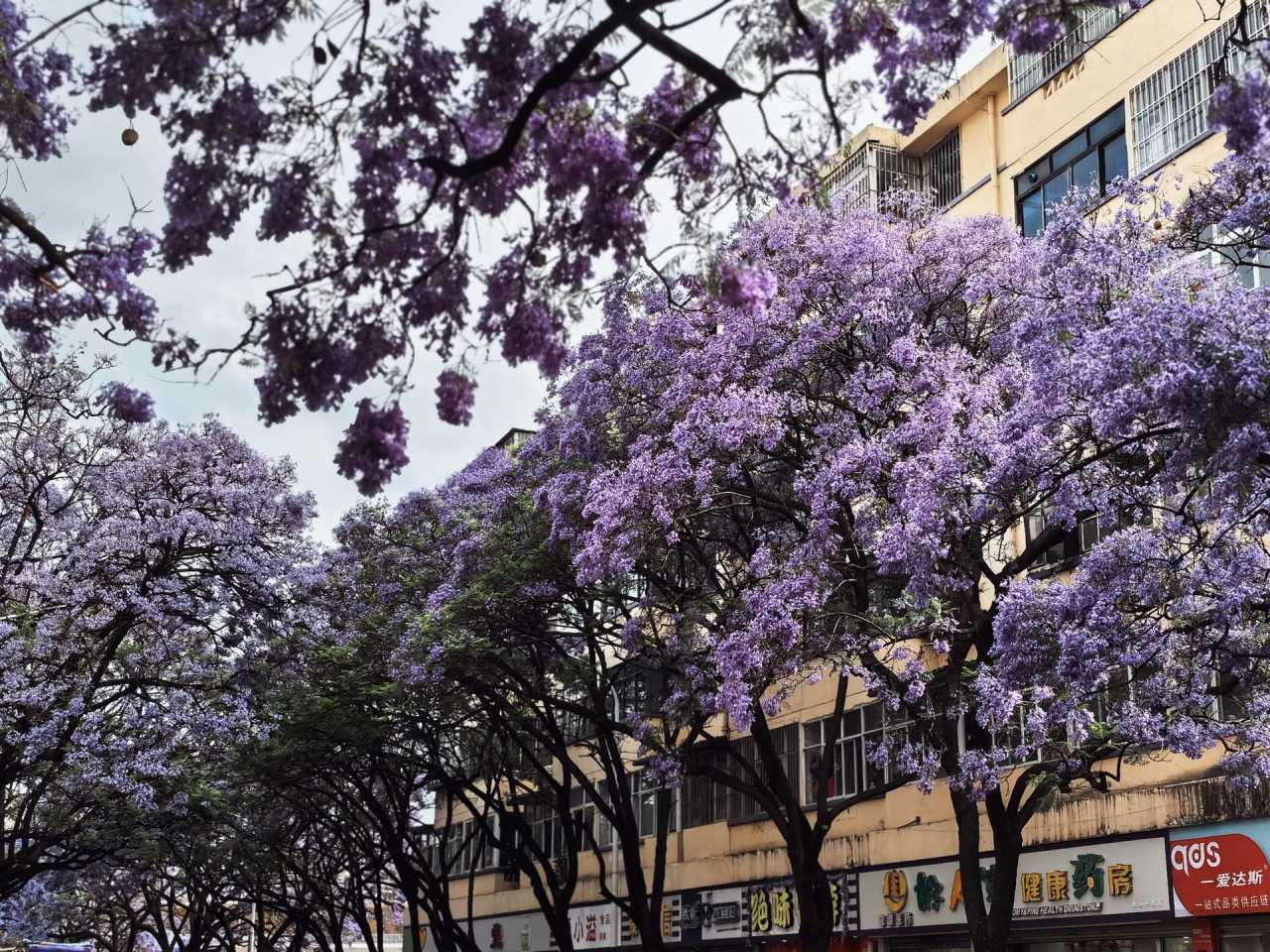
Flowers and buildings are a perfect match, whether it's old residential buildings or retro restaurants, they complement each other beautifully.
The crowds under the trees were bustling, so I had to keep my camera pointing upward, unable to capture a sense of depth. Please forgive me, fellow travel enthusiasts.
These were the most flourishing trees in the northern section, but they had been set up with a platform for paid photography. The worst part was that you weren't allowed to use your own phone; you had to use their photographer. Whether printed or digitally edited, it cost 20 RMB per photo. This was simply...
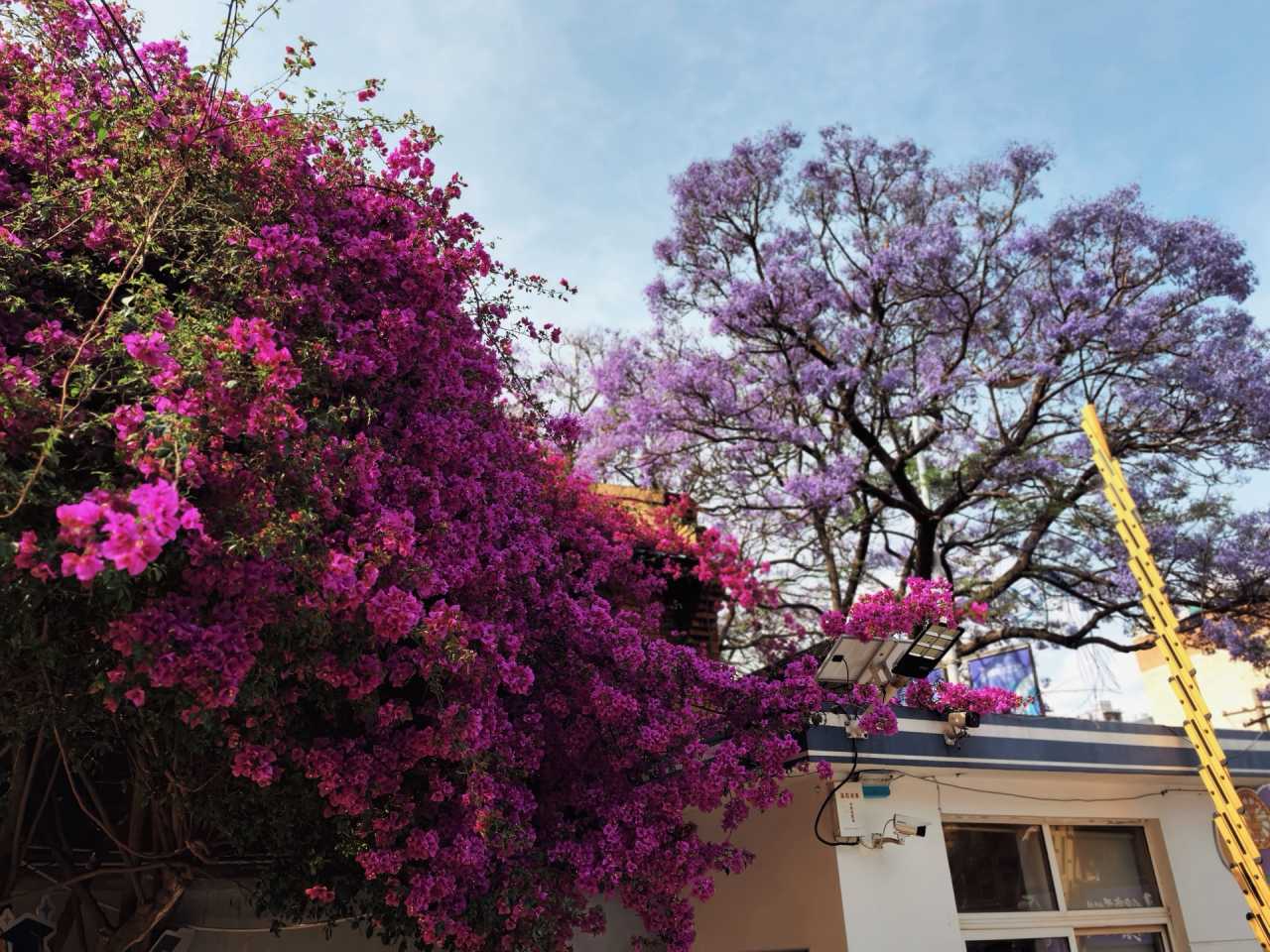
A scene with bougainvillea and jacaranda in the same frame. The specific location is inside the language training school in the northern section; you have to go inside to take photos.
The most beautiful spot in the southern section has been turned into a theme park, also with scaffolding set up. However, here you are not forced to use their photographer. You can take as many photos as you want, for as long as you want, for 20 RMB per person. Compared to the previous one, this is more reasonable.
I also bought a jacaranda-themed ice cream for 12 RMB. The milk flavor was very light, just a prop for photos.
If you don't want to spend money, you can only take photos from outside the fence, and you can still get some decent shots.
Before I knew it, I had reached the intersection. The visit to this two-kilometer-long top flower event was over, and my feelings were mixed. Although the blooms were not as good as in previous years, for someone seeing such a long purple tunnel for the first time, I was still somewhat excited and thrilled. But the crowded masses and the artificially erected platforms charging fees to frame the beautiful scenery somewhat distanced this grand May-limited flower event from words like romance and awe.
Wenlin Street
If Jiaochang Middle Road left me slightly disappointed, then Wenlin Street gave me a great surprise. The street is lined with various small coffee shops, bars, and independent bookstores, full of a leisurely and artistic vibe. It might be one of the most romantic streets in Kunming. If I had time, I would have liked to order a coffee here, find a lounge chair, and spend an afternoon basking in the sun.
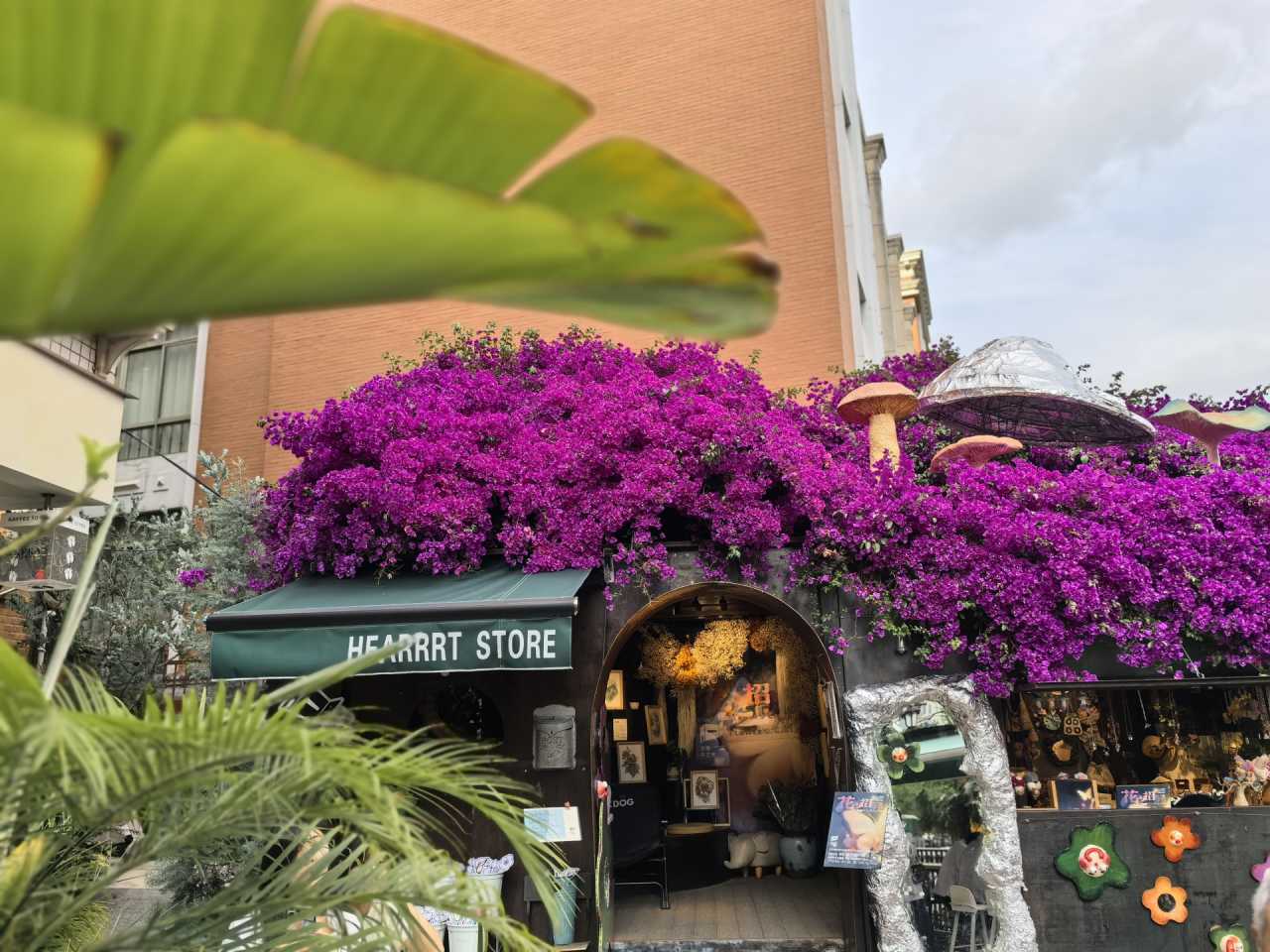
Especially the bougainvillea in full bloom everywhere along the street, displaying astonishing vitality and感染力, so beautiful they look like artificial flowers.
My understanding of the lushness of bougainvillea was refreshed the next day when I saw a bougainvillea waterfall near the hotel. Fellow enthusiasts who want to check it out can navigate directly to "Caohai Alley." It's actually right next to the Haigeng Dam, within walking distance from the InterContinental Hotel.
The entire wall, about five stories high, is covered from top to bottom with climbing bougainvillea, blooming brilliantly and dazzlingly. I even carefully looked at the roots and leaves to confirm they were real flowers (I noticed that many shops on Kunming Old Street use artificial bougainvillea).
Green Lake (Cuihu)
Walking to the end of Wenlin Street leads to Cuihu Park. It is said that Cuihu has a special meaning for Kunming locals. Wang Zengqi once described it as "Kunming's eye," saying, "Without Cuihu, Kunming wouldn't be Kunming." Many people say Cuihu has a magical power; just taking a walk there fills you with joy. People say no one would commit suicide when they come to Cuihu.
In reality, Cuihu's lake surface is not large, surrounded by high-rise residential buildings. Its existence forcefully restores a sense of tranquility and comfort amidst the hustle and bustle.
Haixin Pavilion is the absolute core and landmark of Cuihu Park. This Qing Dynasty pavilion built in the center of the lake is the best spot to experience the charm of the "jade in the city."
It was already evening. The air in the park was noticeably more humid and fresh. The emerald green lake water reflected the lush greenery as far as the eye could see.
I haven't seen boats like this in a long time. They resemble models from the last century, but on Cuihu, they look surprisingly harmonious.
Guan Yu Lou (Fish Viewing Pavilion) is most famous for the couplet hanging at its entrance. The first line reads: "A pavilion stands like wings, occupying one-tenth of the green water." The second line reads: "When will I be free, to drink with the bright moon, three cups in hand?" This couplet, composed by Huang Kuiguang of the Qing Dynasty, has a carefree artistic conception and is often selected for famous couplet appreciation.
After walking through the entire park, as someone from West Lake in Hangzhou, I naturally couldn't fully appreciate the state Wang Zengqi described. However, upon entering the park, I felt surrounded by lush greenery, with air as fresh as if washed by water. Having such a place in the city center truly is like an eye, capable of touching the heart directly.
Kunming Old Street
The next morning, right after breakfast, a torrential downpour began. I felt troubled, wondering how to proceed with my planned itinerary. I waited in the hotel lobby bar for half an hour, but there was no sign of the rain stopping. I steeled myself and decided to quickly visit Kunming Old Street in the rain.
Kunming Old Street is composed of over ten streets and alleys, including Guanghua Street and Wenming Street. Bluestone-paved roads connect numerous historical buildings, such as the Jiubei Building (Wine Glass Building), Nie Er's Former Residence, the Ma Family Courtyard, the Victory Memorial Hall for the War of Resistance Against Japan, and the Oriental Bookstore. There are also many shops selling local specialties, jewelry, coffee, and tea. Because of the rain, I headed straight for the Jiubei Building, which interested me.
The Jiubei Building gets its name from its unique design. Viewed from above, two symmetrical curved building blocks embrace the Victory Memorial Hall for the War of Resistance Against Japan behind them. The overall shape resembles a goblet, symbolizing "raising two glasses of wine to celebrate victory." The designer was Li Hua, a professor from Tsinghua University. Later, because citizens felt the name "Jiubei Building" was too literal, they引用 Li Bai's poem line "Do not let the golden goblet face the moon empty," giving it a more poetic and romantic name: Duiyue Lou (Moon-facing Building). It is also called the "Paper Sliver Building" because, when viewed from the side, the building is very thin, with the narrowest point being only about two meters wide. From a distance, it looks like a piece of paper standing there, making it very photogenic. Today, the Jiubei Building has been converted into a high-end guesthouse. Next time I come to Kunming, I might experience staying there.
Behind it are the Victory Memorial Hall for the War of Resistance Against Japan and the monument. Despite the rain, there was a steady stream of visitors taking photos. By this time, the rain had gradually lessened, so I started wandering around the old street area.
Because it was raining and still morning, there were relatively few tourists on the street. For an old street usually bustling with noise and everyday life, this was a rare moment of tranquility.
The bougainvillea in the photo should be realistic artificial decorations.
There are also jacaranda trees in the old street, and they are exceptionally tall, standing out like a crane among chickens.
By the Panlong River
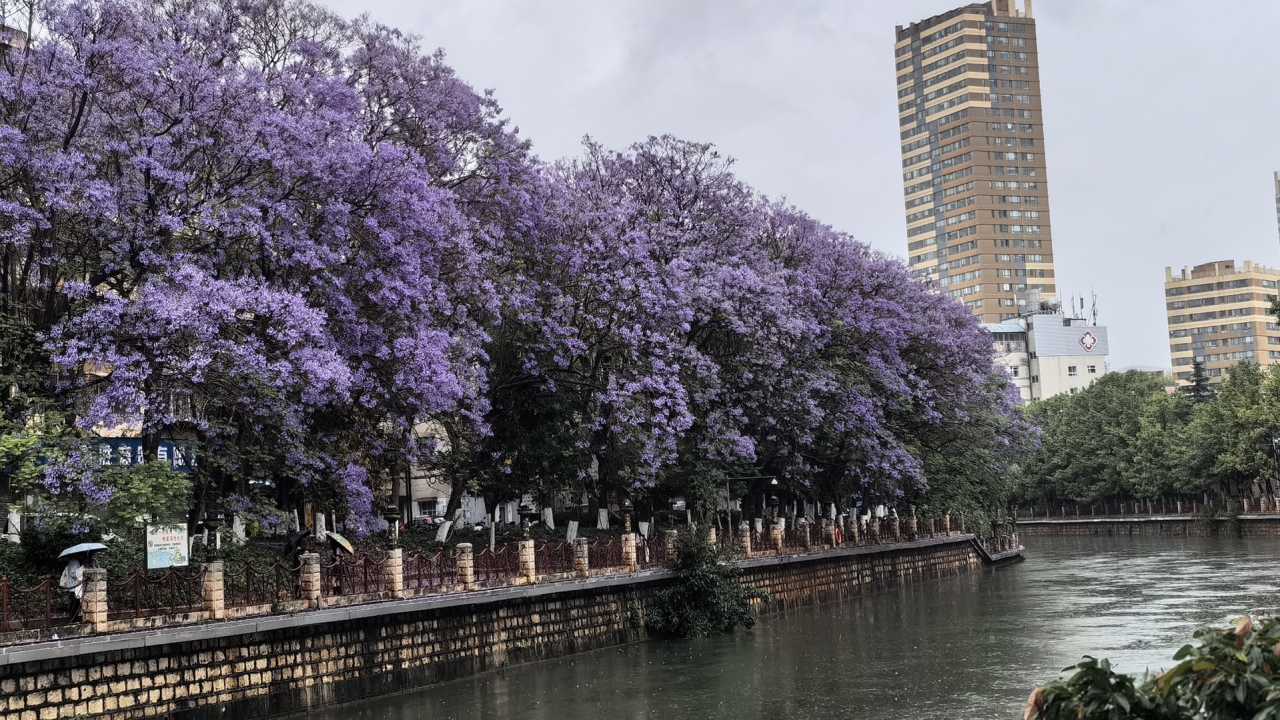
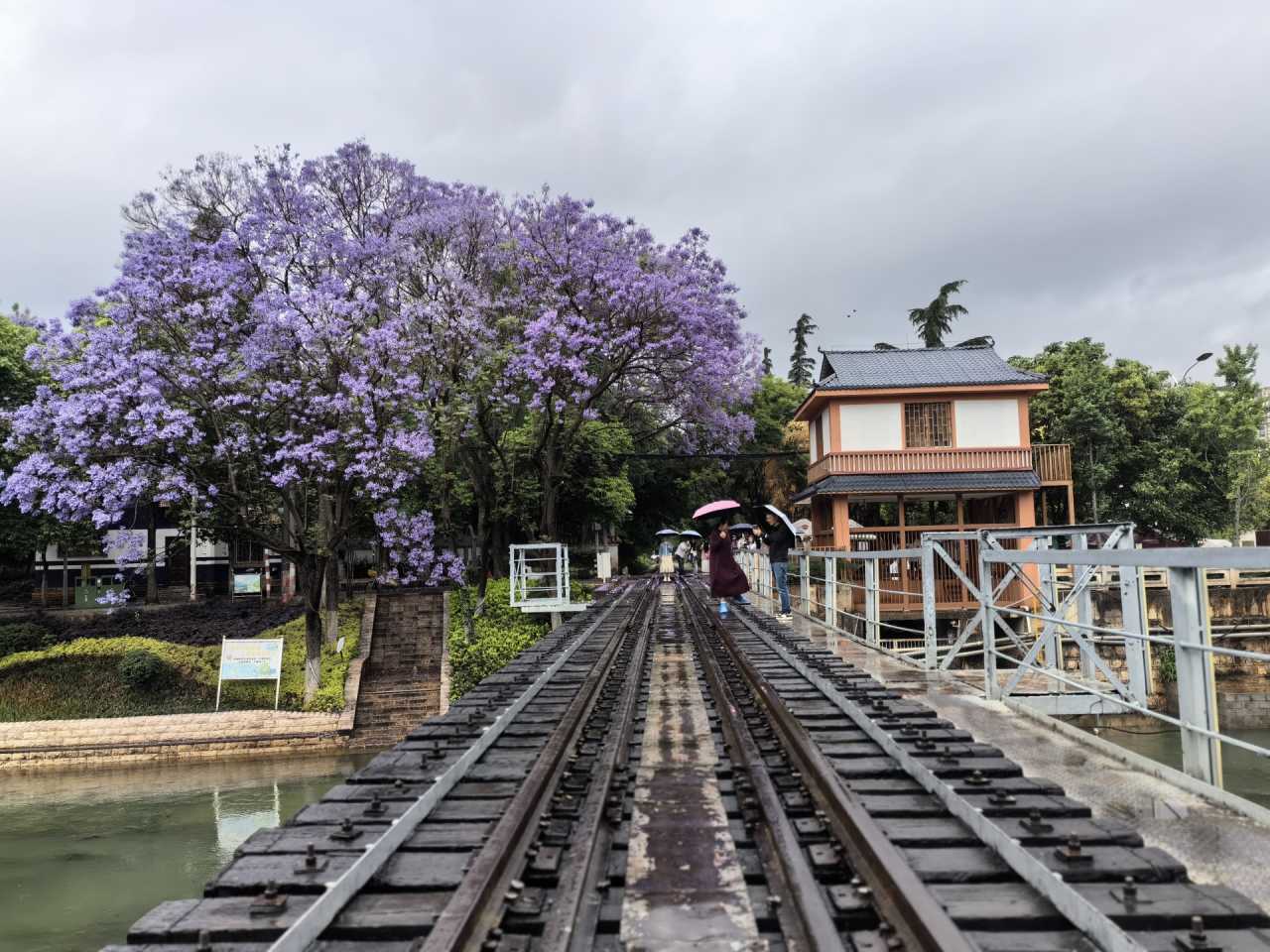
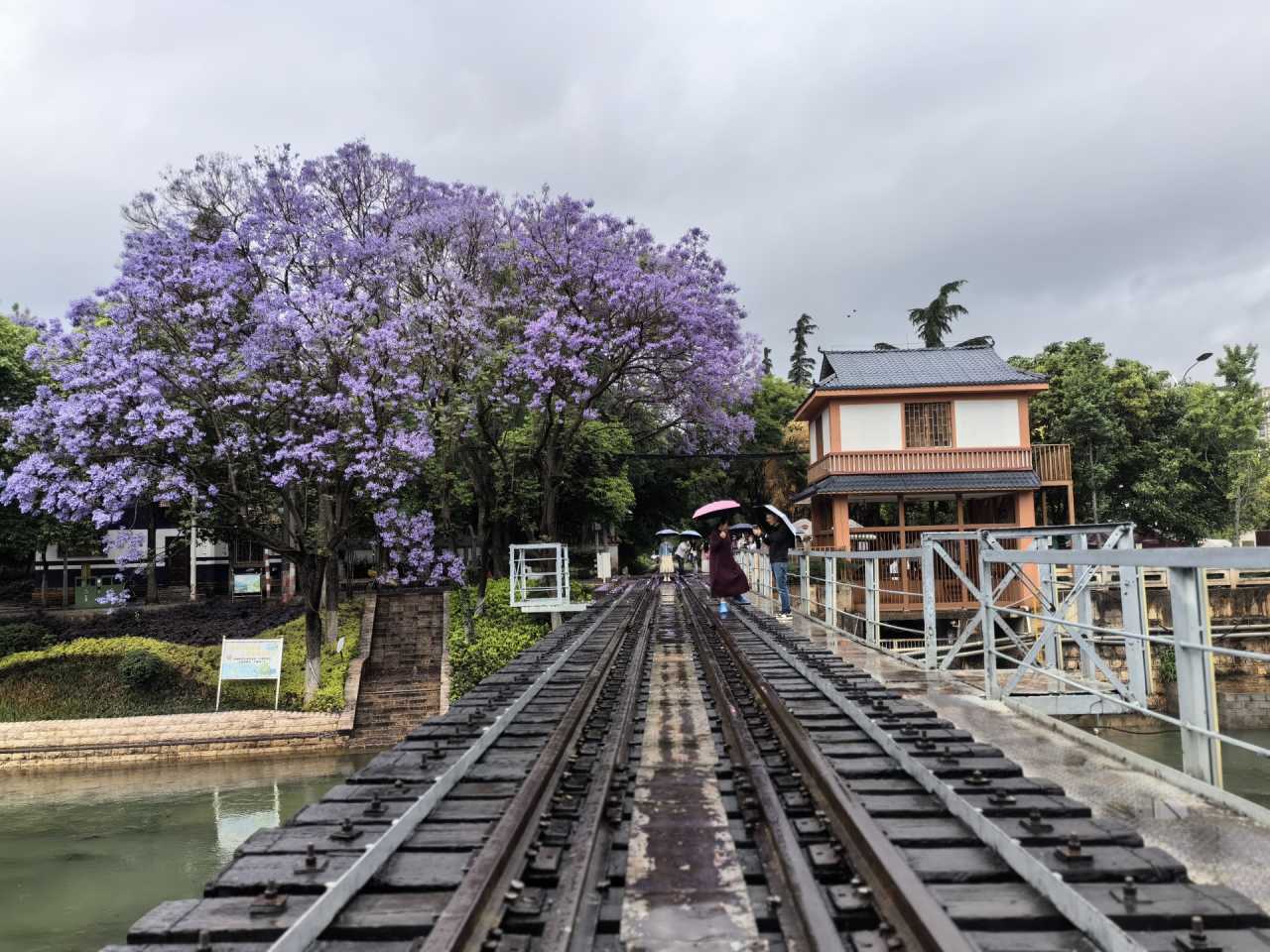
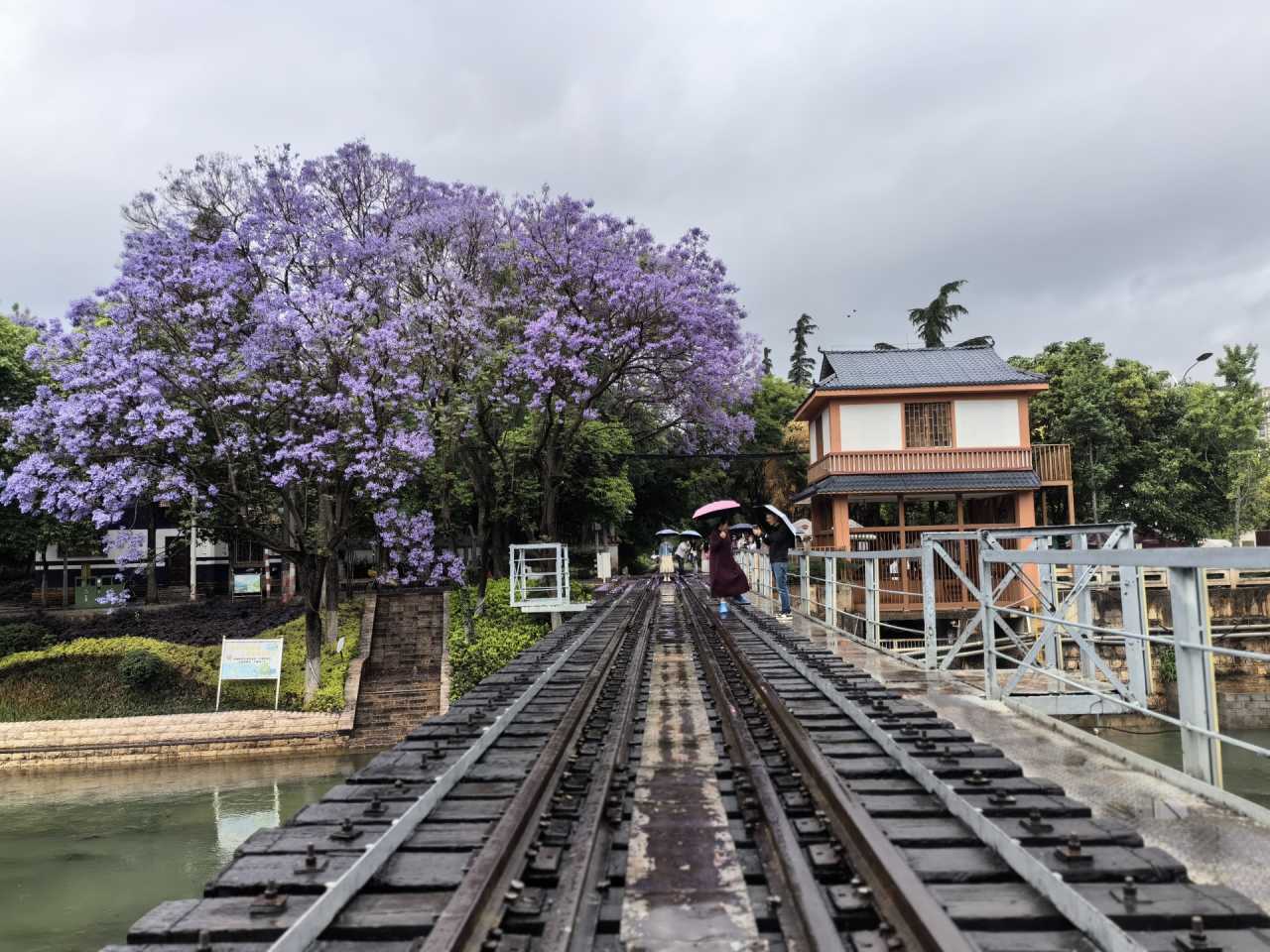
Seeing the rain easing, my urge to chase flowers began to stir again. I took a taxi directly to Youguan Bridge to see how the jacaranda along the Panlong River were blooming. The depth created by the abandoned railway tracks at Youguan Bridge, paired with a few jacaranda trees at the bridgehead, creates a Japanese-style清新 and serene natural atmosphere, making it a popular photo spot.
At this point, the rain gradually intensified again, driving away some of the crowd's enthusiasm for taking photos, making the painting scene quieter.
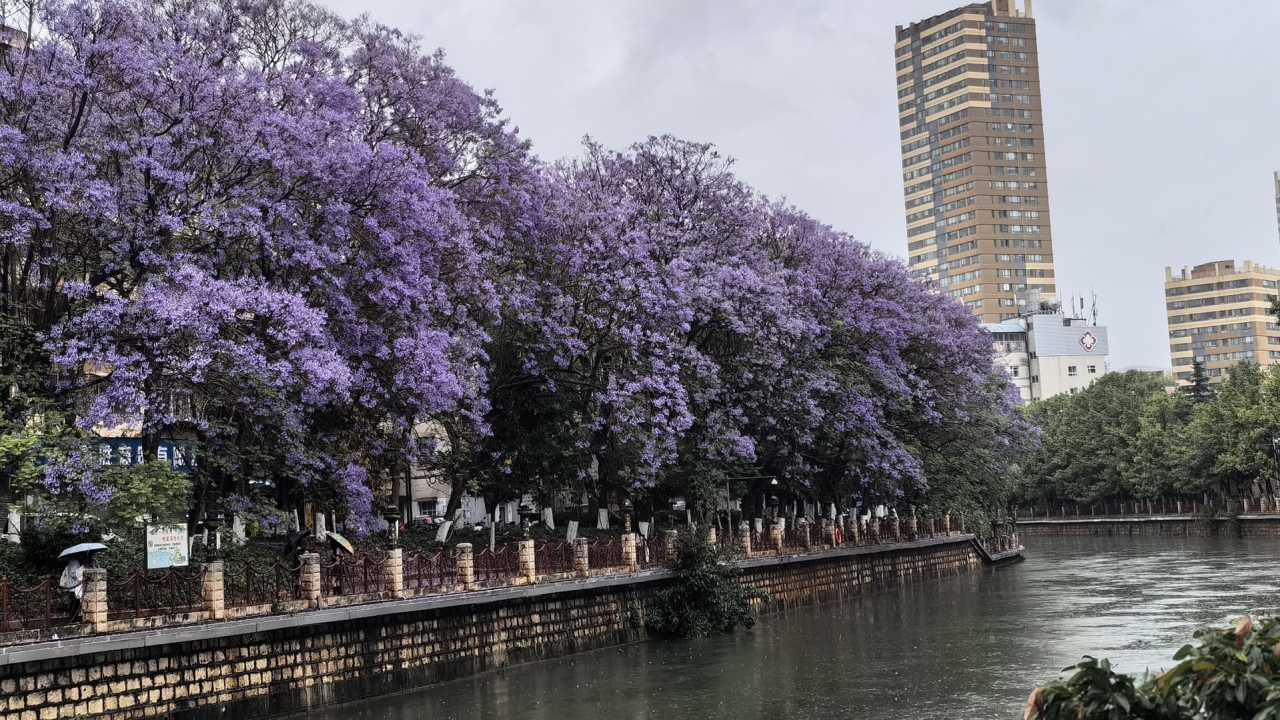
Walking to the riverbank to photograph the most flourishing jacaranda tree, it was indeed the most vibrant blue.
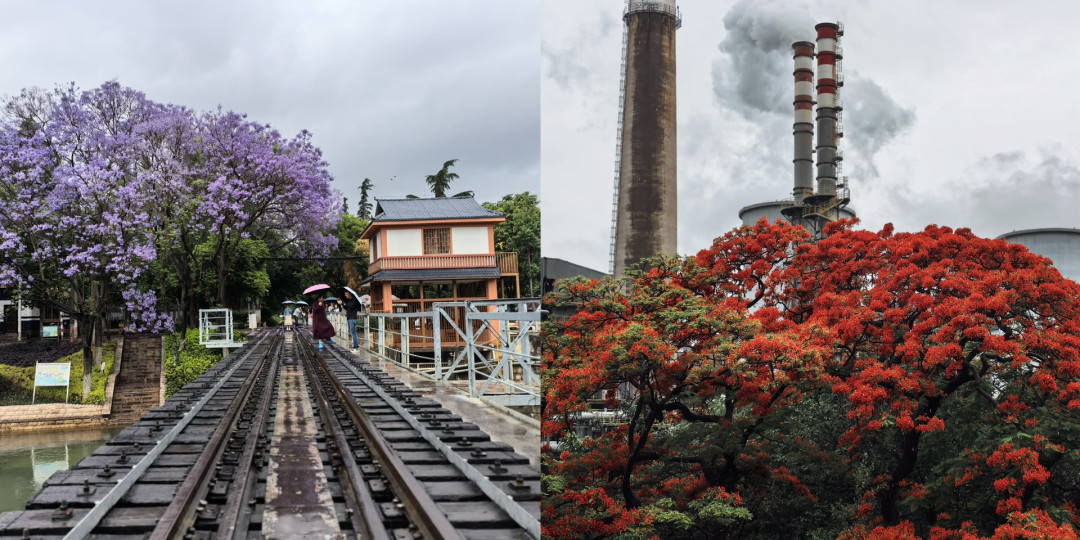
After crossing the bridge, the railway tracks stretch into the distance. Although there are no more jacaranda trees further on, the fallen petals nearby combined with the deep perspective of the tracks in the distance create an irreplaceable atmospheric photo spot.
Just as I came down from Youguan Bridge and reached Xiao Caiyuan Overpass, a heavy downpour poured down without warning. Without an umbrella, I had to use my coat to cover my head and run into a small street-side shop to take shelter. The rain showed no sign of stopping. Knowing I had to leave Kunming that evening and time was tight, I bought an umbrella in the shop and continued exploring the flowers in the rain along Binjiang West Road. Although the rain was inconvenient, it wasn't all bad. First, there were fewer people. Second, the jacaranda flowers became more vivid and colorful after being wet by the rain.
This is the view captured from the Panlong River Bridge on Renmin Middle Road. This is also a classic online photo spot for jacaranda along the Panlong River. With a telephoto lens, you can capture the winding depth of the river.
The flower scenery on the west bank of Binjiang West Road, near the police station section, was the most flourishing.
Shooting from the opposite bank towards Binjiang West Road, there was a platform set up on the other side, perhaps specifically for photographing the flowers. Using a 3x zoom, I got a shot with flowers and an industrial-style staircase in the same frame.
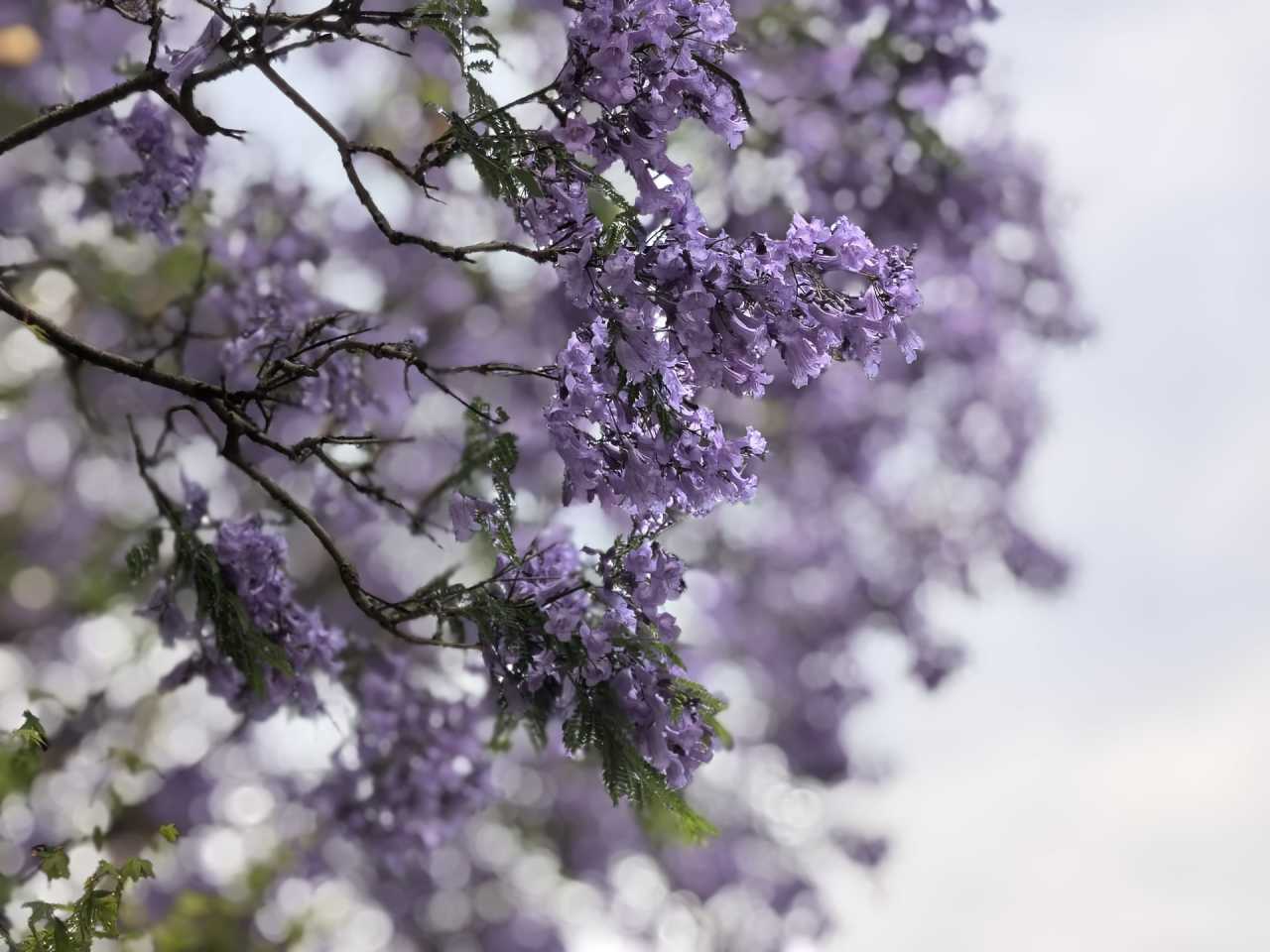
Here are two close-ups. The flowers, washed by the rain and still carrying raindrops, had a fresh blue-purple color that was especially moving.
Xunjin Street City Walk
I persisted in walking along both banks of Binjiang West Road in the rain until my hair and clothes were completely soaked. It was also lunchtime. I thought I should find a place to sit down, rest, and collect my thoughts. Coffee and a light meal seemed like a good idea. So I took a taxi directly to Xunjin Street, which also brought the biggest surprise after the rain that day.
This area, consisting of Xunjin Street, Tiepi Alley, Houxin Street, and Shulin Street, forms a slow-living district. It emphasizes a slow and soft lifestyle. The alleys are long, narrow, and quiet. The various shops on both sides are exquisite and bohemian. After the recent rain, they appeared vibrant, lively, and interesting.
Xunjin Street is an old street that records Kunming's modern history of opening up and its fashionable stories. Liang Sicheng and Lin Huiyin once lived at "Zhiyuan," No. 9 Xunjin Street. Today, the street has become a place for stylish coffee shops.
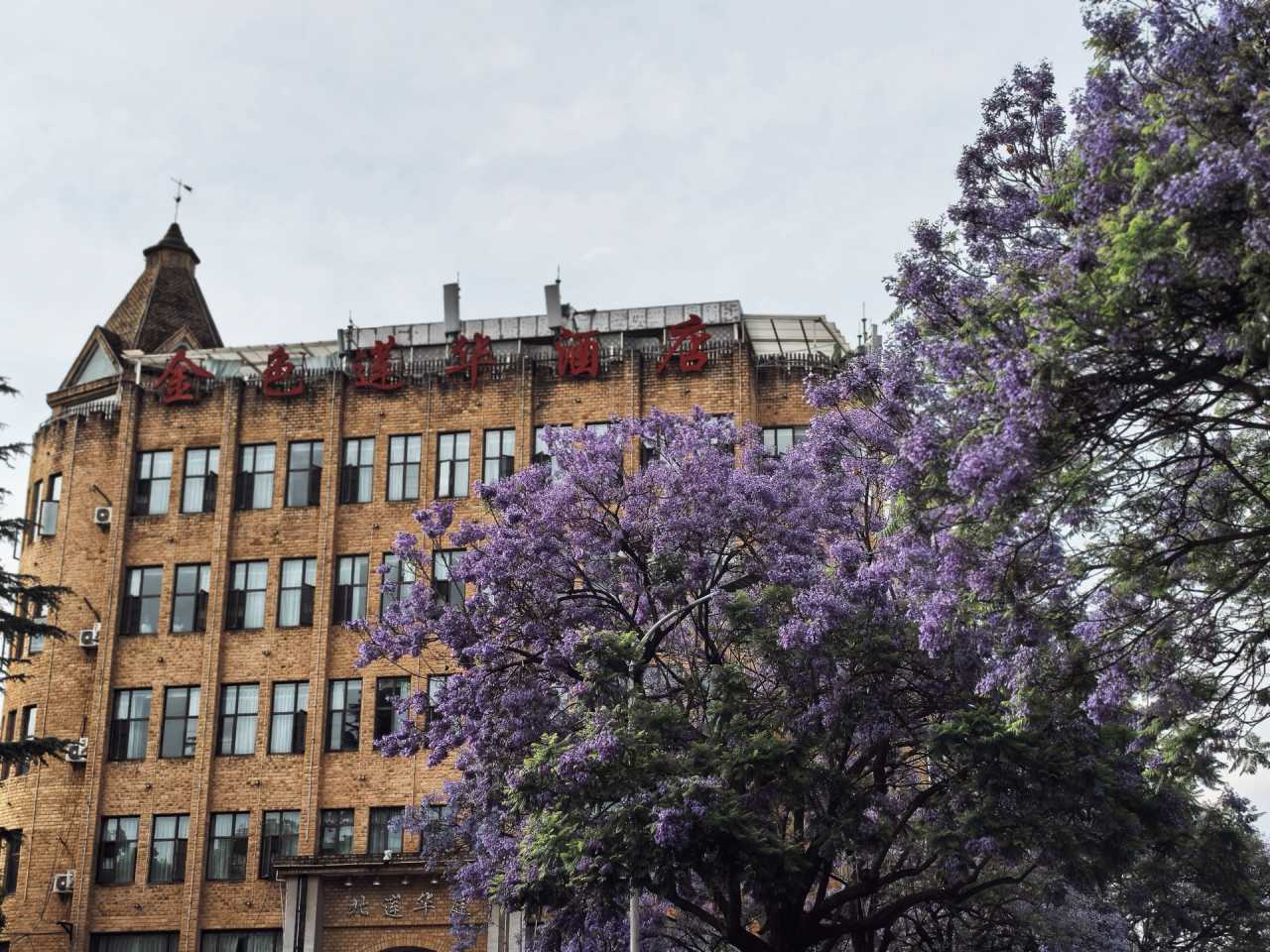
Jingde Alley connects Dongsi Street, Shulin Street, and the Xunjin New Village loop. It is named after the Hua family. With graffiti walls and plane trees, it has a strong artistic atmosphere and was my favorite.
Tiepi Alley is another popular online jacaranda photo spot. On-site observation showed that the jacaranda here are generally taller than those on Jiaochang Middle Road, making them unsuitable for low-angle or eye-level shots. They are only suitable for drone or high-angle photography, or using a high-angle telephoto lens to capture people among the flowers. Online rumors about needing to make a reservation at a美容院 that is not open to the public aren't really necessary. The effect from the high-angle outdoor staircase at Caiyun Li is the same.
Although it's not suitable for portraits, this place is full of the artistic and relaxed atmosphere cherished by locals. Red brick old factory buildings, remnants of French-style villas, and the sea of purple flowers in the sky intertwine, creating story-filled scenes with every shot.
On the surrounding walls of Xunjin Street, the words "Kunming" are paired with gold line drawings of local architectural silhouettes (such as Jinri Tower, East and West Pagodas, etc.), creating a strong urban cultural atmosphere. The spire of the East Pagoda is faintly visible amidst the簇拥 bougainvillea. The neatly arranged public bicycles on Shulin Street showcase the level of Kunming's urban management.
This city walk ended with a beautiful meal, marking the end of my two-day flower-chasing trip in Kunming. In the evening, I took a high-speed train to my next destination: Panzhihua.
About Panzhihua
Panzhihua, located at the southernmost tip of Sichuan Province, is an immigrant city built due to its mineral resources and the Third Front construction. It is planted with many kapok trees (also known as Panzhihua trees) and is the only city named after a flower.
In 1965, influenced by the international environment at the time, the massive Third Front construction began. A single telegram completely rewrote the fate of this place. Deep in the mineral-rich mountains and valleys of the southwestern hinterland, the State Council approved the establishment of the Panzhihua Special Zone. Centered around Panzhihua Iron and Steel (Panzhihua Gang), it implemented a government-enterprise integrated management model. Later, for secrecy reasons, it was externally renamed "Dukou City," and its mailing address was just a postal box code. It wasn't until the 1980s that the name Panzhihua was restored.
Tens of thousands of workers left their hometowns and flocked from all over the country to this land awaiting development. During those years of "production first, life later," they set up简陋 shacks and, amidst the rolling dust of the dry-hot valley, built a steel city with their blood and sweat.
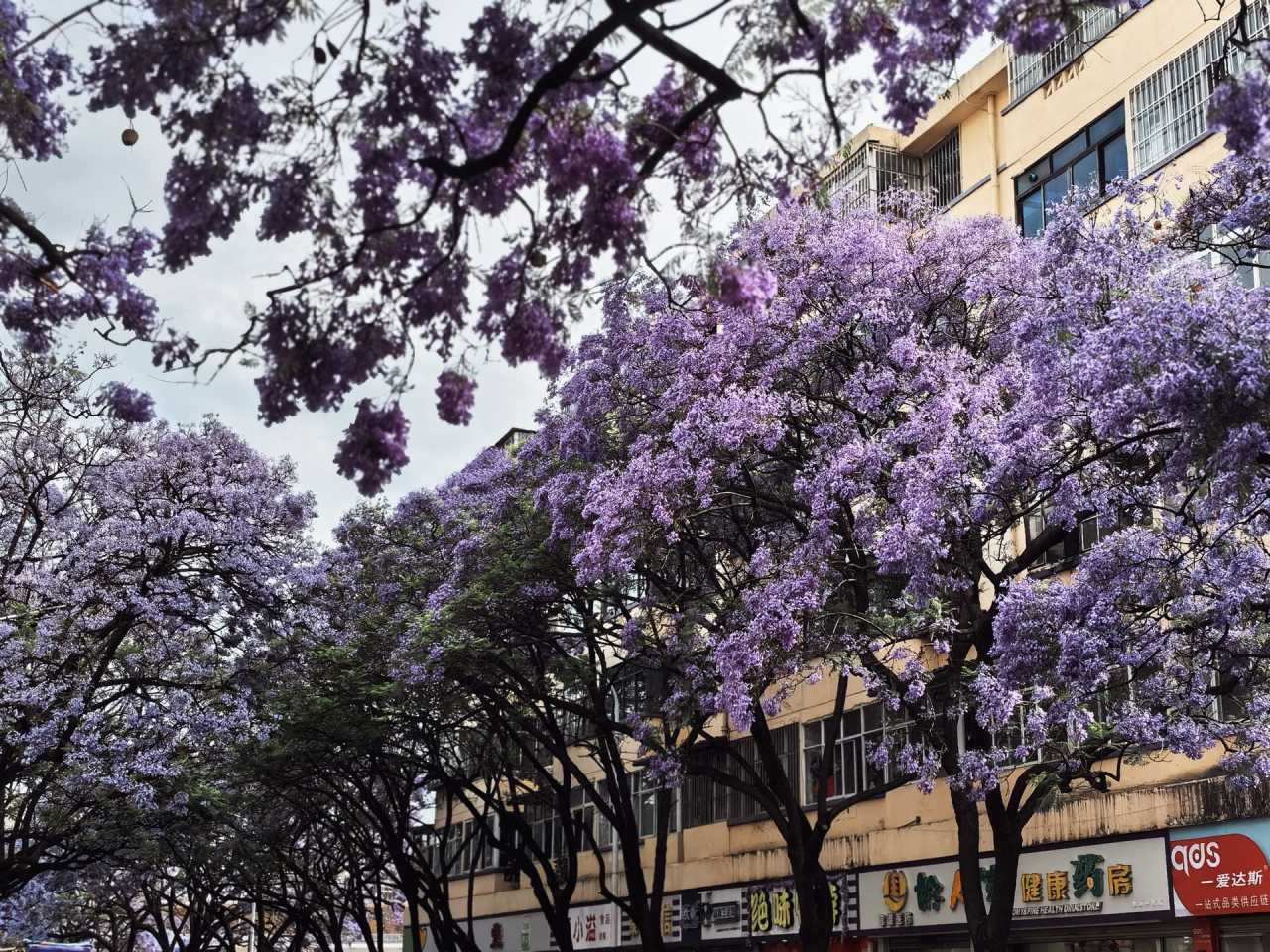
Panzhihua has top-tier mineral resources and contributes the highest per capita GDP in Sichuan. However, due to the decline of Panzhihua Gang, state control over vanadium and titanium resources, and the闭塞 of its valley地理位置, Panzhihua has long faced the serious and尴尬 situation of population outflow. In recent years, Panzhihua has leveraged its unique "vertical climate based on the south subtropical zone" to build a B-side to its city image as a fruit capital and a tourism and health retreat destination.
The above is information I researched. Now let me talk about my personal experience during my two-day trip to Panzhihua.
First, getting around is hard work. The urban area of Panzhihua is divided into three districts: Renhe District, Eastern District, and Western District. There are over ten kilometers between districts, and a taxi ride takes about 30 minutes. The city is all uphill and downhill; walking on flat ground is basically a luxury. This morning, I walked from my hotel, the Hampton by Hilton, to the Wanda Plaza in the Eastern District. The navigation showed 894 meters, but it took me over thirty minutes, including a long flight of stairs down. It's truly more Chongqing than Chongqing.
This picture illustrates the problem best. The entire city is built on the mountain. My hotel was in the high-rise building area, and Wanda was at the very bottom. The vertical distance on the map was 890 meters. Because of this terrain, it's impossible to build a subway or ride a bicycle. Ordinary citizens basically have to walk or use public transport.
Second, urban development is uneven. The Eastern District CBD area is all high-rise residential buildings, estimated to be over 20 stories. This is probably still related to the terrain. But the outskirts of the Eastern District and the Western District still have abandoned Panzhihua Gang factory buildings and old residential areas still in use, creating a huge contrast. Municipal construction needs further improvement.
Third, the locals are warm and straightforward. In two days, I took about ten taxi rides to see the flowers. Every driver I met was enthusiastic and willing to communicate, proactively introducing various tips and local customs. They spoke directly and honestly. Special commendation for them.
About the Flame Tree (Phoenix Tree)
The most widely known flower language of the flame tree is "fiery youth" and "farewell." Its blooming period coincides with graduation season. Whenever flame trees bloom on campus, it预示着 another batch of students is about to bid farewell to school and head for distant places. Therefore, it is also called the "graduation tree," with the tree full of red flowers seemingly toasting to youth.
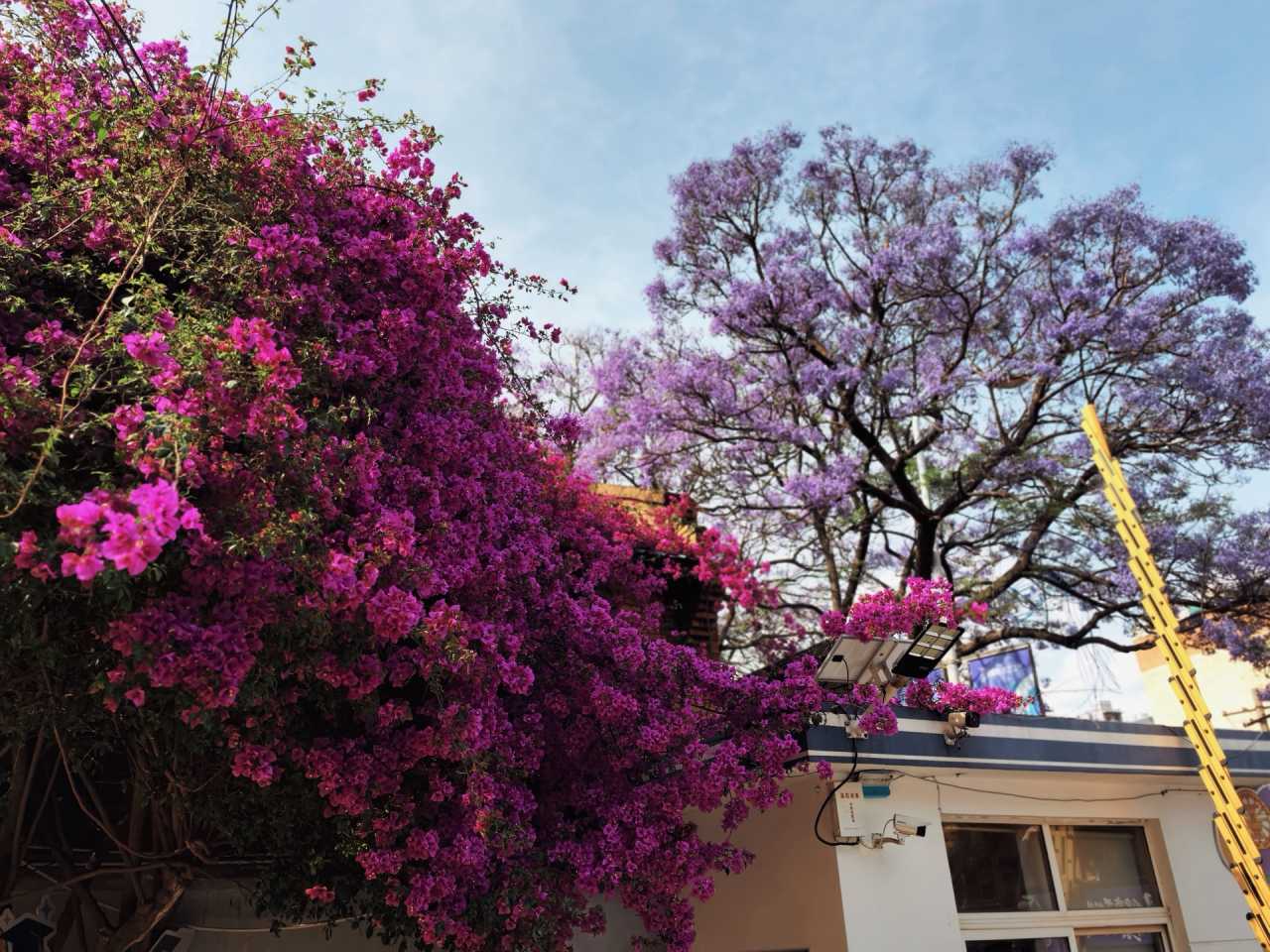
In Panzhihua, the flame tree is a mark of youth for the older generation. In the 1970s, accompanied by the clarion call of the Third Front construction, the older generation of builders planted these flame trees. They have shared the breath and fate of this city. In 1987, the flame tree was officially designated the "city tree." At that time, Panzhihua's streets were lined with flame trees, creating a magnificent landscape of "city-wide red glow," which was the city's most distinctive label.
In the mid-to-late 1990s, the flame trees suffered severe infestations of the Paysandisia archon moth and inchworms. These insects were not only difficult to eradicate but would also "fall from the sky," dropping into people's hair and collars, earning them the nickname "hanging ghosts," causing great distress to residents' lives. Furthermore, the fine leaves of the flame tree were extremely difficult to sweep up after falling, putting immense pressure on sanitation workers.
Faced with high control costs and persistent pest problems, large-scale cutting became a无奈 choice. In 2002, the city tree was officially changed to the kapok tree. Now, times have changed, and those surviving flame trees have ushered in their "golden age." Today, they are no longer the city's "annoyance" but Panzhihua's hottest online attraction and a载体 for "red nostalgia." Every April and May, the flame trees bloom on schedule, reigniting the entire city with a sweeping force, attracting countless people to visit. I was one of them. Following online guides, I began a day-long flower-chasing tour.
Dahuadi
I chose Dahuadi as my first stop for chasing flame trees. Mainly because I saw online photos of flame trees framed together with large factory chimneys, perfectly replicating the city's spiritual framework. I couldn't wait to see it with my own eyes. Fortunately, the driver I met was born in Dahuadi and knew the photo spot by heart, so we got there without any trouble.
In front of the flame tree is an area of rooftops. Online guides say that a few days ago, you could still climb up there. Perhaps because of the May Day holiday, it has been specially reinforced, and now it's impossible to get up.
Walking from the Dahuadi bus stop direction, there is a tall flame tree leaning out onto the street. Isn't it just like the lyrics of the song "At the Crossroads Where Flame Trees Bloom"?
In the distance, there is another tree with a beautiful drooping branch, covered in fiery red flowers, forming a beautiful road sign with the street sign above.
Yongping Alley
I called for a taxi in Dahuadi for twenty minutes without a response. Finally, I had to add a 6 RMB surcharge to get a ride. That's when I realized how remote this place was. On second thought, it made sense. If it weren't far from the main roads, these flame trees probably wouldn't have been preserved. So, most of the flower-viewing spots recommended in online guides are in old residential areas or near abandoned factory buildings, full of a sense of history.
Different views on both sides of the same flame tree. The building was originally a dormitory for the 19th Metallurgical Construction Company (Shijiuye) workers, now abandoned. Like the flame tree, they are both old-timers with a long history.
Walking further along Yongping Alley, the old buildings or small bungalows inside are still inhabited. The flame trees here are all much taller than the bungalow roofs, almost as high as the power lines. They should be about fifty years old.
A flame tree on the rooftop against the light. Its umbrella-shaped branches are sparse, clean, and clearly structured. Even without emitting dazzling fire-red, it doesn't diminish its inherent beauty.
Flame Tree Park
In Panzhihua, any place called a park requires climbing mountains. Entering the Flame Tree Park gate, it's all uphill along the winding mountain road. The roadsides are lined with flame trees, and you can also overlook the cityscape in the distance. But for someone like me who doesn't like climbing, it wasn't very worthwhile.
On a rainy day, even during the May Day holiday, there were very few tourists. As I walked, I found myself alone. I gritted my teeth and made it to the observation deck for a panoramic view of the city. But as far as the eye could see, the large patches of red all over the mountain did not appear. As online sources said, the peak bloom had not yet arrived. So I decisively gave up on summiting and went down the mountain for lunch.
Chunmiao Alley
Chunmiao Alley is in the Western District. It was a 14-kilometer taxi ride from Wanda Plaza in the Eastern District to Chunmiao Alley in the Western District. The further we drove, the fewer people we saw on the roads. The driver brother explained that the Western District was originally an industrial area. With the decline and relocation of Panzhihua Gang, a large number of people have moved out, many settling in Xichang or Chengdu. So compared to the bustling Eastern and Renhe Districts, this place feels desolate and quiet. It's part of the pain of urban transformation.
However, suddenly the crowd ahead became dense. I knew we had arrived at Chunmiao Alley, the top online flame tree photo spot. The reason it's a top online spot is that there are two flame trees in full bloom with low-hanging branches, paired with a low wall, making it especially suitable for portrait photography and very photogenic. At this moment, the rain was getting heavier, but it couldn't extinguish people's determination to get their photos.
While waiting in line, I practiced shooting from various angles. Perhaps because the rain had soaked the petals, the color of this flame tree was exceptionally vivid, truly burning like fire. The top spot has its reasons.
Finally, after waiting in line for half an hour in the heavy rain, I got my photos. Thanks to AI, I was able to一键 remove the unavoidable passersby from the frame. Looking at the final results, the wait was not in vain.
Chuxin Garden
Chuxin Garden is not far from Chunmiao Alley. Its official name is "Third Front Construction Culture Park," built to promote the "Third Front Spirit." The park uses micro-scenes, sculptures, and a museum to recreate the era of hard work and entrepreneurship of the older generation of builders. This was also the former site of the Western District government, full of retro nostalgia.
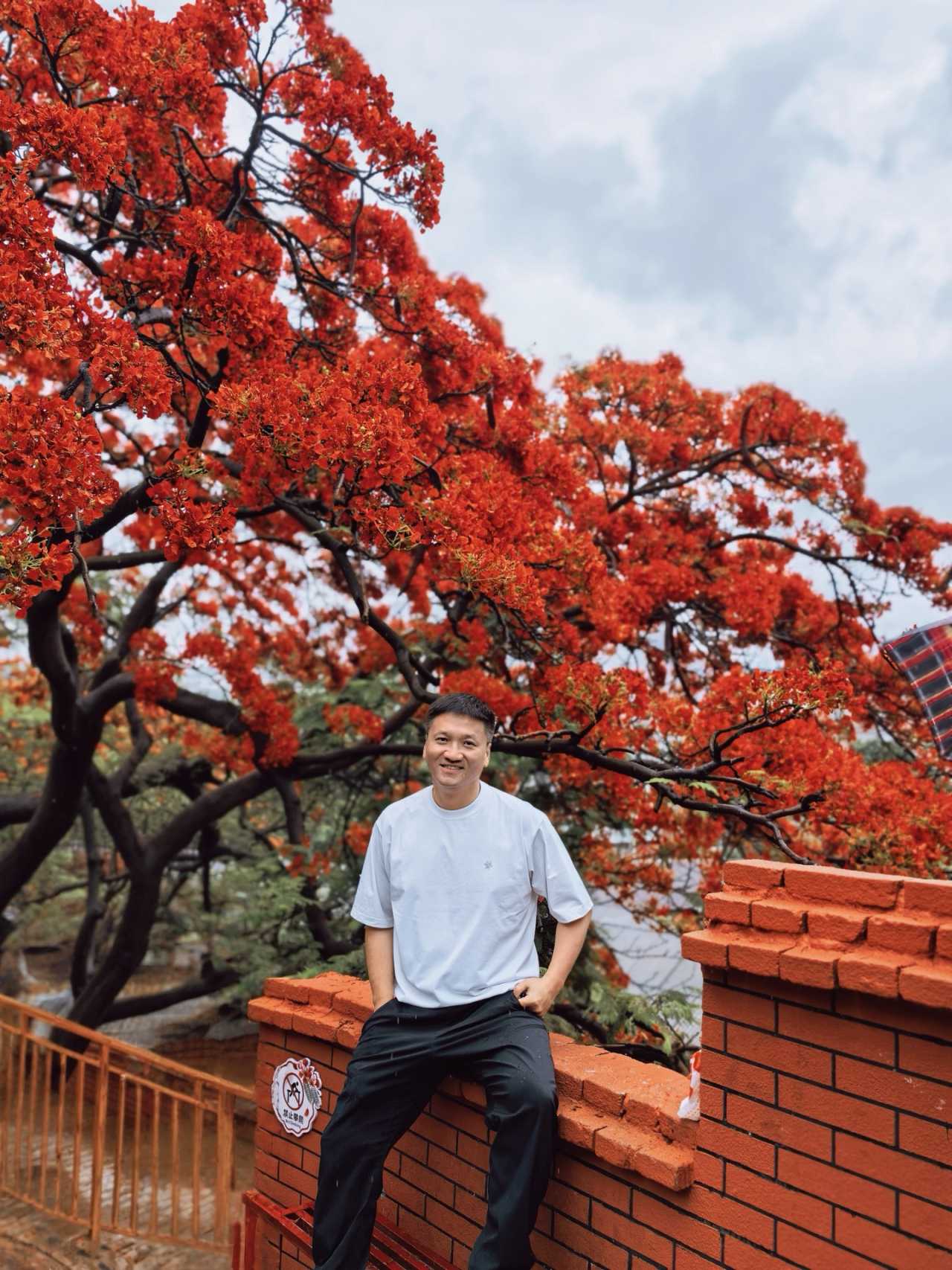
As soon as I entered the park, the retro blackboard newspaper and red-brick office buildings instantly evoked the atmosphere of the Third Front construction era. Paired with the flame trees in full bloom throughout the park, it was stunningly beautiful, beyond words. It was the best of the day's flower chase.
These few flame trees in front of the red-brick office building were like peerless beauties, flawless from every angle. No matter how I photographed them, they were radiant and splendid!
The one next to the Third Front Construction Memorial Exhibition Room appeared more subtle and gentle. Together with the stairs and railings, it brought everyone back to those bygone days, recalling the fiery youth of the past.
Eastern District Talent Apartment
I returned to the hotel from Chuxin Garden, thinking I would fly to Shanghai early the next morning and transfer back to Hangzhou. But in the evening, I received a call. Due to flight flow control, my flight was changed from 10:00 AM to 3:00 PM. So I had an extra half-day. This sudden free time felt awkward. Going to a distant attraction would be too rushed, worrying about the time. Continuing to explore flowers in the city felt pointless after seeing the breathtaking beauty at Chuxin Garden. Could there be anything better worth visiting?
After a night of deliberation, I woke up the next day to find clear skies and occasional sunshine. I couldn't help feeling frustrated. It had rained heavily all day yesterday, but today, the sun was shining brightly to see me off. So I immediately decided to take one last look at the flame trees in the sunlight. I took a taxi to the Eastern District Talent Apartment. It turned out to be a brilliant decision.
Near the Talent Apartment is the Panzhihua Public Security Bureau. Following the small path directly opposite the bureau's main gate, you enter a park. The park is filled with flame trees. Some branches with drooping flowers hung low, forming a unique landscape against the mountain terrain and the distant city high-rises.
The flame trees in the park are all decades old, which is rare in a bustling city. The green ground was scattered with fallen flame tree petals, forming a layer of fine, dense crimson rain. It was stunningly beautiful.
Walking up the winding mountain path, I found myself at eye level or looking down on the park's flame trees. With the added boost of sunlight breaking through the clouds, the view was filled with fiery red. It was absolutely incredible! Making this the last stop of my trip was the perfect finishing touch!
Final Thoughts
Three days, two cities. I got to know and understand these cities by seeking out and photographing their flowers. The same May, the same journey home, but the flowers told different stories for the two cities. The jacaranda falls slowly, like Kunming people trying to hold onto spring. The flame tree blooms urgently, like Panzhihua people grasping the sun's warmth. Between the blooming and falling of flowers, the character of a city spreads and permeates. The meaning of travel, I suppose, is to happen upon such a flower event at this time, in this place, exactly when you are meant to see it. There's no need to deliberately search for anything; just...
You should also read:

Solo in Yunnan: A Wanderer’s Guide to the Land of Eternal Spring
Solo in Yunnan: A Wanderer’s Guide to the Land of Eternal Spring There’s something magical about traveling alone. No compromises, no schedules to keep, no one to please but yourself. I’ve been on the road for nearly three months now, and not once have I…
Continue reading...
Into the Hidden Valley: A Solo Journey Through the Mysterious Dulong River
Into the Hidden Valley: A Solo Journey Through the Mysterious Dulong River Deep in the northwestern corner of Yunnan Province, tucked away from the modern world, lies a place that feels like a secret whispered among mountains. The Dulong River Valley is not just a…
Continue reading...
God’s Abandoned Palette: A Self-Drive Journey Through Yunnan’s Dongchuan Red Land
God’s Abandoned Palette: A Self-Drive Journey Through Yunnan’s Dongchuan Red Land Travel has never been about reaching some distant geographic coordinate. It’s about encountering, along the way, the version of yourself buried beneath the rubble of daily routine. During this May Day holiday, I finally…
Continue reading...