Solo Through Southern Yunnan: No Regrets for Youth — A 15-Day Backpacking Deep Dive Across Yunnan
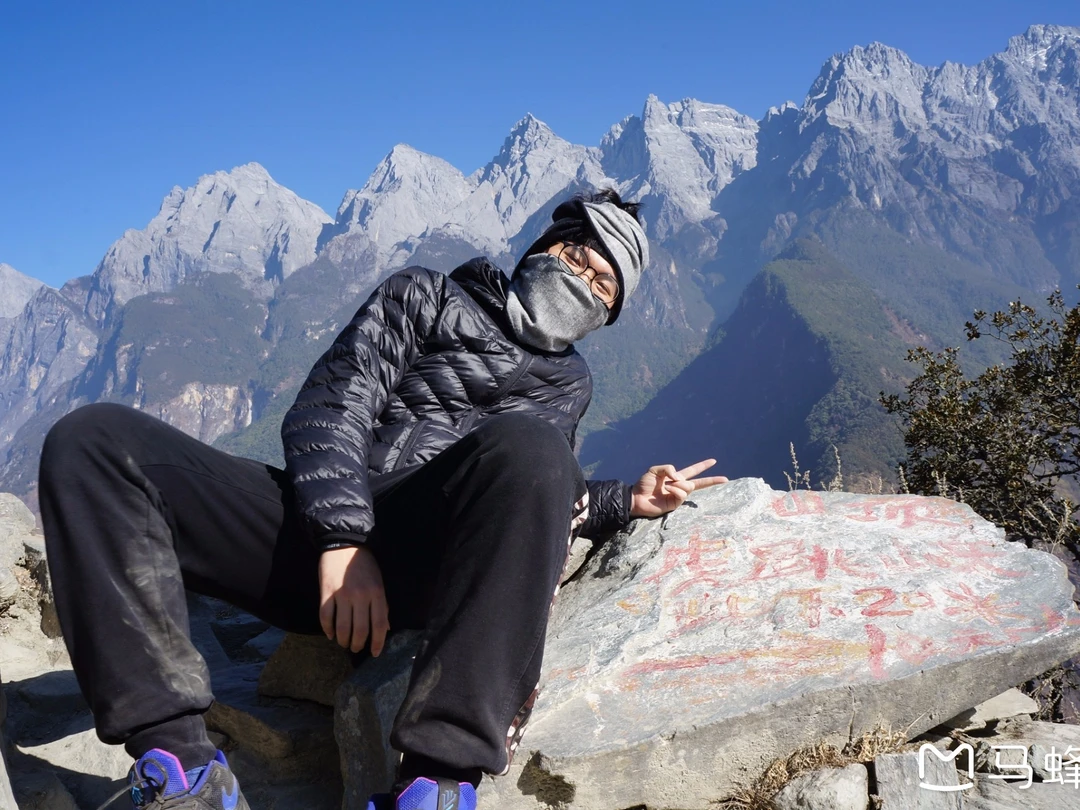
Solo Through Southern Yunnan: No Regrets for Youth — A 15-Day Backpacking Deep Dive Across Yunnan
Departure: A Long-Overdue Liberation
"Why are you going again? Didn't you just come back not long ago?" My father's voice was calm yet carried an unmistakable firmness.
This was my second time proposing a trip to Yunnan within six months. The last time, I followed friends on a standard tour group route — Lijiang, Dali, Kunming, a tidy three-city loop. We circled the ancient towns, memorized every alley and shop, yet something felt missing. On the evening before our return, I watched the sunset at Caicun Pier. The breeze from Erhai Lake brushed gently against my face, and in that moment, I told myself: I will come back. Little did I know that just four months later, I would set foot again on this land I'd come to regard as a second home.
My obsession with Yunnan probably began in middle school. Bits and pieces from books, magazines, and TV painted a vague but beautiful picture — like a long-time crush I never had the courage to approach. This time, it was my first genuine solo long-distance journey: one backpack, one plane ticket, and the resolve to just go.
Before leaving, I hesitated for a long time. Everything I found online warned me that winter wasn't the season for Yunnan. But I've never bought into the idea that "off-season means no scenery." To me, the real difference between peak and off-peak isn't the landscape — it's the crowds. Rather than jostling through shoulder-to-shoulder tourists in high season, I'd rather have the world to myself when it's quiet. Without the crush of people, accommodation and transport are cheaper, and you can relax into a much more easygoing pace.
The seed of this story was actually planted during my first math class after National Day. I was physically in the classroom, but my mind had already wandered off. Bored out of my mind, I stumbled upon an article about Jianshui and the Yuanyang Rice Terraces, and my thoughts instantly drifted to the colorful clouds of Yunnan. That semester, with the pressure of switching majors and everything else, felt unbearably long and stifling. Travel became my only antidote. I had no detailed plan, no fixed destination — just like the books say: "Just board a train and start your wandering." I believed that once I set out, the answers would reveal themselves along the way.
The Pack: Minimalist Winter Journey
This was my first winter trip, and I didn't take it lightly. A week before departure, I specifically bought a 50-liter backpack, which would accompany me through twenty days of autumn and winter. Keeping my hands free was the iron rule I set for myself.

Clothing: Two down jackets (one lightweight long-sleeve, one thick vest), one long-sleeve shirt, two pairs of pants (one base layer, one cotton-padded), cotton socks, a scarf, and gloves. This gear was enough to handle Yunnan's average winter temperatures ranging from zero to ten degrees Celsius. South of Kunming, starting from Jianshui, it was warm during the day except for the cool mornings and evenings. But in winter, Shangri-La's mornings and evenings dipped below zero — my clothing was a bit thin, and I had to tough it out on sheer willpower.
Yunnan winters are extremely dry, so moisturizer and sunscreen are essentials. The sun is brilliant, and protection is important. But because of personal preference, I brought none of these — okay, I admit it, that was stubbornness.
The day before departure, I stuffed my backpack to the brim. Despite my best efforts to streamline, besides warm clothes and daily necessities, I still packed an extra set of clothes and a notebook. I planned to write a travel journal along the way. As it turned out... let's just say I never quite developed that habit.
Kunming: Unexpected Warmth at the Transit Hub
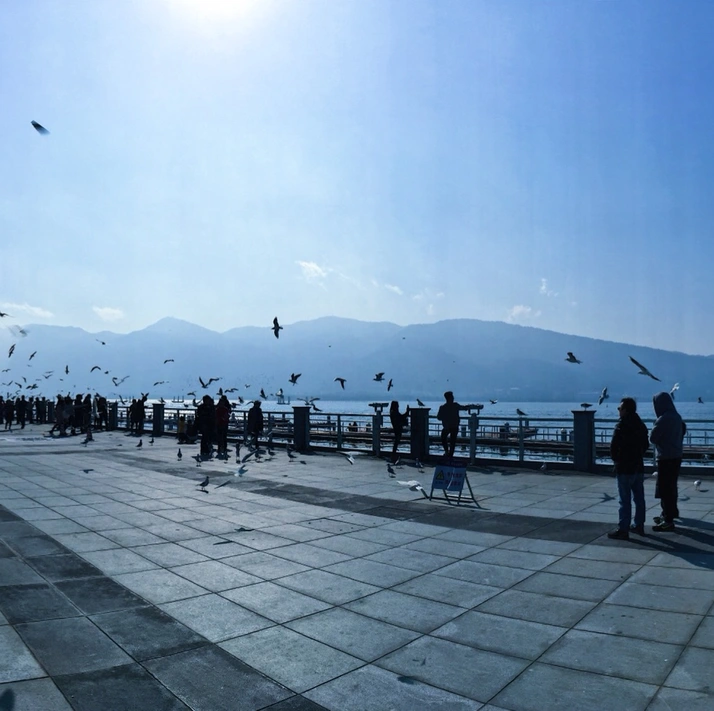
Overnight at the Airport and First Encounters
I'd been watching plane tickets for two or three months before departure. With an early winter break and off-season travel, plus accumulated vouchers on Fliggy, my round-trip cost only about 600 yuan. The catch with budget tickets is spending the night at the airport — this time, I barely slept again, but with experience from last time and fewer people in the off-season, it was easy to find three consecutive seats to stretch out on. Other than slightly burning eyelids the next day, I managed fine.
Guangzhou to Kunming: two hours by plane. I checked in at 5 a.m., and by 10 a.m., stepping out of Changshui Airport, I took a deep breath of fresh air — the taste of freedom.
When I first arrived in Kunming, the weather wasn't kind. The sky was gray, and a cold wind hit me. I found a hostel near Dianchi Lake and checked in. The owner came out to greet me, laughing: "You picked a bad time — yesterday was clear and sunny, but today it's overcast, rainy, and cold." Despite the bad luck, the afternoon brought a brief moment of sunshine by the lake — a small favor from the heavens.
A Chance Encounter at the Hostel
At the hostel, I met a girl from Northeast China studying in Xinjiang — Sister Xiaofan. In the soft lamplight, she lounged leisurely on the sofa in the common area, reading The Ferryman. She didn't even look up when I walked in. I thought she was a traveler, but after chatting, I learned she was just a volunteer there. Her daily tasks included tidying up and washing sheets, with occasional downtime. Listening to her talk about past travels, her studies, and her vision of an ideal lifestyle, I felt genuine admiration. "Open a small shop — run it when you feel like it, travel when you don't" — that's the life I dream of too. "You are the company you keep" — this reminded me I still have a long way to go. She also recommended two guidebooks: The Moon and Sixpence and Walden.
That afternoon, I stayed at the hostel to catch up on sleep. My roommate turned out to be a player from the Chinese Super League's Changchun Yatai team — a chatty guy from the Northeast. But I was too tired to talk much and didn't get his autograph, which I still regret a little.
By evening, I wanted to wander out. It was too late for the Yunnan Ethnic Village and Haigeng Park. Sister Xiaofan suggested Yunnan University, along with that elusive "Yunda Snack Street" I never managed to find.
A Century of Light and Shadow at Yunnan University
Yunnan University is steeped in history. It still preserves ancient buildings designed and built in the last century, some used as classrooms, others as administrative offices. These structures, spanning two centuries, have witnessed countless rises and falls of history through a hundred years of wind and rain. As night fell, the entire campus was bathed in a faint yellow light, making it feel as though such evenings were no different from those in the 1930s and 1940s.
I don't have much fondness for city nightscapes. I biked around Kunming's streets for a while — actually, I got lost — but I wasn't in a hurry. When I got tired, I stopped at a roadside shop for a very spicy rice noodle (guoqiao mixian), then headed back to the hostel early. In the evening, I spent time in the common area watching horror movies. I even recommended my horror movie collection to Sister Xiaofan, saying it would keep her volunteer days from getting lonely.
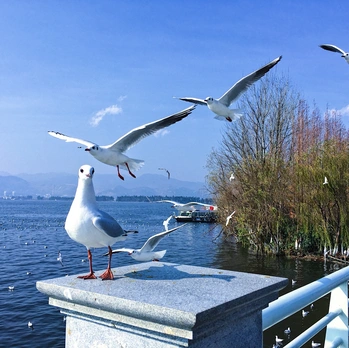
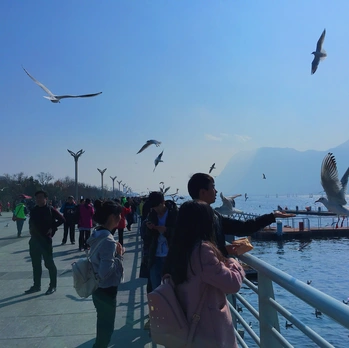
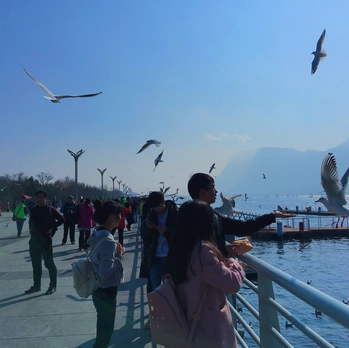
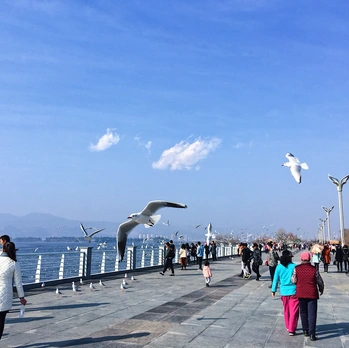
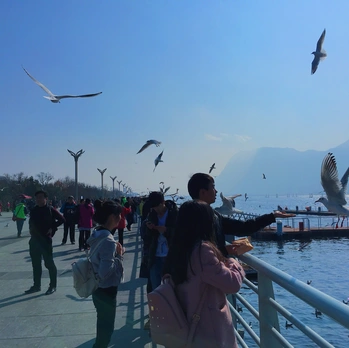
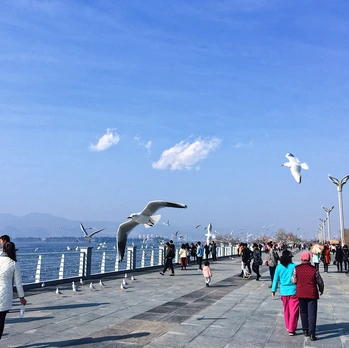
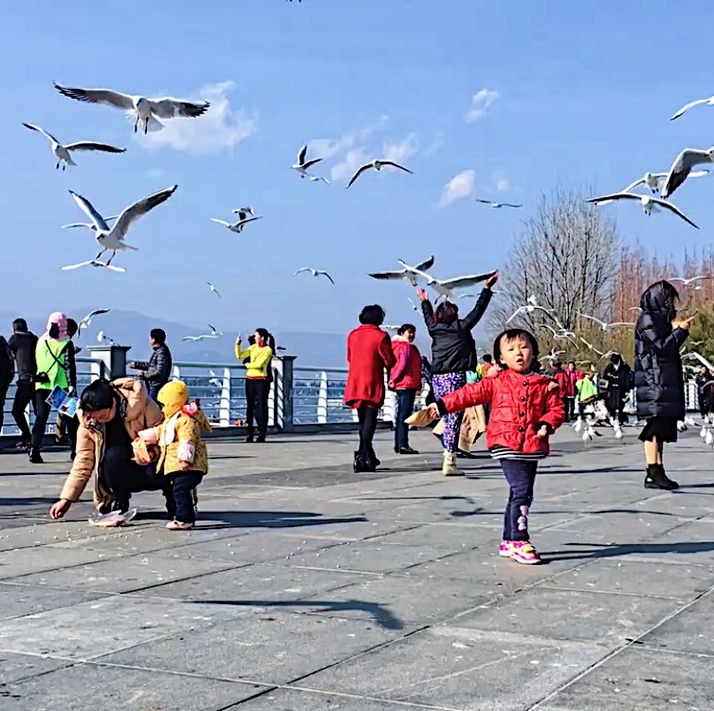
I woke up the next day at noon — just the day before, I'd vowed to get up early and watch the sunrise. I'd planned to visit the Ethnic Village, but the rain defeated me. Unwilling to just sit around, I impulsively biked half an hour to Haigeng Park. The park wasn't big — just another spot to get up close with the seagulls. There weren't many people there, mostly families and couples, radiating sweetness and warmth. I took a few photos and headed back, at the cost of freezing my gloved hands — thinking I'd rather have stayed at the hostel chatting with Sister Xiaofan. The worst part was that the bike's mudguards couldn't keep the muddy water off my backpack, which ended up covered in "chocolate" stains by the time I returned.
For me, Kunming was just a transit and rest stop; I didn't stay long. The city's most popular attractions are mostly commercial streets, no matter how fancy the names. Squeezing through streets where your toes step on the heels of the person in front, listening to chaotic hawking, only made me feel suffocated. So I treated everything as a quick check-in, passing through without lingering.
Practical Tips: The heart of Kunming city is Dianchi Lake and the parks around it. If you have time, experience the slow pace of local seniors — play with the Siberian seagulls, enjoy the winter lake breeze, or explore the folk customs of over twenty ethnic minorities at the Yunnan Ethnic Village. At Yunnan University, you can indulge in the atmosphere of higher education from a century ago.
Jianshui: Slow Time in an Ancient Nanzhao Town
Arriving in Jianshui
Kunming to Jianshui: two hours and forty-two minutes by train. Jianshui is warmer than Kunming, with a latitude and temperature similar to Guangzhou. Stepping off the train, I could immediately feel the familiar heat. The small station was packed with people — all, I assumed, heading for the Yuanyang Rice Terraces.
After exiting, there were local buses at the roadside. Their departure times roughly matched the train arrivals, and almost every one was crammed full. Of course, there were also plenty of private car owners hawking rides.
I fumbled in my pockets and found no change. A woman was standing in front of the bus, and I asked her for help. As we chatted, I learned she was also heading to Jianshui Ancient Town and was confirming the bus route. She paid my fare but refused my WeChat transfer — I met many such people along the way, who paid for my bus but wouldn't accept repayment.
On the bus, she asked if I'd found accommodation. I'd actually booked a hostel right after getting off the train. The hostel bed cost a tenth of her hotel room. She said, "Then I'll follow you." That's one of travel's charms — you never know when or where you'll stumble upon an unexpected adventure.
Caoya Hostel: A Waystation for Wanderers
The hostel we stayed at was called Caoya (Grass Shoots), a cozy place where like-minded souls from all over could meet by chance — like an ancient courier station. Most people coming to Jianshui were heading to Yuanyang to see the rice terraces. The fame of the Yuanyang Terraces had even spread abroad, drawing many foreign visitors.
We were greeted by the hostel's volunteer, Sister Lei. She loved the pace of life in Jianshui and wanted to stay for a while, so she chose to volunteer. She said Caoya often hosted foreigners, and volunteering was a good chance to practice her English. When she'd had enough, she could just leave and move on to the next place.
The hostel had a common area of several dozen square meters. Foreigners were chatting, and other guests were laughing and talking, discussing itineraries or sharing travel stories. The atmosphere was wonderful.
We were hungry, so we first dealt with the food problem. After a struggle, we found a restaurant about to close, grabbed a quick dinner, and returned to the hostel. The ancient town at night wasn't as lively as Lijiang or Dali — nothing too surprising. Following us through the door were a man and a woman. At first, I thought they were a couple, but it turned out they were just travel companions who'd met on the road. Brother Ziran owned a guesthouse in Yuanyang and often slipped away to this hostel in the ancient town for some leisure time. The woman was a teacher at Tibet University — she'd moved to Tibet to teach simply because she loved it.
Practical Info on Yuanyang Rice Terraces: - Winter is the best season to see the terraces - From Jianshui, take a bus from Jianshui Bus Station to Xinjie Bus Station (about 4 hours, 43 yuan) - From Xinjie to Duoyishu, you'll need to charter a car (about 15-20 yuan) - Watch sunrise at Duoyishu, sunset at Laohuzui (Tiger's Mouth), and colorful terraces at Laoyingzui (Eagle's Beak) - Whether you see the most beautiful terraces depends entirely on luck — "Ten miles, different skies" and "Rain in the east, clear in the west" are normal. Even without rain, Yuanyang is often shrouded in fog - Many people choose to wait in Jianshui — maybe three or four days, maybe a month or two
The charm of Jianshui Ancient Town is that once you settle in, you don't feel like leaving. Every morning, wake up, brew a pot of coffee, sit at the shop entrance, and bask in the sun, daydreaming. Eat some Jianshui barbecue, try the grilled tofu — the vendor counts pieces with corn kernels. People pass by at a leisurely pace. When tired, sit on a stone bench by the roadside and enjoy the warm breeze. This is life in Jianshui — simple, unadorned, yet intoxicating.
The Tuanshan Team: A Temporary Family Across Generations
From Jianshui to Hekou, we formed a temporary team — the Tuanshan Team. Four people spanning two or three decades in age gathered in Jianshui, hit it off instantly, and traveled together all the way to Hekou, China's southernmost border with Vietnam.
We called each other: Nineteen (Brother), Eighteen (Sister), Twenty-Eight (Big Sister), and me at fourteen (Handsome Youngster). Eighteen was the Gansu teacher who'd paid my bus fare and followed me to Caoya — she was the team's joke machine and distributor. Nineteen was a photographer from Beijing with Hunan roots. I'd first met him in the hostel common area when he'd just returned from outside. He was also planning to see the Yuanyang Terraces, but first wanted to take the Jianshui Little Train and was looking for teammates. Twenty-Eight, "Big Sister," was someone Nineteen had met in Jianshui Ancient Town — a goofy, playful older soul whose way of thinking was completely different from her age, and she fit right in with us.
The Jianshui Little Train: A Century-Spanning Journey Through Time
The Tuanshan Team's first day began with the Jianshui Little Train. Running twice daily — one morning, one afternoon — it passed through Shuanglong Bridge, Xianghui Bridge, and Tuanshan Village. The first two stops had half-hour layovers; the last stop, an hour.
Tip: If you buy tickets for any other Jianshui attraction, you can use them to get a 30-yuan discount on the little train.
Shuanglong Bridge was originally a three-pavilion, seventeen-arch stone bridge. One pavilion was destroyed in war during the Qing Dynasty, leaving one large and one small. The distance between stops was only ten to twenty minutes.
Tuanshan Ancient Village: Frozen History and Living Memory
Tuanshan Ancient Village was the real highlight of our trip. The village walls still bore many red slogans from the last century, including phrases from the Cultural Revolution — "Criticize," "Overthrow" — words that can't be mentioned today.
General's Mansion was the first thing we saw entering Tuanshan Village, bestowed by Cai E, a general of the Republic of China. General Zhang He was an upright man who managed the tin mines of Gejiu. The villagers of Tuanshan grew wealthy thanks to his rise and returned home to build magnificent mansions and courtyards. On festivals and birthdays, local and even distant dignitaries would send congratulatory plaques. Few of these plaques survived — most were destroyed during the Cultural Revolution — but the General's Mansion had the most of any in Tuanshan Village.
Unfortunately, the good times didn't last. At the peak of everything, Zhang He died a violent death. Cai E's investigation revealed the culprit: Zhu Chaoying of Jianshui, who had murdered him in a bid to seize the tin mines. The Zhu and Zhang families became bitter enemies, and Zhang He's descendants began to decline.
The inner courtyard of the General's Mansion was breathtaking. Beneath the eaves, six screen doors were carved with gold-gilded openwork or relief patterns. Each door had different motifs, each with its own unique story. It was said that local craftsmen were paid based on the total weight of wood shavings they produced while carving. Wealthy families were meticulous in the details, emphasizing artistry and quality, with a distinctive charm. On the walls of the side rooms were calligraphy, paintings, and proverbs by local luminaries like Qiu Tingdong.
The house was still owned by Zhang He's descendants. During the Cultural Revolution, under the wave of "striking landlords and dividing property," the original mansion was forcibly divided into sections and given to outsiders, even people of different surnames. The general's descendants each got a small room. The younger generation had bought new houses outside the village, leaving only the elderly behind. In the inner courtyard, only one room was still occupied — the owner, her husband, and their grandson squeezed into a dozen square meters, living in hardship. Tourists came and went, "freely" visiting. When we asked about their situation, she answered with a smile. Tuanshan Village's tourism had only started developing in recent years. When we asked if the elderly benefited from it, she said yes — 500 yuan a year, often delayed. She brushed it off with a laugh. Consider that Tuanshan Village tickets cost 51 yuan per person, and in peak season, there were hundreds of visitors a day.
In the courtyard stood a pomegranate tree that had withered long ago — like this mansion, it could no longer withstand the wind and rain. This was a缩影 (microcosm) of many old houses in Tuanshan Village — many were only watched over by elderly留守 (left-behind) residents, or had long been abandoned. Yet precisely because of this, far from the noise of the world, their original,古朴 (ancient and simple) appearance had been preserved. Otherwise, the outcome would have been destruction, demolition, or sale.
Zhang Family Garden was a castle-like private estate, second only to the Zhu Family Garden in the county town. It was built by brothers Zhang Guoyi and Zhang Guomin, who made their fortune in Gejiu's mining and business and sent money back home. The garden pond was said to have once served as a school playground. The pillar bases inside were representative of the carving style — the upper patterns symbolized good fortune, while the four corners of the lower part also carried deep meanings. Unfortunately, most had been damaged to varying degrees.
"The Family Tradition of Hundredfold Forbearance" was Tuanshan Village's centuries-old family motto. The elders said it was perhaps this spirit that allowed the much-tormented village to survive to this day.
Imperial Grace Mansion was one of Tuanshan Village's "Eight Great Mansions" and the best-preserved courtyard. It was said to be the highest-grade building among the village's many ancient residences. The inner courtyard of Imperial Grace Mansion was once a filming location for the TV show Chef Nic, and inside were photos of celebrities like Nicholas Tse with the homeowner. Teacher Zhang Liyong was the master of Imperial Grace Mansion and the fifth-generation descendant of Zhang Shuyuan, who built the house. He was a retired teacher from Jianshui No. 1 Middle School, with encyclopedic knowledge of Jianshui and Tuanshan Village's history. He had written books about it, and tourists came specifically to buy them and get his inscriptions.
We spent far more time in Tuanshan Village than the train's return departure time allowed. We didn't head back until 6 p.m., taking a chartered car from the village entrance to the ancient town. The locals said that just the stories depicted on one screen door were rich enough; hearing all the village's tales would take two or three months.
Practical Tip: Tuanshan Village is worth spending half a day listening to the locals' stories and chatting with them. If you're not in a hurry to catch the return train, stay longer to explore. At the village entrance, you can take a local's shuttle bus back to Jianshui for just a few yuan.
Epilogue: Finding Your True Self on the Road
Fifteen days. From Kunming's Dianchi Lake to Jianshui's ancient town, from Tuanshan Village's century-old mansions to Hekou on the China-Vietnam border — I traveled not just geographical distance, but a journey of the soul.
Some say travel is about going from a place you're tired of to a place others are tired of. But for me, travel is a series of liberations — stepping out of daily routines to meet different people, hear different stories, and then carry those stories back into life, enriching myself.
In those fifteen days in Yunnan, I learned to go with the flow, to enjoy solitude, and to find a sense of home in unfamiliar places. Those strangers who paid my bus fare and refused repayment, those travel companions who shared stories at the hostel, those elderly people in Tuanshan Village recounting the past in their old houses — they showed me that the meaning of travel isn't about how many places you've been, but how many people you've met and how many stories you've heard.
Final Practical Tips: - Winter in Yunnan is dry — moisturizing and sun protection are important - Traveling in the off-season saves money and avoids crowds - The Jianshui Little Train is worth experiencing, but save more time for Tuanshan Village - The Yuanyang Rice Terraces depend on weather — consider staying a few extra days in Jianshui to wait for the best conditions - Solo travel isn't lonely — you'll meet many interesting souls along the way
Solo through Southern Yunnan, with no regrets for youth. These fifteen days were the best gift I ever gave myself.
You should also read:

Solo in Yunnan: A Wanderer’s Guide to the Land of Eternal Spring
Solo in Yunnan: A Wanderer’s Guide to the Land of Eternal Spring There’s something magical about traveling alone. No compromises, no schedules to keep, no one to please but yourself. I’ve been on the road for nearly three months now, and not once have I…
Continue reading...
Into the Hidden Valley: A Solo Journey Through the Mysterious Dulong River
Into the Hidden Valley: A Solo Journey Through the Mysterious Dulong River Deep in the northwestern corner of Yunnan Province, tucked away from the modern world, lies a place that feels like a secret whispered among mountains. The Dulong River Valley is not just a…
Continue reading...
God’s Abandoned Palette: A Self-Drive Journey Through Yunnan’s Dongchuan Red Land
God’s Abandoned Palette: A Self-Drive Journey Through Yunnan’s Dongchuan Red Land Travel has never been about reaching some distant geographic coordinate. It’s about encountering, along the way, the version of yourself buried beneath the rubble of daily routine. During this May Day holiday, I finally…
Continue reading...