South of the Clouds: Lugu Lake, Lijiang, and Dali – Mountains, Waters, Ancient Towns, and Stray Dogs
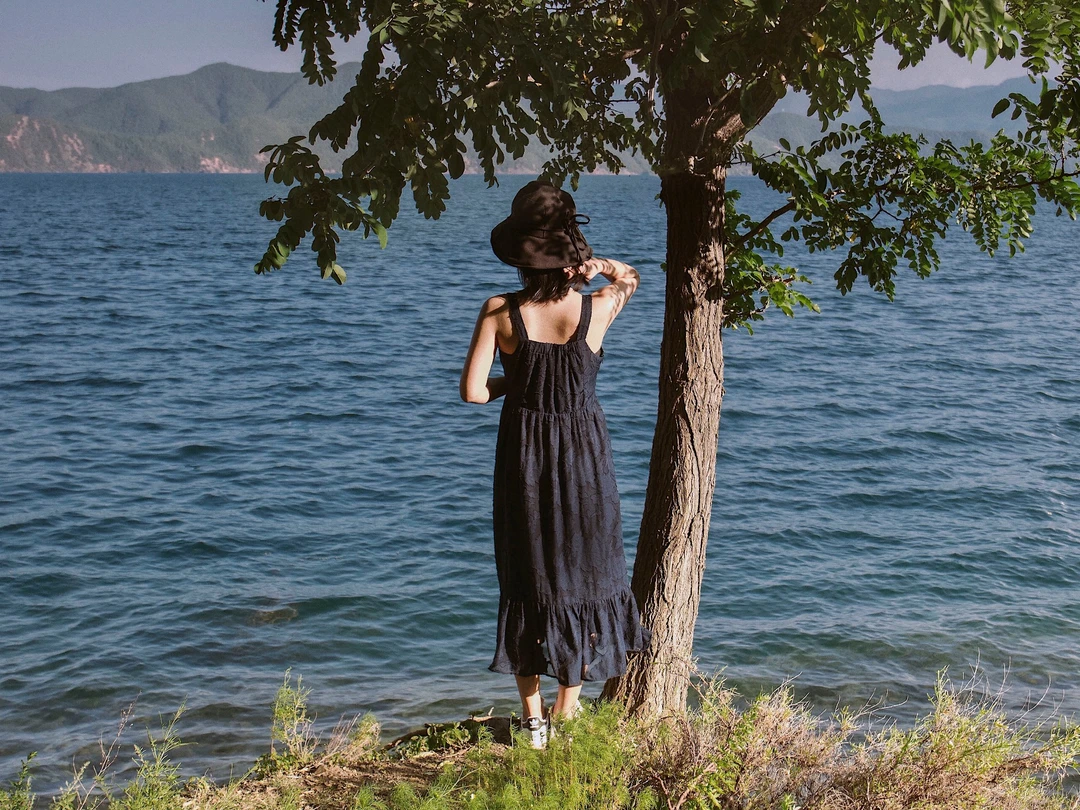
South of the Clouds: Lugu Lake, Lijiang, and Dali – Mountains, Waters, Ancient Towns, and Stray Dogs
In the late summer of 2018, on the eve of my graduate studies, I set off with two close friends – Cong and Yiyi – backpacks loaded, toward Yunnan, a land praised by many and misunderstood by just as many. Over ten days, we wandered from the morning mists of Lugu Lake to the glittering lights of Lijiang, then drifted down to Dali, nestled between Cangshan Mountain and Erhai Lake. When I returned, friends asked what left the deepest impression on me. I blurted out three things: mountains and waters, ancient towns, and dogs.
Yes, you read that right – dogs. At nearly every guesthouse, restaurant, and café in Yunnan, a large dog was posted at the entrance. Samoyeds and golden retrievers formed the main force, huskies came second, and occasionally a poodle would mix in. They lounged lazily on doorsteps or sat upright beside signboards, as if to say, "Welcome. Our specialty? Besides flower cakes, there's me." I even spotted a small blackboard outside one shop, reading "Watchdog on Duty," with a sunglasses-wearing husky crouched beside it. In that moment, I realized the era of the "lucky cat" might truly be over – the age of the "lucky dog" had arrived.
Route and Preparation: One Lonely Planet, Ten Days on a Classic Trail
Before departure, I bought a copy of Lonely Planet's Yunnan and spent a whole week studying it cover to cover. As it turned out, this was the best investment of the entire trip – five-star recommendation, no exaggeration.
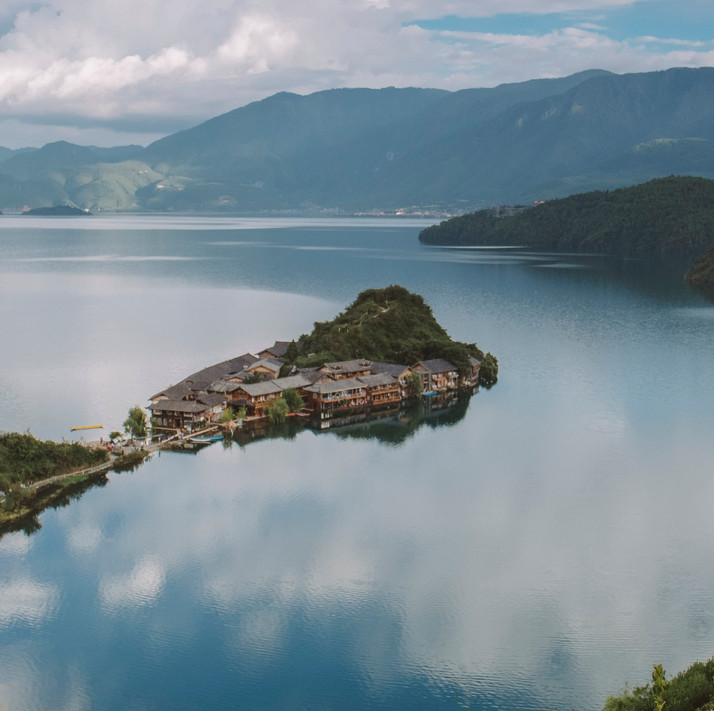
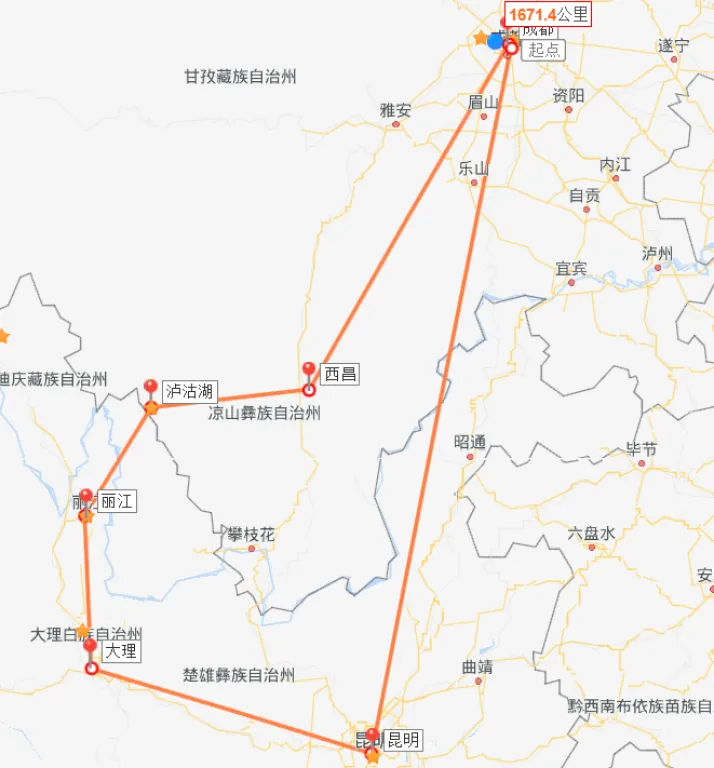
Given time and transportation constraints, we reluctantly scrapped more remote destinations like Shangri-La, Nujiang, Wenshan, and Bamei. We settled on a classic route: Lugu Lake → Lijiang → Dali → Kunming. Over ten days, we hopped between trains, high-speed rails, buses, cars, and planes – practically sampling every mode of transport Yunnan had to offer.

My companions were two old friends: Cong, a seemingly mature adult with the heart of a child; and Yiyi, our portrait model blessed with both looks and presence. My role: carrying the camera, handling the itinerary, and serving as the trio's "chief photographer." This trip we later dubbed our "Yunnan Photoshoot Expedition" – plenty of staged shots ahead, so brace yourselves.
Stop One: Lugu Lake – Daughter of the Goddess Mountain, Lake of the "Watery Casanova" Flower
From Chengdu to Xichang: An Outsider's Night in an Internet Café
On the morning of August 26, we boarded a train from Chengdu North Station to Xichang. A hard-seat ticket for 139 yuan, a six-hour ride, the scenery shifting from cityscapes to连绵的山脉 (continuous mountain ranges). We arrived at Xichang Station around 7 p.m., then caught bus No. 12 to the Xichang Bus Passenger Transport Center.
To catch the early bus the next day, we booked a hotel opposite the station – Yijia Express Hotel, 134 yuan per night, surprisingly good value. Clean, tidy, quiet rooms. My only problem: a pile of unfinished tasks. So that first night, I found a nearby internet café, buried myself in work until late, surrounded by the mixed scent of cigarette smoke and instant noodles. Spending the first night of a vacation in a stranger's internet café – that's a unique experience.
The next morning, we bought direct tickets to Lugu Lake at the bus station, 95 yuan each, about a six-hour ride. The mountain roads twisted and turned, sharp bends one after another, the driver's skill breathtaking. Around 4 p.m., we finally arrived at Lugu Lake.
Goddess Bay: The Flooded Inn and the World's Best Fish Soup
As we got off, a swarm of drivers surrounded us. Our booked guesthouse was in Goddess Bay (Nüshén Wān), a spot famous for its sunset views. Because of the remote location, we couldn't find other tourists to share a ride, but one driver charged only 10 yuan to take us there – reasonable enough.

Feeling the price was fair, we booked him for the next day's lake tour. Standard rate: 300 yuan per car; he gave us a discount at 260. At the time, we thought we'd met a good guy. Later experience proved – we were still too naive.
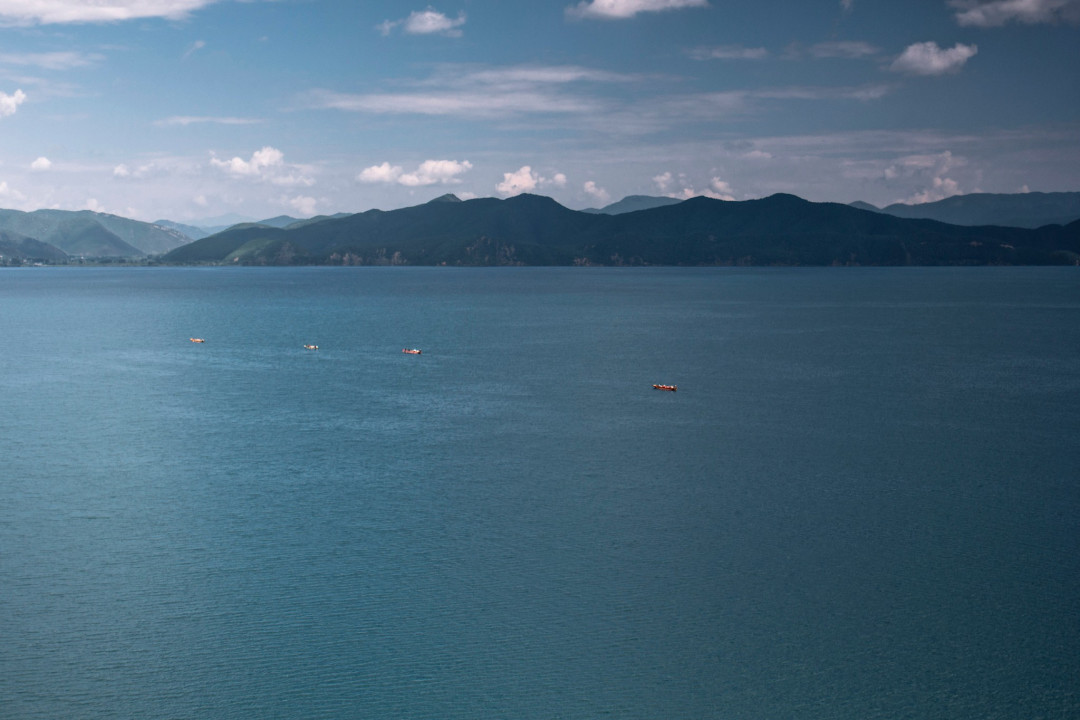
Goddess Bay is a small corner of Lugu Lake, said to offer the most beautiful sunsets. But we came in summer, when clouds were thick, hiding the sunset completely. The spectacular autumn evening glow eluded us. Still, beauty doesn't belong to peak or off-season – it belongs to the four seasons. Even under a gray sky, the lake held a quiet poetry.
We stayed at Tutu Guesthouse in Goddess Bay, 309 yuan per night. Heavy rains that August had raised the lake's water level, flooding the road in front of the inn. We had to take a boat to reach it. The owner offered no pickup service, so we found a boatman ourselves, 25 yuan per boat. We'd booked a first-floor room, but the second floor had better views. The owner said we could upgrade for an extra 50 yuan. We hesitated, then switched.
Breakfast was another letdown. I assumed it was free, but it cost 13 yuan per person for porridge and steamed buns – the buns as hard as my first homemade attempt. Adding up the room, boat fares, and breakfast, it came to nearly 400 yuan – a mediocre experience.
But Goddess Bay had one place that made me forgive every imperfection: "Good Person's Eatery" (Hǎorén Xiǎochī). A five-minute walk uphill from the guesthouse's back door led to this small shop hidden in the woods. 38 yuan per person, eat as much as you like, until you're full. The place was tiny, run only by Good Person Uncle and an auntie, the setting so basic it didn't resemble a proper restaurant – but the taste rivaled star-rated establishments.
Online reviews raved about the松茸土鸡汤 (matsutake and free-range chicken soup) and fish soup. I was prepared, but still stunned. As someone who doesn't usually like fish, I found myself drinking bowl after bowl of the fish soup. White and fragrant, it looked as fresh as it tasted. Good Person Uncle was straightforward and sincere, deadly serious about his food, explaining how to eat each dish when he served it. He boasted that his fish soup was the best in the world – a bold claim, but it was indeed the best I'd ever had. He never used any spices, scallions, or garlic in his cooking, yet the food had no fishy smell. At that moment, I realized: anything done with extreme dedication, whether in technique or spirit, is enough to move people.
Grass Sea and the Marriage Bridge: The Scammed "Millennium Grassland"
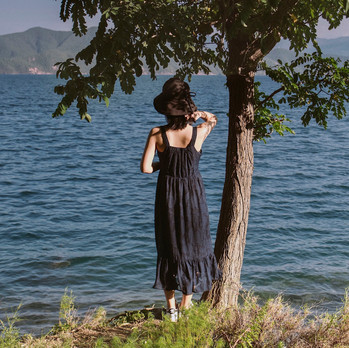
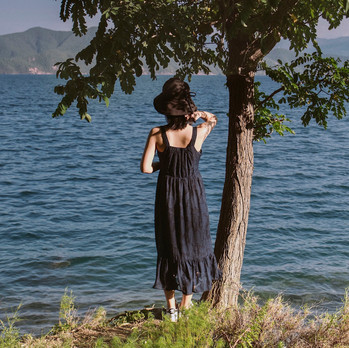
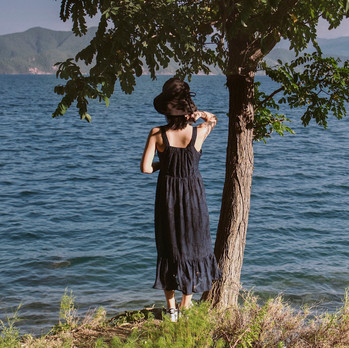
The next morning, we took a boat out of Goddess Bay. As Cong turned to look back, sunlight fell on her face, and I pressed the shutter.

After disembarking, the driver we'd hired the day before was waiting. Our original plan was to circle the lake clockwise from Goddess Bay, passing the Grass Sea (Cǎohǎi), the Marriage Bridge (Zǒuhūn Qiáo), Làngfàng, Sānjiā Village, Dàluòshuǐ, Gémi Goddess Mountain, and finally Lǐgé. But the driver said that stretch wasn't scenic and recommended we visit the "Millennium Grassland" in the southern mountains, then backtrack to the Marriage Bridge, Lovers' Beach, Dázǔ Village, Nísè Village, and Lǐgé.
A warning to future travelers: don't go to this "Millennium Grassland." It sounds grand, but it's basically stepping... stepping... stepping on a grassy marsh in the Grass Sea. The scenery was mediocre, the water dirty, and you had to take off your shoes. 90 yuan per person. The three of us held hands, bouncing on the marsh like a trampoline, feeling utterly foolish. Later, our guesthouse owner told us that drivers get commissions for recommending such attractions.
Still, the boatman who took us across the Grass Sea was kind. He said there was nothing worth photographing there and took us into the reeds instead. He steered the boat right into the thick of them, stopped, and let us shoot freely. The scene reminded me of the film Red Sorghum – except there was no Jiang Wen here.
Next stop: the Grass Sea Marriage Bridge. The current bridge isn't the old one where Mosuo boys and girls once enacted their love stories – it's a new structure built for safety, purely for tourists to photograph and cross. At midday, the bridge was crowded, but the open background on both sides offered plenty of opportunities for skilled photographers.
After the bridge, the driver asked where we wanted to eat. We had no ideas, so he strongly recommended the local steam stone pot fish (zhēngqì shíguō yú). We hesitated but went along – we had no other references. The result: 60 yuan per catty of fish, with the cheapest option starting at around two catties. A photo of celebrities from the show Dear Inn hung on the wall, but even star power couldn't salvage the bland taste. Later, the guesthouse owner told us that drivers get commissions for these recommendations – you could get the same fish for 40 yuan per catty. We were utterly disappointed in this driver.
Lovers' Beach and Lige: A Bad Driver and a Great Hostel
At 2 p.m., the sun was harsh, the water surface white. We stopped briefly at Lovers' Beach on the Sichuan side. A flower floated on the water, oddly named "水性杨花" (literally "watery, fickle flower," a local aquatic plant). Later, I saw it stir-fried in many Yunnan restaurants. Lovers' Beach had a white table, unattended and free to use – we snapped a few photos.

Next, the driver stopped briefly at Lúyuán Cliff, then took us straight to Lǐgé. Lúyuán Cliff is the source of Lugu Lake, an underground water outlet. Scenically, it's just a high place draped with prayer flags – nothing special. Along the way, we passed Dázǔ Village and Nísè Village, where the road ran level with the lake, offering stunning views, but the driver didn't stop. I mentioned wanting to visit the small grassland behind Gémi Goddess Mountain; he pretended not to understand, rushing off to pick up other guests.
In short, this lake tour was a terrible experience. Yiyi later summarized: you should find a young, fun driver who'll help you find photo spots. An uncle like this just doesn't get what young people want.

But Lǐgé surprised us. We stayed at the Lugu Lake International Youth Hostel, not far from the lake in Lǐgé Village. We hadn't booked on Ctrip; we found it by checking places in person. This hostel wasn't listed on any app – only bookable on-site – and it was incredibly cheap: 180 yuan per night for a three-bed room on the second floor with a balcony. We were stunned. Cong's classic line slipped out: "This is way too good!"
The hostel owner was an interesting character. He'd traveled most of China in his youth, running guesthouses in places like Guilin and Phoenix Ancient Town. Whenever those places became too commercialized, he'd move on. In 2006, he came to Lugu Lake, still largely undeveloped, and opened this hostel, staying ever since. That feeling of living a life on the road, of making travel a lifestyle – it was wonderful.
From our balcony, we watched the distant lake and the high clouds, listening to passersby chatting below. Cong would occasionally read snippets of their conversations aloud, and the three of us would burst out laughing. These were the best moments.
Hiking from Lige to Dazu Village: 14 Kilometers of Mountains, Waters, and Sheep
On the fourth day, we decided to hike from Lǐgé to Dázǔ Village, about 14 kilometers. We'd considered cycling, but Lǐgé had almost no bike rentals – the owner said there used to be many, but now everyone takes cars, and the road has steep sections that make cycling dangerous.
According to the Lonely Planet Yunnan route guide: Lǐgé to Nísè is about 7 kilometers, two-thirds of it flat along a mountainside, with a few sharp downhill bends after the viewpoint; Nísè to Xiǎoluòshuǐ is about 3 kilometers, all uphill; past the statue at the entrance of Xiǎoluòshuǐ, you enter Sichuan territory; Xiǎoluòshuǐ to Dázǔ Village is about 4 kilometers, flat after crossing the slope where Lúyuán Cliff sits.
The hostel owner said it would take about 3 hours, but with all our photo stops, it took 5. We didn't leave until 10 a.m. – an hour and a half to get ready, half an hour of balcony photos. By the time we set out, the sun was at its strongest. We slathered on sunscreen – I layered Anessa first, then Kanebo, which worked brilliantly; after half a day of hiking, I wasn't tanned at all.
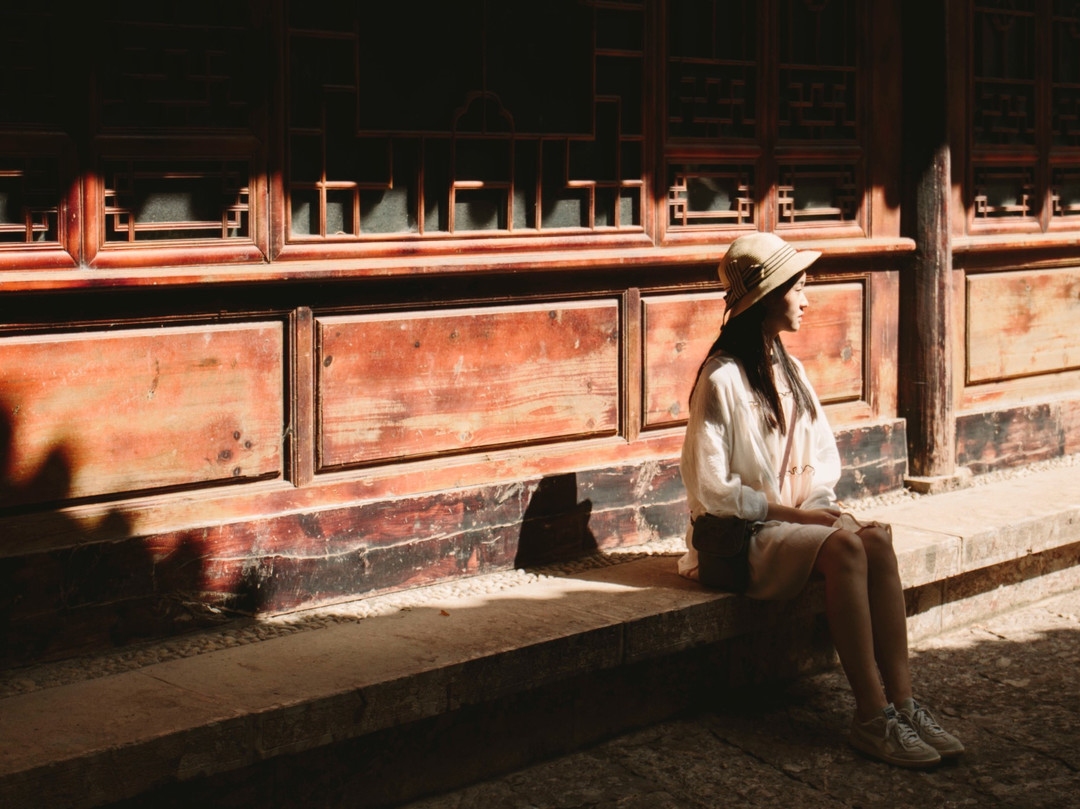
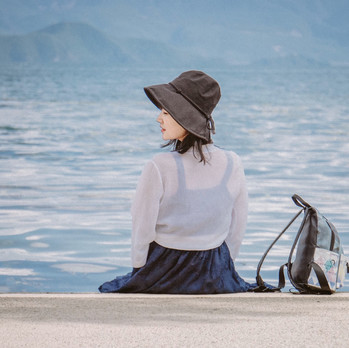
We rested at a bend in the road. The distant lake surface seemed frozen under the midday sun, the silence so complete that even birds were quiet. We sat under a tree, thinking of nothing. This moment was enough. Later, a group of middle-aged hikers came up and sat nearby. Cong muttered that she hoped she'd still be traveling like that when she was old – her mental age was still that of a child.
The view at the next bend took my breath away. Standing before the lake, words failed me. I could only repeat: "Isn't this too beautiful?" But the midday light was too harsh for good photos. The camera made faces look dark, but the iPhone's portrait mode worked wonderfully.
Passing Xiǎoluòshuǐ, we saw the statue marking the border between Sichuan and Yunnan – we'd crossed two provinces in one day. Beyond Xiǎoluòshuǐ, the road flattened, and the lakeside highway was stunning. At another bend, we saw a flock of sheep moving nimbly along the rocky mountainside. Cong asked, "Why can these sheep walk on the mountain?" I replied, "Because they're 'mountain sheep' (shānyáng, a pun on the word for goat)." Cong said, "Wow, that makes so much sense. I'm almost convinced." I was almost convincing myself.
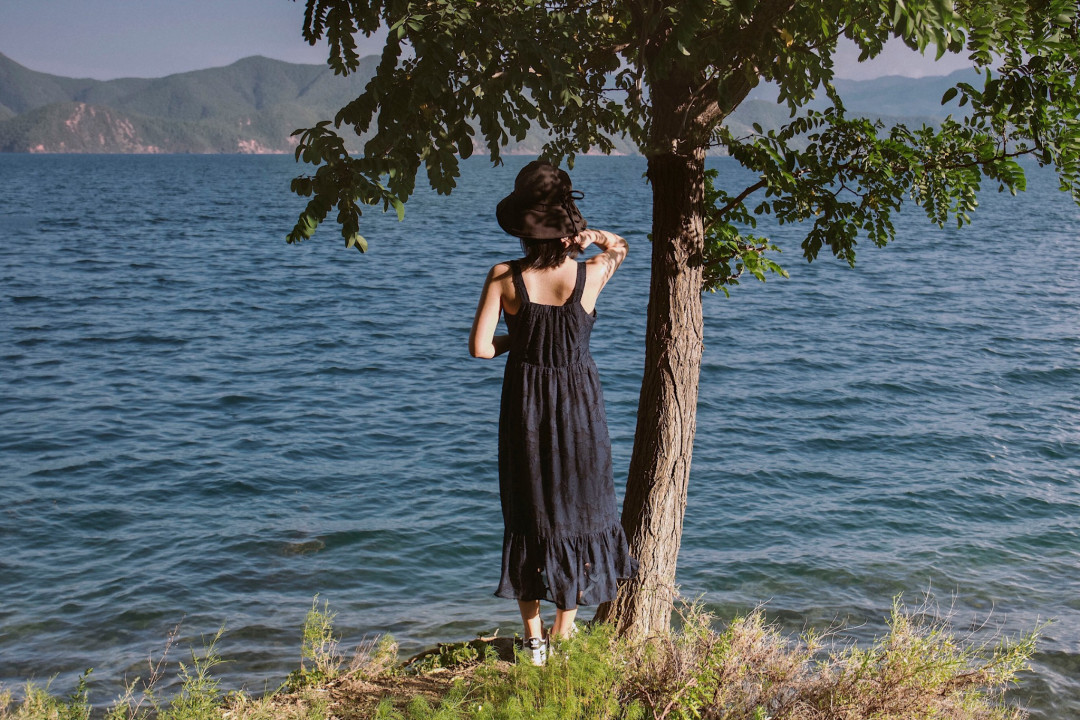
As the sun set, the light was beautiful. Yiyi stood on a rock, reminding me of the mermaid princess in Andersen's fairy tales, gazing out at the sea. A tree grew by the lake, perfect for portraits. At another bend, we encountered a passing horse team – the sound of hooves, bells, and lapping water formed a symphony of humans and nature.
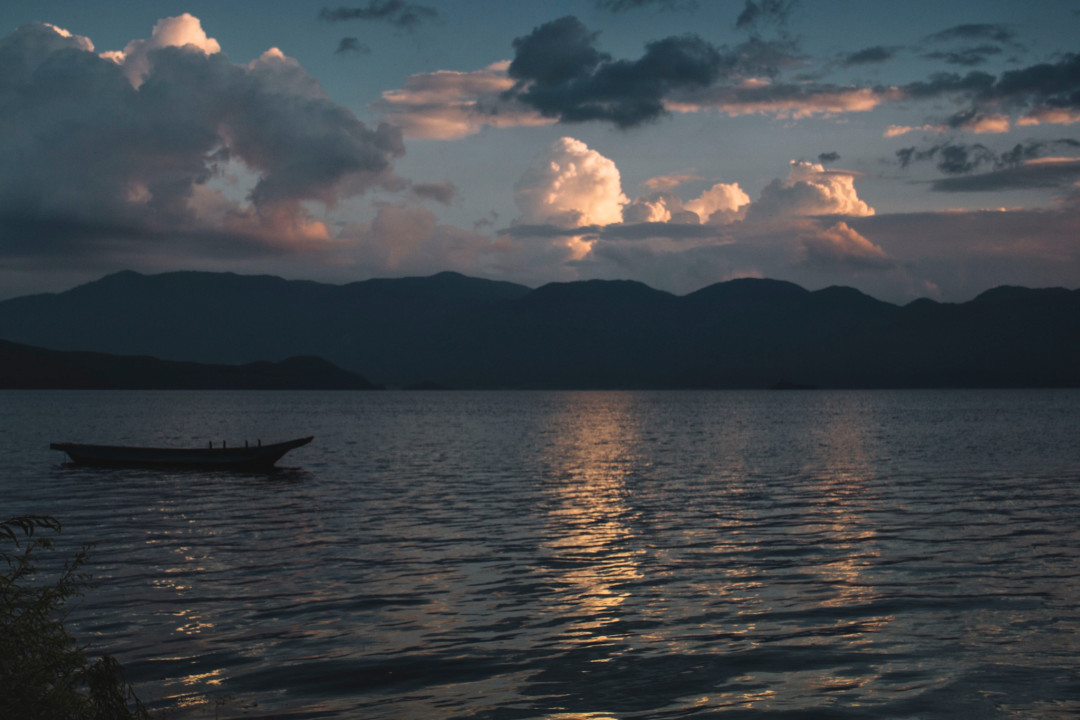
When we reached Dázǔ Pier, the sunset was nearly gone. The sun was blocked by Gémi Goddess Mountain. The hostel owner said it was a shame, but I found it beautiful – light streamed through the clouds like an army charging forth. Pink clouds reflected on the lake, small boats drifting with the wind. We took photo after photo, reluctant to leave.
Daluoshui: The Last Stop Before Commercialization

As darkness fully set in, we finally got a car and arrived at our booked "On the Road" guesthouse around 8 p.m. Since discovering the joy of the youth hostel, we'd switched to hostels – mainly because we were broke.
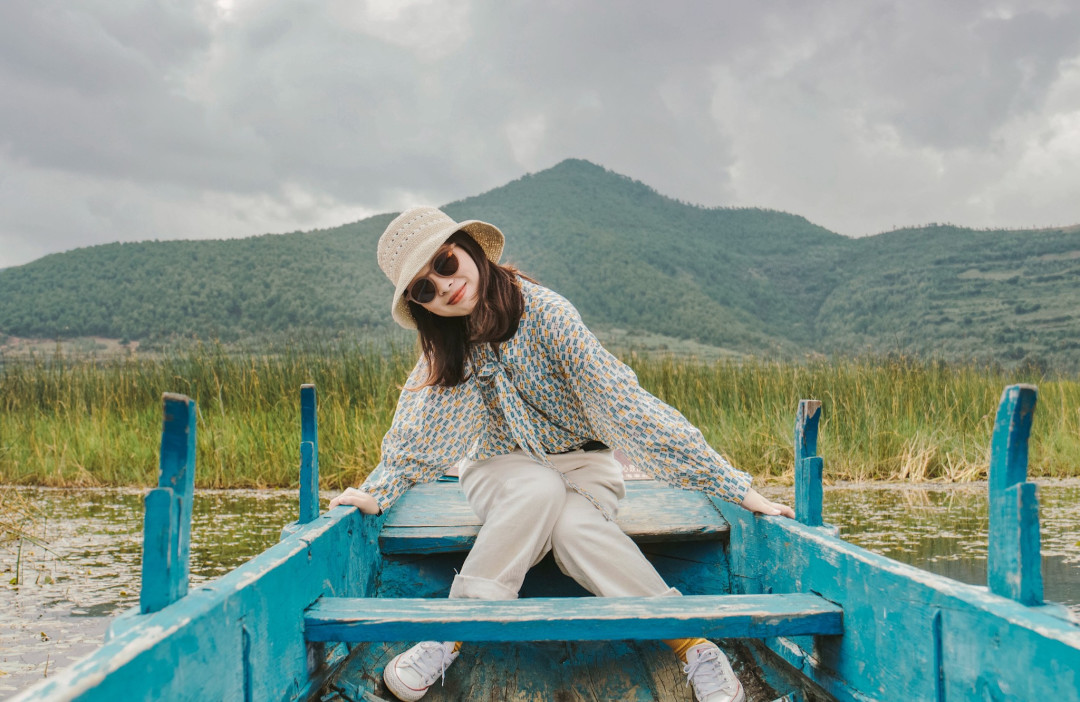
The "On the Road" guesthouse had a back door leading to the lake, but the raised water had flooded the lakeside path. I noticed an interesting pattern: pet dogs can measure a tourist spot's commercialization. In Goddess Bay and Lǐgé, dogs were rare. In Dàluòshuǐ – the largest and earliest developed town on Lugu Lake – guesthouses started keeping dogs. A high-society poodle lounged lazily at the door.
We planned to watch the sunrise the next morning, then take a bus to Lijiang. Unfortunately, it was another cloudy day. We hadn't pre-booked tickets, and by the time we bought them that day, only afternoon buses were available. The guesthouse owner helped us contact a driver she knew – a medium-sized minibus. The standard rate was 100 yuan per person; she got us a 10-yuan discount. But the bus wouldn't leave until 11 a.m., and it was only 8 a.m. – we had to kill time at the guesthouse.
We wandered the yard, took photos, swung on the swing, went back to the room to listen to music. Cong and Yiyi lay around chatting about their favorite novels, doing nothing while waiting for the bus. At 11:30, the bus finally arrived. The route to Lijiang passed the side of the lake we hadn't visited. When we gasped at the scenery near Sānjiā Village, the young driver proactively stopped to let us take photos – proof that you should find a young driver.
Stop Two: Lijiang – The Old Town, Shuhe, and That Road Not Worth Taking

Dayan Ancient Town: Overlooking from Lion Hill and Paper Umbrellas in the Alleys
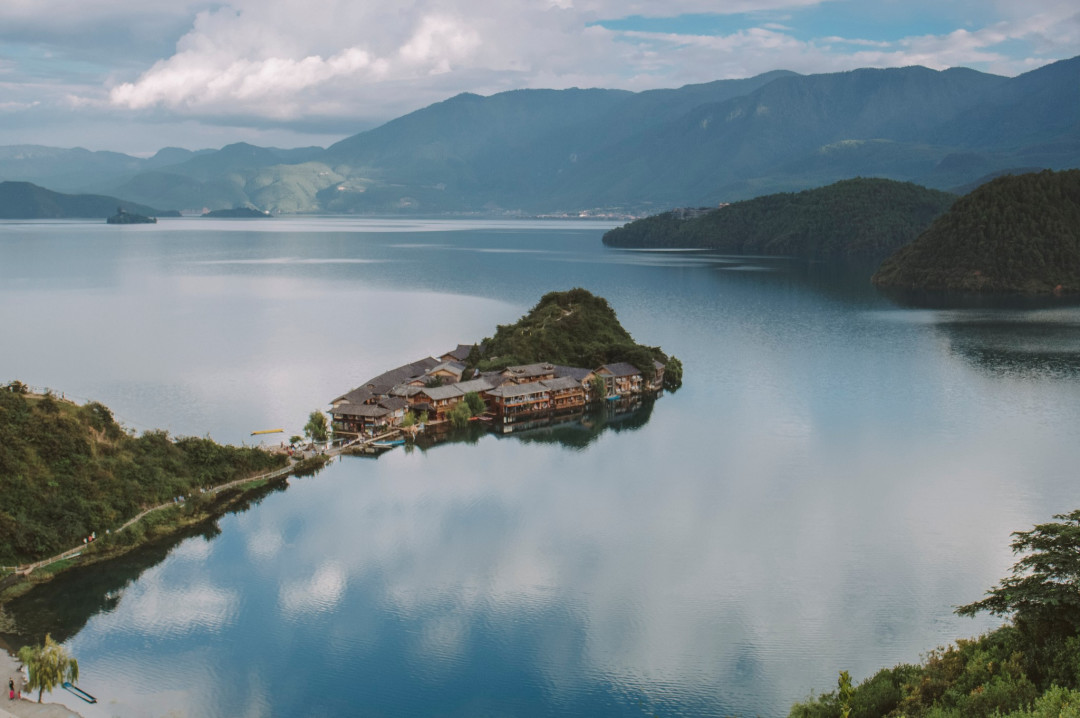
On the afternoon of the fifth day, we arrived at Lijiang Old Town. To overlook the town, we booked a room at Yuègǔlóu Guesthouse, halfway up Lion Hill, 188 yuan per night. The three of us dragged our luggage along the cobblestone paths, twisting and turning, climbing to the highest point then descending a bit – exhausted, but the view was worth it.
The guesthouse's second floor was a common area with a panoramic view of the entire old town. The room was finely designed, with a 2-meter bed. 188 yuan was a steal. A banana tree grew outside one room's window – such a poetic scene. A bit of rain would have made it even more classical.
What sets Lijiang Old Town apart from others: first, the architecture and streets – grand, majestic, yet delicate; second, the sky – clouds piled up like mountain peaks, framing the whole town. Dongba script was everywhere, cute and mysterious. Paper umbrellas hung in the alleys, far more beautiful than the colorful flags in many other ancient towns.
We took a long detour to try the二哥鸡汤米线 (Second Brother's Chicken Soup Rice Noodles) recommended by Lonely Planet – it was just okay. Bars near Lion Hill advertised "best viewing platforms" for free, but once they led you up, you had to order drinks to take photos – classic old town tricks.
At night, Sìfāng Street was ablaze with lights. Folk singers performed in bars, their voices drifting into the noisy streets. How could you visit Lijiang without experiencing its night atmosphere?
Shuhe Ancient Town: A Lesson Not Worth Learning
On the sixth day, we finally woke up early – but no sunrise. We planned to visit Shuhe Ancient Town in the morning, then head to Dali in the afternoon. A Didi ride to Shuhe cost about 30 yuan. But the driver, whether intentionally or not, took us to the paid entrance, where we were charged 40 yuan each.

Word has it that if you walk in from the outside, Shuhe Ancient Town is free. Once inside, you'd agree it's not worth the ticket. The ticket seller kept repeating, "Student tickets are half price – do you have a student ID?" – perhaps even she recognized the place wasn't worth the fee.
The imitation ancient style was too half-hearted – it looked like every other ancient town in every city. The whole town was deserted, with a bleak, unvisited feel. Its only advantage: with few people, you could take photos without restraint. We set the camera on an electric scooter's seat, used a remote shutter, and did a ten-shot burst.
Disappointed, we left Shuhe. A warning to future travelers: skip it unless absolutely necessary – it's not worth your time, money, or energy. A netizen later suggested that Baisha Ancient Town is the most worthwhile – fewer people, more interesting. Yùhú Village (Xuěsōng Village), at the foot of Jade Dragon Snow Mountain, is also worth a visit. If you have time, these two places are definitely more interesting than Shuhe.
In the End: Three Things Yunnan Taught Me

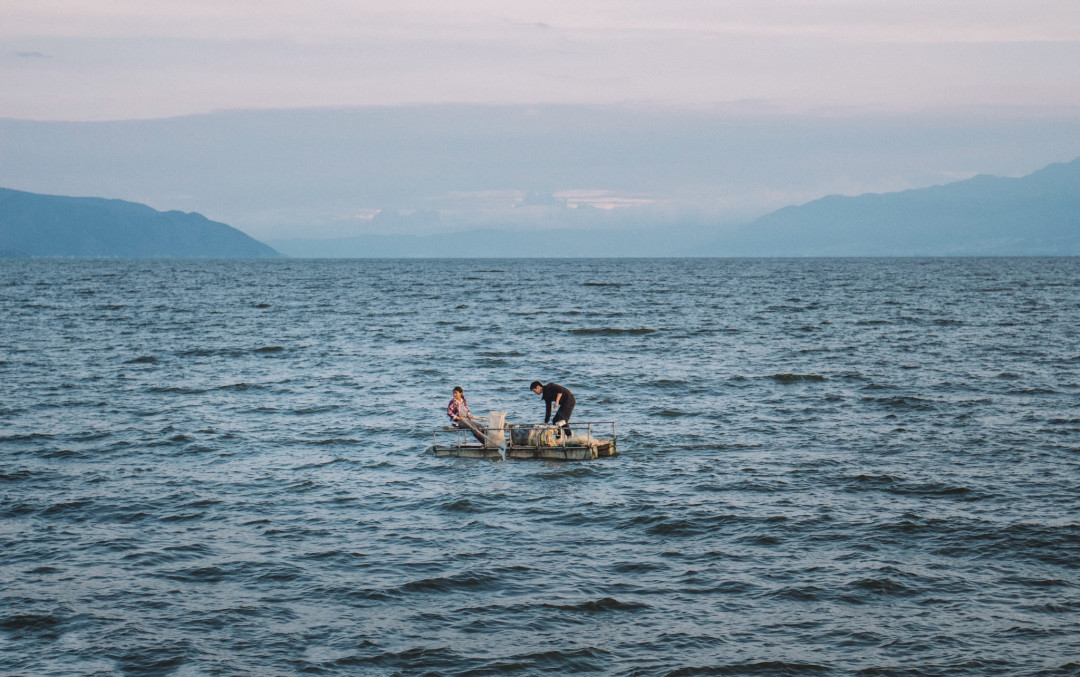

Ten days of travel – from the morning mists of Lugu Lake to the lights of Lijiang, from Dali's Cangshan Mountain to Kunming's train station. The roads we walked, the sights we saw, the people and dogs we met – all became shining fragments of memory.
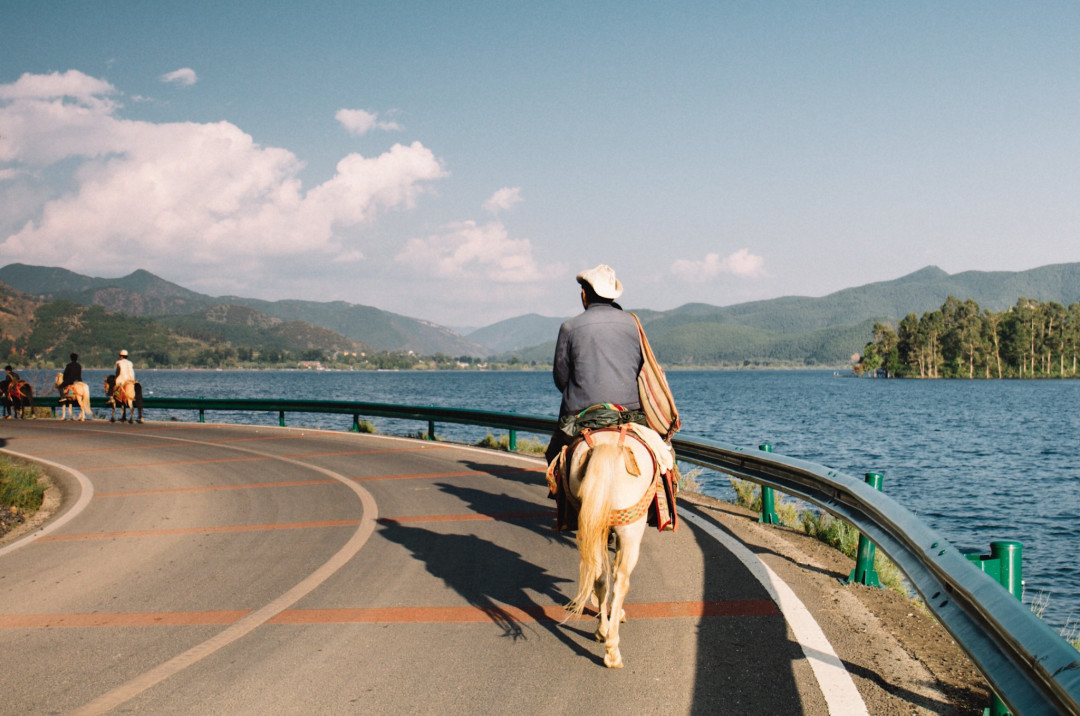
The first thing Yunnan taught me: the beauty of mountains and waters doesn't belong to peak or off-season – it belongs to the four seasons. Lugu Lake on a cloudy day has its quiet stillness; on a sunny day, its bright clarity. Each season has its own charm.
The second thing: the most precious part of travel is often not the scenery itself, but who you share it with. Sitting on the balcony of the Lǐgé youth hostel, listening to Cong read passersby's conversations, the three of us laughing together. On the hiking trail, cracking a silly pun about "mountain sheep." In the guesthouse yard, doing nothing while waiting for the bus, chatting about favorite novels. These moments are more memorable than any tourist attraction.
The third thing: Yunnan really does have a lot of dogs. But those "lucky dogs" lounging at guesthouse doors, restaurant corners, and café steps – in a way, they've become the warmest footnote to this land. Lazy, unhurried, taking things at their own pace – just like Yunnan's rhythm of life.
If you're planning a trip to Yunnan, my advice: bring a Lonely Planet, find a young driver, skip Shuhe, skip the Millennium Grassland, and save time for Baisha and Yùhú Village. And don't forget to stop on the roadside and say hello to those "watchdogs" – they might understand the warmth of this land better than any travel guide.
You should also read:
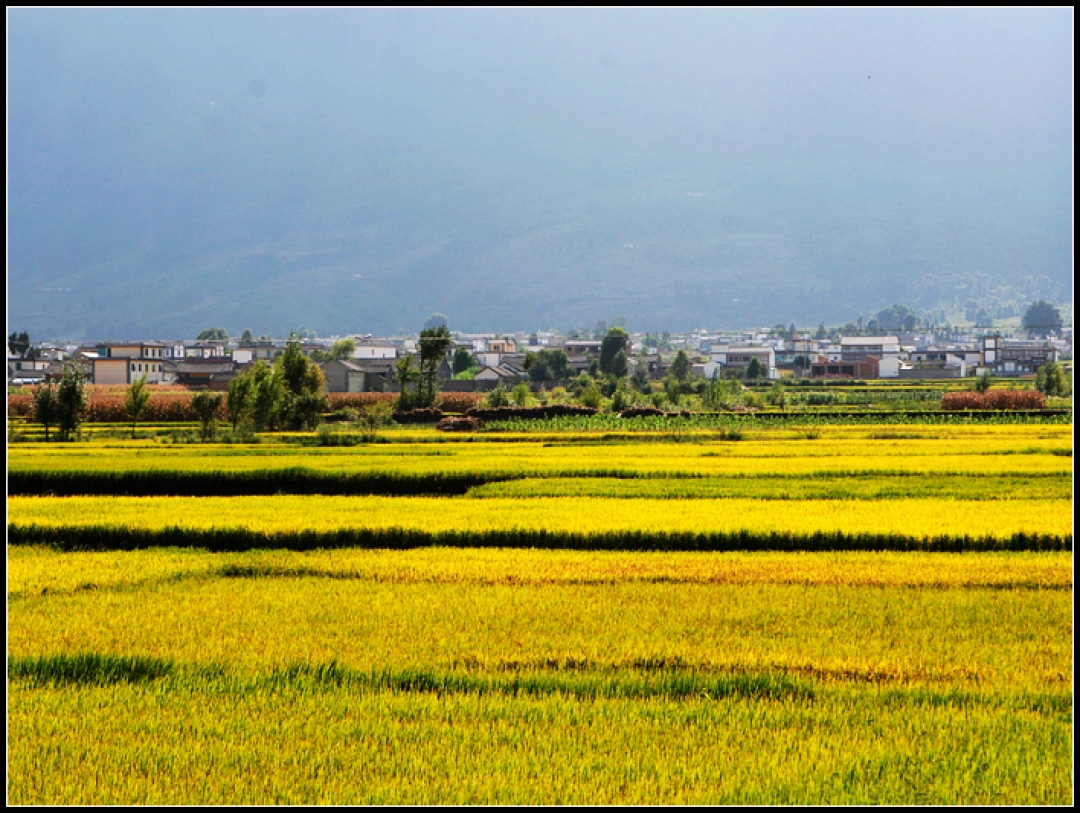
A 9-Day Yunnan Journey: From Lijiang to Dali to Tengchong – A Trip Toward Self-Reconciliation
A 9-Day Yunnan Journey: From Lijiang to Dali to Tengchong – A Trip Toward Self-Reconciliation Some say travel is simply going from a place you're tired of to a place other people are tired of. It stings to hear, but it's painfully true. Yet there's…
Continue reading...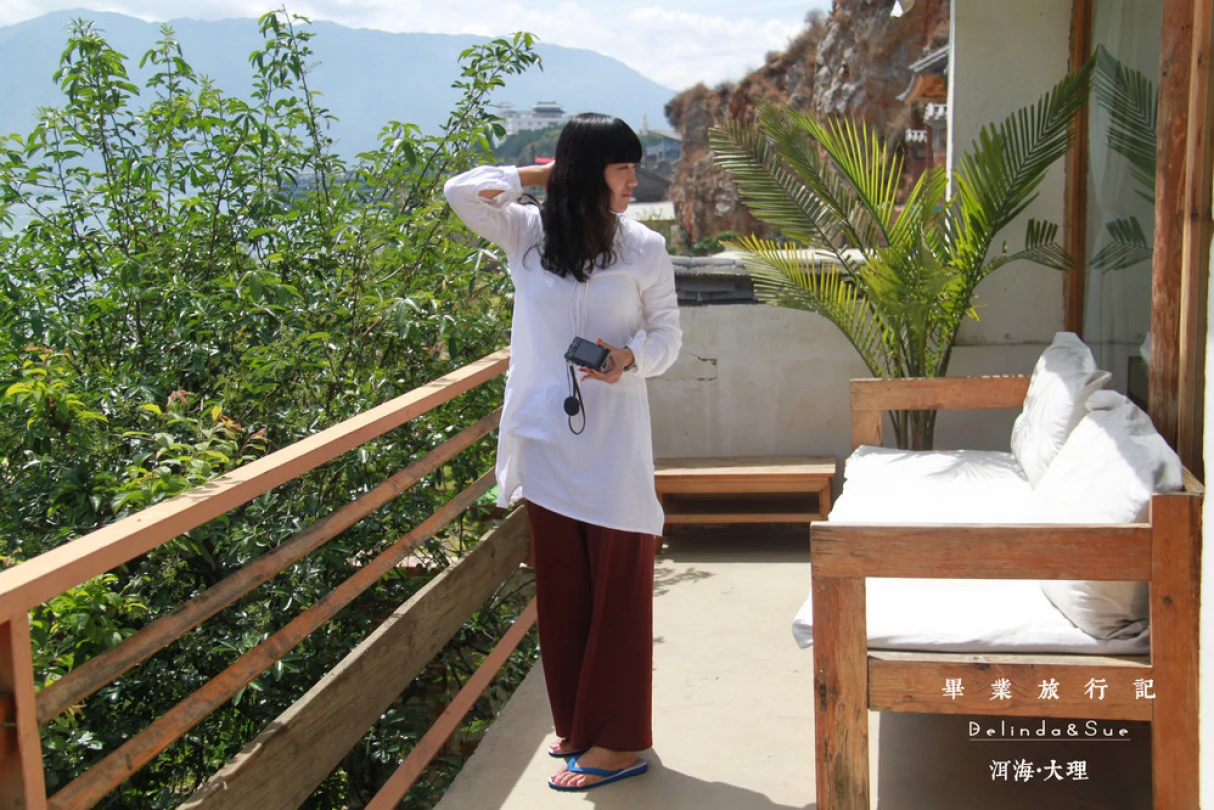
Two Girls' Graduation Trip: Dali and Shuanglang – A Poetic Farewell to Mountains and Sea
Two Girls' Graduation Trip: Dali and Shuanglang – A Poetic Farewell to Mountains and Sea Preface: Catching the Tail of Youth, Heading South During our senior year of college, my roommate and I – two girls studying in Beijing – decided to bid farewell to…
Continue reading...
Cloud Travelogue · Dali of Wind, Flowers, Snow, and Moon: A Three-Day, Two-Night Journey of a Free Spirit
Cloud Travelogue · Dali of Wind, Flowers, Snow, and Moon: A Three-Day, Two-Night Journey of a Free Spirit I am a cultured female foodie with a touch of rogue charm. I slung on my backpack, took my lover's hand, and set off on a spontaneous…
Continue reading...