Stories of a Small Town – A Letter to the Unconventional Ancient City of Jianshui
Stories of a Small Town – A Letter to the Unconventional Ancient City of Jianshui
If you've grown tired of those "fake ancient towns" overrun with tourists and lined with identical souvenir shops selling cheap trinkets from Yiwu, then Jianshui might just restore your faith that truly living ancient towns still exist in China. There are no noisy bar streets here, no cookie-cutter souvenir stores. Instead, you'll find elderly people basking in the sun on cobblestone streets, steaming tofu stalls in narrow alleyways, and ancient wells polished to a gleam by the passage of time.
In January 2018, I packed my backpack and spent three days alone in this small town in southeastern Yunnan. I thought it would be just a transit stop on my way to the Yuanyang Rice Terraces, but it turned out to be the place I least wanted to leave on my entire journey. Jianshui is the kind of secret hideaway you want to keep all to yourself—fresh, elegant, steeped in antiquity, leisurely, and yet brimming with the warmth of everyday life.
Why Jianshui Deserves a Special Trip
Jianshui was historically known as the "Confucian Athens of Southern Yunnan" (滇南邹鲁), where Confucian culture has been deeply rooted for centuries. Fortunately, due to its remote location in southern Yunnan, it escaped much of the warfare and destruction that plagued the region over the past hundred years. The refined, graceful lifestyle of traditional Chinese culture still flows vividly through every corner of the city.
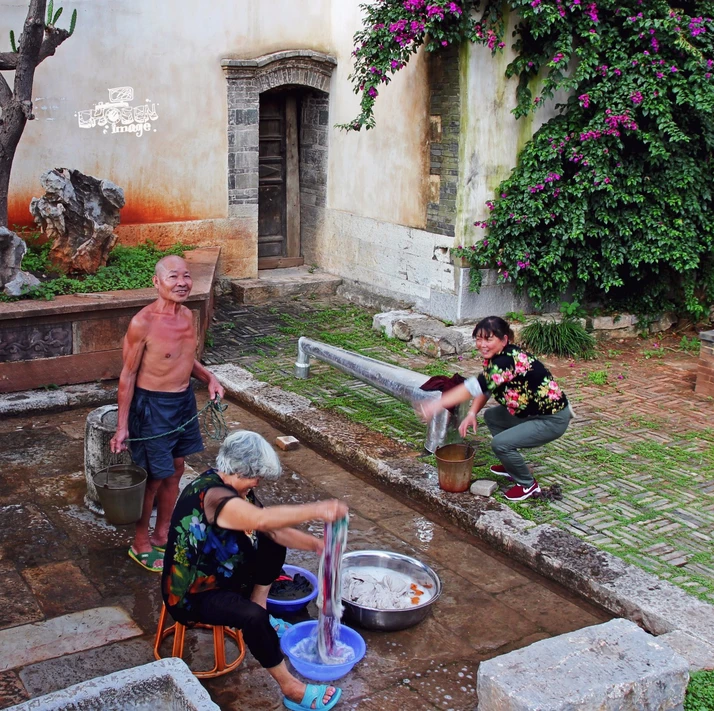
Even more fortunate is that Jianshui has not been reduced to one of those formulaic commercial ancient towns. The residents remain the protagonists of daily life—in the morning, elderly women wash clothes by the ancient wells; in the afternoon, old men play chess and chat on street corners; in the evening, the aroma of home-cooked meals wafts from every household. When tourists arrive, they blend into the city naturally, like an extra member of the community, neither too hot nor too cold, just right.
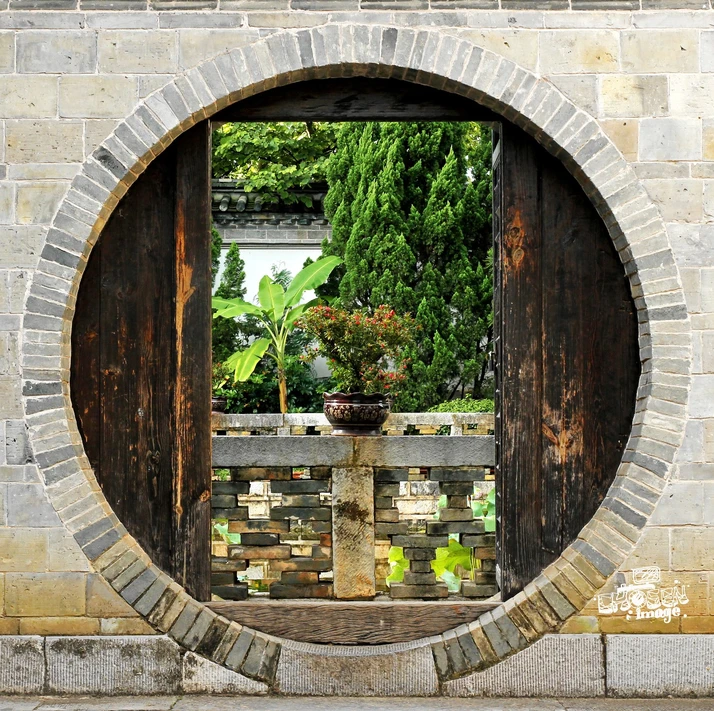
The second-largest Confucius Temple in China and the exquisite private garden of the Zhu Family Garden (朱家花园) are Jianshui's signature attractions. But what truly hooks you are the surprises off the beaten path—cycling to Tuanshan Village (团山村) to see a century-old village, waiting for a sunset that belongs only to you at the Twin Dragon Bridge (双龙桥), or venturing into deep alleys to discover ancient wells of various shapes.
Oh, and I haven't even mentioned Jianshui's rice noodles. How good are they? I ate breakfast at the same small shop three mornings in a row. The second time I arrived in Jianshui at noon, I actually jogged from the east gate of the ancient city to the west gate, afraid I'd miss closing time. Jianshui's barbecue is also legendary—a perfect fusion of northern and southern flavors, with taste that's top-notch but prices that have stayed stuck a decade in the past.
Ancient Charm: An Unexpected Traditional Music Performance
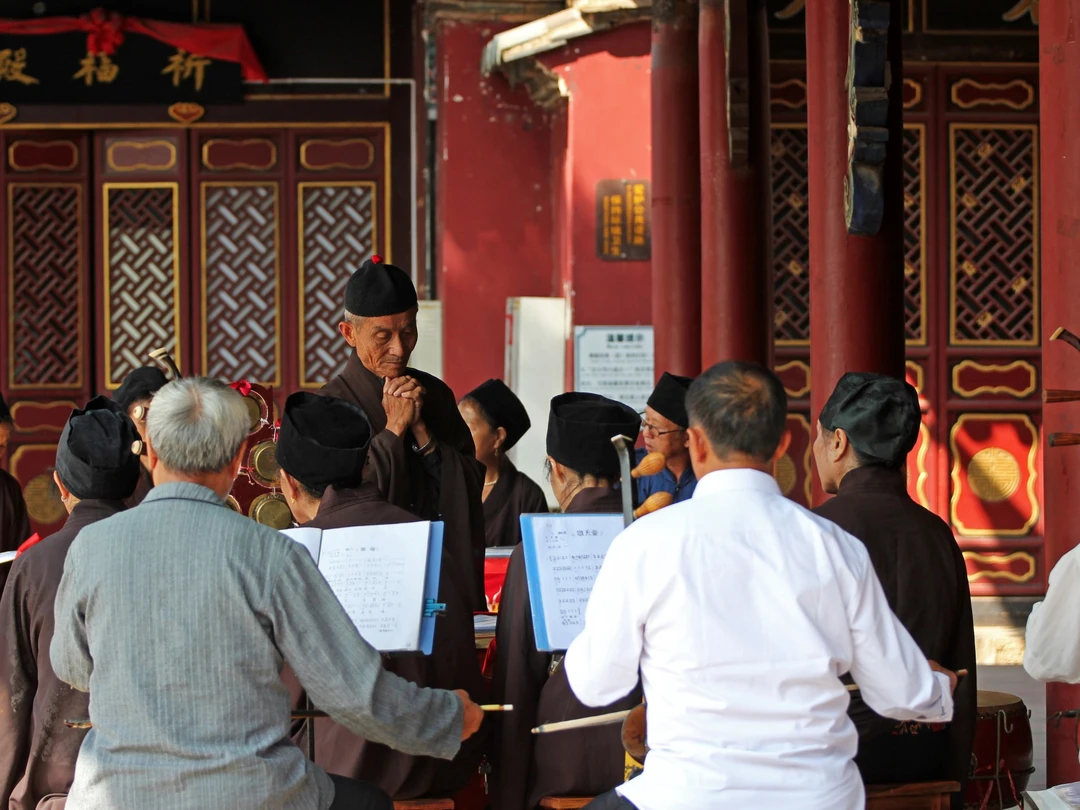
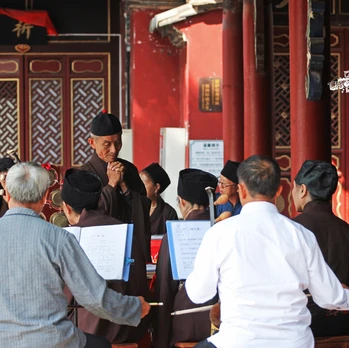
The Confucius Temple in Jianshui offers free traditional music performances every weekend, but only if you buy the expensive entrance ticket. I had given up on it until I passed by the Tianjun Temple (天君庙) on Lin'an Road—a small Taoist shrine.

Following the principle of "never pass up a chance when you're passing by," I wandered in for a look. The temple was tiny, just two courtyards, but in front of the main hall, a crowd of elderly people had gathered with traditional instruments. I tilted my head and noticed a sign on the side door that read "Jianshui Folk Traditional Music Association." My intuition told me luck had arrived.
At ten o'clock sharp, drums and gongs rang out, their sound carrying the solemn authority of religious music. I asked a local man nearby what ceremony this was. He smiled and said it was just some routine Taoist activities, similar to monks chanting sutras. "You city kids probably haven't seen anything like this," he teased.
All the performers were spirited elderly men and women, each with an instrument and a sheet of music, completely focused and meticulous. From a distance, it looked like a full arsenal of musical weapons in action. I had stumbled upon this most authentic, raw performance entirely by chance. These unexpected surprises along the journey are probably why I'm so obsessed with travel.
Faded Glory: The Rise and Fall of the Zhu Family Garden
During the National Day holiday, I was watching the TV drama Nothing Gold Can Stay with my mom. The Wu Family Mansion in the show always reminded me of Jianshui's Zhu Family Garden. The same story of rising from nothing, amassing great wealth, facing multiple confiscations of property, and enduring ups and downs that inevitably lead to decline.
In the off-season of September, the Zhu Family Garden had very few visitors. I wandered around for half an hour before I managed to latch onto a guide. The sparse crowd actually accentuated the sense of historical vicissitude—this kind of garden tour is a rare treat.
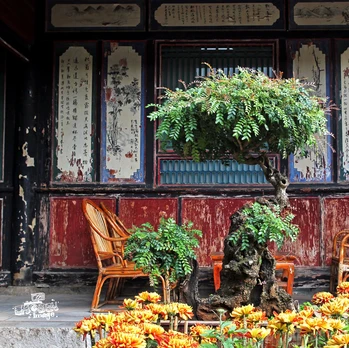
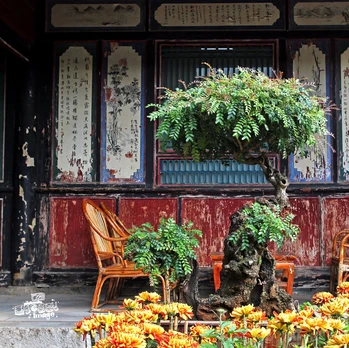
Jianshui's ancient architecture loves to use colorful paintings and calligraphy as decoration, and the Zhu Family Garden, as a prime example, is no exception. But time has eroded many of these paintings, leaving them faded and dilapidated. "Since ancient times, autumn has been a season of solitude and sorrow." The blooming chrysanthemums and the mottled paintings silently tell the story of this family's faded splendor.
Time Frozen: Tuanshan Village's Immortalized Past
If the Zhu Family Garden is like "an old tree blooming anew," then the Imperial Grace Mansion (皇恩府) in Tuanshan Village is a specimen of time frozen.
The owner of the old house is called Teacher Zhang. He now lives in this inherited home with his wife, while their children have moved away to other cities. Except for the ten or so minutes when tour groups visit, this place is as quiet as another world. Teacher Zhang is known as the encyclopedia of Jianshui, but he's a man of few words and doesn't actively engage with the stream of tourists.
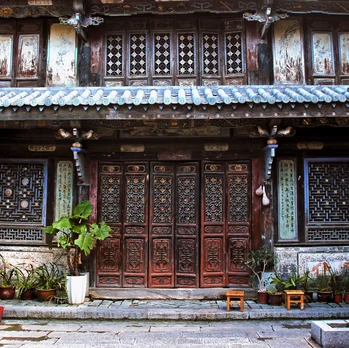
I had done some homework beforehand and asked him about a few characteristics of southern Yunnan's ancient architecture. Seeing that "this kid might actually know something," he brought out a book he had written about the Imperial Grace Mansion and pointed me to the highlights in the backyard. The wooden carvings of the Nine Immortals in the backyard were so lifelike they left a deep impression. Although the Imperial Grace Mansion is far out in a "mountain village," the exquisiteness of its wood and stone carvings rivals any ancient building I've ever visited. The intricate, delicate wooden carvings on the small windows alone must have cost me countless shutter clicks.
Sunset: A Private Memory at Twin Dragon Bridge
The sunset at Twin Dragon Bridge is the kind of beauty that leaves you speechless.
First, take in the seventeen-arch bridge and its three pavilions bathed in the golden light of dusk from a distance—"a long bridge lying across the waves" is the perfect description. Then step onto the polished bluestone slabs and walk to the pavilion at the center of the bridge. The scenery of the Lujiang River unfolds on both sides. A gentle breeze blows, and the copper bells on the eaves let out a crisp, clear chime. Sunset, ancient bridge, bluestone, river breeze, copper bells, old pavilion—this atmosphere is irresistible even to those who aren't passionate about ancient architecture.
What's even more precious is that this place is rarely crowded. I'm grateful that the sunset at Twin Dragon Bridge remains hidden away, and I'm almost selfish enough to hope it stays that way forever.
Craftsmanship: The Purple Pottery Legend of Wanyao Village
Jianshui's purple pottery (紫陶) is famous far and wide, with the main production area located in Wanyao Village (碗窑村), just three kilometers north of the ancient city. It's a five-minute taxi ride from the north gate.
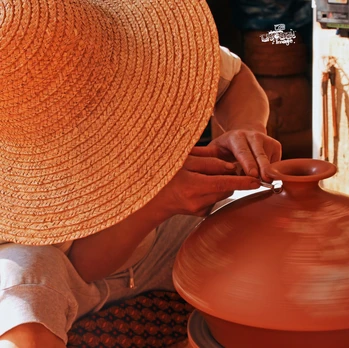
At the entrance to the village, there's a visitor center and some shops selling fine purple pottery. As you walk deeper into the village, almost every household sells purple pottery, and many pieces are of excellent quality. In the back half of the village, you'll find the most famous Shaokang Pottery Workshop (绍康陶艺坊). Visitors are welcome, and you can watch the entire pottery-making process firsthand.
I watched as two lumps of clay, under the hands of a master with the rugged bearing of a Zhang Fei or a Li Kui, were transformed into rudimentary pottery vessels in just ten minutes. As for the techniques of intaglio carving and polishing, those are different skills altogether. Travelers interested in handicrafts should not miss this fantastic place.
Food: Worth a Special Trip for Rice Noodles and Barbecue
Rice Noodles: A Michelin Three-Star Experience
The Michelin three-star standard is "worth a special journey to taste," and I believe Jianshui's rice noodles (米线) meet that criterion.
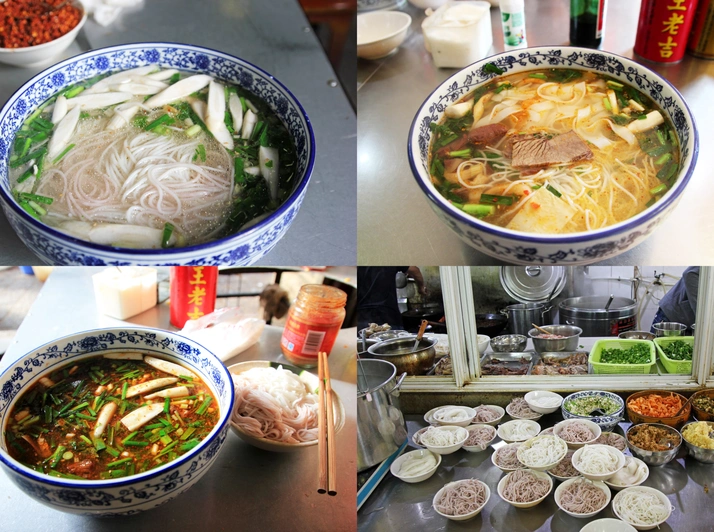
Having tasted my way through half of China, I actually ate breakfast at the same shop in Jianshui for three consecutive days—and it was rice noodles, which I don't even particularly like. That's nothing short of a miracle. The reason for the miracle is simple: they were just too delicious.
No matter which broth base you choose, it's only ten yuan (about $1.40). Don't be fooled by the seemingly bare surface; the real treasures are all at the bottom of the bowl. Grass sprouts (草芽), a local specialty vegetable, taste like a denser, non-spicy scallion—to be honest, I wasn't a huge fan. But the real highlight comes later: thin rice noodles, wide rice noodles, white rice noodles, red rice noodles—all free to add! Blood curd (血旺) and tofu pudding (豆花) are yours to scoop freely—also free! Pickled radish and other side dishes? Help yourself—still free!
The bowls for Jianshui's rice noodles are as big as the soup bowls in northern Chinese homes. As for Mengzi's cross-bridge rice noodles (过桥米线), their bowls are practically the size of my washbasin. In any case, coming to Honghe to taste the best rice noodles should be on your must-do itinerary.
Barbecue: Dominating Half of Yunnan's BBQ Scene
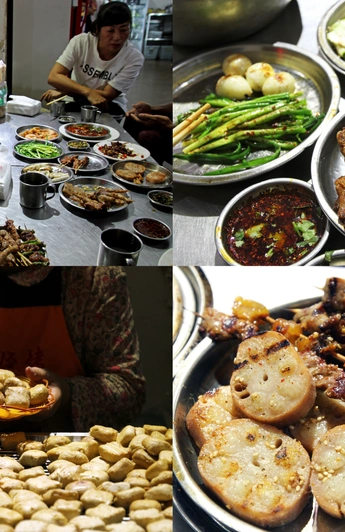
Jianshui's barbecue (烧烤) is said to dominate half of Yunnan's barbecue scene. There are quite a few barbecue stalls in the ancient city, but the quality is average. After watching the sunset at Twin Dragon Bridge, I resolutely walked for 20 minutes to find Ziyang Barbecue (紫阳烧烤), a favorite among locals.
Having plenty of experience eating alone at barbecues in Chongqing, I was no stranger to dining solo. "Boss, just me," I said. Is it strange to eat alone? Why is everyone staring?
Jianshui's grilled tofu (烤豆腐) has already been heavily promoted by A Bite of China. I recommend sitting at the tofu grilling stall if you're in a small group—it creates a great atmosphere. The grilled tofu is handled by an elderly woman. With the rise and fall of her chopsticks, she knows exactly when each piece of tofu is perfectly cooked. For every piece of tofu a person eats, a corn kernel lands in that person's bowl—not a single mistake. This ability to multitask with such calm precision has the air of a martial arts master.
All the meat is delicious, but the small meat skewers (小肉串) are the top recommendation—one yuan each. Southern barbecue prices with northern barbecue portions—excellent value. The sweet version is even more memorable than the spicy one. Grilled chicken feet (烤鸡脚) are also a specialty: first marinated for flavor, then deboned before grilling. It's hard for them not to be good. Among the vegetables, I most recommend grilled small squash (烤小瓜, i.e., zucchini). Who knew it could taste so fresh and elegant when grilled? It's the perfect palate cleanser when you're tired of eating meat.
In short, Jianshui's barbecue offers an incredibly cost-effective dining experience. The shop also serves various insect dishes, but they're not cheap—if you're feeling adventurous, I suggest eating your fill first before taking a look. And don't eat too much. You know what I mean.
Practical Guide: Transportation, Accommodation, and Itinerary
Transportation
- Getting to Jianshui: The best round-trip option from Kunming is by train. It takes about the same time as a bus but costs half as much and is safer. Multiple trains run daily. From the train station, take bus No. 919 to the city center.
- Getting Around: The ancient city and its surroundings are walkable. For Tuanshan Village, take a rural bus from outside the north gate (one per hour). For Wanyao Village, take a bus or taxi. Didi (ride-hailing) is very convenient.
Accommodation
Staying in the ancient city is the most convenient. In September, you can get a clean standard room for around 100 yuan (about $14). The Minkang Inn (民康客栈), recommended by Lonely Planet, is on the main street of the ancient city, with standard rooms starting at just over 40 yuan ($5.60)—incredible value. There are also hostels within the ancient city.
Recommended Itinerary
Day 1: Morning – Eat rice noodles at [Weidao Lin'an] (味道临安) near the west gate → Visit the Big Well (大井) outside the west gate → Walk along Lin'an Road to visit the Confucius Temple, Jianshui County Government Office, Puhua Temple, the Imperial Examination Hall, and Tianjun Temple → Lunch at [Fuji Restaurant] (福籍菜馆) → Afternoon – Visit the [Zhu Family Garden] on Hanlin Street → Chaoyang Tower → Yinghui Road → Lin'an Station → Dinner, then enjoy the night view of Chaoyang Tower.
Day 2: Morning – Visit Wanyao Village to see purple pottery craftsmanship → Afternoon – Take the small train or a car to explore Tuanshan Village and Twin Dragon Bridge → Watch the sunset at Twin Dragon Bridge → Jianshui barbecue.
Day 3: Wander the ancient city at your leisure, using the ancient wells as a thread to connect your explorations. If interested, head to Mengzi or Shiping to begin the next leg of your journey.
Must-Eat List

- Weidao Lin'an Rice Noodles (West Gate): Ten yuan per bowl, all toppings free. Full marks.
- Ziyang Barbecue (near Guangci Lake, in the residential area): Every dish is a winner. Full marks.
- Papaya Old Shop (木瓜老店): Yogurt with purple rice milk, sweet fermented rice wine, papaya water (木瓜水). Excellent value.
- Grilled Tofu: Available everywhere on the streets. The key is the dipping sauce.
Final Thoughts
Jianshui is the kind of ancient city where you check in and never want to leave. This isn't just my opinion—it's the almost unanimous verdict of every traveler I met in southeastern Yunnan.
From the delicious rice noodles and barbecue to the ancient architecture of the Zhu Family Garden and Tuanshan Village; from the sunset at Twin Dragon Bridge to the chance encounter with a traditional music performance; from the joy of searching for ancient wells to the craftsmanship of the purple pottery workshops—Jianshui shows you, in its own way, what a truly "living" ancient city looks like.
If you're also looking for a place where you can slow down, quiet your mind, and settle in, then go to Jianshui. Go before too many people discover it. Go while it's still that fresh, elegant, and leisurely small town.
You should also read:
24 Days, 1400 Yuan: A Solo Journey Along the Sichuan-Yunnan Route, Trading Stories for Scenery
24 Days, 1400 Yuan: A Solo Journey Along the Sichuan-Yunnan Route, Trading Stories for Scenery Setting Out, Not to Escape, but to Find Myself The year I graduated from university, I did two "crazy" things: I quit my job, and I set off on a…
Continue reading...
2012, Conquering Lugu Lake and Lijiang: A World of Azure and a City of Splendor
2012, Conquering Lugu Lake and Lijiang: A World of Azure and a City of Splendor Prologue: Three Guys on a Youthful Expedition Just after the May Day holiday in 2012, my buddies Hui Ge, Xiao Chen, and I—three strapping young men—shouldered our backpacks and set…
Continue reading...
Before the Tongue: Discovering Nuodeng, the Ancient Salt Town Time Forgot
Before the Tongue: Discovering Nuodeng, the Ancient Salt Town Time Forgot There’s a peculiar magic in places that have been left behind by history. They don’t try to impress you. They don’t have polished welcome centers or laminated maps. They just are—worn, quiet, and utterly…
Continue reading...