Strolling Among the Clouds: Gathering Autumn's Light on the Western Sichuan Plateau
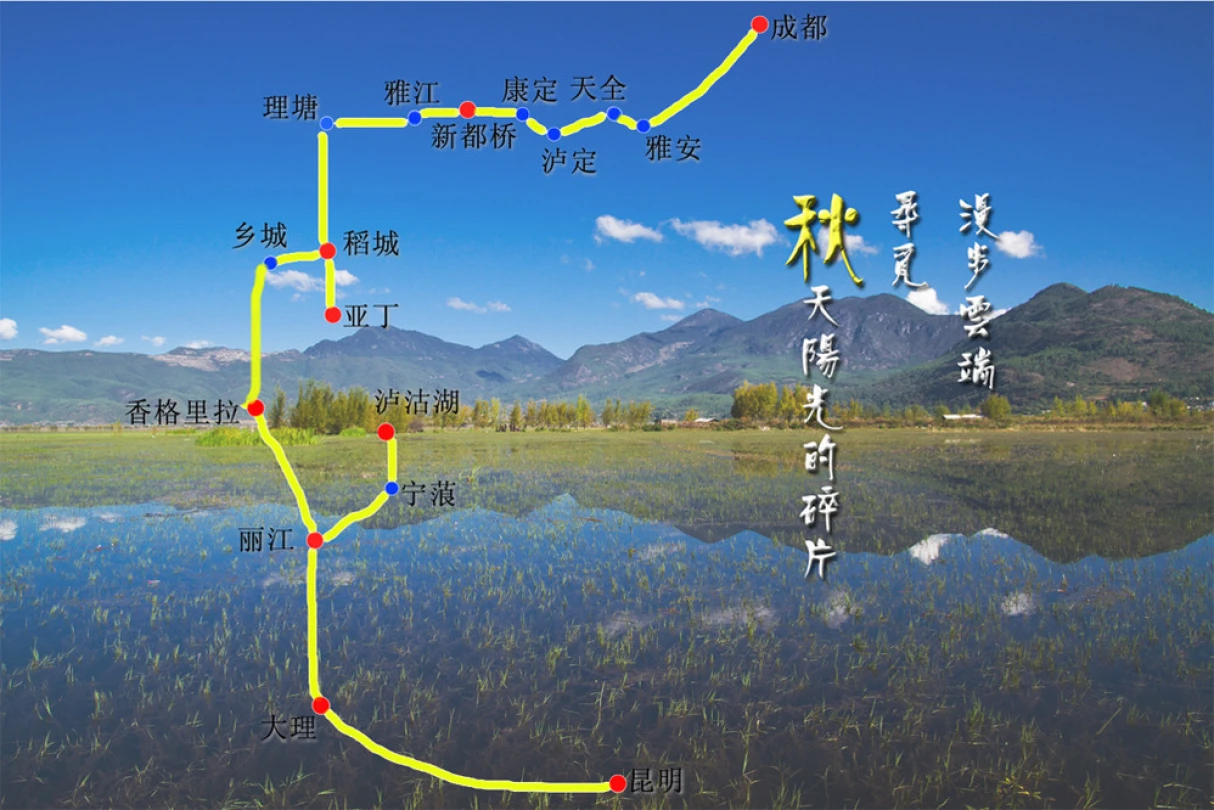
Strolling Among the Clouds: Gathering Autumn's Light on the Western Sichuan Plateau
Prologue: A Sun Chaser's Journey
Autumn sunlight is like a gentle painter, using golden brushstrokes to smear the last traces of warmth across the earth. It slips through the gaps between your fingers, shattering into dappled patches of light and shadow that scatter deep into the recesses of memory. I once grew irritable at the midsummer chorus of frogs, but when autumn arrived, I learned to make peace with the past. When the poplar leaves began to dance under the spotlight of the sun, I knew it was time to set out—to the highlands, to a place closer to the sun, to let myself shine brilliantly in this sea of gold.
Last autumn, a group of friends and I bounced along the Sichuan-Tibet Southern and Northern Routes, arriving back in Xinduqiao in early November—exhausted but overjoyed. At that time, the sky was thick with clouds, everything was withering, and we could only sigh in disappointment. But it was precisely that regret that planted the seed for a return visit to Western Sichuan. In October 2011, when the golden autumn arrived as promised, I set foot on this land once again with an unshakable determination.
Chapter One: Return to Xinduqiao—A Fairy Tale of Light and Shadow
From Guangzhou to Kangding: A Long Journey
As the plane took off from Guangzhou, the sea of clouds outside the window churned in the twilight. Bored, I flipped through the newspaper, scanning from the headlines to the classifieds, then fidgeted with the in-flight magazine, eagerly waiting for the flight attendant to wheel the coffee cart by. My travel companion, Fang, was perfectly at ease. He had pulled his baseball cap low, leaned against the seat, and was fast asleep—those usually darting eyes of his nowhere to be seen.
When we landed at Chengdu Shuangliu Airport, I immediately spotted the towering figure of our friend Dadong. This old pal had already arranged everything for us—food, lodging, and transportation—and had come all the way from Guang'an to pick us up. This sudden burst of enthusiasm almost moved us to tears.
After a brief overnight stay in the Land of Abundance, we caught the first bus from the Chengdu Tourist Distribution Center to Kangding (departing at 7:10 AM) the next morning. The road conditions on the Southern Sichuan-Tibet Highway (G318) were decent, but the scenery was unremarkable, which gave us the perfect excuse to sleep like logs. Around 2:30 PM, we arrived in Kangding. The station was packed with various cars offering shared rides to Xinduqiao for 30-40 yuan per person. We splurged 120 yuan on a taxi and headed straight for our first destination.
Not long after crossing Zheduo Mountain, sunlight suddenly broke through the clouds and poured down. The gloomy mood that had accompanied us the entire way instantly lifted. I quickly asked the driver to stop and took the first photo of the trip.
Yak Inn: Reunion and First Encounter
At 5:30 PM, we arrived at Yak Inn. I immediately recognized July standing at the entrance—the "branch leader" of Xinduqiao on Mafengwo. I had seen her portraits online before and was amazed, though I had my doubts. Seeing her in person, I was convinced the photos needed no Photoshop. And the innkeeper's good looks were as bright as the day's sunshine.
With July's enthusiastic help, we quickly settled in and then rushed out into the world outside. As the sun set, the fields and hills of Xinduqiao were dappled with light and shadow. We were like clay pigeon shooters, aiming our lenses at every patch of light we could find.
The beauty of Xinduqiao is understated and delicate. Flat farmland, rolling hills, scattered groves, solitary Tibetan houses, or grand estates—everything looks like a fairy-tale world built from building blocks. Passing by an unfamiliar doorstep, a young girl in simple clothes cast a shy glance at me before quickly lowering her eyes. I pretended nothing had happened and continued walking at a leisurely pace, but my heart had already skipped a beat.
An Unexpected Snowfall and Regrets
That evening, Fang was still buzzing with energy and dragged me out with his 400mm telephoto lens to photograph the moon. But after scouring every corner around the inn, the moon was nowhere to be found. Who ever heard of going to Xinduqiao to shoot the moon? Such an outlandish idea was bound to backfire.
A heavy snowfall in the dead of night completely dashed our plans to watch the sunrise or ride bicycles in Xinduqiao. The next morning, the world was covered in a blanket of silver. Deep snow piled up in front of Yak Inn. Travelers planning to head west crowded at the entrance—some threw their hands up in despair, others wore long faces.
After much hesitation, we called the driver from yesterday and asked him to take us to Tagong. The 30-kilometer trip cost 60 yuan round trip—a fair price. The driver wore his Tibetan-style wide-brimmed hat perfectly straight, which immediately put us at ease.
Outside the window, the sky and earth were a seamless expanse of white. Approaching the river valley before Tagong, the icy landscape sent two Southerners into a frenzy of joy. Fang and I usually don't like having our pictures taken, but this time he insisted on capturing his face—frozen red with a hint of purple—in a photo. Using my ultra-wide-angle lens, I squeezed him to the edge of the frame, leaving plenty of room for the snowy riverbank and distant snow-capped mountains.
We trudged through the snow on the riverbank, testing the waterproofing of our hiking boots while stuffing as much snow as possible into the frame. At that moment, I almost lost control of my emotions and wanted to lie down on the snow and never get up.
When we saw Tagong Monastery, we calmed down. We had been here last year, so we had no special plans this time. The driver offered to take us in for a look, and we couldn't refuse.
By noon, we were back in Xinduqiao. After the snow, the sky had cleared, and the sunlight gently licked the snow-covered ground. We returned to our room to rest. In this light and leisurely place, there was no need to rush. Lying in bed, I felt a bit restless. A ray of sunlight slipped through the crack in the small window, teasing the glasses, watch, and water bottle on the table, occasionally bothering Fang as well. But he remained unfazed, his snoring rising and falling as usual.
By the time we yawned and stepped out of the inn, the clouds had already gathered in the sky, faithfully guarding the sun. We exchanged a look of disappointment, and a life motto was born:
If you like a photographer, send him to Xinduqiao. (Let him melt happily in the sun.) If you hate a photographer, send him to Xinduqiao. (Let him suffer miserably under the clouds.)
We wandered aimlessly in the direction of Juli Monastery, mostly keeping our exposed body parts tucked into our clothes. At the big bend in Waze Township, a poplar grove and a small stream kept us crouched for over an hour, but we accomplished nothing. As we retreated, I vented my frustration by randomly pressing the shutter—and accidentally "hit" a girl in red.
Back at the inn, we still had plenty of time. We huddled in a corner of the bar, too lazy to chat, ignoring each other. The atmosphere was gloomy. A young man from Xi'an at the next table was explaining why he had chosen to cycle the Sichuan-Tibet Highway alone: "It's very straightforward. I got dumped. On October 1st, I got dumped. On October 2nd, I bought a bicycle. On October 3rd, I started my westward journey." I felt embarrassed to look at him—I had bought a ticket days in advance and arrived comfortably by bus. Who was I compared to him?
A guy named Sun from Shanghai, along with his girlfriend, came over to our table and started talking endlessly about Wolf Totem, the meaning of travel, and the essence of life. Fang kept looking at me, and I kept looking at the ground, searching for a crack to disappear into. We wanted to share a ride with Sun to Daocheng, but he was already suffering from headaches and chest tightness in Xinduqiao. I suggested they go to Danba instead: "The road conditions are good, the altitude is low, and the scenery is stunning."
That evening, we kept muttering about the weather and finally reached a consensus: if it was sunny tomorrow, we would execute Plan A and stay in Xinduqiao; otherwise, Plan B—head to Daocheng!
Chapter Two: The Bumpy Road to Daocheng—A Frustrating Journey
Failed Hitchhiking and a Rip-Off Ride
On the fourth day, we both woke up early and instinctively looked out the window, stretching our necks as far as they would go. The sky was as pale as a sheet of paper, highlighting the silent poplar trees swaying in the breeze. Without making eye contact, we bent down, packed our bags, and silently began implementing Plan B. We even packed away the two pieces of advice from July, the innkeeper: the beauty of Xinduqiao isn't on the flat ground—you need a telephoto lens to sweep the high vantage points; the back hill offers a stunning cold sunrise, while the front hill offers a romantic sunset. And a whole bunch of photography tips would be brought back untouched.
No regrets. In life, nine out of ten things don't go as planned. It's been that way ever since monkeys evolved into humans. Besides, this wouldn't be our last trip to Western Sichuan.
At 7:30 AM, we walked to the nearest highway. From this moment on, countless buses from Kangding to Daocheng would pass by. We guessed we could flag one down within an hour. But no matter how we stuck out our thumbs, stretched out our arms, or even lay down on the road, all the buses either roared past with contempt or cruised by with disdain. We could only flip them off from behind.
Later, we gave up on the idea of getting a direct bus to Daocheng and begged every vehicle heading to Litang, Batang, Xiangcheng, or Derong to stop. But luck was not on our side. After 8:30 AM, a solo traveler coming from the opposite direction told us: "The long-distance buses to Daocheng all leave Kangding around 6 AM. They've pretty much all passed by now."
I walked over to a big tree, vented my frustration, then returned to the roadside, standing there foolishly, gesturing with my hands and muttering to myself: "What's wrong with my hitchhiking technique?" Fang said, "Damn it! Try lifting your skirt. Maybe that'll work."
Shared ride! Heaven never seals off all exits! We flagged down a Chang'an minivan and asked the driver to take us to town where we could find a ride. And so began a full day of frustrating adventures.
The driver told us to wait, then came back and said there was a car—250 yuan per person! Fine, as long as we could get to Daocheng, that was all we wanted. We were handed over to another Tibetan driver, who was busy on top of his car, shouting "Litang, Litang, Daocheng!" while swiftly tying down luggage.
When he came down, he asked, "Where did you come from?" We replied, "Just up ahead, Waze Township." The Tibetan driver put on a righteous face: "We've been cheated by him—pointing to the driver who sold us out! I should charge you 500 yuan, but he already took 160 from me, saying it was the fare to bring you from Kangding!"
Fang's temples bulged with anger. The sky over Xinduqiao was still overcast.
12 Hours in a "Sardine Can"
By the time the car actually started moving, it was 10:30 AM. A Chang'an minivan carrying eight people! From Xinduqiao to Daocheng, it would take 12 hours.
Outside, the entire section of G318 from Xinduqiao to Litang was under construction. What's a road under repair in Sichuan like? Use your imagination—I won't describe it. Every few hours, a snow-capped mountain would sway past: Gao'ersi, Jianziwan, Kazila... The sky had cleared, but the snow was still accumulating. The proud, cold mountains cast ever-lengthening shadows in the sunlight.
Inside, the only two Han Chinese were squeezed into the back row. Fang spread his arms and braced himself against the seatbacks in front, occasionally freeing one hand to relax. Even so, his bald head kept banging against the window with a thud. It was hot, and we wanted to take off our clothes, but there was no space in the van. When Fang stood up and curled into a ball, I could take off my left sleeve; conversely, when I stood up, he could take off his right sleeve.
Our faces were grim, and we barely spoke. Suddenly, a Tibetan guy next to us pulled a shiny foot-long knife from his waistband. Fang and I closed our eyes, tilted our heads back slightly, putting on a brave face. When we opened our eyes, we saw he had just peeled an apple. Then he tossed the apple into the air, and the "wolf-fearing" knife traced a few arcs, splitting the apple into several pieces.
At 6:30 PM, we arrived in Litang. Except for the two of us fools, everyone else got off. The driver said, "We're not going any further tonight. You can either stay here for the night or pay an extra 100 yuan for another driver to take you to Daocheng." We were prepared for this: no matter how late it was or what it cost, we had to reach Daocheng today!
After 12 hours, being deceived by three drivers, and spending 600 yuan, we finally arrived in Daocheng Town around 10 PM. We struggled to get out of the car, reassembling our 206 bones, grateful that not a single screw had come loose. Then we stood by the roadside, looking around. The night was quiet, and we had no idea where to go.
A white minivan silently pulled up in front of us. The driver leaned out and asked, "Need a ride?" Painted on the side of the van were the words "Daocheng Mama International Youth Hostel." Oh, Daocheng Mama! We'd heard of it—it had a good reputation. We got in, knowing this was the hostel's free shuttle.
Daocheng Mama and First Glimpse of Yading
Soon, we arrived at the hostel. The reception area wasn't big, but it was packed with people—groups, couples, individuals, some talking, some drinking, some silent. The décor was casual and a bit messy. A fireplace burned by the entrance, where a few dogs and people were warming themselves together. A little monkey was tied up in the middle of the room, jumping around—behaving well with men but putting on a show for women. When the owner saw me smoking, he asked sternly, "First time here?" I said yes. He said, "Put out that cigarette!" I thought it was a no-smoking policy, so I obediently walked to the door, stubbed it out, and tossed it. Fang told me the owner was worried about altitude sickness. Oh! Should I go back and pick up the cigarette butt?
That night, at an altitude of 3,700 meters, Fang and I breathed steadily and snored evenly as we fell asleep. Whether we dreamed of Yading's three sacred mountains and three holy lakes, I can't say for sure.
The next morning at 8:30 AM, with the help of Daocheng Mama, we shared a ride into Yading (50 yuan per person). We left most of our unnecessary luggage at the hostel. As for Yading, enough people have already heaped praise on it—I don't need to repeat it. Right now, our biggest concern was: would the heavens open up for us?
Along the way, the car made a few routine stops. Even though I knew the scenery was breathtaking, everyone in the car was busy fantasizing about Yading. How could I be the first to shout, "Wow! Beautiful!! Stop!!!" Fang didn't want to either.
Sela—nature could easily use a small mountain town in southwestern Sichuan as its stage and put on a spectacular performance. The gentle breeze provided the accompaniment, the white clouds danced, and the sun provided the lighting. But I had no idea who was responsible for the painting and coloring.
The Chitu River Valley and Gongling Monastery—I took a few steps around the monastery's perimeter, while Fang stood in the shade of the gate to cool off. The religious atmosphere in southwestern Sichuan is far less intense than in the northwest. Last year, the further northwest we went, the more reverent we became—we even kowtowed.
Mount Xiannairi—one of the three sacred mountains that put Yading on the map. I never expected to find such a great angle outside the scenic area. What is a sacred mountain? Is it a snow-capped mountain with religious elements? Is it the dazzling, heart-stopping holy glow of the unreachable, unclimbable white snow under the sunlight? Forget it—the profoundness of Tibetan Buddhism is beyond the comprehension of ordinary folks like us.
Chapter Three: Yading—Bittersweet Beneath the Sacred Mountains
Expensive Lodging and a Powerless Night
Nearly 1 PM, the driver stopped directly in front of a guesthouse in Yading Village. The 320-yuan standard room made our faces turn pale, but we had no choice. Back in Daocheng, someone had warned us: once you enter the Yading scenic area, every step of the way will cost you money. So the night before, we had stocked up on food and drinks in Daocheng, practically cleaning out a small supermarket.
Lunch: a plate of lamb stew with radish, a plate of stir-fried greens with greens, and two bowls of rice—total cost: 87 yuan. Fang and I fought over the lamb in the radish stew, and Fang eventually won, facing the sacred mountain with a pious expression.
We still had plenty of time before heading to the scenic area, so we wandered around the pasture behind the guesthouse. The driver slowly finished his lavish lunch, meticulously picked his teeth clean, and then finally took us to our final destination—Longtongba, the only entrance to Yading's core scenic area.
We followed the classic two-day Yading itinerary: - Day 1: Daocheng → Yading, enter the scenic area in the afternoon, hike Longtongba → Chonggu Monastery → Pearl Lake (Mount Xiannairi), return to lodging. - Day 2: Hike Longtongba → Chonggu Monastery → Luorong Pasture → Milk Lake, Five-Color Lake (Mount Yangmaiyong, Mount Xianuoduoji), return to Daocheng.
From Longtongba, it was a few hundred meters' walk to Zhaguanbeng, where there was a horse station where you could ride majestically up to Chonggu Monastery. But we preferred self-torture, politely declining all the locals who offered to carry our bags. Climbing at nearly 4,000 meters felt like walking on flat ground—though our mouths couldn't keep up with our breathing rhythm, but that's a minor detail.
The clouds over Yading were tightly packed, their shape resembling the involuntary contraction of facial muscles when a person is unhappy. The morning had been so cheerful—what happened, heavens? Fang said, "Maybe we should look at ourselves. Did our personalities crack or did our charm oxidize?"
So the entire afternoon's itinerary left no decent records. Two hours later, we reached Pearl Lake, casually captured a lazy reflection of Mount Xiannairi, and then called it a day. Fang, however, managed to catch a girl in a daze of ecstasy by the sacred mountain and holy lake.
When we returned to the guesthouse in Yading Village, night was slowly falling. A chorus of wailing erupted from inside and outside the guesthouse: No power! No dinner, no lights, no TV, no electric blankets, no hot water!
Fuming, I went to negotiate with the landlady: "Don't you have a contingency plan? Like a generator? For a 300-yuan room, all we get are two bed boards?" The landlady replied politely, appropriately, and gently: "Don't talk about 300 yuan. During Golden Week, it's 800 yuan, and it's the same!" I was speechless. I turned to look for Fang to back me up, but he was banging his head against a pillar and had passed out.
That night, after devouring a feast of cold-water-soaked instant noodles, we lay down in our clothes, comforted by the gentle breeze that slipped through the window cracks and bypassed the snow-capped mountains. In the vast darkness, as if the 2012 apocalypse had arrived early, our hearts surged with emotion and our minds wandered endlessly.
Yading Day Two: Sunlight and Regret Intertwined
The second day in Yading started with a repeat of yesterday's route, heading up to Chonggu Meadow. The weather in the morning was unpredictable—sometimes good, sometimes bad. Fang and I were dizzy with the effort, spending more time chasing sunlight than pressing the shutter. I said, "This is exhilarating!" Fang said, "This is damn exhilarating!"
The mountain was covered in dazzling yellow pine trees. We had a heated debate about this: Fang believed it was due to lack of water, nutrients, and oxygen, while I thought it was a special variety. Later, Baidu told us: these were Sichuan larches!
Prayer flags—the most spectacular I had seen on this trip. Thousand-year-old Mani piles—in northwestern Sichuan, every Mani stone is carved with mantras, spells, and totems, while in southwestern Sichuan, they just look like ordinary stones.
Chonggu Monastery meadow was picturesque. There were two ways to get from the meadow to Luorong Pasture: take an electric cart for 80 yuan round trip, or hike for about 5 hours. Take the cart! A man can be poor but not lacking in ambition. After a long wait, a gust of mountain wind whisked us to the pasture. Here, we could see the other two sacred mountains at the same time: Mount Xianuoduoji and Mount Yangmaiyong.
But Mount Yangmaiyong remained hidden behind clouds and mist, refusing to show its true face. We nibbled on the eight or ten bread rolls we had brought, waited for over an hour, but ultimately never saw it appear.
Friendly reminder: On the second day of the Yading trip, you need to bring your own trail lunch. There isn't even a small shop in the entire scenic area. If you're lucky, you might find the most diligent person at the Chonggu Monastery meadow rest area who cleans and boils water. They might sell you a bowl of instant noodles for 10 yuan, no change given. Keep a low profile during the transaction.
Putting Yading against a pure gray-white backdrop made this once-enchanting, dreamy place lose much of its luster. This is what they call fate playing tricks! If the heavens are set, the earth follows suit—how dare mortals scheme against it! We gave up on continuing our hike to Milk Lake and Five-Color Lake, turning back to Longtongba instead.
When we got back to Longtongba, it was still early. The Daocheng Mama shuttle hadn't arrived yet. As we sat around chatting, we learned that if you're not too picky about accommodation, you could stay nearby. This would be very convenient for entering and exiting the core scenic area, watching the golden light on the snow mountains, and saving money.
We waited for the car, then for people; once the people arrived, we waited for the drivers to coordinate; after they coordinated, we waited again to pick up our luggage from the Yading Village guesthouse; and then we waited some more... Finally, I had to leave Fang behind and go ahead. The chivalrous Fang curled up in another empty car and continued waiting. Little did he know, on the way back, I was sold like a piglet three more times and squeezed into a sardine can for over an hour!
Yading Assessment Report
That evening, Fang and I feasted at a restaurant in Daocheng Town, making up for two days of hunger and cold. Over the meal, we slowly sipped and discussed, forming the Yading Assessment Report:
- Scenic Beauty: Beautiful! Under good lighting conditions: absolutely stunning!
- Trail Design: Too many repetitive sections, easily breaks the will of visitors with poor physical condition.
- Service Quality: Food, lodging, and transportation are all subpar.
- Cost: High. Very, very high.
- Overall Assessment: The authorities' grand plan of "Jiuzhaigou and Huanglong in the north, Daocheng and Yading in the south" is ambitious, but if current shortcomings are not continuously improved, it may easily remain just empty words on paper.
Chapter Four: Leisurely Days in Daocheng
After one night, we had no clear goals for today—just aimlessly wandering around Daocheng Town.
It was still early, so I took a stroll by the Bang River alone. I watched the morning sunlight gradually spread toward me, with no one else around. I looked around, following the crisp chirping of birds, but couldn't tell which corner of the forest they were in. Bathed in the cool breeze, there was no hint of late autumn's chill. Instead, I felt my breathing become light and smooth, my blood flowing joyfully with a gurgling sound. At this time on a normal day, I would be clumsily dodging car exhaust on my way to work—a world of difference from now.
When I got back to the hostel, Fang was still sound asleep. I didn't wake him. I sat alone in the courtyard, watching the sunlight slowly creep over the eaves and spill onto the bluestone path. At that moment, all the bumps, frustrations, and regrets melted away. It turns out the meaning of travel isn't about seeing how many perfect landscapes you can find, but about being able to gather the light of autumn even amidst the imperfections.
Epilogue: Gathering the Fragments of Sunlight
My trip to Western Sichuan was like a game of hide-and-seek with the sun. We waited for the sunrise after the snow in Xinduqiao, got jostled to pieces on the road to Daocheng, and faced off against the clouds beneath the sacred mountains of Yading. But it was precisely these imperfections that made the occasional bursts of sunlight all the more precious.
Life is the same. We're always chasing perfect moments, forgetting that those shattered fragments of light are equally worth treasuring. Autumn sunlight is soft, yet dazzling. It slips through your fingers, shattering into patches of light that fall on the ground, fall into your heart, and become the warmest marks in your memory.
If you also want to go to Western Sichuan to gather the light of autumn, remember this: - The beauty of Xinduqiao requires patience—the most moving scenes come after the snow clears. - The road to Daocheng and Yading is full of surprises—be mentally prepared to get "screwed over." - The sunlight on the plateau is both generous and stingy—seize every moment of brilliance. - Most importantly: bring a good attitude and accept all imperfections.
Because the most beautiful scenery is often hidden at the end of the most difficult journey.
You should also read:
Yunnan's Colorful Clouds: Touching Shangri-La — A Dialogue with the Sky
Yunnan's Colorful Clouds: Touching Shangri-La — A Dialogue with the Sky If you ask me where in China is closest to heaven, I would tell you without hesitation: Shangri-La. The name itself carries a mysterious magic, as if every syllable whispers tales of distant lands.
Continue reading...
A Soulful Journey to the South of the Clouds: A Love at First Sight
A Soulful Journey to the South of the Clouds: A Love at First Sight Prologue: When Destiny Took a Detour Some journeys are meticulously planned; others arrive as unexpected gifts from fate. I had always believed that Tibet was my soul's true destination—the lover to…
Continue reading...
Let the Knight's Soul Take Flight in Shuanglang
Let the Knight's Soul Take Flight in Shuanglang Prologue: Yunnan, a Journey of the Soul Some places, once you set foot in them, take root in your heart and grow. Yunnan is that kind of place for me. Two years ago, I set foot on…
Continue reading...