Ten Days in Yunnan | From "Dai-flavored" to "Tashi Delek" — A Cross-Season Road Trip Adventure

Ten Days in Yunnan | From "Dai-flavored" to "Tashi Delek" — A Cross-Season Road Trip Adventure
Before Departure, I Told My Family to Pack Clothes for All Four Seasons
"Yunnan? Just bring a spring jacket. How bad could the weather be?"
My friend asked casually, but I could only smile wryly. Pulling up the weather forecast on my phone, I saw temperatures ranging from 30°C to -10°C — a full 40-degree swing. I replied, "Pack clothes for every season. Summer wear to down jackets. Don't leave anything behind."
They thought I was joking. But when I stood in the early morning of Shangri-La, watching ice crystals form on the car window, and recalled how just days earlier in Xishuangbanna I was desperate for short sleeves — I truly understood that the magic of Yunnan could never be summed up by the cliché "spring-like all year round."
This was a road trip from tropical rainforest to highland snowfields — 10 days, 3,500 kilometers, from the exotic "Dai-flavored" charm all the way to the Tibetan greeting of "Tashi Delek." If you want to experience this crazy "four seasons in one day" adventure, this guide might save you a few detours.
Trip Overview: 10 Days, 3,500 Kilometers, from 30°C to -10°C
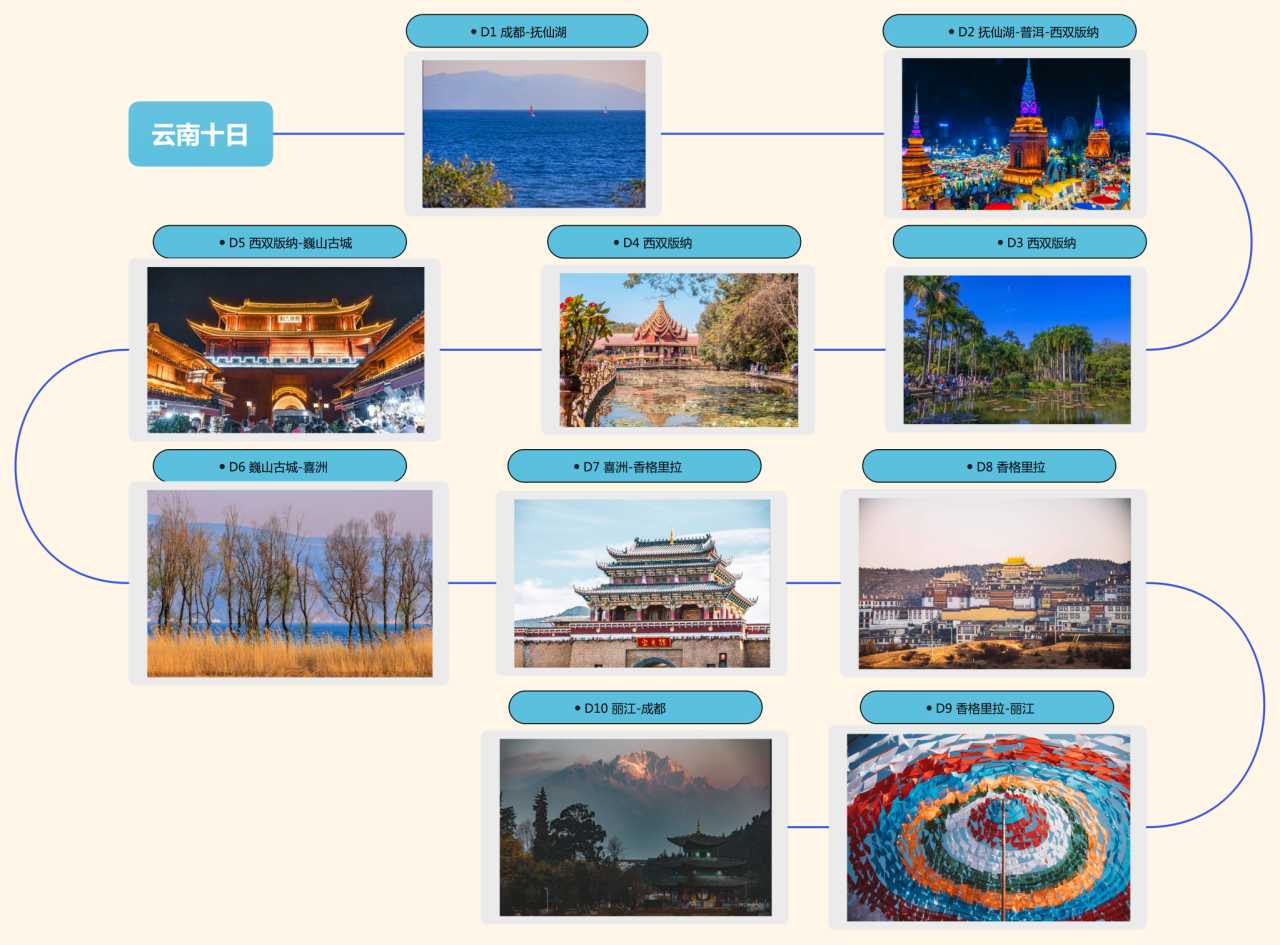
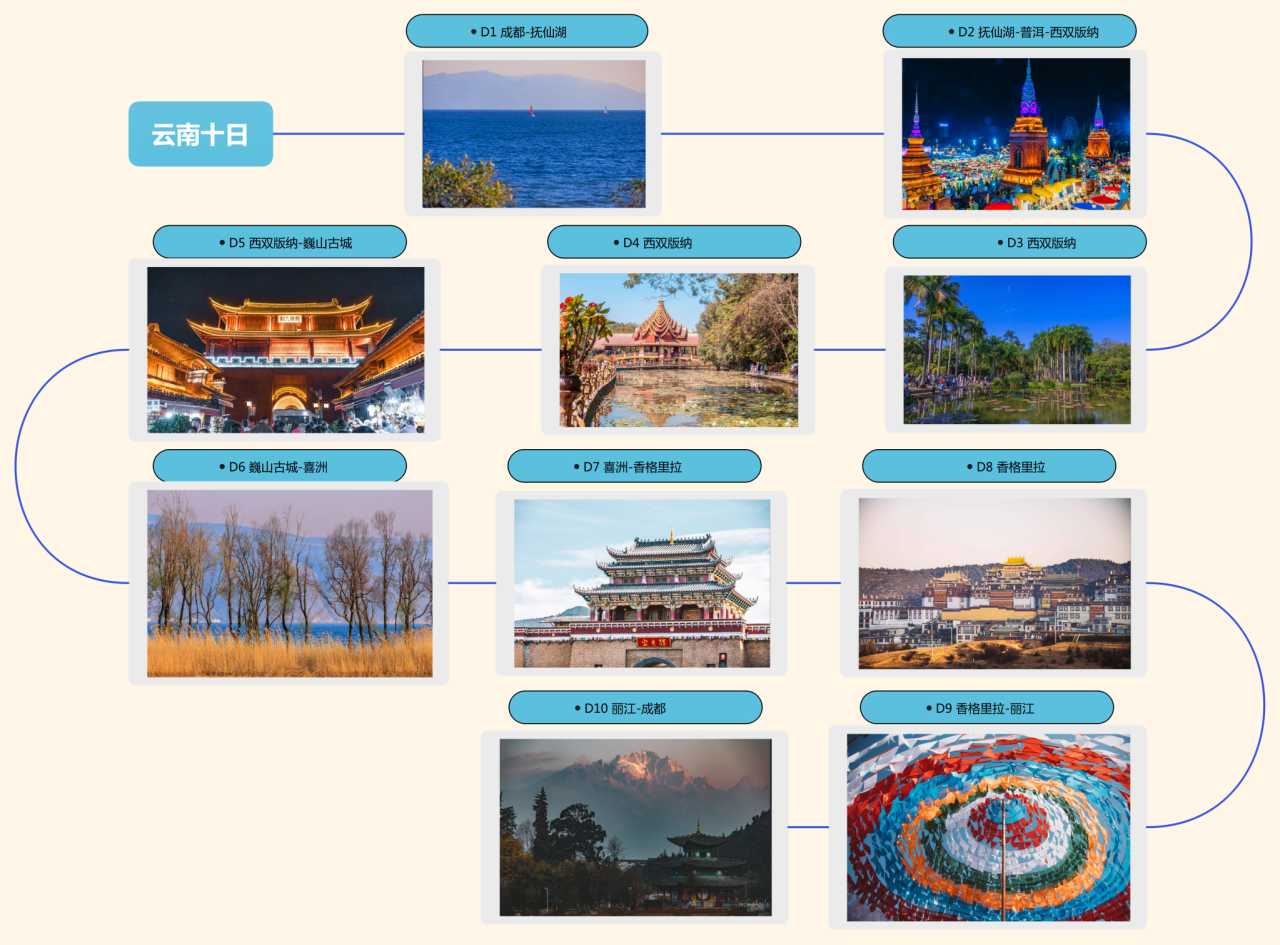
Day 1: Chengdu → Fuxian Lake
Day 2: Fuxian Lake → Pu'er Nàkēlǐ → Xishuangbanna (Starlight Night Market)
Day 3: Xishuangbanna (Xishuangbanna Tropical Botanical Garden + Riverside Night Market)
Day 4: Xishuangbanna (Mantin Park)
Day 5: Xishuangbanna → Weishan Ancient Town
Day 6: Weishan Ancient Town → Xizhou Ancient Town
Day 7: Xizhou → Shangri-La (Dukezong Ancient Town)
Day 8: Shangri-La (Napa Lake + Songzanlin Monastery + Potatso National Park)
Day 9: Shangri-La → Lijiang (Baisha Ancient Town + Dayan Old Town)
Day 10: Lijiang (Black Dragon Pool) → Chengdu
Self-driving the entire route, road conditions were generally good. The only things to watch for: black ice on the roads in Shangri-La in the morning, and the winding, traffic-heavy "devil's stretch" on the Kunming-Mohan Expressway — novice drivers, be extra cautious.
Fuxian Lake: An Unexpected Gift of the "Sea"
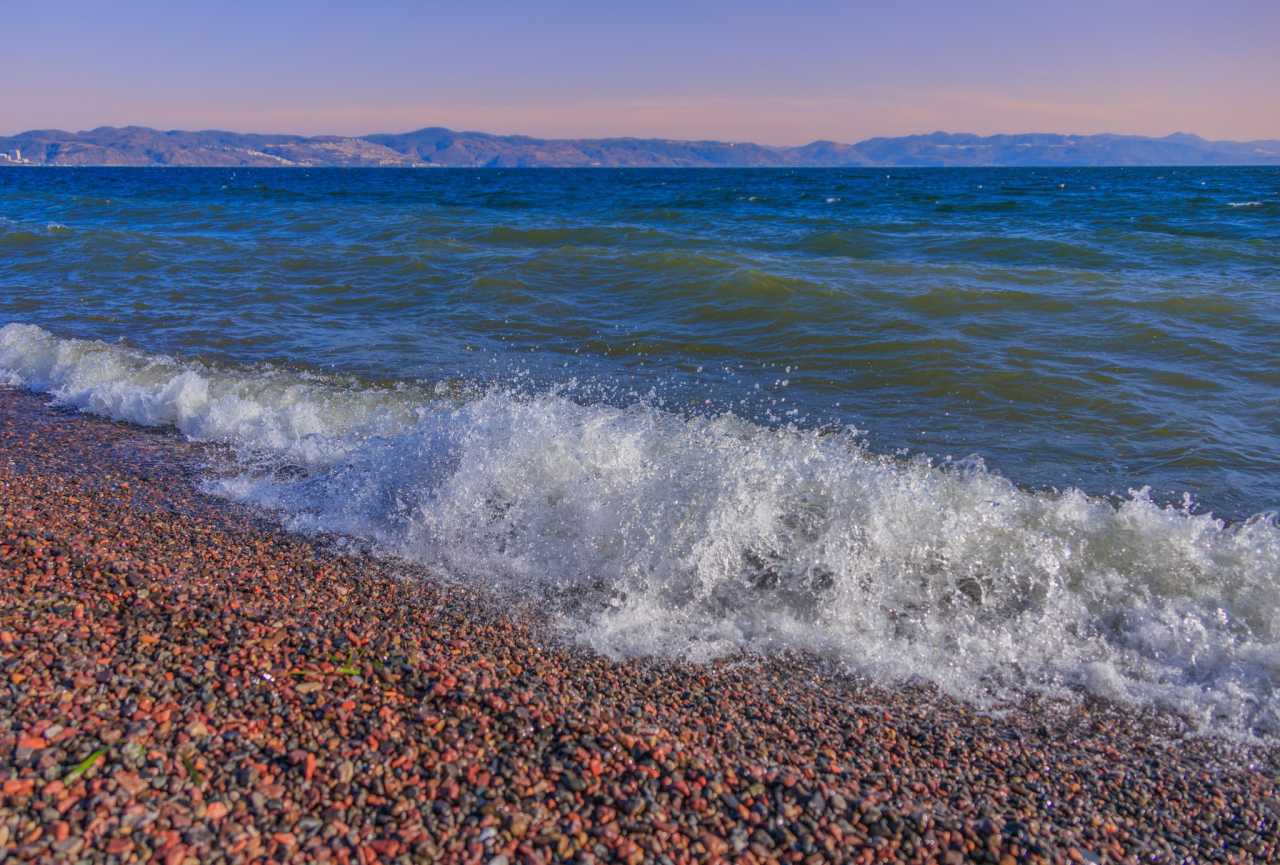
We originally planned to just pass through Fuxian Lake for one night, but it became the biggest surprise of the entire trip.
We had intended to go to Kunming's Haigeng Dam to see the seagulls, but my daughter's comment — "There are too many seagulls there, I'll get bombed" (referring to their droppings) — made us change course and head to Fuxian Lake instead. And this "backup" destination turned out to be breathtakingly beautiful.
A Lakeview Room for 100 RMB Per Person — An Absolute Steal
At the hotel in Guanglong Town, we paid just 100 RMB per person for a room with a lake view. The value for money was a knockout blow to any other tourist destination. Standing in the room, gazing at the shimmering lake, I half-wondered if I was at some coastal resort.
Fuhaiwan Wetland Park: The Seagulls Are the Real Stars
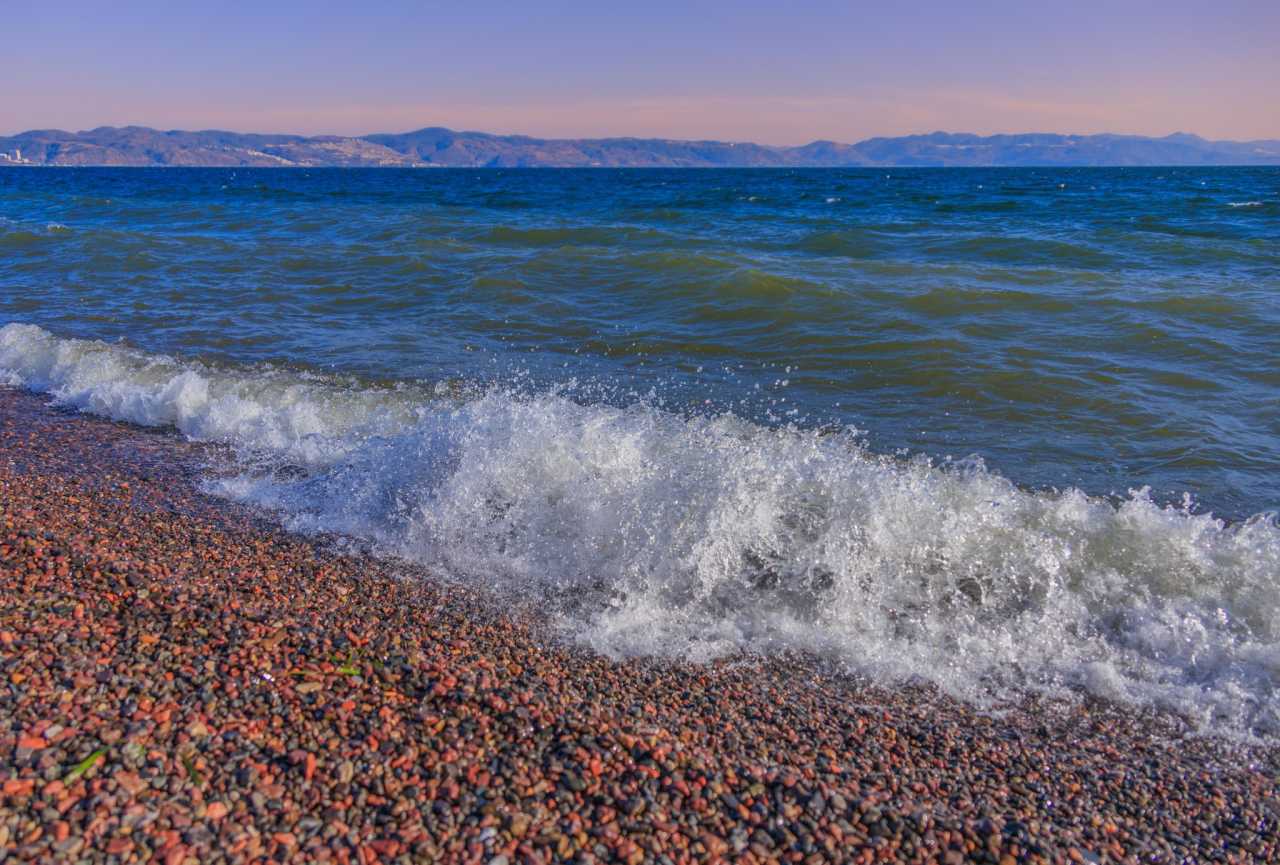
We rented a shared bike along the lakeside cycling path and rode all the way to Fuhaiwan Wetland Park. The water here was much clearer than at the Red Sand Beach — no muddy red sediment, just crystal-clear water like emerald.

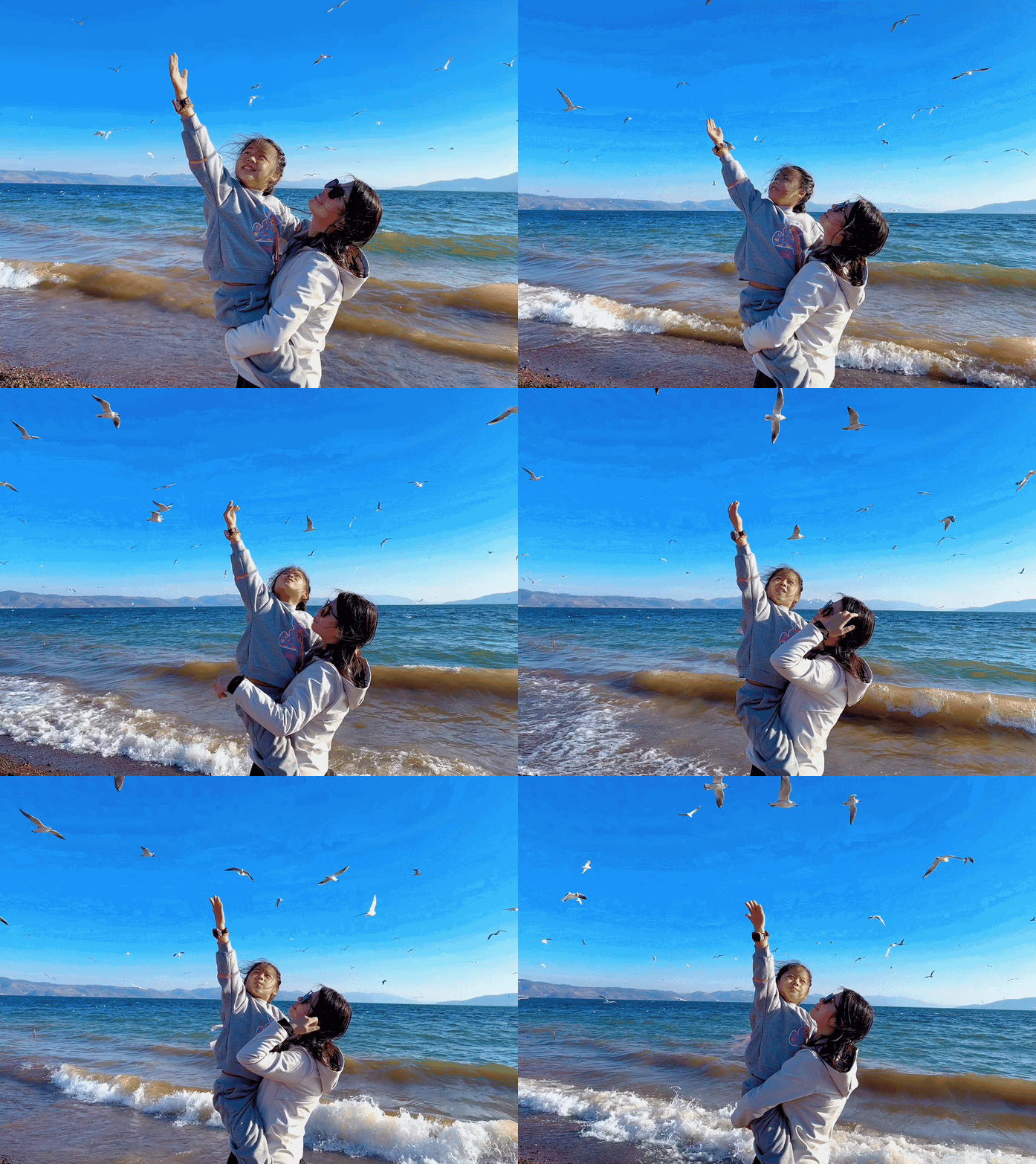
The biggest surprise? The flock of seagulls that had flown all the way from Siberia to spend the winter. They swept across the lake in groups, their wings splashing water that glittered in the sunlight. My daughter, with empty hands, still managed to attract a swarm of seagulls circling around her — that feeling of trust was more moving than any scenic spot.
Practical Tips:
- Fuxian Lake is perfect for a "lie-flat vacation" — fewer crowds, reasonable prices, great for families with kids.
- The stones along the shore are unique, some even resembling agate. My daughter couldn't stop collecting them.
- The Starlight Night Market here is smaller than the one in Xishuangbanna, but it's cozy. The grilled beef skewers and steam-pot stone-grilled fish are highly recommended.
Nàkēlǐ: The Gentlest "Rest Stop" on the Ancient Tea Horse Road
Heading south from Fuxian Lake toward Xishuangbanna, I deliberately made a detour to Nàkēlǐ in Pu'er. I thought it was just an ordinary little village, but it turned out to be one of the most memorable "hidden gems" of the entire trip.
Nàkēlǐ is one of the best-preserved post stations on the ancient Tea Horse Road from the old Pu'er Prefecture. It lacks the noise of Dali and Lijiang, and it's free from the artificial feel of over-commercialization. The cobblestone paths have been polished smooth by time, streams meander through the old village, the air carries a faint tea fragrance, and every few steps you can see the ancient stone slabs etched with horse hoof prints — as if you can still hear the jingling bells of the caravans.
Making a Pu'er Tea Cake at "Gao Laozhuang"
We stumbled into a Pu'er tea shop called "Gao Laozhuang" (Gao's Manor), and it turned out to be a place with quite a pedigree — the cast of the Chinese variety show "Running Man" had filmed here, and even a former chairman had visited. The old tea master guided my daughter through the entire traditional process of making a tea cake by hand: weighing the tea, steaming it, kneading, pressing with a stone mold, and letting it set in the shade. She was thrilled the whole time, and when she finally held that tea cake she made herself, she clutched it like a rare treasure.
Practical Tips:
- Nàkēlǐ works well as a mid-journey stop — 2 to 3 hours is enough.
- The dried beef (gānbā) here is very much to Sichuan tastes — highly recommended.
- The weather in Pu'er is so comfortable that you completely forget it's winter.
Xishuangbanna: From Starlight Night Market to Tropical Rainforest
Starlight Night Market: The "Ice and Fire" of Asia's Largest Night Market
The Starlight Night Market in Xishuangbanna is on a completely different scale from the one at Fuxian Lake. Its sheer size and stunning nightscape make it arguably the largest in Asia. Glittering stalls spread out along the Mekong River, blending Dai, Thai, and Lao flavors, with the air filled with the aromas of charcoal grills, sour-spicy seasonings, and sweet sticky rice.

Must-Eat List:
- 舂鸡脚 (pounded chicken feet): The night market's top seller — sour, spicy, and refreshing, the more you eat, the more addictive it gets.
- 菠萝饭 (pineapple rice): Purple sticky rice mixed with pineapple chunks, sweet but not cloying.
- 泡鲁达 (Paoluda): A coconut milk-based drink with dried bread pieces and sago — the perfect antidote to spicy food.
- 傣味烧烤 (Dai-style barbecue): The lemongrass-grilled fish is a must-order — crispy on the outside, tender inside, with spices penetrating every fiber of the fish.
One little "easter egg" here: you'll occasionally hear the familiar voice of a northeastern Chinese guy, instantly pulling you back from "Southeast Asia" to reality.
Practical Tips:
- The Starlight Night Market is free to enter, but you need to scan a QR code with Douyin (TikTok's Chinese version) — possibly to promote the app.
- I recommend staying near the Water-Splashing Square (Pōshuǐ Guǎngchǎng); it's much quieter and more comfortable than Gào Zhuāng.
- Prices here are on the high side — be mentally prepared.
Xishuangbanna Tropical Botanical Garden: A "Plant Museum" of the Rainforest
The Xishuangbanna Tropical Botanical Garden, run by the Chinese Academy of Sciences, is absolutely the natural highlight of any trip to Xishuangbanna. It's divided into two sections, each with a completely different character.
West Section: A refined tropical garden, perfect for photo ops. Must-visit spots include the Giant Water Lily Pond, the Palm Garden, and the Exotic Flowers and Plants Garden — every corner feels like Alice in Wonderland. The water lilies are fewer in winter, but still impressive.
East Section: A pristine tropical rainforest, ideal for hiking. The "single tree forming a forest" phenomenon here is jaw-dropping — a single banyan tree's aerial roots take root and grow into trunks, eventually creating an entire "forest." There are also the towering wàngtiān shù (sky-reaching trees), which shoot straight up into the clouds, disproving the old notion that "China has no typical tropical rainforest."
Practical Tips:
- Definitely hire a guide; otherwise, you'll just be skimming the surface.
- The East Section has fewer visitors, but hiking takes longer — allow at least 2 hours.
- Don't touch unknown plants in the rainforest — safety first.
Mantin Park: Become a "Dai Princess" for a Day
Mantin Park was the royal garden of the Dai kings. In the Dai language, it's called "Chunhuan," meaning "Garden of the Soul." Stepping inside feels like traveling back a thousand years to the Dai royal court.
My daughter got a full Dai-style makeover here — golden Dai clothing, the works — and posed for photos around the park, looking every bit a little princess. The white pagodas, red walls, and tropical plants provided perfect backdrops at every turn.
Practical Tips:
- Mantin Park requires an entrance fee — it's not a free attraction.
- There are many makeup and costume shops; just pick the outfit you like — prices are similar.
Weishan Ancient Town: So Laid-Back You'll Want to Retire There
Heading north from Xishuangbanna, the climate gradually shifts from humid heat to a gentle warmth. Weishan Ancient Town is the kind of place that makes you think, "I'd love to live here when I'm old."
Without Lijiang's noise or Dali's commercialization, Weishan retains the most authentic Nanzhao Kingdom atmosphere. Cobblestone streets, old wooden houses, elderly people soaking up the sun — everything moves at just the right pace.
Shangri-La: From Summer to a Winter Wonderland
Leaving Xizhou and heading west, the altitude gradually rises. When snow-capped mountains, prayer flags, and Tibetan-style houses began appearing outside the window, I knew we had arrived in Shangri-La.
Dukezong Ancient Town: Sunlight on the Prayer Wheel
Dukezong Ancient Town is the soul of Shangri-La. Sunlight streams down from the rooftops of Guishan Park, illuminating the giant prayer wheel, making it gleam with a golden light that carries an inexplicable sense of the sacred. This prayer wheel requires at least ten people to turn. Our family of three, joined by other tourists, worked together to get it slowly rotating.
Songzanlin Monastery: The Solemnity of the "Little Potala Palace"
Songzanlin Monastery is known as the "Little Potala Palace." With its golden roofs and white walls set against the blue sky and white clouds, it feels especially solemn and majestic. Sunlight filters through the prayer flags, casting light and shadow across the red walls, inspiring a sense of awe.
Potatso National Park: A Winter Fairy Tale
In winter, Potatso may lack the lush green of spring and summer, but the lakes, forests, and meadows covered in snow and ice have a unique, tranquil beauty. My daughter went horseback riding in the snow for the first time, galloping freely, laughing so hard she couldn't stop.
Practical Tips:
- Shangri-La is above 3,300 meters in altitude — altitude sickness is a real risk. It's best to spend a night in Lijiang to acclimate first.
- Winter days and nights have extreme temperature swings — bright and sunny during the day, but below -10°C at night. Make sure to bundle up.
- Sunscreen and moisturizer are equally important — the high-altitude UV is intense, and the air is very dry.
Lijiang: From Baisha to Dayan — Two Flavors

Baisha Ancient Town: Drinking Coffee on the Rooftops
Baisha Ancient Town is one of the most "authentic" ancient towns in Lijiang. It lacks the noise of Dayan Old Town, offering only quiet streets, sunbathing dogs, and tourists who climb onto rooftops to drink coffee.
It seems like everyone who visits Baisha does the same thing — climb onto a roof and sip coffee. Sitting on the roof tiles, with snow-capped mountains in the distance and a pour-over coffee in hand — that feeling is probably the best definition of "slow living."
Dayan Old Town: A Panoramic View from "Lijiang's Eye"

Dayan Old Town is heavily commercialized, but the "Lijiang's Eye" observation deck is still worth a visit. Standing high above, you can take in the entire old town — snow-capped mountains in the distance, gray tiles and white walls up close. It's so beautiful it brings tears to your eyes.
Black Dragon Pool: A Free View of the Golden Mountains
Black Dragon Pool Park is now open for free! If you're lucky, you can witness the spectacular sight of the "Golden Mountains" — the snow peaks reflected in the pool, shimmering with golden light, looking so surreal you'd think it's not real.
Final Thoughts: What Did This Cross-Season Journey Teach Me?
10 days, 3,500 kilometers, from 30°C to -10°C, from short sleeves to down jackets, from "Dai-flavored" to "Tashi Delek" — this road trip gave me a whole new understanding of Yunnan.
A Few Practical Takeaways:
Bring enough clothes: Yunnan's weather can take you through all four seasons in a single day. Short sleeves, spring jackets, down jackets — you need them all.
Plan your driving route carefully: The Kunming-Mohan Expressway has many curves and heavy traffic — novices, be careful. On holidays, avoid the entrance to Dali's old town; take the detour from Shuānglǎng direction for a smoother ride.
Watch out for altitude sickness in Shangri-La: It's best to spend a night in Lijiang to adjust. Dukezong is at 3,300 meters, Potatso at 3,600 meters — those prone to altitude sickness should prepare in advance.
Don't forget sunscreen and moisturizer: High-altitude UV is strong, and the air is dry. Sunscreen and moisturizer are essentials.
The most beautiful scenery is on the road: The seagulls of Fuxian Lake, the Pu'er tea of Nàkēlǐ, the tropical rainforest of Xishuangbanna, the winter wonderland of Shangri-La — every place is worth stopping for.
Finally, let me leave you with this: Don't let the temperature swings scare you away from Yunnan. Because it's precisely this "four seasons in one day" magic that makes this land so captivating.
From "Dai-flavored" to "Tashi Delek" — this cross-season journey is one you need to take for yourself.
You should also read:
Escaping Nanning, Falling Under Lijiang's Spell: Our Four-Person, Ten-Day Yunnan Dream
Escaping Nanning, Falling Under Lijiang's Spell: Our Four-Person, Ten-Day Yunnan Dream Before We Set Off: No Pain, No Obsession Have you ever had that impulse—suddenly tired of the office fluorescent lights, the crush of the subway, the endless parade of identical takeout boxes, and just…
Continue reading...
Solo in Yunnan: A Wanderer’s Guide to the Land of Eternal Spring
Solo in Yunnan: A Wanderer’s Guide to the Land of Eternal Spring There’s something magical about traveling alone. No compromises, no schedules to keep, no one to please but yourself. I’ve been on the road for nearly three months now, and not once have I…
Continue reading...
God’s Abandoned Palette: A Self-Drive Journey Through Yunnan’s Dongchuan Red Land
God’s Abandoned Palette: A Self-Drive Journey Through Yunnan’s Dongchuan Red Land Travel has never been about reaching some distant geographic coordinate. It’s about encountering, along the way, the version of yourself buried beneath the rubble of daily routine. During this May Day holiday, I finally…
Continue reading...