Walking the High Road Alone: Tiger Leaping Gorge – The First Chapter of Retracing the Lijiang-Dali Route
Walking the High Road Alone: Tiger Leaping Gorge – The First Chapter of Retracing the Lijiang-Dali Route
From Smog to Sunshine: A Spontaneous Escape
Winter in Chengdu is always shrouded in a layer of gray, oppressive gloom. In January 2026, as I once again stared out the window at the sunless haze, the long string of "sunny" icons on my phone screen for Yunnan felt like a silent summons, piercing straight into my heart.
Where to go? Yunnan has eight prefectures, eight autonomous prefectures, and sixteen prefecture-level administrative divisions. I counted—there were still six places I hadn't set foot in. Among the famous attractions, Puzhehei is best for spring and summer; the transportation to Yuanyang Rice Terraces is a headache; Shangri-La sits at too high an altitude, and visiting in winter seems unwise. After weighing the options, Lijiang became the only choice.
Travel companion? Forget it. For Sichuanese people, the first stop on any out-of-province trip is Lijiang nine times out of ten. Everyone around me either "went there ages ago" or "you've never been?"—that line sounded familiar, exactly the same response I got from travel buddy @WindOfSevenColors when I invited him to Wuyi Mountain. Fine. Traveling alone is more liberating anyway.
This trip's itinerary followed my favorite principle: "no backtracking." Funny enough, back in November 2013, I had taken almost the exact same route: fly from Chengdu to Lijiang, Lijiang to Jianchuan, Jianchuan to Dali, then fly back to Chengdu. Thanks to Yunnan's abundant tourism resources, not a single attraction overlapped between the two trips. That time, luck wasn't on my side: the first day was wasted at Shuangliu Airport due to airline issues, I got stuck in a massive traffic jam on National Highway 214 midway, and the return trip was delayed half a day by the preceding flight, almost making me late for work. But those "little incidents" on the road became the most vivid highlights in my memory.
This time, the heavens were especially generous. Everything went so smoothly that it felt unreal, and I once again earned that "beautiful tan" from the plateau sunshine.
Tiger Leaping Gorge: A Wound Split Open in the Earth
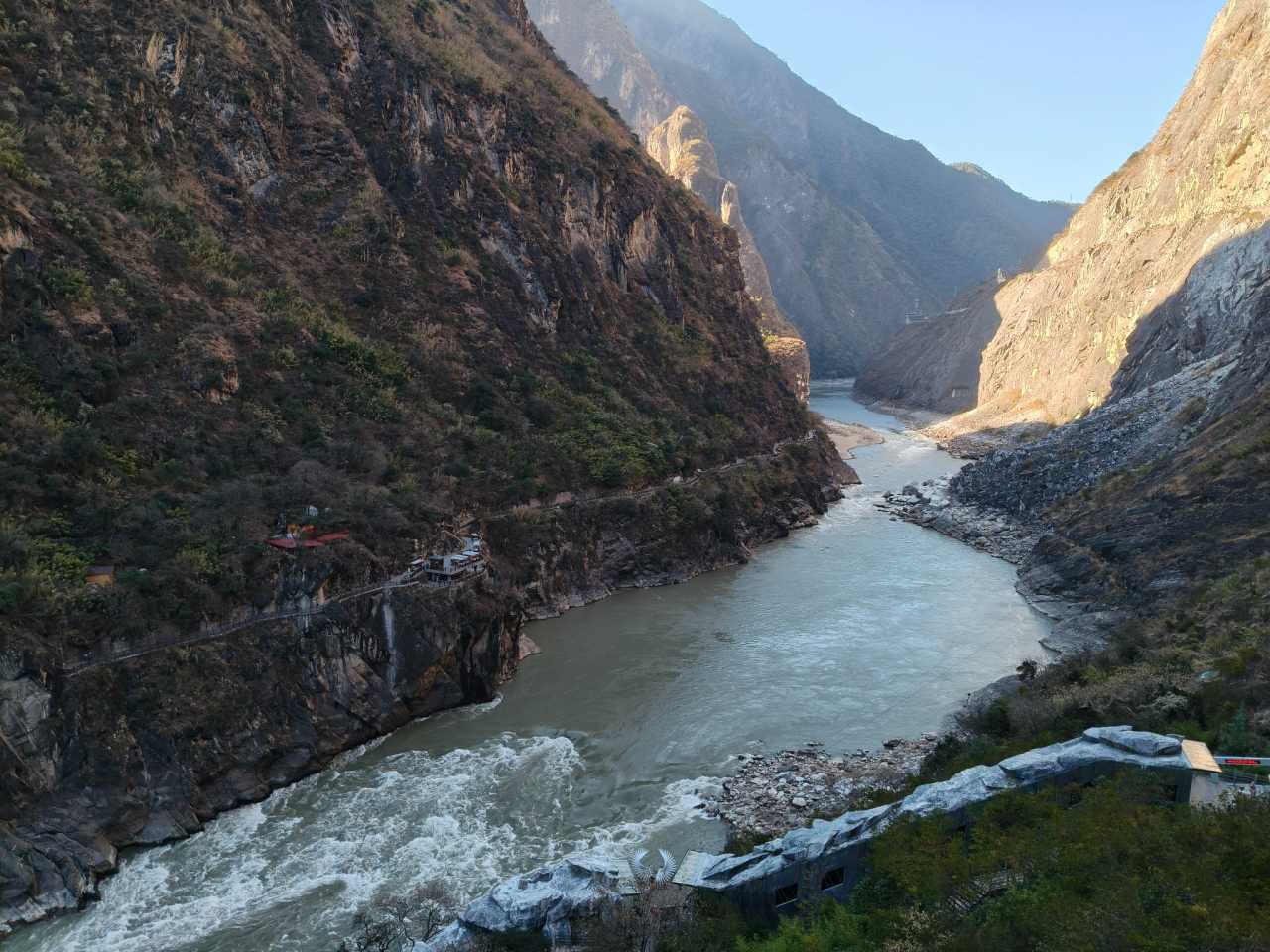
The Yangtze River originates from the snowy peaks of the Tanggula Mountains, winding its way south, surging through the confines of the Hengduan Mountains. At Shigu Town in Lijiang, it suddenly abandons its two brothers, the Nu River and the Lancang River, making a sharp turn northward. Facing the two five-thousand-meter snow mountains, Jade Dragon and Haba, it used primordial force to squeeze through, creating a passage. This power gave birth to a massive canyon—Tiger Leaping Gorge.

Stretching about 23 kilometers, Tiger Leaping Gorge is divided into upper, middle, and lower sections. The elevation difference between the upper and lower mouths is 220 meters; the widest point of the river is just 60 meters, and the narrowest only 30 meters. The once-gentle river here transforms into raging torrents, thundering northward. At the narrowest point, a massive rock stands in midstream. Legend has it that a tiger once leaped across the river here, giving it the name "Tiger Leaping Rock," and the gorge became famous worldwide.
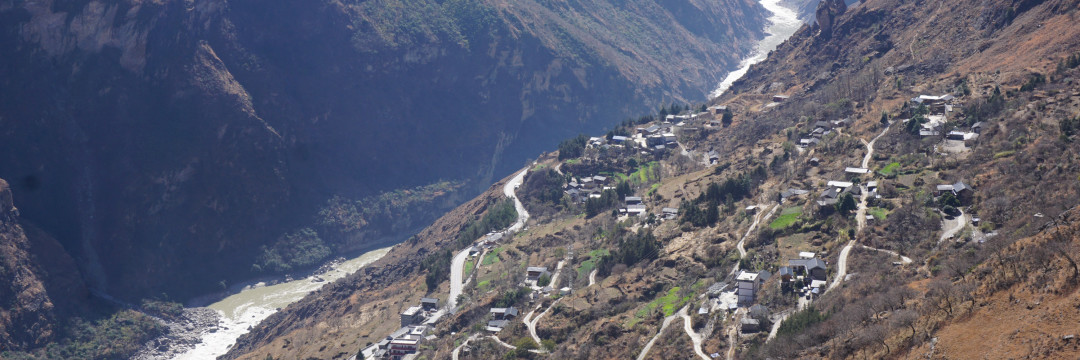
The river surface sits at an elevation of less than 1,800 meters, while the flanking snow mountains exceed 5,000 meters—a vertical drop of over 3,900 meters. This is one of the deepest canyons on Earth. The southern bank, Jade Dragon Snow Mountain, is nearly vertical cliffs along the gorge, offering no path. The northern bank, Haba Snow Mountain, has gentler slopes, with a road running through the entire gorge at lower elevations (marked as "East Ring Road" on maps), while scattered small villages dot the higher slopes. Ancient Tea Horse Road caravans passed through here, and over centuries, they trod a dirt path along the cliffside at mid-mountain—this became the foundation of the later-famous High Road hiking trail.
Tiger Leaping Gorge boasts titles like "First Gorge of the Ten-Thousand-Mile Yangtze River," "One of the World's Deepest Canyons," and "One of China's Ten Most Beautiful Canyons." Lijiang's Yulong County and Diqing's Shangri-La City are divided by the Jinsha River, with scenic areas developed on both banks. The Shangri-La Tiger Leaping Gorge Scenic Area (Upper Tiger Leaping) opened as early as 1992, while the Lijiang side's scenic area only reopened in the second half of 2025.
But what truly made Tiger Leaping Gorge world-famous isn't these official scenic areas—it's that ancient path suspended halfway up Haba Snow Mountain.
High Road Hiking: From Backpackers to Internet Celebrity Spot
In the 1980s, a group of foreign backpackers discovered this ancient path hugging the Jinsha River. They crossed mountains and valleys to get there, bringing demand for food and lodging. Around 1988, the founder of Halfway Guesthouse, Uncle Feng, hosted the first foreign backpacker, beginning a service of providing food and accommodation for hikers. His success inspired surrounding villagers, and more guesthouses and inns sprang up, with services becoming increasingly comprehensive.
Through word-of-mouth among foreign hikers and recommendations from Lonely Planet, the Tiger Leaping Gorge High Road hiking trail quickly gained fame in the international outdoor community. For a long time, European and American backpackers far outnumbered domestic tourists. Around 2014, a Korean variety show filmed here, and Tiger Leaping Gorge hiking became a craze in South Korea—young people listed it as a rite of passage, while middle-aged and elderly considered it a must-do before they die.
In 2024, a photo of actor Li Xian by the Jinsha River in Middle Tiger Leaping exploded on social media. Countless young Chinese flooded into Tiger Leaping Gorge, eager to snap a star's "photo of a lifetime." However, irresponsible promotion led to a massive influx of tourists with zero outdoor experience. In the summer of 2025, Shangri-La authorities had to close the high-risk "Sky Ladder" and "Daydreaming Rock" attractions. But during the 2026 Spring Festival, two consecutive accidents involving falls from cliffs and drowning occurred along this route.
This raises concerns: will the Tiger Leaping Gorge hiking trail be shut down entirely like other places? Or will it be taken over by cultural tourism departments, building roads and selling tickets? As ordinary tourists, we can't predict. But I know that outdoor activities are a product of economic development, and the love for adventure is innate in young people. Forceful measures won't seal it off; what management should do is guide with the flow, provide risk warnings, and offer safeguards and rescue routes. As for participants correctly assessing their abilities and preparing adequately—that's a learning process only they can undertake. No one else can help.
My One-Day Tiger Leaping Gorge: A Greedy Yet Cowardly Compromise
There are multiple ways to visit Tiger Leaping Gorge. The easiest is joining a tour group—a couple hundred yuan covers everything. Shuttle buses are also convenient; you can book through Lijiang Transportation Company's "Lijiao Travel" mini-program or the "Zhongxia Shuttle" mini-program, with a one-way fare of 50 yuan. Since I bought tickets too late and "Lijiao Travel" was sold out, I had to choose "Zhongxia Shuttle." The service was good—they provided a hiking route map on the bus and could store large luggage for free at TINA's.
I'm greedy yet cowardly—I couldn't bear to give up the scenic area, but I also wanted to hike. In the end, I settled on a compromise: first visit the Shangri-La Tiger Leaping Gorge Scenic Area, then take a bus to the intersection below Tea Horse Guesthouse, catch a private car near the hiking trail, follow the signs to Halfway Guesthouse, then take another private car to the local bay intersection on the East Ring Road, and wait for the return shuttle.
This plan was a bit half-baked, but inadvertently, I unlocked Diqing Prefecture, checked off a corner of the Three Parallel Rivers World Natural Heritage site, admired Tiger Leaping Gorge—ranked second among China's ten most beautiful canyons by China National Geography—and walked the easiest section of the High Road hiking trail. I felt like I'd hit the jackpot.
Shangri-La Tiger Leaping Gorge Scenic Area
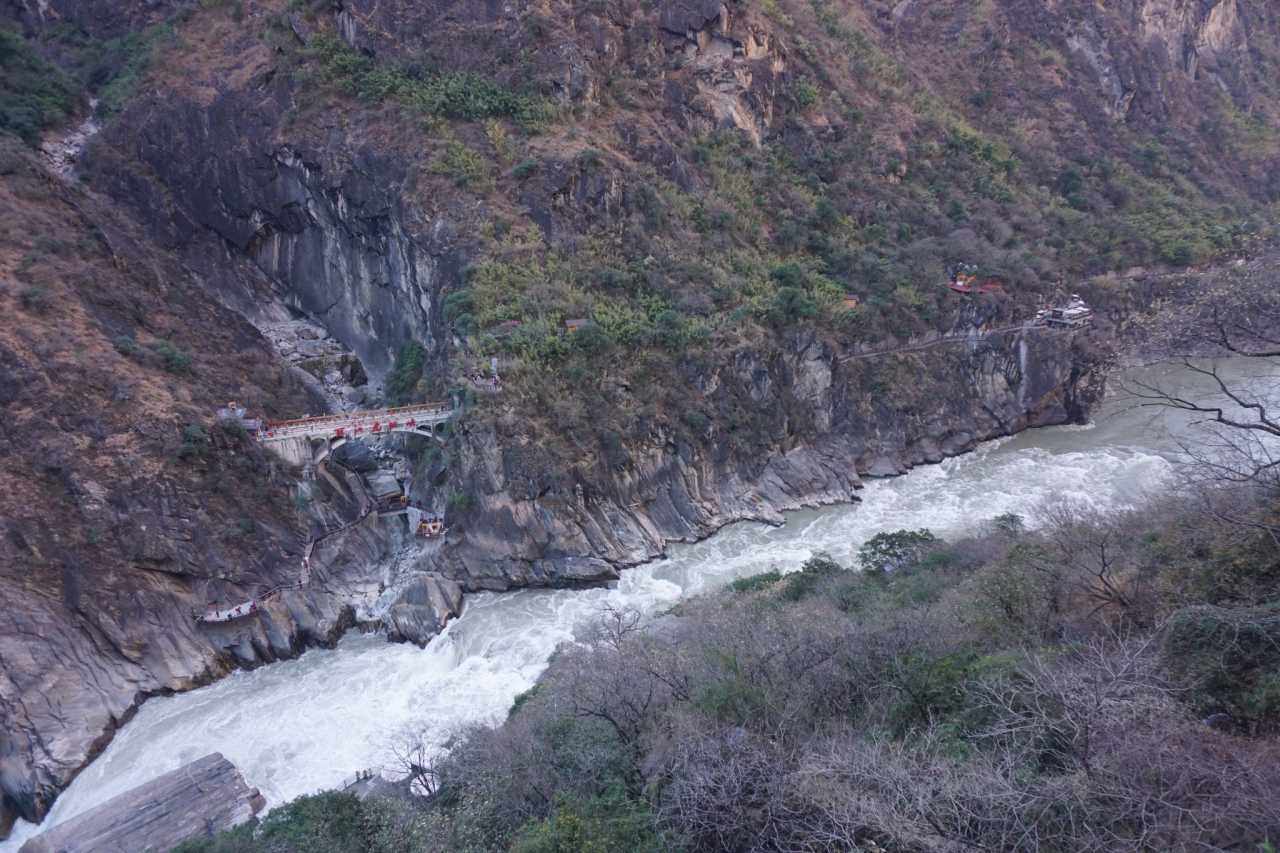
The scenic area requires a ticket—40 yuan, which isn't expensive. Without taking the elevator, a round trip takes about one and a half to two hours. There's an elevator that goes straight down to the riverside viewing platform, so those with limited stamina needn't worry. Compared to the High Road hiking trail, this spot offers a close-up view of the Jinsha River's majesty and the "grand canyon" feel of the towering peaks and deep valley.
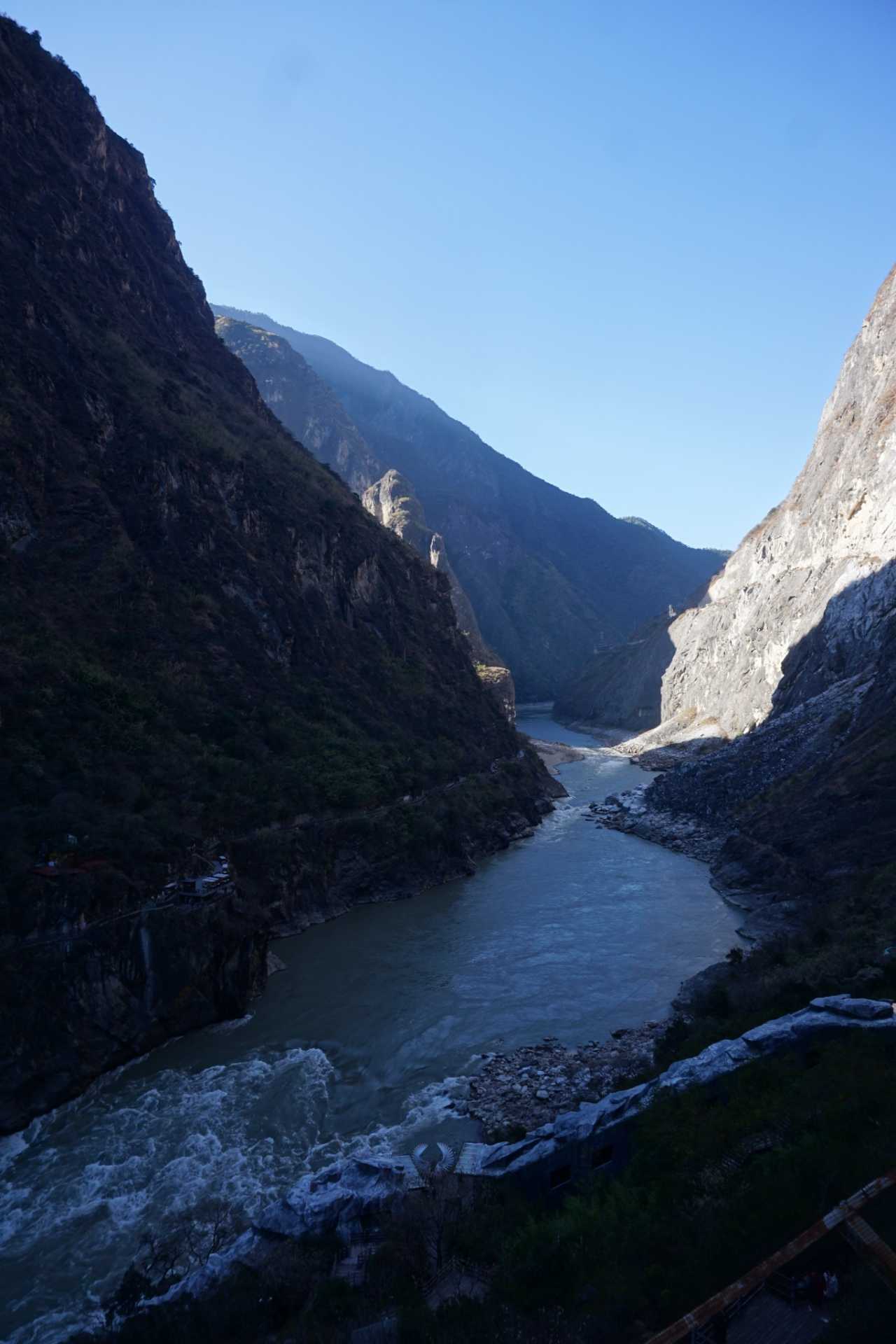
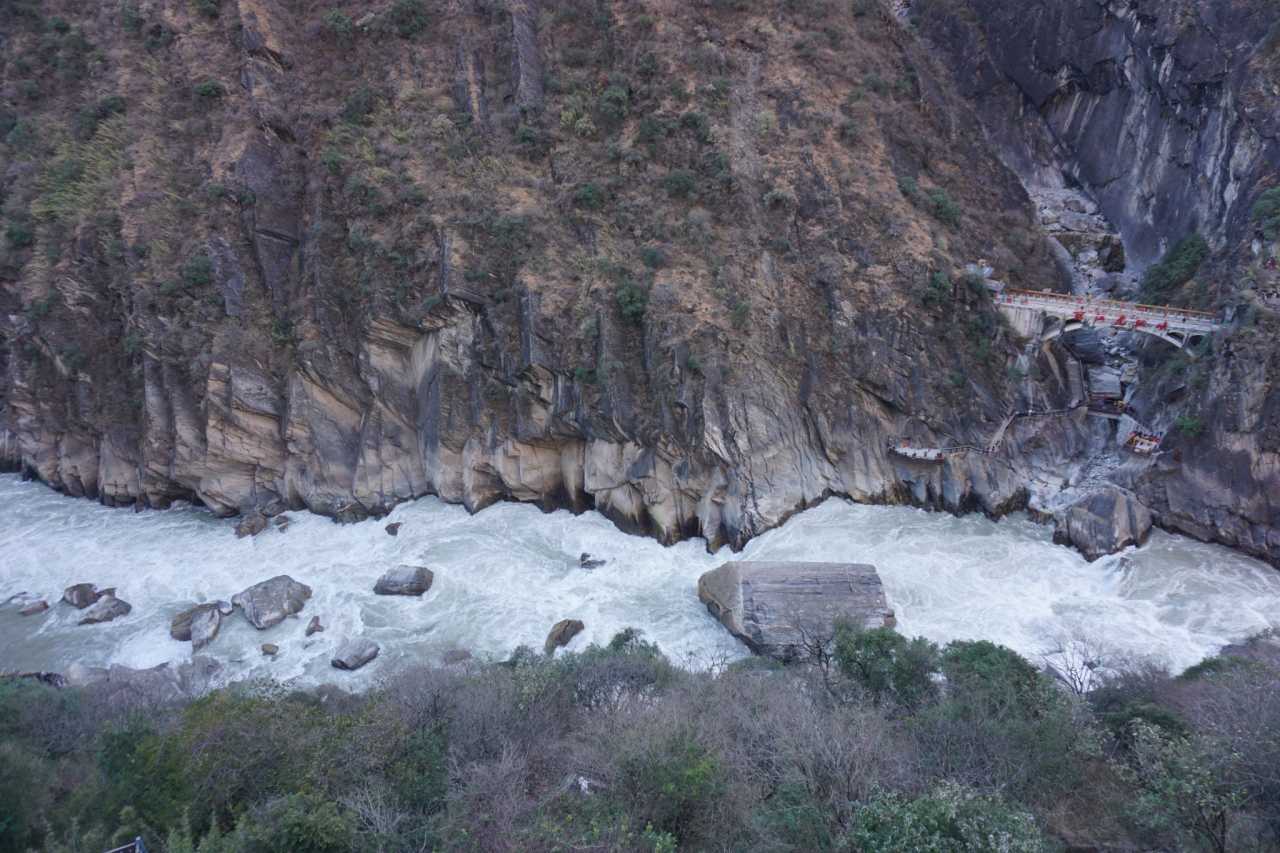
Winter and spring are the dry season in northwestern Yunnan. The Jinsha River's water level is very low, with jagged boulders exposed on both banks and clear, bright water. The current in the gorge is swift, and even from high up, you can hear the roaring crash of water. It reminded me of a line from A Letter to Zhu Yuansi: "Swift currents are swifter than arrows; fierce waves are like galloping steeds. On both banks, high mountains are covered with cold trees..." During the Southern Dynasties, the Fuchun River hadn't yet been dammed, and the mountains on both sides were steeper than now. But compared to Tiger Leaping Gorge, the elevation difference is far less. The sense of compression and the spectacular view certainly can't compare. Compared to the ancients, we can go to far more places, but our literary talent falls woefully short. Borrowing classical texts to describe the scene before me feels shameful.
Looking down from the scenic area entrance, the road on the opposite bank belongs to the Lijiang Tiger Leaping Gorge Scenic Area. At nearly 10:30 AM, the sun could only illuminate one side of the mountain. The wind near the river was strong and chilly. Definitely wear a hat.
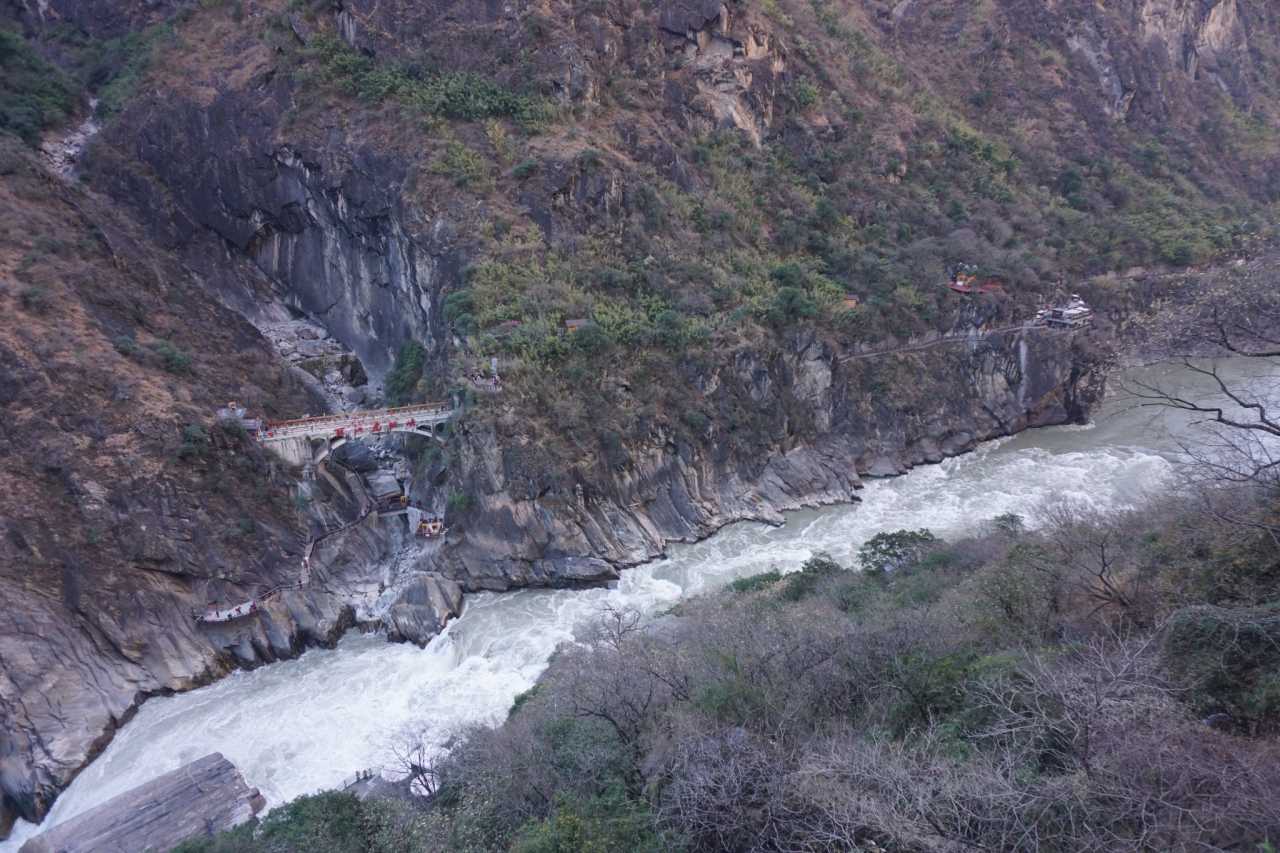
The tiger sculpture by the river is admittedly a bit ugly, but I still followed convention and took a photo. Quite a few tourists were queuing for a picture. Tiger Leaping Gorge is a classic example of a place where the real view is far more magnificent than the photos—the observation boardwalk is built with concrete pillars on the riverbank's jumble of rocks. Its proximity to the Jinsha River can't compare to wild spots, but for a coward like me, it's more than enough.
By around 11 o'clock, sunlight gradually filled the gorge. On the opposite bank, the Lijiang Tiger Leaping Gorge Scenic Area has riverbanks at nearly ninety degrees, with boardwalks carved into the rock face. It turns out that Sun Ranweng, who wrote the long couplet for Grand View Tower, once visited Tiger Leaping Gorge and composed a poem, Jinsha River: "Splitting the barbarian domain with an axeless trace, flowing out from plow oxen toward Lijiang in haste. A single line divides heaven as a moat; two mountains clash, with stone as the gate..." It seems he agreed with Xu Xiake that the Jinsha River is the true source of the Yangtze, but was curious about where the Jinsha's upper reaches originated. Unfortunately, by the time Xu Xiake reached Lijiang, he was already at the end of his strength. If the Travel Sage had arrived in Lijiang in his prime, he might have traveled upstream all the way into Tibetan regions.
The loop around the scenic area took one hour and twenty minutes. At the parking lot, beside the roadside cliff, under the engraved characters "Tiger Leaping Jinsha," small green letters read "Tiger Fragrance Beautiful Road"—so this "East Ring Road" has this name, and it's truly a road worthy of its beautiful reputation.
High Road Hiking: Tea Horse to Halfway
The shuttle dropped us off at the intersection below Tea Horse Guesthouse. Just then, a private car happened to be idling there, picking up passengers. It was already carrying a group of hikers, so in theory, it shouldn't have taken another person. But at midday, there were no other cars around, so I had to take the risk. I stood in the luggage area behind the van's rear seats for the entire ride to the hiking starting point.
In good weather, this section is easy to walk. The entire path is a rural dirt road with virtually no elevation gain. Along the way, there are three pay toilets, two or three stalls selling water and snacks, and good cell signal. But most sections are very narrow and hug the cliff; when two people pass each other, at least one has to turn sideways to get by. Only a few sections have token railings that are better than nothing. The wind is strong—the tip of my hiking pole kept lifting upward. This stretch made me grateful that I've gained some weight recently.
Perhaps due to the altitude, there aren't many tall trees along the way—mostly grass and shrubs. January is the dry season, and the vegetation on the cliffs is withered and yellow, giving off a somewhat desolate feel. The UV rays are intense on clear days, and there's virtually no shade the entire way. Definitely wear a hat.
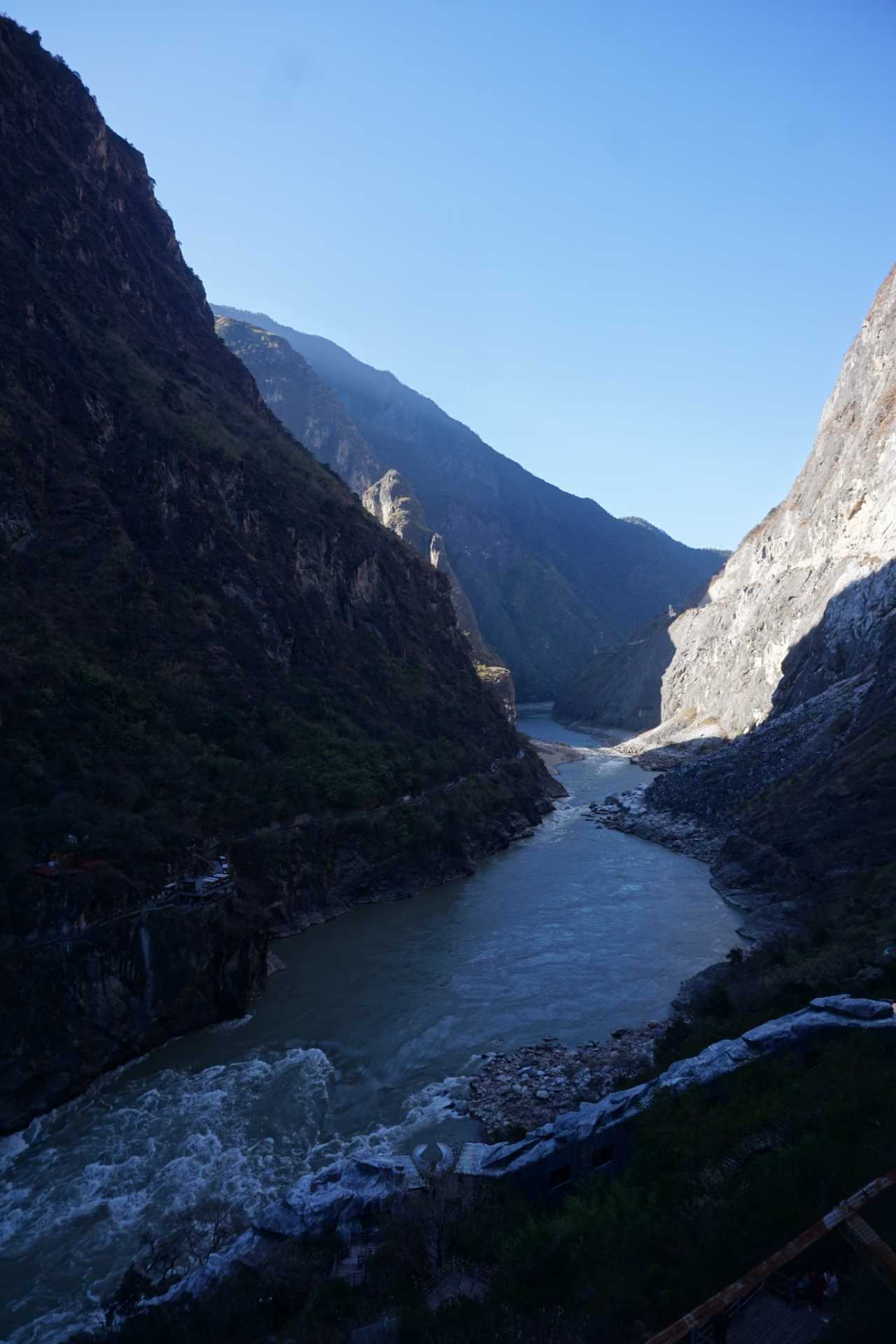
Resting at a snack stall, I faced the dark, brooding Jade Dragon Snow Mountain on the opposite side, its peaks jagged like the teeth of a wild beast. Compared to the peaks along the Three Gorges, these mountains are more majestic and towering, raw and desolate, exuding an untamed wildness.
At the start, I could only see the gorge, not the Jinsha River. As the cement road turned into a narrow dirt trail, the Jinsha appeared below, thin as a silver ribbon. The western side of Jade Dragon Snow Mountain, right next to the Jinsha, was all black, rugged cliffs. The first word that came to my mind was "ferocious."
A stone jutting out over the cliff was named "Eagle Beak Rock," with a small sign beside it reading "Photo fee: six yuan." The person collecting the fee was probably off at lunch. Even if they'd paid me sixty yuan, this coward wouldn't have dared to go up there.
In the distance, I spotted a relatively tall tree, standing out prominently on a patch of withered yellow grassland. Even with its dry, bare branches, the tree was beautiful. It must be stunning in spring and summer.
The contrast between yellow Haba and black Jade Dragon was striking. Passing a mountain spur, I looked up at Haba above me and across at Jade Dragon on the opposite bank. The drought made this side of Jade Dragon Snow Mountain look especially desolate.
Advice for Future Travelers
If you enjoy in-depth travel, I recommend arranging two days around Tiger Leaping Gorge.
Day One: Hike the essence of the High Road: from Tea Horse Guesthouse to Halfway Guesthouse, then to Longdong Waterfall, TINA's, and Zhang Teacher Guesthouse. Take the afternoon shuttle back to Lijiang. If you have little outdoor experience, poor stamina, or the weather is bad, I don't recommend the High Road hiking trail. Especially in bad weather—heavy fog, rain, slippery paths, and falling rocks can be deadly. A wild trail is never "anyone with legs can do it."
Day Two: Book a one-day tour itinerary: visit Shigu Town's First Bend of the Jinsha River, Tiger Leaping Gorge Scenic Area, Middle Tiger Leaping viewing platform, and Baishui Terrace, then stay overnight in Shangri-La.
The Tiger Leaping Gorge High Road hiking trail is very famous. Many online articles claim it's hailed as "one of the world's top ten classic hiking routes." I checked—no official organization has ever certified this "world top ten." It's probably a "ranking" by outdoor activity organizers, enthusiasts, or self-media. Mr. Lu Xun once said that Chinese people have an obsession with "top ten" lists. It seems this obsession has infected the outdoor community too.
Whether it's top ten or top hundred, with the surge in outdoor activities in recent years, classic routes like Tiger Leaping Gorge High Road naturally attract both outdoor enthusiasts and inexperienced followers. Although the trail conditions are relatively "gentle" and the services are considerate—some restaurant menus are in Chinese, English, and Korean; along the way, you can not only buy grilled sausages but also find water, electricity, and internet—there are very few sections with guardrails. Some parts are narrow and cling to cliffs, the dirt path is slippery, and the wind is strong. These are all risk factors. It's not "anyone with legs can do it" or "just go."
In short: this is a wild trail. The risks are greater than in scenic areas, and rescue is harder. In good weather, be cautious. In bad weather, the difficulty increases exponentially—try not to go.
Epilogue: What the Gorge Taught Me
Sitting on the return shuttle, watching the gorge gradually recede outside the window, I thought of Sun Ranweng's line: "The rushing waves have surged since ancient times; where else can we seek the river's source?" Tiger Leaping Gorge has stood there since time immemorial, the river flowing day and night. And every traveler who comes here is searching for something in their own way.
Some seek a "photo of a lifetime." Some seek the thrill of conquest. Some just want to temporarily escape the gloom of the city. And me? Perhaps I just wanted to confirm, on those narrow cliffside paths, amid the roar of the Jinsha River, that I'm still alive—still capable of being awed by magnificent scenery, still able to feel satisfied by a smooth trip.
What this journey taught me isn't how to conquer a canyon, but how to make peace with my own fear. Admitting that I'm timid, admitting that I'm greedy, admitting that I want to see the most beautiful views without taking too many risks—there's nothing shameful about that. At Tiger Leaping Gorge, on those cliffside trails, in those afternoons scorched by the sun, I learned to be honest with myself.
Perhaps that's the meaning of travel. Not to prove anything. Not to show off anything. Just simply to go out and walk. Then return to daily life, carrying a load of weariness and satisfaction.
Ten thousand miles traveled, ten thousand volumes read. Where will the next stop be?
You should also read:
Setting Off Alone: Finding the Meaning of Travel in Lijiang
Setting Off Alone: Finding the Meaning of Travel in Lijiang Every woman should have at least two things in her life worth braving: one is cutting off her long hair without hesitation, and the other is embarking on a journey alone. In the spring of…
Continue reading...
Walking Yunnan — A 23-Day Solo Journey, A Pilgrimage of Faith
Walking Yunnan — A 23-Day Solo Journey, A Pilgrimage of Faith Foreword: That Lonely Planet and a Long-Planned Escape In the winter of 2011, Songjiang, Shanghai was bone-chillingly cold. I huddled in a corner of my dorm room after lights-out, covered in hand warmers, clutching…
Continue reading...
Yunnan! Paradise on Earth – The Yubeng Chapter: A Soul-Cleansing Journey into Seclusion
Yunnan! Paradise on Earth – The Yubeng Chapter: A Soul-Cleansing Journey into Seclusion Prologue: Why Yubeng? If you ask me which place in Yunnan is most worth hiking to, I would answer without hesitation: Yubeng. This is not an answer I give lightly. As a…
Continue reading...